Delivery Driver, Medical and Pharmacy Courier Desiree Fontenot
Delivery Driver, Medical and Pharmacy Courier
[email protected] | (225) 555-0964 | Baton Rouge, United States
Profile
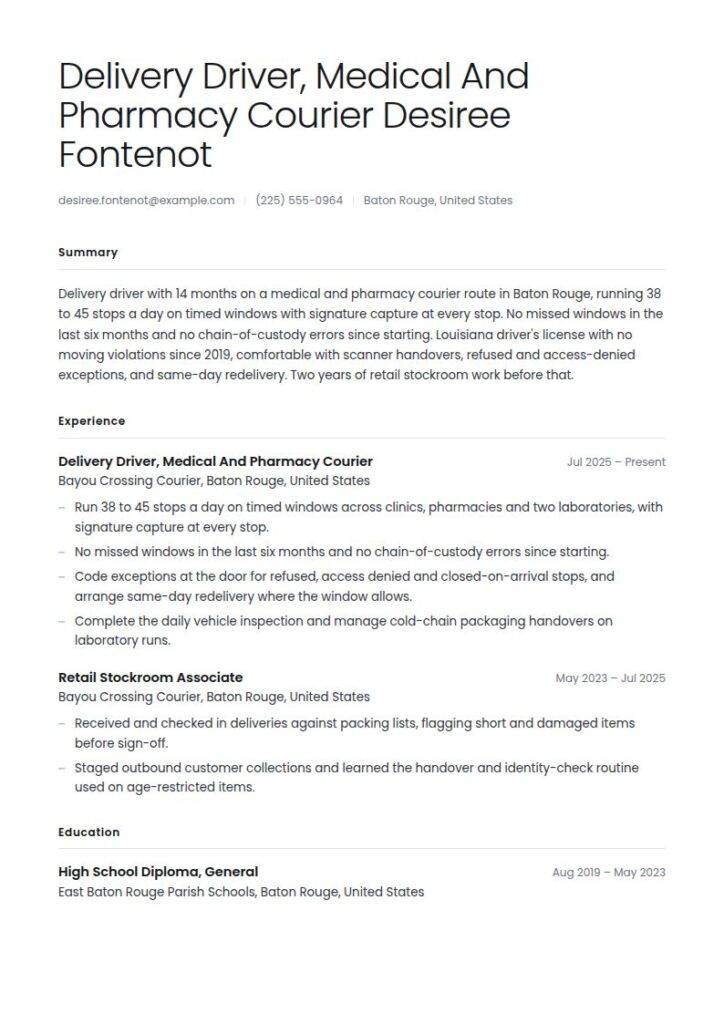
Delivery driver with 14 months on a medical and pharmacy courier route in Baton Rouge, running 38 to 45 stops a day on timed windows with signature capture at every stop. No missed windows in the last six months and no chain-of-custody errors since starting. Louisiana driver's license with no moving violations since 2019, comfortable with scanner handovers, refused and access-denied exceptions, and same-day redelivery. Two years of retail stockroom work before that.
Work Experience
07/2025 - Present, Delivery Driver, Medical and Pharmacy Courier, Bayou Crossing Courier, Baton Rouge, United States
- Run 38 to 45 stops a day on timed windows across clinics, pharmacies and two laboratories, with signature capture at every stop.
- No missed windows in the last six months and no chain-of-custody errors since starting.
- Code exceptions at the door for refused, access denied and closed-on-arrival stops, and arrange same-day redelivery where the window allows.
- Complete the daily vehicle inspection and manage cold-chain packaging handovers on laboratory runs.
05/2023 - 07/2025, Retail Stockroom Associate, Bayou Crossing Courier, Baton Rouge, United States
- Received and checked in deliveries against packing lists, flagging short and damaged items before sign-off.
- Staged outbound customer collections and learned the handover and identity-check routine used on age-restricted items.
Education
08/2019 - 05/2023, High School Diploma, General, East Baton Rouge Parish Schools, Baton Rouge, United States
Skills
Proof of delivery and signature capture, 85
Exception coding at the door, 70
Timed delivery window management, 80
Chain-of-custody handling, 80
Handheld scanner and driver app, 85
Daily vehicle inspection, 75
Customer handover and service recovery, 70
Languages
English, native
Certificates
06/2023, Louisiana Driver's License, Louisiana Office of Motor Vehicles
Motor vehicle record clear of moving violations since 2019.
08/2025, Chain-of-Custody Handling for Medical Courier Deliveries, Bayou Crossing Courier
Employer program covering sealed handovers, cold chain and refusal procedure.
03/2025, First Aid and CPR, American Red Cross
Summary
A delivery driver resume is a one to two page document organized around the doorstep rather than the vehicle: how you capture proof of delivery, how you code an exception, how many stops you carry and what your customers do when something goes wrong. This guide gives you three adaptable versions and current Bureau of Labor Statistics pay and outlook for the occupation.
Delivery Driver resume examples by experience level
A delivery driver resume is a one to two page document, and the part of the job it has to be about is the last thirty seconds of each trip.
Driving is the easy half. What an employer is actually buying is what happens at the door: whether the package ends up with the right person, whether the record of that is clean, and whether the customer calls afterwards. In practice, the driving does not generate a record. Instead, the door does, and the record is what gets audited.
Resume guide for a delivery driver resume
To that end, this guide and the corresponding delivery driver resume example will cover:
- First, how to write a delivery driver resume, section by section
- Then, what proof of delivery, exceptions and release decisions look like on a page
- Next, three adaptable summaries: new driver, route driver and lead driver
- Also, how stops per day, windows and route type prove capacity
- Finally, what the job market looks like and what you can expect to earn
How to write a delivery driver resume
Overall, six sections: contact header, summary, delivery experience, service and accuracy record, license and clearances, and skills. One page for your first few years, two once you have trained drivers or carried more than one route type.
| Section | What it answers for the reader | Where it goes |
|---|---|---|
| License and clearances | Can this person be insured and put on a van next week? | Header and a short block, with the record stated |
| Delivery experience | How many stops, what window, residential or commercial? | Reverse chronological, with volume named |
| Service and accuracy record | What does their exception and complaint history look like? | Its own block, with rates and periods |
| Skills | Which scanner, which app, which handling rules? | Short, grouped, named |
Stops a day is your single most useful number
Every delivery operation sizes a route by stops, and a hiring manager reads a stop count as a statement about capacity, geography and stamina all at once.
Give the number with its shape: "140 to 165 stops a day, roughly 80 percent residential, on a 9 a.m. to 8 p.m. window." That tells a reader the density of the route, the mix of doors and the length of the day, which is three facts in one line.
Then give the second number, which almost nobody writes: your exception rate, or your on-time rate against the window the operation promised. A driver who can state both has described the job in a way a manager can compare against their own board.
Run the finished document through the ATS resume checker before you apply. Most delivery employers screen through a portal, and a file the portal cannot read is a file nobody reads.
Choosing the best resume format for a delivery driver resume
Reverse chronological. Delivery work is checked for continuity and for driving record, and both of those live in dates.
Keep it to one column. However, skills-first formats hide the thing that gets you hired, which is that you have carried a comparable route at a comparable volume for a reasonable length of time. If you have moved between employers often, group short assignments under one agency or contractor line rather than listing five separate entries that make a steady year look unsteady.
Include your contact information
| ✅ Right | ❌ Wrong |
|---|---|
| Desiree Fontenot | Desiree Fontenot |
| Delivery Driver, 160 stops a day, residential and commercial | Hardworking delivery professional |
| Baton Rouge, LA, clean driving record, no moving violations since 2019 | Baton Rouge, LA |
| (225) 555-0964, [email protected] | (225) 555-0964, [email protected] |
Also put the driving record in the header. After all, every delivery employer runs it, insurance depends on it, and a line that answers the question early saves a screening call.
Make use of a summary
In short, four lines: route type and volume, the window you run, your delivery accuracy or exception record, and one thing about how you handle customers.
Delivery driver with 14 months on a medical and pharmacy courier route in Baton Rouge, running 38 to 45 stops a day on timed windows with signature capture at every stop. No missed windows in the last six months and no chain-of-custody errors since starting. Louisiana driver's license with no moving violations since 2019, comfortable with scanner handovers, refused and access-denied exceptions, and same-day redelivery. Two years of retail stockroom work before that.
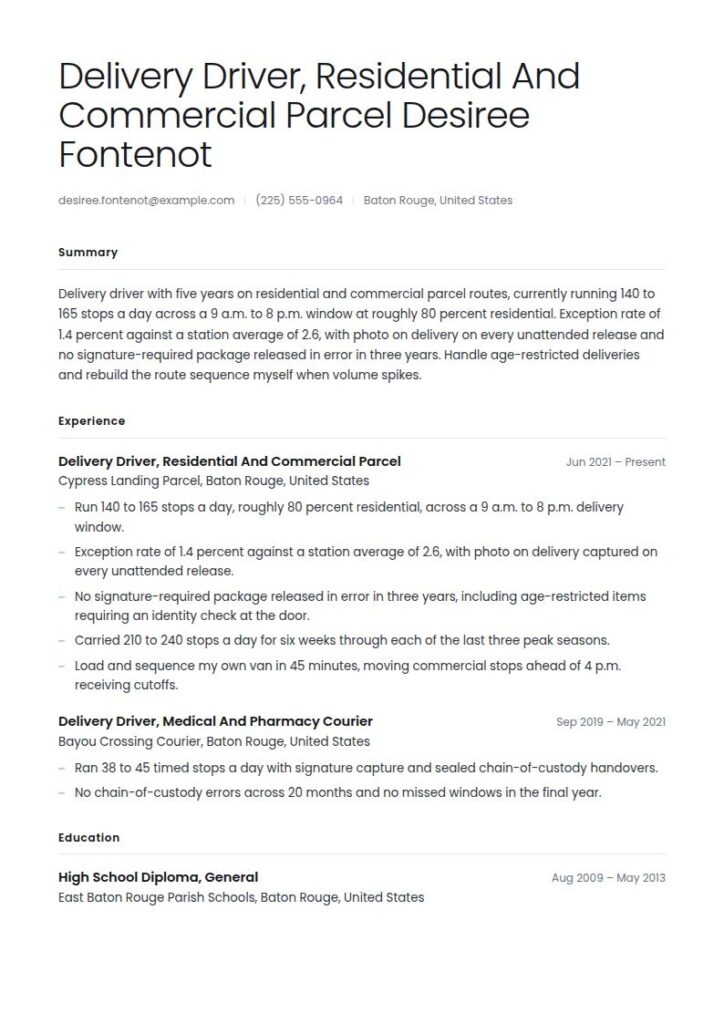
Delivery driver with five years on residential and commercial parcel routes, currently running 140 to 165 stops a day across a 9 a.m. to 8 p.m. window at roughly 80 percent residential. Exception rate of 1.4 percent against a station average of 2.6, with photo on delivery on every unattended release and no signature-required package released in error in three years. Handle age-restricted deliveries and rebuild the route sequence myself when volume spikes.
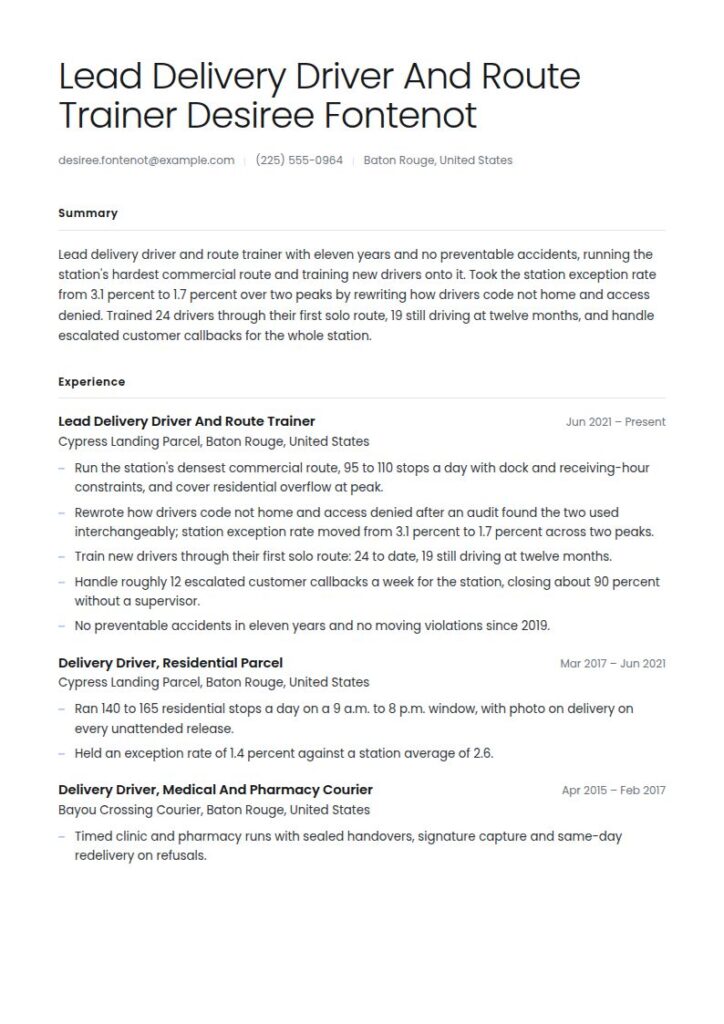
Lead delivery driver and route trainer with eleven years and no preventable accidents, running the station's hardest commercial route and training new drivers onto it. Took the station exception rate from 3.1 percent to 1.7 percent over two peaks by rewriting how drivers code not home and access denied. Trained 24 drivers through their first solo route, 19 still driving at twelve months, and handle escalated customer callbacks for the whole station.
Right vs wrong: the same delivery driver summary, twice
| ✅ Right | ❌ Wrong |
|---|---|
| Five years on residential and commercial parcel routes, 140 to 165 stops a day across a 9 a.m. to 8 p.m. window. | Experienced delivery driver with excellent time management skills. |
| Exception rate of 1.4 percent against a station average of 2.6, photo on delivery on every unattended release. | Consistently delivers packages accurately and on time. |
| No signature-required package released in error in three years. | Committed to outstanding customer service every single day. |
For example, the left column is a driver whose route can be handed over on Monday. In contrast, the right column is a driver a manager would have to watch for a week first.
Outline your delivery experience
Employer, city, vehicle, route type and dates, then three to five bullets. Volume goes in the header line of each job so a reader does not have to hunt for it.
Meanwhile, route type is the part applicants leave vague, and it changes the job completely. For instance, residential routes are high stop counts, unattended releases, gates, dogs and no one home. By contrast, commercial routes are fewer stops, bigger freight, loading docks, receiving hours and a named person who signs. Mixed routes are both, usually with the commercial stops front-loaded because receiving closes at four. Therefore, say which you ran, and say the split.
| Instead of | Use |
|---|---|
| Delivered packages to customers in a timely manner | Ran 140 to 165 stops a day, roughly 80 percent residential, on a 9 a.m. to 8 p.m. window |
| Provided excellent customer service | Handled escalated callbacks for the station, closing 90 percent without a supervisor |
| Scanned and tracked packages | Captured photo on delivery on every unattended release; no signature-required package released in error in three years |
| Maintained a good delivery record | Exception rate of 1.4 percent against a station average of 2.6 across two peak seasons |
| Loaded the van each morning | Load and sequence my own van in 45 minutes, resequencing commercial stops ahead of 4 p.m. receiving cutoffs |
Lead Delivery Driver and Route Trainer, Cypress Landing Parcel, Baton Rouge, LA, June 2021 to Present
Run the station's densest commercial route, 95 to 110 stops a day with dock and receiving-hour constraints, and cover residential overflow during peak.
Rewrote how drivers code not home and access denied after an audit found the two being used interchangeably; station exception rate moved from 3.1 percent to 1.7 percent across two peaks.
Train new drivers through their first solo route: 24 to date, 19 still driving at twelve months.
Take escalated customer callbacks for the station, roughly 12 a week, and close about 90 percent without a supervisor.
No preventable accidents in eleven years and no moving violations since 2019.
The job is decided at the door: proof of delivery, exceptions and the customer in front of you
In fact, everything an employer will ever know about your driving comes from what the scanner recorded at the door. That record is the product. Write your resume around it.
To begin with, proof of delivery is the first half. Depending on the operation, for example, it is a signature, a photo of the package where you left it, a scan at a named location, or a handover to a named person with an identity check. Each has a rule attached, and the rules are where drivers get into trouble: a signature-required package cannot be released, an age-restricted item needs the identity check completed at the door rather than assumed, and an unattended release is a judgement call the driver makes and the company later defends. Then say on your resume which proof types you have worked with and which release decisions were yours.
How delivery exceptions separate drivers
Exceptions are the second half, and they are the part that separates drivers. An exception is any stop that did not complete as a delivery, and it has to be coded correctly, because the code is what triggers the next action.
| Exception | What it means | What it triggers |
|---|---|---|
| Not home | No one available and the release rules do not allow an unattended drop | Redelivery attempt, usually next business day |
| Refused | The recipient declined the item | Return to station and return to sender |
| Damaged | Visible damage identified before handover | Claim opened, photo evidence, return |
| Access denied | Gate, code, locked lobby, dog, no safe approach | Redelivery, often with a note back to the shipper |
| Incorrect address | Address does not exist or does not match | Address correction and reattempt |
In practice, two codes doing each other's work is the most common data problem in a delivery operation, and it is the one a station manager will immediately recognize if you mention it. To illustrate, a route that logs everything as not home hides an access problem that could be fixed with a gate code; a route that logs everything as access denied looks like a driver avoiding attempts. Being able to say you audited and corrected that is a genuinely senior thing to have done.
Volume: 140 to 165 stops a day, roughly 80 percent residential, 9 a.m. to 8 p.m. window
Proof of delivery: photo on delivery for unattended releases, signature capture for signature-required and age-restricted items, named-recipient handover with identity check on pharmacy work
Exceptions: 1.4 percent exception rate against a station average of 2.6; no signature-required package released in error in three years
Customer contact: 12 escalated callbacks a week handled directly, roughly 90 percent closed without a supervisor
Record: no preventable accidents in eleven years, no moving violations since 2019
The delivery driver and the customer at the door
The third part is the customer, who is the only person in the whole chain who sees you. A delivery driver is the physical form of a company that the recipient otherwise deals with through a screen, which is why service recovery is worth a line on your resume: the redelivery you arranged directly, the neighbor handover you set up, the missing package you traced. One sentence describing a recovery you personally closed does more than a paragraph about caring.
Finally, the qualification itself. Delivery vehicles are typically under 26,001 pounds, so a commercial driver's license is not the normal requirement for this work; what is expected is a driver's license from the state you are employed in and a clean driving record (BLS Occupational Outlook Handbook, Delivery Truck Drivers and Driver/Sales Workers, last modified 27 August 2026). That makes the record itself the credential, so state it as a fact with a date rather than as a claim.
Build a snapshot of your key skills
Ten to fourteen entries, grouped so the reader can scan them: the doorstep work, the route work, and the vehicle.
At the door: Proof of delivery capture, photo on delivery, signature and release rules, age-restricted identity checks, exception coding, redelivery arrangement, service recovery
Route: Route sequencing and resequencing, receiving-hour and dock scheduling, delivery window management, load and scan verification, peak volume handling
Vehicle and safety: Cargo van and box truck operation, daily vehicle inspection, defensive driving, hand truck and dolly work, safe lifting, securing a load for a multi-stop route
Systems: Handheld scanner and driver app, dispatch messaging, chain-of-custody documentation for medical courier work
List your education and certifications
The Handbook records a high school diploma or equivalent as the typical entry-level education for delivery truck drivers and driver/sales workers, with on-the-job training of one month or less after hire (BLS Occupational Outlook Handbook, last modified 27 August 2026). As a result, the certifications section is short and the record section carries the weight.
Louisiana driver's license, current, motor vehicle record clear of moving violations since 2019
High School Diploma, Baton Rouge, LA, 2013
Certifications: Defensive driving program, employer certification, renewed 2025. Age-restricted delivery certification, employer program, 2022. Chain-of-custody handling for medical courier deliveries, employer program, 2019. First aid and CPR, American Red Cross, 2025.
Choose the right layout and design
Above all: one column, 11 or 12 point type, clear headings, no photograph. Similarly, put volume numbers where a reader's eye lands first, which is the line under each job title rather than the fourth bullet.
State stops a day, route type and the delivery window for every job. Name the proof of delivery types you have used. Give an exception rate or an on-time rate if you know it, with the period. Put the driving record in the header with a date. Say which release decisions were yours. Describe one service recovery you closed yourself.
Do not write "delivered packages" as a bullet; it is the job title. Do not leave route type vague when residential and commercial are different jobs. Do not claim a CDL you do not hold. Do not omit the driving record; the employer pulls it anyway. Do not list every short agency assignment separately when one grouped line reads as steadier and is just as true.
Delivery driver job market and outlook
A growing occupation, and one of the few in transport where growth rather than churn is doing the work.
| Measure | Value |
|---|---|
| Delivery truck drivers and driver/sales workers, 2025 | 1,511,400 |
| Light truck drivers, 2025 | 1,068,500 |
| Driver/sales workers, 2025 | 442,900 |
| Projected change, 2025-35 | 7%, about 103,000 new jobs |
| Projected annual openings | ~152,700 |
| Typical entry-level education | High school diploma or equivalent |
| On-the-job training | 1 month or less |
| Median annual wage, May 2025 | $43,950 ($21.13 per hour) |
Source: U.S. Bureau of Labor Statistics, Occupational Outlook Handbook, Delivery Truck Drivers and Driver/Sales Workers, May 2025 wage data and 2025 to 2035 projections, last modified 27 August 2026.
One job title, two different occupations, and a $14,000 gap
The Handbook splits this occupation in two, and the split is the most useful thing on the page. Light truck drivers had a May 2025 median annual wage of $44,860 and driver/sales workers $38,770 (BLS Occupational Outlook Handbook, last modified 27 August 2026).
Where each group works explains the gap. Among light truck drivers, 37 percent are employed in couriers and messengers, the best-paid industry for them at a $47,700 median. Among driver/sales workers, 39 percent are in food services, the lowest-paid industry in the occupation at a $30,580 median (BLS, May 2025).
That is a $17,120 spread between the largest employer of one half of the occupation and the largest employer of the other, under the same job title. Before you write a word, know which of the two your target job belongs to, because the evidence they read for is different: courier work is judged on stops, windows and exception rates, and driver/sales work is judged on the account, the order and what you sold at the stop.
Next, where light truck drivers work, and what it pays:
| Industry | Share of light truck driver employment | Median annual wage (May 2025) |
|---|---|---|
| Couriers and messengers | 37% | $47,700 |
| Retail trade | 17% | $34,350 |
| Wholesale trade | 14% | $44,740 |
| Self-employed | 7% | Not published |
Source: U.S. For reference: Bureau of Labor Statistics, Occupational Outlook Handbook, May 2025.
What salary you can expect as a delivery driver
The median annual wage across delivery truck drivers and driver/sales workers was $43,950 as of May 2025, or $21.13 an hour (BLS Occupational Outlook Handbook, last modified 27 August 2026). That single figure hides more than it shows.
Split it and the picture sharpens. For instance, light truck drivers had a median of $44,860, and the industry that employs 37 percent of them, couriers and messengers, paid a median of $47,700. Meanwhile, retail trade, which employs 17 percent of them, paid $34,350 (BLS, May 2025). In other words: same license, same vehicle class, a $13,350 difference in the middle of the range.
Likewise, the driver/sales half tells the same story from the other end. Specifically, wholesale trade pays a median of $49,090 and employs 25 percent of driver/sales workers; food services pays $30,580 and employs 39 percent of them (BLS, May 2025).
Ultimately, the practical conclusion is that the biggest single move available to a delivery driver is a sector move, not a raise. As a result, a resume built on stops, windows, exception rates and proof of delivery discipline travels into courier and wholesale work. On the other hand, a resume built on "delivered orders to customers" does not travel anywhere, because it describes nothing an employer can compare.
Key takeaways for a delivery driver resume
- In short, write the resume about the door, not the drive.
- To start, put stops a day, route type and the delivery window under every job title.
- In addition, name the proof of delivery types you have used and the release decisions that were yours.
- Then give an exception rate or on-time rate with its period, and say what you compare it to.
- Finally, put the driving record in the header, with a date.
- Describe one service recovery you closed yourself.
- Know whether your target job is courier work or driver/sales work; they pay differently and read differently.
Build your delivery driver resume in 15 minutes with our AI resume builder.
Related transport and logistics resume examples
- Truck driver resume
- Dispatcher resume
- Package handler resume
- Warehouse worker resume
- Logistics coordinator resume
- Tractor driver resume
- Stock clerk resume
- Order filler resume
- Warehouse supervisor resume
- Transport and logistics resume
- Supply chain resume
- Aviation resume
Pair it with a matching delivery driver cover letter.
Delivery driver resume questions, answered
How long should a delivery driver resume be?
One page for your first few years. Two once you have trained drivers, run more than one route type, or carried a record worth listing station by station. A second page of duties is worse than one page of numbers.
Do I need a CDL to be a delivery driver?
Usually not. Delivery vehicles are typically under 26,001 pounds, so the expected qualification is a driver's license from the state you work in plus a clean driving record rather than a commercial driver's license (BLS Occupational Outlook Handbook, last modified 27 August 2026). If you do hold a CDL, put it on the page anyway; it widens the vehicles you can be assigned.
What do I put on a delivery driver resume with no experience?
Anything that shows you can carry a schedule and handle a customer without supervision: rideshare or food delivery with a trip count, retail stockroom or receiving work, moving and removals, or any job with a route and a time window. Then the driving record, the license and your availability. The Handbook lists on-the-job training of one month or less for this occupation (BLS Occupational Outlook Handbook, last modified 27 August 2026), so employers expect to train you; what they will not do is guess whether you can be relied on alone.
Should I put my exception rate on the resume if it is average?
Yes, if you can say what it is measured against. An exception rate of 2.5 percent on a station averaging 2.6 is a fine line on a resume. What reads badly is a number with no comparison, because the reader cannot tell whether it is good, and a driver who understands their own exception data is already unusual.
How do I describe peak season?
As a volume change with a number. "Carried 210 to 240 stops a day for six weeks through peak, against a normal route of 160" says more about you than any adjective. Peak is also where most delivery hiring happens, so a driver who has worked one and came back is showing something employers pay attention to.