Inventory and Replenishment Analyst Ingrid Svensdotter
Inventory and Replenishment Analyst
[email protected] | (208) 555-1026 | Boise, United States
Profile
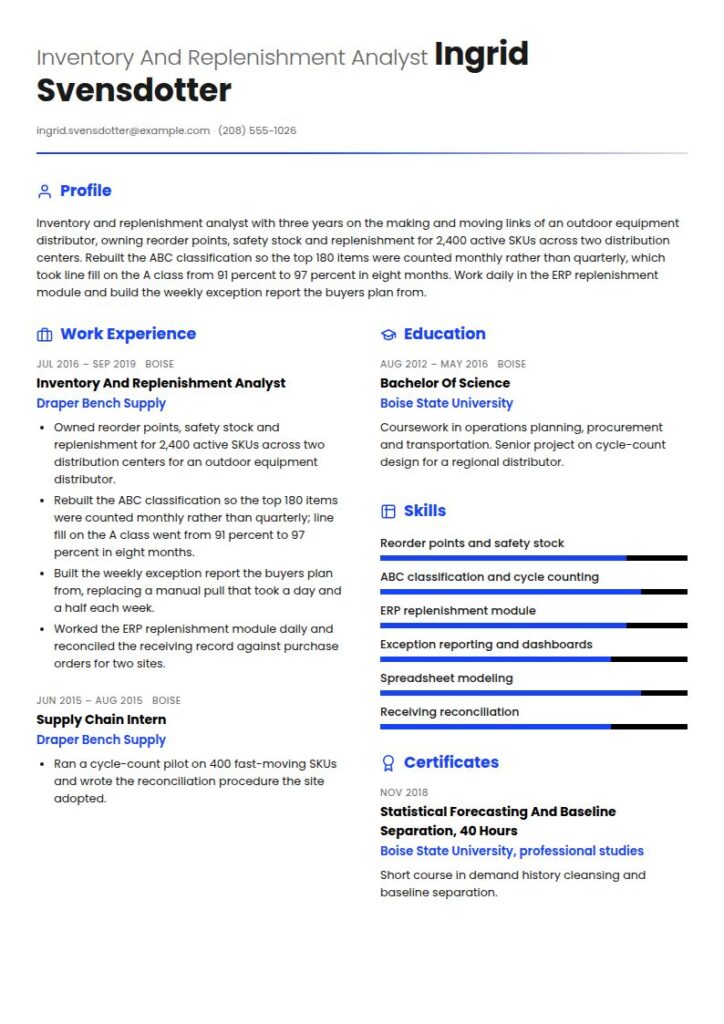
Inventory and replenishment analyst with three years on the making and moving links of an outdoor equipment distributor, owning reorder points, safety stock and replenishment for 2,400 active SKUs across two distribution centers. Rebuilt the ABC classification so the top 180 items were counted monthly rather than quarterly, which took line fill on the A class from 91 percent to 97 percent in eight months. Work daily in the ERP replenishment module and build the weekly exception report the buyers plan from.
Work Experience
07/2016 - 09/2019, Inventory and Replenishment Analyst, Draper Bench Supply, Boise, United States
- Owned reorder points, safety stock and replenishment for 2,400 active SKUs across two distribution centers for an outdoor equipment distributor.
- Rebuilt the ABC classification so the top 180 items were counted monthly rather than quarterly; line fill on the A class went from 91 percent to 97 percent in eight months.
- Built the weekly exception report the buyers plan from, replacing a manual pull that took a day and a half each week.
- Worked the ERP replenishment module daily and reconciled the receiving record against purchase orders for two sites.
06/2015 - 08/2015, Supply Chain Intern, Draper Bench Supply, Boise, United States
- Ran a cycle-count pilot on 400 fast-moving SKUs and wrote the reconciliation procedure the site adopted.
Education
08/2012 - 05/2016, Bachelor of Science, Supply Chain Management, Boise State University, Boise, United States
Coursework in operations planning, procurement and transportation. Senior project on cycle-count design for a regional distributor.
Skills
Reorder points and safety stock, 80
ABC classification and cycle counting, 85
ERP replenishment module, 80
Exception reporting and dashboards, 75
Spreadsheet modeling, 85
Receiving reconciliation, 75
Languages
English, native
Swedish, intermediate
Certificates
11/2018, Statistical forecasting and baseline separation, 40 hours, Boise State University, professional studies
Short course in demand history cleansing and baseline separation.
Summary
Supply chain is not one job. It is five links that are hired separately, paid differently and rarely managed by the same person: planning, sourcing, making, moving and returning. This guide shows you how to say which links you have worked, what evidence each one is read for, and what the Bureau of Labor Statistics publishes on pay across the six occupations the field is built on.
Supply Chain resume examples by experience level
A supply chain resume is a one to two page document, and the phrase in its title does almost no work.
"Supply chain" covers five links: planning what is needed, sourcing it, making it, moving it, and handling what comes back. Those links are hired separately, paid very differently, and usually report to different managers. A resume that says "supply chain professional" has told the reader which building it wants to work in, not which job it can do.
The fix is small. Say which links you have actually touched, in the order that matters to the posting, and give each one its own evidence.
Resume guide for a supply chain resume
This guide and the corresponding supply chain resume example will cover:
- How to write a supply chain resume, section by section
- The five links, what each is hired on, and which to lead with
- Three adaptable summaries: the analyst, the planner and the manager
- How to show results when the numbers you own are not financial
- What six published occupations pay across the chain
How to write a supply chain resume
Six sections: contact header, summary, a links line, experience, systems and skills, and education and certifications. One page for the first five years, two once you own more than one link.
The links line is the section most candidates skip, and it is the one that makes the rest legible. Three or four words per link, naming what you held rather than what you were near.
| Section | What it answers for the reader | Where it goes |
|---|---|---|
| Links line | Which parts of the chain has this person held? | One line under the summary |
| Experience | What moved, by how much, over what period? | Reverse chronological, scope in the header |
| Systems and skills | Which planning, ERP and reporting tools, at what depth? | Grouped, named, no ratings |
| Education and certifications | Degree, and any credential with its year | Short, at the end |
Write a links line and let the reader place you in ten seconds
A hiring manager reading supply chain resumes wants one answer first: is this a planner, a buyer, an inventory person, a logistics person, or someone who has run more than one of those?
A links line answers it immediately: "Plan: 18-month demand plan, monthly sales and operations planning. Source: 74 suppliers, qualification and scorecards. Move: two distribution centers, outbound transport. Return: returns and disposition program."
Four short entries, and the reader knows you are a manager across the chain rather than a specialist in one part of it. Leave out any link you only observed; claiming five when you held one is the common overreach here, and it is caught in the first interview question.
Run the finished file through the ATS resume checker first. Manufacturers and third-party logistics providers screen through a portal, and the links line has to survive the parse.
Choosing the best resume format for a supply chain resume
Reverse chronological, single column. Careers in this field move across links as often as they move up, and a dated timeline turns a sideways move into a story rather than a question.
A hybrid is defensible in one case: you have genuinely worked three or more links and the posting spans them. Even then, put the links line above a full chronological history, never instead of it. A functional resume with no dates reads as an attempt to make one link sound like five.
Include your contact information
| ✅ Right | ❌ Wrong |
|---|---|
| Ingrid Svensdotter | Ingrid Svensdotter |
| Supply Chain Manager: planning, sourcing, inventory, distribution, returns | Supply chain professional and results-driven leader |
| 340 finished goods, 74 suppliers, 2 distribution centers | End-to-end supply chain expertise |
| (208) 555-1026, [email protected], Boise, ID | (208) 555-1026, [email protected] |
The second line names the links, the third gives the scope of the chain you ran, and between them a reader knows whether to keep reading.
Make use of a summary
Four lines: which links you hold, the scope of the chain, one measured result, and your systems.
Inventory and replenishment analyst with three years on the making and moving links of an outdoor equipment distributor, owning reorder points, safety stock and replenishment for 2,400 active SKUs across two distribution centers. Rebuilt the ABC classification so the top 180 items were counted monthly rather than quarterly, which took line fill on the A class from 91 percent to 97 percent in eight months. Work daily in the ERP replenishment module and build the weekly exception report the buyers plan from.
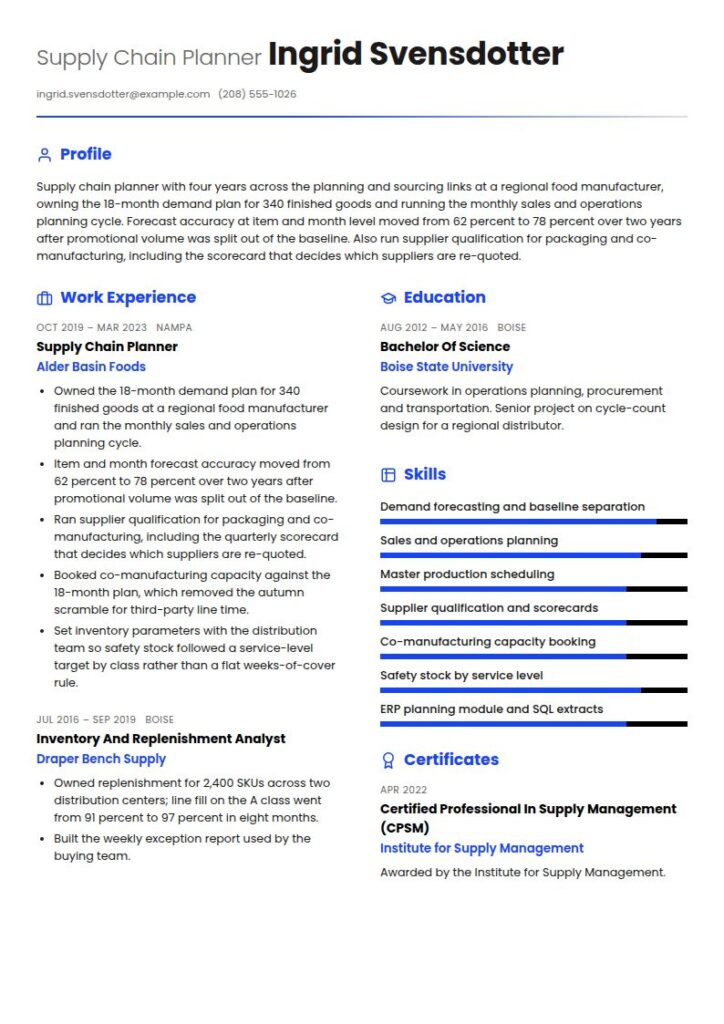
Supply chain planner with four years across the planning and sourcing links at a regional food manufacturer, owning the 18-month demand plan for 340 finished goods and running the monthly sales and operations planning cycle. Forecast accuracy at item and month level moved from 62 percent to 78 percent over two years after promotional volume was split out of the baseline. Also run supplier qualification for packaging and co-manufacturing, including the scorecard that decides which suppliers are re-quoted.
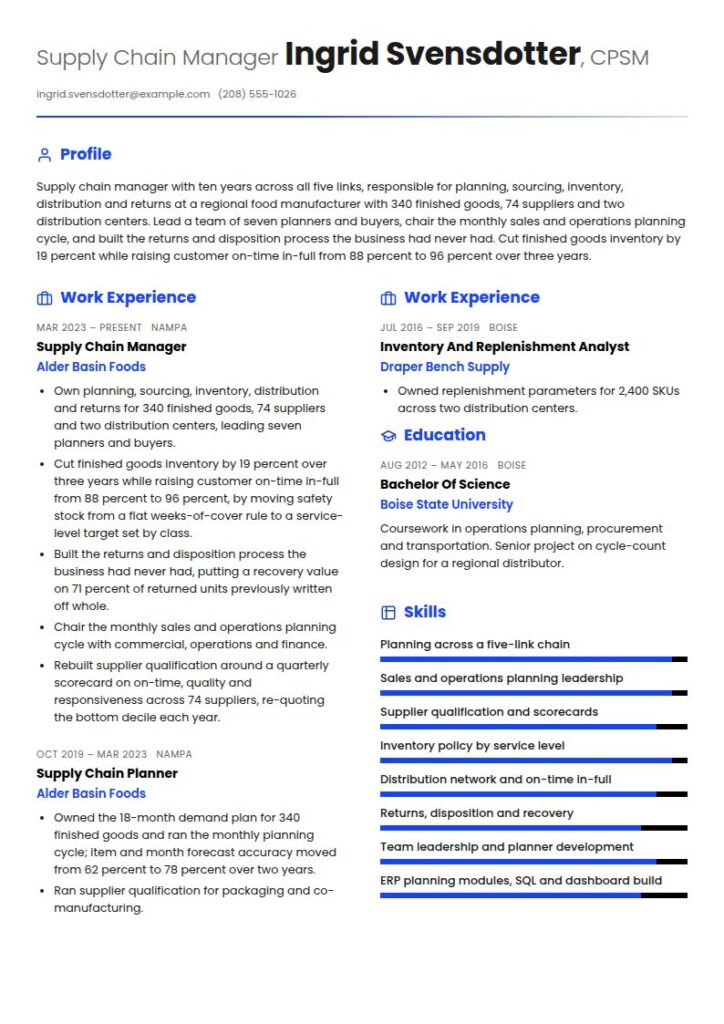
Supply chain manager with ten years across all five links, responsible for planning, sourcing, inventory, distribution and returns at a regional food manufacturer with 340 finished goods, 74 suppliers and two distribution centers. Lead a team of seven planners and buyers, chair the monthly sales and operations planning cycle, and built the returns and disposition process the business had never had. Cut finished goods inventory by 19 percent while raising customer on-time in-full from 88 percent to 96 percent over three years.
Right vs wrong: the same supply chain summary, twice
| ✅ Right | ❌ Wrong |
|---|---|
| Supply chain planner across the planning and sourcing links at a regional food manufacturer. | Supply chain professional with end-to-end experience. |
| Owns the 18-month demand plan for 340 finished goods and runs the monthly sales and operations planning cycle. | Responsible for optimizing supply chain processes and driving efficiencies. |
| Forecast accuracy at item and month level from 62 percent to 78 percent over two years. | Consistently improved KPIs and delivered cost savings. |
The right-hand column is what most of these resumes say, and none of it can be checked. The left names a link, a scope and a number with a period attached.
Outline your supply chain experience
Employer, what they make or sell, scope and dates in the header line, then three to five bullets, each belonging to one link and carrying a number.
Scope is how a reader sizes the job, and it differs by link: SKUs, horizon and granularity for planning; supplier count, categories and lead times for sourcing; lines, changeovers and turns for making; sites, volume and on-time for moving; return rate and recovery for returning.
| Instead of | Use |
|---|---|
| Managed end-to-end supply chain operations | Owned planning, sourcing, inventory, distribution and returns for 340 finished goods, 74 suppliers and two distribution centers |
| Improved forecast accuracy | Item and month forecast accuracy from 62 percent to 78 percent over two years by splitting promotional volume out of the baseline |
| Reduced inventory levels | Cut finished goods inventory by 19 percent while raising on-time in-full from 88 percent to 96 percent over three years |
Supply Chain Manager, Alder Basin Foods, Nampa, ID, March 2023 to Present. Regional food manufacturer, 340 finished goods, 74 suppliers, two distribution centers.
Own all five links and lead seven planners and buyers, chairing the monthly sales and operations planning cycle with commercial, operations and finance.
Cut finished goods inventory by 19 percent over three years while raising customer on-time in-full from 88 percent to 96 percent, by moving safety stock from a flat weeks-of-cover rule to a service-level target set by class.
Built the returns and disposition process the business had never had, which put a recovery value on 71 percent of returned units that had previously been written off whole.
Rebuilt supplier qualification around a quarterly scorecard on on-time, quality and responsiveness across 74 suppliers, re-quoting the bottom decile each year.
Your resume is read link by link: planning, sourcing, making, moving, returning
The field fits in one table: five links, five sets of evidence, and the published occupation nearest each one.
| Link | The work | What a hiring manager reads as evidence | Nearest published occupation, May 2025 median |
|---|---|---|---|
| Plan | Demand forecasting, sales and operations planning, master scheduling, capacity | Forecast accuracy and bias, plan attainment, horizon, the cycle you chaired | Logisticians, $82,320 |
| Source | Supplier selection and qualification, contracts, purchase orders, scorecards | Supplier count, category spend, lead times, supplier on-time, scorecard outcomes | Buyers and purchasing agents, $77,710; purchasing managers, $148,080 |
| Make | Materials planning, production scheduling, inventory parameters, expediting | Schedule adherence, stockouts and line-down events, inventory turns, cover | Material recording clerks, $47,600 |
| Move | Warehousing, outbound transport, fulfillment, import and export paperwork | On-time in-full, cost per unit shipped, dock to stock, sites run | Transportation, storage, and distribution managers, $107,230; hand laborers and material movers, $38,220 |
| Return | Returns authorization, credits, disposition, recovery, recalls and withdrawals | Return rate, recovery value, credit cycle time, disposition mix | No single published occupation; usually split between the sourcing and moving teams |
Source: U.S. Bureau of Labor Statistics, Occupational Outlook Handbook, six occupational profiles, May 2025 wage data, last modified 27 August 2026.
Plan
Planning evidence is a horizon and a cycle, not a spreadsheet. Say how far out you planned, at what granularity, how often the plan was reviewed, and who was in the room. A planner who chairs a monthly sales and operations planning cycle with commercial and finance is doing a different job from one who publishes a weekly requirements run.
Source
Sourcing evidence is a supplier population and what you did to it. Give the number of suppliers, the categories, and the mechanism: qualification, scorecards, re-quoting, dual sourcing, contract length. The mechanism separates a buyer who placed orders from one who shaped a supply base.
Make
The making link is where inventory lives, and it is the one most often misdescribed. Say which parameters you set, reorder points, safety stock, lot sizes and the service level behind them, and what you were measured on: schedule adherence, stockouts, turns, cover. Inventory numbers without the service number beside them read as a cut rather than an improvement.
Move
Moving is the most visible link and the easiest to quantify: sites, volume, on-time in-full, cost per unit shipped, dock to stock. Give the scope of the physical network in the header line so the reader can size it before the bullets start.
Return
Returns are the link almost nobody writes about, which is why writing about them works. Reverse flow has its own vocabulary, returns authorization, disposition, recovery, credits, recalls and withdrawals, and its own measures. A candidate who can say what happened to returned units, and what proportion was recovered rather than written off, stands out in a stack of forward-only resumes.
Which links sit together depends on the size of the company, so mirror the posting rather than your last job title. In a small business one person often runs planning, sourcing and inventory while a third-party logistics provider handles moving. In a large one those are three departments with three managers, and a candidate claiming all of them reads as someone who has not worked at that scale. Work out which link the posting is hiring for, then put it first in the summary, in the links line and in the top three bullets of your most recent job.
The growth is in planning; the decline is in the record keeping
The five links are not moving in the same direction. Logisticians, the occupation nearest the planning link, are projected to grow 18 percent between 2025 and 2035, much faster than the average, from an employment base of 255,100, with about 26,600 openings a year (BLS Occupational Outlook Handbook, last modified 27 August 2026).
Material recording clerks, the occupation nearest the record-keeping side of making and moving, are projected to fall 6 percent over the same decade, from 1,273,500 to 1,203,100, a loss of about 70,300 jobs, while still generating roughly 98,600 openings a year (BLS, same cycle).
The same decade is adding planning roles and removing clerical ones. If your experience is on the recording side, the transferable evidence is the decision you influenced with the record, not the record itself: write the parameter you changed and the service level that followed, not the number of transactions you keyed.
Build a snapshot of your key skills
Twelve to sixteen entries in four groups, weighted towards the links the posting is hiring for. Name systems by module rather than by vendor, and do not attach percentages.
Planning: Demand forecasting and baseline separation, sales and operations planning, master production scheduling, capacity and co-manufacturing booking, scenario planning
Sourcing: Supplier qualification, request for quotation and re-quoting, supplier scorecards, dual sourcing, contract renewal calendars
Inventory and fulfillment: Reorder points and safety stock by service level, ABC classification, cycle counting programs, on-time in-full, dock to stock
Systems and analysis: ERP planning and replenishment modules, warehouse management reporting, spreadsheet modeling, SQL extracts, dashboard build and exception reporting
List your education and certifications
Education matters more here than in most of transport and logistics, and it matters unevenly across the links. The Bureau of Labor Statistics records a bachelor's degree as the typical entry-level education for logisticians and for buyers and purchasing agents, a high school diploma or equivalent for material recording clerks, and a high school diploma or equivalent plus five years or more of related work experience for transportation, storage, and distribution managers (Occupational Outlook Handbook, last modified 27 August 2026).
On credentials the Handbook is deliberately vague. It says only that some workers "may choose to earn optional certification in an area such as procurement or supply chain management" and that certification "helps to demonstrate that candidates have attained competency in the field." It names none. The named credentials come from professional bodies: the Institute for Supply Management awards the Certified Professional in Supply Management (CPSM), the Certified Professional in Supplier Diversity (CPSD) and the Advanced Professional in Supply Management (APSM). Write yours with the awarding body and the year.
Bachelor of Science, Supply Chain Management, Boise State University, Boise, ID, 2016
Certified Professional in Supply Management (CPSM), Institute for Supply Management, 2022
Continuing study: sales and operations planning design workshop, 2024. Statistical forecasting, 40 hours, 2023.
Choose the right layout and design
One column, 11 or 12 point type, no photograph, no skill bars, no chain graphic. Percentage bars next to system names are especially damaging here: the reader wants to know which module you worked in, and a bar answers a question nobody asked.
Put a links line under the summary naming only the links you held. Give the scope of the chain in the header line of each job: SKUs, suppliers, sites. Pair every inventory number with the service number beside it. Name the planning horizon and the granularity. Put the returns link on the page if you have run it, because few candidates do. Lead with whichever link the posting is hiring for.
Do not write "end-to-end supply chain" unless you can name all five links and show evidence for each. Do not give a cost saving with no baseline or period. Do not list ERP vendors with no module or depth attached. Do not claim a certification without its awarding body and year. Do not describe a cross-functional project as though you owned the link it touched.
Supply chain job market and outlook
There is no Bureau of Labor Statistics occupation called supply chain. The honest reading is across the six published occupations that hold the field's employment, and their spread is the point.
| Occupation | Link | Jobs, 2025 | Projected change, 2025-35 | Median annual wage, May 2025 |
|---|---|---|---|---|
| Hand laborers and material movers | Move | 6,917,800 | 4% | $38,220 |
| Material recording clerks | Make and move | 1,273,500 | -6% | $47,600 |
| Buyers and purchasing agents | Source | 604,400 with purchasing managers | 6% | $77,710 |
| Logisticians | Plan | 255,100 | 18% | $82,320 |
| Transportation, storage, and distribution managers | Move | 228,100 | 6% | $107,230 |
| Purchasing managers | Source | 604,400 with buyers and agents | 4% | $148,080 |
Source: U.S. Bureau of Labor Statistics, Occupational Outlook Handbook, four occupational profiles, May 2025 wage data and 2025 to 2035 projections, last modified 27 August 2026.
Openings tell a different story from growth. Hand laborers and material movers generate about 904,200 openings a year and material recording clerks about 98,600, against roughly 26,600 for logisticians, 18,300 for transportation, storage, and distribution managers and 53,600 across purchasing managers, buyers and agents combined (BLS, same cycle). The hiring volume sits on the moving link; the growth sits on the planning link.
What salary you can expect in supply chain
There is no supply chain salary. The six published occupations span $38,220 to $148,080 in May 2025 medians, a range of $109,860 inside one field (BLS Occupational Outlook Handbook, last modified 27 August 2026). Which link you work is worth more than how long.
Inside the sourcing link alone the gap is $70,370: buyers and purchasing agents at $77,710 against purchasing managers at $148,080, both May 2025. Within the moving link, the same pattern shows up as $38,220 for hand laborers and material movers against $107,230 for transportation, storage, and distribution managers.
Industry changes the number again. Logisticians had a May 2025 median of $103,790 in the federal government and $83,990 in manufacturing, where 22 percent of them work, against $63,530 in transportation and warehousing (BLS, May 2025). Transportation, storage, and distribution managers show the same shape: $156,720 in management of companies and enterprises and $120,650 in government against $102,850 in transportation and warehousing, where 30 percent of them work (BLS, May 2025).
The largest single move available to most people here is not a promotion inside their link but a move to a link or an industry that pays differently for the same skill. A resume written link by link is what makes that move legible.
Key takeaways for a supply chain resume
- Say which of the five links you have held, and leave out the ones you only observed.
- Put a links line under the summary with three or four words for each link.
- Give the scope of the chain in the header line of each job: SKUs, suppliers, sites, horizon.
- Pair every inventory number with the service number beside it.
- Write the returns link if you have run it; almost nobody does, and it separates a file.
- Lead with whichever link the posting is hiring for, in the summary and the top bullets.
- Expect the pay ladder to run from $38,220 to $148,080, and aim at the link you want next.
Build your supply chain resume in 15 minutes with our AI resume builder.
Related transport and logistics resume examples
- Logistics coordinator resume
- Procurement manager resume
- Inventory manager resume
- Warehouse manager resume
- Transport and logistics resume
- Warehouse supervisor resume
- Truck driver resume
- Dispatcher resume
- Order filler resume
- Stock clerk resume
- Warehouse worker resume
- Aviation resume
Pair it with a matching supply chain cover letter.
Supply chain resume questions, answered
Should I use the phrase "supply chain" on my resume at all?
In the title line, yes, because it is what people search. Everywhere else, replace it with the link. "Supply chain experience" says nothing; "18-month demand plan for 340 finished goods" and "74 suppliers under a quarterly scorecard" say what you did and which manager should read it.
Which link should I lead with?
Whichever the posting is hiring for, even if it is not your most recent job. Work out which link the responsibilities occupy, then put that link first in the summary, first in the links line and in the top three bullets of your most recent job. Everything else stays on the page, lower down.
Do I need a degree to work in supply chain?
It depends entirely on the link. The Handbook records a bachelor's degree as typical for logisticians and for buyers and purchasing agents, a high school diploma or equivalent for material recording clerks, and a high school diploma or equivalent plus five years or more of related experience for transportation, storage, and distribution managers (Occupational Outlook Handbook, last modified 27 August 2026). The planning and sourcing links gate on education; the moving link gates on experience.
How do I show results if I do not have financial numbers?
Use the operational number your link is measured on, with a before, an after and a period: forecast accuracy for planning, supplier on-time for sourcing, schedule adherence and stockouts for making, on-time in-full for moving, recovery rate for returns. Most companies will not let you publish a cost figure anyway, and an operational number with a time frame beats a saving with no baseline.
Is supply chain a growing field?
Parts of it are growing quickly and parts are shrinking. Logisticians are projected to grow 18 percent between 2025 and 2035 from a base of 255,100, while material recording clerks are projected to fall 6 percent, from 1,273,500 to 1,203,100 (BLS Occupational Outlook Handbook, last modified 27 August 2026). The planning link is where the new roles are; the clerical recording work is where they are going.