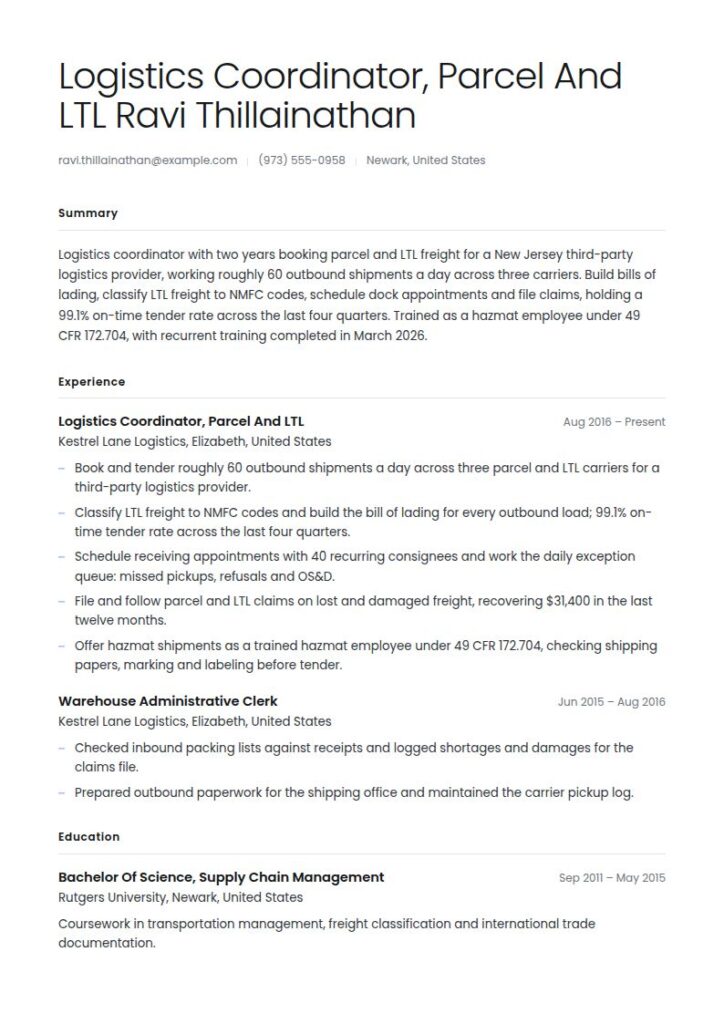
Logistics Coordinator, Parcel and LTL Ravi Thillainathan
Logistics Coordinator, Parcel and LTL
[email protected] | (973) 555-0958 | Newark, United States
Profile
Logistics coordinator with two years booking parcel and LTL freight for a New Jersey third-party logistics provider, working roughly 60 outbound shipments a day across three carriers. Build bills of lading, classify LTL freight to NMFC codes, schedule dock appointments and file claims, holding a 99.1% on-time tender rate across the last four quarters. Trained as a hazmat employee under 49 CFR 172.704, with recurrent training completed in March 2026.
Work Experience
08/2016 - Present, Logistics Coordinator, Parcel and LTL, Kestrel Lane Logistics, Elizabeth, United States
- Book and tender roughly 60 outbound shipments a day across three parcel and LTL carriers for a third-party logistics provider.
- Classify LTL freight to NMFC codes and build the bill of lading for every outbound load; 99.1% on-time tender rate across the last four quarters.
- Schedule receiving appointments with 40 recurring consignees and work the daily exception queue: missed pickups, refusals and OS&D.
- File and follow parcel and LTL claims on lost and damaged freight, recovering $31,400 in the last twelve months.
- Offer hazmat shipments as a trained hazmat employee under 49 CFR 172.704, checking shipping papers, marking and labeling before tender.
06/2015 - 08/2016, Warehouse Administrative Clerk, Kestrel Lane Logistics, Elizabeth, United States
- Checked inbound packing lists against receipts and logged shortages and damages for the claims file.
- Prepared outbound paperwork for the shipping office and maintained the carrier pickup log.
Education
09/2011 - 05/2015, Bachelor of Science, Supply Chain Management, Rutgers University, Newark, United States
Coursework in transportation management, freight classification and international trade documentation.
Skills
LTL classification and NMFC coding, 75
Bill of lading preparation, 85
Parcel rate shopping and manifesting, 80
Appointment scheduling, 75
Freight claims and OS&D, 70
Transportation management system booking, 70
Hazmat shipping papers, 65
Languages
English, native
Tamil, native
Spanish, beginner
Certificates
03/2026, Hazmat Employee Training, 49 CFR 172.704, Pipeline and Hazardous Materials Safety Administration rule, delivered by employer program
All five required categories: general awareness and familiarization, function-specific, safety, security awareness and in-depth security training. Recurrent training due at least once every three years, next due March 2029.
Summary
A logistics coordinator resume is a one to two page document naming the freight modes you have actually moved, the documents you produce and check, and your hazmat training status with its date. This guide gives you three adaptable versions, the mode vocabulary that proves the experience, the document set you are accountable for, and current Bureau of Labor Statistics pay and outlook for the work.
Logistics Coordinator resume examples by experience level
In short, a logistics coordinator resume is a one to two page document that names the freight modes you have moved, the documents you are accountable for, and the training that lets you touch regulated shipments.
However, most applicants write the job as a list of verbs: coordinate, schedule, track, communicate. Every coordinator does those things. What separates two files is which mode the verbs were applied to, because a parcel desk and an ocean import desk share a job title and almost no working vocabulary.
Resume guide for a logistics coordinator resume
To that end, this guide and the corresponding logistics coordinator resume example will cover:
- First, how to write a logistics coordinator resume, section by section
- Then, why the mode you coordinate belongs near the top of the page
- Next, three adaptable summaries: first desk, multi-mode, and senior coordinator
- The document set you are genuinely accountable for, and how to say so
- Also, what hazmat training means on a resume and how to date it
- Finally, what the job market looks like and what you can expect to earn
How to write a logistics coordinator resume
Overall, six sections: contact header, summary, modes and systems, coordination experience, education and certifications, and skills. One page early, two once you carry more than one mode.
The order is deliberate: mode sits high because it is the filter, and the same experience bullet means different things depending on what was in the trailer.
| Section | What it is answering | Where it goes |
|---|---|---|
| Modes and systems | Has this person moved the kind of freight we move? | Directly under the summary |
| Coordination experience | What did they own, and at what volume? | Reverse chronological, with numbers |
| Documents | Can they produce and check a clean document set? | Inside experience, named by document |
| Training and certifications | Can they legally touch a regulated shipment today? | Its own block, with dates |
Write the mode into your job title line, not just your bullets
A recruiter filling an ocean import desk searches for bookings, containers, customs entry and incoterms. A recruiter filling a domestic truckload desk searches for tendering, detention and carrier sourcing. The same resume rarely reads as a match for both, and trying to look like a match for both usually produces a file that matches neither.
Put the mode in the title line under your name: "Logistics Coordinator, LTL and Truckload" or "Logistics Coordinator, Ocean and Air Import". Then repeat it in each job heading, because coordinators move between desks and an employer wants to know which desk you were sitting at in which year.
"Parcel and LTL 2021 to 2023, truckload 2023 to 2025, ocean import since 2025" is a career. "Multimodal experience" is a phrase.
Run the finished file through the ATS resume checker before you send it. Freight employers screen through applicant tracking systems, and mode keywords are what those systems match on.
Choosing the best resume format for a logistics coordinator resume
Reverse chronological. In general, one page early, then two pages once you have carried multiple modes, a document responsibility or a team.
A functional format is a bad fit here because the reader is checking a sequence: which mode, for how long, at what volume, and how recently. Otherwise, a format that hides the timeline invites the assumption that the timeline is the problem.
Include your contact information
| ✅ Right | ❌ Wrong |
|---|---|
| Ravi Thillainathan | Ravi Thillainathan |
| Logistics Coordinator, Ocean and Air Import, LTL and Truckload | Logistics professional with a passion for supply chain |
| Hazmat employee trained, 49 CFR 172.704, recurrent March 2026 | Hazmat certified |
| (973) 555-0958, [email protected], Newark, NJ | (973) 555-0958, [email protected] |
In particular, two details do real work in that header. The mode line tells a hiring manager whether to keep reading, and the dated hazmat line tells them whether you can be put on a regulated shipment in your first week.
Make use of a summary
In short, four lines: your mode or modes, your volume, the documents or the desk you own, and one measured result.
Logistics coordinator with two years booking parcel and LTL freight for a New Jersey third-party logistics provider, working roughly 60 outbound shipments a day across three carriers. Build bills of lading, classify LTL freight to NMFC codes, schedule dock appointments and file claims, holding a 99.1% on-time tender rate across the last four quarters. Trained as a hazmat employee under 49 CFR 172.704, with recurrent training completed in March 2026.
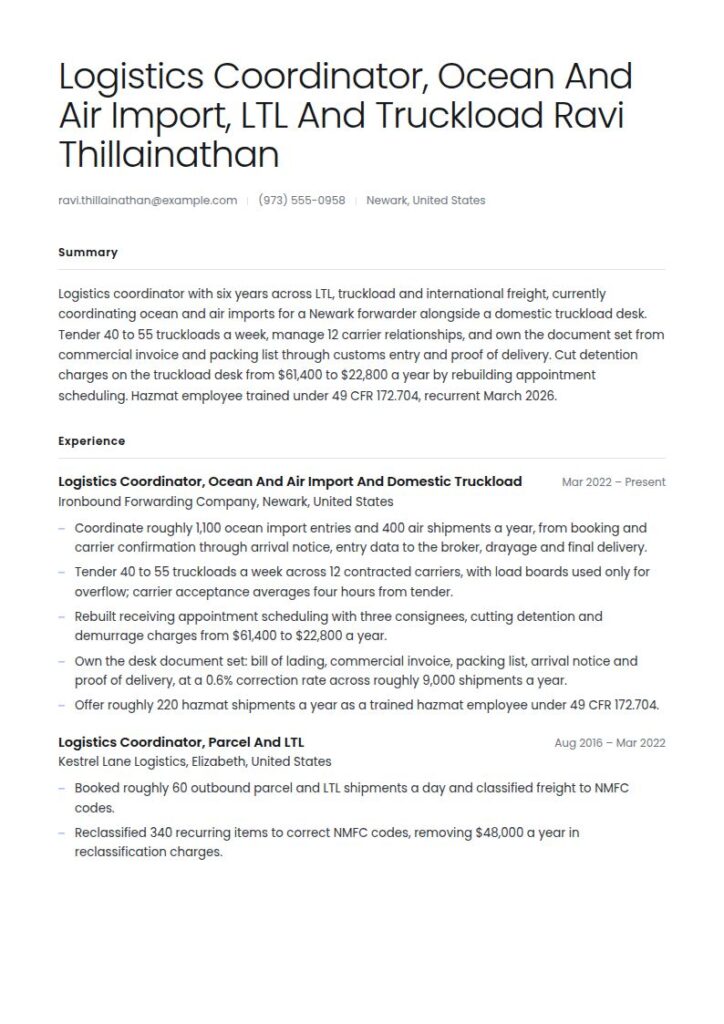
Logistics coordinator with six years across LTL, truckload and international freight, currently coordinating ocean and air imports for a Newark forwarder alongside a domestic truckload desk. Tender 40 to 55 truckloads a week, manage 12 carrier relationships, and own the document set from commercial invoice and packing list through customs entry and proof of delivery. Cut detention charges on the truckload desk from $61,400 to $22,800 a year by rebuilding appointment scheduling. Hazmat employee trained under 49 CFR 172.704, recurrent March 2026.
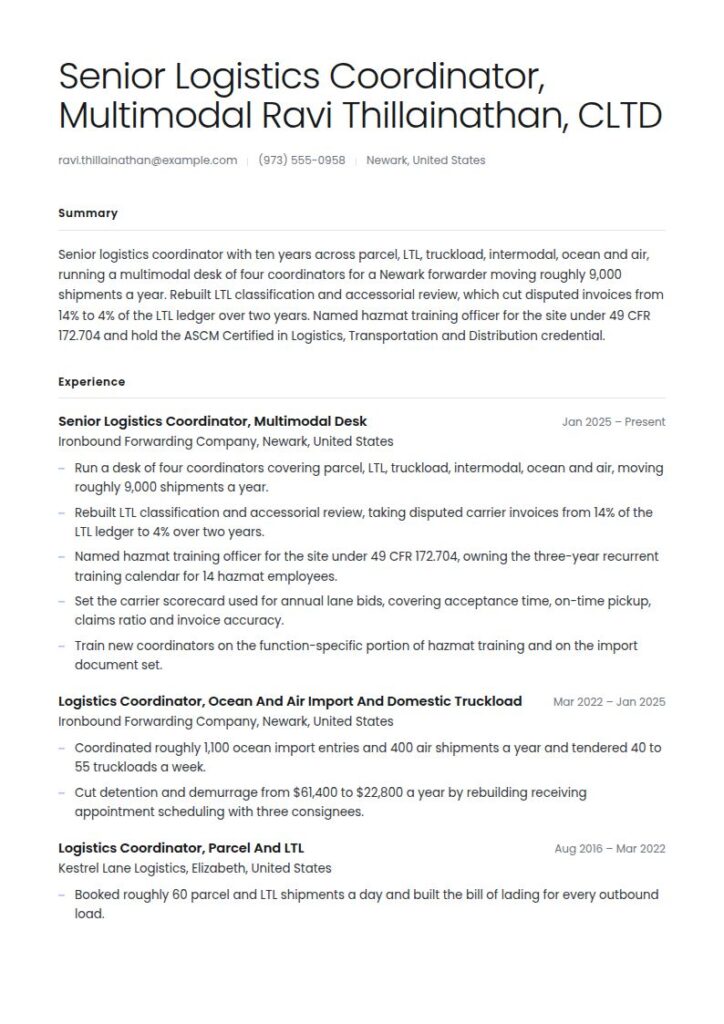
Senior logistics coordinator with ten years across parcel, LTL, truckload, intermodal, ocean and air, running a multimodal desk of four coordinators for a Newark forwarder moving roughly 9,000 shipments a year. Rebuilt LTL classification and accessorial review, which cut disputed invoices from 14% to 4% of the LTL ledger over two years. Named hazmat training officer for the site under 49 CFR 172.704 and hold the ASCM Certified in Logistics, Transportation and Distribution credential.
Right vs wrong: the same logistics coordinator summary, twice
| ✅ Right | ❌ Wrong |
|---|---|
| Logistics coordinator with six years across LTL, truckload and international freight. | Logistics professional with experience in all aspects of the supply chain. |
| Tender 40 to 55 truckloads a week and manage 12 carrier relationships. | Responsible for coordinating shipments and communicating with carriers. |
| Own the document set from commercial invoice through customs entry and proof of delivery. | Handle all shipping paperwork and documentation. |
| Cut detention charges from $61,400 to $22,800 a year by rebuilding appointment scheduling. | Improved efficiency and reduced costs. |
In practice, a manager can put the right column on a desk on Monday. In contrast, the left column needs an interview before anyone knows what it means.
Outline your coordination experience
Then list the employer, the kind of operation it was, your desk, and dates. Then three to five bullets, each naming a mode, a document or a carrier relationship, and each carrying a number.
| Instead of | Use |
|---|---|
| Coordinated shipments with carriers | Tendered 40 to 55 truckloads a week across 12 contracted carriers, with a 4-hour average tender-to-acceptance time |
| Prepared shipping documentation | Produced bills of lading, packing lists and commercial invoices for 9,000 shipments a year, with a 0.6% document correction rate |
| Tracked orders and resolved issues | Worked a 60-shipment daily exception queue: missed pickups, refused deliveries, OS&D and reconsignments |
| Reduced shipping costs | Reclassified 340 recurring SKUs to correct NMFC codes, removing $48,000 a year in reclassification charges |
| Handled hazardous shipments | Offered 220 hazmat shipments a year as a trained hazmat employee under 49 CFR 172.704, checking shipping papers, marking, labeling and placarding before tender |
Logistics Coordinator, Ocean and Air Import and Domestic Truckload, Ironbound Forwarding Company, Newark, NJ, March 2022 to Present
Coordinate 1,100 ocean import entries and roughly 400 air shipments a year, from booking and carrier confirmation through arrival notice, customs entry data to the broker, drayage and final delivery.
Tender 40 to 55 truckloads a week across 12 contracted carriers, with load boards used only for overflow; carrier acceptance averages four hours from tender.
Rebuilt receiving appointment scheduling with three consignees, which cut detention and demurrage charges from $61,400 to $22,800 a year.
Offer roughly 220 hazmat shipments a year, checking shipping papers, marking, labeling and placarding, and train two new coordinators on the function-specific portion of their hazmat training.
The mode you coordinate decides your whole vocabulary: parcel, LTL, truckload, intermodal, ocean and air
After all, employers hire coordinators by mode, and the six modes below are six different jobs sharing a title. Write the ones you have done, in the words those desks actually use, and leave the others off rather than implying coverage you cannot defend in an interview.
| Mode | What the desk actually does | The words that prove you did it |
|---|---|---|
| Parcel | Rate shops between service levels, builds manifests, watches transit commitments, files claims on lost and damaged pieces | Service level, manifest, dimensional weight, address correction, claim, transit commitment |
| LTL | Classifies freight, builds the bill of lading, books appointments, argues accessorials and reweighs | Freight class, NMFC code, bill of lading, accessorial, liftgate, inside delivery, reclassification, OS&D |
| Truckload | Sources and tenders to carriers, negotiates spot against contract, manages detention and driver hours | Tender, contracted lane, spot rate, detention, layover, drop trailer, load board |
| Intermodal | Books containers to rail ramps, arranges drayage, chases chassis and ramp availability | Container, chassis, drayage, rail ramp, per diem, ingate and outgate, street turn |
| Ocean | Books sailings, produces and checks the export and import document set, works with the broker on entry | Booking, sailing, arrival notice, commercial invoice, packing list, incoterms, customs entry, demurrage |
| Air | Books to flight, manages cut-off times, handles high value and time critical, screens for restricted cargo | Air waybill, cut-off, consolidation, chargeable weight, dangerous goods declaration |
Therefore, say which of those columns you have lived in and for how long. For example, a hiring manager filling an intermodal desk does not expect a parcel coordinator to know what a street turn is; what they cannot forgive is a resume that pretends to know.
The document set is where a coordinator is genuinely accountable
The part of the job that carries consequences is the paperwork, because a wrong document is a refused delivery, a customs hold, a denied claim or a fine. Also name the documents you produce and the ones you check:
- Bill of lading. The contract of carriage and the document a claim is decided on. Say whether you build it, check it, or only receive it back signed.
- Packing list. The count the consignee receives against. Carriers and shippers argue overages and shortages from this document, so say whether you reconcile it.
- Commercial invoice. The value declaration an entry is built from on international freight. Say whether you produce it or check it before it goes to the broker.
- Proof of delivery. The document that closes the shipment and releases the invoice. Say what your clean POD rate is if you know it.
- Shipping papers for hazardous materials. The proper shipping name, hazard class, identification number, packing group and quantity, plus the emergency response information that travels with the load.
If you offer hazmat, you are a hazmat employee and the training has a clock on it
Under 49 CFR 172.704, administered by the Pipeline and Hazardous Materials Safety Administration, a hazmat employee must receive training in five categories: general awareness and familiarization, function-specific training, safety training, security awareness training, and in-depth security training. The rule states that "a hazmat employee must receive the training required by this subpart at least once every three years" at 172.704(c)(2).
The part most coordinators do not realize is who counts. A person who packs, labels, documents or offers a hazardous shipment is a hazmat employee, which reaches shipping office and warehouse staff and not only drivers.
So put it on the page as a dated line: "Hazmat employee training, 49 CFR 172.704, all five categories, recurrent March 2026." That tells a hiring manager you can be scheduled on regulated freight now and exactly when you next come due. "Hazmat certified" tells them neither.
Build a snapshot of your key skills
Next, twelve to fifteen entries in four groups: modes, documents and compliance, systems, and commercial. Keep modes first, because that is the group the reader scans.
Modes: Ocean and air import, Domestic truckload tendering, LTL classification and routing, Intermodal and drayage, Parcel rate shopping and manifesting
Documents and compliance: Bill of lading, Commercial invoice and packing list, Customs entry data preparation, Incoterms 2020 application, Hazmat shipping papers under 49 CFR 172.704, OS&D and claims
Systems: Transportation management system booking and tendering, Carrier and forwarder portals, EDI 204, 214 and 990 transaction monitoring, Excel modeling for lane and rate comparison
Commercial: Carrier sourcing and rate negotiation, Accessorial and invoice audit, Detention and demurrage control, Appointment scheduling with consignees, Service level reporting
List your education and certifications
Certifications with dates first if they gate the work, then degrees, then training that is renewed on a cycle.
Hazmat Employee Training, 49 CFR 172.704, all five required categories, most recent recurrent training March 2026, next due March 2029
Certified in Logistics, Transportation and Distribution (CLTD), ASCM, 2024
Bachelor of Science, Supply Chain Management, Rutgers University, Newark, NJ, 2019
Additional training: Incoterms 2020 workshop (2023). Transportation management system administrator training, in house (2024). Freight claims and OS&D handling (2022).
Notably, the Bureau of Labor Statistics reports that logisticians typically enter with a bachelor's degree, no work experience in a related occupation and no on-the-job training (BLS Occupational Outlook Handbook, last modified 27 August 2026). Coordination roles sit lower on that ladder and people commonly reach them from a warehouse floor or a shipping office, so if your route in was operational, write the operational years as the qualification.
Choose the right layout and design
Above all: single column, 11 or 12 point type, clear headings, no photograph, no graphics. That matters because freight employers run applicant tracking systems that parse the file into fields, and two columns, text boxes and icons are where that parsing fails.
Put the mode in your title line and in every job heading. Give volumes: shipments a day, loads a week, entries a year. Name the documents you produce and the ones you only check. Date your hazmat training and say when it is next due. Say which systems you have actually worked in. Use the trade word where the trade uses it: tender, accessorial, drayage, arrival notice.
Do not write "multimodal experience" without naming the modes and the years. Do not claim customs knowledge you cannot evidence; the broker relationship is checkable. Do not list a transportation management system you have seen demonstrated. Do not write "hazmat certified" without the regulation and the date. Do not fill the page with tracking and communication duties that every coordinator does.
Logistics coordinator job market and outlook
In fact, the occupation sits between two published groups that are moving in opposite directions, and knowing which one you aim your resume at is most of the career strategy.
| Measure | Logisticians |
|---|---|
| Jobs, 2025 | 255,100 |
| Projected change, 2025-35 | 18% (much faster than average) |
| Projected annual openings | ~26,600 |
| Typical entry-level education | Bachelor's degree |
| Median annual wage, May 2025 | $82,320 |
Source: U.S. Bureau of Labor Statistics, Occupational Outlook Handbook, Logisticians, last modified 27 August 2026, 2025-35 projections and May 2025 wage data.
The nearer comparison is clerical. Material recording clerks held 1,273,500 jobs in 2025 and are projected to fall to 1,203,100 by 2035, a change of -6 percent, with about 98,600 openings a year, mostly replacements (BLS Occupational Outlook Handbook, Material Recording Clerks, last modified 27 August 2026).
| Occupation | Median annual wage, May 2025 | Projected change, 2025-35 |
|---|---|---|
| Logisticians | $82,320 | 18% |
| Production, planning, and expediting clerks | $59,650 | -1% |
| Material recording clerks, group | $47,600 | -6% |
| Weighers, measurers, checkers, and samplers, recordkeeping | $46,380 | -5% |
| Shipping, receiving, and inventory clerks | $45,260 | -8% |
Source: U.S. For reference: Bureau of Labor Statistics, Occupational Outlook Handbook, 2025-35 projections and May 2025 wage data.
Two neighboring occupations, a 24 point gap in outlook
Logisticians are projected to grow 18 percent between 2025 and 2035, much faster than the average, adding openings of about 26,600 a year (BLS Occupational Outlook Handbook, Logisticians, last modified 27 August 2026). Material recording clerks, the group that contains shipping, receiving and inventory clerks, are projected to change by -6 percent over the same decade, from 1,273,500 jobs in 2025 to 1,203,100 in 2035 (BLS Occupational Outlook Handbook, Material Recording Clerks, last modified 27 August 2026).
A logistics coordinator job can sit on either side of that line, and the title does not tell you which. Data entry against a fixed process, transactional order keying and receiving paperwork sit on the clerical side. Carrier selection, network and lane analysis, cost modeling and mode decisions sit on the analytical side.
So write the analytical work first, even when it was a smaller part of your week. A bullet saying you compared three carriers on a lane, modeled the cost and moved the freight argues for the $82,320 median rather than the $45,260 one.
Manufacturing employs 22 percent of logisticians, professional, scientific, and technical services 15 percent, the federal government 14 percent, transportation and warehousing 11 percent and wholesale trade 11 percent (BLS Occupational Outlook Handbook, Logisticians, last modified 27 August 2026). For instance, forwarders and third-party logistics providers, where most coordinators start, sit inside that transportation and warehousing share.
What salary you can expect as a logistics coordinator
The median annual wage for logisticians was $82,320 as of May 2025 (BLS Occupational Outlook Handbook, last modified 27 August 2026). For production, planning, and expediting clerks, the detailed occupation closest to a transactional coordinator desk, the May 2025 median was $59,650, and for shipping, receiving, and inventory clerks it was $45,260 (BLS Occupational Outlook Handbook, Material Recording Clerks, last modified 27 August 2026).
Industry moves the number more than the title does. Among logisticians the May 2025 median was $103,790 in the federal government, $84,730 in professional, scientific, and technical services, $83,990 in manufacturing, $74,920 in wholesale trade and $63,530 in transportation and warehousing (BLS Occupational Outlook Handbook, Logisticians, last modified 27 August 2026). For material recording clerks the pattern repeats: manufacturing paid a median of $48,950 and employed 28 percent of the group, against $39,290 in retail trade, which employed 14 percent (BLS Occupational Outlook Handbook, Material Recording Clerks, last modified 27 August 2026).
Two things on a resume move you between those bands: mode, since international and truckload desks generally pay above parcel and order-entry desks, and accountability for documents and compliance, since a coordinator named as the trained hazmat employee or auditing carrier invoices is carrying risk rather than keystrokes.
Key takeaways for a logistics coordinator resume
- To start, name your mode in the title line and in every job heading, with the years attached.
- Also write each mode in its own vocabulary; a reader takes the wrong words as the wrong experience.
- Finally, give volumes: shipments a day, loads a week, entries a year, carriers managed.
- Name the documents you produce and the ones you check, including shipping papers.
- Date your hazmat training under 49 CFR 172.704 and say when it is next due.
- Put the analytical work first, because that is the side of the occupation that is growing.
- Keep the file single column and parseable, since a system reads it before a person does.
Build your logistics coordinator resume in 15 minutes with our AI resume builder.
Related transport and logistics resume examples
- Dispatcher resume
- Supply chain resume
- Transport and logistics resume
- Inventory manager resume
- Procurement manager resume
- Warehouse manager resume
- Warehouse supervisor resume
- Truck driver resume
- Delivery driver resume
- Order filler resume
- Warehouse worker resume
- Aviation resume
Pair it with a matching logistics coordinator cover letter.
Logistics coordinator resume questions, answered
How long should a logistics coordinator resume be?
One page for your first five years. Two pages once you have coordinated more than one mode, carried a document or compliance responsibility, or supervised other coordinators. A third page is never read.
Do I need a degree to be a logistics coordinator?
Not usually. The Bureau of Labor Statistics reports that material recording clerks typically enter with a high school diploma or equivalent and up to one month of on-the-job training, or up to six months for production, planning, and expediting clerks (BLS Occupational Outlook Handbook, last modified 27 August 2026). A bachelor's degree becomes the typical entry point at the logistician level, where the May 2025 median was $82,320. If you are moving up without a degree, the resume has to carry analytical work explicitly.
Which certification is worth listing?
List whatever is dated and checkable. Hazmat employee training under 49 CFR 172.704 belongs on the page with its date because it gates what you can be assigned. ASCM publishes the Certified in Logistics, Transportation and Distribution credential, which is the commonly recognized one for this work. Beyond that, employer training on a transportation management system or on freight claims is worth a line if it is recent.
How do I show results when I do not control the freight?
Use the things a coordinator does control: tender acceptance time, detention and demurrage charges, accessorial disputes won, document correction rate, on-time pickup, clean proof of delivery rate, and reclassification savings. Give a before, an after and a period. A coordinator who took detention from $61,400 to $22,800 a year has a result, even though they never drove a truck.
How do I write this resume with no logistics experience?
Write the adjacent work as logistics work. Shipping office, receiving dock, an order desk, inventory counting and any role where you handled a bill of lading or a packing list all count, and should be described using the document names. A file that shows a document vocabulary and a training date beats a file that shows enthusiasm.