Assistant Warehouse Manager, 240,000 sq ft food-grade DC Gerald Nkemelu
Assistant Warehouse Manager
[email protected] | (901) 555-0970 | Memphis, United States
Profile
Assistant warehouse manager with ten years in Memphis distribution, two of them holding the safety and compliance file for a 240,000 square foot food-grade building running two shifts. Own the powered industrial truck program under OSHA 29 CFR 1910.178(l) for 46 operators, including the three-year performance evaluation and the five refresher triggers, and post the OSHA 300A summary by 1 February each year under 29 CFR 1904.32. Recordable injury rate fell from 7.4 to 4.8 across two years while outbound volume rose 12%.
Work Experience
05/2019 - Present, Assistant Warehouse Manager, Wolf River Distribution, Memphis, United States
- Hold the safety and compliance file for a 240,000 square foot food-grade building running two shifts, 22 dock doors and 71 associates.
- Run the powered industrial truck program for 46 operators under OSHA 29 CFR 1910.178(l), including the three-year performance evaluation and the five refresher triggers.
- Maintain the OSHA 300 log and post the 300A annual summary by 1 February, held to 30 April, under 29 CFR 1904.32.
- Recordable injury rate fell from 7.4 to 4.8 across two years while outbound volume rose 12%.
- Host customer audits on the second shift and close corrective actions assigned to the building.
03/2015 - 05/2019, Warehouse Supervisor, Second Shift, Wolf River Distribution, Memphis, United States
- Supervised 28 associates on outbound across a two-shift food-grade building.
- Ran operator evaluations on shift and logged near-miss reports into the corrective action file.
06/2011 - 02/2015, Warehouse Associate, Wolf River Distribution, Memphis, United States
- Receiving, put-away and outbound loading on powered industrial trucks; evaluated operator from 2012.
Education
08/2009 - 05/2011, Associate of Applied Science, Logistics and Supply Chain Management, Southwest Tennessee Community College, Memphis, United States
Coursework in warehousing operations, transportation and workplace safety regulation.
Skills
Powered industrial truck program under 29 CFR 1910.178(l), 85
OSHA 300 and 300A recordkeeping, 80
Incident investigation and root cause, 75
Inbound and outbound scheduling, 80
Labor planning across shifts, 75
Warehouse management system reporting, 75
Corrective action management, 75
Languages
English, native
Igbo, native
Spanish, beginner
Certificates
04/2024, OSHA 30-Hour General Industry, OSHA Outreach Training Program
General industry safety and health standards, including powered industrial trucks and materials handling.
06/2019, Powered Industrial Truck Trainer and Evaluator, Designated by employer under OSHA 29 CFR 1910.178(l)
Employer designation to train and evaluate operators. The certification is the employer's and is not a portable license.
Summary
A warehouse manager resume is a one to two page document describing the building you ran, the regulations it was inspected against, and the safety and compliance record it held under you. This guide gives you three adaptable versions, the compliance block most applicants leave out, the four obligations that sit with you personally, and current Bureau of Labor Statistics pay and outlook for the occupation.
Warehouse Manager resume examples by experience level
A warehouse manager resume is a one to two page document that describes the building you ran, the rules it was inspected against, and the record it held while you held it.
Most warehouse manager resumes are throughput documents: cases per hour, orders shipped, cost per unit, fill rate. Those numbers matter, but a hiring director half expects you to have them. What decides the interview is the other file: the powered industrial truck program, the injury log, the hazmat training calendar and the audits the site passed or failed. A site can recover from a slow week. It cannot recover from an inspection that finds fifty untrained operators and no evaluation records.
Resume guide for a warehouse manager resume
This guide and the corresponding warehouse manager resume example will cover:
- How to write a warehouse manager resume, section by section
- Why the compliance record belongs above the throughput numbers
- Three adaptable summaries: assistant manager, site manager and multi-building manager
- The four regulatory obligations a warehouse manager personally carries
- What the job market looks like and what you can expect to earn
How to write a warehouse manager resume
Six sections: contact header, summary, the building and its compliance record, management experience, education and certifications, and skills. One page is rare in this job; two is normal, because the Bureau of Labor Statistics expects five years or more of related experience before you hold the title at all.
| Section | What it is answering | Where it goes |
|---|---|---|
| The building | What did this person actually run? | First line of the summary |
| Compliance record | What was it inspected against, and what did it hold? | Its own block, under the summary |
| Management experience | What changed in the building while they ran it? | Reverse chronological, with numbers |
| Certifications | Which training is current, and dated? | Its own block, with expiry dates |
Write the building before you write the numbers
A throughput number means nothing until the reader knows the building it came from. Twelve thousand cases a shift is either impressive or alarming depending on whether it came out of a 90,000 square foot cross-dock or a 500,000 square foot food-grade distribution center.
Give the reader four facts in one line: square footage, what the building does, how many shifts it runs, and what kind of freight it holds. "410,000 square foot food-grade distribution center, three shifts, ambient and refrigerated, 34 dock doors" takes eleven seconds to read and makes every number after it interpretable.
Then, if your building shipped regulated freight, say so in the same breath. A hazmat site is a different management job from a dry goods site, and an employer with a hazmat license in their own building is reading for exactly that.
Run the finished file through the ATS resume checker before you send it. Distribution employers screen at volume, and regulation citations parse badly out of an unusual layout.
Choosing the best resume format for a warehouse manager resume
Reverse chronological, two pages. The reader traces a progression from the floor upward, and that progression is the argument.
A functional format fails here because warehouse management is trusted by tenure in a building. A manager who held one site for four years and carried its record is a different proposition from one who held three sites for a year each, and the dates are the evidence.
Include your contact information
| ✅ Right | ❌ Wrong |
|---|---|
| Gerald Nkemelu | Gerald Nkemelu |
| Warehouse Manager, 410,000 sq ft food-grade DC, 3 shifts | Experienced warehouse professional and team leader |
| OSHA 30-Hour General Industry, 2024. Hazmat employee trained, 49 CFR 172.704, recurrent 2026 | OSHA certified, safety trained |
| (901) 555-0970, [email protected], Memphis, TN | (901) 555-0970, [email protected] |
The second line does work the job title cannot. "Warehouse Manager" describes a 40,000 square foot stockroom and a half-million square foot distribution center equally badly, and the reader is trying to tell those apart.
Make use of a summary
Four lines: the building, the compliance record you held, one operational result, and the training that is current.
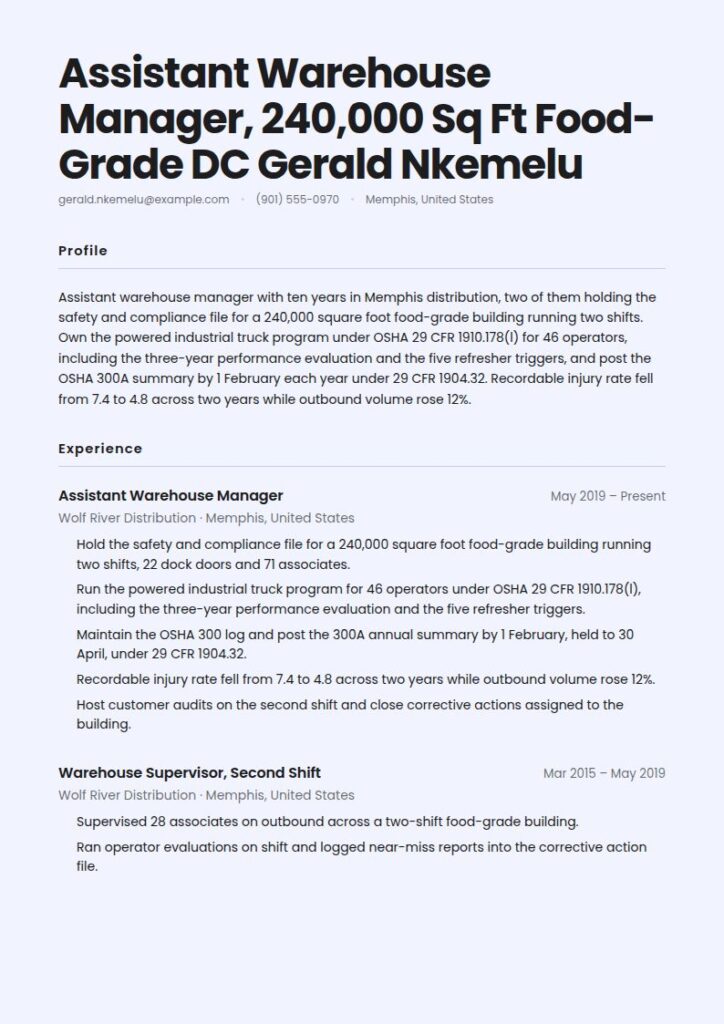
Assistant warehouse manager with ten years in Memphis distribution, two of them holding the safety and compliance file for a 240,000 square foot food-grade building running two shifts. Own the powered industrial truck program under OSHA 29 CFR 1910.178(l) for 46 operators, including the three-year performance evaluation and the five refresher triggers, and post the OSHA 300A summary by 1 February each year under 29 CFR 1904.32. Recordable injury rate fell from 7.4 to 4.8 across two years while outbound volume rose 12%.
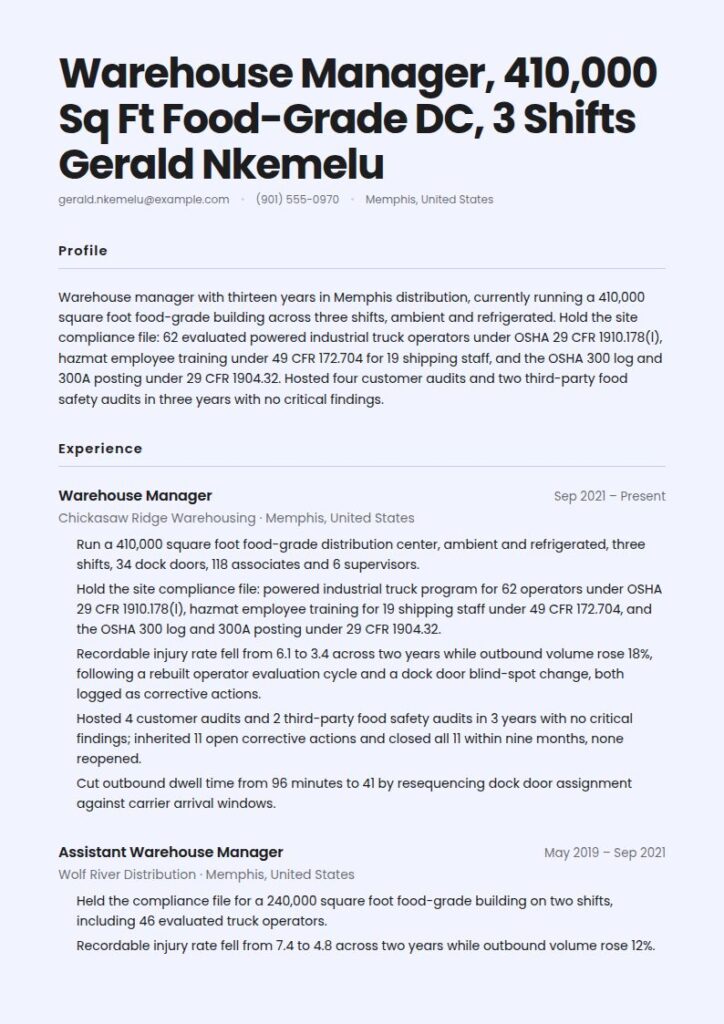
Warehouse manager with thirteen years in Memphis distribution, currently running a 410,000 square foot food-grade building across three shifts, ambient and refrigerated. Hold the site compliance file: 62 evaluated powered industrial truck operators under OSHA 29 CFR 1910.178(l), hazmat employee training under 49 CFR 172.704 for 19 shipping staff, and the OSHA 300 log and 300A posting under 29 CFR 1904.32. Hosted four customer audits and two third-party food safety audits in three years with no critical findings.
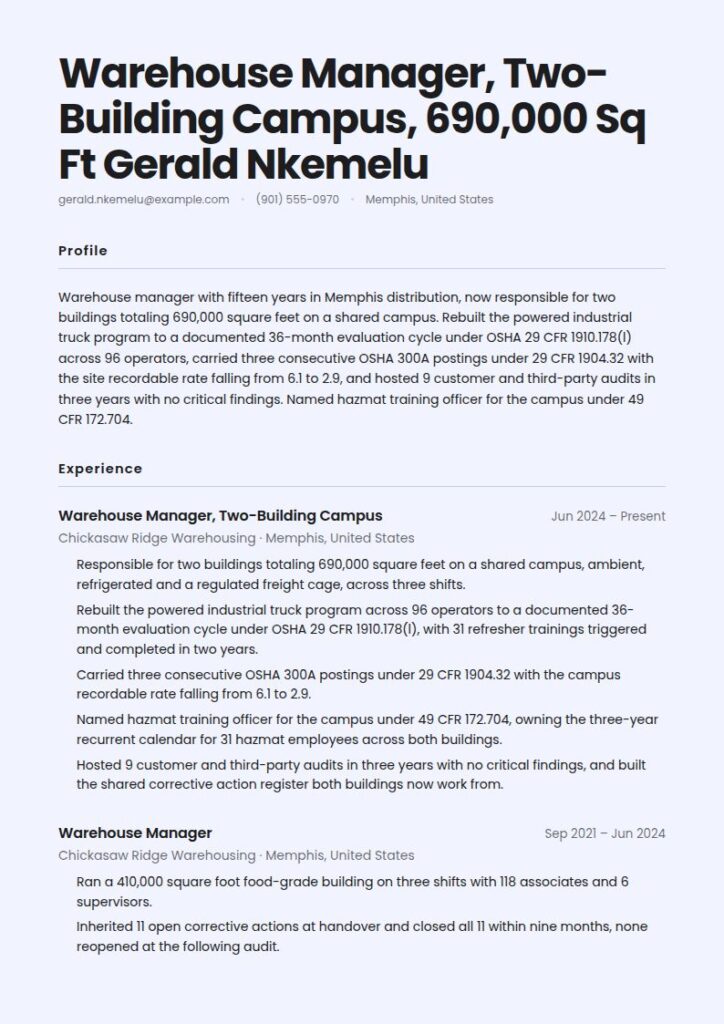
Warehouse manager with fifteen years in Memphis distribution, now responsible for two buildings totaling 690,000 square feet on a shared campus. Rebuilt the powered industrial truck program to a documented 36-month evaluation cycle under OSHA 29 CFR 1910.178(l) across 96 operators, carried three consecutive OSHA 300A postings under 29 CFR 1904.32 with the site recordable rate falling from 6.1 to 2.9, and hosted 9 customer and third-party audits in three years with no critical findings. Named hazmat training officer for the campus under 49 CFR 172.704.
Right vs wrong: the same warehouse manager summary, twice
| ✅ Right | ❌ Wrong |
|---|---|
| Running a 410,000 square foot food-grade building across three shifts, ambient and refrigerated. | Managing a large, fast-paced warehouse operation. |
| 62 evaluated truck operators under OSHA 29 CFR 1910.178(l), on a documented three-year cycle. | Ensuring a safe working environment and OSHA compliance at all times. |
| Hosted four customer audits and two third-party food safety audits with no critical findings. | Maintaining high standards and excellent customer relationships. |
| Recordable injury rate fell from 6.1 to 3.4 across two years while outbound volume rose 18%. | Committed to safety and continuous improvement. |
The right column can be verified in an interview by someone who has run a building. The left column is what a candidate writes when they have not.
Outline your warehouse experience
Employer, the building, your dates, and then three to five bullets. Each bullet should name either a regulation, an audit, a system or a number, and nothing should be a duty you would list for anyone in the department.
| Instead of | Use |
|---|---|
| Ensured compliance with OSHA regulations | Rebuilt the powered industrial truck program to a documented 36-month evaluation cycle for 62 operators under OSHA 29 CFR 1910.178(l) |
| Maintained a safe work environment | Took the recordable injury rate from 6.1 to 3.4 across two years, with the OSHA 300A posted by 1 February and held to 30 April each year |
| Handled hazardous materials shipments | Trained and recorded 19 hazmat employees across the five categories in 49 CFR 172.704, on the three-year recurrent cycle |
| Passed customer audits | Hosted 4 customer and 2 third-party food safety audits in 3 years, closing 11 corrective actions with none reopened |
| Improved warehouse efficiency | Cut outbound dwell time from 96 minutes to 41 by resequencing dock door assignment against carrier arrival windows |
Warehouse Manager, Chickasaw Ridge Warehousing, Memphis, TN, September 2021 to Present
410,000 square foot food-grade distribution center, ambient and refrigerated, three shifts, 34 dock doors, 118 associates and 6 supervisors.
Hold the site compliance file: powered industrial truck program for 62 operators under OSHA 29 CFR 1910.178(l), hazmat employee training for 19 shipping staff under 49 CFR 172.704, and the OSHA 300 log and 300A annual posting under 29 CFR 1904.32.
Recordable injury rate fell from 6.1 to 3.4 across two years while outbound volume rose 18%; the reduction followed a rebuilt operator evaluation cycle and a dock-door blind-spot change, both documented in the corrective action log.
Hosted 4 customer audits and 2 third-party food safety audits in 3 years with no critical findings; closed 11 corrective actions, none reopened at the following audit.
Cut outbound dwell time from 96 minutes to 41 by resequencing dock door assignment against carrier arrival windows.
The safety and compliance record is yours before the throughput is: OSHA, the truck program and the audit
Four obligations sit with the person who runs the building. A warehouse manager resume that names all four, with the regulation and the record, separates itself from every file in the stack that says "ensured OSHA compliance".
| What the building is inspected against | The authority | What you can put on the page |
|---|---|---|
| Powered industrial truck operator training and evaluation | OSHA, 29 CFR 1910.178(l) | Operators trained and evaluated, the evaluation cycle, refresher training triggered and actioned |
| Injury and illness recordkeeping and posting | OSHA, 29 CFR 1904.32 | The 300 log maintained, the 300A posted and held for the required window, the recordable rate and its direction |
| Hazmat employee training | PHMSA, 49 CFR 172.704 | Hazmat employees trained across the five categories, the three-year recurrent cycle, who owns the calendar |
| Customer, third-party and regulatory audits | Your customers, auditors and regulators | Audits hosted, findings by severity, corrective actions closed and whether any reopened |
The powered industrial truck program
This is the one a site is most often cited on, and the one most managers describe least precisely. The employer must ensure each operator "is competent to operate a powered industrial truck safely" under 1910.178(l)(1)(i), and "an evaluation of each powered industrial truck operator's performance shall be conducted at least once every three years" under 1910.178(l)(4)(iii).
Refresher training is not optional and not annual. Under 1910.178(l)(4)(ii) it is triggered when the operator has been observed operating unsafely, has been involved in an accident or a near-miss, is evaluated as not operating safely, is assigned a different type of truck, or when a workplace condition changes in a way that could affect safe operation.
Two consequences for your resume. First, the certification is the employer's, not a portable license, so what you managed was a program and a record, not a set of cards. Second, the refresher triggers are the part that proves you ran it: a manager who can say "18 refreshers triggered in two years, 6 of them after near-miss reports" has clearly been running the program rather than filing it.
The injury log and the posting window
Under 29 CFR 1904.32 the employer must post the OSHA Form 300A annual summary "no later than February 1 of the year following the year covered by the records" and keep "the posting in place until April 30."
That is a date a hiring director can check against your story, and it is worth naming because it demonstrates you know which obligations have calendars attached. Pair it with your recordable rate, its direction and the period, and say what changed, because the rate on its own could be luck.
The Handbook expects five years before the job and no training after it
Transportation, storage, and distribution managers typically enter the occupation with a high school diploma or equivalent, five years or more of work experience in a related occupation, and no on-the-job training once appointed (BLS Occupational Outlook Handbook, Transportation, Storage, and Distribution Managers, last modified 27 August 2026).
Read that as a hiring instruction. The employer is not planning to develop you. They are buying a record that already exists, and the only place that record can be examined before the interview is your resume.
This is why the compliance block outperforms a throughput list. Five years of experience is the entry ticket, so it does not differentiate anyone in the stack. A documented three-year operator evaluation cycle, a falling recordable rate with the reason attached, and six audits hosted without a critical finding are the things that distinguish one experienced manager from another, and almost nobody writes them down.
Audits, and how to write them honestly
Give the count, the type and the outcome by severity. An audit that went badly belongs too, if you fixed it: "inherited 11 open corrective actions, closed all 11 within nine months, none reopened at the following audit" is a stronger claim than a clean record you did nothing to earn, because it shows the mechanism.
Compliance record, Chickasaw Ridge Warehousing, September 2021 to present
Powered industrial trucks: 62 operators, OSHA 29 CFR 1910.178(l), documented 36-month evaluation cycle, 18 refresher trainings triggered and completed in two years.
Injury and illness: OSHA 300 log maintained in house, 300A posted by 1 February and held to 30 April in each of three years, recordable rate 6.1 to 3.4 across two years.
Hazardous materials: 19 hazmat employees trained across the five categories in 49 CFR 172.704, three-year recurrent cycle, training calendar owned on site.
Audits: 4 customer audits, 2 third-party food safety audits, 0 critical findings, 11 corrective actions closed, 0 reopened.
Build a snapshot of your key skills
Twelve to fifteen entries in three groups: compliance and safety first, then operations, then systems. The order is the argument.
Compliance and safety: Powered industrial truck program administration under OSHA 29 CFR 1910.178(l), OSHA 300 and 300A recordkeeping, Hazmat employee training under 49 CFR 172.704, Corrective action management, Incident investigation and root cause, Customer and third-party audit hosting
Operations: Inbound and outbound scheduling, Dock door and yard management, Labor planning across shifts, Cycle counting programs, Returns and reverse logistics, Carrier appointment management
Systems and people: Warehouse management system configuration and reporting, Labor management reporting, Supervisor development and succession, Shift handover discipline, Contractor and temporary labor induction
List your education and certifications
Dated training first, because it expires. Then degrees.
OSHA 30-Hour General Industry, OSHA Outreach Training Program, 2024
Hazmat Employee Training, 49 CFR 172.704, all five required categories, most recent recurrent training 2026, next due 2029
Powered industrial truck trainer and evaluator, designated by employer under OSHA 29 CFR 1910.178(l), 2019 and current
Associate of Applied Science, Logistics and Supply Chain Management, Southwest Tennessee Community College, Memphis, TN, 2010
Additional training: Incident investigation and root cause analysis (2023). Food safety and sanitation for warehousing (2022, renewed 2025).
Note the phrasing on the trainer line. Designated by an employer is accurate, and it is a stronger claim than implying a portable license, because the certification belongs to the employer.
Choose the right layout and design
Single column, 11 or 12 point type, clear headings, no photograph. Keep the compliance block as a short labeled list rather than a table when submitting through a portal, because tables are where parsers lose content.
Open with the building: square footage, function, shifts and freight type. Give the compliance record its own labeled block. Cite the regulation by number when you name an obligation. Give the recordable rate with a direction, a period and the change that caused it. Say how many audits you hosted and what the findings were. Date every piece of training and say when it is next due.
Do not write "ensured OSHA compliance", which says nothing that can be checked. Do not imply your truck certification is a portable license. Do not claim a clean audit record without saying who audited you. Do not lead the page with throughput when the reader is buying a record. Do not hide a site that went badly; write what you inherited and what you closed.
Warehouse manager job market and outlook
A small, well-paid occupation with steady growth and a high entry bar.
| Measure | Value |
|---|---|
| Transportation, storage, and distribution manager jobs, 2025 | 228,100 |
| Projected change, 2025-35 | 6% |
| Projected annual openings | ~18,300 |
| Typical entry-level education | High school diploma or equivalent |
| Work experience in a related occupation | 5 years or more |
| Median annual wage, May 2025 | $107,230 ($51.55 per hour) |
Source: U.S. Bureau of Labor Statistics, Occupational Outlook Handbook, Transportation, Storage, and Distribution Managers, last modified 27 August 2026, 2025-35 projections and May 2025 wage data.
Hand laborers and material movers, the workforce you would be managing, held 6,917,800 jobs in 2025 with a group median annual wage of $38,220 as of May 2025 and projected growth of 4 percent to 2035 (BLS Occupational Outlook Handbook, Hand Laborers and Material Movers, last modified 27 August 2026). That is the ratio the occupation runs on.
Where the jobs sit:
| Industry | Share of employment | Median annual wage (May 2025) |
|---|---|---|
| Transportation and warehousing | 30% | $102,850 |
| Wholesale trade | 15% | $100,670 |
| Manufacturing | 13% | $117,660 |
| Government, excluding state and local education and hospitals | 8% | $120,650 |
| Management of companies and enterprises | 7% | $156,720 |
Source: U.S. Bureau of Labor Statistics, Occupational Outlook Handbook, May 2025.
What salary you can expect as a warehouse manager
The median annual wage for transportation, storage, and distribution managers was $107,230, or $51.55 an hour, as of May 2025 (BLS Occupational Outlook Handbook, last modified 27 August 2026).
Industry moves that number more than anything you can negotiate. The same Handbook page puts the May 2025 median at $156,720 in management of companies and enterprises, $120,650 in government excluding state and local education and hospitals, $117,660 in manufacturing, $102,850 in transportation and warehousing and $100,670 in wholesale trade. Third-party logistics and contract warehousing sit inside that transportation and warehousing figure, which is the largest employer of the occupation at 30 percent and near the bottom of the pay range.
Movement between those bands comes from two things: the building, meaning square footage, shift count, freight type and whether the site is regulated, and the record, because an employer paying at the top of a band is buying down risk. The evidence that you reduce risk is a documented truck program, a falling recordable rate and audits hosted without critical findings.
Key takeaways for a warehouse manager resume
- Open with the building: square footage, function, shifts and freight type.
- Give the compliance record its own block, above the throughput numbers.
- Name the regulation when you name an obligation: 1910.178(l), 1904.32, 172.704.
- Prove the truck program with evaluation cycle and refresher triggers, not card counts.
- Give the recordable rate with a direction, a period and the change that caused it.
- Count your audits and say what the findings were, including the ones you inherited.
- Date every certification and say when it is next due.
Build your warehouse manager resume in 15 minutes with our AI resume builder.
Related transport and logistics resume examples
- Warehouse supervisor resume
- Inventory manager resume
- Warehouse worker resume
- Order filler resume
- Package handler resume
- Stock clerk resume
- Logistics coordinator resume
- Supply chain resume
- Procurement manager resume
- Dispatcher resume
- Transport and logistics resume
- Truck driver resume
Pair it with a matching warehouse manager cover letter.
Warehouse manager resume questions, answered
How long should a warehouse manager resume be?
Two pages is normal and appropriate. The Bureau of Labor Statistics reports that transportation, storage, and distribution managers typically enter with five years or more of related work experience (BLS Occupational Outlook Handbook, last modified 27 August 2026), and a career that long does not compress onto one page without losing the compliance record that makes it hireable.
Do I need a degree to be a warehouse manager?
Not typically. The Handbook gives the typical entry-level education as a high school diploma or equivalent, with five years or more of work experience in a related occupation and no on-the-job training (BLS Occupational Outlook Handbook, last modified 27 August 2026). If you came up from the floor, write the floor years as the qualification rather than as filler, because that is the route the occupation actually uses.
What certifications belong on a warehouse manager resume?
Anything dated and checkable. OSHA Outreach Training Program courses, hazmat employee training under 49 CFR 172.704 with its recurrent date, and your designation as a powered industrial truck trainer or evaluator under 29 CFR 1910.178(l). Write the designation as employer-granted, because that is what it is.
How do I write about a site that had an incident?
Write it as a corrective action. What happened, what the investigation found, what changed in the building, and what the rate did afterwards. A manager who describes a serious near-miss and the program change that followed reads as someone who has run a real building. A spotless record with no mechanism behind it reads as a record nobody kept.
I supervise a shift, not a building. What do I write?
Write what you actually hold. Shift headcount, the zones you covered, the part of the compliance file that was yours and the part that was not. Saying the truck program sat with the site manager while you ran operator evaluations on your shift is more credible than claiming the whole file.
Should throughput numbers come off the resume entirely?
No. Cases per hour, lines shipped, fill rate, dwell time and cost per unit all belong in the experience bullets, and a manager with no operating numbers looks like an administrator. The argument is about order: the compliance record goes first because it is what an employer cannot fix after hiring you.