Emergency Medical Dispatcher Malik Nyarko
Emergency Medical Dispatcher
[email protected] | (330) 555-1032 | Akron, United States
Profile
Emergency medical dispatcher with 21 months on a private medical transport desk, answering 60 to 80 calls a shift and controlling 14 ambulances and wheelchair vans across two counties. Held a median call-to-dispatch interval of 52 seconds and logged every unit status change in the computer-aided dispatch record. Authorized to assign the closest available unit and to hold a non-emergency transfer without supervisor approval.
Work Experience
06/2018 - Present, Emergency Medical Dispatcher, Riverbell Medical Transport, Akron, United States
- Answered 60 to 80 calls a shift and controlled 14 ambulances and wheelchair vans across two counties.
- Held a median call-to-dispatch interval of 52 seconds across the shift.
- Logged every unit status change in the computer-aided dispatch record at the moment it changed.
- Authorized to assign the closest available unit and to hold a non-emergency transfer without supervisor approval.
09/2017 - 06/2018, Non-Emergency Transport Scheduler, Riverbell Medical Transport, Akron, United States
- Booked 90 to 120 scheduled transports a week against vehicle availability and appointment windows.
- Rebuilt the daily booking sheet so held and pending transports were visible to the dispatch desk before the shift started.
Education
08/2016 - 05/2018, Associate of Applied Science, Business Management, Stark State College, North Canton, United States
Coursework in operations, business communication and records management, completed while working an overnight shift pattern.
Skills
Computer-aided dispatch, 85
Unit assignment and status control, 85
Radio discipline and plain language, 85
Protocol-based call handling, 80
Call-to-dispatch interval management, 80
Incident documentation, 80
Appointment and transport scheduling, 80
Overnight and weekend shift coverage, 90
Languages
English, native
Twi, conversational
Certificates
09/2018, Emergency Medical Dispatcher Certification, Riverbell Medical Transport, employer-delivered program
Protocol-based call handling and pre-arrival medical instruction, maintained through annual call review.
06/2018, CPR and First Aid, American Red Cross
Adult, child and infant CPR and first aid.
Summary
A dispatcher resume is a one to two page document that proves your calls held up when somebody read them back afterwards. This guide builds the page on the timestamped record the job produces, separates the public safety desk from the freight and service desk, and gives an honest account of what federal wage data publishes for this occupation and what it does not.
Dispatcher resume examples by experience level
In short, a dispatcher resume is a one to two page document, and what it has to prove is not that you can talk calmly on a radio. It is that your calls held up when somebody read them back afterwards.
In fact, dispatch is one of the few jobs where you write down every decision as you make it. A computer-aided dispatch incident, a load tender, a service ticket, an exception code, a radio log: each carries a timestamp, and someone who was not there reviews each one later. That record is the qualification for the next desk; however, most applicants throw it away to write "handled high call volume in a fast-paced environment" instead.
Also, two desks share this title: the public safety console, and the freight, service and utility desk. In practice, they are different hiring markets, and this guide says how the resume changes between them.
Resume guide for a dispatcher resume
To that end, this guide and the corresponding dispatcher resume example will cover:
- First, how to write a dispatcher resume, block by block
- Then, the decision record: what you owned, what you escalated, how it was logged and what it cost
- Next, three adaptable summaries: first desk, experienced dispatcher and desk lead
- Also, why public safety and freight dispatch are two different hiring markets
- Finally, what federal wage data publishes for this work, and what it does not
How to write a dispatcher resume
Overall, six blocks: contact header, summary, decision authority, dispatch experience, systems, and education and certifications. In general, one page for your first five years, then two once you have run a desk overnight with no supervisor in the building.
| Block | What it is answering | Where it goes |
|---|---|---|
| Decision authority | What was this person allowed to decide without asking? | Directly under the summary |
| Dispatch experience | What volume, what geography, what hours? | Reverse chronological, volume in the header line |
| Systems | Which console will they already know on day one? | Grouped and named by product |
| Education and certifications | Which desk can they be put on? | Short, near the foot of the page |
Give the volume, the window and the coverage, never the word busy
"High volume" means nothing, because volume is relative to the desk. Write three numbers instead.
The volume: calls answered a shift, units or drivers controlled, loads tendered a week. The window: the service level you worked to, or the interval between a call landing and a unit moving. The coverage: the hours the desk ran, how many dispatchers were on it with you, and whether you were alone overnight.
"Sole dispatcher on a 24 hour desk from 22:00 to 06:00, controlling 38 drivers and 210 to 260 loads a week across five states" is checkable in every part.
Run the finished file through the ATS resume checker before you send it. Emergency communications centers, carriers and field service companies nearly all screen through a portal first.
Choosing the best resume format for a dispatcher resume
Therefore: reverse chronological, single column, one page early in a career.
However, the functional format is a trap here. A dispatch supervisor reads the timeline for shift history: which shift you worked, how long you held it, and whether you have ever covered nights and weekends, because a desk that cannot staff 02:00 on a Sunday has a real problem. A skills-first layout deletes exactly that.
If your history has short stints, keep the dates and explain each in a clause: contract ended, center consolidated, seasonal program, moved from nights to days. That reads far better than a gap.
Include your contact information
| ✅ Right | ❌ Wrong |
|---|---|
| Malik Nyarko | Malik Nyarko |
| Lead Dispatcher, 24 Hour Freight Desk, EMD Certified | Experienced dispatcher and team player |
| Akron, OH. Available for nights, weekends and holiday rotation | Akron, OH |
| (330) 555-1032, [email protected] | (330) 555-1032, [email protected] |
Next, put the desk type in the header line. After all, public safety, freight, field service, utility, transit, towing and medical transport are separate jobs with separate consoles, and a supervisor screening forty files wants one of them. In addition, put your shift availability there; it is the fastest way out of the maybe pile.
Make use of a summary
In short, four lines: the desk and the volume, what your employer let you decide alone, one outcome with a number and a period attached, and the systems you already know.
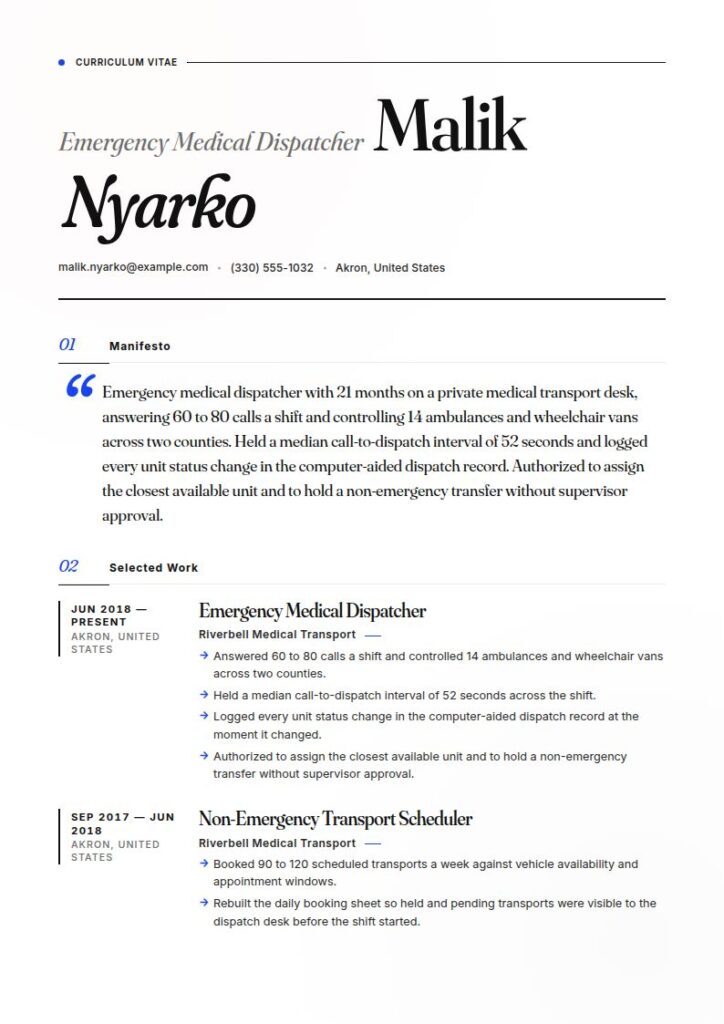
Emergency medical dispatcher with 21 months on a private medical transport desk, answering 60 to 80 calls a shift and controlling 14 ambulances and wheelchair vans across two counties. Held a median call-to-dispatch interval of 52 seconds and logged every unit status change in the computer-aided dispatch record. Authorized to assign the closest available unit and to hold a non-emergency transfer without supervisor approval.
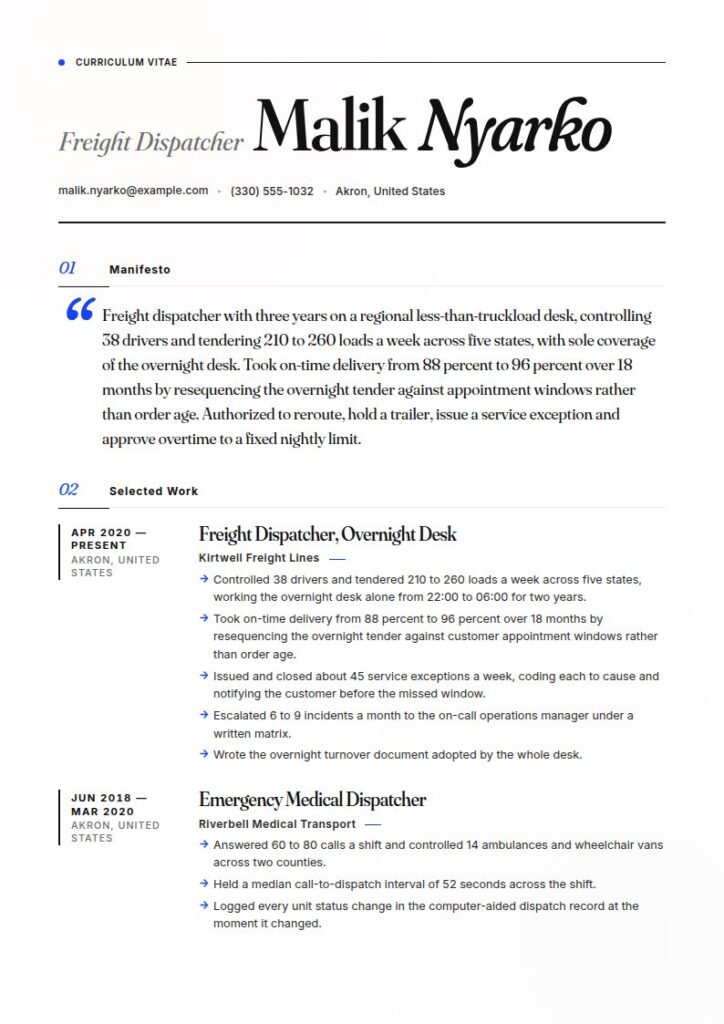
Freight dispatcher with three years on a regional less-than-truckload desk, controlling 38 drivers and tendering 210 to 260 loads a week across five states, with sole coverage of the overnight desk. Took on-time delivery from 88 percent to 96 percent over 18 months by resequencing the overnight tender against appointment windows rather than order age. Authorized to reroute, hold a trailer, issue a service exception and approve overtime to a fixed nightly limit.
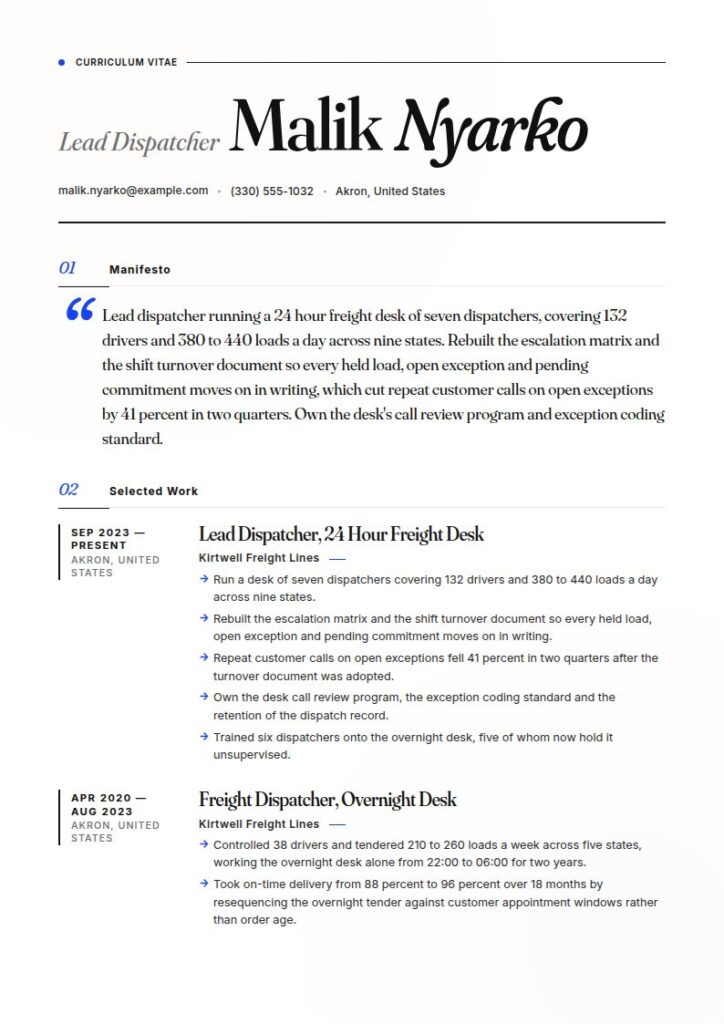
Lead dispatcher running a 24 hour freight desk of seven dispatchers, covering 132 drivers and 380 to 440 loads a day across nine states. Rebuilt the escalation matrix and the shift turnover document so every held load, open exception and pending commitment moves on in writing, which cut repeat customer calls on open exceptions by 41 percent in two quarters. Own the desk's call review program and exception coding standard.
Right vs wrong: the same dispatcher summary, twice
| ✅ Right | ❌ Wrong |
|---|---|
| Controlled 38 drivers and 210 to 260 loads a week across five states, sole coverage overnight. | Handled high call volume in a fast-paced environment. |
| Authorized to reroute, hold a trailer and issue a service exception without escalation. | Made decisions quickly under pressure. |
| Took on-time delivery from 88 percent to 96 percent over 18 months. | Consistently improved operational efficiency. |
For example, a reviewer can check the ✅ column against a dispatch report in ten minutes. In contrast, the ❌ column is in half the other files on the desk.
Outline your dispatch experience
Then give the employer, what it moves, the desk and the shift, the volume, and the dates in the header line of each job. Then three to five bullets, each carrying a number and a period.
| Instead of | Use |
|---|---|
| Dispatched drivers and monitored their routes | Controlled 38 drivers and tendered 210 to 260 loads a week across five states on the overnight desk |
| Answered a high volume of incoming calls | Answered 60 to 80 calls a shift at a median call-to-dispatch interval of 52 seconds |
| Helped improve on-time performance | Took on-time delivery from 88 percent to 96 percent over 18 months by resequencing the overnight tender |
Freight Dispatcher, Overnight Desk, Kirtwell Freight Lines, Akron, OH, April 2020 to August 2023
Controlled 38 drivers and tendered 210 to 260 loads a week across five states, working the overnight desk alone from 22:00 to 06:00 for the last two years of the role.
Took on-time delivery from 88 percent to 96 percent over 18 months by resequencing the overnight tender against customer appointment windows rather than order age.
Issued and closed about 45 service exceptions a week, coding each to cause and notifying the customer before the missed window.
Wrote the overnight turnover document adopted by the whole desk, listing every held load, open exception and pending commitment for the incoming shift.
Dispatch leaves a timestamped record: write what you decided, what you escalated and what it cost
Above all, this is the block that separates a dispatcher's resume from a call handler's, and almost nobody writes it.
Everything you do on a desk lands in a system with your identifier and the time on it: in public safety the computer-aided dispatch incident, the unit status change and the recorded line; on a freight or service desk the load tender, the exception, the appointment change and the note attached to each. A supervisor deciding whether to trust you with a bigger desk is asking what your record looks like when someone pulls it.
Four questions your dispatch record answers
So write it as a record. Four questions, answered in order.
What you decided alone. The authority you held, listed. Rerouting, resequencing, holding a load or a trailer, swapping a driver, splitting a run, dispatching a second unit, authorizing overtime, refusing a pickup. It is not the same everywhere, which is why writing yours is informative.
What you escalated, and to whom. Name the triggers and the role, not the person. "Escalated breakdowns, load refusals, hazardous road conditions and any hold expected to run past a customer cutoff to the on-call operations manager" says you worked somewhere with defined boundaries and stayed inside them.
How it was logged. Exception codes applied to cause rather than symptom, unit status entered at the moment it changed, a note on every held load, a turnover document at end of shift. This is what a quality review actually scores.
What it cost or saved. Detention hours, overtime hours, a missed window, a second truck sent, a customer call avoided. One number per decision type is plenty.
| Decision | Usually owned by the dispatcher | Usually escalated |
|---|---|---|
| Reroute or resequence inside the shift | Yes, within the published service level | Only if it breaks a customer commitment |
| Hold a unit, trailer or load | Yes, for a defined period | A hold running past a customer cutoff |
| Authorize overtime | Up to a fixed limit, where one is set | Anything above the limit |
Authority held: reroute and resequence within the published service level, hold a trailer up to four hours, swap a driver between runs, issue and code a service exception, authorize overtime up to two hours a driver a night.
Escalation: breakdowns, load refusals, hazardous road conditions, any hold expected to run past a customer cutoff, and any second appointment change on one order, escalated to the on-call operations manager under a written matrix. 6 to 9 incidents a month.
Logging standard: unit status entered at the moment of the change, exception coded to cause rather than symptom, a note on every held load, a written turnover document at end of shift.
Result: on-time delivery from 88 percent to 96 percent over 18 months; repeat customer calls on open exceptions down 41 percent in two quarters after the turnover document was adopted.
Now the part that decides which resume you are writing, because the title covers two markets.
The public safety dispatcher desk
The public safety desk. The emergency services console is the only dispatch desk the federal Handbook covers in detail. The Bureau of Labor Statistics reports that public safety telecommunicators typically enter with a high school diploma or equivalent, no prior related experience and moderate-term on-the-job training, with local government employing 79 percent of them (BLS Occupational Outlook Handbook, Public Safety Telecommunicators, last modified 27 August 2026). Certification matters here in a way it does not on a commercial desk: the Handbook states that many states and localities require these workers to be certified, and names Emergency Medical Dispatcher certification as the credential for giving medical instruction over the phone. If you hold it, put it in the header line. The record here is protocol-shaped: the intervals you held, the call review scores and the incident documentation.
The freight, service and utility dispatch desk
The freight, service and utility desk. Here the record is commercial: the load tender and whether it was accepted first time, the exception and its code, the appointment window and whether it was protected, the detention that followed a hold. One regulatory line is worth understanding, because it decides who may do this work for whom.
Federal regulation 49 CFR 371.2 defines a broker as a person who, for compensation, arranges, or offers to arrange, the transportation of property by an authorized motor carrier, while employees and bona fide agents of a motor carrier are not brokers when they arrange shipments that carrier is authorized and legally bound to transport. A dispatcher employed by a carrier sits on one side of that line without doing anything; an independent dispatch service selling load-finding has to know where it sits. Do not argue the law on your resume; just say whether you dispatched for a carrier or as an outside service.
Build a snapshot of your key dispatcher skills
Twelve to sixteen entries in four groups, weighted toward decisions and systems rather than generic communication.
Dispatch: Load tendering and carrier assignment, Route sequencing against appointment windows, Unit assignment and status control, Exception coding to cause, Hold and release decisions
Decision and escalation: Written escalation matrix, Shift turnover documentation, Incident documentation, After-action review, Overtime authorization within a limit
Communication: Radio discipline and plain language, Customer notification before a missed window, Multi-agency and multi-site coordination
Systems: Computer-aided dispatch, Transportation management system load tender, Telematics and vehicle location, Field service ticketing, Recorded line review
Name the console by product where you can: a dispatcher who already knows the platform is productive in week one rather than week four.
List your education and certifications
Formal education rarely gates this work: the Handbook lists a high school diploma or equivalent as the typical entry-level education for public safety telecommunicators, with no prior related experience and moderate-term on-the-job training (BLS Occupational Outlook Handbook, last modified 27 August 2026). Certification is the gate, so put it first.
Emergency Medical Dispatcher certification, employer-delivered program, completed September 2018, maintained through annual call review
CPR and first aid, American Red Cross, renewed 2026
Dispatch quality assurance and call review, internal program, 2022
Incident documentation and records retention, internal program, 2024
Associate of Applied Science, Business Management, Stark State College, North Canton, OH, 2018
Write the year on every training line and say whether you maintain it. A certification from six years ago with nothing after it reads worse than none.
Choose the right layout and design
Likewise, single column, 10 or 11 point type, one page early, no photograph and no rating bars. After all, a dispatch supervisor may open this on a phone between incidents.
State the desk type and your shift availability in the header line. Give volume, window and coverage as three separate numbers. List the decisions you were authorized to make alone. Name the escalation triggers and the role you escalated to. Say how you logged and coded, and give one result with a period attached.
Do not write "high volume" or "fast-paced" anywhere. Do not claim authority you did not hold, because a reference check on a desk is one phone call. Do not name a caller, a patient, an incident address or a customer account. Do not describe an escalation as a failure; escalating correctly is the skill. Do not hide short stints behind a functional layout.
Dispatcher job market and outlook
The U.S. Bureau of Labor Statistics publishes no current Occupational Outlook Handbook profile for dispatchers other than police, fire and ambulance. Meanwhile, the commercial desk sits on the Handbook's data page for occupations not covered in detail, and the static per-occupation wage pages that once carried it have been retired, leaving only figures from an older cycle. Rather than quote a stale number, this page names the published occupations that bracket the work.
| Published occupation, BLS | Jobs, 2025 | Projected change, 2025-35 | Annual openings | Median annual wage, May 2025 |
|---|---|---|---|---|
| Public safety telecommunicators | 105,600 | 4% | ~9,000 | $53,040 |
| Material recording clerks | 1,273,500 | -6% | ~98,600 | $47,600 |
| Logisticians | 255,100 | 18% | ~26,600 | $82,320 |
| Transportation, storage, and distribution managers | 228,100 | 6% | ~18,300 | $107,230 |
Source: U.S. Bureau of Labor Statistics, Occupational Outlook Handbook, four occupational profiles, May 2025 wage data and 2025 to 2035 projections, last modified 27 August 2026.
Also note one clarification: the material recording clerks page does not cover dispatchers. It is here as the adjacent clerical occupation, not because a dispatcher belongs in it.
The published desk is small, stable and almost entirely local government
Public safety telecommunicators held 105,600 jobs in 2025, projected to grow 4 percent through 2035, about 3,900 new jobs, with roughly 9,000 openings a year over the decade (BLS Occupational Outlook Handbook, last modified 27 August 2026). Local government employs 79 percent of them, state government 5 percent, ambulance services 5 percent, educational services 4 percent and hospitals 3 percent (BLS, May 2025).
That concentration explains the hiring process better than the growth rate does. Four out of five of these jobs are filled through a public employer's process: a posted classification, a testing battery, a background investigation and a fixed pay step. The resume there has to clear a scored screen, so use plain headings and name the certification exactly.
The commercial desk is the opposite. It hires on volume and authority, often within the week. One career, two different applications.
What salary you can expect as a dispatcher
The only current federal median for any dispatch desk is the public safety one: public safety telecommunicators had a median annual wage of $53,040, or $25.50 an hour, as of May 2025 (BLS Occupational Outlook Handbook, last modified 27 August 2026). For example, inside that, state government paid a median of $60,840, local government $54,280, hospitals $48,340, educational services $47,900 and ambulance services $46,430 (BLS, May 2025). The spread from the top of that list to the bottom is $14,410 for work that looks similar from outside, and it is mostly about who the employer is rather than what the job asks.
For the commercial desk BLS publishes no current figure, so use the bracketing occupations as the band. By contrast, below sits the clerical record-keeping tier: material recording clerks at a group median of $47,600, with shipping, receiving and inventory clerks at $45,260 and production, planning and expediting clerks at $59,650 (BLS, May 2025). Similarly, above it sits the planning tier: logisticians at $82,320, growing 18 percent between 2025 and 2035, and transportation, storage and distribution managers at $107,230 (BLS, May 2025).
In other words, that ladder is the argument for writing the decision record. The gap between a dispatcher and a planner is documented authority: what your employer trusted you to decide, what you escalated correctly, and what the record showed afterwards. The Handbook notes that transportation, storage and distribution managers typically have five years or more of related work experience and no on-the-job training after hire (BLS Occupational Outlook Handbook, last modified 27 August 2026), so everything qualifying you for that step must be visible before an employer hires you.
Key takeaways for a dispatcher resume
- To start, give volume, window and coverage as three numbers; never write "high volume".
- List the decisions your employer authorized you to make alone, because authority varies by desk.
- Name the escalation triggers and the role you escalated to.
- Say how you logged and coded, since that is what a quality review scores.
- Then attach one cost or saving to each decision type, with a period.
- In addition, say which desk you worked: public safety, freight, field service, utility or transit.
- Finally, put certification and shift availability in the header line.
Build your dispatcher resume in 15 minutes with our AI resume builder.
Related transport and logistics resume examples
- Logistics coordinator resume
- Delivery driver resume
- Truck driver resume
- Transport and logistics resume
- Warehouse supervisor resume
- Supply chain resume
- Warehouse manager resume
- Inventory manager resume
- Order filler resume
- Package handler resume
- Tractor driver resume
- Aviation resume
Pair it with a matching dispatcher cover letter.
Dispatcher resume questions, answered
How long should a dispatcher resume be?
One page for your first five years. Two once you have run a desk alone overnight, led a shift, or built something the desk still uses, such as an escalation matrix or a turnover document. The decision record earns the second page faster than a longer history does.
Why does this page not give a single dispatcher salary figure?
Because there is no current one for most of the job. The Bureau of Labor Statistics publishes a Handbook profile for public safety telecommunicators, median $53,040 as of May 2025, but none for dispatchers other than police, fire and ambulance, and the static wage pages that once carried that occupation have been retired. This page names bracketing occupations instead.
Can I move from freight dispatch to a 911 desk, or the other way?
Yes, and both moves happen, but the applications are not interchangeable. A public safety application is usually a scored public process with a testing battery and a background investigation, and certification carries real weight: the Handbook notes that many states and localities require public safety telecommunicators to be certified (BLS Occupational Outlook Handbook, last modified 27 August 2026). A commercial desk hires on volume, authority and availability. Rewrite the header line and the certification block for whichever you are applying to.
What do I put on a dispatcher resume with no dispatch experience?
Any work with a queue, a timestamp and a decision in it. Field service scheduling, a tow desk, a security control room, a transit control post, military radio work. Write the volume, the hours, what you were allowed to decide alone and what you escalated. Then add your shift availability, which matters more at entry level than anything else.
Should I name the customers or the incidents I handled?
No. Name the type of work, the volume and the outcome, never an account, an address, a caller or a patient. On the public safety side that is the standard the desk is run on, and a resume that breaks it tells a supervisor what they need to know.