Purchasing Agent, Indirect and MRO Yolanda Quisenberry
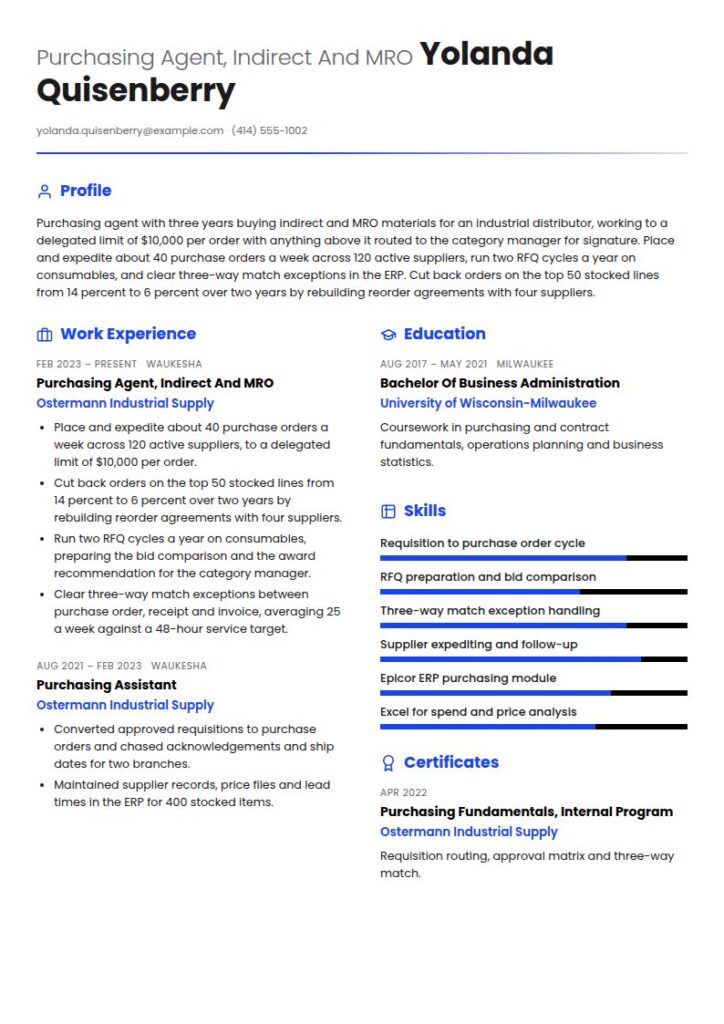
Purchasing Agent, Indirect and MRO
[email protected] | (414) 555-1002 | Milwaukee, United States
Profile
Purchasing agent with three years buying indirect and MRO materials for an industrial distributor, working to a delegated limit of $10,000 per order with anything above it routed to the category manager for signature. Place and expedite about 40 purchase orders a week across 120 active suppliers, run two RFQ cycles a year on consumables, and clear three-way match exceptions in the ERP. Cut back orders on the top 50 stocked lines from 14 percent to 6 percent over two years by rebuilding reorder agreements with four suppliers.
Work Experience
02/2023 - Present, Purchasing Agent, Indirect and MRO, Ostermann Industrial Supply, Waukesha, United States
- Place and expedite about 40 purchase orders a week across 120 active suppliers, to a delegated limit of $10,000 per order.
- Cut back orders on the top 50 stocked lines from 14 percent to 6 percent over two years by rebuilding reorder agreements with four suppliers.
- Run two RFQ cycles a year on consumables, preparing the bid comparison and the award recommendation for the category manager.
- Clear three-way match exceptions between purchase order, receipt and invoice, averaging 25 a week against a 48-hour service target.
08/2021 - 02/2023, Purchasing Assistant, Ostermann Industrial Supply, Waukesha, United States
- Converted approved requisitions to purchase orders and chased acknowledgements and ship dates for two branches.
- Maintained supplier records, price files and lead times in the ERP for 400 stocked items.
Education
08/2017 - 05/2021, Bachelor of Business Administration, Supply Chain Management, University of Wisconsin-Milwaukee, Milwaukee, United States
Coursework in purchasing and contract fundamentals, operations planning and business statistics.
Skills
Requisition to purchase order cycle, 80
RFQ preparation and bid comparison, 65
Three-way match exception handling, 80
Supplier expediting and follow-up, 85
Epicor ERP purchasing module, 75
Excel for spend and price analysis, 70
Languages
English, native
Spanish, intermediate
Certificates
04/2022, Purchasing Fundamentals, internal program, Ostermann Industrial Supply
Requisition routing, approval matrix and three-way match.
Summary
A procurement manager resume is a one to two page document naming the spend you were trusted with, the signature limit that came with it, and the rulebook that governed how you bought. This guide gives you three adaptable versions for a buyer, a senior buyer and a manager, the public and private tracks written as the different jobs they are, and current Bureau of Labor Statistics pay and outlook.
Procurement Manager resume examples by experience level
In short, a procurement manager resume is a one to two page document that names the spend you were trusted with, the signature limit that came with it, and the rulebook you had to buy inside.
Two facts decide whether the file gets a call, and neither can be inferred from a job title. To begin with, the first is how much you could commit without a second signature. Similarly, the second is which rulebook governed the commitment. For example, buying four million dollars a year against a published federal threshold and buying it against a company approval matrix are different jobs with different evidence and different failure modes.
Resume guide for a procurement manager resume
To that end, this guide and the corresponding procurement manager resume example will cover:
- First, how to write a procurement manager resume, section by section
- Next, three adaptable summaries: purchasing agent, senior buyer and procurement manager
- Then, the public track and the private track, written as the different jobs they are
- Finally, what the job market looks like and what you can expect to earn
How to write a procurement manager resume
Overall, seven sections: contact header, summary, authority and scope, procurement experience, sourcing and supplier management, education and certifications, and skills. One page while you are still a buyer, two once you carry a category, a team or a signature limit worth stating.
Authority sits directly under the summary because it is the filter: spend authority is the cheapest available proxy for whether you have already done the job at the level being hired.
| Section | What it is answering | Where it goes |
|---|---|---|
| Authority and scope | How much could this person commit alone, and on what? | Directly under the summary |
| Procurement experience | What did they buy, from how many suppliers, and what changed? | Reverse chronological, numbers in every bullet |
| Sourcing and supplier management | Can they run a competition and manage what comes out of it? | Its own block once you have run several |
| Education and certifications | Do they clear the stated bar for the post? | Bachelor's degree is the usual entry line |
Notably, the Bureau of Labor Statistics Occupational Outlook Handbook lists a bachelor's degree as the typical entry-level education for purchasing managers, buyers and purchasing agents, and adds that purchasing managers typically need several years of experience in a related role first.
Run the finished file through the ATS resume checker before you submit. Procurement postings attract volume, and large buying organizations parse applications into a system before anyone opens one.
Choosing the best resume format for a procurement manager resume
Reverse chronological. In practice, a procurement career reads as a ladder of authority, and the ladder is the argument: card buyer, then purchase order buyer to a limit, then category owner, then contract signatory, then the person who sets other people's limits.
However, functional formats fail here for a specific reason. After all, procurement is full of people who assembled documents for a decision someone else made, and a functional resume makes that indistinguishable from having made the decision. Therefore, an authority line in every role is what separates the two.
One page for a buyer. Then two once you manage people, own categories or hold a contract signature. Never three.
Include your contact information
| ✅ Right | ❌ Wrong |
|---|---|
| Yolanda Quisenberry, CPSM | Yolanda Quisenberry |
| Procurement Manager, Direct and Indirect | Results-driven procurement professional |
| $86M annual spend, $2M signature authority, team of 6 | Extensive experience in purchasing and vendor relations |
| (414) 555-1002, [email protected], Milwaukee, WI | (414) 555-1002, [email protected] |
However, the third line is the one most candidates leave off. It costs eleven words and answers the question that otherwise takes four minutes of bullet archaeology to answer badly.
Put your delegated authority in the first three lines, as a number
Write the limit exactly as your delegation schedule states it; the wording carries meaning to anyone who has held one. "Signature authority to $250,000 per purchase order, unlimited on contracts already awarded against an approved vehicle" says more about your job than a paragraph of narrative.
If your authority changed during a role, give the range and the date. "Raised from $50,000 to $250,000 in March 2024" reads as a promotion inside a job title that never changed, a common shape in procurement that resumes routinely fail to show.
Make use of a summary
In short, four lines: your level and the spend attached to it, the limit, the categories, and one result with a number and a time frame.
Purchasing agent with three years buying indirect and MRO materials for an industrial distributor, working to a delegated limit of $10,000 per order with anything above it routed to the category manager for signature. Place and expedite about 40 purchase orders a week across 120 active suppliers, run two RFQ cycles a year on consumables, and clear three-way match exceptions in the ERP. Cut back orders on the top 50 stocked lines from 14 percent to 6 percent over two years by rebuilding reorder agreements with four suppliers.
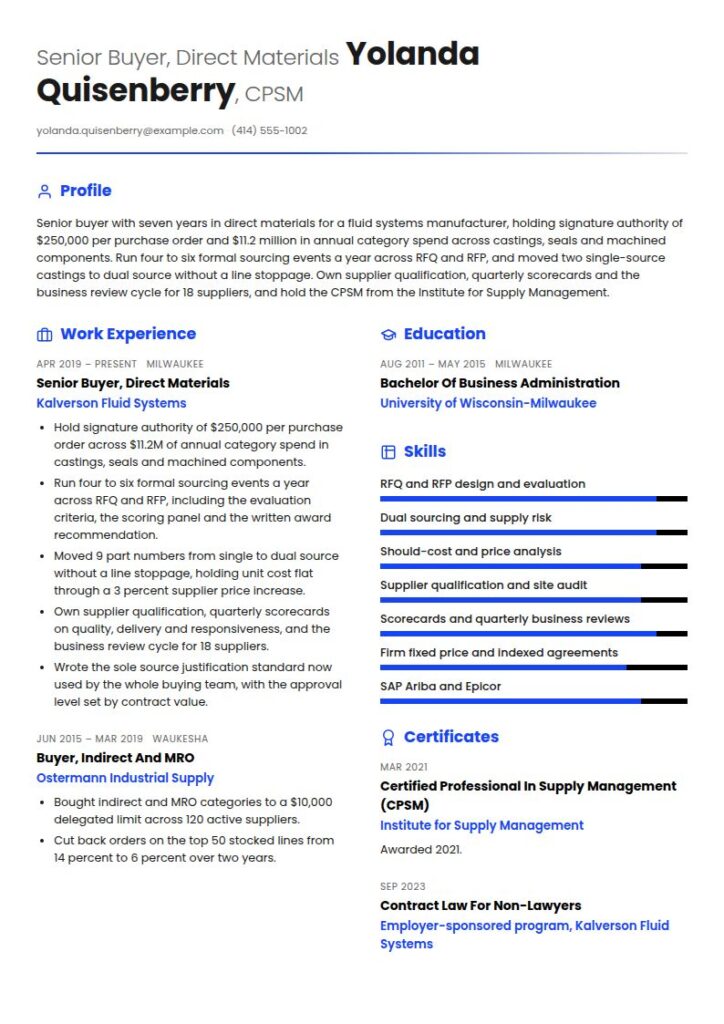
Senior buyer with seven years in direct materials for a fluid systems manufacturer, holding signature authority of $250,000 per purchase order and $11.2 million in annual category spend across castings, seals and machined components. Run four to six formal sourcing events a year across RFQ and RFP, and moved two single-source castings to dual source without a line stoppage. Own supplier qualification, quarterly scorecards and the business review cycle for 18 suppliers, and hold the CPSM from the Institute for Supply Management.
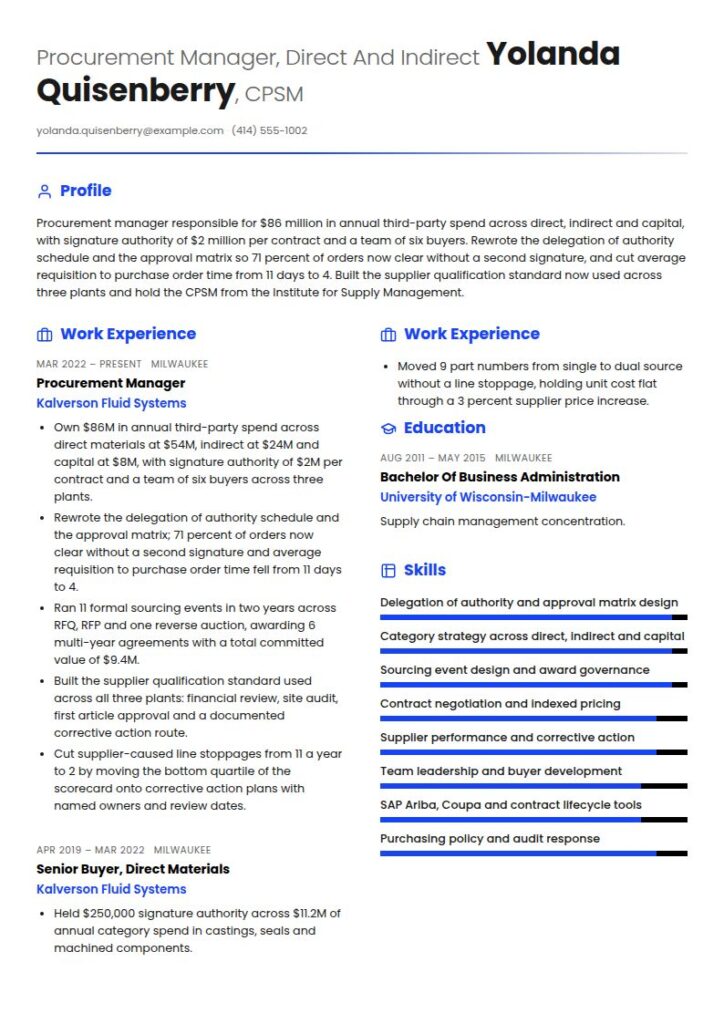
Procurement manager responsible for $86 million in annual third-party spend across direct, indirect and capital, with signature authority of $2 million per contract and a team of six buyers. Rewrote the delegation of authority schedule and the approval matrix so 71 percent of orders now clear without a second signature, and cut average requisition to purchase order time from 11 days to 4. Built the supplier qualification standard now used across three plants and hold the CPSM from the Institute for Supply Management.
Right vs wrong: the same procurement manager summary, twice
| ✅ Right | ❌ Wrong |
|---|---|
| Procurement manager responsible for $86 million in annual third-party spend across direct, indirect and capital. | Experienced procurement leader with a strong background in strategic sourcing. |
| Signature authority of $2 million per contract and a team of six buyers. | Manages vendor relationships and oversees the purchasing function. |
| Rewrote the delegation of authority schedule so 71 percent of orders clear without a second signature. | Drove significant cost savings through effective negotiation. |
As a result, the right column can be matched against a job description in seconds. In contrast, the left column cannot be matched against anything.
Outline your procurement experience
Employer, city, dates, then the authority line, then three to five bullets. Also, every bullet carries a number: spend, count, time or percentage, in that order of usefulness.
| Instead of | Use |
|---|---|
| Managed vendor relationships | Ran quarterly business reviews for 18 suppliers covering $11.2M of category spend, with a scorecard on quality, delivery and responsiveness |
| Achieved significant cost savings | Took castings from single to dual source across 9 part numbers, holding unit cost flat through a 3 percent supplier price increase |
| Negotiated contracts with suppliers | Negotiated and awarded 6 multi-year agreements, 2 firm fixed price and 4 with an indexed material clause, total committed value $9.4M |
| Managed purchasing for a city department | Ran 14 formal solicitations a year under the city procurement code, held a $50,000 delegated award limit and took anything above it to council |
Procurement Manager, Kalverson Fluid Systems, Milwaukee, WI, March 2022 to Present
Own $86M in annual third-party spend across direct, indirect and capital, with signature authority of $2M per contract and a team of six buyers across three plants.
Rewrote the delegation of authority schedule and the approval matrix; 71 percent of orders now clear without a second signature and average requisition to purchase order time fell from 11 days to 4.
Cut supplier-caused line stoppages from 11 a year to 2 by moving the bottom quartile of the scorecard onto corrective action plans with named owners and review dates.
Show the spend you were trusted with and the process that spend forced
Above all, this section decides the page, and it rests on one idea: in procurement the number is not the achievement, it is what determines which process you were obliged to follow. Therefore, write the authority first, in its own block, the way your organization wrote it.
Spend under management: $86M annually. Direct materials $54M, indirect $24M, capital $8M.
Signature authority: $2M per contract. Purchase orders under $250,000 delegated to senior buyers, under $10,000 to plant buyers.
Rulebook: company delegation of authority schedule, revised 2024. Three-quote requirement above $25,000, competitive solicitation above $250,000, board approval above $2M.
Vehicles: 14 master supply agreements, 3 group purchasing organization contracts, 2 consignment agreements.
Team: 6 buyers, 3 plants, 1 procurement analyst.
Then say which track you worked, because the public and private sides of procurement are two labor markets that share a vocabulary and very little else.
Public track procurement thresholds and codes
The public track. On the public side the thresholds are published, and which side of a line a purchase falls on decides the process before anyone exercises judgement. In federal buying the Federal Acquisition Regulation sets those lines, and they moved recently: the Federal Register inflation-adjustment rule published on 27 August 2025, implementing the five-year adjustment required by 41 U.S.C. 1908, raised the micro-purchase threshold from $10,000 to $15,000 and the simplified acquisition threshold from $250,000 to $350,000, effective 1 October 2025.
| Federal Acquisition Regulation threshold | Before 1 October 2025 | From 1 October 2025 |
|---|---|---|
| Micro-purchase threshold | $10,000 | $15,000 |
| Simplified acquisition threshold | $250,000 | $350,000 |
Source: Federal Acquisition Regulation, inflation adjustment of acquisition-related thresholds, Federal Register, 27 August 2025, effective 1 October 2025.
Those figures govern federal buying only. Meanwhile, a state, a county, a school district and a transit authority each set their own thresholds in their own code, and a private company sets them in a delegation schedule nobody outside it has read. Never write a state or private limit as though it were federal. If you did work federal, say so plainly and name the band you operated in.
A public-side resume needs: the code you bought under, your delegated award limit, formal solicitations run a year, protest and award documentation, and whether you held a warrant or its local equivalent.
Private track: your delegation of authority
The private track. There is no published threshold. Your equivalent is the delegation of authority schedule, the approval matrix that routes a requisition to the right signatures, and the contract vehicles you could buy against without starting a competition. Those three documents are the whole answer to "what could you do alone", and almost nobody puts any of them on a resume.
A private-side resume needs: spend under management split by type, your signature limit, the quote and competition thresholds in your matrix, the vehicles you could draw on, and whether you signed or recommended.
Sourcing events a procurement manager should name
Then the sourcing events you have actually run. Name them, because each one implies a different amount of work and a different kind of evidence.
| Event | What it means you did | The evidence a reader wants |
|---|---|---|
| RFI | Gathered market and capability information before committing | Responses received, and what the scan changed |
| RFQ | Competed a defined specification on price and terms | Number of bidders, award basis, cycle time |
| RFP | Competed on scope and approach against weighted criteria | Evaluation criteria, panel size, award justification |
| Reverse auction | Ran a live bidding event on a commoditised buy | Lot value, participation, whether the saving held |
| Sole source | Awarded without competition, with a written justification | The justification standard and who approved it |
The sole source line separates candidates. Anyone can award without competition; doing it properly means writing the justification, getting it approved at the right level, and defending it a year later.
Then the contract types and the supplier work. Firm fixed price, cost reimbursable, time and materials, indexed clauses, blanket orders, consignment. Then supplier qualification, the scorecard, corrective action, and how you exit a supplier, because exit is where procurement either has a process or discovers it does not.
Build a snapshot of your key skills
Next, twelve to fourteen entries in four groups: authority and process, sourcing, supplier management, systems.
Authority and process: Delegation of authority schedules, Approval matrix design, Requisition to purchase order cycle, Three-way match exception handling, Purchasing policy and audit response
Sourcing: RFI, RFQ and RFP design, Bid evaluation and weighted scoring, Reverse auction execution, Sole source justification, Should-cost and price analysis
Contracting and supplier management: Firm fixed price and indexed agreements, Master supply agreements, Supplier qualification and site audit, Scorecards and quarterly business reviews, Corrective action and supplier exit
Systems: SAP Ariba, Coupa, Epicor, Excel modeling for spend analysis, Contract lifecycle management tools
Keep the systems row honest. Be precise, because procurement interviews test tool claims within ten minutes.
List your education and certifications
Degree first if the posting names one, then certifications, then the training your employer put you through.
Bachelor of Business Administration, Supply Chain Management, University of Wisconsin-Milwaukee, Milwaukee, WI, 2014
Certified Professional in Supply Management (CPSM), Institute for Supply Management, 2021
Contract Law for Non-Lawyers, employer-sponsored program, 2023
Internal: Delegation of authority and approval matrix owner training, 2022
On credentials, by contrast, the Handbook is deliberately vague. It says only that some workers may choose to earn optional certification in an area such as procurement or supply chain management, and that certification helps to demonstrate competency in the field. It names no credential, so do not claim that any particular certification is a federal requirement.
For instance, the Institute for Supply Management awards the Certified Professional in Supply Management (CPSM), the Certified Professional in Supplier Diversity (CPSD) and the Advanced Professional in Supply Management (APSM), and verifies its legacy C.P.M. and A.P.P. credentials. Also write the exact name and the year.
Choose the right layout and design
Single column, 11 or 12 point, white space around the authority block so a scanning reader lands on it. Likewise, no photograph, no skills bar charts, no two columns: the numbers are the point, and a column break in the middle of a spend figure is a real parsing risk.
State spend under management and signature authority as numbers in the first three lines. Name the rulebook you bought inside. Split spend by direct, indirect and capital. Name the sourcing events you ran and the award basis. Say whether you signed or recommended. Give supplier counts alongside spend, since 12 suppliers at $40M is a different job from 400 at $40M.
Do not write savings without the baseline and the period. Do not imply federal thresholds applied to a private or municipal buy. Do not claim ownership of a category you supported. Do not list every ERP you have touched. Do not call yourself a strategic sourcing professional without naming one event you ran end to end.
Procurement manager job market and outlook
A mid-sized occupation growing at about the average, with heavy replacement demand and a pay ladder that is unusually steep between its two halves.
| Measure | Value |
|---|---|
| Purchasing managers, buyers and purchasing agents, jobs 2025 | 604,400 |
| Projected change, 2025-35 | 6% overall, about 34,400 new jobs |
| Purchasing managers alone, projected change | 4% |
| Buyers and purchasing agents alone, projected change | 6% |
| Projected annual openings | About 53,600 |
| Typical entry-level education | Bachelor's degree |
| Median annual wage, May 2025, occupation overall | $81,670, or $39.27 per hour |
Source: U.S. Bureau of Labor Statistics, Occupational Outlook Handbook, 2025-35 projections and May 2025 wage data.
The gap between buyer and manager is the largest single fact on this page
The Occupational Outlook Handbook put the May 2025 median annual wage for purchasing managers at $148,080 and for buyers and purchasing agents at $77,710. That is a gap of $70,370 inside one published occupation, and it is almost entirely a gap in authority rather than in category knowledge.
The Handbook also states that purchasing managers typically need several years of experience in a related occupation before the job, while buyers and purchasing agents need only a few months of on-the-job training. The move that doubles your pay is the move from executing a purchase to deciding one, and the only evidence a resume can carry for it is a delegated limit, a signature, and a decision someone else had to live with.
Next, where purchasing managers work, and what each setting pays:
| Industry | Share of purchasing manager employment | Median annual wage, May 2025 |
|---|---|---|
| Manufacturing | 23% | $136,610 |
| Management of companies and enterprises | 18% | $167,870 |
| Government | 12% | $150,920 |
| Wholesale trade | 11% | $135,550 |
| Professional, scientific, and technical services | 8% | $168,060 |
Source: U.S. Bureau of Labor Statistics, Occupational Outlook Handbook, May 2025.
In other words, the largest employer of purchasing managers pays the least of the five, and the two highest payers are the smallest employers. Moving from manufacturing to professional services means real translation work: those buyers write more contracts and are read for process discipline rather than part knowledge.
What salary you can expect as a procurement manager
Overall, the median annual wage for purchasing managers was $148,080 as of May 2025, against $77,710 for buyers and purchasing agents, with the whole occupation sitting at $81,670 a year or $39.27 an hour (BLS Occupational Outlook Handbook, May 2025).
Industry moves the number. For example, purchasing managers in professional, scientific, and technical services had a median of $168,060 and those in management of companies and enterprises $167,870, against $136,610 in manufacturing and $135,550 in wholesale trade, with government at $150,920 (BLS, May 2025). On the buyer side, however, the ordering reverses: government paid buyers and purchasing agents a median of $95,780, ahead of management of companies at $83,990, manufacturing at $77,890, wholesale trade at $71,640 and retail trade at $57,840 (BLS, May 2025). Public buying pays comparatively well at the buyer grade and modestly at the manager grade; corporate and professional services do the opposite.
Ultimately, inside a band, what moves an offer is authority, category and evidence of process. A candidate showing a signature limit, a category they owned rather than supported, and one sourcing event run end to end negotiates from a different position than one with the same years and a page of savings percentages.
Key takeaways for a procurement manager resume
- To start, put spend under management and signature authority in the first three lines, as numbers.
- Then name the rulebook: a published procurement code, the Federal Acquisition Regulation, or a company delegation of authority schedule.
- In addition, split spend by direct, indirect and capital; they are bought differently and hired for differently.
- Also name the sourcing events you personally ran, and the award basis for each.
- Say whether you signed or recommended, because references check exactly that.
- Similarly, anchor every savings claim to a baseline, a scope and a period of time.
- Finally, give supplier counts next to spend, and write certifications with their exact awarding body and year.
Build your procurement manager resume in 15 minutes with our AI resume builder.
Related transport and logistics resume examples
- Supply chain resume
- Inventory manager resume
- Logistics coordinator resume
- Warehouse manager resume
- Transport and logistics resume
- Stock clerk resume
- Order filler resume
- Warehouse supervisor resume
- Dispatcher resume
- Truck driver resume
- Warehouse worker resume
- Delivery driver resume
Pair it with a matching procurement manager cover letter.
Procurement manager resume questions, answered
How long should a procurement manager resume be?
One page while you are a buyer or purchasing agent. Two once you own categories, manage buyers or hold a contract signature, because the authority block, the category split and the sourcing history need the room.
Should I put dollar figures for spend on my resume?
Yes, and it is the highest-value change most procurement candidates can make. Spend under management is not confidential the way a supplier price is: it is the scale of your job. Give it annually and pair it with your signature limit.
How do I write savings so they are believed?
Give the baseline, the scope, the period and the method. "Cut unit cost 8 percent" is unverifiable. "Held unit cost flat across 9 castings through a 3 percent supplier price increase, over 18 months, by dual sourcing" is a claim a reference can confirm. Say whether it was cost avoidance or a realized reduction; readers assume the worse of the two when you do not.
Do I need a certification to be hired as a procurement manager?
No. The Handbook says only that some workers may choose to earn optional certification in procurement or supply chain management and that it helps demonstrate competency; it names no credential and no requirement. The Institute for Supply Management's CPSM is worth listing where you hold it and worth pursuing where an employer funds it, but nobody who has read a real signature limit on your page rejects you for lacking one.
What do I write if I have never had signature authority?
Write what you did have, precisely. Preparing sourcing packs, running evaluations, presenting recommendations to an approval board, administering contracts after award and managing supplier performance are all real procurement work and all of it is hired. What damages a file is blurred language: "awarded", "negotiated and signed" and "approved" are words a reference is asked about directly.