Inventory Control Clerk Sunita Ramaswamy
Inventory Control Clerk
[email protected] | (559) 555-1014 | Fresno, United States
Profile
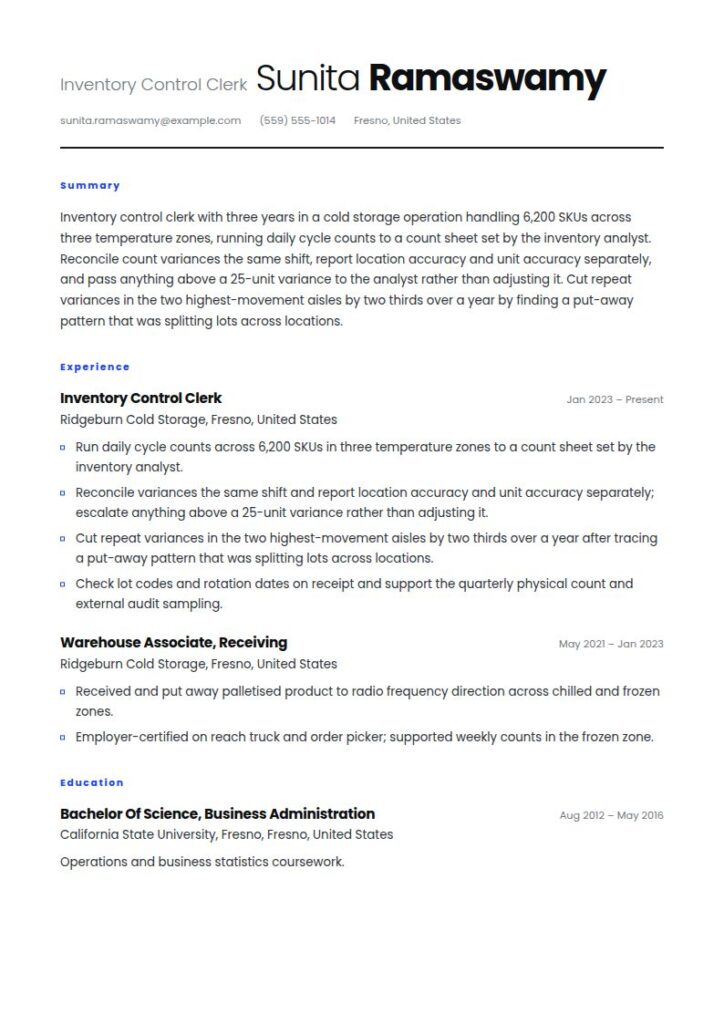
Inventory control clerk with three years in a cold storage operation handling 6,200 SKUs across three temperature zones, running daily cycle counts to a count sheet set by the inventory analyst. Reconcile count variances the same shift, report location accuracy and unit accuracy separately, and pass anything above a 25-unit variance to the analyst rather than adjusting it. Cut repeat variances in the two highest-movement aisles by two thirds over a year by finding a put-away pattern that was splitting lots across locations.
Work Experience
01/2023 - Present, Inventory Control Clerk, Ridgeburn Cold Storage, Fresno, United States
- Run daily cycle counts across 6,200 SKUs in three temperature zones to a count sheet set by the inventory analyst.
- Reconcile variances the same shift and report location accuracy and unit accuracy separately; escalate anything above a 25-unit variance rather than adjusting it.
- Cut repeat variances in the two highest-movement aisles by two thirds over a year after tracing a put-away pattern that was splitting lots across locations.
- Check lot codes and rotation dates on receipt and support the quarterly physical count and external audit sampling.
05/2021 - 01/2023, Warehouse Associate, Receiving, Ridgeburn Cold Storage, Fresno, United States
- Received and put away palletised product to radio frequency direction across chilled and frozen zones.
- Employer-certified on reach truck and order picker; supported weekly counts in the frozen zone.
Education
08/2012 - 05/2016, Bachelor of Science, Business Administration, California State University, Fresno, Fresno, United States
Operations and business statistics coursework.
Skills
Cycle counting and variance reconciliation, 80
Location and unit accuracy reporting, 75
Lot code and rotation date control, 80
Radio frequency scanning, 85
Warehouse management system inventory transactions, 75
Excel for count reporting, 70
Languages
English, native
Tamil, native
Spanish, intermediate
Certificates
03/2024, Powered Industrial Truck Operator Certification, Employer-certified under OSHA 29 CFR 1910.178(l), Ridgeburn Cold Storage
Reach truck and order picker. Most recent evaluation 2024.
Summary
An inventory manager resume is a one to two page document that says which of the three layers of inventory work you actually owned: the parameters, the count, or the write-off. This guide gives you three adaptable versions, the reason a manufacturer, a distributor and a retailer mean different things by the title, and current Bureau of Labor Statistics pay for both halves of it.
Inventory Manager resume examples by experience level
An inventory manager resume is a one to two page document that says which part of inventory work you actually owned, because the title covers three jobs and most candidates claim all three when they held one.
To start, layer one is the parameters: reorder points, safety stock, min and max levels, ABC classification, lot sizes and the service level you were told to hold. Then layer two is the count: the cycle-count program, count frequency by class, location accuracy against unit accuracy, the reconciliation and who is allowed to adjust the record. Finally, layer three is the consequence: shrink, obsolescence, ageing stock and the write-off that somebody has to sign.
Of course, they look like one job from outside. Inside, however, they are a planner, a controller and a manager, with different evidence, different screens and different failure modes. As a result, a resume that does not separate them reads as vague to all three of the hiring managers who might open it.
Resume guide for an inventory manager resume
To that end, this guide and the corresponding inventory manager resume example will cover:
- First, how to write an inventory manager resume, section by section
- Then, the three layers of inventory ownership, and how to prove which one was yours
- Next, three adaptable summaries: inventory clerk, inventory analyst and inventory manager
- Also, why a manufacturer, a distributor and a retailer mean different things by the title
- Finally, what the job market looks like and what you can expect to earn
How to write an inventory manager resume
Overall, six sections: contact header, summary, scope of ownership, inventory experience, systems and skills, and education and certifications. One page while the work is transactional, two once you set parameters or sign adjustments.
| Section | What it is answering | Where it goes |
|---|---|---|
| Scope of ownership | Which of the three layers did this person hold? | Directly under the summary |
| Inventory experience | What changed in accuracy, availability or value? | Reverse chronological, numbers in each bullet |
| Systems | Which record was the system of truth, and what did they do in it? | Its own group, named by system |
| Education and certifications | Does the file clear a stated bar? | Last, unless a posting names one |
Run the finished file through the ATS resume checker before you submit. These postings sit in high-volume systems and are often screened on system names first.
Choosing the best resume format for an inventory manager resume
Reverse chronological. Inventory careers move through the layers in order, and the order is the argument: you count, then you reconcile, then you set the numbers that decide what gets counted, then you sign what gets written off. After all, a format that hides the sequence hides the promotion.
A second page is justified once you own parameters or approve adjustments, because the parameter set, the count design and the write-off history each need their own evidence.
Include your contact information
| ✅ Right | ❌ Wrong |
|---|---|
| Sunita Ramaswamy | Sunita Ramaswamy |
| Inventory Manager, Distribution and Finished Goods | Detail-oriented inventory professional |
| 41,000 SKUs, $32M inventory value, ABC parameters and write-off authority to $25,000 | Experienced in inventory control and stock management |
| (559) 555-1014, [email protected], Fresno, CA | (559) 555-1014, [email protected] |
In fact, the third line does the work of a paragraph. SKU count gives the complexity, inventory value gives the scale, and the last clause says which layers you held. A reader deciding whether to open the file has their answer.
Say which layer you owned, in the organization’s own words
Three sentences, three different jobs, and all three are often written as "managed inventory".
Parameters: "Set and maintained reorder points, safety stock and ABC classification for 41,000 SKUs against a 98 percent line fill target."
Count: "Designed the cycle-count program: A items monthly, B quarterly, C annually, with location accuracy reported separately from unit accuracy."
Consequence: "Signed inventory adjustments to $25,000 and prepared the quarterly obsolescence review for the controller."
Use the wording your organization used, including the limit. If you recommended rather than approved, write "prepared" or "recommended", because inventory references are asked precisely that question.
Make use of a summary
Four lines: your layer, the scale in SKUs and value, the sector, and one measured result that belongs to your layer rather than to the warehouse.
Inventory control clerk with three years in a cold storage operation handling 6,200 SKUs across three temperature zones, running daily cycle counts to a count sheet set by the inventory analyst. Reconcile count variances the same shift, report location accuracy and unit accuracy separately, and pass anything above a 25-unit variance to the analyst rather than adjusting it. Cut repeat variances in the two highest-movement aisles by two thirds over a year by finding a put-away pattern that was splitting lots across locations.
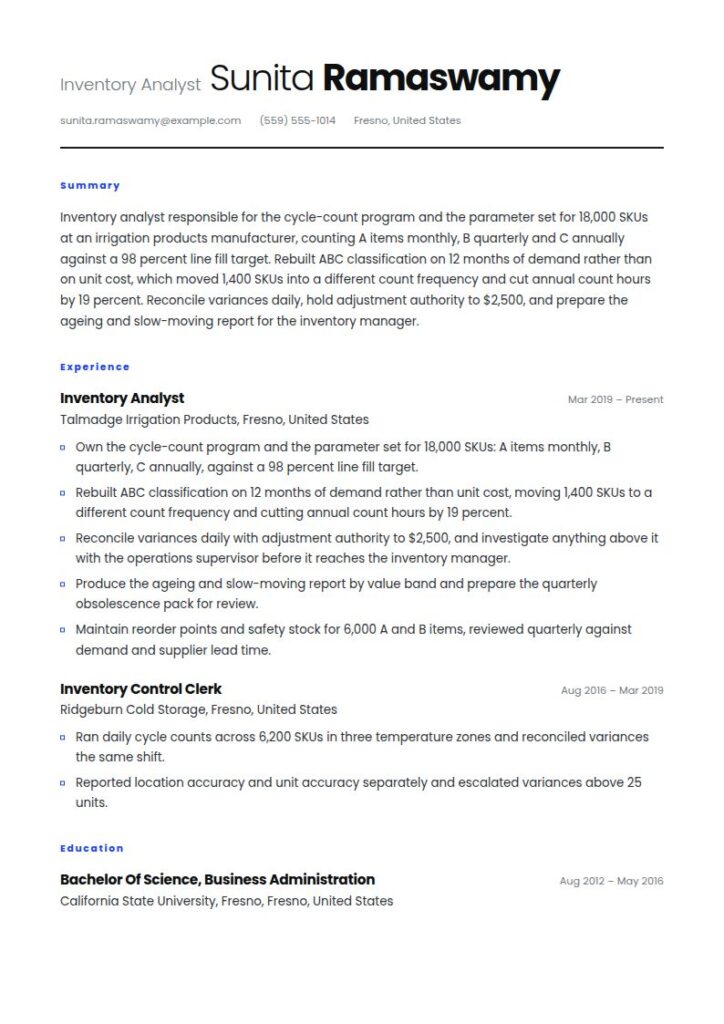
Inventory analyst responsible for the cycle-count program and the parameter set for 18,000 SKUs at an irrigation products manufacturer, counting A items monthly, B quarterly and C annually against a 98 percent line fill target. Rebuilt ABC classification on 12 months of demand rather than on unit cost, which moved 1,400 SKUs into a different count frequency and cut annual count hours by 19 percent. Reconcile variances daily, hold adjustment authority to $2,500, and prepare the ageing and slow-moving report for the inventory manager.
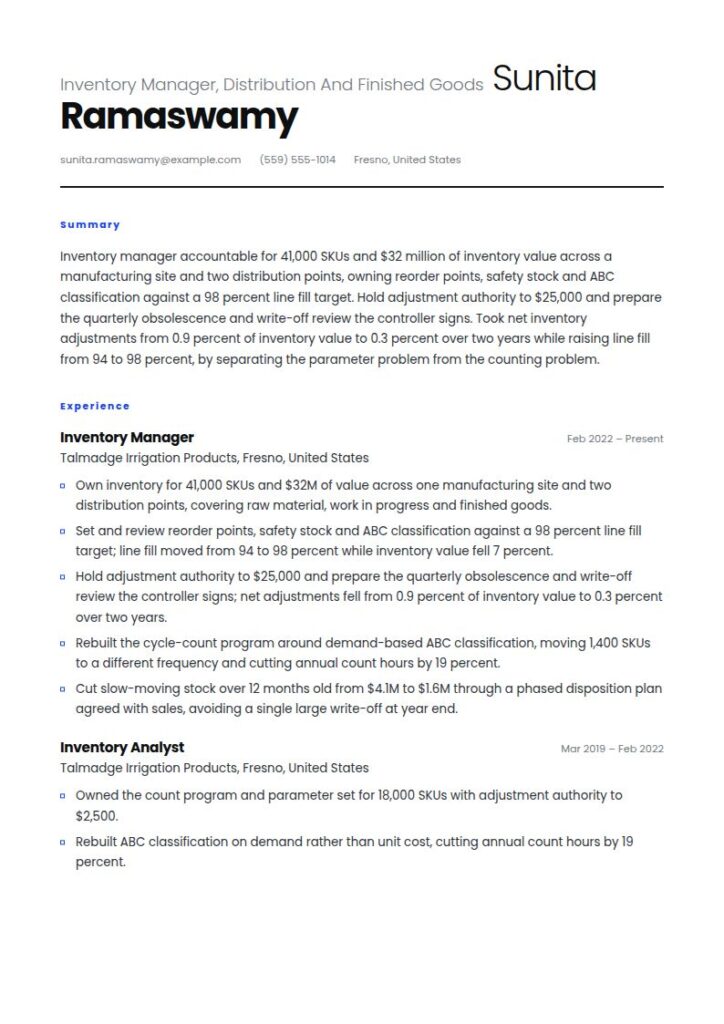
Inventory manager accountable for 41,000 SKUs and $32 million of inventory value across a manufacturing site and two distribution points, owning reorder points, safety stock and ABC classification against a 98 percent line fill target. Hold adjustment authority to $25,000 and prepare the quarterly obsolescence and write-off review the controller signs. Took net inventory adjustments from 0.9 percent of inventory value to 0.3 percent over two years while raising line fill from 94 to 98 percent, by separating the parameter problem from the counting problem.
Right vs wrong: the same inventory manager summary, twice
| ✅ Right | ❌ Wrong |
|---|---|
| Accountable for 41,000 SKUs and $32M of inventory value across a manufacturing site and two distribution points. | Experienced inventory manager with a strong background in stock control. |
| Own reorder points, safety stock and ABC classification against a 98 percent line fill target. | Responsible for maintaining accurate inventory levels at all times. |
| Took net adjustments from 0.9 percent of inventory value to 0.3 percent while raising line fill from 94 to 98 percent. | Improved inventory accuracy and reduced stock discrepancies. |
For example, the right column tells a reader which layer this candidate held and how big the problem was. In contrast, the left column is a job description with a pronoun in front of it.
Outline your inventory experience
Employer, sector, SKU count and inventory value, dates, then three to five bullets. Also, every bullet carries a number, and the numbers should not all be accuracy percentages.
| Instead of | Use |
|---|---|
| Maintained accurate inventory records | Reconciled cycle-count variances daily across 41,000 SKUs, reporting location accuracy and unit accuracy separately |
| Managed stock levels | Set reorder points and safety stock for 41,000 SKUs against a 98 percent line fill target, reviewed quarterly against demand |
| Reduced excess inventory | Cut slow-moving stock over 12 months old from $4.1M to $1.6M through a phased disposition plan agreed with sales |
| Performed cycle counts | Designed the count program by ABC class, A monthly, B quarterly, C annually, and cut annual count hours by 19 percent |
| Handled inventory discrepancies | Hold adjustment authority to $25,000; net adjustments fell from 0.9 percent of inventory value to 0.3 percent over two years |
| Worked with the warehouse team | Traced a recurring variance to a put-away rule splitting lots across locations, and rewrote the rule with the operations supervisor |
Inventory Manager, Talmadge Irrigation Products, Fresno, CA, February 2022 to Present
Own inventory for 41,000 SKUs and $32M of value across one manufacturing site and two distribution points, covering raw material, work in progress and finished goods.
Set and review reorder points, safety stock and ABC classification against a 98 percent line fill target; line fill has moved from 94 to 98 percent while inventory value fell 7 percent.
Hold adjustment authority to $25,000 and prepare the quarterly obsolescence and write-off review the controller signs; net adjustments fell from 0.9 percent of inventory value to 0.3 percent over two years.
Rebuilt the cycle-count program around demand-based ABC classification, moving 1,400 SKUs to a different frequency and cutting annual count hours by 19 percent.
Cut slow-moving stock over 12 months old from $4.1M to $1.6M through a phased disposition plan agreed with sales, avoiding a single large write-off at year end.
Say which inventory decisions you actually owned: the parameters, the count or the write-off
Write this as three separate claims, because a hiring manager is filling a job that sits in exactly one of them.
Layer one: the parameters. This is planning work. Reorder points, safety stock, min and max levels, lot sizes, ABC classification and the service level target you were given. The evidence is what you changed and what happened to availability and value together, because moving one without the other is not a result.
Above all, the strongest parameter sentence names the basis of your classification. For instance, ABC by unit cost, by annual usage value, by demand frequency and by criticality produce different answers, and a candidate who knows which one their organization used and why is immediately distinguishable from one who inherited a spreadsheet.
Layer two: owning the inventory count
Layer two: the count. This is control work, and it has more moving parts than resumes usually admit.
| What a count program decides | What a resume should say |
|---|---|
| Frequency by class | A monthly, B quarterly, C annually, and what set the classes |
| Count method | Blind or verified, scanned or counted, by location or by item |
| Accuracy measure | Location accuracy and unit accuracy, reported separately |
| Variance handling | The threshold for investigation, and who is allowed to adjust |
| Reconciliation | Same shift, next day, or at period close, and against which record |
However, that fourth row is the one that matters most and appears least. In practice, who may adjust the record, and up to what value, is the real boundary between counting and controlling inventory, and stating your own limit is the fastest way to place yourself on the right side of it.
Layer three: shrink, obsolescence and write-offs
Layer three: the consequence. Shrink, obsolescence, ageing and slow-moving stock, and the write-off. This is the layer that touches finance, and it is where an inventory manager either has authority or does not.
Similarly, say what you produced and what you signed: the ageing report and its buckets, the obsolescence provision, the disposition plan, the scrap approval, the year-end count support for external audit. A phased disposition agreed with sales is a more sophisticated claim than a large write-off, because it shows you managed the consequence rather than recording it.
What the inventory manager title means by sector
Then say which sector you did it in, because the title is not portable.
| Sector | What "inventory manager" usually means there |
|---|---|
| Manufacturing | Raw material and work in progress, bills of material, lot and batch traceability, production supply |
| Distribution and wholesale | Finished goods, fill rate, supplier lead times, slotting and replenishment across locations |
| Retail | Store and distribution center stock, shrink, seasonal markdown and allocation across sites |
| Cold chain and food | Lot codes, rotation and expiry dates, temperature zones, shorter shelf life and tighter tolerances |
For example, a manufacturer reading a retail inventory resume sees no bills of material and no work in progress. Likewise, a retailer reading a manufacturing one sees no shrink and no markdown. Therefore, name your sector in the first line and translate the rest.
Build a snapshot of your key skills
Next, twelve to fourteen entries in four groups matching the three layers plus systems.
Parameters and planning: Reorder point and safety stock calculation, ABC classification by usage value, Min and max design, Lot sizing, Service level and line fill targets
Counting and control: Cycle-count program design, Blind count methodology, Location and unit accuracy reporting, Variance investigation, Period close and audit support
Consequence: Ageing and slow-moving analysis, Obsolescence provisioning, Disposition and scrap planning, Shrink investigation
Systems: SAP MM, Oracle NetSuite, warehouse management system inventory modules, Radio frequency scanning, Excel and Power Query for demand and ageing analysis
List your education and certifications
Meanwhile, most postings ask for a degree or equivalent experience. Certifications are optional in this field, so list what you genuinely hold and let the scope block carry the weight.
Bachelor of Science, Business Administration, California State University, Fresno, CA, 2016
Certificate in Supply Chain Management, California State University, Fresno, Continuing and Global Education, 2020
Powered Industrial Truck Operator Certification, employer-certified under OSHA 29 CFR 1910.178(l), reach truck and order picker, most recent evaluation 2024
Internal: Cycle-count program administrator, Talmadge Irrigation Products, 2022
In addition, the forklift line is worth a note. Specifically, under OSHA 29 CFR 1910.178(l) that certification is issued by the employer and the record carries the operator's name, the training date, the evaluation date and who performed them, with re-evaluation at least once every three years. It does not travel with you, so write it as employer-certified rather than as a license.
Choose the right layout and design
In short: single column, 11 or 12 point, the scope block high on the page. That matters because inventory readers scan for three things in the first pass: SKU count, inventory value and the system name. Therefore, make all three findable without reading a bullet.
Say which layer you owned, in your employer's own wording. Give SKU count and inventory value as separate numbers. Name your adjustment or write-off authority, including the limit. Report location accuracy and unit accuracy separately if you measured both. Name your sector and translate the vocabulary for the one you are applying to. Pair every availability claim with what happened to inventory value.
Do not write "managed inventory" and leave the layer unstated. Do not quote a single accuracy percentage as your whole record. Do not claim you approved adjustments if you prepared them. Do not list a system you have only seen reports from. Do not describe a write-off as a saving; the reader knows what it is.
Inventory manager job market and outlook
Notably, the occupation splits exactly along the fault line this page has been describing, and the Bureau of Labor Statistics publishes the two halves separately.
| Published occupation | Median annual wage, May 2025 | Which layer it covers |
|---|---|---|
| Material recording clerks, group | $47,600 | Counting and record keeping |
| Shipping, receiving, and inventory clerks | $45,260 | The transactional record |
| Transportation, storage, and distribution managers | $107,230 | Parameters, consequence and the people |
Source: U.S. Bureau of Labor Statistics, Occupational Outlook Handbook, 2025-35 projections and May 2025 wage data.
| Measure | Material recording clerks | Transportation, storage, and distribution managers |
|---|---|---|
| Jobs, 2025 | 1,273,500 | 228,100 |
| Projected 2035 | 1,203,100 | Not stated separately |
| Projected change, 2025-35 | -6%, about -70,300 jobs | 6%, faster than the average |
| Projected annual openings | About 98,600 | About 18,300 |
| Typical entry-level education | High school diploma or equivalent | High school diploma or equivalent |
| Work experience in a related occupation | Not required | 5 years or more |
Source: U.S. Bureau of Labor Statistics, Occupational Outlook Handbook, 2025-35 projections and May 2025 wage data.
The decline is in the clerking, not in the deciding
Material recording clerks are projected to fall 6 percent between 2025 and 2035, from 1,273,500 jobs to 1,203,100, a loss of about 70,300, while transportation, storage, and distribution managers are projected to grow 6 percent over the same decade (BLS Occupational Outlook Handbook, 2025-35 projections).
Those two numbers describe one change, not two. Scanning, automated replenishment and system-generated count schedules are removing the transactional layer of inventory work, which is the layer this occupation used to hire most of its people into. What is not being automated is deciding what the parameters should be, judging whether a variance is a counting problem or a process problem, and taking responsibility for a write-off.
The instruction to your resume is plain. Every line that describes you executing a transaction is competing against the shrinking half of the occupation. Every line that describes you deciding something is competing in the growing half, and the growing half pays $107,230 against $47,600 (BLS, May 2025).
For example, manufacturing employs 28 percent of material recording clerks, transportation and warehousing 14 percent, retail trade 14 percent and wholesale trade 13 percent. Meanwhile, for the management occupation, transportation and warehousing employs 30 percent, wholesale trade 15 percent, manufacturing 13 percent and government 8 percent (BLS, May 2025).
What salary you can expect as an inventory manager
In short, your pay follows the layer, not the title. At the record-keeping end, material recording clerks had a median of $47,600 a year, or $22.89 an hour, as of May 2025, with shipping, receiving, and inventory clerks at $45,260 and production, planning, and expediting clerks, the closest published match for parameter work inside the clerical group, at $59,650 (BLS, May 2025). At the management end, by contrast, transportation, storage, and distribution managers had a median of $107,230, or $51.55 an hour (BLS, May 2025).
Industry shifts both ends. For material recording clerks, for instance, manufacturing paid a median of $48,950, transportation and warehousing $47,990 and wholesale trade $46,310, against $39,290 in retail trade and $39,000 in temporary help services. Likewise, for the management occupation, management of companies and enterprises paid $156,720, government $120,650, manufacturing $117,660, transportation and warehousing $102,850 and wholesale trade $100,670 (BLS, May 2025).
The sector advice is consistent at both levels: manufacturing and wholesale pay better for inventory work than retail, and the gap is wider at the bottom of the ladder than at the top.
Ultimately, what moves an individual offer is the layer and the authority attached to it. SKU count, inventory value, whether you set parameters or executed them, and the value of an adjustment you could sign are the four facts that decide where in the band you are placed. In fact, all four fit in two lines near the top of the page.
Key takeaways for an inventory manager resume
- First, say which layer you owned: parameters, the count, or the consequence.
- Then give SKU count and inventory value as separate numbers near the top.
- Name your adjustment or write-off authority, including the limit.
- Report location accuracy and unit accuracy separately where you measured both.
- Pair every availability claim with what happened to inventory value.
- In addition, name the basis of your ABC classification, not just that you had one.
- Name your sector and translate the vocabulary for the one you are applying to.
- Finally, write "prepared" or "recommended" where you did not approve.
Build your inventory manager resume in 15 minutes with our AI resume builder.
Related transport and logistics resume examples
- Stock clerk resume
- Warehouse manager resume
- Supply chain resume
- Procurement manager resume
- Order filler resume
- Warehouse supervisor resume
- Logistics coordinator resume
- Transport and logistics resume
- Warehouse worker resume
- Package handler resume
- Truck driver resume
- Aviation resume
Pair it with a matching inventory manager cover letter.
Inventory manager resume questions, answered
How long should an inventory manager resume be?
One page while the work is transactional. Two once you set parameters or approve adjustments, because the parameter set, the count design and the write-off history each need their own evidence and none of them compresses into a bullet.
What is the difference between an inventory manager and an inventory analyst?
In most organizations the analyst owns the numbers and the manager owns the consequences. An analyst sets or recommends parameters, runs the count program and produces the ageing report; a manager approves adjustments, signs off disposition and answers for the inventory value at period close. The titles are used loosely, so describe the work rather than relying on the label.
Should I put accuracy percentages on my resume?
Yes, but say which accuracy and give both where you have them. Location accuracy and unit accuracy answer different questions, and a candidate who reports only one usually turns out to have measured only one. Pair the number with the count method, because a 99 percent accuracy figure from a verified count means something different from the same figure from a blind count.
What if I did not have authority to adjust inventory?
Say what you did have, precisely. Counting, investigating, reconciling and preparing the adjustment for approval is real inventory control work and it is hired every day. Writing "prepared adjustments for approval to $25,000" is both more honest and more informative than "managed inventory adjustments", and it survives a reference call.
Does experience in one sector transfer to another?
It transfers, but only if you translate it. The layers are the same everywhere: someone sets the parameters, someone counts, someone signs the write-off. The vocabulary is not, and a manufacturer reading about markdown and shrink, or a retailer reading about work in progress and bills of material, will assume the gap is larger than it is. Name the layer you owned in language both sectors share, then name your own sector's specifics once.
How do I show results if inventory value went up on my watch?
Explain what it bought. Inventory going up alongside a fill rate that rose, a stockout count that fell or a new product line that launched is a managed decision, and saying so is stronger than hiding it. What damages a file is a single number with no context, because the reader assumes the worst available explanation.