Sunita Ramaswamy Inventory Manager, Distribution and Finished Goods Fresno, 93711, United States [email protected] · (559) 555-1014
16 September 2026
Ms. Marisol Dunsmuir Director of Operations Sagehen Foods Visalia, United States
Application for Inventory Manager, Sagehen Foods
Dear Ms. Dunsmuir,
I am applying for the Inventory Manager post at Sagehen Foods. I currently own inventory for 41,000 SKUs and $32 million of value at Talmadge Irrigation Products across one manufacturing site and two distribution points, which means the parameters as well as the count: reorder points, safety stock and ABC classification against a 98 percent line fill target, with adjustment authority to $25,000 and the quarterly obsolescence review that our controller signs.
The work I would most want to bring is the separation of two problems that usually get treated as one. When I took the role, inventory accuracy was being managed by counting more often, and net adjustments were running at 0.9 percent of inventory value. Counting harder was not fixing it, because most of the variance came from a put-away rule that split lots across locations. We rewrote the rule, then rebuilt ABC classification on twelve months of demand rather than on unit cost, which moved 1,400 SKUs to a different count frequency and cut annual count hours by 19 percent. Net adjustments are now 0.3 percent, line fill has gone from 94 to 98 percent, and inventory value is down 7 percent.
Sagehen is a food business, so lot codes, rotation and shelf life carry weight that they do not in irrigation products, and I would expect to spend my first weeks on expiry-driven ageing rather than on value-driven ageing. What transfers directly is the three-layer discipline: who sets the parameters, who may adjust the record and up to what value, and who signs the write-off. The first thing I would want to look at is your variance threshold and adjustment authority, because that is usually where a count program quietly stops being a control.
I hold a Certificate in Supply Chain Management from California State University, Fresno, and I have prepared year-end count support for external audit in each of the last four years. I can start on four weeks of notice. Thank you for your time.
Sincerely, Sunita Ramaswamy
Summary
An inventory manager cover letter says which layer of the job you owned, the parameters, the count or the write-off, gives the scale in SKUs and inventory value, and follows one decision to a measured result. This guide gives you a full adaptable letter, the openings that work, and what to write when you are moving between sectors.
Inventory Manager cover letter examples by experience level
An inventory manager cover letter is a one-page letter that answers a single question: which part of inventory work did you own? Setting the parameters, running the count, or carrying the consequence.
The reader knows the title covers all three and that most applicants write as though they held all three. A letter that names one layer, gives its scale and follows one decision to a result is unusual enough to be read to the end.
Guide to an inventory manager cover letter
This guide and the corresponding inventory manager cover letter example will cover:
- How to structure the letter, paragraph by paragraph
- What counts as evidence beyond an accuracy percentage
- How the letter changes when you move between sectors
- The openings that work
How to write an inventory manager cover letter
| Paragraph | Its job | Length |
|---|---|---|
| Opening | The post, the layer you own, SKU count and inventory value | 2 to 3 sentences |
| Evidence | One decision, followed to availability and value together | 4 sentences |
| Fit | Something real about their inventory problem, and what you would look at first | 3 sentences |
| Close | Authority limit, availability, thank you | 2 sentences |
Availability and value are one claim, not two
The fastest way to lose an inventory reader is to give them one half of the trade-off. Fill rate went up: at what inventory cost? Inventory value came down: what happened to stockouts?
Write them together. "Line fill moved from 94 to 98 percent while inventory value fell 7 percent" is a sentence that cannot be produced by accident, and any experienced reader knows it.
If the two moved the same unwelcome way, say so and say why. Inventory that rose alongside a new product line or a doubled supplier lead time is a managed decision, and describing it accurately reads better than a number with no context.
An inventory manager cover letter example you can adapt
Dear Ms. Dunsmuir,
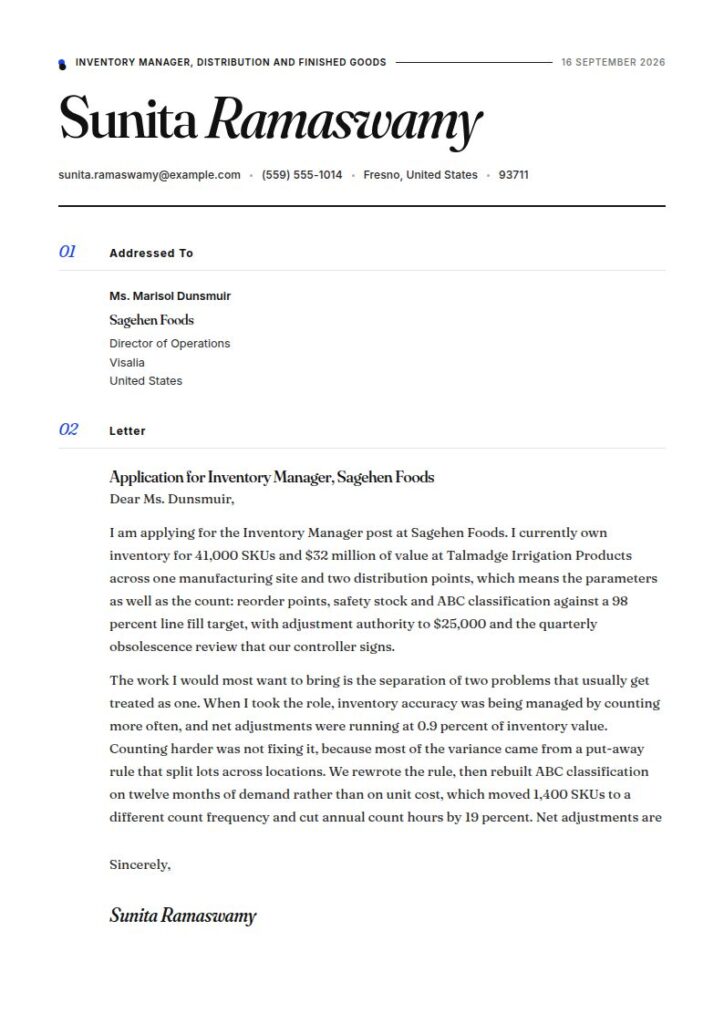
I am applying for the Inventory Manager post at Sagehen Foods. I currently own inventory for 41,000 SKUs and $32 million of value at Talmadge Irrigation Products across one manufacturing site and two distribution points, which means the parameters as well as the count: reorder points, safety stock and ABC classification against a 98 percent line fill target, with adjustment authority to $25,000 and the quarterly obsolescence review that our controller signs.
The work I would most want to bring is the separation of two problems that usually get treated as one. When I took the role, inventory accuracy was being managed by counting more often, and net adjustments were running at 0.9 percent of inventory value. Counting harder was not fixing it, because most of the variance came from a put-away rule that split lots across locations. We rewrote the rule, then rebuilt ABC classification on twelve months of demand rather than on unit cost, which moved 1,400 SKUs to a different count frequency and cut annual count hours by 19 percent. Net adjustments are now 0.3 percent, line fill has gone from 94 to 98 percent, and inventory value is down 7 percent.
Sagehen is a food business, so lot codes, rotation and shelf life carry weight that they do not in irrigation products, and I would expect to spend my first weeks on expiry-driven ageing rather than on value-driven ageing. What transfers directly is the three-layer discipline: who sets the parameters, who may adjust the record and up to what value, and who signs the write-off. The first thing I would want to look at is your variance threshold and adjustment authority, because that is usually where a count program quietly stops being a control.
I hold a Certificate in Supply Chain Management from California State University, Fresno, and I have prepared year-end count support for external audit in each of the last four years. I can start on four weeks of notice. Thank you for your time.
Sincerely, Sunita Ramaswamy
Openings that work
| Instead of | Use |
|---|---|
| I am writing to apply for the inventory manager position | I own inventory for 41,000 SKUs and $32M of value across a plant and two distribution points |
| I have strong attention to detail and inventory experience | I set reorder points, safety stock and ABC classification against a 98 percent line fill target |
| I consistently improve inventory accuracy | Net adjustments fell from 0.9 percent of inventory value to 0.3 percent over two years |
Evidence that is not an accuracy percentage
Accuracy percentages are the default inventory claim and the least informative, because the number depends on the count method behind it. Use claims that carry their own method.
| Kind of evidence | What it looks like in a sentence |
|---|---|
| The trade-off | Line fill from 94 to 98 percent while inventory value fell 7 percent |
| Root cause | Traced recurring variance to a put-away rule splitting lots across locations |
| Program design | ABC rebuilt on demand rather than unit cost, 1,400 SKUs reclassified |
| Consequence managed | Slow-moving stock over 12 months old cut from $4.1M to $1.6M |
| Authority | Adjustment authority to $25,000; obsolescence pack prepared for the controller |
Moving between sectors
The layers are the same everywhere and the vocabulary is not, which is the difficulty of an inventory application that crosses sectors.
A manufacturer reading about markdown and shrink hears retail. A retailer reading about work in progress and bills of material hears manufacturing. A cold chain business reads everything through lot codes, rotation and expiry. Name the layer you owned in language all of them share, admit the one thing that does not transfer, and say what you would do about it in the first month. That paragraph beats any claim of adaptability, because it demonstrates the thing it claims.
Name the layer you owned in the first two sentences. Give SKU count and inventory value as separate numbers. Pair every availability claim with what happened to inventory value. State your adjustment or write-off limit. Name the sector gap and what you would do about it. Keep it to one page.
Do not lead with an accuracy percentage and nothing else. Do not claim you approved adjustments if you prepared them. Do not describe a write-off as a saving. Do not list systems in the letter; the resume carries those. Do not imply a retail inventory background reads the same as a manufacturing one.
The clerking is shrinking, the deciding is growing
The BLS Occupational Outlook Handbook projects material recording clerks to fall 6 percent between 2025 and 2035, from 1,273,500 jobs to 1,203,100, while transportation, storage, and distribution managers are projected to grow 6 percent over the same decade.
The pay gap runs the same way: a May 2025 median of $47,600 for material recording clerks and $45,260 for shipping, receiving, and inventory clerks, against $107,230 for transportation, storage, and distribution managers (BLS Occupational Outlook Handbook, May 2025).
Your letter sits on one side of that line or the other. Sentences about executing transactions place you in the shrinking half. Sentences about deciding parameters, judging a variance and carrying a write-off place you in the growing half, and they are the sentences most applicants leave out.
Length, format and sending it
One page, four paragraphs, 250 to 400 words. PDF unless the portal says otherwise.
Address a person. Inventory reports into operations, supply chain or finance depending on the company, and knowing which tells the reader you looked. If the posting says the role reports to a controller, write for a controller.
Keep the figures identical to your resume; an inventory reader notices a mismatch faster than any other hiring manager. Our inventory manager resume example uses the numbers written here.
Key takeaways
- Name the layer you owned: parameters, the count, or the consequence.
- Give SKU count and inventory value as separate numbers in the opening.
- Pair every availability claim with what happened to inventory value.
- Follow one decision to a result rather than listing four improvements.
- State your adjustment or write-off limit, and say if you prepared rather than approved.
- Name the sector gap and what you would do about it, and keep the figures identical to your resume.
Write your inventory manager cover letter in 10 minutes with our AI cover letter builder.
Inventory manager cover letter questions, answered
How long should an inventory manager cover letter be?
One page, four paragraphs, 250 to 400 words. The opening sentence carries the layer and the scale, which leaves the page for one decision and one honest sentence about fit.
Should I use accuracy percentages in the letter?
Only with their method or their consequence attached. "99 percent unit accuracy on blind counts of A items" is a claim; "99 percent inventory accuracy" is a number without a question behind it. Better still, give the trade-off: availability and inventory value together.
What if I have never had write-off authority?
Say what you prepared instead. Producing the ageing report, building the disposition plan and assembling the obsolescence pack for a controller is real work at the consequence layer, and describing it accurately beats an ambiguous claim to have managed write-offs. Reference calls ask exactly this.
How do I write a letter for a sector I have not worked in?
Name the layer you owned in neutral language, then name the specific gap and what you would do about it. A candidate who says that expiry-driven ageing is different from value-driven ageing and that they would start there reads as someone who has understood the job. A candidate who claims the sectors are basically the same reads as someone who has not.
Does an inventory letter need to mention systems?
Barely. Name the system of record once if it matches the posting and leave the rest to the resume. Inventory readers care more about whether you set the parameters inside the system than about which system it was, and a letter listing software spends its only page on the least differentiating thing in the file.