Rosalind Etcheverry Station Operations Manager, Air Cargo Reno, 89509, United States [email protected] · (775) 555-1038
16 September 2026
Ms. Ardith Garrity Ground Operations Fairholme Air Services Salt Lake City, United States
Application for Ground Operations Manager, Fairholme Air Services
Dear Ms. Garrity,
I am applying for the Ground Operations Manager post at your Salt Lake City station. I currently run a 24 hour air cargo station with 46 staff across the ramp, the load control desk and the operations center, covering 9 scheduled departures a day and a seasonal charter program, and I came up through the ramp on the same apron.
The result I would want to bring is the turn plan. We were briefing crews and equipment on the morning of the operation and losing the first two departures to it, so I moved the brief to the night before and rebuilt the turn sequence around aircraft type rather than scheduled time. On-time departure went from 79 percent to 94 percent over two years and has held there through two winter seasons, including the de-icing months. Over the same period the station closed two winters with no ground damage event, which I put down to training every seasonal hire before their first airside assignment rather than during it.
Your posting says the station is adding a second overnight bank this winter. That is the part I would want to work on first, because a second bank is a rostering and equipment problem before it is a volume problem: the same tugs, loaders and de-icing rigs have to serve two peaks, and the training record has to be ahead of the hiring rather than behind it. I have built one seasonal crew from nothing and would be glad to do it again.
I hold a current airport security badge and airside driving authorization, I have worked rotating and overnight rosters for seven years, and I can give six weeks of notice. Thank you for your time.
Sincerely, Rosalind Etcheverry
Summary
An aviation cover letter has one job before any other: to say which of the sector's five labor markets you belong to. This guide gives you a full adaptable letter for the ramp and operations side, the openings that work, what counts as evidence when safety is the subject, and how the letter changes between the flight deck, the cabin, the hangar, the tower and the ground.
Aviation cover letter examples by experience level
An aviation cover letter is a one-page letter that says which aviation you mean, what you worked on, how much of it, and what changed while you were responsible.
In practice, the sector is five labor markets sharing an airfield: the flight deck, the cabin, the maintenance hangar, the tower and the operations center, and the ramp and ground side. A different manager hires for each and reads for different things; therefore, a letter that opens with a love of flight tells that manager nothing they can use.
Guide to an aviation cover letter
In short, this guide and the corresponding aviation cover letter example will cover:
- First, how to structure the letter, paragraph by paragraph
- Then, why the aircraft type and the volume belong in the first two sentences
- What counts as evidence when the subject is safety
- Also, how the letter changes between the five sides of the sector
- Finally, the openings that keep a reader on a strong file to the end
How to write an aviation cover letter
| Paragraph | Its job | Length |
|---|---|---|
| Opening | The post, your side of the fence, the station, the volume | 2 to 3 sentences |
| Evidence | One change you made, one number, one period of time | 4 to 5 sentences |
| Fit | Something specific about their operation and what you would work on | 3 to 4 sentences |
| Close | The ticket that admits you, roster availability, notice period | 2 sentences |
Name the aircraft and the volume before you name yourself
Every aviation reader has the same first question: have you done this, at this size, on this kind of aircraft?
So answer it in the opening sentence. "I run a 24 hour air cargo station with 46 staff across the ramp, the load control desk and the operations center, covering 9 scheduled departures a day" settles the side of the fence, the scale and the shift pattern at once.
The same rule scales down. A ramp applicant writes turns a shift and aircraft types, a maintenance applicant ratings and task categories, a flight deck applicant hours and ratings. None of them needs a paragraph of introduction first.
An aviation cover letter example you can adapt
Dear Ms. Garrity,
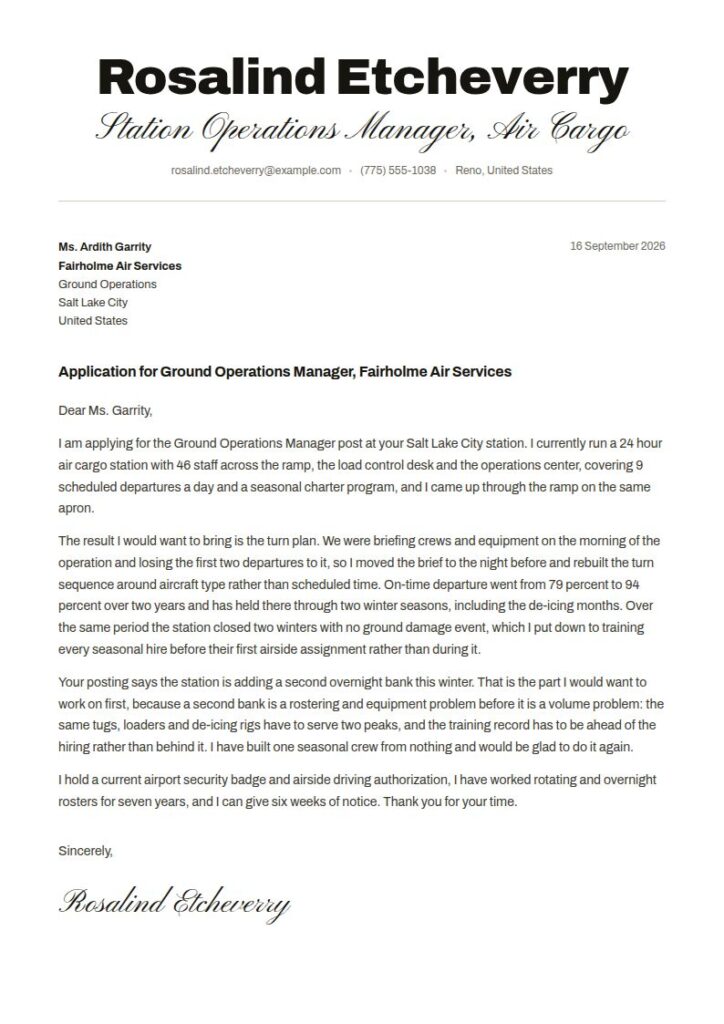
I am applying for the Ground Operations Manager post at your Salt Lake City station. I currently run a 24 hour air cargo station with 46 staff across the ramp, the load control desk and the operations center, covering 9 scheduled departures a day and a seasonal charter program, and I came up through the ramp on the same apron.
The result I would want to bring is the turn plan. We were briefing crews and equipment on the morning of the operation and losing the first two departures to it, so I moved the brief to the night before and rebuilt the turn sequence around aircraft type rather than scheduled time. On-time departure went from 79 percent to 94 percent over two years and has held there through two winter seasons, including the de-icing months. Over the same period the station closed two winters with no ground damage event, which I put down to training every seasonal hire before their first airside assignment rather than during it.
Your posting says the station is adding a second overnight bank this winter. That is the part I would want to work on first, because a second bank is a rostering and equipment problem before it is a volume problem: the same tugs, loaders and de-icing rigs have to serve two peaks, and the training record has to be ahead of the hiring rather than behind it. I have built one seasonal crew from nothing and would be glad to do it again.
I hold a current airport security badge and airside driving authorization, I have worked rotating and overnight rosters for seven years, and I can give six weeks of notice. Thank you for your time.
Sincerely, Rosalind Etcheverry
Openings that work
| Instead of | Use |
|---|---|
| I have always been passionate about aviation | I run a 24 hour air cargo station with 46 staff across the ramp, load control and operations |
| I am writing to apply for the advertised position | I am applying for the Ground Operations Manager post at your Salt Lake City station |
| I have strong attention to detail and work well under pressure | I came up through the ramp on the same apron and have worked rotating and overnight rosters for seven years |
| I am seeking a challenging role in the aviation industry | On-time departure went from 79 percent to 94 percent over two years and has held there |
What counts as evidence in aviation
For example, pick two, and give each a period. Aviation reads claims as records, so write them as records.
| Kind of evidence | What it looks like in a sentence |
|---|---|
| Volume | Worked 14 to 18 turns a shift across turboprop freighters and business jets |
| Punctuality | Took on-time departure from 79 percent to 94 percent over two years |
| Safety record | Closed two winter seasons with no ground damage event and no reportable airside vehicle incident |
| Readiness | Trained every seasonal hire before their first airside assignment |
| Roster | Worked rotating and overnight patterns for seven years, including full de-icing seasons |
However, safety is where the temptation to write a paragraph is strongest and the payoff smallest: a named record with a period beats a stated commitment.
One letter per side of the fence
Say which of the five markets you are applying to in the first line. Give the aircraft type and the volume. Write the ticket that admits you in that market's own words: hours and ratings for the flight deck, the cabin certificate and your fleet types, the Airframe and Powerplant ratings for the hangar, the training route for the tower, the badge and employer training for the ground. Name one real thing from their posting.
Do not open with a love of flight. Do not send a ramp letter to a hangar or a hangar letter to a station. Do not claim an aircraft type you have only worked around. Do not identify a crew member, a customer or a specific incident. Do not leave a training line undated.
The side of the fence is the pay decision, not the letter
The five markets pay very differently for work that happens within sight of itself. As of May 2025 the Bureau of Labor Statistics put airline pilots, copilots and flight engineers at a median of $232,140, air traffic controllers at $148,080, aircraft mechanics and service technicians at $79,870 and flight attendants at $63,580, while ground handling is paid off the hand laborers and material movers scale at $38,220 (BLS Occupational Outlook Handbook, last modified 27 August 2026).
Sizes differ as sharply, and not in the direction most people expect: 24,000 air traffic controllers against 133,700 flight attendants and 159,800 aircraft and avionics mechanics and technicians, all 2025 (BLS Occupational Outlook Handbook, last modified 27 August 2026).
A cover letter cannot move those numbers. It can make sure the right manager reads it, which is the argument for naming your side of the fence in the first line.
Length, format and sending it
One page, four paragraphs, 250 to 400 words. PDF unless the portal says otherwise, named for yourself and the post: rosalind-etcheverry-ground-operations-manager-cover-letter.pdf.
Address a person. An operator's site usually names station and base leadership; for this reason, a generic salutation on an otherwise specific letter reads as one file sent to every station in the region.
Use the same figures as your resume so the two agree. Our aviation resume example is written with the numbers used here.
Key takeaways
- First, name your side of the fence in the first line: flight deck, cabin, hangar, tower or ground.
- Give the aircraft type and the volume before anything about yourself.
- Then use one change you made, with a number and a period attached.
- Also, write safety as a record, never as a commitment.
- In addition, name one real detail from their posting and say what you would work on.
- Finally, close with the ticket that admits you, your roster availability and your notice period.
- Above all, write a different letter for each market.
Write your aviation cover letter in 10 minutes with our AI cover letter builder.
Aviation cover letter questions, answered
How long should an aviation cover letter be?
One page, four paragraphs, 250 to 400 words. Station and base managers read applications in batches around an operation, and length is not read as effort.
Do I need a cover letter if the airline or handler uses a portal?
Attach one wherever there is a field for it. The portal collects the same structured answers from everyone: certificates, dates, availability. The letter is the only place you can say what you changed at your station and what it did to the numbers.
What do I write with no aviation experience at all?
Apply to the ground side, which is the only one of the five with no certificate at the door, and write the nearest work you have done in its vocabulary. Warehouse, dock, yard, fuel or heavy vehicle work all transfer. Give volume, shift pattern and safety record, then say plainly that you can pass the background check behind an airport security badge.
Should I mention hours or a private pilot license in a letter for a ground job?
One clause at the close, not in the opening. It shows you understand the operation. Lead with it and the reader assumes you will leave for the flight deck as soon as your hours allow, which is not what the post is for.
How do I write about a safety event I was involved in?
Only if the application asks, and then factually and without identifying anyone: what happened, what the finding was, and what changed afterwards. Aviation treats an honest, closed report as evidence of a working safety culture. What it cannot accept is discovering the event later from somebody else.