Nadia Sokolowski Warehouse Associate, Inbound and Replenishment Toledo, 43611, United States [email protected] · (419) 555-0952
11 September 2026
Ms. Danika Ruszkowski Operations Swan Creek Fulfillment Toledo, United States
Application for Warehouse Associate, Inbound, Swan Creek Fulfillment
Dear Ms. Ruszkowski,
I am applying for the Warehouse Associate post on the inbound side at Swan Creek Fulfillment. I have worked both ends of a 410,000 square foot third-party logistics building: three years inbound on receiving and put-away, and five years since on replenishment and outbound. I can work your twilight shift, 14:30 to 23:00, and I am available for the autumn to January ramp.
On the inbound side at Ottawa River Distribution I checked in 12 to 16 trailers a shift against bills of lading and advance ship notices across four client accounts, and I quarantined short and damaged receipts rather than posting them through to clear the dock. On the outbound side I keep roughly 2,100 pick faces fed ahead of each wave, which is what decides whether the pick path stalls at 19:00. I trained six new associates on receiving and put-away during the last autumn ramp.
Your posting says the inbound team is taking on two new client accounts this winter. Account starts are where receiving accuracy slips, because the paperwork and the put-away rules are new to everyone on the dock at once, and that is the work I would want to be part of. I would also cover the returns cage, which I do regularly when it backs up.
I am cleared by my current employer on electric pallet jack, walkie rider and stand-up reach truck, most recent evaluation 2025, and I hold an OSHA 10-hour General Industry card. I can start within two weeks of an offer. Thank you for your time.
Sincerely, Nadia Sokolowski
Summary
A warehouse worker cover letter names the part of the building you have worked in, the shift window you can cover, and one counted result from the floor. This guide gives you a full adaptable letter, the openings that work in a high-volume stack, and what changes when you apply to inbound rather than outbound.
Warehouse Worker cover letter examples by experience level
A warehouse worker cover letter is a one-page letter telling an operations manager which part of their building you have already worked in, which shift you can cover, and one thing you did that somebody counted.
That list is short on purpose. Warehouse hiring happens in batches against a start date two weeks away, and the letter that answers the scheduling question in its first three lines gets the call.
Guide to a warehouse worker cover letter
This guide and the warehouse worker cover letter example below will cover:
- How to structure the letter, paragraph by paragraph
- Why your flow position belongs in the first sentence
- What counts as evidence when nobody gave you a scorecard
- How to write shift and peak availability as an offer
- The openings that get a letter read
How to write a warehouse worker cover letter
| Paragraph | Its job | Length |
|---|---|---|
| Opening | The role, your flow position, your shift window | 2 to 3 sentences |
| Evidence | One area, one count, one thing that got better | 4 to 5 sentences |
| Fit | Something specific about their building, and what you would cover | 3 to 4 sentences |
| Close | Equipment clearance, availability, thank you | 2 sentences |
Put the door and the clock in your first three lines
An operations manager opening a folder of applications is not weighing character. They are holding a rota with a hole in it on a particular shift, in a particular part of the building. Write the two facts that close that gap: "I have worked inbound receiving for three years and replenishment and outbound for five, and I can work your twilight shift, 14:30 to 23:00."
If you have worked both ends of a building, say so in the first paragraph. Being moveable when volume shifts is worth more than any adjective.
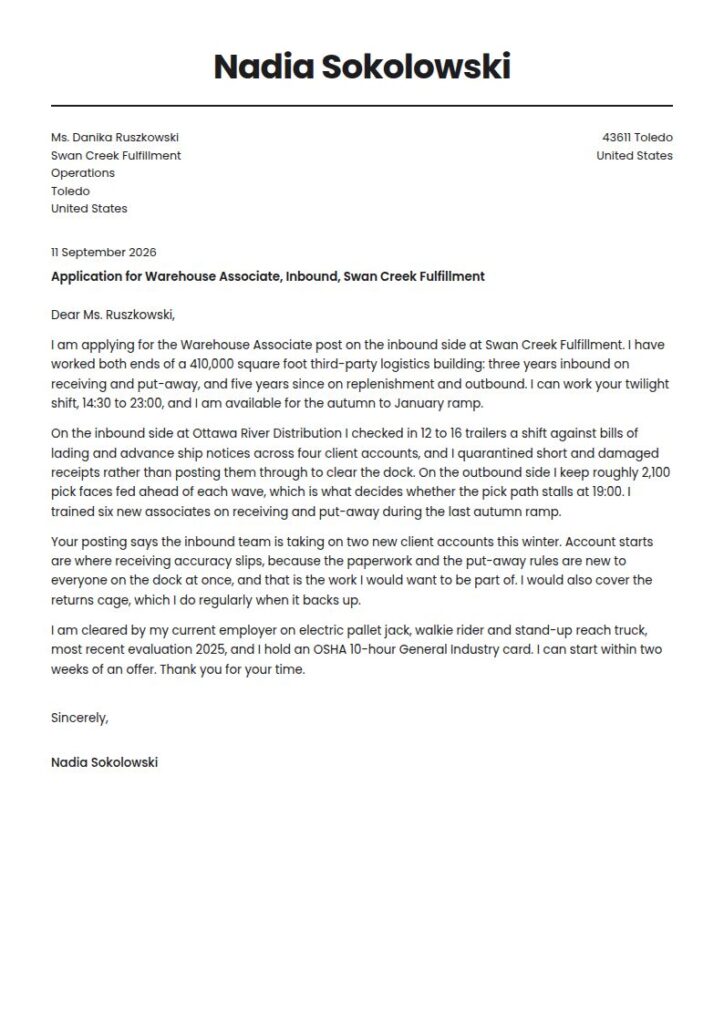
A warehouse worker cover letter example you can adapt
Dear Ms. Ruszkowski,
I am applying for the Warehouse Associate post on the inbound side at Swan Creek Fulfillment. I have worked both ends of a 410,000 square foot third-party logistics building: three years inbound on receiving and put-away, and five years since on replenishment and outbound. I can work your twilight shift, 14:30 to 23:00, and I am available for the autumn to January ramp.
On the inbound side at Ottawa River Distribution I checked in 12 to 16 trailers a shift against bills of lading and advance ship notices across four client accounts, and I quarantined short and damaged receipts rather than posting them through to clear the dock. On the outbound side I keep roughly 2,100 pick faces fed ahead of each wave, which is what decides whether the pick path stalls at 19:00. I trained six new associates on receiving and put-away during the last autumn ramp.
Your posting says the inbound team is taking on two new client accounts this winter. Account starts are where receiving accuracy slips, because the paperwork and the put-away rules are new to everyone on the dock at once, and that is the work I would want to be part of. I would also cover the returns cage, which I do regularly when it backs up.
I am cleared by my current employer on electric pallet jack, walkie rider and stand-up reach truck, most recent evaluation 2025, and I hold an OSHA 10-hour General Industry card. I can start within two weeks of an offer. Thank you for your time.
Sincerely, Nadia Sokolowski
Say which part of the building you want to work in
Most warehouse cover letters ask for "any available position". That sounds obliging and reads as unplaced, because the manager still has to work out where you would stand. Name the flow position instead, and name it twice: once as what you have done, once as what you are applying for.
| If you are applying to | Lead with | And add |
|---|---|---|
| Inbound receiving and put-away | Trailers a shift and the paperwork you checked against | How you handled shorts and damages |
| Replenishment | Pick faces fed, and whether you work ahead of the wave | What happened to short picks |
| Outbound pick and pack | Orders a shift and the cut time you worked to | Pack quality and what got rejected |
| Returns and reverse logistics | Units dispositioned a day and the categories | Restock cycle time and credit reconciliation |
Openings that work
| Instead of | Use |
|---|---|
| I am writing to apply for any available warehouse position | I am applying for the inbound Warehouse Associate post and I can work your twilight shift, 14:30 to 23:00 |
| I am a hard worker with a strong work ethic | I have worked three years inbound and five on replenishment and outbound in the same building |
What counts as evidence on a warehouse floor
Not every building hands out a scorecard. You almost always have a number anyway, if you look at what your day was measured against.
| Kind of evidence | What it looks like in a sentence |
|---|---|
| Volume | Checked in 12 to 16 trailers a shift across four client accounts |
| Coverage | Kept 2,100 pick faces fed ahead of each wave through the autumn ramp |
| An exception you caught | Quarantined short and damaged receipts rather than posting them through to clear the dock |
| Being asked back | Returned for a second and third peak season at the same site |
That last row is worth more than applicants think. In an occupation with about 904,200 openings a year against employment of 6,917,800, most of them replacements (BLS Occupational Outlook Handbook, 2025 to 2035 projections), a site that invited you back tells the next employer something no adjective can.
Shift, peak and the availability paragraph
Write the clock times and the days, then the thing most applicants will not take on: the overnight rotation, Saturday receiving, the autumn to January ramp, freezer or chill.
Name the flow position in the first sentence and give your shift window in clock times. Give one count from the floor and one thing that got better. Say if you have worked both ends of the building. Name the peaks you have worked and whether you are available for the next one.
Do not ask for "any available position". Do not describe yourself as hard-working, reliable or detail-oriented, because every letter in the folder does. Do not claim a forklift license, since certification under OSHA 29 CFR 1910.178(l) belongs to the employer and the site. Do not run past one page.
Which half of the occupation you are writing to
Hand laborers and material movers split across two halves of the economy with a real pay gap. Retail trade employs 35 percent of the group at a median of $36,090, and transportation and warehousing employs 22 percent at a median of $44,710, against a group median of $38,220 (BLS Occupational Outlook Handbook, May 2025).
The vocabulary of your letter tells a reader which half you come from. Trailers, advance ship notices, load plans, waves and cut times read as distribution. "Stocking and general duties" reads as a stockroom, and is answered at stockroom rates.
Length, format and sending it
One page, four paragraphs, 250 to 400 words. PDF unless the portal asks for Word, named for yourself and the post: nadia-sokolowski-warehouse-associate-cover-letter.pdf. Address a person where you can find one: "To Whom It May Concern" on an otherwise specific letter reads as a file sent to twelve buildings.
Keep the same numbers as your resume so the two agree. Our warehouse worker resume example uses the figures here, and the free ATS checker will tell you whether the pair parses cleanly.
Key takeaways
- Name the flow position you have worked in the first sentence.
- Give your shift window in clock times, not as "flexible".
- Say whether you are available for the autumn to January ramp.
- Use one count from the floor and one thing that got shorter.
- Name one real detail about their building, from their own posting.
- Call your truck clearance employer-certified and give the evaluation year.
- Address a named person and keep it to one page.
Write your warehouse worker cover letter in 10 minutes with our AI cover letter builder.
Warehouse worker cover letter questions, answered
How long should a warehouse worker cover letter be?
One page, four paragraphs, 250 to 400 words. These are read in batches against a start date, and length does not read as effort.
Do I need a cover letter if the application is just an online form?
Attach one wherever there is a field for it. The form collects the same answers from everybody; the letter is the only place to say which end of the building you have worked and which shift you can cover.
What do I write with no warehouse experience at all?
Write the two things a building screens for at entry: your shift availability in clock times, and whether you are cleared on powered equipment. If you are not, say you are willing to be trained on site. Then give a counted result from anywhere you have worked: a stocking rate, a line count, tickets an hour.
Should I mention that most of my work has been through an agency?
Yes, presented as one block with the sites underneath. Administrative and support services, which includes temporary help, employs 11 percent of hand laborers and material movers (BLS Occupational Outlook Handbook, May 2025), so agency work is ordinary here.
How do I write about peak season without sounding temporary?
Say how many peaks you have worked, where, and what you were trusted with by the end of each one. Peak is when buildings hire most and decide who they want back, so offering to work the next one reads as steady.