Title Assistant, Licensed Florida Title Agent Yadira Zamarripa
Title Assistant
[email protected] | (813) 555-1309 | Fort Myers, United States
Profile
Title assistant supporting a residential closing pipeline of roughly 70 files a month across six Florida counties, handling search ordering, examination intake, payoff and estoppel requests and commitment assembly. Cleared 214 curative items last year, mostly unreleased mortgages, open permits and name variances, and cut the average age of an outstanding requirement from 11 days to 4 by moving payoff requests to the day the commitment issued. Completed the 40 hour Florida title insurance course and hold a 4-10 resident title agent license.
Work Experience
08/2016 - Present, Title Assistant, Estero Bay Title Agency, Fort Myers, United States
- Support a residential pipeline of roughly 70 files a month across six Florida counties: search ordering, examination intake, payoff and estoppel requests, commitment assembly.
- Cleared 214 curative items last year, mostly unreleased mortgages, open permits and name variances.
- Cut the average age of an outstanding Schedule B requirement from 11 days to 4 by moving payoff requests to commitment day.
- Maintain the county recording checklists and track rejected instruments to re-recording.
06/2014 - 08/2016, Post-Closing Clerk, Estero Bay Title Agency, Fort Myers, United States
- Worked the post-closing queue: recording confirmation, final policy assembly and trailing document follow-up on roughly 60 files a month.
- Built the first rejection log by county, which became the pre-recording checklist.
Education
08/2012 - 05/2014, Associate of Arts, Business Administration, Hillsborough Community College, Tampa, United States
Followed by the 40 hour Florida approved title insurance classroom course, completed 2016.
Skills
Search ordering and examination intake, 80
Commitment assembly, 75
Payoff and estoppel procurement, 85
Schedule B requirement tracking, 75
Recording and post-closing, 85
County recorder and clerk of court portals, 85
Languages
English, native
Spanish, native
Certificates
03/2017, Florida Resident Title Insurance Agent, license type 4-10, Florida Department of Financial Services
Active and appointed. Continuing education current.
05/2016, Notary Public, State of Florida, Florida Department of State
Commission current.
Summary
A title insurance coordinator resume is a one to two page document built on the file clock: searches ordered, commitments issued and reviewed, defects cured before closing, the closing disclosure date protected, and instruments recorded clean. This guide gives you three adaptable versions, a curative worked example, and current federal data for the occupations around it.
Title Insurance Coordinator resume examples by experience level
A title insurance coordinator resume is a one to two page document about a clock. Files arrive with a closing date already promised to a buyer, a seller, a lender and two agents, and the coordinator is responsible for getting a clean, insurable title to that date.
Volume alone does not carry the page. Two candidates both write "coordinated title files"; the one who gets called wrote how many files, how many defects were cured before closing rather than after, how many closings moved because of a title issue, and what the recording rejection rate was.
Resume guide for a title insurance coordinator resume
This guide and the corresponding title insurance coordinator resume example will cover:
- How to write a title insurance coordinator resume, section by section
- The file clock, and how to put your ownership of it on the page
- Three adaptable summaries: assistant, coordinator and senior coordinator
- What to quantify: files, cure rate, closing date integrity, recording rejections
- Licensing, and why the state you work in changes the document
How to write a title insurance coordinator resume
Six blocks: contact header, a summary with volume and property types, the file clock block, work history, license and certifications, and skills. One page for your first five years, two once you carry commercial files or supervise a pipeline.
The license block sits high, because in most states it is a gate rather than an achievement. A coordinator working under an appointed agent is a different proposition from one licensed and appointed themselves, and the reader wants that settled first.
| Block | What it is answering | Where it goes |
|---|---|---|
| License and appointment | Can this person sign, disburse or bind under our underwriter? | Under the summary |
| File clock | Do they own a closing date, or only perform the steps? | Its own block, in a table |
| Curative work | Which defects have they cleared, and how? | Inside the file clock block |
| Experience | Volume, property types, states and counties | Reverse chronological, with numbers |
Name your states and counties; this job does not travel by default
Title work is local law and local practice. Rate regulation is set state by state, and in some states the premium is not something an agency competes on at all. In Texas the Department of Insurance sets title insurance premium rates and policy forms by commissioner's order, with the current basic premium rate chart effective 1 March 2026 (Texas Department of Insurance, Texas Title Insurance Basic Premium Rates, page updated 5 June 2026). Other states work differently.
Licensing varies just as much. In Florida a resident title insurance agent must complete a 40 hour department-approved classroom course in title insurance within four years of applying, or show at least one year of responsible title insurance duties in the previous four, then pass an examination and be fingerprinted, and may not sell a policy for an insurer that has not appointed them (Florida Department of Financial Services, Resident Title Insurance Agent 4-10 license requirements, retrieved 17 September 2026).
Your state regulator is the source that governs you, not this page. The resume point is that a hiring manager in one state cannot assume your experience transfers, so name the states, the counties and the appointments you hold.
Run the finished file through the ATS resume checker before you send it. Title agencies and their underwriters almost always parse applications into a system first.
Choosing the best resume format for a title insurance coordinator resume
Reverse chronological, with the file clock block directly under the summary. The reader is assessing whether you have carried a pipeline through to recording, and the timeline is the evidence. Functional formats fail here for a specific reason: this job is a sequence, and a format that hides which years you spent on which step hides the only progression that matters.
Include your contact information
| ✅ Right | ❌ Wrong |
|---|---|
| Yadira Zamarripa | Yadira Zamarripa |
| Title Insurance Coordinator, Licensed Florida Title Agent | Detail-oriented real estate professional |
| FL 4-10 resident title agent license, appointed | Licensed and experienced |
| (813) 555-1309, [email protected], Tampa, FL | (813) 555-1309, [email protected] |
Put the license type on the page. A reader who has to work out whether you are licensed assumes you are not, and that assumption decides what they can put you on.
Make use of a summary
Four lines: volume and property types, the states and counties you work, one number about the clock, and license status.
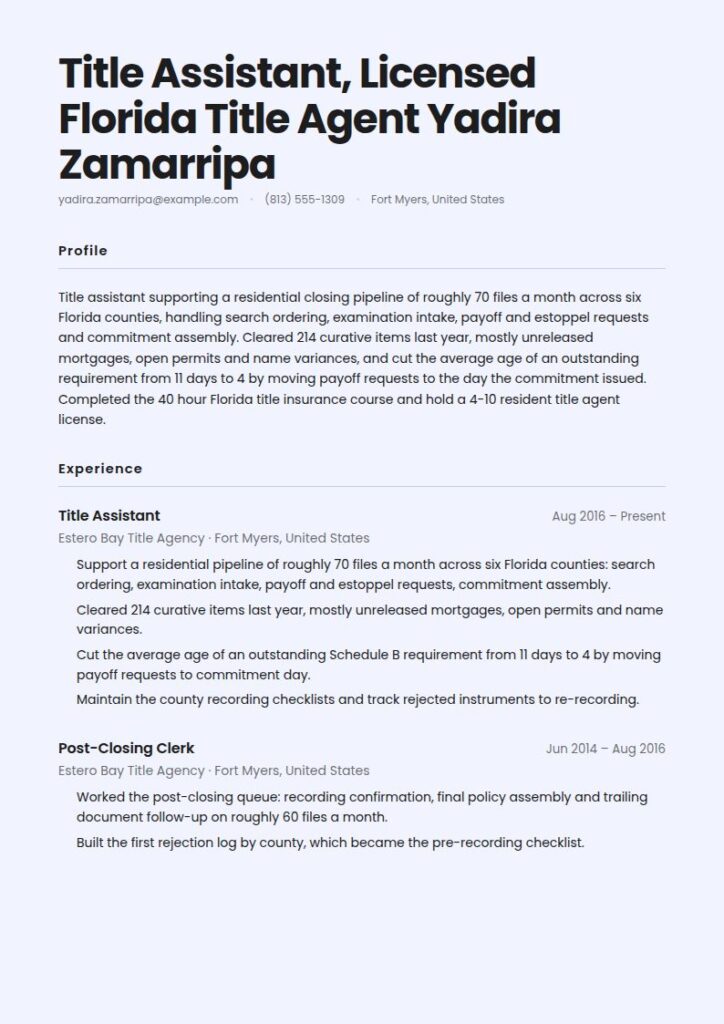
Title assistant supporting a residential closing pipeline of roughly 70 files a month across six Florida counties, handling search ordering, examination intake, payoff and estoppel requests and commitment assembly. Cleared 214 curative items last year, mostly unreleased mortgages, open permits and name variances, and cut the average age of an outstanding requirement from 11 days to 4 by moving payoff requests to the day the commitment issued. Completed the 40 hour Florida title insurance course and hold a 4-10 resident title agent license.
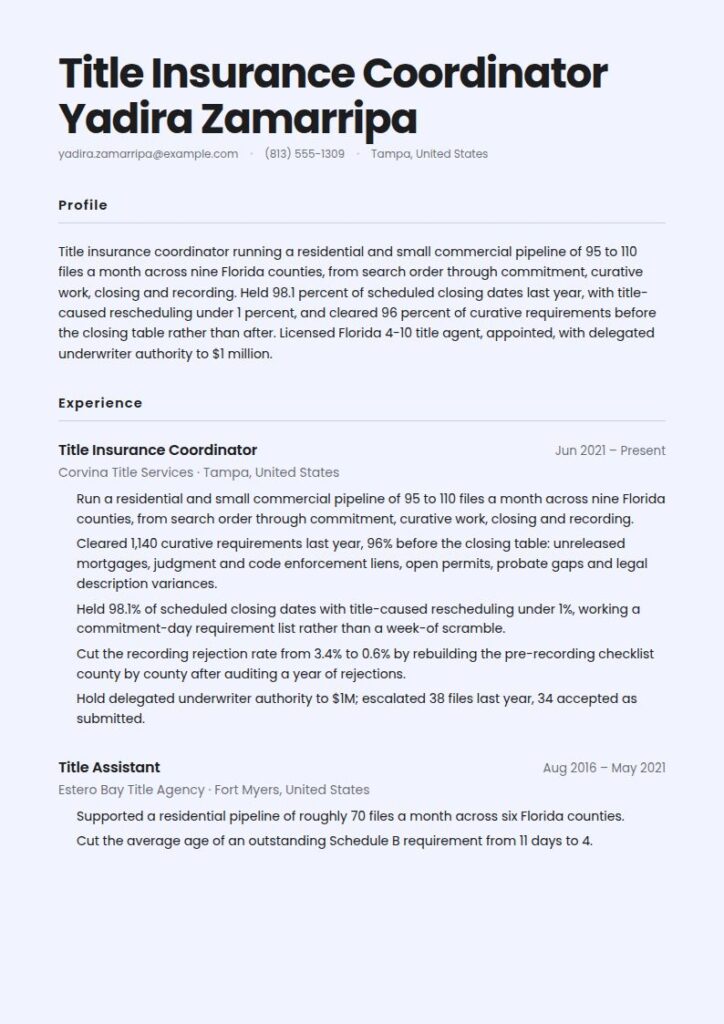
Title insurance coordinator running a residential and small commercial pipeline of 95 to 110 files a month across nine Florida counties, from search order through commitment, curative work, closing and recording. Held 98.1 percent of scheduled closing dates last year, with title-caused rescheduling under 1 percent, and cleared 96 percent of curative requirements before the closing table rather than after. Licensed Florida 4-10 title agent, appointed, with delegated underwriter authority to $1 million.
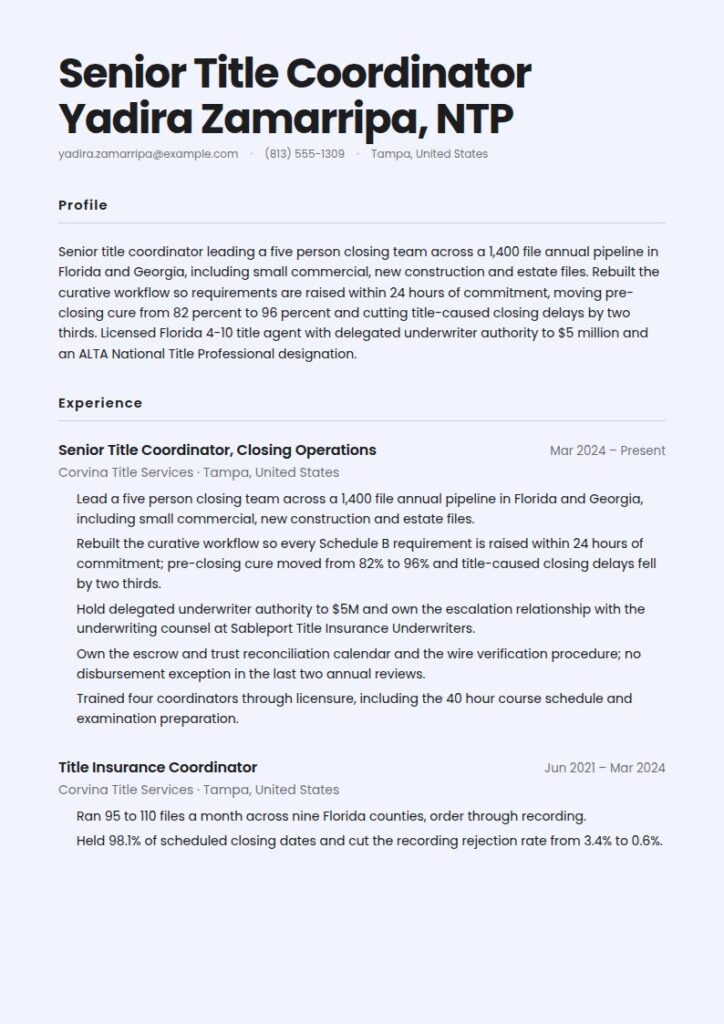
Senior title coordinator leading a five person closing team across a 1,400 file annual pipeline in Florida and Georgia, including small commercial, new construction and estate files. Rebuilt the curative workflow so requirements are raised within 24 hours of commitment, moving pre-closing cure from 82 percent to 96 percent and cutting title-caused closing delays by two thirds. Licensed Florida 4-10 title agent with delegated underwriter authority to $5 million and an ALTA National Title Professional designation.
Right vs wrong: the same title insurance coordinator summary, twice
| ✅ Right | ❌ Wrong |
|---|---|
| Runs 95 to 110 residential and small commercial files a month across nine Florida counties. | Experienced title professional with a strong background in real estate closings. |
| Held 98.1 percent of scheduled closing dates, with title-caused rescheduling under 1 percent. | Consistently ensured smooth and timely closings for all parties involved. |
| Cleared 96 percent of curative requirements before the closing table rather than after. | Skilled at resolving title issues and working with underwriters. |
The right column is a production record. The left is a description of the job, which every applicant writes.
Outline your title and closing experience
Agency, what it closes, the states and counties, the monthly file volume, and dates. Then four or five bullets, each carrying a number tied to the clock or to a defect.
| Instead of | Use |
|---|---|
| Coordinated title files from opening to closing | Ran 95 to 110 residential and small commercial files a month across nine Florida counties, order to recording |
| Resolved title issues | Cleared 1,140 curative requirements last year, 96% of them before the closing table |
| Worked with underwriters | Hold delegated authority to $1M; 38 escalations last year, 34 accepted as submitted |
| Ensured timely closings | Held 98.1% of scheduled closing dates; title-caused rescheduling under 1% |
| Handled recording | Recording rejection rate 0.6%, from 3.4%, after rebuilding the pre-recording checklist by county |
Title Insurance Coordinator, Corvina Title Services, Tampa, FL, June 2021 to Present
Run a residential and small commercial pipeline of 95 to 110 files a month across nine Florida counties, from search order through commitment, curative work, closing and recording.
Cleared 1,140 curative requirements last year, 96 percent of them before the closing table: unreleased mortgages, judgment and code enforcement liens, open permits, probate gaps and legal description variances.
Held 98.1 percent of scheduled closing dates with title-caused rescheduling under 1 percent, working a commitment-day requirement list rather than a week-of scramble.
Cut the recording rejection rate from 3.4 percent to 0.6 percent by rebuilding the pre-recording checklist county by county after an audit of a year of rejections.
Hold delegated underwriter authority to $1 million; escalated 38 files last year, 34 accepted as submitted.
The file clock: order, commitment, cure, disclosure, recording
This is the section that separates a title insurance coordinator resume from an examiner's and from a loan processor's. An examiner is assessed on whether the search was complete and the judgement sound; a processor on the borrower's conditions; a coordinator on whether a clean, insurable title reaches a promised date.
Write the clock as a table. Six lines, and it is the fastest way to show you own a closing rather than perform steps inside one.
| Station | What has to happen | Who you are chasing | Where files die |
|---|---|---|---|
| Order and open | File opened, search ordered, parties and payoff contacts collected | Agent, lender, seller | An order placed without the legal description confirmed |
| Commitment issued | Search examined, Schedule B requirements and exceptions set | Examiner, underwriter | Nobody reads the requirements until closing week |
| Curative | Each requirement worked to a recordable or waivable resolution | Payoff lenders, municipalities, courts, heirs, surveyors | A release needing a signature from a lender that no longer exists |
| Figures | Settlement figures agreed against the lender's numbers | Lender, agents, payoff and estoppel sources | An estoppel letter with a number nobody budgeted |
| Disclosure and closing | Closing disclosure delivered in time, documents executed | Lender, closer, parties | A change that restarts a waiting period nobody scheduled for |
| Recording and policy | Instruments recorded, gap covered, policy issued | County recorder, underwriter | A rejected instrument sitting unnoticed for a week |
The curative block, written as resolutions rather than problems
Volume of defects is background. What you did with each one is the job.
| Requirement | How it gets cleared |
|---|---|
| Unreleased mortgage | Payoff ordered, release obtained and recorded, or a requirement that the release record before policy |
| Judgment, tax or code enforcement lien | Payoff at closing with the case number and amount stated, or a recorded satisfaction |
| Open or expired building permit | Municipal permit search, inspection and closeout, or an agreed escrow with a written scope |
| Probate or heirship gap | Personal representative deed, order of summary administration, or referral to counsel |
| Legal description or name variance | Scrivener's affidavit or corrective instrument, executed and recorded, never silently amended |
| Survey matter, encroachment or easement | Survey obtained, specific exception drafted, or an underwriter-approved endorsement |
Write yours as counts by category for a year, plus the share cleared before closing. That percentage is the most useful number on the page: it separates a coordinator who works the requirement list on commitment day from one who discovers it on Thursday for a Friday closing.
The closing disclosure date is a date you protect
The coordinator usually knows first when a change threatens the closing date, and saying so reads as competence rather than compliance recital.
Under Regulation Z, the creditor "shall ensure that the consumer receives the disclosures required under paragraph (f)(1)(i) of this section no later than three business days before consummation" (12 CFR 1026.19(f)(1)(ii)(A), Electronic Code of Federal Regulations, current as of 15 September 2026). Three changes then require a corrected disclosure and a new three business day waiting period: the annual percentage rate becoming inaccurate, the loan product changing, and a prepayment penalty being added (12 CFR 1026.19(f)(2)(ii), same source).
The disclosure duty belongs to the creditor and the interpretation to your agency's counsel. The resume claim is operational: you flag figure changes early enough for the lender to act, and you schedule around the waiting period rather than into it.
Write the recording and gap numbers; almost nobody does
Two coordinators both write "handled recording". One adds: "recording rejection rate 0.6 percent, down from 3.4 percent, after auditing a year of rejections and rebuilding the pre-recording checklist by county".
Only the second sentence proves the person understands what happens after the table. A rejected instrument is an unrecorded interest, an unclosed gap and eventually a claim, and it is invisible to anyone who has not worked a recording queue. Pull the figure from your agency's recording log for a year; if nobody tracks it, count a quarter and say so.
Build a snapshot of your key skills
Twelve to fourteen entries in four groups. Keep the systems group specific, because title production platforms are not interchangeable.
File management: Search ordering and examination intake, Commitment assembly and review, Schedule B requirement tracking, Closing date management, Policy issuance
Curative: Payoff and release procurement, Lien and judgment resolution, Permit closeout, Estoppel reconciliation, Probate documents, Corrective instruments and affidavits
Closing and funds: Settlement statement preparation, Escrow and trust reconciliation, Disbursement control, Wire verification and fraud screening, Recording and gap coverage
Systems and sources: Title production and closing platforms, county recorder and clerk of court portals, municipal lien search vendors, underwriter portals and rate calculators
List your education, license and certifications
License first with its type and status, then appointments, then designations, then education.
Florida Resident Title Insurance Agent, license type 4-10, Florida Department of Financial Services, active and appointed.
National Title Professional designation, American Land Title Association, 2025. Notary Public, State of Florida, commission current.
Associate of Arts, Business Administration, Hillsborough Community College, Tampa, FL, 2014. Continuing education current, including annual title insurance and escrow accounting hours.
A degree is not a requirement for this occupation and a license often is. If you are not yet licensed, say what you have completed toward it and what remains; that is a shorter conversation than an omission.
Choose the right layout and design
Single column, 11 point, plain headings, no photograph. The file clock and curative blocks are the two places here where a table reads faster than sentences; use prose everywhere else. Keep tables to two or three columns with no merged cells, and do not put the license into a header graphic, because agency applicant systems flatten a document before anyone opens it.
Put the license type and appointment status in the first block. Give monthly file volume and property types together. State the share of curative requirements cleared before closing. Report closing date integrity and title-caused rescheduling as two numbers. Name your states and counties. Give the recording rejection rate. Name the title production platform and the county portals you use.
Do not write "coordinated title files" without a volume. Do not list defects found without saying how each type was resolved. Do not put a property address, a party name, a loan number or a file number on the page, ever. Do not claim delegated underwriter authority you do not hold; it is verified in the first reference call. Do not describe yourself as detail-oriented, because the numbers do that or nothing does.
Title insurance coordinator job market and outlook
Be precise about what the federal data covers, because there is no Occupational Outlook Handbook profile for title insurance coordinator and the closest published occupation is one the Handbook does not profile in detail either.
| Occupation | Employment, 2025 | Projected change, 2025 to 2035 | Annual openings | Median annual wage, May 2025 |
|---|---|---|---|---|
| Title examiners, abstractors and searchers | 59,800 | +1,300, which is 2 percent | Not published | $58,650 |
| Loan officers | 283,000 | 1 percent growth | ~17,100 | $76,690 |
| Real estate brokers and sales agents | 530,600 | +8,300, which is 2 percent | ~40,400 | $57,400 |
Source: U.S. Bureau of Labor Statistics, Occupational Outlook Handbook, May 2025 wage data and 2025 to 2035 projections, including the Data for Occupations Not Covered in Detail page, all last modified 27 August 2026.
None of those is your job. A title insurance coordinator sits between the first two: the work is the title chain and the closing file, and the pace is set by lending volume.
A small occupation next to a much larger one it depends on
Title examiners, abstractors and searchers numbered 59,800 in 2025, with employment projected to rise 1,300, or 2 percent, through 2035 and a median annual wage of $58,650 as of May 2025 (BLS Occupational Outlook Handbook, Data for Occupations Not Covered in Detail, last modified 27 August 2026). Because that occupation has no detailed profile, BLS publishes no percentile spread and no annual openings estimate for it.
Next to it sits the transaction volume that creates the work: real estate brokers and sales agents numbered 530,600 in 2025 with about 40,400 openings a year, and loan officers 283,000 with about 17,100 (same Handbook, 2025 to 2035 projections).
Title coordination is a small, credentialed occupation attached to a large and cyclical one. Hiring follows capacity in agencies that already exist rather than scaling smoothly with transactions, which is why volume, cure rate and closing date integrity carry a resume here. In a small market, the file that proves throughput gets the interview.
What salary you can expect as a title insurance coordinator
There is no published median for this job title. The nearest published occupation, title examiners, abstractors and searchers, had a median annual wage of $58,650 as of May 2025, and because it has no detailed Handbook profile there is no published tenth or ninetieth percentile to quote (BLS Occupational Outlook Handbook, May 2025 wage data). Treat any range you are offered as an employer band, not a federal figure.
For context inside the same transaction, loan officers had a median of $76,690 and real estate brokers and sales agents $57,400 as of May 2025, brokers at $73,220 and sales agents at $52,830 (same source). Coordination work sits in that neighborhood, with the stability of a salaried back-office role rather than the spread of a commissioned one.
Four things move an offer and all four fit on the page. Licensure is first, because a licensed and appointed coordinator can do things an unlicensed one cannot. Property type is second: commercial, new construction and estate files price above residential refinance. Delegated underwriter authority is third, since it removes a senior person from the file. Throughput is fourth and is the one candidates leave out: monthly volume, pre-closing cure rate and closing date integrity, each with a period attached.
Key takeaways for a title insurance coordinator resume
- Lead with license type and appointment status; in most states it is a gate.
- Give monthly file volume with property types and counties in one line.
- Write the file clock as a table, station by station.
- State the share of curative requirements cleared before closing, not the count.
- Report closing date integrity and title-caused rescheduling separately.
- Include the recording rejection rate; almost nobody does.
- Never put a property, a party, a loan number or a file number on the page.
Build your title insurance coordinator resume in 15 minutes with our AI resume builder.
Related resume examples
- Career change resume
- Entry-level resume
- One-year experience resume
- General resume
- Buyer resume
- National sales controller resume
- Scientist resume
- Translator resume
- Self-employed resume
- Freelancer resume
- Part-time job resume
- Work-from-home resume
If your work is the search and the judgement rather than the file and the date, the title examiner resume example is written for that job instead. Pair this one with a matching title insurance coordinator cover letter.
Title insurance coordinator resume questions, answered
What is the difference between a title insurance coordinator and a title examiner?
An examiner searches the chain of title and decides what belongs on Schedule B. A coordinator takes the resulting commitment and drives the file to a clean recording by a promised date: ordering, curative work, payoffs and estoppels, settlement figures, closing logistics and recording. In a small agency one person often does both; if that is you, split your bullets so the reader sees how much of each.
Do I need a license to be a title insurance coordinator?
It depends on your state and on what your role touches. Handling premium, signing policies or acting for an insurer generally requires a license and an appointment; supporting work under a licensed agent often does not. Florida requires a 40 hour approved title insurance course within four years of applying or a year of responsible title duties, then an examination and fingerprinting, and prohibits selling a policy for an insurer that has not appointed the agent (Florida Department of Financial Services, Resident Title Insurance Agent 4-10 license requirements, retrieved 17 September 2026). Check your own regulator, not a job board.
What do I write with no title experience?
Write the adjacent work as production. Mortgage processing, escrow assistance, municipal records, paralegal support, insurance customer service and county recording all transfer, and all have volumes attached. Then name the state course you have completed or enrolled in, the software you have used and the counties you know. Someone who can work a recorder's portal and a payoff queue on day one is a real hire.
Can I mention marketing or referral relationships on the resume?
Describe the work, not the referrals. Settlement service referrals are regulated: under Regulation X, "No person shall give and no person shall accept any fee, kickback or other thing of value pursuant to any agreement or understanding" that settlement service business involving a federally related mortgage loan be referred to any person (12 CFR 1024.14, Electronic Code of Federal Regulations, current as of 15 September 2026). Your agency's counsel governs what your role may do. On a resume, a line about business developed is less persuasive than a line about files closed on time anyway.
What numbers should I collect before I write?
Five, all for one year: files closed, curative requirements cleared and the share cleared before closing, scheduled closing dates held, title-caused reschedulings, and recording rejections. If your agency does not track one, count a month or a quarter and say which. A stated sample is credible; an unlabeled estimate is not.