Yadira Zamarripa Title Insurance Coordinator, Licensed Florida Title Agent Tampa, 33602, United States [email protected] · (813) 555-1309
17 September 2026
Mr. Emeric Tamblyn Closing Operations Manager Alderbrook Title Group Sarasota, United States
Application for Title Insurance Coordinator, Alderbrook Title Group
Dear Mr. Tamblyn,
I am applying for the Title Insurance Coordinator post at Alderbrook Title Group. I am a licensed and appointed Florida 4-10 title agent carrying 95 to 110 residential and small commercial files a month across nine counties, from search order through commitment, curative work, closing and recording, with delegated underwriter authority to $1 million. Your posting mentions a pipeline that has outgrown its current process, which is the situation I was hired into three years ago.
At Corvina Title Services I changed one thing that moved everything else: every Schedule B requirement is now raised and worked within 24 hours of the commitment issuing, rather than in the week before closing. Curative requirements cleared before the closing table went from 82 percent to 96 percent, I held 98.1 percent of scheduled closing dates last year with title-caused rescheduling under 1 percent, and the recording rejection rate fell from 3.4 percent to 0.6 percent after I audited a year of rejections and rebuilt the pre-recording checklist county by county. The defects themselves did not change; the day we found them did.
Alderbrook's move into new construction closings is the part I would want to look at first. New construction brings notice of commencement, lien waiver collection and permit closeout onto the requirement list, and those items have longer lead times than the payoff and estoppel work a resale pipeline is built around. I would start by splitting the requirement templates by product type so the new construction files open with the right clock on them.
I hold delegated underwriter authority to $1 million and an active Florida appointment, and my continuing education is current. I can start within three weeks. Thank you for your time.
Sincerely, Yadira Zamarripa
Summary
A title insurance coordinator cover letter tells a closing manager your license status, how many files a month you carry, how many defects you cure before the table rather than after, and how many scheduled closing dates you held. This guide gives you a full adaptable letter, the evidence that counts when your files are confidential, and the openings that get a strong file read.
Title Insurance Coordinator cover letter examples by experience level
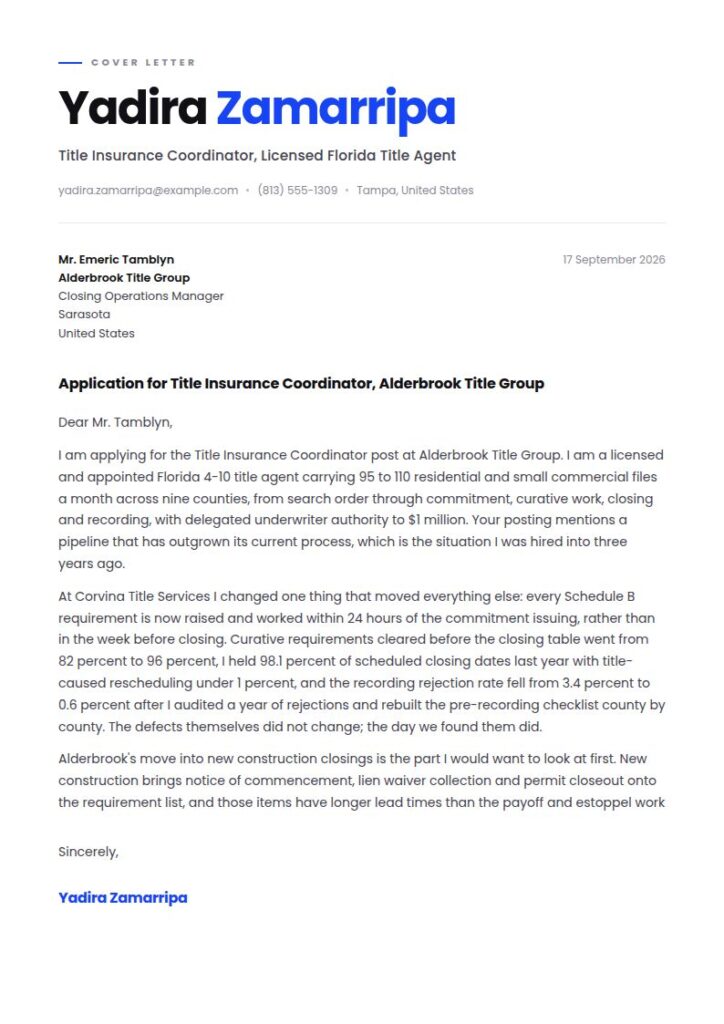
A title insurance coordinator cover letter is a one page letter that answers three questions before the reader has to ask them: are you licensed, how many files a month can you carry, and do your closings happen on the day they were promised.
The reader is usually a closing manager or an agency principal who is short-staffed and knows exactly what a missed closing costs. They are reading for throughput, and for whether you cure defects early or discover them late.
Guide to a title insurance coordinator cover letter
This guide and the corresponding title insurance coordinator cover letter example will cover:
- How to structure the letter, paragraph by paragraph
- Why license status and file volume belong in the first two sentences
- What counts as evidence when every file you have touched is confidential
- How the letter changes between residential refinance work and commercial files
- The openings that work and the ones that get a file set aside
How to write a title insurance coordinator cover letter
| Paragraph | Its job | Length |
|---|---|---|
| Opening | The post, your license status, your monthly file volume and counties | 2 to 3 sentences |
| Evidence | One workflow change, the mechanism, and the cure or closing number | 4 to 5 sentences |
| Fit | Something specific about their agency, and what you would look at first | 3 to 4 sentences |
| Close | Underwriter authority, availability, thank you | 2 sentences |
Lead with license, volume and counties, in that order
A closing manager reading applications is solving a capacity problem. The three facts that solve it are whether you are licensed and appointed, how many files a month you can carry, and which counties you already know.
"I am a licensed and appointed Florida 4-10 title agent carrying 95 to 110 residential and small commercial files a month across nine counties" answers all three in one sentence. Nothing else in the letter is worth as much.
Then give one number about the clock, because everybody claims to be organized and almost nobody puts a percentage next to it.
A title insurance coordinator cover letter example you can adapt
Dear Mr. Tamblyn,
I am applying for the Title Insurance Coordinator post at Alderbrook Title Group. I am a licensed and appointed Florida 4-10 title agent carrying 95 to 110 residential and small commercial files a month across nine counties, from search order through commitment, curative work, closing and recording, with delegated underwriter authority to $1 million. Your posting mentions a pipeline that has outgrown its current process, which is the situation I was hired into three years ago.
At Corvina Title Services I changed one thing that moved everything else: every Schedule B requirement is now raised and worked within 24 hours of the commitment issuing, rather than in the week before closing. Curative requirements cleared before the closing table went from 82 percent to 96 percent, I held 98.1 percent of scheduled closing dates last year with title-caused rescheduling under 1 percent, and the recording rejection rate fell from 3.4 percent to 0.6 percent after I audited a year of rejections and rebuilt the pre-recording checklist county by county. The defects themselves did not change; the day we found them did.
Alderbrook's move into new construction closings is the part I would want to look at first. New construction brings notice of commencement, lien waiver collection and permit closeout onto the requirement list, and those items have longer lead times than the payoff and estoppel work a resale pipeline is built around. I would start by splitting the requirement templates by product type so the new construction files open with the right clock on them.
I hold delegated underwriter authority to $1 million and an active Florida appointment, and my continuing education is current. I can start within three weeks. Thank you for your time.
Sincerely, Yadira Zamarripa
Openings that work
| Instead of | Use |
|---|---|
| I am writing to express my interest in the title coordinator position | I am a licensed and appointed Florida 4-10 title agent carrying 95 to 110 files a month across nine counties |
| I am a detail-oriented professional with real estate experience | I clear 96 percent of curative requirements before the closing table rather than after |
| I have a proven record of ensuring smooth closings | I held 98.1 percent of scheduled closing dates last year, with title-caused rescheduling under 1 percent |
| I would love the opportunity to join your team | Your move into new construction closings is the part I would want to look at first |
The right column can be verified in a reference call. The left column is what every other letter in the folder says.
What counts as evidence when every file is confidential
You cannot name a property, a party or a file. You do not need to.
| Kind of evidence | What it looks like in a sentence |
|---|---|
| Volume | 95 to 110 residential and small commercial files a month across nine counties |
| Cure rate | 96 percent of curative requirements cleared before the closing table |
| Date integrity | 98.1 percent of scheduled closing dates held, title-caused rescheduling under 1 percent |
| Recording | Rejection rate 0.6 percent, down from 3.4 percent, after a checklist rebuild by county |
| Escalation | Delegated authority to $1 million; 38 escalations last year, 34 accepted as submitted |
| Defect mix | Unreleased mortgages, judgment and code enforcement liens, open permits, probate gaps |
| Funds control | Escrow and trust reconciliation on a fixed calendar, no disbursement exception in two reviews |
Every one is a production statistic about you rather than information about a transaction. A property address, a party name, a loan number and a file number never belong on an application document.
Residential, commercial and refinance files read differently
Match the letter to the agency's product mix. A refinance-heavy shop wants speed and volume, so lead with files a month and turn time. A purchase and new construction shop wants requirement discipline, so lead with pre-closing cure rate and the defect types you handle. A commercial desk wants entity documents, surveys, leases and endorsements, so name the largest insured amount you have coordinated and the endorsements you have worked with. Say which states and counties you are current in, because practice is local.
Do not send the same letter to a residential refinance agency and a commercial desk. Do not claim delegated underwriter authority you do not hold; it is verified in the first reference call. Do not put a property, a party, a loan number or a file number in the letter. Do not recite regulation at the reader, who works with it every day. Do not describe yourself as detail-oriented in a letter that contains no numbers.
A small occupation attached to a large and cyclical one
There is no Bureau of Labor Statistics profile for title insurance coordinator, and the closest published occupation is not profiled in detail either. Title examiners, abstractors and searchers numbered 59,800 in 2025, with employment projected to rise by 1,300, or 2 percent, through 2035 and a median annual wage of $58,650 as of May 2025, with no published percentile spread and no annual openings estimate (BLS Occupational Outlook Handbook, Data for Occupations Not Covered in Detail, last modified 27 August 2026).
The transaction volume that generates the work is much larger. Real estate brokers and sales agents numbered 530,600 in 2025 with about 40,400 openings a year, and loan officers 283,000 with about 17,100 and a median of $76,690 (same Handbook, May 2025 wage data and 2025 to 2035 projections).
The hiring consequence is that openings here are capacity decisions inside agencies that already exist, not a wave you can ride. A letter that proves throughput in a named set of counties is competing for a small number of specific seats, and specificity is what wins them.
Length, format and sending it
One page, four paragraphs, 280 to 400 words. PDF unless the portal says otherwise, named for yourself and the post: yadira-zamarripa-title-coordinator-cover-letter.pdf.
Address a person. Agency principals and closing managers are named on almost every title company website, and "Dear Hiring Manager" on an otherwise specific letter reads as a file sent to eight agencies in one afternoon.
Use the same figures as your resume so the two agree. Our title insurance coordinator resume example is written with the numbers used here, and both are worth running through the free ATS checker before you send them.
Key takeaways
- Open with license status, monthly file volume and counties, in that order.
- Give one number about the clock, not a claim about being organized.
- Name the workflow change and what it moved, rather than listing duties.
- State delegated underwriter authority and the escalation record behind it.
- Match the letter to the agency's product mix, since refinance and commercial want different things.
- Never name a property, a party, a loan number or a file number.
- Address a named person and keep it to one page.
Write your title insurance coordinator cover letter in 10 minutes with our AI cover letter builder.
Title insurance coordinator cover letter questions, answered
How long should a title insurance coordinator cover letter be?
One page, four paragraphs, 280 to 400 words. Closing managers read these between files, and a second page does not read as thoroughness.
Should I write the letter differently if I am not licensed yet?
Yes, and be direct about it. Say where you are in the process: the course completed or booked, the examination date, the fingerprinting. Then lead with what you can do now. An unlicensed candidate who runs a curative queue well is useful from the first week, and most agencies would rather sponsor someone competent through licensure than wait.
What if my experience is escrow or mortgage processing rather than title?
Write it as production and map it explicitly. Payoff procurement, estoppel reconciliation, settlement figures, disbursement and recording appear in both jobs, and the volumes transfer directly. Then name the title-specific things you have touched: commitment review, Schedule B requirements, curative documents. A one-sentence map beats hoping the reader makes it for you.
Should I mention closing disclosure timing in the letter?
Only operationally, and briefly. The disclosure duty sits with the creditor, and the rule is that the consumer must receive the Closing Disclosure no later than three business days before consummation (12 CFR 1026.19(f)(1)(ii)(A), Electronic Code of Federal Regulations, current as of 15 September 2026). What a closing manager wants to hear is that you flag figure changes early enough for the lender to act and schedule around the waiting period rather than into it. One clause does that.
How do I write to an agency I do not know?
Spend ten minutes on their site first: the counties they close in, whether they advertise commercial or new construction work, which underwriters they are agents for, whether they have opened an office recently. One accurate sentence about what they are actually doing is the part of the letter that cannot be reused, and it is the part that gets read twice.