Title Searcher Otilia Markovich
Title Searcher
[email protected] | (216) 555-0144 | Cleveland, United States
Profile
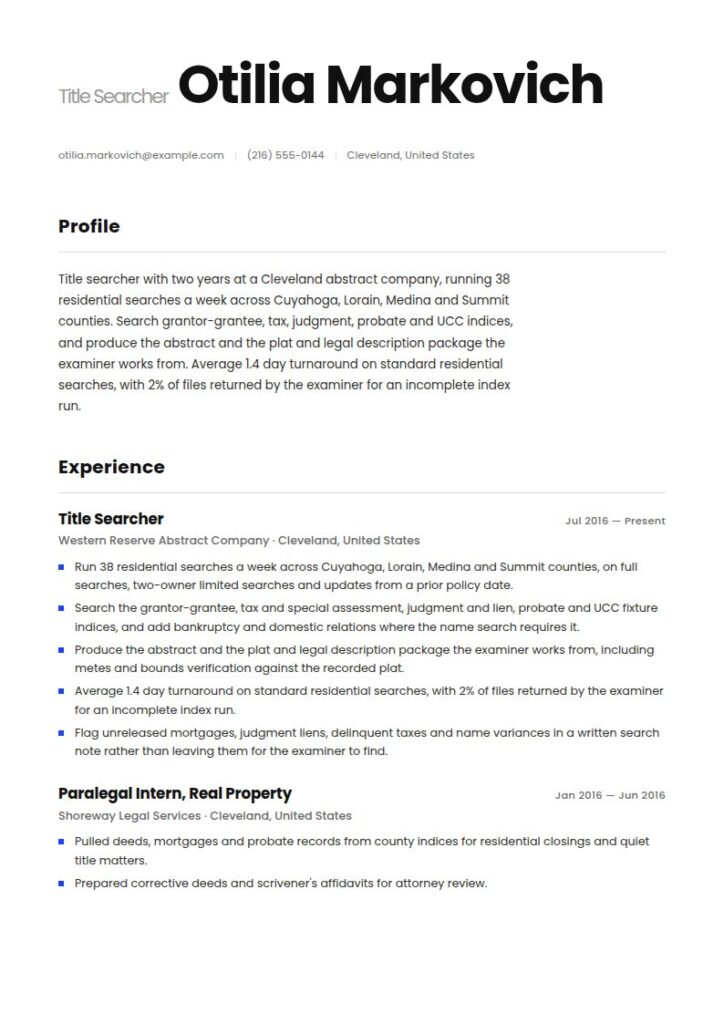
Title searcher with two years at a Cleveland abstract company, running 38 residential searches a week across Cuyahoga, Lorain, Medina and Summit counties. Search grantor-grantee, tax, judgment, probate and UCC indices, and produce the abstract and the plat and legal description package the examiner works from. Average 1.4 day turnaround on standard residential searches, with 2% of files returned by the examiner for an incomplete index run.
Work Experience
07/2016 - Present, Title Searcher, Western Reserve Abstract Company, Cleveland, United States
- Run 38 residential searches a week across Cuyahoga, Lorain, Medina and Summit counties, on full searches, two-owner limited searches and updates from a prior policy date.
- Search the grantor-grantee, tax and special assessment, judgment and lien, probate and UCC fixture indices, and add bankruptcy and domestic relations where the name search requires it.
- Produce the abstract and the plat and legal description package the examiner works from, including metes and bounds verification against the recorded plat.
- Average 1.4 day turnaround on standard residential searches, with 2% of files returned by the examiner for an incomplete index run.
- Flag unreleased mortgages, judgment liens, delinquent taxes and name variances in a written search note rather than leaving them for the examiner to find.
01/2016 - 06/2016, Paralegal Intern, Real Property, Shoreway Legal Services, Cleveland, United States
- Pulled deeds, mortgages and probate records from county indices for residential closings and quiet title matters.
- Prepared corrective deeds and scrivener's affidavits for attorney review.
Education
08/2014 - 05/2016, Associate of Applied Science, Paralegal Studies, Cuyahoga Community College, Cleveland, United States
Coursework in real property, civil procedure and legal research. Certificate in real estate documents and recording practice.
Skills
Grantor-grantee index searching, 85
Tax and special assessment records, 80
Judgment and lien searches, 75
Probate and estate records, 65
Plat and legal description verification, 75
County recorder and clerk of courts online indices, 85
Abstract preparation, 80
Microsoft 365, 80
Languages
English, native
Croatian, native
Certificates
03/2017, Notary Public, State of Ohio, Ohio Secretary of State, OH-2211784
Commission current, renewed on the standard Ohio cycle.
Summary
A title examiner resume is a one to two page document built on search competence and judgement: the search period you examine, the indices you search, the defects you have cleared, and what you put on Schedule B. This guide gives you three adaptable versions, a worked search to commitment workflow, and current Bureau of Labor Statistics employment and wage data.
Title Examiner resume examples by experience level
A title examiner resume is a one to two page document that proves two things: you can search a chain of title, and you have judgement about what belongs on Schedule B.
Those are the only two questions. Everything else, including speed, follows from them. An examiner who misses a judgment lien costs the underwriter a claim; an examiner who excepts to everything in sight costs the agency a deal and an angry lender call. The resume that shows volume, search type and how defects were actually resolved is the one that reads as competent rather than as careful.
Resume guide for a title examiner resume
This guide and the corresponding title examiner resume example will cover:
- How to write a title examiner resume, section by section
- The search to commitment workflow, and how to put your judgement on the page
- Three adaptable summaries: searcher, examiner and senior commercial examiner
- What to quantify: files a week, search types, property types, counties and states
- What the federal data does and does not publish about this occupation
How to write a title examiner resume
Six blocks: a contact header, a summary with your volume and search types, work history, a search and examination block, licenses and education, and skills. One page for your first six years, two once you examine commercial, multi-state or mineral title.
| Block | What it is answering | Where it goes |
|---|---|---|
| Summary | How many files a week, what kind, in which counties? | Top of the page, four lines |
| Work history | Which defects did they find, and how were they resolved? | Reverse chronological, a number in every bullet |
| Search and examination block | Which indices, which search types, which underwriters? | Its own block after experience |
| Jurisdictions | Which states and counties can they work tomorrow? | A single line, listed explicitly |
The jurisdictions line is the cheapest advantage on this page. Recording practice, indexing, tax cycles and search custom are county-level facts, and an examiner who already knows a county's quirks is productive in week one rather than week six.
Run the finished file through the free Rezoom ATS resume checker before you send it. Title agencies and underwriters both parse applications before anyone reads them.
Choosing the best resume format for a title examiner resume
Reverse chronological, single column, plain. One page early, two once you carry commercial or mineral work.
This is a document-handling occupation, which makes the format part of the evidence. A two column template that collapses into scrambled text in a parser has already answered a question about your attention to documents, and not in your favor.
Include your contact information
| ✅ Right | ❌ Wrong |
|---|---|
| Otilia Markovich | Otilia Markovich |
| Senior Title Examiner, Commercial and Mineral Title | Title professional with strong research skills |
| Ohio Title Insurance Agent, ODI #OH-4471928 | Licensed and experienced in title |
| (216) 555-0144, [email protected], Cleveland, OH | (216) 555-0144, [email protected] |
If you hold a title insurance agent license, put the state and the number on it. Escrow and settlement handling is regulated: Ohio, for example, requires a title insurance agent to keep books and records of the title insurance business, to "maintain a separate record of all receipts and disbursements of escrow funds" without commingling, to carry coverage protecting the parties against theft, misappropriation, fraud or failure to properly disburse, and to maintain an errors and omissions policy above limits set by the superintendent (Ohio Revised Code 3953.23, checked 12 September 2026). A reader who handles that risk wants your license visible.
Make use of a summary
Four lines: files a week, search types, property and jurisdiction coverage, and one quality number.
Title searcher with two years at a Cleveland abstract company, running 38 residential searches a week across Cuyahoga, Lorain, Medina and Summit counties. Search grantor-grantee, tax, judgment, probate and UCC indices, and produce the abstract and the plat and legal description package the examiner works from. Average 1.4 day turnaround on standard residential searches, with 2% of files returned by the examiner for an incomplete index run.
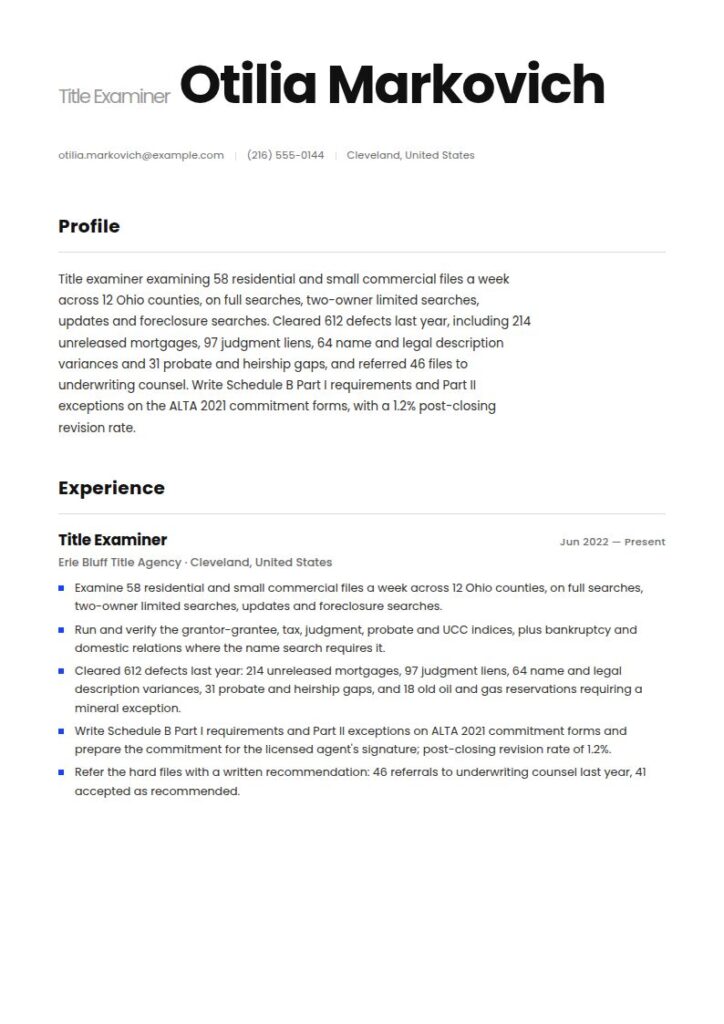
Title examiner examining 58 residential and small commercial files a week across 12 Ohio counties, on full searches, two-owner limited searches, updates and foreclosure searches. Cleared 612 defects last year, including 214 unreleased mortgages, 97 judgment liens, 64 name and legal description variances and 31 probate and heirship gaps, and referred 46 files to underwriting counsel. Write Schedule B Part I requirements and Part II exceptions on the ALTA 2021 commitment forms, with a 1.2% post-closing revision rate.
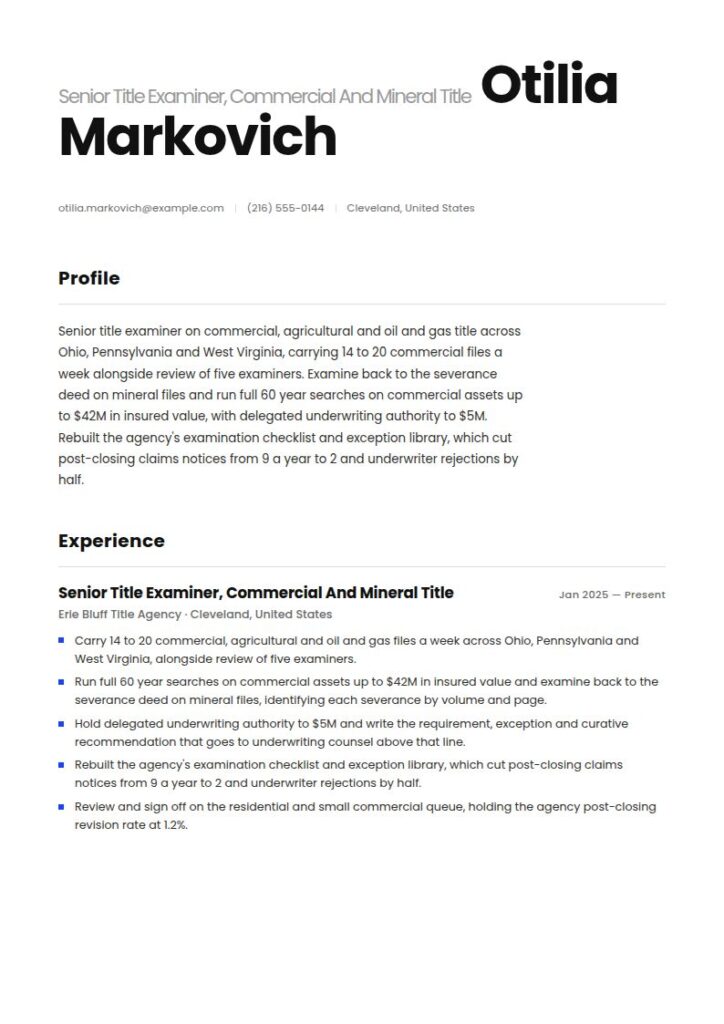
Senior title examiner on commercial, agricultural and oil and gas title across Ohio, Pennsylvania and West Virginia, carrying 14 to 20 commercial files a week alongside review of five examiners. Examine back to the severance deed on mineral files and run full 60 year searches on commercial assets up to $42M in insured value, with delegated underwriting authority to $5M. Rebuilt the agency's examination checklist and exception library, which cut post-closing claims notices from 9 a year to 2 and underwriter rejections by half.
Right vs wrong: the same title examiner summary, twice
| ✅ Right | ❌ Wrong |
|---|---|
| Examine 58 residential and small commercial files a week across 12 Ohio counties. | Experienced title examiner with excellent research and analytical skills. |
| Cleared 612 defects last year, including 214 unreleased mortgages and 97 judgment liens. | Responsible for reviewing title searches and identifying issues. |
| Write Schedule B Part I requirements and Part II exceptions, 1.2% post-closing revision rate. | Detail oriented, accurate and able to work under tight deadlines. |
The wrong column describes a job. The right column describes a person who has already done it at a volume the reader can compare with their own desk.
Outline your title examiner experience
Agency, underwriter or law firm, the property types, your title and dates. Then three to five bullets, each naming a search type or a defect class and carrying a number.
| Instead of | Use |
|---|---|
| Reviewed title searches for residential properties | Examined 58 files a week: full searches, two-owner limited searches, updates and foreclosure searches |
| Identified title issues and worked to resolve them | Cleared 612 defects in a year: 214 unreleased mortgages, 97 judgment liens, 64 legal description variances, 31 heirship gaps |
| Prepared title commitments | Wrote Schedule B Part I requirements and Part II exceptions on ALTA 2021 commitment forms, 58 a week |
| Worked with underwriters on difficult files | Referred 46 files to underwriting counsel with a written summary and a recommended exception, 41 accepted as written |
| Maintained quality and accuracy | Held the post-closing revision rate at 1.2% and had no claims notice attributable to my examination in three years |
Title Examiner, Erie Bluff Title Agency, Cleveland, OH, June 2022 to Present
Examine 58 residential and small commercial files a week across 12 Ohio counties, on full searches, two-owner limited searches, updates and foreclosure searches.
Run and verify the grantor-grantee, tax, judgment, probate and UCC indices, plus bankruptcy and domestic relations where the name search requires it.
Cleared 612 defects last year: 214 unreleased mortgages, 97 judgment liens, 64 name and legal description variances, 31 probate and heirship gaps, and 18 old oil and gas reservations requiring a mineral exception.
Write Schedule B Part I requirements and Part II exceptions, and prepare the commitment for the licensed agent's signature; post-closing revision rate of 1.2%.
Refer the hard files with a written recommendation: 46 referrals to underwriting counsel last year, 41 accepted as recommended.
The search to commitment workflow, and what goes on Schedule B
This is the section that separates a title examiner resume from a records clerk's, and it is the one almost nobody writes.
An examiner is hired on two things: whether the search was complete, and whether the judgement that followed it was sound. Both are provable on paper.
What a complete search means, written as evidence
State the search period and the indices, because "performed title searches" does not say whether you ran two owners back or sixty years.
| Element | What to put on the page |
|---|---|
| Search period | Full 60 year search, two-owner limited search, 40 year search to root of title, or update from a prior policy date |
| Indices searched | Grantor-grantee, tax and special assessments, judgment and lien, probate and estate, UCC fixture filings, bankruptcy, domestic relations |
| Name search discipline | Name variants, aliases, marital and entity name changes, and the date range each name was run through |
| Plat and description | Recorded plat, metes and bounds verification, appurtenant easements, prior conveyance gaps |
| Posting and vesting | Current vested owner, the deed that vested them, and every interest between that deed and the search date |
The defects, and what you did with each one
Volume of defects is interesting. What you did about each one is the job.
| Defect found | Resolution or exception |
|---|---|
| Unreleased mortgage | Payoff and release obtained, or a requirement on Schedule B Part I that the release be recorded |
| Judgment lien or state tax lien | Certificate of release, payoff at closing, or a requirement naming the case and amount |
| Delinquent taxes or special assessments | Requirement for payment at closing, with the tax year and amount stated |
| Gap in the chain or missing conveyance | Corrective deed, affidavit of facts, or a quiet title referral to counsel |
| Probate or heirship issue | Certificate of transfer, estate documents, or an exception for unprobated interests |
| Legal description or name variance | Scrivener's affidavit or corrective instrument; never silently corrected |
| Easement, setback or encroachment | Survey exception, or a specific exception citing the recorded instrument |
| Severed mineral or oil and gas interest | Exception to the severed estate, with the severance deed identified by volume and page |
The judgement: Part I or Part II
The ALTA Commitment for Title Insurance separates the two, and knowing which is which is the fastest way to sound like an examiner rather than a searcher. Schedule A sets out the commitment date, the policy to be issued, the proposed insured, the amount, the estate or interest, the vesting and the land. Schedule B, Part I is titled Requirements, the things that must be done before the policy issues, such as paying the proper parties and getting the right documents executed and recorded. Schedule B, Part II is titled Exceptions, the matters the policy will not cover (American Land Title Association, Commitment for Title Insurance, 2021 v. 01.00, adopted 1 July 2021).
Put one sentence on your resume about how you use that distinction, because it is the whole craft: a defect that can be cured before closing becomes a requirement, and a defect that cannot becomes an exception, and every judgement in between is a conversation with the underwriter.
Write the defects you cleared, not the searches you ran
Two examiners both write "examined residential title files". One of them adds: "cleared 612 defects last year, including 214 unreleased mortgages, 97 judgment liens, 64 name and legal description variances and 31 probate and heirship gaps".
The second resume is the only one that proves a search was actually read. It also tells a hiring examiner what you have seen, which is how they decide whether to put you on straightforward refinance updates or on the estate files that arrive with three dead siblings and a misdescribed parcel.
Pull the numbers from your own production log or your agency's examination report for one year, and write the four or five largest defect categories with counts. If your agency does not track it, count a single month and say so.
Jurisdiction is a qualification, so write it as one
Recording and search practice are local, and two distinctions are worth stating outright.
The first is county coverage: name the counties you search, because the indexing, the tax cycle and the online availability of records differ across them. The second is the legal structure of the state you work in. In some states title is conveyed on the strength of an abstract and a title insurance commitment prepared by a title agency, and in others the practice is built around an attorney's examination and opinion of title. Say which one you have worked in, because it determines who signs off on your work and what your file is expected to contain.
That distinction is a live industry argument, not a neutral fact. The American Land Title Association publicly opposes attorney opinion letters as substitutes for title insurance, arguing that unregulated alternatives may leave homeowners and lenders exposed to risks title insurance is designed to cover, with gaps around public records, fraud, legal defense, pricing and regulatory oversight (American Land Title Association, unregulated alternatives to title insurance, checked 12 September 2026). You do not need a position on it, but you should know it exists before the interview.
Search types: Full 60 year searches, two-owner limited searches, updates from prior policy date, foreclosure and judicial sale searches, commercial due diligence searches.
Indices: Grantor-grantee, tax and special assessments, judgment and lien, probate and estate, UCC fixture filings, bankruptcy, domestic relations.
Property types: Residential resale and refinance, small and mid multifamily, retail and industrial commercial to $42M insured value, agricultural, and oil and gas with severed mineral estates.
Jurisdictions: Ohio, 12 counties including Cuyahoga, Lorain, Medina, Summit, Lake, Geauga and Portage. Pennsylvania and West Virginia on mineral files.
Forms and systems: ALTA 2021 commitment and policy forms, RamQuest, SoftPro, county recorder and clerk of courts online indices, Data Trace and county plat records.
Underwriting: Delegated authority to $5M. 46 referrals to underwriting counsel last year, 41 accepted as recommended. Post-closing revision rate of 1.2%.
Build a snapshot of your key title examiner skills
Twelve to sixteen entries in four groups. Keep the judgement in the first group rather than burying it under software.
Examination: Chain of title construction, Search period determination, Name and alias search discipline, Legal description and plat verification, Requirement and exception drafting, Curative instrument preparation
Records: Grantor-grantee indices, Tax and assessment records, Judgment and lien searches, Probate and estate records, UCC fixture filings, Foreclosure and judicial sale records
Specialist: Oil, gas and severed mineral title, Agricultural and acreage title, Commercial due diligence, Easement and encroachment analysis, Survey review
Systems and forms: ALTA commitment and policy forms, RamQuest, SoftPro, Data Trace, county online index research, Microsoft 365
List your education, licenses and certifications
License first if you hold one, then any state or association training, then the degree.
Ohio Title Insurance Agent, Ohio Department of Insurance, #OH-4471928, active, with errors and omissions coverage and escrow theft coverage as required by Ohio Revised Code 3953.23
Notary Public, State of Ohio, commission #OH-2211784, current through 2029
Associate of Applied Science, Paralegal Studies, Cuyahoga Community College, Cleveland, OH, 2016
Training: ALTA commitment and policy forms update, 2025. Oil, gas and mineral title examination, 2023. Ohio foreclosure and judicial sale title practice, 2022.
There is no national license for examination itself, so this section is short unless you hold an agent or escrow license. Do not pad it. A reader is looking for the license, the state and the specialist training, in that order.
Choose the right layout and design
Single column, 11 point type, no photograph, no rating bars. PDF, named for yourself and the role.
Give files examined per week and per year. Name the search types you run, including updates and foreclosure searches. List the indices you search. Count the defects you cleared by category. Name your counties and states. Say whether you write requirements and exceptions yourself, and under whose signature. Put your underwriting referral volume and acceptance rate on the page.
Do not write "performed title searches" without a search period. Do not list property types you have only seen in training. Do not imply you signed commitments if a licensed agent signed them. Do not claim underwriting authority you do not hold. Do not omit the counties; for this job they are a qualification, not an address.
Title examiner job market and outlook
Be precise about what the federal data does and does not say, because this occupation is one of the ones the Bureau of Labor Statistics does not profile in detail.
| Measure | Value |
|---|---|
| Title examiners, abstractors and searchers, employment 2025 | 59,800 |
| Projected change, 2025 to 2035 | +1,300, which is 2 percent (slower than average) |
| Median annual wage, May 2025 | $58,650 |
| Wage percentile spread | Not published |
| Projected annual openings | Not published |
Source: U.S. Bureau of Labor Statistics, Occupational Outlook Handbook, Data for Occupations Not Covered in Detail, updated 27 August 2026, and May 2025 wage data.
There is no detailed Occupational Outlook Handbook profile for title examiners, abstractors and searchers, which means there is no published tenth and ninetieth percentile, no industry wage breakdown and no annual openings estimate for the occupation. Anyone quoting you a percentile range for this job is quoting something else.
A small, slow-growing occupation is a credential market, not a volume market
Title examiners, abstractors and searchers numbered 59,800 in 2025, with employment projected to rise by 1,300, or 2 percent, through 2035 and a median annual wage of $58,650 as of May 2025 (Bureau of Labor Statistics Occupational Outlook Handbook, Data for Occupations Not Covered in Detail, updated 27 August 2026).
Compare that with the occupations around it. Real estate brokers and sales agents numbered 530,600 in 2025 with about 40,400 openings a year, and property, real estate and community association managers 460,400 with about 36,900 (same Handbook, 2025 to 2035 projections). Title examination is roughly one ninth the size of either and it generates nothing like their churn.
The practical consequence is that you are not competing in a volume market. Hiring is driven by who can examine commercial, agricultural or mineral title, in named counties, without sending everything to underwriting counsel. Depth of search experience, breadth of jurisdiction and a low revision rate are the levers, and all three fit on one page.
What salary you can expect as a title examiner
The median annual wage for title examiners, abstractors and searchers was $58,650 as of May 2025 (Bureau of Labor Statistics Occupational Outlook Handbook, May 2025 wage data). Because the occupation has no detailed profile, there is no published percentile spread, so treat any range you are quoted as an employer's internal band rather than a federal figure.
For context inside real estate, appraisers and assessors of real estate had a median of $67,960 and property, real estate and community association managers $69,990 as of May 2025, while real estate sales agents had a median of $52,830 (same source). Title examination sits in the middle of that group, with the stability of a credentialed back-office occupation rather than the spread of a commission one.
Four things move an offer, and all four belong on the page. Property type is the largest: commercial, agricultural and mineral examination is priced above residential refinance updates because far fewer people do it. Jurisdiction is the second, since a multi-state examiner can be moved between pipelines. Delegated underwriting authority is the third, because it removes a senior person from the file. Quality is the fourth: a documented revision rate and a clean claims record are the most persuasive numbers available to you, and almost nobody includes them.
Key takeaways for a title examiner resume
- Lead with files examined a week, then the search types behind that number.
- Name the indices you search; "performed title searches" says nothing.
- Count defects cleared by category, and say how each class was resolved.
- Show the Part I and Part II judgement, because that is the craft.
- List your counties and states; jurisdiction is a qualification here.
- Put your underwriting referral volume and acceptance rate on the page.
- Give a quality number: revision rate, rejections, or claims attributable to your examination.
Build your title examiner resume in 15 minutes.
Related real estate resume examples
- Real estate agent resume
- Realtor resume
- Real estate resume
- Real estate coordinator resume
- Real estate assistant resume
- Property manager resume
- Assistant property manager resume
- Leasing consultant resume
- Leasing agent resume
- New home sales consultant resume
- Interior designer resume
- Architect resume
Pair it with a matching title examiner cover letter.
Title examiner resume questions, answered
How long should a title examiner resume be?
One page for your first six years. Two once you examine commercial, agricultural or mineral title, work across states, or supervise other examiners. The search and examination block is what earns the second page.
What is the difference between a title searcher, an abstractor and a title examiner?
The searcher runs the indices and collects the documents, the abstractor assembles them into an abstract of title, and the examiner reads the result, decides what the chain shows, and writes the requirements and exceptions. Federal statistics count all three together as title examiners, abstractors and searchers (Bureau of Labor Statistics Occupational Outlook Handbook, updated 27 August 2026), so on a resume you have to say which work you actually did.
Do I need a license to be a title examiner?
Not for examination itself in most places, but escrow and settlement work is regulated and title insurance agents are licensed by state insurance departments. Ohio, for example, requires a title insurance agent to keep separate escrow records without commingling, to carry coverage against theft and misappropriation, and to hold an errors and omissions policy (Ohio Revised Code 3953.23, checked 12 September 2026). If you hold that license, it belongs in your header.
What should I quantify if my agency does not track anything?
Count one month yourself and label it as one month. Files examined, search types by count, defects by category, referrals to underwriting, and anything that came back after closing. A single honest month with a date on it is far stronger than a page of adjectives, and it gives you a number to improve.
How do I move from residential into commercial or mineral title?
Write the hardest files you have already done. A residential examiner who has cleared heirship gaps, quiet title referrals, severed mineral reservations and foreclosure chains is closer to commercial work than one who has only run refinance updates. Name those files, take the specialist training, and ask for the agricultural and acreage work in your current queue first.