Assistant Property Manager Roshni Vaidyanathan
Assistant Property Manager
[email protected] | (704) 555-0188 | Charlotte, United States
Profile
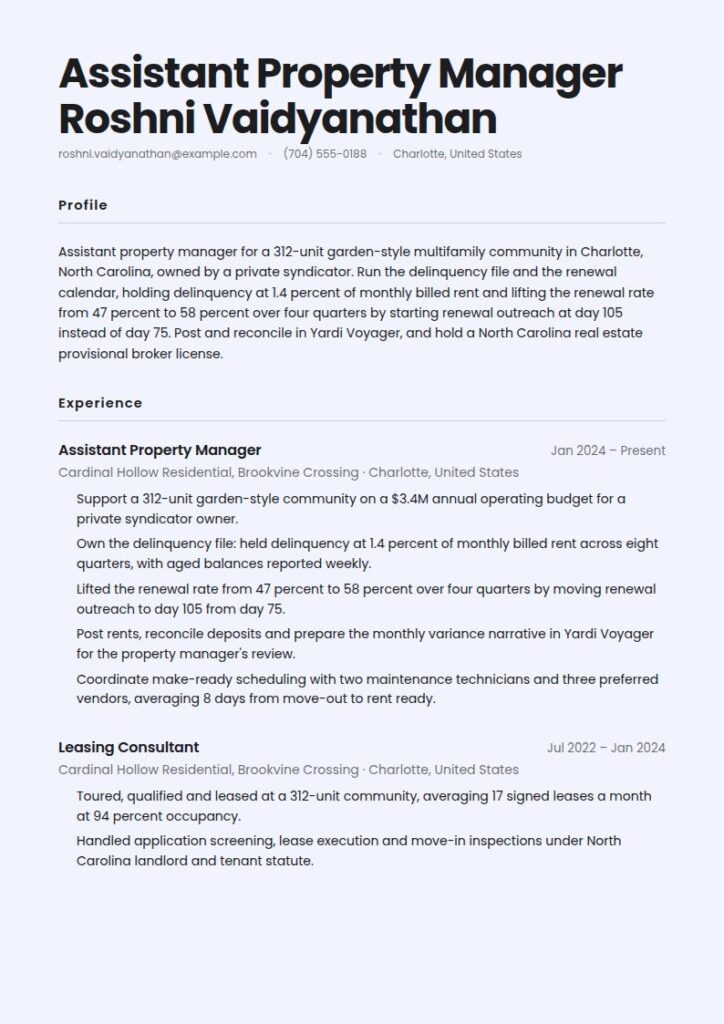
Assistant property manager for a 312-unit garden-style multifamily community in Charlotte, North Carolina, owned by a private syndicator. Run the delinquency file and the renewal calendar, holding delinquency at 1.4 percent of monthly billed rent and lifting the renewal rate from 47 percent to 58 percent over four quarters by starting renewal outreach at day 105 instead of day 75. Post and reconcile in Yardi Voyager, and hold a North Carolina real estate provisional broker license.
Work Experience
01/2024 - Present, Assistant Property Manager, Cardinal Hollow Residential, Brookvine Crossing, Charlotte, United States
- Support a 312-unit garden-style community on a $3.4M annual operating budget for a private syndicator owner.
- Own the delinquency file: held delinquency at 1.4 percent of monthly billed rent across eight quarters, with aged balances reported weekly.
- Lifted the renewal rate from 47 percent to 58 percent over four quarters by moving renewal outreach to day 105 from day 75.
- Post rents, reconcile deposits and prepare the monthly variance narrative in Yardi Voyager for the property manager's review.
- Coordinate make-ready scheduling with two maintenance technicians and three preferred vendors, averaging 8 days from move-out to rent ready.
07/2022 - 01/2024, Leasing Consultant, Cardinal Hollow Residential, Brookvine Crossing, Charlotte, United States
- Toured, qualified and leased at a 312-unit community, averaging 17 signed leases a month at 94 percent occupancy.
- Handled application screening, lease execution and move-in inspections under North Carolina landlord and tenant statute.
Education
08/2018 - 05/2022, Bachelor of Science, Business Administration, University of North Carolina at Charlotte, Charlotte, United States
North Carolina provisional broker pre-licensing course completed 2022 at an approved education provider.
Skills
Delinquency and collections, 85
Renewal and retention programs, 80
Yardi Voyager posting and reconciliation, 80
Make-ready and turn scheduling, 75
Fair housing, 85
North Carolina landlord and tenant statute, 75
Languages
English, native
Tamil, intermediate
Certificates
09/2022, North Carolina Real Estate Provisional Broker License, North Carolina Real Estate Commission, NC-298471
Postlicensing education in progress toward full broker status.
11/2020, Certified Apartment Manager (CAM), National Apartment Association
Summary
A property manager resume is a one to two page document that states the portfolio as a table rather than as adjectives, and answers the licensing question before a reader has to ask it. This guide gives you three adaptable versions, the portfolio table that replaces a paragraph of description, and current Bureau of Labor Statistics pay and outlook figures.
Property Manager resume examples by experience level
A property manager resume is a one to two page document that states the portfolio in a table and answers the licensing question in the header.
Those two things solve the problem this title has. "Property manager" covers a person running one 300-unit apartment community, a person running 1.4 million square feet of suburban office, and a person running fourteen homeowner associations from a laptop. Those are three unrelated jobs sharing a job title, and a reader who cannot tell which one you do in five seconds moves on.
Resume guide for a property manager resume
This guide and the corresponding property manager resume example will cover:
- How to write a property manager resume, section by section
- The portfolio table that replaces a paragraph of description
- Three adaptable summaries: assistant manager, property manager, regional manager
- Which license your state requires, and why it belongs in the header
- What the job market looks like and what you can expect to earn
How to write a property manager resume
Six sections: contact header with license, summary, portfolio table, management experience, skills and systems, and education with certifications.
The portfolio table sits second because every question a hiring owner or management company has is a question about scale and asset class, and a table answers all of them at once.
| Section | What it is answering | Where it goes |
|---|---|---|
| License | Can this person legally manage property for an owner in my state? | Header, with number and state |
| Portfolio table | How many doors or square feet, what asset class, at what performance? | Directly under the summary |
| Experience | What did they move, and over what period? | Reverse chronological, one metric per bullet |
| Systems | Which accounting and management platform? | Named by product, not as "property management software" |
Doors and square feet are the unit of account, so lead with them
Every other industry number is read against portfolio size. A $40,000 delinquency figure means one thing at 200 doors and something else at 3,000.
Give the number the way the industry gives it: 3,140 units across eleven communities, or 1.4 million rentable square feet across nine assets, or 2,180 homes under management, or fourteen associations totaling 3,900 doors. Add the asset class in the same line, because multifamily, single-family rental, commercial, industrial, student, affordable and community association management are separate hiring markets that rarely trade candidates.
Then give the owner type. Institutional owners, private syndicators, family offices and association boards all want different reporting, and a candidate who names theirs is telling the reader which reporting cadence they already know.
Run the finished file through the free Rezoom ATS resume checker before you send it. Management companies run applicant tracking systems that read the file before a regional manager does, and a table built out of tab characters will not survive that.
Choosing the best resume format for a property manager resume
Reverse chronological, one page below five years, two once you carry a portfolio rather than a property.
The only structural departure worth making is the portfolio table, and it is worth making because property management is one of the few fields where the entire scope of a job can be stated in six rows. A reader who has seen that table does not need your first paragraph.
Include your contact information
| ✅ Right | ❌ Wrong |
|---|---|
| Roshni Vaidyanathan, CPM | Roshni Vaidyanathan |
| Regional Property Manager, 3,140 units across 11 multifamily communities | Experienced property management professional |
| North Carolina Real Estate Broker License #NC-298471 | Licensed in NC |
| (704) 555-0188, [email protected], Charlotte, NC | (704) 555-0188, [email protected] |
Three of those four lines are facts a reader would otherwise have to dig for. The license line in particular saves a phone call, because in most states a person managing property for someone else needs one.
Make use of a summary
Four lines: portfolio size and asset class, owner type, one occupancy or delinquency number, and the license.
Assistant property manager for a 312-unit garden-style multifamily community in Charlotte, North Carolina, owned by a private syndicator. Run the delinquency file and the renewal calendar, holding delinquency at 1.4 percent of monthly billed rent and lifting the renewal rate from 47 percent to 58 percent over four quarters by starting renewal outreach at day 105 instead of day 75. Post and reconcile in Yardi Voyager, and hold a North Carolina real estate provisional broker license.
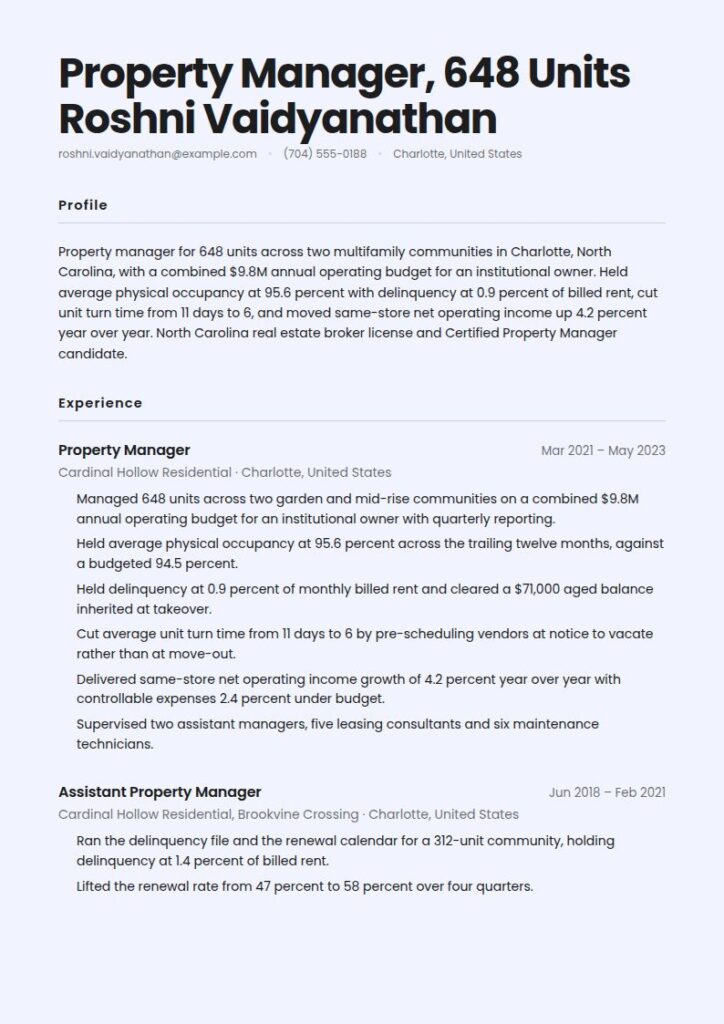
Property manager for 648 units across two multifamily communities in Charlotte, North Carolina, with a combined $9.8M annual operating budget for an institutional owner. Held average physical occupancy at 95.6 percent with delinquency at 0.9 percent of billed rent, cut unit turn time from 11 days to 6, and moved same-store net operating income up 4.2 percent year over year. North Carolina real estate broker license and Certified Property Manager candidate.
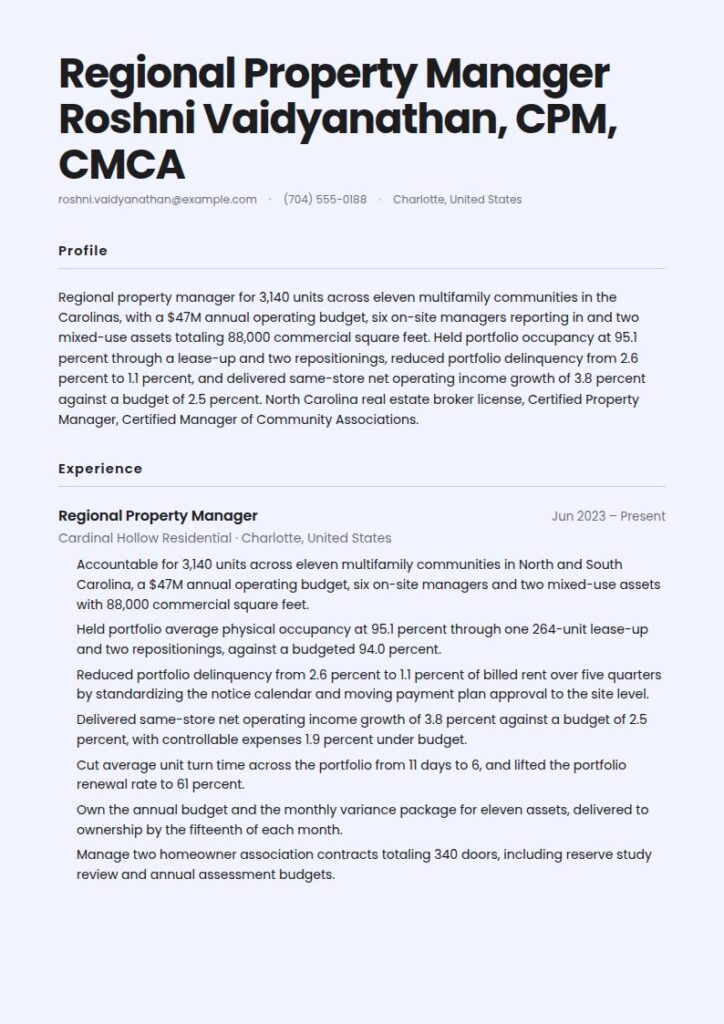
Regional property manager for 3,140 units across eleven multifamily communities in the Carolinas, with a $47M annual operating budget, six on-site managers reporting in and two mixed-use assets totaling 88,000 commercial square feet. Held portfolio occupancy at 95.1 percent through a lease-up and two repositionings, reduced portfolio delinquency from 2.6 percent to 1.1 percent, and delivered same-store net operating income growth of 3.8 percent against a budget of 2.5 percent. North Carolina real estate broker license, Certified Property Manager, Certified Manager of Community Associations.
Right vs wrong: the same property manager summary, twice
| ✅ Right | ❌ Wrong |
|---|---|
| 3,140 units across eleven multifamily communities in the Carolinas, $47M operating budget. | Manages a large portfolio of residential properties. |
| Portfolio occupancy 95.1 percent through a lease-up and two repositionings. | Consistently maintains high occupancy levels. |
| Reduced portfolio delinquency from 2.6 percent to 1.1 percent. | Strong track record of collections and resident retention. |
| Same-store net operating income growth of 3.8 percent against a budget of 2.5 percent. | Focused on maximizing asset value for ownership. |
The left column is an operating statement. The right column is a job description, and the reader already has one of those.
Outline your property management experience
Employer, owner or client type, portfolio, budget and dates. Then three to five bullets, each carrying a metric that an asset manager would recognize.
| Instead of | Use |
|---|---|
| Managed a large apartment community | Managed 648 units across two communities on a combined $9.8M annual operating budget |
| Maintained high occupancy | Held average physical occupancy at 95.6 percent across the trailing twelve months |
| Handled rent collection and delinquency | Cut delinquency from 2.6 percent to 1.1 percent of billed rent over five quarters |
| Improved resident retention | Lifted the renewal rate from 47 percent to 58 percent by moving renewal outreach to day 105 |
| Coordinated make-ready and maintenance | Reduced average unit turn time from 11 days to 6 by pre-scheduling vendors at notice rather than at move-out |
| Worked on budgets and reporting | Built the annual budget and monthly variance package for a $47M portfolio, reported to ownership by the fifteenth |
Regional Property Manager, Cardinal Hollow Residential, Charlotte, NC, June 2023 to Present
Accountable for 3,140 units across eleven multifamily communities in North and South Carolina, a $47M annual operating budget, six on-site managers and two mixed-use assets with 88,000 commercial square feet.
Held portfolio average physical occupancy at 95.1 percent through one 264-unit lease-up and two repositionings, against a budgeted 94.0 percent.
Reduced portfolio delinquency from 2.6 percent to 1.1 percent of billed rent over five quarters by standardizing the notice calendar and moving the payment plan approval to the site level.
Delivered same-store net operating income growth of 3.8 percent against a budget of 2.5 percent, with controllable expenses held 1.9 percent under budget.
Cut average unit turn time across the portfolio from 11 days to 6 by pre-scheduling vendors at notice to vacate rather than at move-out.
Own the annual budget and the monthly variance package for eleven assets, delivered to ownership by the fifteenth of each month.
Put the portfolio in a table, and clear the licensing gate
Two things decide whether a property manager resume is read seriously, and neither of them is a paragraph.
The portfolio table
Property management is an operating job measured on an operating statement. Write the statement.
Portfolio: 3,140 units across 11 communities, plus 88,000 commercial square feet in two mixed-use assets
Asset class: Multifamily, garden and mid-rise, Class A and Class B, one affordable property under a LIHTC compliance plan
Owner type: Institutional owner, two joint venture partners, quarterly reporting
Occupancy: 95.1 percent average physical occupancy, trailing twelve months
Delinquency: 1.1 percent of monthly billed rent, down from 2.6 percent
Renewal rate: 61 percent, portfolio average
Turn time: 6 days average from move-out to rent ready
Net operating income: same-store growth of 3.8 percent against a 2.5 percent budget
Budget: $47M annual operating, $6.2M capital over three years
Eight rows, no adjectives, and a regional director can price you from it. Adapt the rows to your asset class: commercial swaps occupancy for leased rate and weighted average lease term, single-family rental swaps turn time for days on market and maintenance cost per home, and community association management swaps the whole thing for associations, doors, reserve study status and assessment collection rate.
Two rules make the table credible. State the period every rate belongs to, because a trailing twelve month occupancy and a snapshot occupancy are different claims. And give a starting point for anything you improved, since "delinquency 1.1 percent" is a fact while "delinquency reduced from 2.6 percent to 1.1 percent over five quarters" is a result.
The licensing gate
Managing property for someone else is regulated work in most of the country, and the resume should settle it in the header rather than in an interview.
The Bureau of Labor Statistics Occupational Outlook Handbook states that property, real estate and community association managers may need a license issued by the state where they work, that in most states property managers must hold a property management license or a real estate broker's license, that managers who buy or sell property must have a real estate license, and that in some states community association managers also need one.
The details are set state by state, and the exemptions matter as much as the rule. The Texas Real Estate Commission, for example, publishes that no license is required to act as an on-site manager of an apartment complex, but that the exemption applies only to apartments and that managers of condominiums or townhomes need to be licensed. It also publishes that leasing or renting property as an employee of the property owner does not require a license under Rule 535.34, while soliciting prospects by phone as a rental agent does (Texas Real Estate Commission, frequently asked questions, checked 12 September 2026).
Community association management is regulated separately again. The Community Association Managers International Certification Board lists Alaska, California, Connecticut, Florida, Georgia, Illinois, Nevada and Virginia as states with licensing, registration or certification requirements for community association managers, and notes that Illinois requires a professional license that can be satisfied by passing the CMCA examination after twenty hours of pre-license education in community association management taken within the twenty-four months before the exam (CAMICB state-specific requirements, checked 12 September 2026). Requirements change, so confirm your own state with its regulator before you write a claim about it.
Whatever your situation, write one unambiguous line: the state, the license type, the number, the expiry, and the credential. If you are exempt, say which exemption you are relying on. A reader who has to guess assumes the worse answer.
Occupancy is only half the story, and turnover is the other half
The national rental vacancy rate was 7.3 percent in the second quarter of 2026, ranging from 5.3 percent in the West to 9.5 percent in the South (U.S. Census Bureau, Quarterly Residential Vacancies and Homeownership, released 28 July 2026).
Individual operators run far tighter than the national figure, and they publish how. Mid-America Apartment Communities reported same-store average physical occupancy of 95.3 percent for the second quarter of 2026, alongside a trailing twelve month resident turnover rate of 39.6 percent, effective renewal lease rate growth of 5.2 percent and a same-store net operating income decline of 1.0 percent (MAA second quarter 2026 results, released 29 July 2026).
Read those four numbers together and you have the whole argument for the portfolio table. An operator can hold occupancy and still lose net operating income, because turnover, renewal pricing and controllable expenses all move underneath it. A resume that reports occupancy alone is reporting the number that is easiest to hold. Report the renewal rate and the turn time beside it and you are describing how you held it.
Build a snapshot of your key skills
Twelve to fourteen entries in four groups: operations, financial, compliance, and systems named by product.
Operations: Lease-up and repositioning, Renewal and retention programs, Make-ready and turn scheduling, Vendor sourcing and contract management, Capital project oversight, Emergency and after-hours response
Financial: Annual operating budget, Monthly variance reporting, Net operating income analysis, Delinquency and collections, Capital expenditure planning, Utility billing and recovery
Compliance: Fair housing, Landlord and tenant statute in North Carolina and South Carolina, LIHTC file compliance, Reserve studies and association budgets, Insurance claim administration
Systems: Yardi Voyager, RealPage OneSite, Entrata, AppFolio, Yardi RENTCafe, Microsoft Excel financial modeling
List your education, license and certifications
License first, then degree, then the designations. Name the issuing body in full each time, because in this field the body is the credential.
North Carolina Real Estate Broker License, North Carolina Real Estate Commission, #NC-298471, active, broker-in-charge eligible
Bachelor of Science, Business Administration, University of North Carolina at Charlotte, Charlotte, NC, 2014
Certified Property Manager (CPM), Institute of Real Estate Management, 2024
Certified Manager of Community Associations (CMCA), Community Association Managers International Certification Board, 2025
Certified Apartment Manager (CAM), National Apartment Association, 2020
Tax Credit Specialist, LIHTC compliance, 2022
Choose the right layout and design
Single column, 11 or 12 point, real markdown or table formatting rather than tab-aligned columns, no photograph, no logos. Applicant tracking systems used by management companies parse the file into a structured record, and a portfolio table built with spaces becomes a single unreadable line.
Keep the table to label and value pairs on their own lines if you are unsure how a portal will handle a grid. A parser can read "Occupancy: 95.1 percent average physical, trailing twelve months" in any format.
State doors or square feet in the first line, with the asset class. Name the owner type and the reporting cadence. Give every rate a period. Show a starting point for anything you improved. Put the license type, number and state in the header. Name the accounting platform by product. Say which statutes and compliance regimes you have actually worked under.
Do not write "large portfolio" or "multiple properties" when the number is a fact you know. Do not report occupancy with nothing beside it. Do not claim net operating income growth without saying whether it is same-store. Do not blur multifamily, commercial and association experience into one line; they are different hiring markets. Do not describe a license you do not hold, since the state register is public and takes ten seconds to check.
Property manager job market and outlook
A mid-sized occupation with steady growth, and one where the federal category deliberately bundles three different jobs together.
| Measure | Value |
|---|---|
| Property, real estate and community association manager jobs, 2025 | 460,400 |
| Projected change, 2025 to 2035 | +4 percent, about 17,100 jobs |
| Projected annual openings | About 36,900 |
| Typical entry-level education | High school diploma or equivalent |
| Median annual wage, May 2025 | $69,990, or $33.65 an hour |
Source: Bureau of Labor Statistics Occupational Outlook Handbook, May 2025 wage data and 2025 to 2035 projections.
Where the jobs sit:
| Setting | Share of employment, 2025 | Median annual wage, May 2025 |
|---|---|---|
| Real estate | 56 percent | $64,290 |
| Self-employed workers | 31 percent | Not reported separately |
| Religious, grantmaking, civic and professional organizations | 2 percent | $73,620 |
Source: Bureau of Labor Statistics Occupational Outlook Handbook, May 2025.
Nearly a third of the occupation is self-employed, which is a useful thing to know when you are writing the file. A large share of the people you are competing with manage their own or a family portfolio, and a resume that proves institutional reporting discipline separates itself immediately.
What salary you can expect as a property manager
The median annual wage for property, real estate and community association managers was $69,990 in May 2025, with the lowest 10 percent earning less than $41,010 and the highest 10 percent more than $139,680 (Bureau of Labor Statistics Occupational Outlook Handbook, May 2025).
That is a band of roughly $99,000 inside one occupational title, and the portfolio table is what moves you along it. Doors under management, asset class, budget size and whether you carry people are the four variables that actually price the job, and all four belong on the page.
Industry matters too, and not in the direction most candidates expect. Managers in religious, grantmaking, civic and professional organizations had a median of $73,620 in May 2025, against $64,290 for managers in real estate (Bureau of Labor Statistics Occupational Outlook Handbook, May 2025). The higher-paying category includes association management, which is also the segment most likely to be separately licensed. Credentialed, regulated work pays better here than the generic title.
Key takeaways for a property manager resume
- Lead with doors or square feet and the asset class; every other number is read against them.
- Put the portfolio in a table, not a paragraph, and give each rate its period.
- Report delinquency, renewal rate and turn time beside occupancy; occupancy alone is the easy number.
- Say whether net operating income movement is same-store, and against what budget.
- Put the license type, number and state in the header, because most states require one.
- Name the owner type and the reporting cadence you already work to.
- Name the accounting platform by product; "property management software" tells a reader nothing.
Build your property manager resume in 15 minutes.
Related real estate resume examples
- Assistant property manager resume
- Real estate resume
- Real estate agent resume
- Realtor resume
- Leasing consultant resume
- Leasing agent resume
- Real estate coordinator resume
- Real estate assistant resume
- New home sales consultant resume
- Title examiner resume
- Architect resume
- Interior designer resume
Pair it with a matching property manager cover letter.
Property manager resume questions, answered
How long should a property manager resume be?
One page below five years. Two once you carry a portfolio rather than a single property, because the second page holds the portfolio table, the budget figures and the compliance regimes. Three pages is a sign the table has not been written.
Do I need a real estate license to be a property manager?
In most states, yes. The Bureau of Labor Statistics Occupational Outlook Handbook states that in most states property managers must hold a property management license or a real estate broker's license, and that managers who buy or sell property must have a real estate license. Exemptions exist and they are narrow: the Texas Real Estate Commission, for instance, publishes that on-site apartment managers are exempt but that managers of condominiums or town homes are not. Check your own state regulator and then write the answer in your header.
Is community association management the same job?
No, and the resume should not pretend it is. The work is governing documents, boards, reserve studies, assessments and covenant enforcement rather than leasing and renewals. It is also separately regulated in several states: the Community Association Managers International Certification Board lists Alaska, California, Connecticut, Florida, Georgia, Illinois, Nevada and Virginia as having licensing, registration or certification requirements. If you have done both, give them separate blocks with separate metrics.
What numbers should I use if I manage commercial rather than residential?
Swap the residential rows for the commercial ones. Rentable square feet under management, leased rate rather than physical occupancy, weighted average lease term, tenant retention at expiry, recovery ratio on operating expenses, and capital or tenant improvement dollars delivered. The structure of the table does not change, only the row labels.
How do I show results when the market moved against me?
Give the market figure beside yours. The national rental vacancy rate was 7.3 percent in the second quarter of 2026 and 9.5 percent in the South (U.S. Census Bureau, released 28 July 2026), so holding 94 percent occupancy in a soft southern submarket is a result rather than an apology. The same applies to net operating income: state the budget you were held to and whether you beat it.
Should I list the number of staff I supervise?
Yes, with the roles. "Six on-site managers, four leasing consultants and eleven maintenance technicians" tells a regional director what span of control you have carried, which is the single biggest difference between a property manager job and a regional one. Add turnover in your own team if it is good; retention of maintenance staff is a genuine operating advantage and very few candidates mention it.