Architectural Designer Nnamdi Eze M.Arch
Architectural Designer
[email protected] | (414) 555-0165 | Milwaukee, United States
Profile
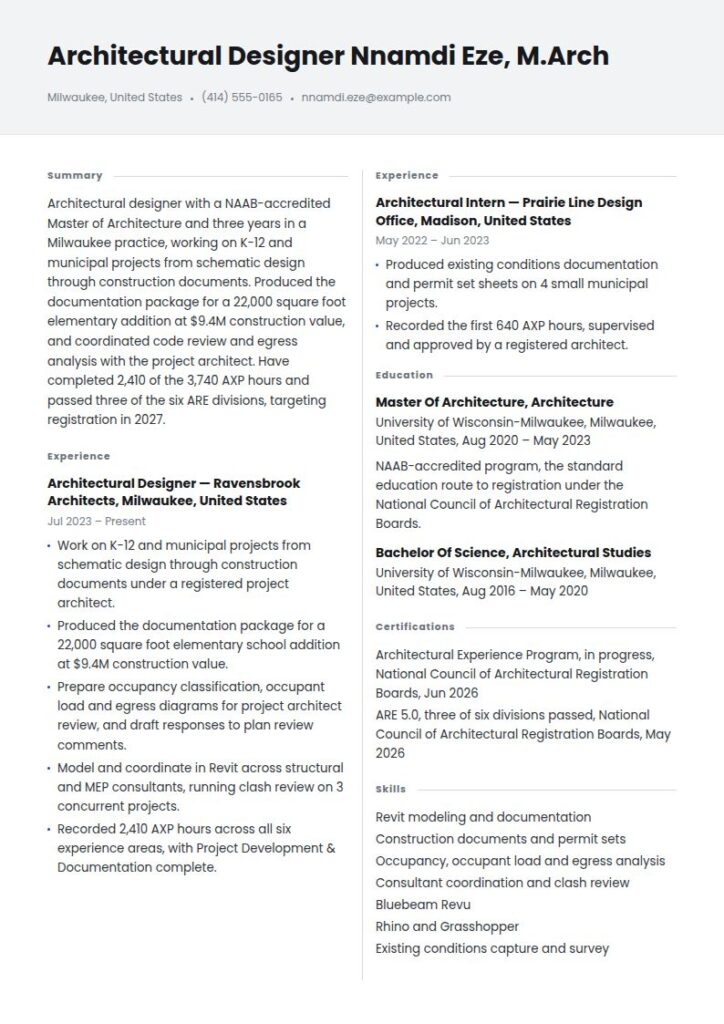
Architectural designer with a NAAB-accredited Master of Architecture and three years in a Milwaukee practice, working on K-12 and municipal projects from schematic design through construction documents. Produced the documentation package for a 22,000 square foot elementary addition at $9.4M construction value, and coordinated code review and egress analysis with the project architect. Have completed 2,410 of the 3,740 AXP hours and passed three of the six ARE divisions, targeting registration in 2027.
Work Experience
07/2023 - Present, Architectural Designer, Ravensbrook Architects, Milwaukee, United States
- Work on K-12 and municipal projects from schematic design through construction documents under a registered project architect.
- Produced the documentation package for a 22,000 square foot elementary school addition at $9.4M construction value.
- Prepare occupancy classification, occupant load and egress diagrams for project architect review, and draft responses to plan review comments.
- Model and coordinate in Revit across structural and MEP consultants, running clash review on 3 concurrent projects.
- Recorded 2,410 AXP hours across all six experience areas, with Project Development & Documentation complete.
05/2022 - 06/2023, Architectural Intern, Prairie Line Design Office, Madison, United States
- Produced existing conditions documentation and permit set sheets on 4 small municipal projects.
- Recorded the first 640 AXP hours, supervised and approved by a registered architect.
Education
08/2020 - 05/2023, Master of Architecture, Architecture, University of Wisconsin-Milwaukee, Milwaukee, United States
NAAB-accredited program, the standard education route to registration under the National Council of Architectural Registration Boards.
08/2016 - 05/2020, Bachelor of Science, Architectural Studies, University of Wisconsin-Milwaukee, Milwaukee, United States
Skills
Revit modeling and documentation, 85
Construction documents and permit sets, 75
Occupancy, occupant load and egress analysis, 65
Consultant coordination and clash review, 70
Bluebeam Revu, 80
Rhino and Grasshopper, 75
Existing conditions capture and survey, 70
Languages
English, native
Igbo, native
Certificates
06/2026, Architectural Experience Program, in progress, National Council of Architectural Registration Boards
2,410 of the 3,740 required hours recorded across all six experience areas. Project Development & Documentation complete at 1,520 hours.
05/2026, ARE 5.0, three of six divisions passed, National Council of Architectural Registration Boards
Practice Management, Project Management and Programming & Analysis passed. Remaining three divisions scheduled through 2027.
Summary
An architect resume is a one to two page document that states your licensure status precisely, names the project types and construction values you have delivered, and shows which phases you have carried. This guide gives you three adaptable versions, the NCARB path to registration in the detail a principal expects, and current Bureau of Labor Statistics pay and outlook.
Architect resume examples by experience level
An architect resume is a one to two page document that states your licensure status exactly, names the building types and construction values you have delivered, and shows which phases of each project you actually carried.
The first of those is not a formality. An unlicensed designer, a candidate part way through the path, and a registered architect who can seal drawings are three different hires with three different rates and three different roles on a project team. A resume that leaves the reader guessing which one you are gets sorted into the slowest pile, because the person reading it cannot staff you until they know.
Resume guide for an architect resume
This guide and the corresponding architect resume example will cover:
- How to write an architect resume, section by section
- How to state your position on the path to licensure, whichever stage you are at
- Three adaptable summaries: designer, project architect and senior project architect
- What the stamp actually makes you responsible for
- What the job market looks like and what you can expect to earn
How to write an architect resume
Six sections: contact header, summary, licensure and registration, project experience, technical skills, and education. One page for your first five years, two once you have projects through construction administration and a role worth describing.
Licensure sits directly under the summary because it is the gate. Everything below it is read differently depending on what it says.
| Section | What it is answering | Where it goes |
|---|---|---|
| Licensure and registration | Licensed, mid-path or unlicensed, and where | Directly under the summary |
| Project experience | Building type, construction value, phases carried | Reverse chronological, one figure per bullet |
| Technical skills | Documentation, modeling and code capability | Grouped, not an alphabetical software list |
| Education | NAAB-accredited degree, and which pathway it opens | Last, with the accreditation named |
Say the phases, not the project names
Project names look impressive and tell a hiring principal nothing about what you did. Phase does.
Schematic design is a different skill from design development, which is a different job again from construction documents, and construction administration is the phase most firms struggle hardest to staff. A candidate who has taken three projects from SD through CA is worth more than a candidate who has touched fifteen projects in SD only, and the resume has to make that visible.
Write it as a range on each project: "SD through CA, 68,000 square foot mixed-use, $31M construction value." That is one line and it answers four questions.
Run the finished file through the free Rezoom ATS resume checker before you submit. Mid-size and large practices run applications through a recruiting system before a principal opens them.
Choosing the best resume format for an architect resume
Reverse chronological, one column, with a project list that carries building type, construction value and phase. Two pages is normal and expected once you have a decade behind you; three is not.
The resume is not the portfolio. Keep them separate files, and keep the resume plain enough that a parser and a printer can both handle it. Firms ask for both, read the resume first to sort, and open the portfolio to decide.
Include your contact information
| ✅ Right | ❌ Wrong |
|---|---|
| Nnamdi Eze, AIA | Nnamdi Eze |
| Project Architect, Registered in Wisconsin and Illinois | Architectural professional |
| Wisconsin Registration #A-14027, NCARB Certificate holder | Licensed architect |
| (414) 555-0165, [email protected], Milwaukee, WI | (414) 555-0165, [email protected] |
Put the registration number and the states on the page. It is the single fastest thing a reader can verify, and it decides whether you can be named on a submittal in the jurisdiction the firm works in.
Make use of a summary
Four lines: your licensure status, building types, the phases you carry, and one project with a construction value attached.
Architectural designer with a NAAB-accredited Master of Architecture and three years in a Milwaukee practice, working on K-12 and municipal projects from schematic design through construction documents. Produced the documentation package for a 22,000 square foot elementary addition at $9.4M construction value, and coordinated code review and egress analysis with the project architect. Have completed 2,410 of the 3,740 AXP hours and passed three of the six ARE divisions, targeting registration in 2027.
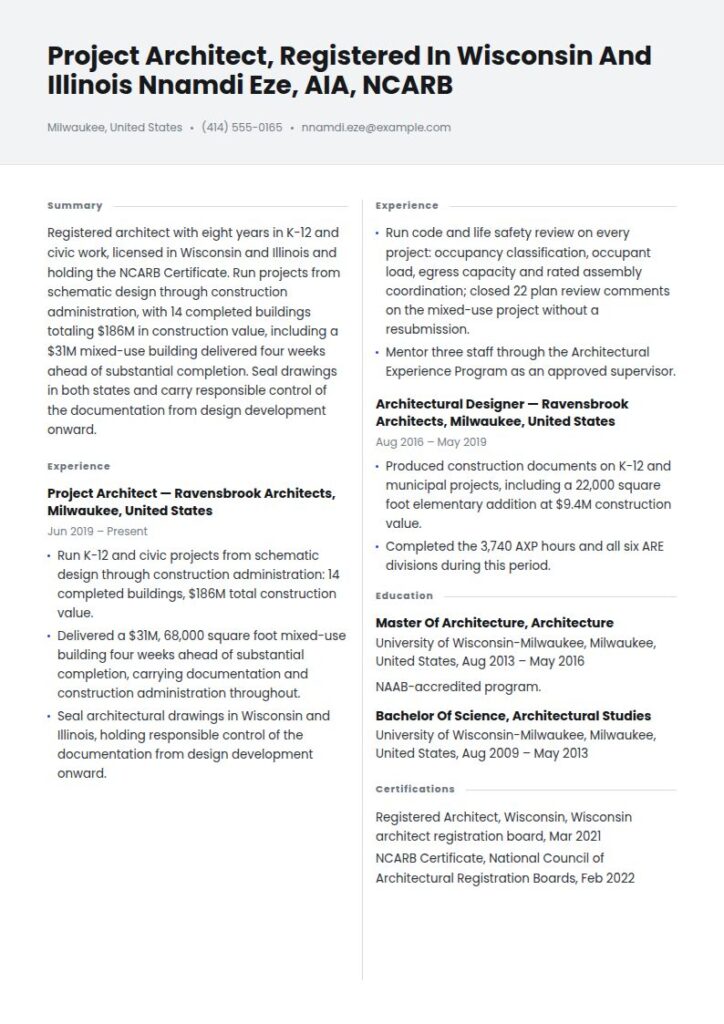
Registered architect with eight years in K-12 and civic work, licensed in Wisconsin and Illinois and holding the NCARB Certificate. Run projects from schematic design through construction administration, with 14 completed buildings totaling $186M in construction value, including a $31M mixed-use building delivered four weeks ahead of substantial completion. Seal drawings in both states and carry responsible control of the documentation from design development onward.
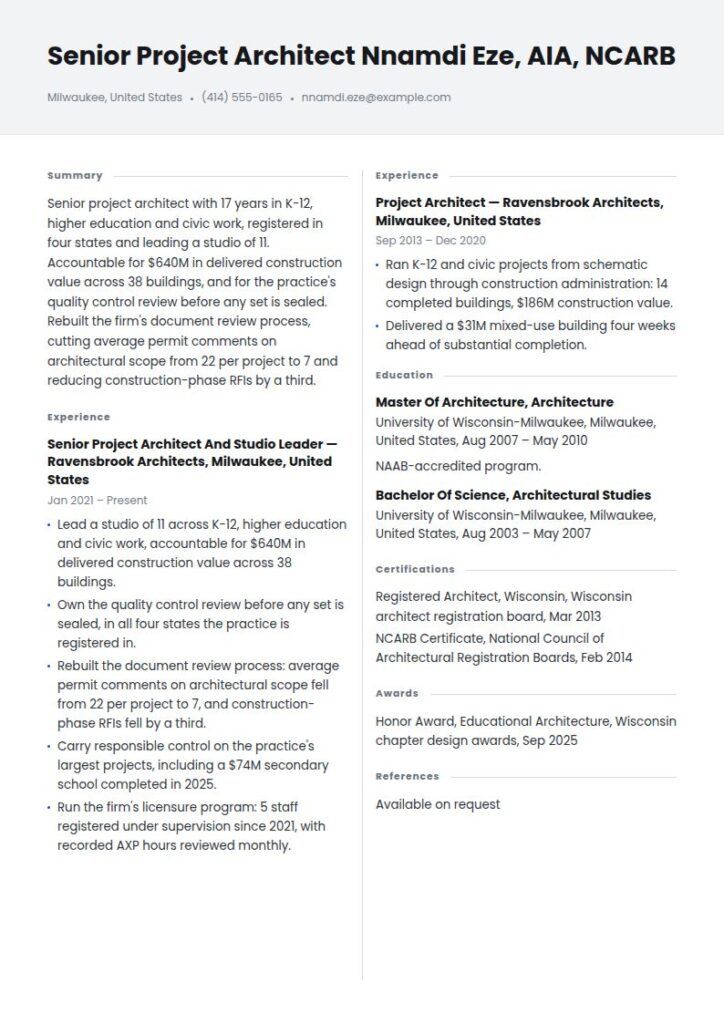
Senior project architect with 17 years in K-12, higher education and civic work, registered in four states and leading a studio of 11. Accountable for $640M in delivered construction value across 38 buildings, and for the practice's quality control review before any set is sealed. Rebuilt the firm's document review process, cutting average permit comments on architectural scope from 22 per project to 7 and reducing construction-phase RFIs by a third.
Right vs wrong: the same architect summary, twice
| ✅ Right | ❌ Wrong |
|---|---|
| Registered architect, licensed in Wisconsin and Illinois, holding the NCARB Certificate. | Experienced architectural professional with a strong design sensibility. |
| Runs projects from schematic design through construction administration. | Involved in all phases of the architectural design process. |
| 14 completed buildings totaling $186M in construction value. | Contributed to a number of significant projects. |
The right column can be put on a job, named on a submittal and priced into a fee proposal. The left column has to be interviewed before any of that can happen, and most files never get that far.
Outline your project experience
Firm, city, dates, role, then three to five bullets. Each bullet names a building type and carries a number: square footage, construction value, phase, schedule or a documentation outcome.
| Instead of | Use |
|---|---|
| Worked on a variety of architectural projects | Delivered 14 buildings totaling $186M construction value across K-12 and civic work |
| Involved in all phases of design | Carried 6 projects from schematic design through construction administration, including punch and closeout |
| Prepared construction documents | Produced and coordinated the permit set for a 68,000 square foot mixed-use building at $31M construction value |
| Ensured code compliance | Ran occupancy classification, occupant load and egress analysis, and resolved 22 plan review comments without a second resubmission |
| Coordinated with consultants | Led weekly coordination with structural, MEP, civil and landscape across 4 concurrent projects, running clash review in Revit |
Project Architect, Ravensbrook Architects, Milwaukee, WI, June 2019 to Present
Run K-12 and civic projects from schematic design through construction administration: 14 completed buildings, $186M total construction value.
Delivered a $31M, 68,000 square foot mixed-use building four weeks ahead of substantial completion, carrying the documentation and construction administration throughout.
Seal architectural drawings in Wisconsin and Illinois, holding responsible control of the documentation from design development onward.
Run code and life safety review on every project: occupancy classification, occupant load, egress capacity and rated assembly coordination, closing 22 plan review comments on the mixed-use project without a resubmission.
Mentor three staff through the Architectural Experience Program, reviewing and approving recorded hours as supervisor.
Say where you are on the path to the stamp
This is the section every architecture resume needs and most of them hide. Write it as a status, not as a hope.
All states and the District of Columbia require architects to be licensed (BLS Occupational Outlook Handbook, architects, 2025-35 edition), and the path has three parts administered through the National Council of Architectural Registration Boards.
Education
A degree from a program accredited by the National Architectural Accrediting Board is the standard route (NCARB, checked 12 September 2026). Not every state requires one, and NCARB reports that 13 percent of new architects in 2025 used an alternative pathway based on experience rather than a NAAB-accredited degree, up from 11 percent in 2024 (NCARB by the Numbers, 2026 edition).
On the resume, name the accreditation explicitly. "Master of Architecture, NAAB-accredited" removes a question that otherwise gets asked at first interview.
Experience: the Architectural Experience Program
The AXP requires 3,740 hours across six experience areas (NCARB, checked 12 September 2026):
| Experience area | Hours required |
|---|---|
| Practice Management | 160 |
| Project Management | 360 |
| Programming & Analysis | 260 |
| Project Planning & Design | 1,080 |
| Project Development & Documentation | 1,520 |
| Construction & Evaluation | 360 |
That distribution is itself an argument about what the profession values. More than 40 percent of the total sits in Project Development & Documentation, and it is the area candidates most often fall short in because it is the least glamorous part of a project. If your hours in that area are complete, say so, because a principal reading it knows exactly what it means.
Examination: the Architect Registration Examination
The ARE 5.0 has six divisions, named for the same competency areas (NCARB, checked 12 September 2026): Practice Management, Project Management, Programming & Analysis, Project Planning & Design, Project Development & Documentation, and Construction & Evaluation. All divisions must be completed within five years, starting from the date of the first passed division.
The path is long, and it is getting shorter
NCARB reported that the overall median time to licensure fell to 12.3 years in 2025, the lowest in nearly a decade, and that average time to complete the ARE fell to two years, the lowest in the history of the computerized examination (NCARB by the Numbers, 2026 edition).
Read that as a reason to write your position down precisely rather than vaguely. If the median candidate takes over twelve years from starting education to registration, then almost everyone applying for a mid-level role is somewhere in the middle of that path, and "somewhere in the middle" is not a useful thing for a principal to read.
Write the three numbers instead: hours logged out of 3,740, divisions passed out of six, and the date you expect to register. A candidate who is 3,100 hours in with four divisions passed is a genuinely different hire from one who has not started, and the difference is worth real money in a firm that needs another sealer in eighteen months.
What the stamp makes you responsible for
The seal is not a formality or a signature of approval. Under the NCARB Model Law, technical submissions prepared under the responsible control of the architect and required by the authority having jurisdiction for building permits or regulatory approvals must be sealed and signed, and by sealing a submission the architect represents that they were in responsible control of its content during preparation and applied the required professional standard of care (NCARB Model Law and Regulations, Section 401).
Responsible control itself is defined as responsibility for exercising the ultimate authority over, and possessing the knowledge and ability to oversee, delegate and integrate the design and technical decisions related to the preparation of the project's instruments of service and its implementation, in conformance with the standard of care (NCARB Model Law, Section 103).
That is why "worked on" is such a weak phrase on an architect's resume. The profession has a precise word for what it means to be accountable for a drawing, and using the vague one signals that you have not been.
Registered Architect, Wisconsin #A-14027, 2021. Illinois reciprocal registration, 2023. NCARB Certificate holder, 2022.
Education: Master of Architecture, NAAB-accredited program, 2016.
Experience: Architectural Experience Program completed 2020, 3,740 hours across all six experience areas. Now an approved AXP supervisor for three staff.
Examination: ARE 5.0, all six divisions passed, completed 2021.
Responsible control: seal architectural documents in Wisconsin and Illinois, holding responsible control of the documentation from design development through construction administration.
If you are mid-path, the same block works and is more useful, not less. Write the hours, the divisions and the target date, and a firm can plan around it.
Build a snapshot of your key architect skills
Twelve to sixteen entries in four groups, so the list supports the argument rather than listing software.
Documentation and delivery: Construction documents and permit sets, specifications, construction administration, submittal and RFI review, punch and closeout
Codes and life safety: Occupancy classification and occupant load, means of egress analysis, rated assembly coordination, accessibility compliance review, plan review comment response
Modeling and coordination: Revit and model management, clash detection and consultant coordination, Bluebeam Revu, Rhino and Grasshopper, point cloud and existing conditions capture
Practice: Fee proposals and scope definition, consultant contracts, project scheduling, AXP supervision, quality control review before sealing
List your education and certifications
Degree first with the accreditation named, then registration by state with numbers and dates, then the NCARB Certificate, then anything technical.
Master of Architecture, NAAB-accredited program, University of Wisconsin-Milwaukee, Milwaukee, WI, 2016
Bachelor of Science, Architectural Studies, University of Wisconsin-Milwaukee, Milwaukee, WI, 2013
Registered Architect: Wisconsin #A-14027 (2021), Illinois reciprocal (2023)
NCARB Certificate holder, 2022. AIA member.
Continuing education: health, safety and welfare hours current in both states. Mass timber design, 2025. Building enclosure commissioning, 2024.
Choose the right layout and design
Single column, 10 or 11 point, clear headings, no photograph and no graphic skill bars. Send a PDF named for yourself and the role, under 2MB, and link the portfolio rather than attaching it.
State your licensure status in the header, whatever it is. Give AXP hours out of 3,740 and ARE divisions out of six if you are mid-path. Name the NAAB accreditation on your degree. Put construction value and square footage on every project bullet. Say which phases you carried, and use "responsible control" only where it is accurate. Link a portfolio that opens in one click.
Do not call yourself an architect in a jurisdiction where you are not registered; the title is protected and firms check. Do not write "worked on" when you mean you drafted one sheet of it. Do not list a project by name with no building type, value or phase attached. Do not embed portfolio images in the resume file. Do not run to three pages.
Architect job market and outlook
A mid-size occupation growing at about the average rate, heavily concentrated in one industry, with a wide spread between the entry and the top of the range.
| Measure | Value |
|---|---|
| Architect jobs, 2025 | 124,600 |
| Projected change, 2025-35 | 4% (about as fast as average) |
| Projected annual openings | About 6,900 |
| Typical entry-level education | Bachelor's degree |
| Median annual wage, May 2025 | $99,280 |
Source: U.S. Bureau of Labor Statistics, Occupational Outlook Handbook, architects, 2025-35 projections and May 2025 wage data.
Where the jobs sit, and what each setting pays:
| Setting | Share of employment | Median annual wage (May 2025) |
|---|---|---|
| Architectural, engineering and related services | 74% | $98,440 |
| Self-employed workers | 14% | Not available |
| Construction | 4% | $95,760 |
| Government, excluding state and local education and hospitals | 3% | $115,920 |
Source: U.S. Bureau of Labor Statistics, Occupational Outlook Handbook, architects, May 2025.
Three quarters of the occupation works in one industry, which means most architects change firms rather than sectors, and a resume is usually read by somebody who does the same work you do. Write it for a peer, not for a generalist recruiter.
What salary you can expect as an architect
The median annual wage for architects was $99,280 as of May 2025. The lowest 10 percent earned less than $62,300 and the highest 10 percent more than $161,420 (BLS Occupational Outlook Handbook, architects, May 2025).
Registration is the clearest step inside that range. An unlicensed designer is billed at a lower rate, cannot be named as the architect of record, and cannot seal. The transition from designer to project architect is usually the largest single jump in an architectural career, and it is gated by the three requirements above rather than by tenure.
Government work pays a median of $115,920, the highest of the published settings, and is worth knowing about if the hours in private practice have stopped being worth the design work. Construction employers pay a median of $95,760, close to the private practice figure, and hire architects for owner-side and design-build roles where construction administration experience is the thing being bought.
Key takeaways for an architect resume
- State your licensure status in the header: registered and where, or hours and divisions if mid-path.
- Name the NAAB accreditation on your degree; it removes a first-interview question.
- Give AXP progress as hours out of 3,740 and ARE progress as divisions out of six.
- Put building type, square footage and construction value on every project bullet.
- Say which phases you carried, and be honest that construction administration is what firms are short of.
- Use "responsible control" only where it is accurate; it is a defined term, not a flourish.
- Keep the resume plain and parseable, and link the portfolio separately.
Build your architect resume in 15 minutes.
Related real estate resume examples
- Interior designer resume
- Interior decorator resume
- Real estate agent resume
- Realtor resume
- Property manager resume
- New home sales consultant resume
- Real estate resume
- Real estate assistant resume
- Real estate coordinator resume
- Title examiner resume
- Leasing consultant resume
- Assistant property manager resume
Pair it with a matching architect cover letter.
Architect resume questions, answered
How long should an architect resume be?
One page for your first five years, two once you have projects through construction administration, a team or a registration history worth describing. Two pages is normal in this profession and nobody penalises it. Three pages is read as an inability to edit, which is a poor signal in a field built on editing.
Can I call myself an architect if I am not registered?
No. The title is protected, all states and the District of Columbia require architects to be licensed (BLS Occupational Outlook Handbook, architects, 2025-35 edition), and firms verify it. Use "architectural designer" or "designer" and then state your position on the path precisely: hours logged against the 3,740 required by the Architectural Experience Program, and divisions passed of the six in the ARE (NCARB, checked 12 September 2026).
How do I show AXP and ARE progress on a resume?
As two numbers and a date, in the licensure block under your summary. "AXP: 2,410 of 3,740 hours. ARE 5.0: 3 of 6 divisions passed. Target registration 2027." Both requirements are public and countable, so partial progress is a real credential rather than an intention, and it lets a firm plan its sealing capacity.
Does the NCARB Certificate matter on a resume?
It does if you work across state lines or want to. The certificate is the basis on which most jurisdictions grant reciprocal registration, so for a practice with projects in several states it is the difference between a hire who can be added to a submittal in a new state quickly and one who cannot. List it with the year.
What do I put on an architect resume with no professional experience?
Studio projects written like jobs, with building type, area, the systems you resolved and the drawings you produced, plus any AXP hours from an internship. Then software you can actually document in, because a graduate who can model and detail in Revit is billable immediately. Name the NAAB accreditation on your degree and the divisions you have already sat.
Should I send a portfolio with my architect resume?
Yes, as a separate file or a link, and expect it to be the document that decides. Keep the resume plain so it parses and sorts, and put the design argument in the portfolio where it will actually be judged. If you attach a PDF portfolio, keep it under the size limit in the posting and lead it with the projects your resume already named.