Interior Design Assistant Genevieve Arreola
Interior Design Assistant
[email protected] | (303) 555-0200 | Denver, United States
Profile
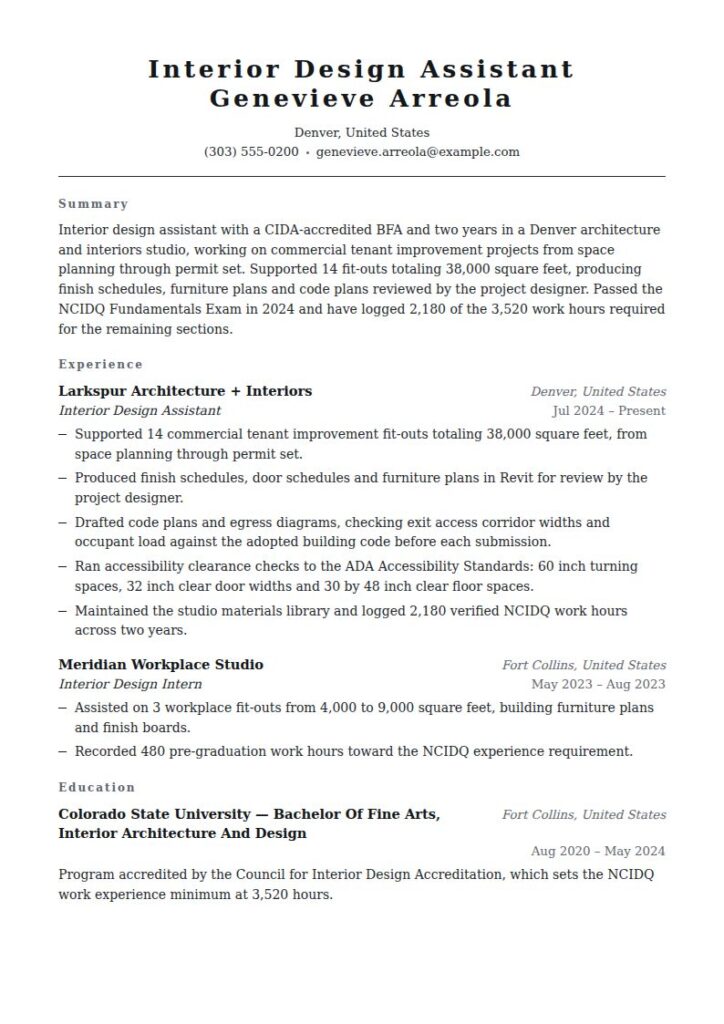
Interior design assistant with a CIDA-accredited BFA and two years in a Denver architecture and interiors studio, working on commercial tenant improvement projects from space planning through permit set. Supported 14 fit-outs totaling 38,000 square feet, producing finish schedules, furniture plans and code plans reviewed by the project designer. Passed the NCIDQ Fundamentals Exam in 2024 and have logged 2,180 of the 3,520 work hours required for the remaining sections.
Work Experience
07/2024 - Present, Interior Design Assistant, Larkspur Architecture + Interiors, Denver, United States
- Supported 14 commercial tenant improvement fit-outs totaling 38,000 square feet, from space planning through permit set.
- Produced finish schedules, door schedules and furniture plans in Revit for review by the project designer.
- Drafted code plans and egress diagrams, checking exit access corridor widths and occupant load against the adopted building code before each submission.
- Ran accessibility clearance checks to the ADA Accessibility Standards: 60 inch turning spaces, 32 inch clear door widths and 30 by 48 inch clear floor spaces.
- Maintained the studio materials library and logged 2,180 verified NCIDQ work hours across two years.
05/2023 - 08/2023, Interior Design Intern, Meridian Workplace Studio, Fort Collins, United States
- Assisted on 3 workplace fit-outs from 4,000 to 9,000 square feet, building furniture plans and finish boards.
- Recorded 480 pre-graduation work hours toward the NCIDQ experience requirement.
Education
08/2020 - 05/2024, Bachelor of Fine Arts, Interior Architecture and Design, Colorado State University, Fort Collins, United States
Program accredited by the Council for Interior Design Accreditation, which sets the NCIDQ work experience minimum at 3,520 hours.
Skills
Revit for interiors, 75
AutoCAD, 80
Finish and door schedules, 70
Code plans and egress diagrams, 60
ADA Accessibility Standards clearance review, 65
Space planning and furniture plans, 75
SketchUp and Enscape, 70
Languages
English, native
Spanish, native
Certificates
09/2024, NCIDQ Fundamentals Exam (IDFX), Council for Interior Design Qualification
First of three NCIDQ sections. IDPX and IDIX scheduled once the 3,520 hour work experience minimum is met.
02/2025, OSHA 10-Hour Construction Safety, OSHA Training Institute
Summary
An interior designer resume is a one to two page document that names your qualification pathway, the codes and accessibility standards you work to, and the project types you have delivered at what size. This guide gives you three adaptable versions, the regulated scope boundary that decides which jobs you are eligible for, and current Bureau of Labor Statistics pay and outlook.
Interior Designer resume examples by experience level
An interior designer resume is a one to two page document that names your qualification pathway, the project types and square footage you have delivered, and the codes and accessibility standards your drawings were held to.
It has to do all three because this occupation has a legal edge to it, and the people hiring know exactly where that edge sits. A commercial studio filling a seat asks one question before any portfolio image loads: can this person carry work that goes to a building department. A resume that answers with adjectives about aesthetics has answered a different question.
Resume guide for an interior designer resume
This guide and the corresponding interior designer resume example will cover:
- How to write an interior designer resume, section by section
- What separates regulated interior design from decoration, in law and on the page
- Three adaptable summaries: assistant, practicing designer and director of interiors
- How to record NCIDQ progress before you are certified, and why it still counts
- What the job market looks like and what you can expect to earn
How to write an interior designer resume
Six sections: contact header, summary, qualification and credentials, project experience, technical skills, and education. One page for your first five years, two once you have run projects through permit and construction administration.
The credential block sits high because in this occupation it is a gate in some places and a title restriction in others, and the reader needs to know which side of it you are on before they read anything else.
| Section | What it is answering | Where it goes |
|---|---|---|
| Qualification and credentials | Can this person be listed on a submittal, or not? | Directly under the summary |
| Project experience | What building types, what size, what phases? | Reverse chronological, one figure per bullet |
| Technical skills | Which documentation tools and which standards? | Grouped by documentation, standards and visualization |
| Education | CIDA-accredited program, and which qualification pathway that opens | Last, with the pathway named |
Write the phases, not just the projects
Almost every interior designer resume lists project names. Very few say which phases the writer actually carried, and phase is what a studio is staffing.
Programming and space planning is a different job from construction documents, which is a different job again from construction administration and punch. A studio that needs someone to run CDs on a 40,000 square foot fit-out cannot tell from "designed corporate office interiors" whether you have ever produced a finish schedule that a contractor bid from.
Write it plainly: "Programming through construction administration on 11 ambulatory care suites, 2,000 to 14,000 square feet each, including permit set and field observation." That sentence gets read twice.
Run the finished file through the free Rezoom ATS resume checker before you send it. Larger architecture and design firms parse applications into a recruiting system before a design director opens them.
Choosing the best resume format for an interior designer resume
Reverse chronological, with a project list that carries square footage and phase. One page early, two once you have permit-set and construction administration work worth itemizing.
A functional format fails here for the same reason it fails in architecture: the reader is working out what you were responsible for at each firm, and detaching skills from employers removes the only way to check.
Include your contact information
| ✅ Right | ❌ Wrong |
|---|---|
| Genevieve Arreola, NCIDQ | Genevieve Arreola |
| Interior Designer, Healthcare and Workplace | Creative interior design professional |
| NCIDQ Certificate #028114, LEED AP ID+C | Certified interior designer |
| (303) 555-0200, [email protected], Denver, CO | (303) 555-0200, [email protected] |
Put the certificate number on the page. It is verifiable, it takes a reader ten seconds, and it converts a claim into a fact. If you are not certified yet, say where you are in the process instead of leaving the line blank.
Make use of a summary
Four lines: the sector you work in, years, the phases you carry, and one number attached to delivered work.
Interior design assistant with a CIDA-accredited BFA and two years in a Denver architecture and interiors studio, working on commercial tenant improvement projects from space planning through permit set. Supported 14 fit-outs totaling 38,000 square feet, producing finish schedules, furniture plans and code plans reviewed by the project designer. Passed the NCIDQ Fundamentals Exam in 2024 and have logged 2,180 of the 3,520 work hours required for the remaining sections.
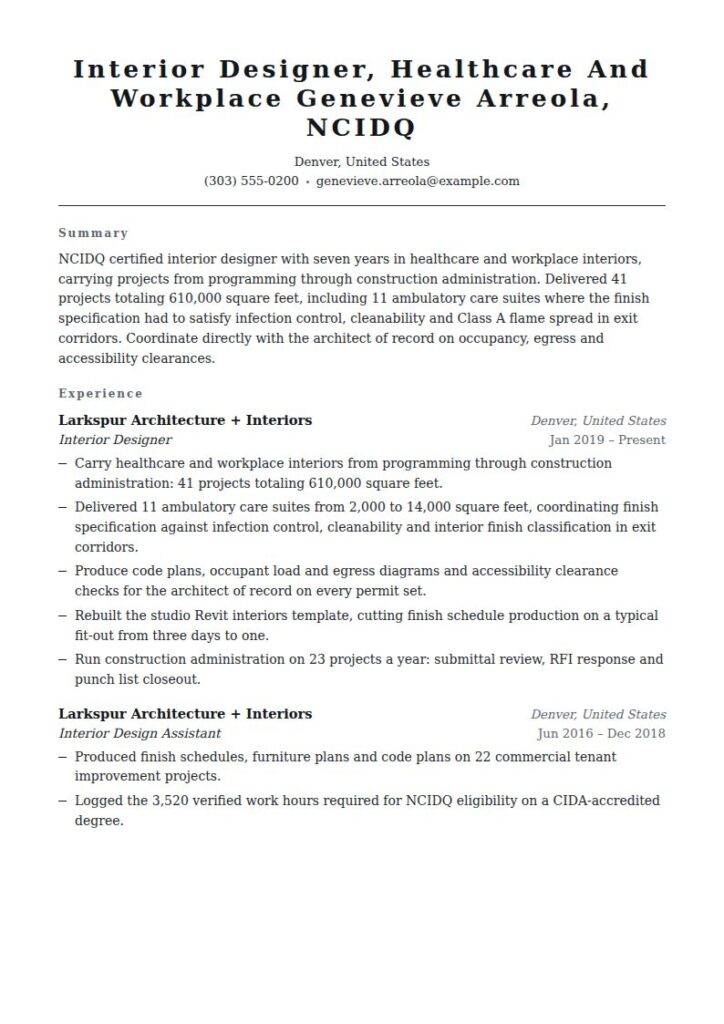
NCIDQ certified interior designer with seven years in healthcare and workplace interiors, carrying projects from programming through construction administration. Delivered 41 projects totaling 610,000 square feet, including 11 ambulatory care suites where the finish specification had to satisfy infection control, cleanability and Class A flame spread in exit corridors. Coordinate directly with the architect of record on occupancy, egress and accessibility clearances.
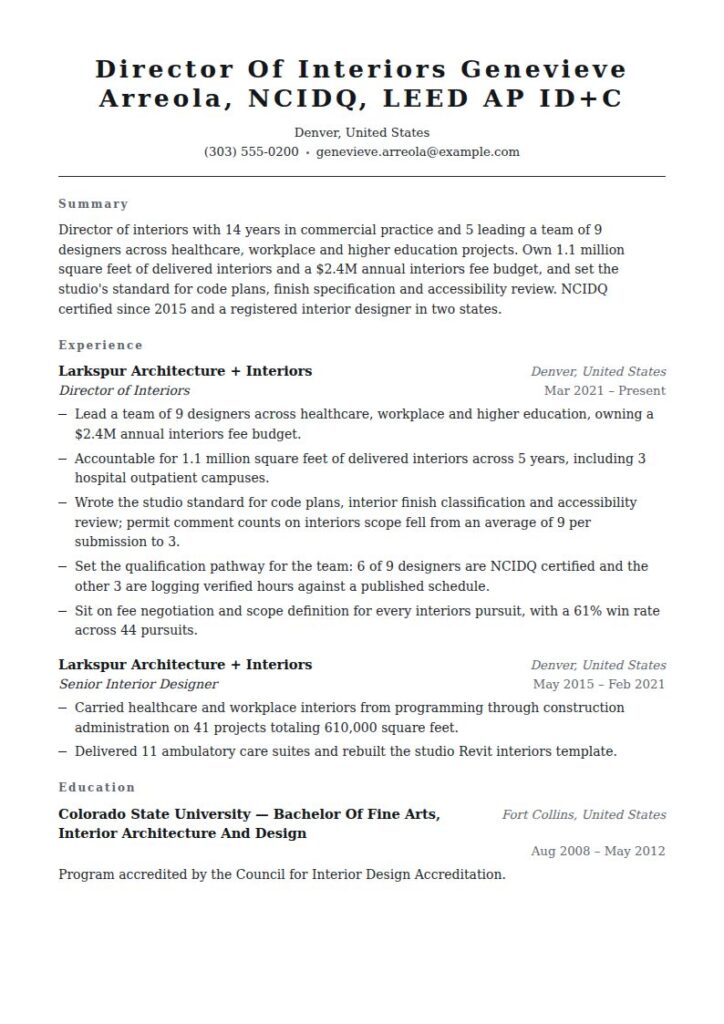
Director of interiors with 14 years in commercial practice and 5 leading a team of 9 designers across healthcare, workplace and higher education projects. Own 1.1 million square feet of delivered interiors and a $2.4M annual interiors fee budget, and set the studio's standard for code plans, finish specification and accessibility review. NCIDQ certified since 2015 and a registered interior designer in two states.
Right vs wrong: the same interior designer summary, twice
| ✅ Right | ❌ Wrong |
|---|---|
| NCIDQ certified interior designer with seven years in healthcare and workplace interiors. | Creative interior design professional with a strong eye for detail. |
| Carries projects from programming through construction administration. | Experienced in all aspects of the interior design process. |
| Delivered 41 projects totaling 610,000 square feet, including 11 ambulatory care suites. | Worked on a wide variety of exciting commercial projects. |
The left column can be staffed onto a job next Monday. The right column could describe a second-year assistant or a studio principal, and a reader with forty files to get through will not spend time finding out which.
Outline your project experience
Firm, city, dates, and then three to five bullets. Every bullet names a building type or a phase and carries a number: square footage, project count, budget, or a schedule outcome.
| Instead of | Use |
|---|---|
| Designed commercial office interiors | Delivered 9 workplace fit-outs from 6,000 to 52,000 square feet, programming through construction administration |
| Created finish schedules and specifications | Wrote finish specifications for 41 projects, including Class A rated wallcoverings in exit access corridors per the interior finish chapter of the adopted code |
| Ensured ADA compliance | Ran accessibility review on every plan set: 60 inch turning spaces, 32 inch clear door widths and 30 by 48 inch clear floor spaces verified before permit submission |
| Worked with contractors | Carried construction administration on 23 projects: submittal review, RFI response and punch, averaging 11 days from punch walk to closeout |
| Used design software | Produced permit sets in Revit with the studio's interiors template; rebuilt the finish and furniture families now used on all projects |
Interior Designer, Larkspur Architecture + Interiors, Denver, CO, January 2019 to Present
Carry healthcare and workplace interiors from programming through construction administration: 41 projects totaling 610,000 square feet.
Delivered 11 ambulatory care suites from 2,000 to 14,000 square feet, coordinating finish specification against infection control, cleanability and interior finish classification in exit corridors.
Produce code plans, occupant load and egress diagrams, and accessibility clearance checks for the architect of record on every permit set.
Rebuilt the studio's Revit interiors template, cutting finish schedule production time on a typical fit-out from three days to one.
Run construction administration on 23 projects a year, including submittal review, RFI response and punch list closeout.
Show the regulated scope an interior designer signs for
This is the section that decides which jobs you are eligible for, and it is the one most portfolios never address.
Interior design and interior decoration are not the same occupation in the eyes of the law, and the difference is not taste. A decorator selects and arranges finishes, furnishings and objects. A regulated interior designer works on the non-structural interior of a building in ways that touch life safety: occupancy and occupant load, means of egress, fire-rated and smoke-resistant assemblies, interior finish classification, and accessibility clearances. Those are the things a building department reviews, and they are the things a designer takes professional responsibility for.
What the qualification actually is
The credential is the NCIDQ Examination, administered by the Council for Interior Design Qualification, Inc. (CIDQ). It is not a degree and it is not a membership. CIDQ reported 17,429 active NCIDQ certificate holders as of 3 November 2025, against 6,448 exam registrations during that year (CIDQ 2025 Annual Report).
The exam is in three sections (CIDQ, checked 12 September 2026):
| Section | What it is | Items | Duration |
|---|---|---|---|
| IDFX, Fundamentals | Available in the final year of a bachelor's or master's program, or to recent graduates | 115 | 3 hours |
| IDPX, Professional | Requires education plus the work experience minimum | 115 | 3 hours |
| IDIX, Implementation | Requires education plus the work experience minimum; replaces the former PRAC practicum | 130 | 4 hours |
Eligibility is education plus verified work hours, and the hours move with the degree (CIDQ work experience minimums, checked 12 September 2026):
| Education | Work hours required |
|---|---|
| Bachelor's or master's in interior design from a program accredited by the Council for Interior Design Accreditation (CIDA) | 3,520 hours, two years full time |
| Non-CIDA bachelor's or master's plus 60 interior design credits | 5,280 hours, three years full time |
| Bachelor's or master's in architecture (NAAB or CACB) plus interior design credits | 5,280 hours, three years full time |
| Associate degree, certificate or diploma plus 60 interior design credits | 7,040 hours, four years full time |
Up to 1,760 hours earned before graduation may count toward the total, so a properly recorded student internship is progress against a published requirement and worth a line.
Twenty-nine states regulate this profession, and they do not regulate it the same way
CIDQ states that twenty-nine U.S. states, Washington D.C., Puerto Rico and eight Canadian provinces have legislation regulating the interior design profession (CIDQ legislative map, checked 12 September 2026).
The regulation comes in two shapes. A title act protects the use of a professional title by qualified individuals. A practice act regulates the provision of specified interior design services within a defined scope, or grants exclusive authority to perform certain regulated activities such as submitting documents for permit review. Some jurisdictions combine the two.
The Bureau of Labor Statistics describes the same split from the candidate's side: in some states only licensed designers may do interior design work, while in others both licensed and unlicensed designers may do the work but only licensed designers may use the title "interior designer" (BLS Occupational Outlook Handbook, interior designers, 2025-35 edition).
So the practical rule for your resume is this. Name your credential and your registration by jurisdiction, because whether you may call yourself an interior designer, and whether you may submit for permit, is decided where the project is, not where you trained. Do not write a state count into your own resume; write your own status in the states you are registered in.
The work a decorator does not touch
Put these on the page by name if you have done them, because they are the fastest proof that you work on the regulated side:
- Occupancy classification and occupant load calculation feeding egress capacity, under the means of egress chapter of the adopted building code
- Interior finish classification for walls and ceilings, which is why a corridor finish is specified differently from the same product in an open office, under the interior finishes chapter of the adopted code
- Fire-rated and smoke-resistant partition types, penetrations and through-penetration firestopping coordination
- Accessibility clearances taken directly from the ADA Accessibility Standards: a 60 inch minimum circular turning space at section 304.3.1, a 30 by 48 inch minimum clear floor or ground space at 305.3, and a 32 inch minimum clear width at doorways at 404.2.3 (ADA Accessibility Standards, U.S. Access Board)
- Construction documents issued for permit, and construction administration once the job is on site
Qualification: NCIDQ Certificate #028114, Council for Interior Design Qualification, certified 2019. Registered interior designer, Colorado and New Mexico. LEED AP ID+C, 2021.
Education pathway: CIDA-accredited BFA in Interior Architecture and Design, 3,520 hour work experience minimum satisfied 2019.
Regulated scope carried: occupancy and occupant load, egress diagrams and exit access corridor widths, fire-rated and smoke partition types, interior finish classification in exit corridors and assembly spaces, accessibility clearance review to the ADA Accessibility Standards, permit sets and construction administration.
Coordination: architect of record, MEP and fire protection engineers, code consultant, general contractor.
Not claimed: structural modifications, life safety engineering analysis, architectural seal.
That last line is worth writing. Naming the boundary you do not cross is what makes everything above it credible.
Build a snapshot of your key interior designer skills
Twelve to sixteen entries in four groups, so the list repeats the argument the page is already making rather than listing software alphabetically.
Documentation: Revit for interiors, AutoCAD, construction documents and permit sets, finish and door schedules, furniture plans and specifications, millwork detailing
Codes and standards: Occupancy and occupant load, means of egress diagrams, interior finish classification, fire-rated and smoke partition types, ADA Accessibility Standards clearance review, healthcare infection control finish criteria
Delivery: Programming and space planning, budget and furniture procurement coordination, submittal and RFI review, construction administration, punch and closeout
Visualization and collaboration: Enscape, SketchUp, Bluebeam Revu, Adobe Creative Suite, Newforma, materials library management
List your education and certifications
Degree first with the program type, then the qualification with its number and date, then registration by state, then anything technical.
Bachelor of Fine Arts, Interior Architecture and Design, Colorado State University, Fort Collins, CO, 2016. Program accredited by the Council for Interior Design Accreditation.
NCIDQ Certificate #028114, Council for Interior Design Qualification, 2019.
Registered Interior Designer, Colorado and New Mexico.
LEED AP Interior Design + Construction, U.S. Green Building Council, 2021.
Continuing education: healthcare interiors and infection control finishes, 2024. Accessibility standards refresher, 2025.
If you are pre-certification, that section is still the most useful part of your resume. Write which sections you have passed, the hours you have logged against your pathway requirement, and the date you expect to sit the rest. A studio can plan around a candidate who will be certified in eleven months. It cannot plan around silence.
Choose the right layout and design
Single column, plain type at 10 or 11 point, clear headings, no photograph and no graphic skill bars. Send a PDF named for yourself and the role.
This is hard advice to take in a visual profession and it is still correct. The resume has to survive a parser and a printer before a designer sees it, so put the design judgement in the portfolio where it will be judged as design.
Put the NCIDQ certificate number and any state registration in the header. Give square footage and building type on every project bullet. Name the phases you carried, not just the projects you touched. Record NCIDQ hours logged and sections passed if you are not yet certified. List the code and accessibility work by name. Link the portfolio once, in the header, as a plain URL.
Do not embed portfolio images, two-column layouts or graphic skill meters in the resume file. Do not write "designed commercial interiors" when the building type and square footage are what a studio is staffing against. Do not imply registration you do not hold in a state where the title is protected. Do not claim architectural scope; the coordination line is more impressive than the overreach. Do not pad a first resume to two pages.
Interior designer job market and outlook
A small occupation, growing at about the average rate, with a quarter of the workforce self-employed and a wide pay spread by sector.
| Measure | Value |
|---|---|
| Interior designer jobs, 2025 | 97,100 |
| Projected change, 2025-35 | 3% (about as fast as average) |
| Projected annual openings | About 7,700 |
| Typical entry-level education | Bachelor's degree |
| Median annual wage, May 2025 | $67,190 |
Source: U.S. Bureau of Labor Statistics, Occupational Outlook Handbook, interior designers, 2025-35 projections and May 2025 wage data.
Where the jobs sit, and what each setting pays:
| Setting | Share of employment | Median annual wage (May 2025) |
|---|---|---|
| Specialized design services | 30% | $67,870 |
| Self-employed workers | 26% | Not available |
| Architectural, engineering and related services | 14% | $78,340 |
| Retail trade | 12% | $50,560 |
| Construction | 6% | $63,330 |
Source: U.S. Bureau of Labor Statistics, Occupational Outlook Handbook, interior designers, May 2025.
That table is the single most useful thing on this page for career planning. The gap between architectural and engineering services at $78,340 and retail trade at $50,560 is roughly $27,800 a year, and it tracks almost exactly the boundary this article is about. The higher-paying setting is the one where the work goes through permit.
What salary you can expect as an interior designer
The median annual wage for interior designers was $67,190 as of May 2025. The lowest 10 percent earned less than $41,420 and the highest 10 percent more than $114,140 (BLS Occupational Outlook Handbook, May 2025).
Three things move a candidate up that range, and all three belong on the resume.
The first is sector. Architectural and engineering services pays a median of $78,340 against $50,560 in retail trade, and the resume that reads as permit-set capable is the one that gets read for the first kind of job.
The second is phase depth. A designer who only produces concepts is priced as a concept designer, while one who carries construction documents and construction administration is billable through the longest part of the project, which is the part studios struggle to staff.
The third is the credential. NCIDQ certification is a published standard with a defined hours requirement behind it, and in a title act or practice act jurisdiction it is the difference between eligible and ineligible.
Key takeaways for an interior designer resume
- Lead with the qualification: NCIDQ number, state registration, and the pathway you satisfied.
- If you are pre-certification, write the sections passed and the hours logged; it is progress against a published bar.
- Name the phases you carried, because studios staff by phase, not by project name.
- Give building type and square footage in every project bullet.
- Put the regulated work on the page by name: occupancy, egress, rated assemblies, interior finish classification, accessibility clearances.
- State the boundary you do not cross; it makes the rest believable.
- Keep the resume single column and parseable, and let the portfolio carry the design.
Build your interior designer resume in 15 minutes.
Related real estate resume examples
- Interior decorator resume
- Architect resume
- Real estate agent resume
- Realtor resume
- Property manager resume
- New home sales consultant resume
- Real estate assistant resume
- Real estate coordinator resume
- Title examiner resume
- Leasing consultant resume
- Leasing agent resume
- Assistant property manager resume
Pair it with a matching interior designer cover letter.
Interior designer resume questions, answered
How long should an interior designer resume be?
One page for your first five years, two once you have permit-set and construction administration work worth itemizing or a team to describe. Keep the project list on the resume short and let the portfolio carry the rest; a recruiter is checking eligibility and phase depth, not browsing.
What is the difference between an interior designer and an interior decorator on a resume?
Scope and regulation. A decorator selects and arranges finishes, furnishings and objects. A regulated interior designer works on the non-structural interior in ways that touch life safety, which is why occupancy, egress, rated assemblies, interior finish classification and accessibility clearances appear on their drawings. CIDQ reports that twenty-nine U.S. states, Washington D.C. and Puerto Rico have legislation regulating the profession (CIDQ legislative map, checked 12 September 2026), and in some of those the title itself is protected. If your work is the second kind, say so in the first four lines. Our [interior decorator resume example](/resume/interior-decorator/) covers the other side.
Do I need NCIDQ certification to get an interior design job?
Not everywhere, but it changes which jobs you are eligible for and how quickly you advance. Eligibility is education plus verified work hours, from 3,520 hours with a CIDA-accredited degree to 7,040 hours with an associate degree plus 60 interior design credits (CIDQ, checked 12 September 2026). Because the requirement is public and countable, writing your progress against it is credible even before you sit the exam.
What do I put on an interior designer resume with no professional experience?
Internships written as jobs, studio projects with real constraints, and hours. Give the building type, the square footage, the phase you took it to, and the standards you worked against. Then the NCIDQ sections you have passed and the hours logged, since up to 1,760 pre-graduation hours may count toward your requirement (CIDQ, checked 12 September 2026). A graduate who can produce a finish schedule and a code plan is immediately useful.
Should I put my portfolio on my interior design resume?
Link it, do not embed it. One plain URL in the contact header, and a portfolio that opens without a login. Images inside the resume file break applicant tracking parsing, and the file's job is to get the portfolio opened rather than to be the portfolio.
How do I show results when the work is visual?
Use the numbers the business runs on: square footage delivered, project count and building type, construction budget, schedule performance, and documentation time saved by a template you built. Give the before, the after and the period. "Cut finish schedule production on a typical fit-out from three days to one" reads as evidence in a way that "streamlined documentation" does not.