Genevieve Arreola Interior Designer, NCIDQ Certificate #028114 Denver, 80205, United States [email protected] · (303) 555-0200
11 September 2026
Ms. Yolanda Prewitt Director of Design Cottonwood Health Design Group Denver, United States
Application for Interior Designer, Cottonwood Health Design Group
Dear Ms. Prewitt,
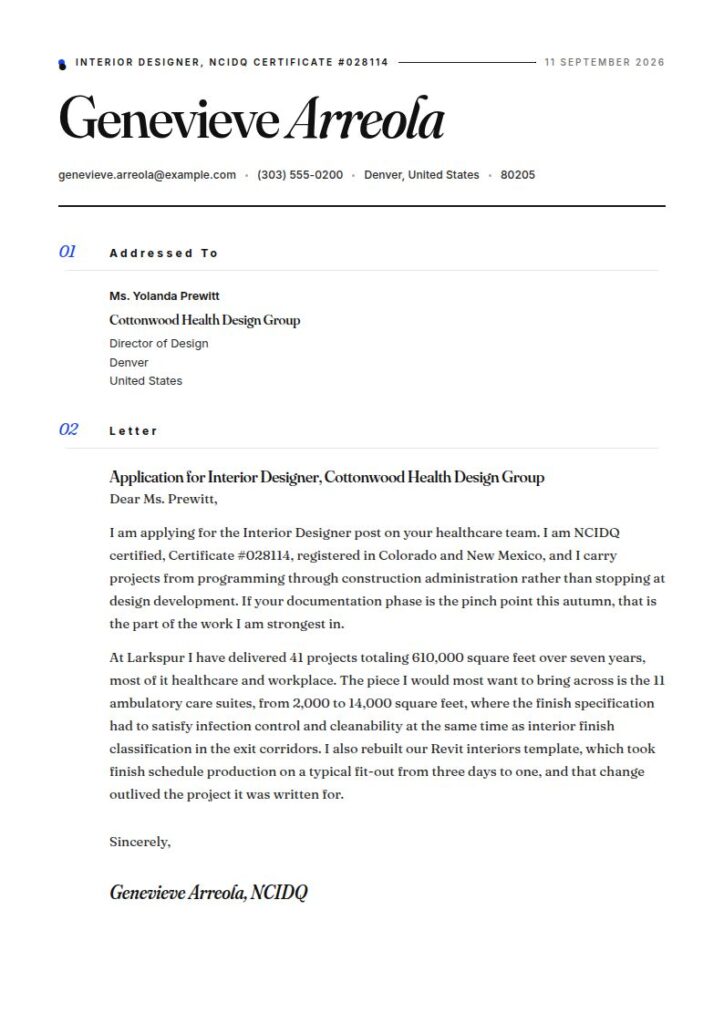
I am applying for the Interior Designer post on your healthcare team. I am NCIDQ certified, Certificate #028114, registered in Colorado and New Mexico, and I carry projects from programming through construction administration rather than stopping at design development. If your documentation phase is the pinch point this autumn, that is the part of the work I am strongest in.
At Larkspur I have delivered 41 projects totaling 610,000 square feet over seven years, most of it healthcare and workplace. The piece I would most want to bring across is the 11 ambulatory care suites, from 2,000 to 14,000 square feet, where the finish specification had to satisfy infection control and cleanability at the same time as interior finish classification in the exit corridors. I also rebuilt our Revit interiors template, which took finish schedule production on a typical fit-out from three days to one, and that change outlived the project it was written for.
I have followed your outpatient work in the north metro, and the way your team handles wayfinding inside a constrained floor plate is the reason I am writing rather than answering a recruiter. I would want to work on the permit and construction administration end of those jobs, and I am glad to carry code plans and accessibility review for the architect of record, which is how my current studio is set up.
My portfolio is at the link in my header and opens without a login. I can give four weeks' notice. Thank you for reading.
Sincerely, Genevieve Arreola, NCIDQ
Summary
An interior designer cover letter names your NCIDQ status, the project phases you can be staffed on, and one delivered project with a size and an outcome attached. This guide gives you a full adaptable letter, the openings that work on a design director, and how the letter changes between a regulated commercial studio and a residential practice.
Interior Designer cover letter examples by experience level
An interior designer cover letter is a one-page letter that tells a studio principal what you are qualified to take responsibility for, which project phases you can be staffed on from next month, and what you delivered the last time you carried a job to site.
Design studios hire against a staffing plan and a fee: a project starting in six weeks, a documentation phase they are short on, a number in a spreadsheet. A letter written for that reads as a professional rather than an applicant.
Guide to an interior designer cover letter
This guide and the corresponding interior designer cover letter example will cover:
- How to structure the letter, paragraph by paragraph
- Why your NCIDQ status belongs in the first three sentences
- What a measured result looks like when the work is visual
- How the letter changes between a regulated commercial studio and a residential practice
- The closing lines that get a portfolio opened
How to write an interior designer cover letter
| Paragraph | Its job | Length |
|---|---|---|
| Opening | The role, your qualification status, and the phases you carry | 2 to 3 sentences |
| Evidence | One project: building type, size, phase, and what changed | 4 to 5 sentences |
| Fit | Something specific about their work, and what you would take on | 3 to 4 sentences |
| Close | Registration, portfolio link, availability, thank you | 2 sentences |
Put your qualification status in the first three sentences
The NCIDQ Examination is administered by the Council for Interior Design Qualification, Inc. (CIDQ), and eligibility is education plus verified work hours: 3,520 hours with a degree from a program accredited by the Council for Interior Design Accreditation, rising to 7,040 hours for an associate degree plus 60 interior design credits (CIDQ, checked 12 September 2026).
That means your status is a countable fact, not a claim. Write it that way. "NCIDQ certified, Certificate #028114, registered in Colorado and New Mexico" settles the question in one line.
If you are not certified, the honest version beats silence: "IDFX passed in 2024, 2,180 of 3,520 hours logged, sitting IDPX in March." A principal can staff around a known date.
An interior designer cover letter example you can adapt
Dear Ms. Prewitt,
I am applying for the Interior Designer post on your healthcare team. I am NCIDQ certified, Certificate #028114, registered in Colorado and New Mexico, and I carry projects from programming through construction administration rather than stopping at design development. If your documentation phase is the pinch point this autumn, that is the part of the work I am strongest in.
At Larkspur I have delivered 41 projects totaling 610,000 square feet over seven years, most of it healthcare and workplace. The piece I would most want to bring across is the 11 ambulatory care suites, from 2,000 to 14,000 square feet, where the finish specification had to satisfy infection control and cleanability at the same time as interior finish classification in the exit corridors. I also rebuilt our Revit interiors template, which took finish schedule production on a typical fit-out from three days to one, and that change outlived the project it was written for.
I have followed your outpatient work in the north metro, and the way your team handles wayfinding inside a constrained floor plate is the reason I am writing rather than answering a recruiter. I would want to work on the permit and construction administration end of those jobs, and I am glad to carry code plans and accessibility review for the architect of record, which is how my current studio is set up.
My portfolio is at the link in my header and opens without a login. I can give four weeks' notice. Thank you for reading.
Sincerely, Genevieve Arreola, NCIDQ
Openings that work
| Instead of | Use |
|---|---|
| I am writing to express my interest in the interior designer position | I am applying for the Interior Designer post on your healthcare team, NCIDQ certified and registered in Colorado |
| I have a strong eye for detail and a love of beautiful spaces | I carry projects from programming through construction administration rather than stopping at design development |
| I have worked on many exciting commercial projects | I have delivered 41 projects totaling 610,000 square feet, most of it healthcare and workplace |
| Your firm's work is very impressive | I have followed your outpatient work in the north metro, and the wayfinding inside a constrained floor plate is why I am writing |
What counts as evidence when the work is visual
Photographs belong in the portfolio. The letter needs a number, and these are the ones a studio tracks.
| Kind of evidence | What it looks like in a sentence |
|---|---|
| Delivered volume | 41 projects totaling 610,000 square feet across seven years |
| Building type depth | 11 ambulatory care suites from 2,000 to 14,000 square feet |
| Phase reach | Programming through construction administration on 23 projects a year |
| Regulatory outcome | Permit comments on interiors scope fell from an average of 9 per submission to 3 |
| Process built | Rebuilt the Revit interiors template, cutting finish schedule production from three days to one |
| People | Six of nine designers on the team now NCIDQ certified, the rest on a published hours schedule |
Regulated commercial studios and residential practices
The same letter does not work in both, because the two readers fear different risks.
For a commercial or institutional studio, lead with qualification status, phases carried and the code and accessibility work you take responsibility for, then one building type with square footage. For a residential or boutique practice, lead with the client relationship and the delivery record: budget bands you have run, procurement and installation you have managed, and how you handle a change of mind at week eleven. In both, name one real thing about their work, taken from their own project pages.
Do not open with a philosophy of design; it delays the only facts the reader wants. Do not describe yourself as creative or detail-oriented, which every letter in the folder does. Do not attach a 40MB portfolio to the email; link it. Do not imply registration you do not hold in a state where the title is protected, because it is verifiable in a minute and it ends the application.
The pay gap follows the regulated work
The median annual wage for interior designers was $67,190 as of May 2025, with the lowest 10 percent under $41,420 and the highest 10 percent over $114,140 (BLS Occupational Outlook Handbook, interior designers, May 2025).
The spread is not random. Interior designers in architectural, engineering and related services earn a median of $78,340, against $50,560 in retail trade, with specialized design services in between at $67,870 (BLS, May 2025). Employment overall is 97,100 jobs, projected to grow 3 percent from 2025 to 2035, with about 7,700 openings a year over the decade.
The better-paid setting is the one where the drawings go to a building department. That is why the letter's first paragraph is about qualification and phase rather than aesthetic, and why CIDQ's position that twenty-nine U.S. states, Washington D.C. and Puerto Rico regulate the profession is worth knowing before you apply out of state (CIDQ legislative map, checked 12 September 2026).
Length, format and sending it
One page, four paragraphs, 250 to 400 words. PDF, named for yourself and the post.
Address a person. Studio leadership is on the firm's own site, and "Dear Hiring Manager" reads as a file sent to twelve firms. Link the portfolio in the header of both documents as a plain URL. Use the same figures as your resume so the two agree; our interior designer resume example uses the numbers here.
Key takeaways
- Name your NCIDQ status, or your exact progress toward it, in the first three sentences.
- Say which phases you carry, because studios staff by phase.
- Give one project with a building type, a square footage and an outcome.
- Put the code and accessibility responsibility on the page; it is the part that is hard to fake.
- Name one real thing about their work, taken from their project pages.
- Link the portfolio, never attach it.
- Address a named person and keep it to one page.
Write your interior designer cover letter in 10 minutes.
Interior designer cover letter questions, answered
How long should an interior designer cover letter be?
One page, four paragraphs, 250 to 400 words. The letter is not the portfolio. Its job is to show you are qualified, staffable and specific, so the portfolio gets opened.
Should I mention NCIDQ if I have not passed it yet?
Yes, with the detail. Say which sections you have passed, how many verified hours you have logged, and when you plan to sit the rest. The hours requirement is published and countable, from 3,520 hours on a CIDA-accredited degree upward (CIDQ, checked 12 September 2026), so progress against it is a real credential rather than an intention.
Do I attach my portfolio to the cover letter?
No. Link it in the header of both documents, as a plain URL that opens without a login. Large attachments are stripped by mail filters and applicant systems, and a portfolio behind a password gets skipped.
What if the studio does residential work, where nothing goes to permit?
Change what the first paragraph proves. A residential practice is buying delivery and client handling, so lead with budget bands run, procurement and installation managed, and how you handled a project that changed direction mid-build. Keep one line about code and accessibility anyway, because it distinguishes you from candidates who have only ever decorated.
Should I write a different letter for every firm?
Change the first and third paragraphs and keep the second. The opening has to match the role and the sector, and the third paragraph must contain one accurate sentence about their actual work. The evidence paragraph is your best project and does not need rewriting.