Nnamdi Eze Project Architect, Registered in Wisconsin and Illinois Milwaukee, 53202, United States [email protected] · (414) 555-0165
11 September 2026
Ms. Adaeze Okafor-Lane Education Studio Principal Kettleridge Architecture Group Milwaukee, United States
Application for Project Architect, Kettleridge Architecture Group
Dear Ms. Okafor-Lane,
I am applying for the Project Architect post on your education team. I am registered in Wisconsin and Illinois, Wisconsin #A-14027, and I hold the NCARB Certificate, so reciprocal registration in Minnesota would be quick if your Twin Cities work needs another sealer. I run projects from schematic design through construction administration rather than handing off after the permit set.
Over eight years at Ravensbrook I have completed 14 buildings totaling $186M in construction value, most of it K-12 and civic. The one I would point you to is a $31M, 68,000 square foot mixed-use building that reached substantial completion four weeks early. I carried the documentation and the construction administration on it, ran the occupancy, occupant load and egress analysis myself, and closed all 22 plan review comments without a resubmission, which is where the four weeks came from.
Your recent secondary school work is the reason I am writing. The phasing on an occupied campus is the hardest part of that work and the part I most want more of, and I would want to take construction administration on those jobs rather than leave at CD issue. I also supervise three staff through the AXP, and I would be glad to keep doing that.
My portfolio is at the link in my header. I can give six weeks' notice to hand over two projects cleanly. Thank you for your time.
Sincerely, Nnamdi Eze, AIA, NCARB
Summary
An architect cover letter states your registration status precisely, names the phases you can be staffed on, and gives one project with its building type, construction value and outcome. This guide gives you a full adaptable letter, how it changes when you are mid-path on the NCARB requirements, and the closing lines that get a portfolio opened.
Architect cover letter examples by experience level
An architect cover letter is a one-page letter that tells a principal whether you can seal drawings, which phases you can be staffed on, and what happened on the last building you carried.
Firms hire architects against a project that already exists. There is a fee, a schedule, a phase they are short on, and often a jurisdiction they need another registered name in. A letter written for that reads as a professional. A letter about your design philosophy reads as a student, whatever your experience.
Guide to an architect cover letter
This guide and the corresponding architect cover letter example will cover:
- How to structure the letter, paragraph by paragraph
- Why your licensure status belongs in the first two sentences
- How the letter changes when you are mid-path rather than registered
- What a measured result looks like on a building project
- The closing lines that get a portfolio opened
How to write an architect cover letter
| Paragraph | Its job | Length |
|---|---|---|
| Opening | The role, your registration status and states, the phases you carry | 2 to 3 sentences |
| Evidence | One building: type, construction value, phases, outcome | 4 to 5 sentences |
| Fit | Something specific about their work, and what you would take on | 3 to 4 sentences |
| Close | Portfolio link, availability, thank you | 2 sentences |
State licensure in the first two sentences, whatever it says
All states and the District of Columbia require architects to be licensed (BLS Occupational Outlook Handbook, architects, 2025-35 edition), so a principal's first question is always the same one.
If you are registered, answer it completely: "Registered in Wisconsin and Illinois, Wisconsin #A-14027, NCARB Certificate holder." The certificate matters because it is the usual basis for reciprocal registration, and a firm working across state lines is quietly counting how fast you could be added to a submittal somewhere new.
If you are mid-path, the answer is two numbers and a date: hours logged against the 3,740 required by the Architectural Experience Program, and divisions passed of the six in the ARE (NCARB, checked 12 September 2026). A firm can plan its sealing capacity around a date. It cannot plan around "currently pursuing licensure".
An architect cover letter example you can adapt
Dear Ms. Okafor-Lane,
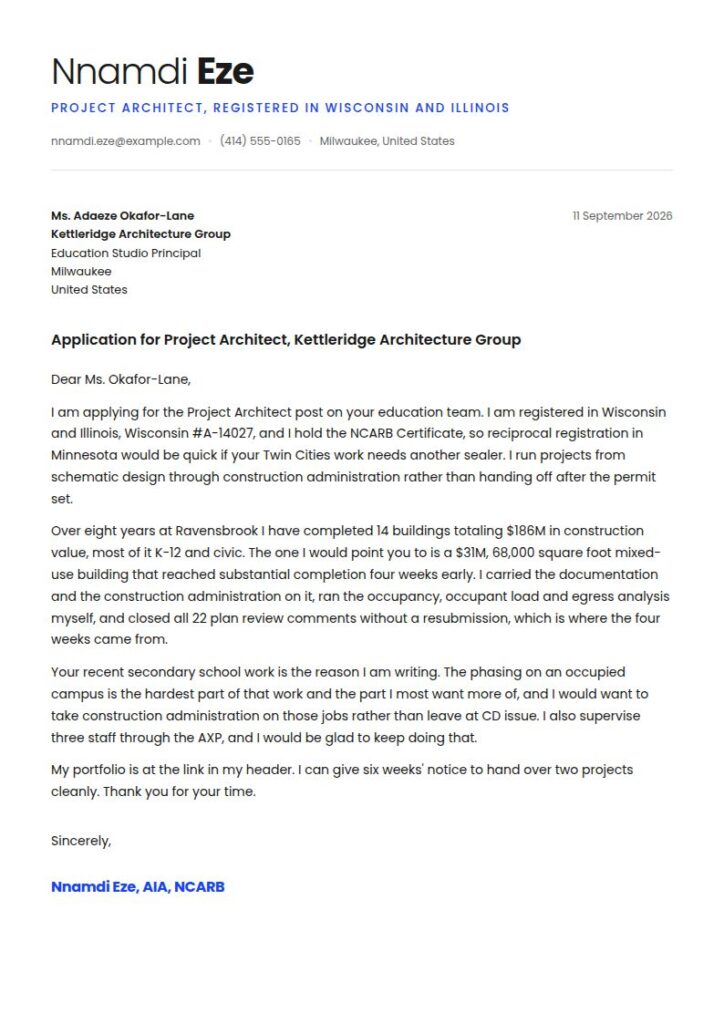
I am applying for the Project Architect post on your education team. I am registered in Wisconsin and Illinois, Wisconsin #A-14027, and I hold the NCARB Certificate, so reciprocal registration in Minnesota would be quick if your Twin Cities work needs another sealer. I run projects from schematic design through construction administration rather than handing off after the permit set.
Over eight years at Ravensbrook I have completed 14 buildings totaling $186M in construction value, most of it K-12 and civic. The one I would point you to is a $31M, 68,000 square foot mixed-use building that reached substantial completion four weeks early. I carried the documentation and the construction administration on it, ran the occupancy, occupant load and egress analysis myself, and closed all 22 plan review comments without a resubmission, which is where the four weeks came from.
Your recent secondary school work is the reason I am writing. The phasing on an occupied campus is the hardest part of that work and the part I most want more of, and I would want to take construction administration on those jobs rather than leave at CD issue. I also supervise three staff through the AXP, and I would be glad to keep doing that.
My portfolio is at the link in my header. I can give six weeks' notice to hand over two projects cleanly. Thank you for your time.
Sincerely, Nnamdi Eze, AIA, NCARB
Openings that work
| Instead of | Use |
|---|---|
| I am writing to express my interest in the architect position | I am applying for the Project Architect post, registered in Wisconsin and Illinois and holding the NCARB Certificate |
| I am passionate about thoughtful, human-centered design | I run projects from schematic design through construction administration rather than handing off after the permit set |
| I have worked on many significant projects | 14 buildings totaling $186M in construction value, most of it K-12 and civic |
| I am currently pursuing licensure | AXP 2,410 of 3,740 hours, three of six ARE divisions passed, targeting registration in 2027 |
What counts as a result on a building project
| Kind of evidence | What it looks like in a sentence |
|---|---|
| Delivered value | 14 buildings totaling $186M in construction value across eight years |
| Schedule | A $31M mixed-use building reached substantial completion four weeks early |
| Regulatory | Closed all 22 plan review comments without a resubmission |
| Documentation quality | Construction-phase RFIs on architectural scope fell by a third after a review process change |
| Phase reach | Carried six projects from schematic design through punch and closeout |
| People | Supervise three staff through the AXP as an approved supervisor |
Registered, mid-path, and unlicensed
If you are registered, name the states, the number and the NCARB Certificate in the first two sentences, and say which jurisdictions you could add quickly. If you are mid-path, give hours, divisions and a target date, then spend the letter on the phase work you can already do unsupervised. If you are unlicensed and not on the path, apply as a designer and lead with production capability: what you can model, detail and coordinate without supervision. In every case, name one real thing about their projects.
Do not call yourself an architect in a state where you are not registered; the title is protected and it is checked. Do not open with a design philosophy. Do not write "involved in all phases", which reads as none of them. Do not attach a large portfolio; link it. Do not name a project without its building type, construction value or your phase on it.
Most applicants are somewhere in the middle of a twelve-year path
NCARB reported that the median time to licensure fell to 12.3 years in 2025, the lowest in nearly a decade, and that the average time to complete the ARE fell to two years, the lowest in the history of the computerized examination (NCARB by the Numbers, 2026 edition). The same report found 13 percent of new architects in 2025 took an alternative pathway rather than a NAAB-accredited degree, up from 11 percent in 2024.
Meanwhile the occupation itself is steady: 124,600 jobs in 2025, projected to grow 4 percent by 2035, with about 6,900 openings a year and a median annual wage of $99,280 as of May 2025 (BLS Occupational Outlook Handbook, architects, May 2025 and 2025-35 projections).
Put those two facts together and the letter writes itself. Registration is scarce relative to the number of people working in the profession, so stating your exact position on that path is the single highest-value sentence you can write, at any stage.
Length, format and sending it
One page, four paragraphs, 250 to 400 words. PDF named for yourself and the post. Link the portfolio rather than attaching it, unless the posting asks for a file and gives a size limit, in which case respect the limit exactly; ignoring it is the first test.
Address a person. Practice leadership is published on almost every firm site. Keep the figures identical to your resume, so the two agree; our architect resume example is written with the numbers used here.
Key takeaways
- State registration, states and certificate in the first two sentences.
- If mid-path, give AXP hours, ARE divisions and a target date instead.
- Name the phases you carry, and say plainly whether that includes construction administration.
- Give one building with a type, a construction value and an outcome.
- Name one real thing about their projects, taken from their own pages.
- Link the portfolio; respect any size limit in the posting.
- Address a named person and keep it to one page.
Write your architect cover letter in 10 minutes.
Architect cover letter questions, answered
How long should an architect cover letter be?
One page, four paragraphs, 250 to 400 words. The portfolio is the long document. The letter exists to establish that you are registered or measurably close to it, staffable on the phases the firm is short of, and specific about their work.
Should I write a cover letter if the firm only asks for a resume and portfolio?
Yes, as the first page of the portfolio PDF or as the email body. It costs you a paragraph and it is the only place you can say which jurisdictions you are registered in, which phases you want, and what you noticed about their projects. None of that fits neatly on a resume.
What do I write if I am not licensed yet?
The exact numbers. Hours logged against the 3,740 required across the six AXP experience areas and divisions passed of the six in the ARE (NCARB, checked 12 September 2026), plus the date you expect to register. Then spend the letter on what you can already do without supervision, which for most mid-path candidates is documentation and consultant coordination.
How do I mention salary in an architect cover letter?
Only if the posting asks. If it does, give a range anchored to published data and your registration status: the median annual wage for architects was $99,280 as of May 2025, with the lowest 10 percent under $62,300 and the highest 10 percent over $161,420 (BLS Occupational Outlook Handbook, May 2025). A registered project architect with construction administration experience sits well above the bottom of that range, and saying so calmly is not a negotiation.
How do I write to a firm whose work is nothing like mine?
Name the transfer honestly. Code and life safety strategy, documentation quality, consultant coordination and construction administration move between building types; a specific typology's program does not. One sentence acknowledging the shift, followed by the phase capability that carries over, reads far better than pretending a school and a laboratory are the same problem.