Otilia Markovich Senior Title Examiner, Commercial and Mineral Title Cleveland, 44113, United States [email protected] · (216) 555-0144
12 September 2026
Ms. Rosalind Achterberg Title Operations Great Lakes Abstract and Title Cleveland, United States
Application for Senior Title Examiner, Great Lakes Abstract and Title
Dear Ms. Achterberg,
I am applying for the Senior Title Examiner post on your commercial team. I hold an Ohio Title Insurance Agent license, Ohio Department of Insurance #OH-4471928, and I currently carry 14 to 20 commercial, agricultural and oil and gas files a week across Ohio, Pennsylvania and West Virginia, with delegated underwriting authority to $5M and full 60 year searches on assets up to $42M in insured value.
Before the commercial desk I examined 58 residential and small commercial files a week across 12 Ohio counties, on full searches, two-owner limited searches, updates and foreclosure searches. In one year I cleared 612 defects: 214 unreleased mortgages, 97 judgment liens, 64 name and legal description variances, 31 probate and heirship gaps, and 18 old oil and gas reservations that became mineral exceptions. I referred 46 files to underwriting counsel with a written recommendation and 41 were accepted as written, and my post-closing revision rate held at 1.2 percent. The work I am proudest of is less glamorous: I rebuilt our examination checklist and exception library, and post-closing claims notices fell from 9 a year to 2.
Your agency's growth into the eastern Ohio acreage and mineral pipeline is why I am writing. Severed mineral estates, unrecorded heirship and forty year old reservations are the files I have spent the last three years on, and they are the ones that come back after closing when the severance was never traced to the deed that created it. I would want the agricultural and mineral queue first, and I would be glad to run the exception library work for your residential examiners as a second assignment.
My agent license is active, with separate escrow records, escrow theft coverage and an errors and omissions policy maintained as Ohio Revised Code 3953.23 requires, and my Ohio notary commission runs through 2029. I can start on four weeks' notice. Thank you for your time.
Sincerely, Otilia Markovich
Summary
A title examiner cover letter names how many files you examine a week, which search types they are, what defects you cleared and how you decide what goes on Schedule B. This guide gives you a full adaptable letter, the openings that beat research language, the evidence that proves judgement rather than effort, and the license line that settles the escrow question before anyone calls you.
Title Examiner cover letter examples by experience level
A title examiner cover letter is a one-page letter that says how many files you examine a week, what kind of searches they are, what you found in them, and how you decide what becomes a requirement and what becomes an exception.
The person reading it is almost always another examiner, or the counsel who signs off on the hard ones. They know exactly which claims can be checked. A letter that says 58 files a week across 12 counties, 612 defects cleared last year and a 1.2 percent post-closing revision rate tells them where to put you on Monday.
Guide to a title examiner cover letter
This guide and the corresponding title examiner cover letter example will cover:
- How to structure the letter, paragraph by paragraph
- Why volume and search type belong in the same sentence
- What to say about Schedule B when a licensed agent signs the commitment
How to write a title examiner cover letter
| Paragraph | Its job | Length |
|---|---|---|
| Opening | The post, your license if you hold one, files a week, search types, counties | 2 to 3 sentences |
| Evidence | Defects cleared by category, referrals, and one quality number | 4 to 6 sentences |
| Fit | Their pipeline or jurisdictions, and what you would take first | 3 to 4 sentences |
| Close | License status, specialist training, availability | 2 sentences |
Put the volume and the search type in the same sentence
Volume without search type is not a number anyone can read. Forty files a week of refinance updates and forty full 60 year commercial searches are different jobs, and an examiner will assume the easier one.
Write both together: "58 files a week across 12 Ohio counties, on full searches, two-owner limited searches, updates and foreclosure searches." If your agency does not track throughput, count one month yourself and label it as one month.
A title examiner cover letter example you can adapt
Dear Ms. Achterberg,
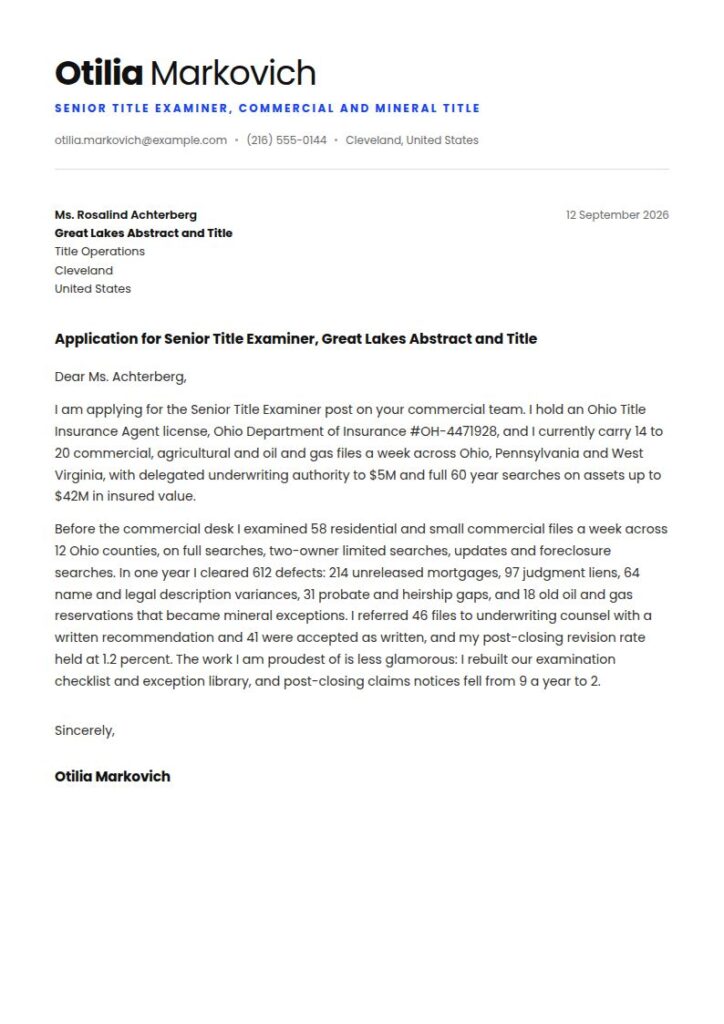
I am applying for the Senior Title Examiner post on your commercial team. I hold an Ohio Title Insurance Agent license, Ohio Department of Insurance #OH-4471928, and I currently carry 14 to 20 commercial, agricultural and oil and gas files a week across Ohio, Pennsylvania and West Virginia, with delegated underwriting authority to $5M and full 60 year searches on assets up to $42M in insured value.
Before the commercial desk I examined 58 residential and small commercial files a week across 12 Ohio counties, on full searches, two-owner limited searches, updates and foreclosure searches. In one year I cleared 612 defects: 214 unreleased mortgages, 97 judgment liens, 64 name and legal description variances, 31 probate and heirship gaps, and 18 old oil and gas reservations that became mineral exceptions. I referred 46 files to underwriting counsel with a written recommendation and 41 were accepted as written, and my post-closing revision rate held at 1.2 percent. The work I am proudest of is less glamorous: I rebuilt our examination checklist and exception library, and post-closing claims notices fell from 9 a year to 2.
Your agency's growth into the eastern Ohio acreage and mineral pipeline is why I am writing. Severed mineral estates, unrecorded heirship and forty year old reservations are the files I have spent the last three years on, and they are the ones that come back after closing when the severance was never traced to the deed that created it. I would want the agricultural and mineral queue first, and I would be glad to run the exception library work for your residential examiners as a second assignment.
My agent license is active, with separate escrow records, escrow theft coverage and an errors and omissions policy maintained as Ohio Revised Code 3953.23 requires, and my Ohio notary commission runs through 2029. I can start on four weeks' notice. Thank you for your time.
Sincerely, Otilia Markovich
Openings that work
| Instead of | Use |
|---|---|
| I am a detail oriented title professional with strong research skills | I examine 58 files a week across 12 Ohio counties, on full searches, limited searches, updates and foreclosure searches |
| I am writing to express my interest in your title examiner position | I am applying for the Senior Title Examiner post; I hold an Ohio Title Insurance Agent license, #OH-4471928 |
| I have extensive experience identifying and resolving title issues | I cleared 612 defects last year, including 214 unreleased mortgages and 97 judgment liens |
Every sentence in the right column can be checked against a production report, which is the only test that matters here.
Turning a search into a paragraph a hiring examiner trusts
Most letters collapse into the story of one difficult file. Resist it, and give categories with counts instead.
| Kind of evidence | What it looks like in a sentence |
|---|---|
| Volume with search type | 58 files a week: full searches, two-owner limited searches, updates and foreclosure searches |
| Referral discipline | 46 files referred to underwriting counsel with a written recommendation, 41 accepted as written |
| Quality | Post-closing revision rate of 1.2 percent, no claims notice attributable to my examination |
The referral line is the one experienced readers look for. An examiner who never refers is guessing, and one who refers everything is a cost; a referral count with an acceptance rate beside it answers that question.
What to say about Schedule B without overclaiming
The craft of this job sits in one distinction, and stating it plainly is worth a paragraph of adjectives. The ALTA Commitment for Title Insurance splits Schedule B into two parts: Part I is Requirements, the things that must be done before the policy issues, and Part II is Exceptions, the matters the policy will not cover (American Land Title Association, Commitment for Title Insurance, 2021 v. 01.00, adopted 1 July 2021). A defect that can be cured before closing becomes a requirement; one that cannot becomes an exception; everything in between is a conversation with an underwriter.
Write what you do with that distinction at the level you actually do it. If you draft requirements and exceptions and a licensed agent signs the commitment, say exactly that. If you hold delegated underwriting authority, name the limit. If you are still a searcher, say so and describe the search notes you write instead.
Give files a week and the search types behind the number. Name your counties and states. Count defects by category. Put your referral volume and acceptance rate on the page. Say whose signature goes on the commitment. Name your license, its state and its number.
Do not build the letter around a single hard file. Do not say "performed title searches" without a search period. Do not imply you signed commitments if a licensed agent signed them. Do not quote a percentile wage range for this occupation; the federal data does not publish one.
A small occupation hires on depth, not on churn
Title examiners, abstractors and searchers numbered 59,800 in 2025, with employment projected to rise by 1,300, or 2 percent, through 2035, and a median annual wage of $58,650 as of May 2025 (Bureau of Labor Statistics Occupational Outlook Handbook, Data for Occupations Not Covered in Detail, updated 27 August 2026).
For scale, property, real estate and community association managers numbered 460,400 in 2025 with about 36,900 openings a year (same Handbook, 2025 to 2035 projections). No comparable openings figure is published for title examination.
A small, slow occupation hires on what you can examine that the current desk cannot, so your letter has one job, which is to name which of those you bring.
Length, format and sending it
One page, four paragraphs, 275 to 400 words. PDF, named for yourself and the post: otilia-markovich-title-examiner-cover-letter.pdf.
Address a person: agencies list their title operations leadership publicly. Keep every figure identical to the one on your resume. Our title examiner resume example uses the same volumes, defect counts and revision rate.
Key takeaways
- Open with files a week and the search types behind the number.
- Name your license, its state and its number if you hold one.
- Count defects by category rather than telling the story of one file.
- Give your referral volume with the acceptance rate beside it, and say who signs the commitment.
- Put one quality number on the page, and name the counties and states you can work tomorrow.
Write your title examiner cover letter in 10 minutes.
Title examiner cover letter questions, answered
How long should a title examiner cover letter be?
One page, four paragraphs, 275 to 400 words. Anything past the fourth paragraph competes with a queue of files.
What do I write if I am a searcher rather than an examiner?
Write the searching accurately and do not borrow the examiner's vocabulary. Searches a week, the indices you run, the counties, your turnaround, your return rate from the examiner, and the defects you flag in your search notes.
Should I mention my title insurance agent license?
Yes, with the state and the number, in the first paragraph. Escrow and settlement handling is regulated: Ohio requires a title insurance agent to keep separate records of escrow receipts and disbursements without commingling, to carry coverage against theft, misappropriation and failure to disburse properly, and to maintain an errors and omissions policy (Ohio Revised Code 3953.23, checked 12 September 2026).
Do I need a cover letter if the agency only posts an application form?
Attach one wherever there is a field for it. The form collects the same structured data from every applicant; the letter is the only place you can state your search types, your jurisdictions and what you would take first.
How do I write to an underwriter rather than a title agency?
Shift from throughput to judgement. An agency is buying files cleared per week; an underwriter is buying the decisions behind them. Lead with referral quality, the exception language you draft and any claims record you can point to, and put the volume second.