Decorating Assistant Cassia Montenegro
Decorating Assistant
[email protected] | (912) 555-0118 | Savannah, United States
Profile
Decorating assistant with two years in a Savannah design retail studio, supporting residential furnishing projects from measure to install. Sourced and tracked 310 purchase orders across 18 projects, with room budgets from $6,000 to $22,000, and ran the receiving and inspection log that cut damaged-on-arrival replacements from 11% to 4% of items. Trained on two to-the-trade vendor portals and the studio's flat fee plus product pricing model.
Work Experience
06/2024 - Present, Decorating Assistant, Harbor & Pine Design Retail, Savannah, United States
- Support residential furnishing projects from measure through install: 18 projects in two years, room budgets from $6,000 to $22,000.
- Raised and tracked 310 purchase orders across two to-the-trade vendor portals, chasing acknowledgements and lead time changes weekly.
- Built and ran the receiving and inspection log at the studio warehouse; damaged-on-arrival replacements fell from 11% to 4% of items.
- Prepare presentation boards, scheduled item lists and client approval sheets for the lead decorator.
- Measure rooms and windows, draw elevations, and stage rooms for photography on install day.
09/2022 - 05/2024, Sales Associate, Furniture and Home, Ossabaw Home Company, Savannah, United States
- Sold case goods and upholstery on a commission floor, learning vendor terms, freight and standard lead times.
- Handled 40 to 60 special orders a quarter, including fabric selection and delivery scheduling.
Education
08/2018 - 05/2022, Bachelor of Arts, Art History, University of Georgia, Athens, United States
Coursework in the history of furniture, textiles and the decorative arts.
Skills
Purchase orders and acknowledgement tracking, 80
Receiving inspection and damage claims, 80
Lead time scheduling, 70
Measuring and elevation drawing, 70
Presentation boards and approval sheets, 75
SketchUp and Canva, 70
Install day preparation and styling, 65
Languages
English, native
Portuguese, native
Certificates
11/2024, Certificate in Residential Interior Decorating, Accredited distance program
Color and finish, space planning for furnishings, window treatments and procurement basics.
04/2025, Window Treatment Measuring and Installation, Vendor training program
Summary
An interior decorator resume is a one to two page document built on a portfolio and a procurement record: the rooms you have finished, the budget bands you have run, the trade accounts you hold, and how you charge. This guide gives you three adaptable versions, the scope boundary you must not cross, and current Bureau of Labor Statistics pay and outlook data.
Interior Decorator resume examples by experience level
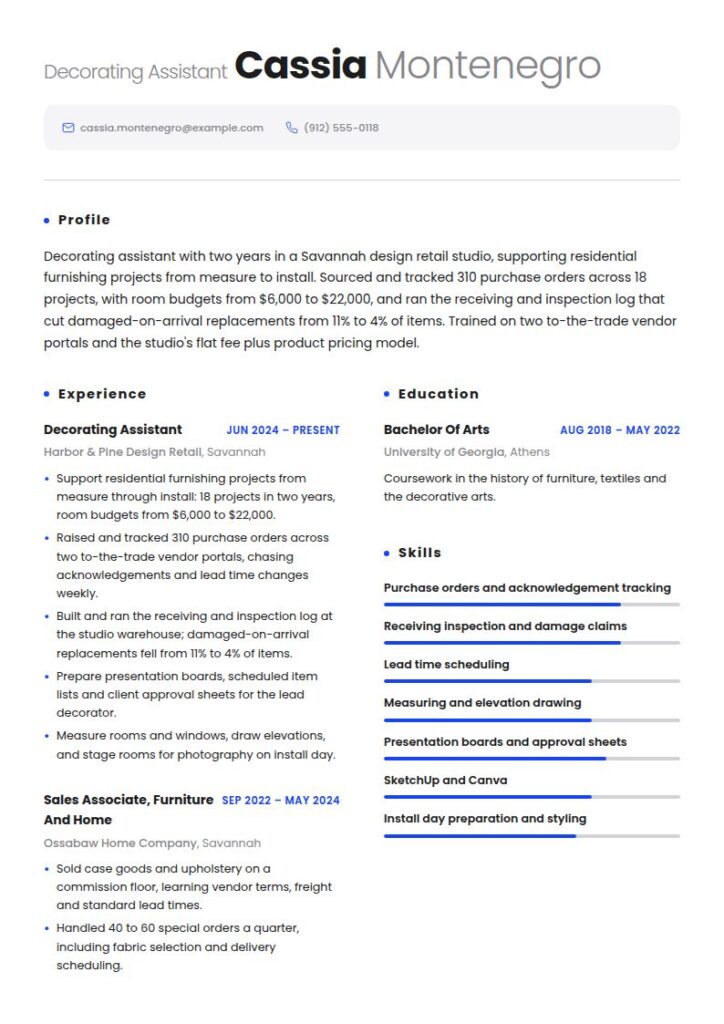
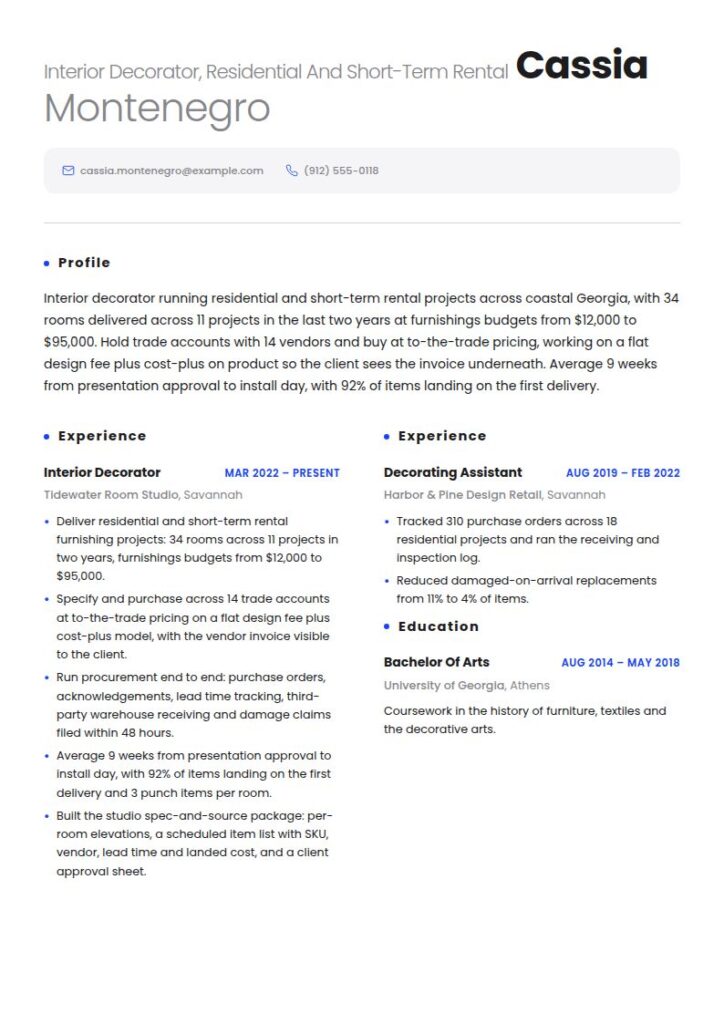
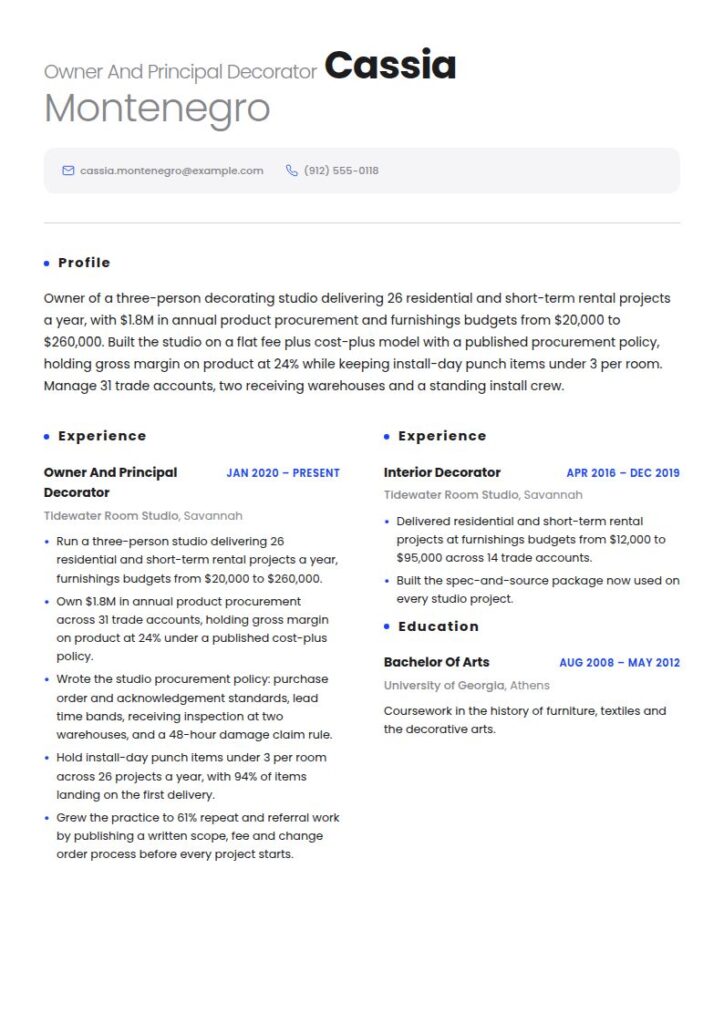
An interior decorator resume is a one to two page document that shows the rooms you have finished, the budgets you have run them on, and the buying and installing machinery behind the photographs.
Start with the part nobody says early enough. No license is required to work as a decorator anywhere in the United States, and that is exactly why the resume has to work harder. There is no exam number to put in the header, no registration to verify, and no gate a reader can check in ten seconds. What there is instead is a portfolio and a procurement record, and a resume that does not carry the second one is asking a client or a studio to take everything on trust.
Resume guide for an interior decorator resume
This guide and the corresponding interior decorator resume example will cover:
- How to write an interior decorator resume, section by section
- The scope boundary you must not cross, and how to state it without weakening the page
- Three adaptable summaries: assistant, working decorator and studio owner
- The procurement workflow that separates a professional from a hobbyist
- What the job market looks like and what you can expect to earn
How to write an interior decorator resume
Six sections: contact header with a portfolio link, summary, project record, procurement and vendor block, skills, and education or training. One page early, two once you have a multi-year project record and a business to describe.
The procurement block is the section this occupation is missing and the one that changes how the page is read. Anyone can post a photograph of a finished room. Far fewer people can describe how 43 items from nine vendors arrived in one week, got inspected, and went in without a second delivery charge.
| Section | What it is answering | Where it goes |
|---|---|---|
| Portfolio link | Can I see the work right now, without a login? | Contact header, as a plain URL |
| Project record | Room count, budget band, and what was delivered | Reverse chronological, one figure per bullet |
| Procurement and vendors | Do they have real trade accounts and a working process? | Its own block, directly after experience |
| Fee model | How does this person charge, and does it match how we pay? | One line in the summary or the procurement block |
Write the room count and the budget band, not the adjective
"Residential decorating projects" tells a reader nothing. Room count and budget band tell them everything, because together they say what kind of work you are actually set up to run.
A decorator who has furnished 60 rooms at $8,000 to $20,000 per room runs a high-volume, fast-turn practice with tight vendor relationships. A decorator who has done 9 whole-house projects at $150,000 to $400,000 runs long, custom, heavily managed jobs with workroom relationships and long lead times. Both are respectable. They are not the same job, and a studio hiring for one will not read the other file twice.
Write it as a range with a period attached: "34 rooms across 11 residential projects in two years, furnishings budgets from $12,000 to $95,000 per project."
Run the finished file through the free Rezoom ATS resume checker before you send it. Design firms and furniture retailers both run applications through a parser first.
Choosing the best resume format for an interior decorator resume
Reverse chronological if you have been employed, with a project block underneath. If you have run your own practice, the format is your business as the employer and projects as the evidence, which is the same shape.
Do not use a heavily designed template. It is counter-intuitive in a visual field, and it is still the right call: the resume is parsed and printed before anyone looks at it, and your design judgement is being assessed in the portfolio anyway. A plain, generous, well-spaced single column with one accent rule reads as confidence.
Include your contact information
| ✅ Right | ❌ Wrong |
|---|---|
| Cassia Montenegro | Cassia Montenegro |
| Interior Decorator, Residential and Short-Term Rental | Creative decorator with an eye for beautiful spaces |
| Portfolio: cassiamontenegro.example.com | Portfolio available upon request |
| (912) 555-0118, [email protected], Savannah, GA | (912) 555-0118, [email protected] |
The portfolio URL is the most important line in the header. "Available on request" is the single most costly phrase on a decorator's resume, because the reader is one click from a decision and you have put a form in the way.
Make use of a summary
Four lines: what you decorate, volume, budget band, and how you work commercially.
Decorating assistant with two years in a Savannah design retail studio, supporting residential furnishing projects from measure to install. Sourced and tracked 310 purchase orders across 18 projects, with room budgets from $6,000 to $22,000, and ran the receiving and inspection log that cut damaged-on-arrival replacements from 11% to 4% of items. Trained on two to-the-trade vendor portals and the studio's flat fee plus product pricing model.
Interior decorator running residential and short-term rental projects across coastal Georgia, with 34 rooms delivered across 11 projects in the last two years at furnishings budgets from $12,000 to $95,000. Hold trade accounts with 14 vendors and buy at to-the-trade pricing, working on a flat design fee plus cost-plus on product so the client sees the invoice underneath. Average 9 weeks from presentation approval to install day, with 92% of items landing on the first delivery.
Owner of a three-person decorating studio delivering 26 residential and short-term rental projects a year, with $1.8M in annual product procurement and furnishings budgets from $20,000 to $260,000. Built the studio on a flat fee plus cost-plus model with a published procurement policy, holding gross margin on product at 24% while keeping install-day punch items under 3 per room. Manage 31 trade accounts, two receiving warehouses and a standing install crew.
Right vs wrong: the same interior decorator summary, twice
| ✅ Right | ❌ Wrong |
|---|---|
| Interior decorator running residential and short-term rental projects across coastal Georgia. | Creative interior decorator with a flair for transforming spaces. |
| 34 rooms across 11 projects in two years, furnishings budgets from $12,000 to $95,000. | Experienced in a wide range of residential decorating projects. |
| Trade accounts with 14 vendors; flat fee plus cost-plus so the client sees the invoice underneath. | Committed to bringing each client's unique vision to life. |
The right column is a business. The left column is a description of a business, and a studio owner reading it can already tell whether their vendor list and yours overlap.
Outline your project experience
Studio or client type, city, dates, then three to five bullets. Each bullet carries a number: rooms, budget, lead time, delivery accuracy, or repeat business.
| Instead of | Use |
|---|---|
| Decorated residential homes for clients | Delivered 34 rooms across 11 residential and short-term rental projects, furnishings budgets $12,000 to $95,000 |
| Selected furniture and accessories | Specified and purchased 610 items across 14 trade accounts, at to-the-trade pricing with a documented cost-plus markup |
| Managed the installation process | Ran install days as a single event: 92% of items landed on the first delivery, average 3 punch items per room |
| Worked within client budgets | Held 10 of 11 projects to the approved furnishings budget, with change orders signed before any reorder was placed |
| Built good vendor relationships | Opened 14 trade accounts and negotiated freight consolidation with two of them, cutting delivery cost per project by roughly $700 |
Interior Decorator, Tidewater Room Studio, Savannah, GA, March 2022 to Present
Deliver residential and short-term rental furnishing projects: 34 rooms across 11 projects in two years, furnishings budgets from $12,000 to $95,000.
Specify and purchase across 14 trade accounts at to-the-trade pricing, working on a flat design fee plus cost-plus on product with the vendor invoice visible to the client.
Run procurement end to end: purchase orders, acknowledgements, lead time tracking, receiving inspection at a third-party warehouse, and damage claims.
Average 9 weeks from presentation approval to install day, with 92% of items landing on the first delivery and an average of 3 punch items per room.
Built the studio's spec-and-source package, a per-room document of elevations, a scheduled item list with SKU, vendor, lead time and landed cost, and a client-facing approval sheet.
What an interior decorator can charge for, and what they may not touch
This is the section that decides whether a client, a studio or a retailer takes you seriously, and it has two halves: the boundary, and the economics.
The boundary, stated plainly
Decorating is finishes, furnishings, window treatments, lighting selection, art and styling. It stops at anything that touches life safety or the permitted condition of the building. You do not alter means of egress, you do not specify rated assemblies, you do not sign or submit drawings for permit review, and you do not take professional responsibility for accessibility compliance. When a project needs any of that, it needs a regulated interior designer or an architect, and the professional move is to say so early and stay on the job.
There is also a naming rule worth knowing before you print a business card. The Bureau of Labor Statistics describes the position this way: in some states only licensed designers may do interior design work, while in others both licensed and unlicensed designers may do the work but only licensed designers may use the title "interior designer" (BLS Occupational Outlook Handbook, interior designers, 2025-35 edition). CIDQ states that twenty-nine U.S. states, Washington D.C., Puerto Rico and eight Canadian provinces have legislation regulating the profession, through title acts, practice acts or a combination (CIDQ legislative map, checked 12 September 2026).
So describe yourself as a decorator, and describe the work you do. Our interior designer resume example covers the regulated side, and knowing where the line is makes you sound more professional rather than less.
How you are actually paid, and what each model says about you
Put the fee model on the resume. It is the fastest signal of what kind of practice you run, and a studio owner or a client reading it knows immediately whether you fit.
| Model | How it works | What it says on a resume |
|---|---|---|
| Flat fee | One agreed design fee for a defined scope, product billed separately | You can scope and estimate accurately; suits repeatable room types |
| Hourly | Time billed against a rate, often with an estimate cap | You are used to advisory and partial-scope work; needs disciplined time records |
| Cost-plus | Product bought at to-the-trade pricing, billed to the client at cost plus an agreed percentage | You run real procurement and can defend a margin; the invoice is visible |
| Retail-minus | Product billed at retail less an agreed discount | You are comfortable with transparent pricing to the client; margin sits in the spread |
| Fee plus product | A flat or hourly design fee combined with cost-plus or retail-minus on product | Most common in practice; state both halves so nobody guesses |
Whichever model you name, name the accounting behind it too. Buying at to-the-trade pricing and reselling to a client is a taxable retail activity in many states, not a service. Washington State's Department of Revenue guide for interior decorators, designers and consultants puts it directly: purchasing goods and reselling them to clients falls under the Retailing classification "even if the goods may be sold at cost or with no markup", a reseller permit is what lets you buy without paying sales tax, service and product charges "must be separately stated or segregated on the invoice", and you remain liable for remitting sales tax "even if you do not collect it from your customers" (Washington State Department of Revenue, interior decorators, designers and consultants guide, checked 12 September 2026). Rules differ by state, but the shape of the problem does not.
Fee model: Flat design fee per room plus cost-plus on product at an agreed percentage, vendor invoice visible to the client. Hourly available for consultation-only scopes.
Trade accounts: 14 active accounts across case goods, upholstery, textiles, lighting and rugs, including two workrooms for custom drapery and two local upholsterers.
Procurement workflow: Spec-and-source package per room, purchase orders with acknowledgement tracking, lead time schedule maintained weekly, receiving and inspection at a third-party warehouse, damage claims filed within 48 hours of receipt.
Lead times carried: 2 to 4 weeks stocked, 8 to 14 weeks standard upholstery, 16 to 22 weeks custom and imported. Install scheduled only when the receiving log shows 95% of items landed.
Compliance: Georgia sales and use tax registration, reseller certificate on file with all trade vendors, design fee and product separately stated on every invoice.
That block is the reason to hire you rather than the talented amateur with a similar photograph, and almost nobody writes it.
Build a snapshot of your key interior decorator skills
Twelve to sixteen entries in four groups, weighted toward the commercial machinery rather than the taste.
Specification and sourcing: Room-by-room spec packages, furniture and textile specification, custom drapery and upholstery specification, rug and lighting selection, finish and paint scheduling
Procurement: Trade account management, purchase orders and acknowledgements, lead time scheduling, freight consolidation, receiving inspection and damage claims, returns and reorders
Commercial: Flat fee and cost-plus estimating, budget presentation and approval sheets, change order control, reseller certificates and sales tax handling, vendor terms negotiation
Delivery and tools: Install day management, styling and photography preparation, Studio Designer or comparable project accounting, SketchUp and Canva presentation boards, measure and elevation drawing
List your education and certifications
There is no license and no mandatory credential, so this section is short and should not be padded. Say what is true, then move the reader back to the portfolio.
Bachelor of Arts, Art History, University of Georgia, Athens, GA, 2018
Certificate in Residential Interior Decorating, accredited distance program, 2020
Georgia sales and use tax registration, active. Reseller certificate on file with all trade vendors.
Continuing training: textile performance and cleaning codes, 2024. Window treatment measuring and installation, 2023. Studio Designer project accounting, 2022.
If you came from retail, staging, merchandising or the trades, say so as a strength. Furniture retail teaches vendor terms and lead times, staging teaches speed and budget discipline, and neither is a weaker start than a design degree in a field that does not require one.
Choose the right layout and design
Single column, 10 or 11 point, one accent color at most, no photograph, no graphic skill bars. PDF, named for yourself and the role. The portfolio link goes in the header and must open in one click.
Put the portfolio URL in the header and make it open without a login. Give room counts and budget bands, not adjectives. Name your fee model and the accounting behind it. List your trade accounts by category and count. Write the procurement workflow as a process with lead times in it. Say plainly what you do not do, and name the professional you bring in when a project crosses that line.
Do not call yourself an interior designer in a state where that title is protected. Do not write "portfolio available upon request". Do not use a heavily designed two-column template that a parser cannot read. Do not present rooms without budgets; a photograph with no number attached could have cost anything. Do not list vendor brand names you merely admire as though they were accounts.
Interior decorator job market and outlook
The Bureau of Labor Statistics does not publish a separate occupational profile for interior decorators; the closest published occupation is interior designers, and the retail trade and self-employment shares inside it are where most decorating work sits.
| Measure | Value |
|---|---|
| Interior designer jobs, 2025 | 97,100 |
| Projected change, 2025-35 | 3% (about as fast as average) |
| Projected annual openings | About 7,700 |
| Self-employed share | 26% |
| Median annual wage, May 2025 | $67,190 |
Source: U.S. Bureau of Labor Statistics, Occupational Outlook Handbook, interior designers, 2025-35 projections and May 2025 wage data.
A quarter of the field works for itself, and the retail lane pays least
Self-employed workers make up 26 percent of interior designer employment, and retail trade a further 12 percent at a median annual wage of $50,560 as of May 2025, against $67,870 in specialized design services and $78,340 in architectural, engineering and related services (BLS Occupational Outlook Handbook, interior designers, May 2025).
Read that as a map of the decorating career rather than a discouragement. Most decorators start in the retail lane, where the pay is lowest and the training in vendors, lead times and customer expectations is best, and the ones who move up either build a self-employed practice or move into a specialized design studio.
What carries you across is the evidence, not the years. A self-employed decorator's resume competes on procurement volume, budget bands, repeat and referral rate and delivery accuracy, because those are the only numbers a reader can use to judge a business that has no license behind it.
What salary you can expect as an interior decorator
There is no separate BLS wage series for interior decorators, so use the interior designers series as the frame and adjust for lane. The median annual wage for interior designers was $67,190 as of May 2025, with the lowest 10 percent under $41,420 and the highest 10 percent over $114,140 (BLS Occupational Outlook Handbook, May 2025).
Employed decorating roles inside furniture and home retail sit toward the lower half of that range, which the retail trade median of $50,560 reflects. Studio roles in specialized design services sit around the middle at $67,870.
Self-employment is the part the wage series cannot describe, because a decorator's income is a design fee plus a margin on product, and the margin is often the larger half. That is precisely why the procurement block belongs on your resume even when you are applying for a salaried role: it is the evidence that you understand where the money in this work actually comes from.
Key takeaways for an interior decorator resume
- Put a working portfolio URL in the header; never write "available upon request".
- Give room counts and budget bands with a period attached, not adjectives.
- Name your fee model, and the accounting and tax handling behind it.
- Write the procurement workflow as a process, with real lead times.
- Count your trade accounts by category; it is the closest thing this field has to a credential.
- State the scope boundary plainly, and name who you bring in when a job crosses it.
- Keep the layout plain and parseable, and let the portfolio carry the design.
Build your interior decorator resume in 15 minutes.
Related real estate resume examples
- Interior designer resume
- Architect resume
- Real estate agent resume
- Realtor resume
- Property manager resume
- New home sales consultant resume
- Real estate assistant resume
- Real estate coordinator resume
- Title examiner resume
- Leasing consultant resume
- Leasing agent resume
- Assistant property manager resume
Pair it with a matching interior decorator cover letter.
Interior decorator resume questions, answered
Do I need a license or certification to work as an interior decorator?
No. Decorating requires no license anywhere in the United States, which is why the portfolio and the procurement record carry the whole file. What you may need is a business registration and a sales tax or reseller certificate if you buy product and resell it to clients, because that is a retail activity rather than a service in many states (Washington State Department of Revenue, interior decorators, designers and consultants guide, checked 12 September 2026).
Can I call myself an interior designer?
Not everywhere. CIDQ reports that twenty-nine U.S. states, Washington D.C. and Puerto Rico regulate the profession through title acts, practice acts or both (CIDQ legislative map, checked 12 September 2026), and BLS notes that in some states only licensed designers may use the title "interior designer" (BLS Occupational Outlook Handbook, 2025-35 edition). Use "interior decorator" and describe the work; it is accurate everywhere and costs you nothing.
How long should an interior decorator resume be?
One page for your first few years, two once you have a multi-year project record, trade accounts and a business to describe. Keep the project list tight and let the portfolio do the visual work; the resume is there to prove the machinery behind the photographs.
What do I put on an interior decorator resume with no professional projects?
Anything with a budget and a deadline attached. Staging jobs, a short-term rental you furnished, a family member's room done on a real budget with a real vendor list, retail floor or design desk work, or a workroom apprenticeship. Write the room count, the budget, the sourcing and the install. A candidate who can produce a purchase order log is more useful on day one than one who can produce only mood boards.
Should I list the vendors I work with?
List them by category and count rather than as a brand parade: "14 trade accounts across case goods, upholstery, textiles, lighting and rugs, including two custom workrooms." That is verifiable in one question at interview and it says what a reader needs to know, which is whether your accounts overlap with theirs and how much of a project you can source without going retail.