Rosalba Quintero Buyer, Direct Materials Denver, 80211, United States [email protected] · (303) 555-2266
11 September 2026
Ms. Ngozi Okafor Procurement Cordera Manufacturing Colorado Springs, United States
Application for Senior Buyer, Cordera Manufacturing
Dear Ms. Okafor,
I am applying for the Senior Buyer post at Cordera Manufacturing. I currently manage $14M in annual direct materials spend at Front Range Instrument Works across 92 active suppliers and roughly 2,400 part numbers, covering machined components, castings, electronic assemblies and engineering resin. Your posting names castings and machined components as the two largest lines in the book, and those are where most of my last four years have gone.
The work I would most want to bring across is the machining consolidation. We were buying from 23 shops, most of them inherited and none of them under agreement. Over two years I moved 460 part numbers down to 11 suppliers with no line-down event and no loss of first article approval status, and the resulting volume let me take 4 percent out of machined component pricing against prior purchase price. The resin and packaging re-tender in the same period came in 9 percent under prior contract pricing across a $4.1M category, verified by our controller against the standard cost roll rather than against my own spreadsheet.
I noticed Cordera has moved two plants onto a single ERP instance this year. That is usually the moment a supplier base turns out to be bigger than anyone thought, and cleaning up lead time and safety stock parameters after a consolidation like that is the work that took our on-time-in-full from 81 percent to 94 percent over six quarters.
I hold the CPSM through the Institute for Supply Management and the CPIM through ASCM, and I can give four weeks' notice. Thank you for your time.
Sincerely, Rosalba Quintero, CPSM
Summary
A buyer cover letter names the spend you manage, the categories it sits in and one savings figure measured against a stated baseline. This guide gives you a full adaptable letter, what changes between a direct materials post and an indirect one, and the openings that get a strong file shortlisted early.
Buyer cover letter examples by experience level
In short, a buyer cover letter is a one-page letter that tells a purchasing manager how much money you spend on someone else's behalf, across which categories, and what you last took out of a price.
That is a narrow brief and it is deliberate. In most cases, the person reading has a category with a number attached and a gap in the team, and they are matching sizes. As a result, a letter that spends its opening on enthusiasm has not started answering yet.
Guide to a buyer cover letter
To help, this guide and the corresponding buyer cover letter example will cover:
- First, how to structure the letter, paragraph by paragraph
- Next, why annual spend belongs in the first sentence
- Then, how to write a savings figure that survives the interview
- Finally, direct materials and indirect spend, and how the letter changes
- What to write when you are moving between sectors
How to write a buyer cover letter
| Paragraph | Its job | Length |
|---|---|---|
| Opening | The post, your current spend, your categories | 2 to 3 sentences |
| Evidence | One category, one baseline, one number, one period | 4 to 5 sentences |
| Fit | Something specific about their spend or supply base | 3 to 4 sentences |
| Close | Certification, notice period, thank you | 2 sentences |
Open with the size of your book
The first sentence of a buyer's letter should contain a dollar figure, a supplier count and a category list. Not because numbers are impressive, but because they are the only way the reader can place you.
"I currently manage $14M in direct materials spend across 92 suppliers, covering machined components, castings, electronic assemblies and resin" answers three screening questions before the reader reaches the second line.
If your book is smaller than the posted role, give the number anyway and name what closed the gap: a consolidation you ran, a category you took over mid-year, a re-tender you led on someone else's book. A smaller number with a trajectory beats no number.
A buyer cover letter example you can adapt
Dear Ms. Okafor,
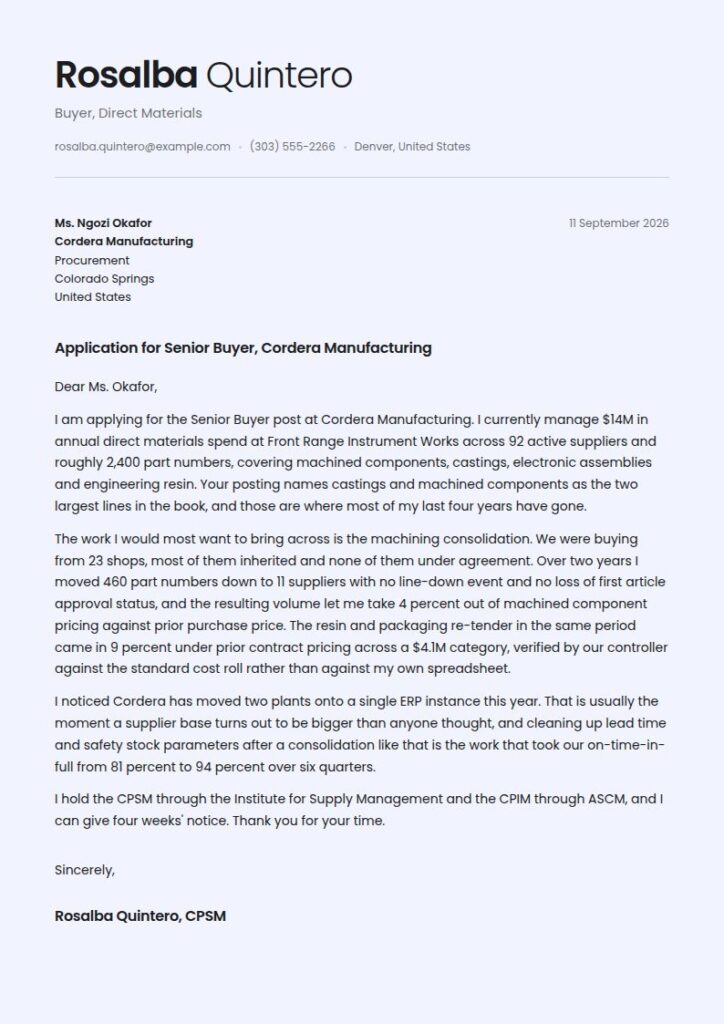
I am applying for the Senior Buyer post at Cordera Manufacturing. I currently manage $14M in annual direct materials spend at Front Range Instrument Works across 92 active suppliers and roughly 2,400 part numbers, covering machined components, castings, electronic assemblies and engineering resin. Your posting names castings and machined components as the two largest lines in the book, and those are where most of my last four years have gone.
The work I would most want to bring across is the machining consolidation. We were buying from 23 shops, most of them inherited and none of them under agreement. Over two years I moved 460 part numbers down to 11 suppliers with no line-down event and no loss of first article approval status, and the resulting volume let me take 4 percent out of machined component pricing against prior purchase price. The resin and packaging re-tender in the same period came in 9 percent under prior contract pricing across a $4.1M category, verified by our controller against the standard cost roll rather than against my own spreadsheet.
I noticed Cordera has moved two plants onto a single ERP instance this year. That is usually the moment a supplier base turns out to be bigger than anyone thought, and cleaning up lead time and safety stock parameters after a consolidation like that is the work that took our on-time-in-full from 81 percent to 94 percent over six quarters.
I hold the CPSM through the Institute for Supply Management and the CPIM through ASCM, and I can give four weeks' notice. Thank you for your time.
Sincerely, Rosalba Quintero, CPSM
Openings that work
| Instead of | Use |
|---|---|
| I am writing to express my interest in the Senior Buyer position | I currently manage $14M in direct materials spend across 92 active suppliers |
| I am a results-driven procurement professional | My categories are machined components, castings, electronic assemblies and resin |
| I have a proven track record of delivering cost savings | A $4.1M resin re-tender came in 9 percent under prior contract pricing over 14 months |
Write a savings figure that survives the interview
In practice, interviewers interrogate every savings number in a buyer's letter. For this reason, write it the way you would defend it.
| Part of the claim | What it looks like | Why it matters |
|---|---|---|
| The baseline | Against prior contract pricing | Without it the figure is an assertion |
| The spend it applied to | Across a $4.1M category | Percent of nothing is nothing |
| The period | Over 14 months | Savings realized in a quarter and savings realized over two years are different claims |
| Who verified it | Verified by the controller against the standard cost roll | This is the sentence that ends the interrogation |
The four together take one line. The last one matters most: a buyer who names the finance function that signed the number off has said something about how they work that no adjective can.
Direct materials and indirect spend
If the post is direct materials, lead with landed cost, supplier quality, line availability and the ERP you run MRP in. If it is indirect, lead with contract coverage, consolidation, maverick spend and the categories you took from uncontrolled to under agreement. If it is public sector, name the CPPB or NIGP-CPP if you hold it. Read their last published tender or annual report and name one real thing from it.
Do not present indirect experience as direct or the reverse; the interview finds it in four minutes. Do not write a savings figure without a baseline. Do not claim a category you supported on one tender as one you own. Do not call yourself a strategic sourcing expert in a letter containing no category names. Do not send a letter with no company name in it.
The sector you buy in is worth more than the title you hold
Buyers and purchasing agents had a median annual wage of $77,710 in May 2025, with the lowest 10 percent under $48,380 and the highest 10 percent over $128,870 (BLS Occupational Outlook Handbook, page last modified 27 August 2026).
That spread is mostly sector, not seniority. Government pays a median of $95,780, management of companies and enterprises $83,990, manufacturing $77,890, wholesale trade $71,640 and retail trade $57,840 for the same occupation (BLS, May 2025).
The promotion track is steeper still: purchasing managers had a median of $148,080, with the top 10 percent over $223,280, and BLS notes they typically need several years of related work experience rather than a further degree (BLS Occupational Outlook Handbook, page last modified 27 August 2026). If your letter is a sector move, that table is the reason to write it, and the thing to argue in the third paragraph is that categories transfer even when industries do not.
Moving between sectors
Category knowledge transfers less than buyers think and process knowledge transfers more. A retail buyer moving into manufacturing will not know castings, and pretending otherwise loses the interview. What comes with you is the tendering process, the negotiation, the supplier scorecard, the consolidation playbook and the ERP discipline.
Write the letter that way: one sentence acknowledging the category gap and how you will close it, then three sentences of process evidence with numbers on them.
Length, format and sending it
One page, four paragraphs, 250 to 400 words. PDF unless the portal says otherwise, named for yourself and the post: rosalba-quintero-senior-buyer-cover-letter.pdf.
Address a person. Also, procurement teams are small and the company site or a published tender usually names their leadership, so "Dear Hiring Manager" on an otherwise specific letter is two minutes of research skipped.
Keep the figures identical to your resume. Our buyer resume example is written with the same book and the same numbers used here, so the two documents agree line for line.
Key takeaways
- To start, put annual spend, supplier count and category names in the first two sentences.
- Say whether the spend is direct, indirect or both.
- Then give one savings figure with its baseline, its spend, its period and who verified it.
- In addition, name one real thing about their supply base or their business, taken from their own material.
- If you are changing sector, acknowledge the category gap in one sentence and spend the rest on process.
- Similarly, put the certification and the notice period in the closing lines.
- In closing, address a named person and keep it to one page.
Write your buyer cover letter in 10 minutes with our AI cover letter builder.
Buyer cover letter questions, answered
How long should a buyer cover letter be?
One page, four paragraphs, 250 to 400 words. The letter's job is to be placeable in fifteen seconds, not to be complete.
Should I put dollar figures in a cover letter?
Yes, for spend under management. It is what the reader needs to size you and is rarely confidential at the level of "roughly $14M in direct materials". If your employer treats it as sensitive, give the supplier count and keep savings as percentages.
What if my savings numbers were team results?
Say so and name your part. "I led the resin and packaging lines of a re-tender covering $4.1M that came in 9 percent under prior contract pricing" is honest and still yours. A claimed team result that unravels in the interview costs more than the smaller true one.
Do I mention the CPSM or CPIM in the letter?
In the closing line, with the issuing body. The CPSM requires three exams plus three years of professional supply management experience with a bachelor's degree, or five years without one (Institute for Supply Management, CPSM certification page, accessed 17 September 2026). If the posting names a credential, move it into the first paragraph.
How do I write to a company whose spend I know nothing about?
Read what is public. Annual reports name capital programs, press releases name new plants and product lines, and public bodies publish their tenders in full. One accurate sentence about a category they are visibly spending in cannot be reused in the next letter, which is exactly why it works.