Nilufar Hakimova Scientist, Protein Engineering, PhD Durham, 27701, United States [email protected] · (919) 555-1315
17 September 2026
Dr. Marit Sundgren Enzyme Engineering Kestrelton Therapeutics Research Triangle Park, United States
Application for Scientist II, Enzyme Engineering, Kestrelton Therapeutics
Dear Dr. Sundgren,
I am applying for the Scientist II position in the enzyme engineering group at Kestrelton Therapeutics. My doctorate and postdoctoral work were in protein engineering, and I run protein expression and purification, differential scanning fluorimetry, stopped-flow kinetics and plate-based screening with automated liquid handling as routine assays. Your posting describes a stability problem on a manufacturing candidate, which is the problem I have spent six years on.
At Tessellate Biosciences I designed and screened a 4,800 variant library across three rounds of directed evolution and raised the thermal stability of the target enzyme by 11 degrees Celsius while retaining 86 percent of specific activity. The part I would most want to bring with me is what happened afterward: I qualified the assay, wrote the method, and handed it to the process group, who now run it without research support. I have done that twice, and the second one took six months rather than eleven because we had standardized the screening platform in between.
Your recent work on continuous processing is why I am writing to you rather than to the general posting. A stability campaign run against a continuous process has a different endpoint from one run against a batch step, and I would want to start by agreeing what the acceptance criterion actually is before designing the library. That conversation is usually worth two rounds of screening.
I am first author on three peer-reviewed papers and a contributing author on four more, second inventor on a granted US patent assigned to my employer, and co-writer of a funded external research proposal. The full publication list is available on request. I can start within a month. Thank you for your time.
Sincerely, Nilufar Hakimova, PhD
Summary
A scientist cover letter is one page that names the problem you can be handed, the techniques you would bring to it, one result that is not a publication, and your output stated at exactly the level you earned. This guide gives you a full adaptable letter, what changes between an academic and an industry reader, and the openings that get a strong file read twice.
Scientist cover letter examples by experience level
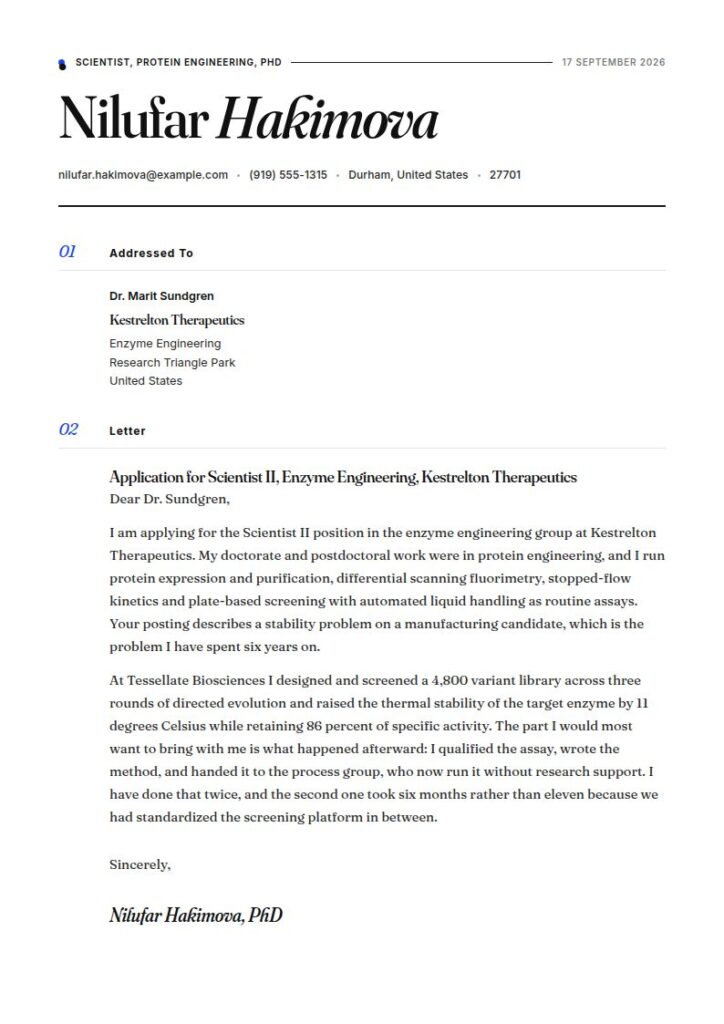
In short, a scientist cover letter is a one page letter that tells a hiring scientist which of their problems they could hand you, what you would bring to it, and what happened the last time someone handed you something similar.
However, it is not a research statement. In other words, a research statement argues for a program you want to run; a cover letter argues that you are the answer to a problem someone else already has. Indeed, this difference is the single most common reason that employers pass over a strong academic candidate.
Guide to a scientist cover letter
Specifically, this guide and the corresponding scientist cover letter example will cover:
- How to structure the letter, paragraph by paragraph
- Why the techniques belong in the first two sentences
- What counts as evidence beyond publications
- How to state authorship, patents and funding without overclaiming
- What changes between an academic search and a company posting
How to write a scientist cover letter
| Paragraph | Its job | Length |
|---|---|---|
| Opening | The post, your field and training, and two or three techniques they named | 2 to 3 sentences |
| Evidence | One problem, what you did, and the result with a number | 4 to 5 sentences |
| Fit | Something specific about their work, and what you would start on | 3 to 4 sentences |
| Close | Output stated exactly, availability, thank you | 2 sentences |
Open with the techniques from their own posting
A hiring scientist reading applications has a bench, a set of instruments and a problem. The first thing they want to know is whether you could run their assays next month without six months of training.
So open with the match: "My doctorate and postdoctoral work were in protein engineering, and I run protein expression and purification, differential scanning fluorimetry and stopped-flow kinetics as routine assays." That is three techniques, named plainly, in one sentence.
Then give one result that is not a publication. A method someone else now runs. A library you built and screened. A process that moved from your bench to a colleague's. Those sentences are rare in academic applications and they are exactly what the reader is buying.
A scientist cover letter example you can adapt
Dear Dr. Sundgren,
I am applying for the Scientist II position in the enzyme engineering group at Kestrelton Therapeutics. My doctorate and postdoctoral work were in protein engineering, and I run protein expression and purification, differential scanning fluorimetry, stopped-flow kinetics and plate-based screening with automated liquid handling as routine assays. Your posting describes a stability problem on a manufacturing candidate, which is the problem I have spent six years on.
At Tessellate Biosciences I designed and screened a 4,800 variant library across three rounds of directed evolution and raised the thermal stability of the target enzyme by 11 degrees Celsius while retaining 86 percent of specific activity. The part I would most want to bring with me is what happened afterward: I qualified the assay, wrote the method, and handed it to the process group, who now run it without research support. I have done that twice, and the second one took six months rather than eleven because we had standardized the screening platform in between.
Your recent work on continuous processing is why I am writing to you rather than to the general posting. A stability campaign run against a continuous process has a different endpoint from one run against a batch step, and I would want to start by agreeing what the acceptance criterion actually is before designing the library. That conversation is usually worth two rounds of screening.
I am first author on three peer-reviewed papers and a contributing author on four more, second inventor on a granted US patent assigned to my employer, and co-writer of a funded external research proposal. The full publication list is available on request. I can start within a month. Thank you for your time.
Sincerely, Nilufar Hakimova, PhD
Openings that work
| Instead of | Use |
|---|---|
| I am writing to express my strong interest in this position | My doctorate and postdoctoral work were in protein engineering; in addition, I run four of the assays your posting names |
| I am a highly motivated researcher with a passion for discovery | Your posting describes a stability problem on a manufacturing candidate, which is what I have spent six years on |
| I have published extensively in peer-reviewed journals | I qualified the assay, wrote the method, and handed it to the process group, who run it without support |
| I believe my skills would be an asset to your organization | Your recent work on continuous processing is why I am writing to you rather than to the general posting |
In contrast, the right column is a person who read the posting. Meanwhile, the left column is a person who wrote one letter and sent it eleven times.
Evidence beyond publications
Publications are necessary and they are not sufficient, because they answer a question about your record rather than about your usefulness next quarter.
| Kind of evidence | What it looks like in a sentence |
|---|---|
| Method transfer | Wrote and transferred the screening method; the process group runs it without research support |
| Scale | Designed and screened a 4,800 variant library across three rounds |
| Instrumentation | Own the plate-based screening platform, including the liquid handling scripts |
| Cycle time | Median time from screening hit to qualified assay fell from eleven months to six |
| People | Trained nine people on the platform; as a result, two of them now run it independently |
| Money | Hold a $1.4 million annual budget for consumables, instrument service and external testing |
| Judgement | Stopped a line of work at the second round when the stability gain did not survive the activity assay |
That last row is worth more than it looks. A candidate who can describe a project they ended, and why, is describing scientific judgement rather than persistence, and interviewers notice.
Stating your output at the level you earned
Say first author, co-first author, corresponding author or contributing author, exactly as it is. Say filed, published or granted for a patent, with your inventor position and the assignee. Give your actual role on funded work: principal investigator, co-investigator, named personnel, or co-writer of a funded proposal. Offer the full publication list rather than pasting it. Name the techniques from their posting that you genuinely run.
Do not write "published in" a journal where you were a middle author. Do not call a preprint peer-reviewed or a submission in press. Do not list unfunded applications. Do not include an h-index or impact factors. Do not send a research statement to a company or a cover letter to a faculty search that asked for a research statement. Do not claim a technique you have watched rather than run; the interview is at a bench.
Funded work is selective, which is why the exact role matters
In fiscal year 2025 the National Institutes of Health received 62,592 research project grant applications and made 8,161 competing awards, a success rate of 13.0 percent, with the R01-equivalent rate also at 13.0 percent (National Institutes of Health, Fiscal Year 2025 by the Numbers, published 12 March 2026).
Roughly one application in eight succeeds, so a funded award is a dated, externally reviewed and checkable fact about you. It is also why the difference between principal investigator, co-investigator and co-writer is worth one extra clause rather than a vague verb.
For context on where the work is, among medical scientists, the largest published research occupation at 181,000 jobs in 2025, research and development services employed 32 percent, hospitals 22 percent and colleges and universities 12 percent (BLS Occupational Outlook Handbook, May 2025). Most of the readers of your letter are not in a university, and the letter should sound like it knows that.
Length, format and sending it
Overall, aim for one page, four paragraphs, 300 to 400 words. Similarly, send a PDF, named for yourself and the post: nilufar-hakimova-scientist-cover-letter.pdf.
Address a person, and where you can, address the person who runs the group rather than the recruiting mailbox. After all, almost every company research page and every institutional site names its group leaders.
Use the same figures as your resume so the two agree. Our scientist resume example is written with the numbers used here, and both are worth running through the free ATS checker before you send them.
Key takeaways
- First, name two or three techniques from their own posting in the first two sentences.
- Give one result that is not a publication.
- Above all, describe a problem someone handed you, not a program you want to run.
- Finally, state authorship, patent stage and funding role exactly.
- Offer the full publication list instead of pasting it.
- Name one real thing about their work and what you would start on.
- Address the group leader and keep it to one page.
Write your scientist cover letter in 10 minutes with our AI cover letter builder.
Scientist cover letter questions, answered
How long should a scientist cover letter be?
One page, four paragraphs, 300 to 400 words. Longer letters are usually research statements in disguise, and a company reader will stop before the part where you get to the evidence.
Is a cover letter different from a research statement?
Yes, and the difference matters. A research statement sets out the program you intend to build and is what faculty searches and fellowship panels ask for. A cover letter argues that you can solve a problem the employer already has. Sending the wrong one is a common and avoidable reason a strong file gets set aside.
What do I write if I have no industry experience at all?
Write the parts of your academic work that were not the science. You wrote protocols other people followed. You trained new members of the group. You ran a shared instrument, managed a consumables line, or met an external reporting deadline. You ended a project when the data said to. Each of those is one sentence with a number, and together they answer the question the reader has, which is whether you can be given a problem and a deadline.
Should I attach my publication list?
Offer it, do not paste it. One line saying the full list is available on request is enough, with three to five selected publications carrying your exact authorship position in the resume. If the posting explicitly asks for a full list, send it as a separate document rather than inside the letter.
How do I write to a group whose work I only know from papers?
Read two of their recent papers properly and name one specific thing, such as a method they adopted, a limitation they flagged in a discussion section, or a direction they said they were moving in. One accurate sentence about their actual work is worth more than a paragraph of admiration, and it is the only part of the letter that could not have been sent to anyone else.