Analytical Chemist Lucian Petrescu B.S.
Analytical Chemist I
[email protected] | (302) 555-1372 | Newark, United States
Profile
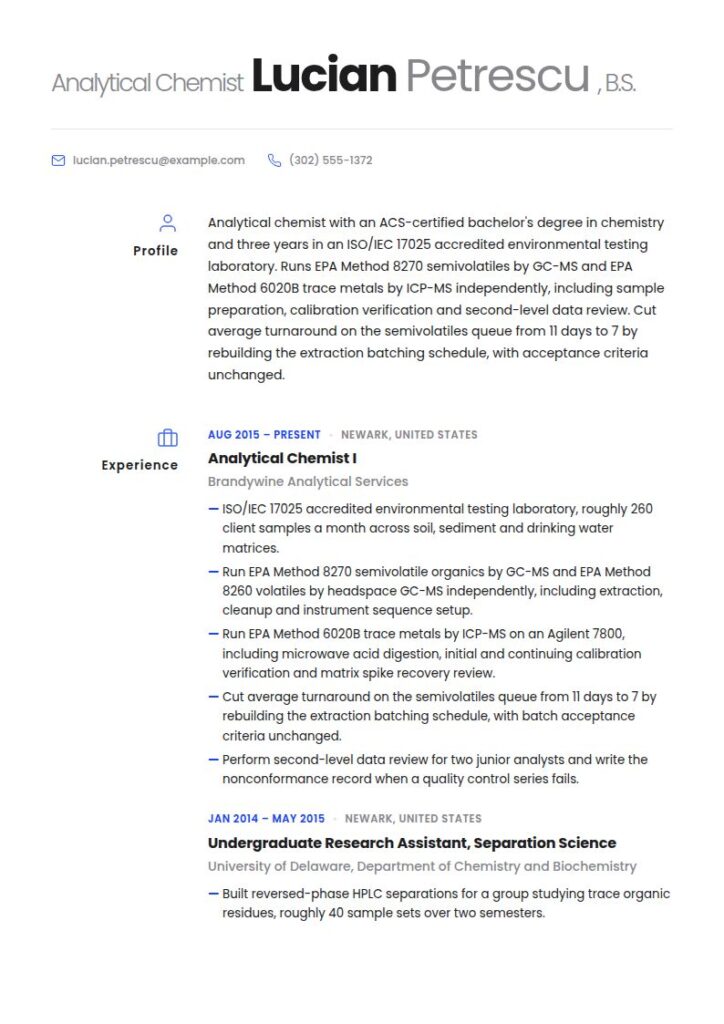
Analytical chemist with an ACS-certified bachelor's degree in chemistry and three years in an ISO/IEC 17025 accredited environmental testing laboratory. Runs EPA Method 8270 semivolatiles by GC-MS and EPA Method 6020B trace metals by ICP-MS independently, including sample preparation, calibration verification and second-level data review. Cut average turnaround on the semivolatiles queue from 11 days to 7 by rebuilding the extraction batching schedule, with acceptance criteria unchanged.
Work Experience
08/2015 - Present, Analytical Chemist I, Brandywine Analytical Services, Newark, United States
- ISO/IEC 17025 accredited environmental testing laboratory, roughly 260 client samples a month across soil, sediment and drinking water matrices.
- Run EPA Method 8270 semivolatile organics by GC-MS and EPA Method 8260 volatiles by headspace GC-MS independently, including extraction, cleanup and instrument sequence setup.
- Run EPA Method 6020B trace metals by ICP-MS on an Agilent 7800, including microwave acid digestion, initial and continuing calibration verification and matrix spike recovery review.
- Cut average turnaround on the semivolatiles queue from 11 days to 7 by rebuilding the extraction batching schedule, with batch acceptance criteria unchanged.
- Perform second-level data review for two junior analysts and write the nonconformance record when a quality control series fails.
01/2014 - 05/2015, Undergraduate Research Assistant, Separation Science, University of Delaware, Department of Chemistry and Biochemistry, Newark, United States
- Built reversed-phase HPLC separations for a group studying trace organic residues, roughly 40 sample sets over two semesters.
- Prepared standards and mobile phases, maintained column records and ran daily system suitability.
Education
08/2011 - 05/2015, Bachelor of Science, Chemistry, ACS-certified degree, University of Delaware, Newark, United States
ACS-certified degree: five foundation courses across analytical, biochemistry, inorganic, organic and physical chemistry, four in-depth courses and 350 laboratory hours beyond general chemistry. Undergraduate research in separation science, two semesters.
Skills
GC-MS, EPA Methods 8270 and 8260, 80
ICP-MS, EPA Method 6020B, 75
Microwave acid digestion, 80
Solid phase and liquid-liquid extraction, 80
Calibration and calibration verification, 75
ISO/IEC 17025 quality control series, 70
Chain of custody and holding times, 80
Laboratory information management systems, 70
Languages
English, native
Romanian, native
Certificates
09/2016, OSHA 40-Hour Hazardous Waste Operations and Emergency Response, OSHA Training Institute Education Center
Annual 8-hour refresher current.
Summary
A chemist resume is a one to two page document naming the analytical methods you can run without supervision, the instruments and detectors behind them, and the regulatory regime the work sat inside. This guide gives you three adaptable versions, the method and platform block most applicants leave out, and current Bureau of Labor Statistics pay and outlook for chemists.
Chemist resume examples by experience level
In short, a chemist resume is a one to two page document that names the methods you can run without supervision, the instruments you run them on, and the regulatory regime the work sat inside.
Those three facts belong together, but they are almost never written together. A laboratory reading your file is deciding whether you could be productive on their platforms, inside their quality system, without a year of training. "Experienced analytical chemist with strong problem-solving skills" answers none of that. "Six years of HPLC and LC-MS/MS method development under cGMP, including three methods transferred to a contract laboratory" answers all of it. The same degree also feeds very different laboratories: chemical manufacturing employs 33 percent of chemists, scientific research and development services 16 percent and testing laboratories 11 percent (BLS Occupational Outlook Handbook, chemists, May 2025), and each reads a resume for something different.
Resume guide for a chemist resume
Specifically, this guide and the corresponding chemist resume example will cover:
- First, how to write a chemist resume, block by block
- Secondly, the method and instrument stack, and why it belongs above your job titles
- Thirdly, three adaptable summaries: new chemist, established analytical chemist and senior method lead
- Fourthly, what cGMP, GLP, USP and ISO/IEC 17025 each demand of your documentation
- Lastly, what the job market looks like and what Bureau of Labor Statistics pay data shows
How to write a chemist resume
Overall, it takes six blocks: contact header, summary, the method and instrument stack, laboratory experience, education, and a short quality and regulatory block. In general, use one page for your first five years, then two once you have validated methods, transferred them between sites, or led a group.
A quality control manager reads for platform match first, because a mismatch costs months of familiarization on an instrument you have never touched. In contrast, a research manager reads for what you made work. Both want the stack early.
| Block | What it is answering | Where it goes |
|---|---|---|
| Method and instrument stack | Which techniques can this person run on which platforms, alone? | Directly under the summary |
| Regulatory regime | Whose rules has this work been done under? | In the stack block and in every job line |
| Laboratory experience | What did they make work, and at what throughput? | Reverse chronological, with volume |
Name the instrument by manufacturer, model and detector
"HPLC experience" is the most common line on a chemist resume and it carries almost no information. There is a long practical distance between an isocratic ultraviolet method on an older binary pump and a gradient method with a photodiode array, and a longer one again between either and a triple quadrupole.
Write the platform, then the chemistry: "Agilent 1290 Infinity II UPLC with diode array and Agilent 6470 triple quadrupole, Empower 3 and MassHunter; reversed-phase gradient methods for related substances and assay, low nanogram per milliliter quantitation in biological matrix."
One sentence, and a hiring manager knows whether you start on their system in week one or week twelve.
Run the finished file through the ATS resume checker first. Instrument names, method numbers and regulatory citations are what a decorative template mangles.
Choosing the best resume format for a chemist resume
Reverse chronological, single column. Use one page for your first five years at the bench, but two once you have validation, transfer, investigation or supervisory work worth listing in its own right. Keep the stack block near the top even though it is not chronological; it is the part a screening reader looks at twice.
However, a skills-only format fails here: analytical work is judged by what you ran, in which system, for how long, and detaching the technique from the job removes the one thing that makes the claim checkable. Also, research chemists add two short blocks: publications and patents, and conference presentations.
Include your contact information
| ✅ Right | ❌ Wrong |
|---|---|
| Lucian Petrescu | Lucian Petrescu |
| Senior Chemist, Method Validation and Transfer | Motivated scientist with a passion for chemistry |
| M.S. Analytical Chemistry; ACS-certified B.S. Chemistry | Chemistry graduate |
| (302) 555-1372, [email protected], Wilmington, DE | (302) 555-1372, [email protected] |
First, put the specialism in the title line, not "chemist" alone. After all, analytical, organic, formulation, polymer, quality control and process chemistry are hired by different managers against different postings, and the title line decides which pile your file lands in.
Make use of a summary
In short, use four lines: specialism and years, the platforms you own, the regime, and one result with a number and a time frame.
Analytical chemist with an ACS-certified bachelor's degree in chemistry and three years in an ISO/IEC 17025 accredited environmental testing laboratory. Runs EPA Method 8270 semivolatiles by GC-MS and EPA Method 6020B trace metals by ICP-MS independently, including sample preparation, calibration verification and second-level data review. Cut average turnaround on the semivolatiles queue from 11 days to 7 by rebuilding the extraction batching schedule, with acceptance criteria unchanged.
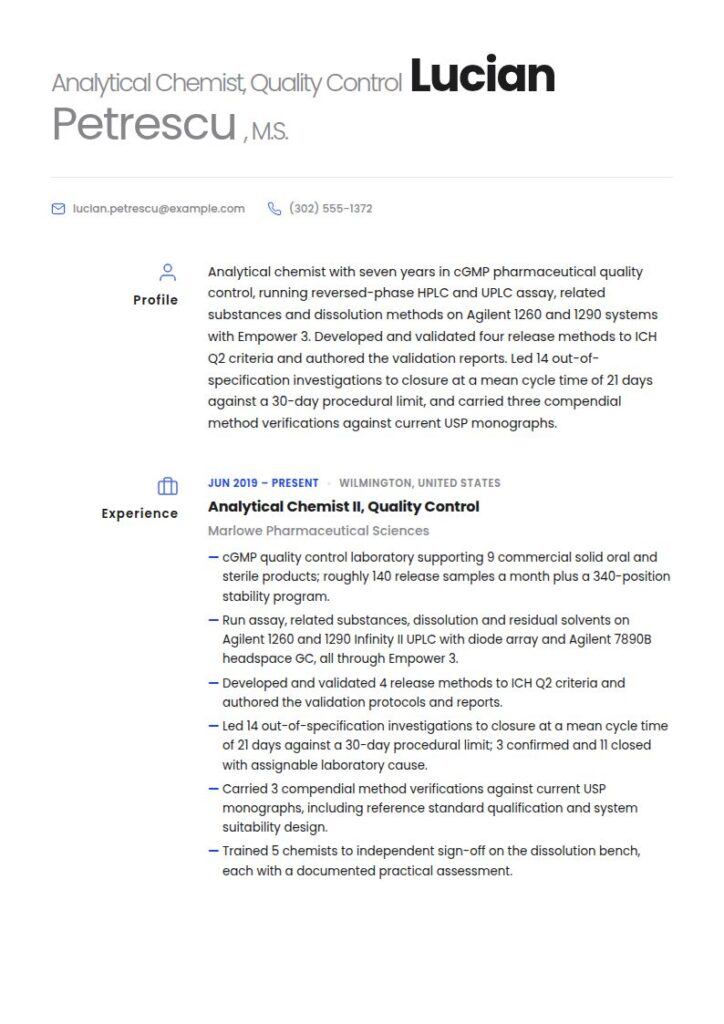
Analytical chemist with seven years in cGMP pharmaceutical quality control, running reversed-phase HPLC and UPLC assay, related substances and dissolution methods on Agilent 1260 and 1290 systems with Empower 3. Developed and validated four release methods to ICH Q2 criteria and authored the validation reports. Led 14 out-of-specification investigations to closure at a mean cycle time of 21 days against a 30-day procedural limit, and carried three compendial method verifications against current USP monographs.
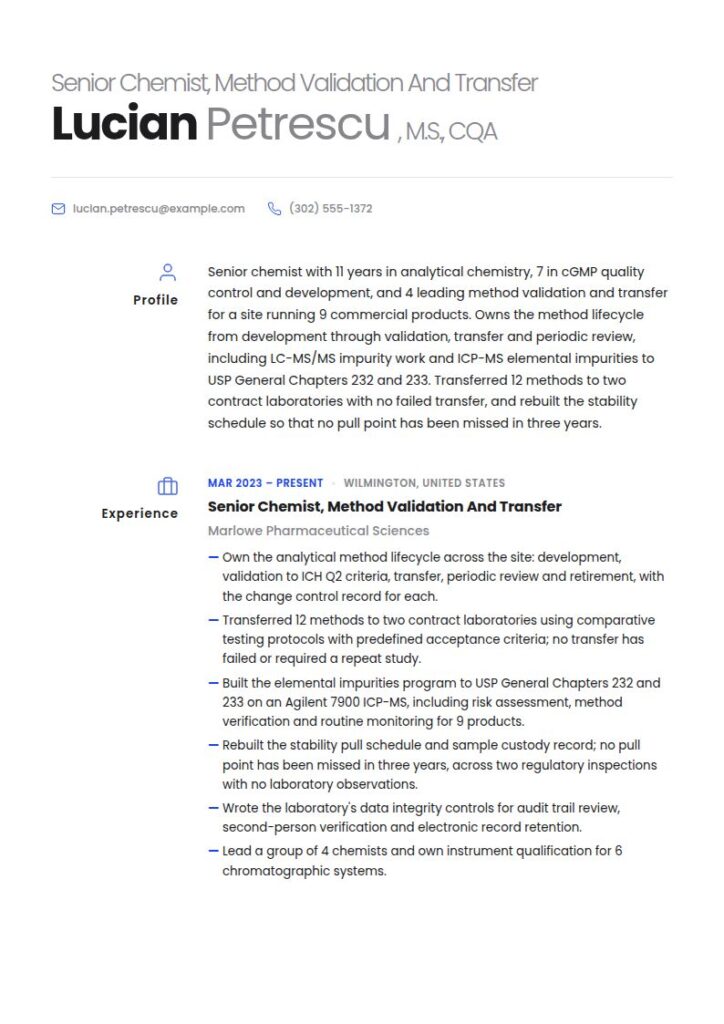
Senior chemist with 11 years in analytical chemistry, 7 in cGMP quality control and development, and 4 leading method validation and transfer for a site running 9 commercial products. Owns the method lifecycle from development through validation, transfer and periodic review, including LC-MS/MS impurity work and ICP-MS elemental impurities to USP General Chapters 232 and 233. Transferred 12 methods to two contract laboratories with no failed transfer, and rebuilt the stability schedule so that no pull point has been missed in three years.
Right vs wrong: the same chemist summary, twice
| ✅ Right | ❌ Wrong |
|---|---|
| Analytical chemist with seven years in cGMP quality control, running assay, related substances and dissolution on Agilent 1260 and 1290 with Empower 3. | Experienced chemist with strong analytical skills and attention to detail. |
| Developed and validated four release methods to ICH Q2 criteria and authored the validation reports. | Responsible for method development and validation activities. |
| Led 14 out-of-specification investigations to closure at a mean cycle time of 21 days against a 30-day limit. | Investigated laboratory issues and worked to resolve them efficiently. |
For example, the left column says which instrument you sit down at on Monday.
Outline your laboratory experience
Employer, site, city, dates, then one line describing the laboratory, then three to five bullets. In practice, that line does the work most applicants expect the bullets to do: regime, matrix, sample volume, systems.
| Instead of | Use |
|---|---|
| Performed analytical testing on samples | Ran assay, related substances and dissolution on 9 commercial solid oral products, roughly 140 samples a month |
| Experience with HPLC and GC | Agilent 1290 UPLC with diode array and Agilent 7890B GC with flame ionization and headspace, to USP monograph and in-house procedures |
| Developed new analytical methods | Validated a reversed-phase related substances method to ICH Q2 criteria, resolving 7 known degradants at the 0.05 percent reporting threshold |
| Investigated out-of-specification results | Led 14 out-of-specification investigations to closure, 3 confirmed and 11 invalidated with assignable cause |
| Worked on method transfer | Transferred 12 methods to two contract laboratories using comparative testing protocols, no failed transfer |
Senior Chemist, Method Validation and Transfer, Marlowe Pharmaceutical Sciences, Wilmington, DE, March 2023 to Present
cGMP quality control and analytical development laboratory supporting 9 commercial solid oral and sterile products. Roughly 140 release samples a month plus a 340-position stability program, running Empower 3 and a validated laboratory information management system.
Own the analytical method lifecycle across the site: development, validation to ICH Q2 criteria, transfer, periodic review and retirement.
Built the elemental impurities program to USP General Chapters 232 and 233 on an Agilent 7900 ICP-MS, including risk assessment, method verification and routine monitoring.
Transferred 12 methods to two contract laboratories using comparative testing protocols with predefined acceptance criteria; no transfer has failed.
Rebuilt the stability pull schedule and the sample custody record; no pull point has been missed in three years, across two inspections with no laboratory observations.
Also, write volume somewhere: samples a month, stability positions, batches released, methods owned.
Write the method and instrument stack inside the regime it ran under
In fact, this is the block that separates two chemists with the same degree, and the one most resumes replace with a row of technique names.
A technique name on its own is a topic, not a capability. "Mass spectrometry" covers a quadrupole on a gas chromatograph, a triple quadrupole running multiple reaction monitoring, an inductively coupled plasma instrument quantifying elements at parts per billion, and a high resolution instrument doing structural identification. Four different jobs. Write which one.
Three tiers of chemist method skills
So write the stack in three tiers. What you run independently. Next, what you run under supervision. What you have developed, validated or transferred rather than only operated. The third tier is the most valuable and the least often distinguished, because running a validated method and proving a method is fit for purpose are different skills and only one is scarce.
| Family | What to name | What a reader learns |
|---|---|---|
| Separations | HPLC, UPLC, GC, ion chromatography; pump, column chemistry, detector, data system | Whether you can run and troubleshoot their release queue |
| Spectrometry | LC-MS/MS, GC-MS, ICP-MS, high resolution accurate mass; ionization and acquisition mode | Whether you do trace quantitation or identification work |
| Spectroscopy | NMR, FTIR, Raman, UV-Vis, atomic absorption; field strength or sampling accessory | Whether you can confirm structure and identity |
| Thermal and physical | Differential scanning calorimetry, thermogravimetric analysis, dissolution, particle size, X-ray powder diffraction | Whether you can characterize a solid form |
| Sample preparation | Solid phase extraction, acid and microwave digestion, headspace, derivatization | Whether you can build a method, not only finish one |
Regulatory regime and documentation for chemists
Then name the regime, because the regime built your documentation habits. The same separation carries very different obligations in a discovery laboratory, a contract testing laboratory and a commercial quality control laboratory, and a regulated employer is screening for whether your habits transfer.
| Regime | Where it applies | What it demands of your record |
|---|---|---|
| cGMP | Release of drug product and substance | Approved procedures, second-person review, audit trails, out-of-specification handling, change control, training records |
| GLP | Nonclinical safety studies | Study protocol, a study director, a quality assurance unit, raw data retention, archive control |
| USP and compendial | Testing against a monograph | Verification under your own conditions, monograph version control, reference standard traceability |
| EPA methods | Environmental and drinking water testing | The method's quality control series, holding times, matrix spikes and duplicates, reporting limits |
| ISO/IEC 17025 | Accredited testing laboratories | Documented scope, validation or verification, measurement uncertainty, proficiency testing, traceable calibration, competence records |
Documentation is a skill and it belongs on the page. Raw data integrity, notebook practice, audit trail review, second-person verification, reference standard traceability and instrument qualification separate a chemist who can be left alone in a regulated laboratory from one who cannot. Name the ones you have owned, and name one investigation: an out-of-specification result, a failed system suitability run traced to a cause, or a method that would not transfer until you found out why.
Run independently: reversed-phase HPLC and UPLC assay, related substances and dissolution, Agilent 1260 and 1290 Infinity II with diode array, Empower 3. Headspace GC with flame ionization for residual solvents, Agilent 7890B. ICP-MS elemental impurities to USP General Chapters 232 and 233, Agilent 7900. Karl Fischer, FTIR identity, UV-Vis.
Developed, validated or transferred: 4 release methods validated to ICH Q2 criteria, 3 compendial verifications against current USP monographs, 12 methods transferred to two contract laboratories with comparative testing protocols.
Trained, run under supervision: LC-MS/MS impurity identification on Agilent 6470 triple quadrupole, MassHunter. Differential scanning calorimetry for solid form screening.
Regime: cGMP release and stability testing, ICH Q1A stability program design, USP compendial verification. Earlier ISO/IEC 17025 accredited testing laboratory work under EPA Methods 8270, 8260 and 6020B.
Documentation and systems: Empower 3 and MassHunter, laboratory information management system, audit trail review, out-of-specification and deviation investigation, change control, instrument qualification.
Build a snapshot of your key skills
Then list twelve to sixteen entries in four groups: techniques, method work, quality and regulatory, and data systems. Named methods and platforms only.
Techniques: reversed-phase HPLC and UPLC, headspace and direct injection GC, ICP-MS, LC-MS/MS, FTIR, UV-Vis, Karl Fischer titration, dissolution, particle size analysis
Method work: method development, validation to ICH Q2, compendial verification, transfer by comparative testing, forced degradation and stability-indicating method design
Quality and regulatory: cGMP, GLP, ISO/IEC 17025, USP compendial practice, EPA methods, out-of-specification investigation, deviation and CAPA, change control, data integrity, inspection support
Data systems: Empower 3, MassHunter, Chromeleon, laboratory information management systems, instrument qualification protocols, calibration verification
Keep this block shorter than the stack above it; the stack is where the evidence lives.
List your education and certifications
Degree first with the discipline and institution, then the ACS certification if you hold it, then graduate research with the technique named, then certifications.
An ACS-certified bachelor's degree is not a generic chemistry degree, because its requirements are published. Under the 2023 ACS Guidelines and Evaluation Procedures for Bachelor's Degree Programs, it requires five foundation courses spanning analytical, biochemistry, inorganic, organic and physical chemistry, a minimum of four in-depth courses which may include research, and 350 laboratory hours beyond general chemistry (American Chemical Society Committee on Professional Training, 2023 guidelines). That last number is the useful one: a concrete claim about bench time that a transcript alone does not make.
Master of Science, Analytical Chemistry, Drexel University, Philadelphia, PA, 2021. Thesis on matrix effects in LC-MS/MS quantitation of trace organic residues, completed part-time while working in quality control.
Bachelor of Science, Chemistry, ACS-certified degree, University of Delaware, Newark, DE, 2016. Five foundation courses, four in-depth courses and 350 laboratory hours beyond general chemistry.
Certifications: ISO/IEC 17025:2017 internal auditor training, 2019. Certified Quality Auditor, American Society for Quality, 2024. Waters Empower 3 system administration, 2022. OSHA 40-hour hazardous waste operations and emergency response, 2017.
If your degree is not ACS-certified, do not imply otherwise. Write the coursework instead, with the research or capstone technique named.
Choose the right layout and design
Finally, keep a single column, 11 or 12 point, plain headings, no photograph, no skill rating bars. Employers parse applications before a scientist opens them, and model numbers, regulatory citations and method numbers are what two-column templates break.
Name the instrument by manufacturer, model and detector, with its data system. Split what you run independently from what you run supervised and what you validated. Name the regime for every role. Give sample volume, stability positions or batches released. State the ACS certification of your degree if you hold it.
Do not write a bare technique list where the platform is what is being screened for. Do not claim method development when you ran a method somebody else developed; that is the first question in a technical interview. Do not put confidential product names, batch numbers, customer names or unpublished structures on a page you send to strangers.
Chemist job market and outlook
Overall, this is a modest, stable occupation concentrated in manufacturing, with an unusually wide pay spread across industries.
| Measure | Value |
|---|---|
| Chemist jobs, 2025 | 84,900 |
| Materials scientist jobs, 2025 | 8,600 |
| Both occupations together, 2025 | 93,500 |
| Projected change, chemists, 2025-35 | 6 percent |
| Projected change, both occupations, 2025-35 | 7 percent |
| Projected annual openings, both occupations | About 6,500 |
| Typical entry-level education | Bachelor's degree |
| Chemist median annual wage, May 2025 | $91,240 |
Source: U.S. Bureau of Labor Statistics, Occupational Outlook Handbook, Chemists and Materials Scientists, May 2025 wages with 2025 to 2035 projections.
Eighty-five thousand chemists, and a wage range above $100,000
There were 84,900 chemist jobs in 2025, with chemist employment projected to grow 6 percent from 2025 to 2035 and about 6,500 openings a year across chemists and materials scientists combined (BLS Occupational Outlook Handbook, 2025 to 2035 projections). The wage distribution is what should shape your page.
The chemist median was $91,240 in May 2025, but the lowest 10 percent earned less than $58,460 and the highest 10 percent more than $160,830 (BLS, May 2025), a spread above $100,000 inside one occupational title.
Industry explains most of it: a median of $137,720 in the federal government and $105,930 in scientific research and development services, against $88,890 in chemical manufacturing and $66,140 in testing laboratories (BLS, May 2025). Your resume cannot change which industry hired you last, but it can show that your methods and documentation transfer to a better-paid one.
Where the jobs sit:
| Industry | Share of chemist employment | Median annual wage (May 2025) |
|---|---|---|
| Chemical manufacturing | 33% | $88,890 |
| Scientific research and development services | 16% | $105,930 |
| Testing laboratories | 11% | $66,140 |
| Federal government | 6% | $137,720 |
| State and local government | 6% | $81,830 |
Source: U.S. Bureau of Labor Statistics, Occupational Outlook Handbook, chemists, May 2025.
Therefore, read that table as a map of four resumes. For instance, a manufacturing file leads with process, scale-up and plant support; a research file with what you made work; a testing laboratory file with accredited methods and turnaround; a government file with the regulatory framework and the method by its official number.
What salary you can expect as a chemist
The median annual wage for chemists was $91,240 as of May 2025, with the lowest 10 percent earning less than $58,460 and the highest 10 percent more than $160,830 (BLS Occupational Outlook Handbook, May 2025). Materials scientists, published on the same page, had a median of $117,790, which is worth knowing if your work sits close to that boundary.
What moves an offer is mostly what your page can carry:
- Industry. The gap between testing laboratories at $66,140 and the federal government at $137,720 (BLS, May 2025) is larger than any raise you will negotiate.
- Regulated experience. cGMP, GLP and ISO/IEC 17025 work is priced because it takes a year to build and cannot be faked in an interview.
- Method ownership. Developing and validating a method, and transferring one successfully, is a different band from running one.
- Platform scarcity. ICP-MS, LC-MS/MS and NMR operators who can also troubleshoot and qualify the instrument are a smaller group than chromatographers.
- Investigation and inspection work. Investigations closed to cycle time, and time in front of an auditor, are the route from bench chemist to group lead.
Key takeaways for a chemist resume
- Above all, put the method and instrument stack directly under the summary, above your job titles.
- Then name every instrument by manufacturer, model and detector, with its data system.
- Split what you run independently from what you run supervised and what you validated.
- Similarly, name the regime for every role: cGMP, GLP, ISO/IEC 17025, USP or EPA.
- In addition, give throughput: samples a month, stability positions, batches released, methods owned.
- State the ACS certification of your degree if you hold it.
- Finally, keep confidential product, batch and customer detail off a page you send to strangers.
Build your chemist resume in 15 minutes with our AI resume builder.
Related medical resume examples
- Lab technician resume
- Lab assistant resume
- Medical technologist resume
- Epidemiologist resume
- Pharmacist resume
- Clinical research coordinator resume
- Medical science liaison resume
- Pharmacy technician resume
- Pharmaceutical sales representative resume
- Healthcare project manager resume
- Healthcare resume
- Medical resume
Pair it with a matching chemist cover letter.
Chemist resume questions, answered
How long should a chemist resume be?
One page for your first five years at the bench. Two once you have validated and transferred methods, led investigations, qualified instruments or supervised a group. A research chemist with a long publication record still keeps the resume to two pages and attaches a curriculum vitae.
Should I list every instrument I have ever touched?
No. Split them into what you run independently, what you run under supervision, and what you have developed, validated or transferred. A stack claiming independence on eleven platforms reads as padded, and the technical interview will find the seam.
What do I put on a chemist resume with no industry experience?
Write your undergraduate or graduate research as a job: the group, the problem, the techniques, the instruments by model, the number of samples or syntheses, and what you produced. Then teaching laboratory work, which is real instrument time and safety responsibility.
Does it matter whether my chemistry degree is ACS-certified?
It helps and it is easy to state. The 2023 ACS guidelines require five foundation courses across analytical, biochemistry, inorganic, organic and physical chemistry, at least four in-depth courses, and 350 laboratory hours beyond general chemistry (American Chemical Society Committee on Professional Training, 2023 guidelines). If your degree is not certified, name the relevant coursework instead; almost no employer treats certification as a gate.
How do I move from a testing laboratory into pharmaceutical or research work?
Make the transferable part explicit. Method verification, calibration, quality control series, chain of custody, traceability and documentation practice all carry across; only the vocabulary changes. Map your EPA or ISO/IEC 17025 experience onto the language of the post you want. The wage gap makes it worth the effort: testing laboratories at a median of $66,140 against $105,930 in scientific research and development services (BLS, May 2025).