Laboratory Assistant, MLA (ASCP) Deniz Yalcin
Laboratory Assistant, Specimen Processing
[email protected] | (614) 555-1462 | Columbus, United States
Profile
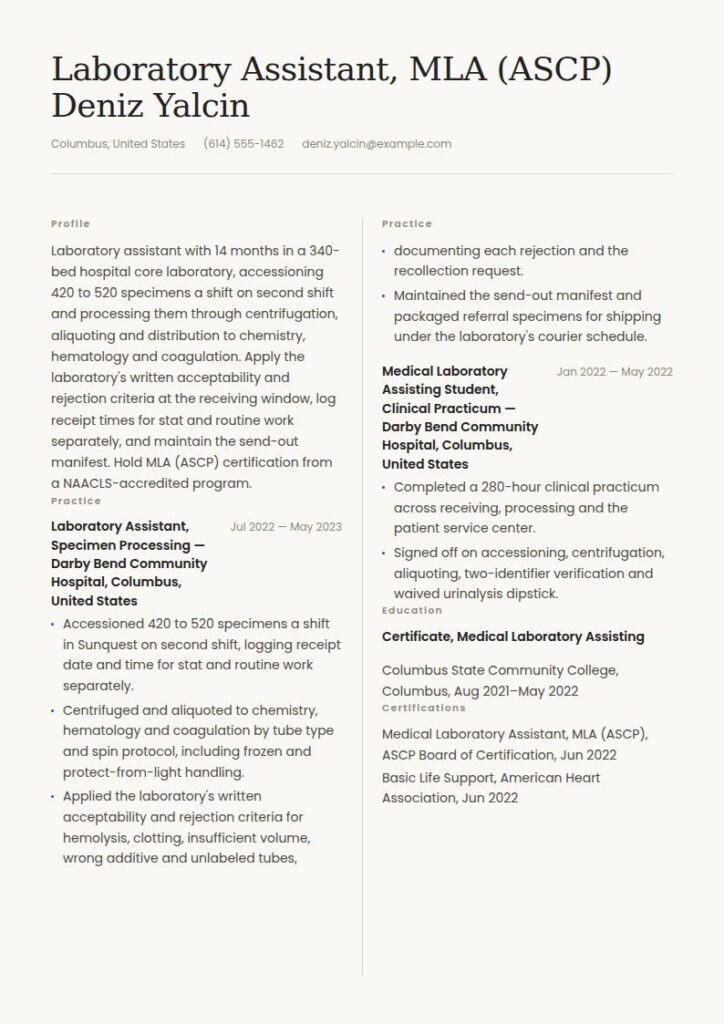
Laboratory assistant with 14 months in a 340-bed hospital core laboratory, accessioning 420 to 520 specimens a shift on second shift and processing them through centrifugation, aliquoting and distribution to chemistry, hematology and coagulation. Apply the laboratory's written acceptability and rejection criteria at the receiving window, log receipt times for stat and routine work separately, and maintain the send-out manifest. Hold MLA (ASCP) certification from a NAACLS-accredited program.
Work Experience
07/2022 - 05/2023, Laboratory Assistant, Specimen Processing, Darby Bend Community Hospital, Columbus, United States
- Accessioned 420 to 520 specimens a shift in Sunquest on second shift, logging receipt date and time for stat and routine work separately.
- Centrifuged and aliquoted to chemistry, hematology and coagulation by tube type and spin protocol, including frozen and protect-from-light handling.
- Applied the laboratory's written acceptability and rejection criteria for hemolysis, clotting, insufficient volume, wrong additive and unlabeled tubes, documenting each rejection and the recollection request.
- Maintained the send-out manifest and packaged referral specimens for shipping under the laboratory's courier schedule.
01/2022 - 05/2022, Medical Laboratory Assisting Student, Clinical Practicum, Darby Bend Community Hospital, Columbus, United States
- Completed a 280-hour clinical practicum across receiving, processing and the patient service center.
- Signed off on accessioning, centrifugation, aliquoting, two-identifier verification and waived urinalysis dipstick.
Education
08/2021 - 05/2022, Certificate, Medical Laboratory Assisting, Columbus State Community College, Columbus, United States
NAACLS-accredited program with a 280-hour clinical practicum in a hospital core laboratory.
Skills
Specimen accessioning in Sunquest, 80
Acceptability and rejection criteria, 75
Centrifugation and aliquoting, 80
Two-identifier verification, 85
Send-out packaging and manifests, 70
OSHA bloodborne pathogen standard, 85
Languages
English, native
Turkish, native
Certificates
06/2022, Medical Laboratory Assistant, MLA (ASCP), ASCP Board of Certification, MLA-3308174
Certified by the accredited program route.
06/2022, Basic Life Support, American Heart Association
Summary
A lab assistant resume is a one page document naming the pre-analytic work you perform, the volume you perform it at, and the point in the workflow where your site's CLIA certificate stops you. This guide gives you three adaptable versions, the scope block most applicants leave out, the certification ladder the ASCP Board of Certification publishes, and current Bureau of Labor Statistics pay and outlook for the occupation above yours.
Lab Assistant resume examples by experience level
In short, a lab assistant resume is a one page document that names the pre-analytic work you do with your hands, the volume you do it at, and the point in the workflow where your site's laboratory certificate stops you.
In practice, almost every weak version of this resume contains the same line: "assisted laboratory staff with daily tasks." A laboratory manager learns nothing from it, because the title covers an enormous range. For example, one lab assistant sorts tubes at a receiving window. Another registers patients, draws blood, judges whether a specimen is acceptable, spins and aliquots it, and runs the waived bench. Those are different hires at different pay, and the difference only reaches the page if you write it there.
Resume guide for a lab assistant resume
Specifically, this guide and the corresponding lab assistant resume example will cover:
- How to write a lab assistant resume, section by section
- The pre-analytic scope block, and why the site's CLIA certificate defines it
- Three adaptable summaries: new, experienced and lead
- The certification ladder from MLA to MLT
- What the job market looks like and what you can expect to earn
How to write a lab assistant resume
Overall, it takes five blocks: contact header, summary, pre-analytic scope, experience with volume, and education with certification. In general, one page works for everyone at this level. Then the scope block goes above experience, because it answers the reader's first question.
| Section | What it is answering | Where it goes |
|---|---|---|
| Certification | Is this verifiable, and which rung is it? | Header line, with the parenthetical |
| Pre-analytic scope | What can they do before the analyzer, and under whose certificate? | Its own block, above experience |
| Volume and shift | Have they worked at my throughput, on my hours? | Employer line |
| Quality numbers | Do they cost me repeats and redraws? | Bullets, with a before and an after |
Write the receiving window as a decision, not a task
The most valuable thing a lab assistant does is judge a specimen. Everything downstream depends on it, and it is the part that never reaches the resume.
Federal rules make the judgment explicit. Under 42 CFR 493.1242(a), a laboratory must hold written procedures for "Specimen labeling, including patient name or unique patient identifier and, when appropriate, specimen source," storage, transport, processing and "Specimen acceptability and rejection," and under 493.1242(b) it "must document the date and time it receives a specimen" (eCFR, current as of 14 September 2026).
So do not write "received and logged specimens." Write what you applied and what it saved: the rejection criteria you work to, the hemolysis and clotting calls you make, the mislabeled tube rate you moved, and the redraws you prevented.
Run the file through the ATS resume checker before you submit. Hospital systems and reference laboratories parse applications into a structured record before a person opens one.
Choosing the best resume format for a lab assistant resume
Reverse chronological, one page. Laboratory, city, setting, shift, throughput, dates, then three to five bullets that each carry a number.
First, put the setting and the shift in the employer line. After all, a hospital core laboratory on nights, a reference laboratory receiving department, a patient service center and a physician office laboratory are four different jobs sharing one title, and shift availability is often why one file gets called first.
Include your contact information
| ✅ Right | ❌ Wrong |
|---|---|
| Deniz Yalcin, MLA (ASCP), PBT (ASCP) | Deniz Yalcin |
| Lead Laboratory Assistant, Pre-Analytic Processing | Hardworking laboratory professional |
| Second shift, Sunquest and Epic Beaker, MLT candidate 2027 | Experienced with lab software |
| (614) 555-1462, [email protected], Columbus, OH | (614) 555-1462, [email protected] |
Similarly, put the credential parenthetical next to your name exactly as the certifying body writes it. MLA (ASCP) and PBT (ASCP) are searchable strings, whereas "certified lab assistant" is not, and a recruiter filtering for the first never sees the second.
Make use of a summary
Four lines: the credential and the rung, the setting and the throughput, the scope you hold, and one quality number with a before and an after.
Laboratory assistant with 14 months in a 340-bed hospital core laboratory, accessioning 420 to 520 specimens a shift on second shift and processing them through centrifugation, aliquoting and distribution to chemistry, hematology and coagulation. Apply the laboratory's written acceptability and rejection criteria at the receiving window, log receipt times for stat and routine work separately, and maintain the send-out manifest. Hold MLA (ASCP) certification from a NAACLS-accredited program.
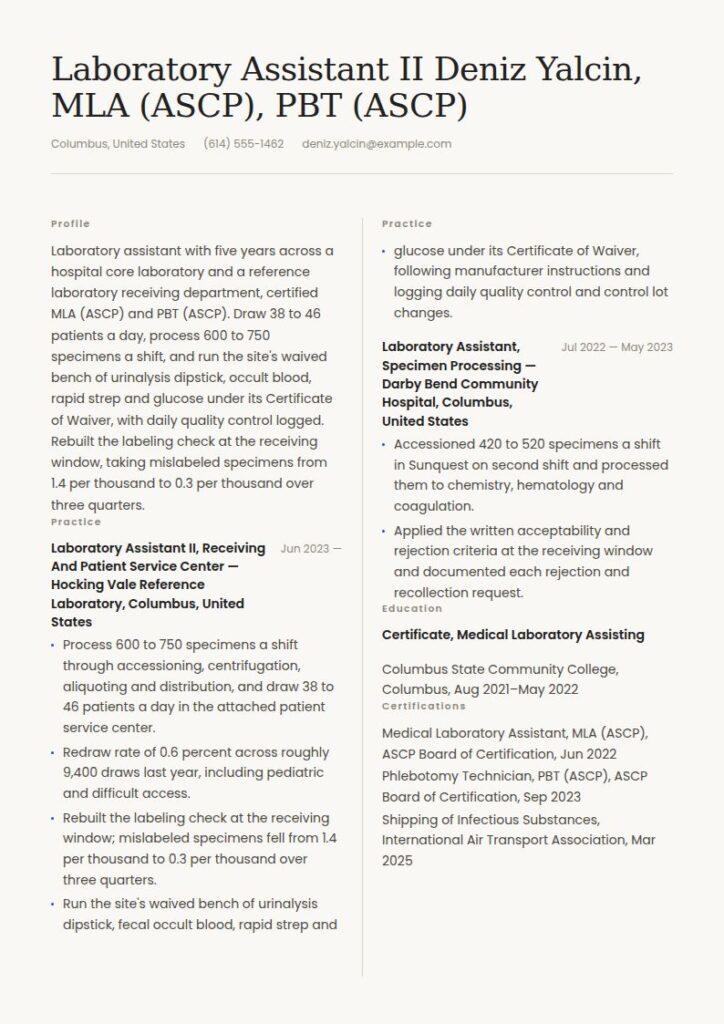
Laboratory assistant with five years across a hospital core laboratory and a reference laboratory receiving department, certified MLA (ASCP) and PBT (ASCP). Draw 38 to 46 patients a day, process 600 to 750 specimens a shift, and run the site's waived bench of urinalysis dipstick, occult blood, rapid strep and glucose under its Certificate of Waiver, with daily quality control logged. Rebuilt the labeling check at the receiving window, taking mislabeled specimens from 1.4 per thousand to 0.3 per thousand over three quarters.
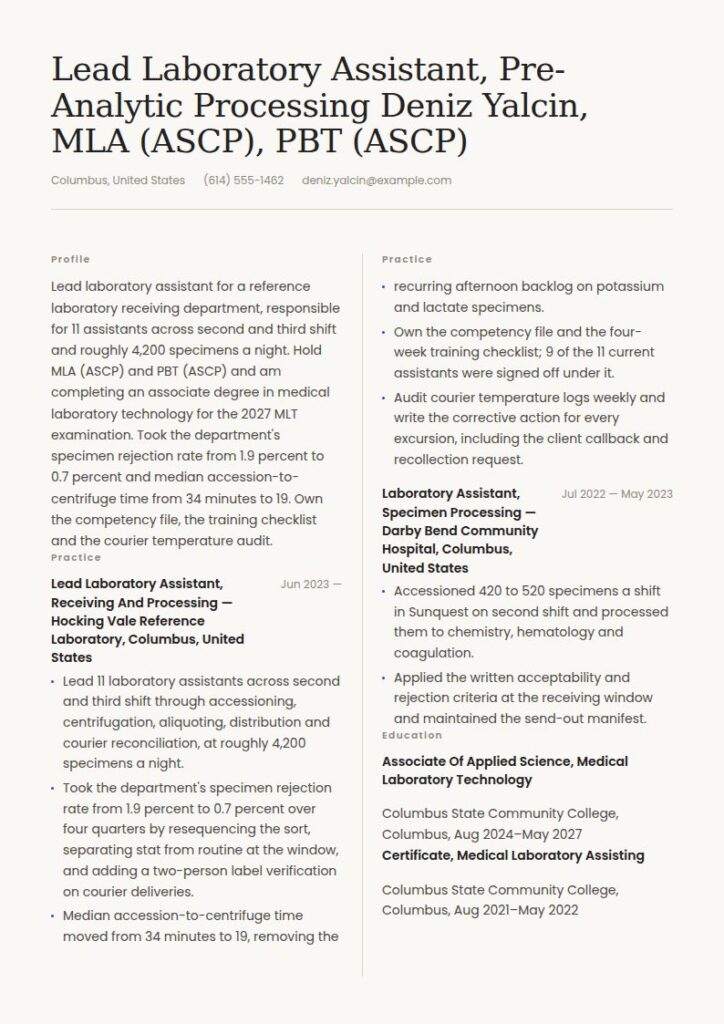
Lead laboratory assistant for a reference laboratory receiving department, responsible for 11 assistants across second and third shift and roughly 4,200 specimens a night. Hold MLA (ASCP) and PBT (ASCP) and am completing an associate degree in medical laboratory technology for the 2027 MLT examination. Took the department's specimen rejection rate from 1.9 percent to 0.7 percent and median accession-to-centrifuge time from 34 minutes to 19. Own the competency file, the training checklist and the courier temperature audit.
Right vs wrong: the same lab assistant summary, twice
| ✅ Right | ❌ Wrong |
|---|---|
| Accession 420 to 520 specimens a shift and process them to chemistry, hematology and coagulation. | Responsible for receiving and processing laboratory specimens. |
| Apply the laboratory's written acceptability and rejection criteria at the receiving window. | Ensured specimen quality at all times. |
| Mislabeled specimens fell from 1.4 per thousand to 0.3 per thousand over three quarters. | Improved accuracy and reduced errors. |
For instance, the right column tells a supervisor which bench you can be put on tomorrow and what it will cost them in repeats. The wrong column, however, asks them to guess.
Outline your experience
Laboratory, city, setting, shift, throughput, dates. Then three to five bullets, each naming a pre-analytic step and carrying a number.
| Instead of | Use |
|---|---|
| Received and logged specimens | Accession 420 to 520 specimens a shift in Sunquest, logging receipt time for stat and routine work separately |
| Prepared specimens for testing | Centrifuge and aliquot 600 to 750 tubes a shift to chemistry, coagulation and send-out, holding median accession-to-centrifuge time at 19 minutes |
| Checked specimens for problems | Apply written rejection criteria for hemolysis, clotting, insufficient volume, wrong additive and unlabeled tubes, documenting each rejection |
| Drew blood from patients | Draw 38 to 46 patients a day including pediatric and difficult access, with a 0.6 percent redraw rate across roughly 9,400 draws last year |
Lead Laboratory Assistant, Hocking Vale Reference Laboratory, Columbus, OH, receiving and processing department, second shift, roughly 4,200 specimens a night, June 2023 to Present
Lead 11 laboratory assistants across second and third shift through accessioning, centrifugation, aliquoting, distribution and courier reconciliation. Took the department's specimen rejection rate from 1.9 percent to 0.7 percent over four quarters by resequencing the sort, separating stat from routine at the window, and adding a two-person label verification on courier deliveries.
Median accession-to-centrifuge time moved from 34 minutes to 19, removing the recurring afternoon backlog on potassium and lactate specimens.
Own the competency file and the four-week training checklist; 9 of the 11 current assistants were signed off under it. Audit courier temperature logs weekly and write the corrective action for every excursion.
What you are allowed to touch before the analyzer, and where CLIA draws the line
In fact, this is the section that separates a lab assistant resume from every neighboring role in a laboratory. Your title, of course, is informal and varies by employer. However, what the law lets you put your hands on does not.
Your job is defined by what happens before the result. The ASCP Board of Certification describes the medical laboratory assistant as someone who "Works in various areas of the laboratory, registering patients, collecting samples, and assessing the acceptability of samples for testing," who "Processes samples for testing including centrifugation, aliquoting, storage, and shipping," and who "Performs waived and point-of-care testing" (ASCP Board of Certification, Medical Laboratory Assistant credential, checked September 2026). Read that as a scope statement, because it is one: it stops at waived testing.
Waived testing is a property of the site, not of you. The tests you run sit under the laboratory's federal certificate. The Centers for Disease Control and Prevention notes that waived tests "must be performed correctly by trained personnel in environments adhering to good laboratory practices," with errors occurring "if manufacturer's instructions are not followed or if personnel are unfamiliar with the test system" (CDC, Waived Tests, last reviewed 2 April 2026). On the page, that means naming the tests, naming the certificate type, and saying whether you log daily quality control. Very few applicants do all three.
Moderate complexity and the personnel rule
Moderate complexity is where the personnel rule starts, and it is written down. Once a laboratory performs nonwaived testing, 42 CFR 493.1423 sets qualifications for testing personnel: a licensed physician, a doctoral, master's or bachelor's degree in a chemical, biological, clinical or medical laboratory science, an associate degree in one of those fields or in medical laboratory technology, "a high school diploma or equivalent" plus "documentation of laboratory training appropriate for the testing performed," or a military medical laboratory procedures course "of at least a duration of 50 weeks" (eCFR, 42 CFR 493.1423, current as of 14 September 2026). That is the line deciding whether you can be scheduled on a nonwaived bench, so say which route you meet, or that you meet none yet.
The lab assistant certification ladder
The certification ladder is published, and the rungs have named requirements. The ASCP Board of Certification lists six routes to MLA (ASCP). Three matter most to working assistants: a high school diploma or equivalent plus a NAACLS-accredited medical laboratory assistant program completed within the last five years; a diploma plus two years of full-time acceptable clinical laboratory experience within the last five, documented across specimen processing, testing support and laboratory operations; and a valid PBT (ASCP) plus one year of that experience (ASCP Board of Certification, checked September 2026). Name the route you used. If your next move is the MLT examination, write the hours finished, the hours outstanding and the date you intend to sit.
Therefore, write it as one block, with the certificate type attached.
Accessioning and receipt: Order entry and accessioning in Sunquest and Epic Beaker, receipt date and time logged separately for stat and routine, requisition reconciliation, courier manifest check-in
Specimen integrity: Written acceptability and rejection criteria for hemolysis, clotting, insufficient volume, wrong additive, expired tube, unlabeled and mislabeled specimens; documented rejection and recollection request; two-identifier verification
Processing: Centrifugation by tube type and spin protocol, aliquoting into labeled secondary tubes, temperature-specific storage, protect-from-light handling, send-out packaging and shipping manifests
Collection: Venipuncture and capillary collection including pediatric and difficult access, order of draw, additive inversions, blood culture technique
Waived testing under site certificate: Urinalysis dipstick, fecal occult blood, rapid strep, glucose meter; manufacturer instructions followed, daily quality control and control lot changes logged
Not in my scope at this site: Nonwaived test performance and result release, result interpretation, quality control acceptance decisions, method verification
That last line matters more than it looks. After all, a manager who has been through an inspection reads an honest scope boundary as evidence that you understand the certificate you work under, and a resume claiming nonwaived testing without a qualifying route reads as a compliance problem first.
Build a snapshot of your key skills
Then list twelve to sixteen entries in four groups. Named steps and systems, not adjectives.
Pre-analytic: Specimen accessioning, Acceptability and rejection criteria, Two-identifier verification, Centrifugation and aliquoting, Aliquot labeling, Send-out packaging and shipping
Collection: Venipuncture, Capillary and heel stick, Pediatric draws, Order of draw, Blood culture technique, Difficult access
Systems: Sunquest, Epic Beaker, Barcode labeling and tube sorters, Courier manifest reconciliation
Quality and compliance: Daily quality control logging, Temperature and excursion logs, Competency documentation, OSHA bloodborne pathogen standard, HIPAA privacy and security, Chemical hygiene
List your education and certifications
Program accreditation first, then the ASCP credential with its number, then any state credential, then the degree you are working toward, with a date.
State licensure is not uniform. BLS notes on the clinical laboratory occupation page that some states require laboratory personnel to be licensed or registered, that requirements vary by state and specialty, and that certification is not always required to enter although employers may prefer certified staff (BLS Occupational Outlook Handbook, checked September 2026). If your state board issues a credential covering your work, name it separately from the national certification.
Medical Laboratory Assistant, MLA (ASCP), ASCP Board of Certification, #MLA-3308174, certified 2022 by the accredited program route
Phlebotomy Technician, PBT (ASCP), ASCP Board of Certification, #PBT-3341902, certified 2023
Certificate, Medical Laboratory Assisting, Columbus State Community College, Columbus, OH, 2022. NAACLS-accredited, 280-hour clinical practicum in a hospital core laboratory.
Associate of Applied Science, Medical Laboratory Technology, Columbus State Community College, expected 2027. 44 of 68 credit hours complete; sitting the MLT (ASCP) examination in 2027.
Additional: Basic Life Support, American Heart Association, 2026. OSHA bloodborne pathogen and HIPAA training, current. IATA infectious substance shipping, 2025.
Choose the right layout and design
Finally, keep a single column, plain type at 11 or 12 point, clear headings, no photograph, no rating bars. Two columns and text boxes are where a parser drops certificate strings, and a number such as MLA-3308174 is the line you cannot afford to lose.
Put the credential parenthetical next to your name, exactly as the certifying body writes it. Give setting, shift and throughput in every employer line. Name the pre-analytic steps you own, in workflow order. Say which certificate type your waived testing sits under. Give one quality number with a before, an after and a period. State the MLT route and examination date.
Do not write "assisted laboratory staff" and stop. Do not claim nonwaived or high complexity testing without a qualifying route under 42 CFR 493. Do not describe result interpretation or quality control acceptance as yours. Do not list a lapsed certification without saying so. Do not put a patient name or medical record number on a resume.
Lab assistant job market and outlook
BLS publishes no separate Handbook profile for laboratory assistants, so read the market through the occupation above yours: clinical laboratory technologists and technicians. In practice, laboratories hire from the same pipeline and promote across that line.
| Measure | Value |
|---|---|
| Clinical laboratory technologist and technician jobs, 2025 | 343,000 |
| Projected change, 2025-35 | 3 percent, about as fast as average, plus 9,400 |
| Projected annual openings | About 20,800 |
| Typical entry-level education | Bachelor's degree for technologists; an associate degree can qualify technicians |
| Median annual wage, May 2025 | $62,930, or $30.26 an hour |
Source: U.S. Bureau of Labor Statistics, Occupational Outlook Handbook, May 2025 wages and 2025-35 projections, published 27 August 2026.
Where that work sits:
| Setting | Share of employment | Median annual wage (May 2025) |
|---|---|---|
| General medical and surgical hospitals, private | 36 percent | $69,190 |
| Medical and diagnostic laboratories | 19 percent | $58,320 |
| Offices of physicians | 10 percent | $56,850 |
| Educational services, state, local and private | 4 percent | $63,690 |
| Other ambulatory healthcare services | 4 percent | $48,140 |
Source: U.S. Bureau of Labor Statistics, Occupational Outlook Handbook, May 2025.
Three quarters of American laboratories only run waived tests
The Centers for Medicare and Medicaid Services counts 300,720 laboratories registered under CLIA as of August 2026, of which 232,736 hold a Certificate of Waiver, against 15,292 with a Certificate of Compliance and 15,541 with a Certificate of Accreditation (CMS, Division of Clinical Laboratory Improvement and Quality, CLIA enrollment, August 2026).
That distribution is the hiring map for this job. Most certified sites are physician offices, clinics and pharmacies running a short waived menu, where a lab assistant does registration, collection, the waived bench and the send-out. The roughly 31,000 sites holding a Certificate of Compliance or Accreditation are the hospital and reference laboratories, where the work is accessioning and processing at volume.
Decide which you are applying to. A waived-site application needs collection, the test menu and patient-facing work in the first four seconds. A reference laboratory application needs throughput, rejection criteria and shift availability.
Staffing pressure has not gone away either: the ASCP 2024 Vacancy Survey, reported in the American Journal of Clinical Pathology in October 2025 from 1,027 responses representing more than 18,626 employees, found vacancy rates below 2022 but still above pre-pandemic levels.
What salary you can expect as a lab assistant
BLS publishes no separate wage for laboratory assistants, so the honest anchor is the occupation directly above. Specifically, clinical laboratory technologists and technicians had a median annual wage of $62,930, or $30.26 an hour, as of May 2025, with the lowest 10 percent under $38,910 and the highest 10 percent over $100,990 (BLS Occupational Outlook Handbook, May 2025). An assistant role sits below that median, so the useful information is the distance: it is what your certification plan is worth in money.
Setting moves pay more than tenure does. Meanwhile, other ambulatory healthcare services pay a median of $48,140 against $69,190 in private hospitals for the laboratory line (BLS, May 2025). Hospitals and reference laboratories also pay shift differentials.
Three things move an individual offer, and all three are documentation rather than negotiation:
- Collection. A PBT (ASCP) with a real draw volume and a redraw rate turns one role into two.
- Shift. Second, third shift and weekend availability is the scarcest thing a receiving department buys.
- The MLT route. Naming the program, the hours complete and the examination date is what gets a laboratory to invest in you, and in many systems it triggers tuition support.
Key takeaways for a lab assistant resume
- Above all, put the credential parenthetical next to your name, because MLA (ASCP) is the searched string.
- Also write the receiving window as a decision, with the rejection criteria you apply.
- Give setting, shift and throughput in every employer line.
- In addition, name your waived tests and the certificate type they sit under.
- Similarly, say where your scope stops, and never claim nonwaived testing without a route under 42 CFR 493.
- Carry one quality number with a before, an after and a period.
- Finally, state the MLT route, hours complete and examination date.
Build your lab assistant resume in 15 minutes with our AI resume builder.
Related medical resume examples
- Lab technician resume
- Medical technologist resume
- Phlebotomist resume
- Medical assistant resume
- CNA resume
- Medical scribe resume
- Clinical research coordinator resume
- Chemist resume
- Medical support assistant resume
- Surgical tech resume
- Pharmacy technician resume
- Respiratory therapist resume
Pair it with a matching lab assistant cover letter.
Lab assistant resume questions, answered
How long should a lab assistant resume be?
One page. Even leading a receiving department across two shifts fits, if the scope block is compressed into labeled lines rather than sentences. Depth belongs in the scope block and the volume figures, not in extra pages.
Do I need certification to work as a lab assistant?
Not everywhere. BLS notes certification is not always required to enter although employers may prefer certified staff, with some states requiring laboratory personnel to be licensed or registered (BLS Occupational Outlook Handbook, checked September 2026). One MLA (ASCP) route is two years of full-time acceptable clinical laboratory experience within the last five, so if you are already working you may be eligible without going back to school (ASCP Board of Certification, checked September 2026).
Can I say I perform laboratory testing?
Only within the certificate your site holds. With a Certificate of Waiver, write the waived tests by name and say they sit under that certificate. Nonwaived testing is different: 42 CFR 493.1423 requires testing personnel to meet a named qualification route, such as an associate degree in a laboratory science or a high school diploma plus documentation of laboratory training appropriate for the testing performed (eCFR, current as of 14 September 2026). If you do not meet a route, do not claim the work.
What do I put on a lab assistant resume with no experience?
Your practicum, written as a job. Accredited programs include supervised clinical hours, so give it an employer line: the laboratory, the setting, the hours, the specimen volume you handled and the steps you were signed off on. Then the credential or examination date, plus Basic Life Support and OSHA bloodborne pathogen training. A candidate who can accession accurately on a second shift is a real hire.
How is a lab assistant different from a phlebotomist or a lab technician?
A phlebotomist collects. A lab technician performs nonwaived testing and must meet a personnel qualification under 42 CFR 493. A lab assistant sits between them on the pre-analytic side: registration, collection at many sites, specimen acceptability, processing, distribution and waived testing. The ASCP description of the credential stops at "Performs waived and point-of-care testing," which is the clearest way to explain the difference on a page (ASCP Board of Certification, checked September 2026).