Certified Medical Assistant Rosalinda Guzman CMA (AAMA)
Certified Medical Assistant
[email protected] | (520) 555-1456 | Tucson, United States
Profile
Certified Medical Assistant with 18 months in a four-provider family medicine clinic, rooming 28 to 34 patients a day and running the back office from open to close. Administer intramuscular, subcutaneous and intradermal injections under direct physician supervision, draw venipuncture and capillary specimens, and run the site's CLIA-waived panel of rapid strep, influenza, urinalysis, glucose and pregnancy testing. Hold the CMA (AAMA) credential and current Basic Life Support certification.
Work Experience
03/2025 - Present, Certified Medical Assistant, Mission Verde Community Health, Tucson, United States
- Room 28 to 34 patients a day across 4 providers in family medicine: vitals, medication reconciliation, chief complaint and screening forms.
- Administer intramuscular, subcutaneous and intradermal injections under direct physician supervision, including adult and childhood immunizations and tuberculin placement and reading.
- Draw venipuncture and capillary specimens and handle labeling, transport and requisition matching.
- Run the site CLIA-waived panel: rapid strep, influenza, urinalysis dipstick, glucose and pregnancy testing, with daily quality control logged.
- Maintain the vaccine refrigerator and freezer temperature logs and the cold chain excursion procedure.
09/2024 - 12/2024, Medical Assistant Extern, Old Pueblo Pediatric Associates, Tucson, United States
- Completed a 160-hour supervised clinical practicum in general pediatrics as part of a CAAHEP accredited program.
- Roomed patients, recorded growth parameters, prepared vaccines and assisted with procedure setup.
Education
08/2023 - 05/2025, Associate of Applied Science, Medical Assisting, Pima Community College, Tucson, United States
CAAHEP accredited program with a 160-hour clinical practicum in general pediatrics.
Skills
Rooming, vitals and medication reconciliation, 85
Injection administration by route, 80
Venipuncture and capillary draw, 75
CLIA-waived testing and quality control, 75
Vaccine storage and cold chain logging, 80
eClinicalWorks, 75
OSHA bloodborne pathogen standard, 85
Languages
English, native
Spanish, native
Certificates
06/2025, Certified Medical Assistant, CMA (AAMA), American Association of Medical Assistants, AAMA-1183074
Recertification due 2030, by examination or continuing education.
01/2026, Basic Life Support Provider, American Heart Association
Current through 2028.
Summary
A medical assistant resume is a one page document naming the clinical procedures you perform, the supervision they happen under and the credential that backs them. This guide gives you three adaptable versions, the scope-of-practice block most applicants leave out, the certification routes the four issuing bodies actually require, and current Bureau of Labor Statistics pay and outlook for the occupation.
Medical Assistant resume examples by experience level
In short, a medical assistant resume is a one page document naming the clinical procedures you perform, the supervision they happen under, and the credential that puts you in a room with a patient.
In practice, most medical assistant resumes fail on the same sentence: "assisted with patient care." A practice manager reading that has learned nothing, because the job varies enormously. For example, one medical assistant rooms patients and takes vitals. Another gives immunizations, draws blood, runs waived laboratory tests and performs electrocardiograms. Those are different hires at different pay, and only one is on your page unless you write it there.
Resume guide for a medical assistant resume
Specifically, this guide and the corresponding medical assistant resume example will cover:
- First, how to write a medical assistant resume, section by section
- Secondly, the clinical procedure block, and why your state decides what goes in it
- Thirdly, three adaptable summaries: new, experienced and lead
- Fourthly, which certification to hold and what each one requires
- Lastly, what the job market looks like and what you can expect to earn
How to write a medical assistant resume
Overall, it takes six blocks: contact header, summary, clinical procedures, experience with numbers, education and certification, and systems. One page for nearly everyone here. Put the credential and the specialty in the header, because a pediatric practice and an orthopedic one want different hands.
| Section | What it is answering | Where it goes |
|---|---|---|
| Certification | Can this person hold the role and be verified? | Header line, with the credential initials |
| Clinical procedures | What can they do in a room, under what supervision? | Its own block, not in bullets |
| Specialty and volume | Have they worked at my pace, with my patients? | Employer line, with visits and clinicians |
Split the clinical work from the administrative work on the page
Medical assistants do both, and a resume that blends them reads as neither. Two blocks, labeled.
The clinical block is procedures: rooming and vitals, injections by route, venipuncture, waived laboratory tests by name, electrocardiograms, spirometry, vision and hearing screening, wound care, sterilization and the vaccine cold chain log.
The administrative block is the flow around them: scheduling, prior authorization support, referral preparation, refill protocols and pre-visit planning. If the posting leans one way, lead with that block.
Run the file through the ATS resume checker first. Health systems parse applications into a structured record before a human opens them.
Choosing the best resume format for a medical assistant resume
Reverse chronological, one page. Practice, city, specialty, clinicians, visits a week, dates, then three to five bullets that each carry a number.
First, put the specialty in the employer line, not in a bullet. After all, pediatric medical assisting is a vaccine and growth-screening job; orthopedics wants casting and splinting; dermatology wants specimen handling. Therefore, a reader scanning for their own specialty needs it in the first line of each entry.
Include your contact information
| ✅ Right | ❌ Wrong |
|---|---|
| Rosalinda Guzman, CMA (AAMA) | Rosalinda Guzman |
| Certified Medical Assistant, Pediatrics | Caring healthcare professional |
| eClinicalWorks and Epic, bilingual English and Spanish | Experienced in EMR systems |
| (520) 555-1456, [email protected], Tucson, AZ | (520) 555-1456, [email protected] |
Put the credential initials next to your name. Similarly, CMA (AAMA), RMA, CCMA and NCMA are searchable strings, and a file saying only "certified medical assistant" is missed by a search for the one the practice asked for.
Make use of a summary
Four lines: credential and specialty, the scale you work at, two or three procedures you own, one result with a before and an after.
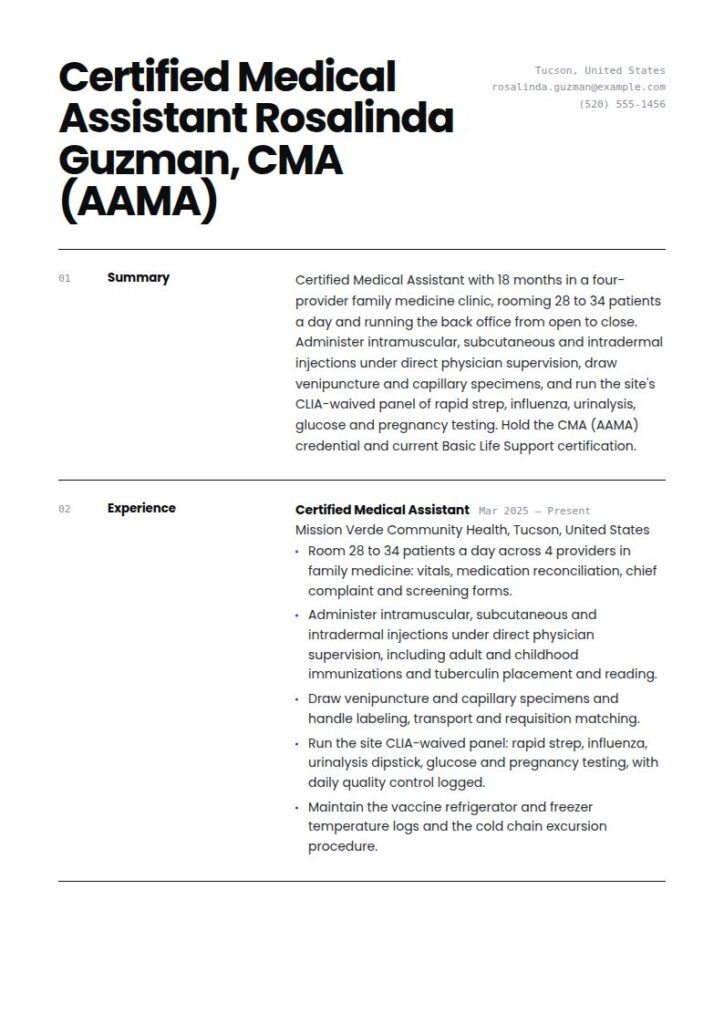
Certified Medical Assistant with 18 months in a four-provider family medicine clinic, rooming 28 to 34 patients a day and running the back office from open to close. Administer intramuscular, subcutaneous and intradermal injections under direct physician supervision, draw venipuncture and capillary specimens, and run the site's CLIA-waived panel of rapid strep, influenza, urinalysis, glucose and pregnancy testing. Hold the CMA (AAMA) credential and current Basic Life Support certification.
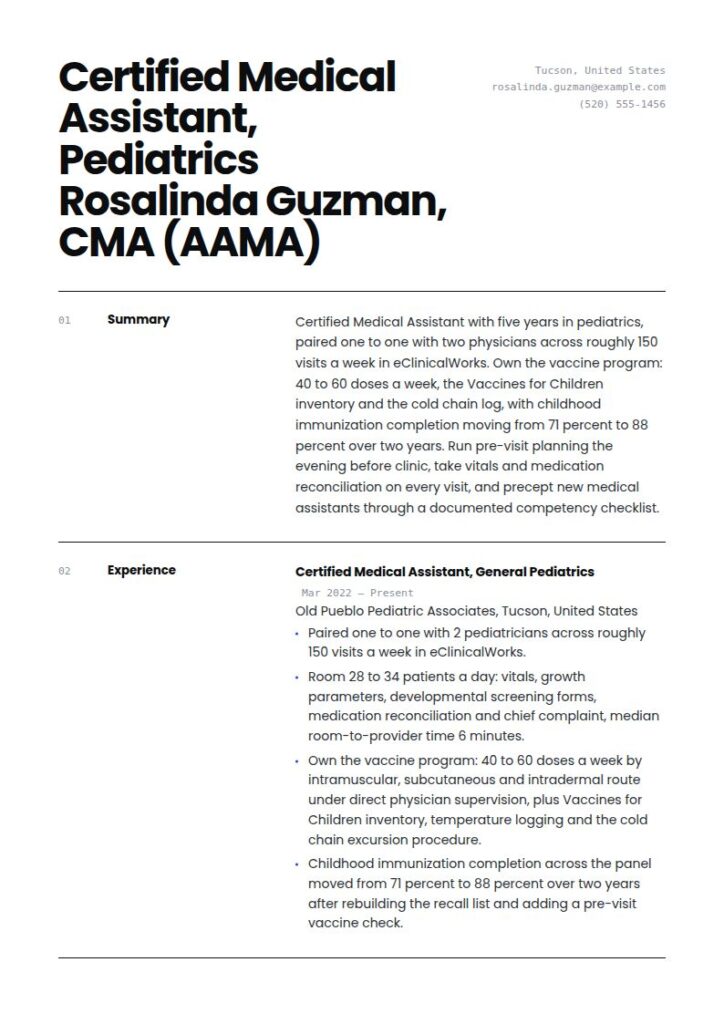
Certified Medical Assistant with five years in pediatrics, paired one to one with two physicians across roughly 150 visits a week in eClinicalWorks. Own the vaccine program: 40 to 60 doses a week, the Vaccines for Children inventory and the cold chain log, with childhood immunization completion moving from 71 percent to 88 percent over two years. Run pre-visit planning the evening before clinic, take vitals and medication reconciliation on every visit, and precept new medical assistants through a documented competency checklist.
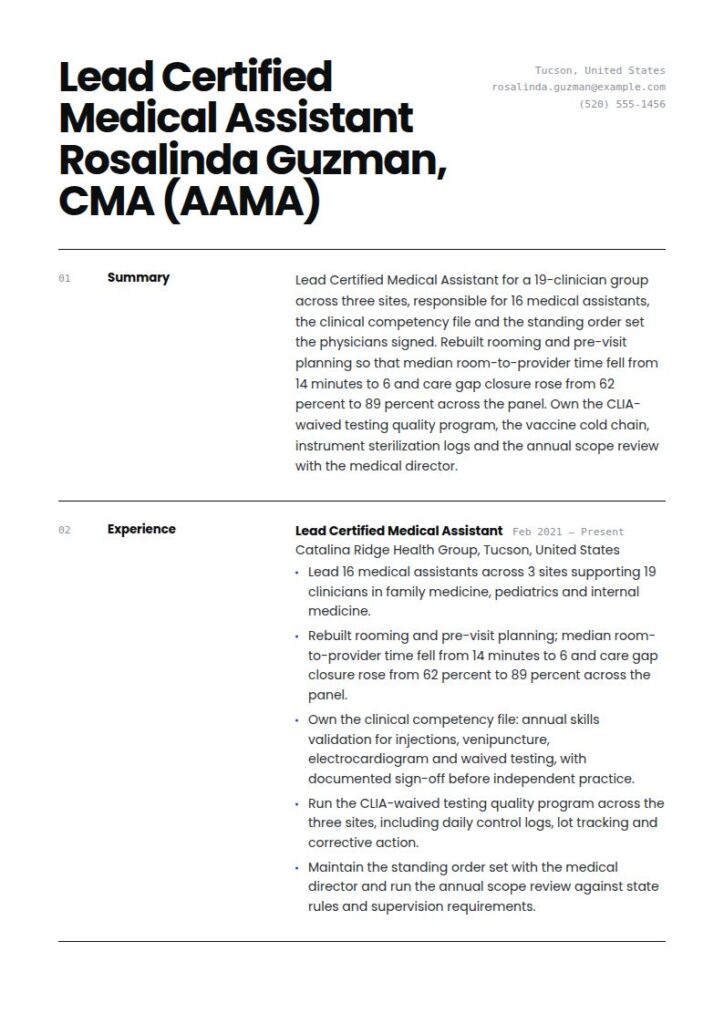
Lead Certified Medical Assistant for a 19-clinician group across three sites, responsible for 16 medical assistants, the clinical competency file and the standing order set the physicians signed. Rebuilt rooming and pre-visit planning so that median room-to-provider time fell from 14 minutes to 6 and care gap closure rose from 62 percent to 89 percent across the panel. Own the CLIA-waived testing quality program, the vaccine cold chain, instrument sterilization logs and the annual scope review with the medical director.
Right vs wrong: the same medical assistant summary, twice
| ✅ Right | ❌ Wrong |
|---|---|
| Paired one to one with two pediatricians across 150 visits a week in eClinicalWorks. | Experienced medical assistant in a busy clinical setting. |
| Administer 40 to 60 vaccine doses a week and own the Vaccines for Children inventory and cold chain log. | Assisted with immunizations and patient care. |
| Childhood immunization completion moved from 71 percent to 88 percent over two years. | Helped improve patient outcomes. |
| Run rapid strep, influenza, urinalysis and glucose testing under the site's CLIA certificate. | Performed various laboratory duties. |
For instance, the right column tells a practice manager which room you can work in on Monday.
Outline your experience
Then list practice, city, specialty, clinicians, visits a week, dates. Then three to five bullets, each naming a procedure and carrying a number.
| Instead of | Use |
|---|---|
| Roomed patients and took vital signs | Room 28 to 34 patients a day: vitals, growth parameters, medication reconciliation and chief complaint, median room-to-provider time 6 minutes |
| Administered injections | Administer 40 to 60 vaccine doses a week by intramuscular, subcutaneous and intradermal route under direct physician supervision |
| Performed laboratory tests | Run the site's CLIA-waived panel: rapid strep, influenza, urinalysis, glucose and hemoglobin A1c, roughly 70 tests a week |
| Helped with patient follow-up | Run pre-visit planning the evening before clinic; care gap closure moved from 62 percent to 89 percent |
Certified Medical Assistant, Old Pueblo Pediatric Associates, Tucson, AZ, general pediatrics, 2 physicians, 150 visits a week, March 2022 to Present
Room 28 to 34 patients a day: vitals, growth parameters, developmental screening forms, medication reconciliation and chief complaint, median room-to-provider time 6 minutes.
Own the vaccine program: 40 to 60 doses a week by intramuscular, subcutaneous and intradermal route under direct physician supervision, plus Vaccines for Children inventory, temperature logging and the cold chain excursion procedure.
Childhood immunization completion moved from 71 percent to 88 percent over two years after I rebuilt the recall list and added a pre-visit vaccine check.
Run CLIA-waived testing under the site certificate: rapid strep, influenza, urinalysis, glucose and hemoglobin A1c, roughly 70 tests a week, with daily quality control logged.
What your state lets you do with your hands, and where that is written
In fact, this is what separates a medical assistant resume from every neighboring role. Your job title, of course, is the same in all fifty states. What it permits is not.
The rule is written at state level, often without naming you. The American Association of Medical Assistants notes that "Scope of practice laws for medical assistants may vary by state" and that many states do not name medical assistants at all, treating them as unlicensed personnel under a delegating clinician (AAMA, state scope of practice resource, checked September 2026). The federal Handbook says the same in one clause: duties vary by state and may include basic laboratory tests and administering "injections or medications as directed by physicians and as permitted by state law" (BLS Occupational Outlook Handbook, checked September 2026).
Injections and medications a medical assistant may give
Injections and medications. Where the state does name you, it is specific. Arizona statute states that "A medical assistant may perform the following medical procedures under the direct supervision of a doctor of medicine, physician assistant or nurse practitioner: 1. Take body fluid specimens. 2. Administer injections" (Arizona Revised Statutes section 32-1456). Arizona also defines who counts as one: a board-approved training program, an unapproved program plus an examination from a certifying organization accredited by the National Commission for Certifying Agencies or the American National Standards Institute, or a physician-designed program meeting the statute (Arizona Administrative Code R4-16-401). Look up your state's equivalent and write the sentence it gives you, with the supervision level, because direct and general supervision mean different staffing models to the person hiring.
CLIA-waived testing. The tests you run sit under the practice's federal laboratory certificate, not your credential. A Certificate of Waiver is "Issued to a laboratory that performs only waived tests," which are "simple laboratory examinations and procedures that have an insignificant risk of an erroneous result" (Centers for Medicare and Medicaid Services, How to Obtain a CLIA Certificate of Waiver, March 2019). Simple is not error-proof: the Centers for Disease Control and Prevention notes that tests "must be performed correctly by trained personnel in environments adhering to good laboratory practices" (CDC, laboratory quality guidance on waived tests, checked September 2026). Name the tests you run, say they sit under the site's CLIA certificate, and say whether you log daily quality control. Few applicants do, and a practice that has been through a survey will notice.
Imaging and limited scope permits
Imaging. This is where medical assistants most often overclaim. Radiography is licensed by states, not by a medical assisting credential. The American Registry of Radiologic Technologists states that "More than 75% of states have licensing laws covering the practice of radiologic technology" and that "If you want to obtain a state license, you must meet the individual state's requirements and apply directly to that state," and it developed the Limited Scope of Practice in Radiography examination "specifically for state licensing purposes" (ARRT, checked September 2026). If you hold a limited scope permit, name it with the issuing state and the body parts it covers; if not, do not write "x-ray" on your resume. The limited operator role is narrow in any case: the American Society of Radiologic Technologists' practice standards for limited x-ray machine operators exclude medication administration, venipuncture, vascular access and informed consent verification (ASRT, Limited X-ray Machine Operator Practice Standards, 23 June 2019).
Therefore, write it as one block, with the supervision level attached.
Under direct physician supervision: Intramuscular, subcutaneous and intradermal injections, including the childhood and adolescent immunization schedule; tuberculin skin test placement and reading; venipuncture and capillary draws; nebulizer treatments
CLIA-waived testing under site certificate: Rapid strep, influenza, urinalysis dipstick, glucose, hemoglobin A1c, pregnancy, mononucleosis; daily quality control logged
Screening and diagnostics: Vitals and growth parameters, 12-lead electrocardiogram, spirometry, vision and hearing screening, developmental screening forms
Procedure support: Laceration repair, incision and drainage, cerumen removal, splinting; instrument processing and autoclave logs
Storage and safety: Vaccines for Children inventory, temperature logging, cold chain excursion procedure, sharps handling, OSHA bloodborne pathogen compliance
Not in scope at this site: Radiography, medication administration beyond delegated injections, triage decisions
Build a snapshot of your key skills
Then use twelve to sixteen entries in four groups. Named procedures and systems, not adjectives.
Clinical: Rooming and vitals, Injection administration by route, Venipuncture and capillary draw, Electrocardiogram, Spirometry, Tuberculin placement and reading, Wound care
Laboratory: CLIA-waived testing, Quality control logging, Specimen collection and transport, Point of care result documentation
Safety and compliance: Vaccine cold chain, Instrument sterilization and autoclave logs, OSHA bloodborne pathogen standard, HIPAA privacy and security, Standing order set adherence
Systems and flow: eClinicalWorks, Epic, athenaOne, Pre-visit planning and care gap review, Refill protocols, Referral preparation, Interpreter coordination
List your education and certifications
Above all, certification is the largest single lever here. Indeed, the Handbook notes that employers "may prefer or require that medical assistants be certified" (BLS Occupational Outlook Handbook, checked September 2026). Four bodies issue the credentials.
The CMA (AAMA) is the most restrictive and therefore the strongest signal. Only graduates of programs accredited by the Commission on Accreditation of Allied Health Education Programs or the Accrediting Bureau of Health Education Schools are eligible for the exam, which runs 200 multiple choice questions in four 40-minute segments, and the credential "must be recertified every 60 months by examination or continuing education" (American Association of Medical Assistants, checked September 2026).
The CCMA from the National Healthcareer Association is the most accessible, with a work experience route as well as a training route: a high school diploma or equivalent plus a program completed within the last five years, or one year of supervised experience within the last three, or two years within the last five. In addition, it renews every two years with 10 continuing education credits (National Healthcareer Association, checked September 2026). The NCMA from the National Center for Competency Testing has comparable routes, including current student, recent graduate and one year of full time experience (NCCT, checked September 2026). American Medical Technologists issues the RMA.
Then write the credential with its initials, issuing body, number and expiry.
Certified Medical Assistant (CMA (AAMA)), American Association of Medical Assistants, #AAMA-1183074, current through 2029
Associate of Applied Science, Medical Assisting, Pima Community College, Tucson, AZ, 2021. CAAHEP accredited program, 160-hour clinical practicum in family medicine.
Additional: Basic Life Support Provider, American Heart Association, 2026. Annual OSHA bloodborne pathogen and HIPAA training, current. Vaccines for Children program training, Arizona Department of Health Services, 2023.
Choose the right layout and design
Finally, keep a single column, plain type at 11 or 12 point, clear headings, no photograph, no rating bars. After all, two columns, text boxes and graphics are where parsing breaks, and a five-star graphic beside "injections" reads badly to a clinician.
Put the credential initials next to your name. Give the specialty, clinician count and visits a week in every employer line. List named procedures with the supervision level attached. Name the waived tests you run and say they sit under the site's CLIA certificate. Give volume with a period: doses a week, tests a week, patients a day. State your state's scope rule if it names medical assistants.
Do not write "assisted with patient care" and stop. Do not claim radiography without a state permit. Do not claim triage, assessment or a nursing scope; delegation is what you work under. Do not list an expired certification without marking it expired. Do not put a patient name, initial or date of birth on a resume.
Medical assistant job market and outlook
Overall, this is one of the largest and fastest growing occupations in American health care, with the growth in outpatient settings.
| Measure | Value |
|---|---|
| Medical assistant jobs, 2025 | 833,900 |
| Projected change, 2025-35 | 13 percent, much faster than average |
| Projected annual openings | About 109,700 |
| Typical entry-level education | Postsecondary nondegree award |
| Median annual wage, May 2025 | $45,690, or $21.97 an hour |
Source: U.S. Bureau of Labor Statistics, Occupational Outlook Handbook, May 2025 wages and 2025-35 projections, published 27 August 2026.
Where the jobs sit:
| Setting | Share of employment | Median annual wage (May 2025) |
|---|---|---|
| Offices of physicians | 56 percent | $45,520 |
| Hospitals, state, local and private | 17 percent | $46,910 |
| Outpatient care centers | 10 percent | $48,560 |
| Offices of other health practitioners | 8 percent | $38,400 |
Source: U.S. Bureau of Labor Statistics, Occupational Outlook Handbook, May 2025.
Roughly 110,000 openings a year, and the credential is the filter
Medical assisting is projected to grow 13 percent from 2025 to 2035, much faster than average, with about 109,700 openings a year from a 2025 base of 833,900 jobs (BLS Occupational Outlook Handbook, 2025-35 projections, published 27 August 2026).
A market that open does not mean every application lands. What sorts the pile is the credential and the procedure list, because the Handbook is explicit that employers "may prefer or require that medical assistants be certified" and that duties, including injections and basic laboratory tests, vary by state law (BLS, checked September 2026).
The pay table shows where the ceiling sits: offices of physicians hold 56 percent of the occupation at a median of $45,520, while outpatient care centers pay $48,560 (BLS, May 2025). For the top of the range, aim at outpatient surgery, urgent care and specialty clinics, and carry a procedure list that justifies it.
What salary you can expect as a medical assistant
Specifically, medical assistants had a median annual wage of $45,690, or $21.97 an hour, as of May 2025 (BLS Occupational Outlook Handbook, May 2025). Setting moves that more than tenure: offices of other health practitioners pay a median of $38,400 against $48,560 in outpatient care centers, roughly 26 percent for the same job title (BLS, May 2025).
Three things move an individual offer. The credential, because a CMA (AAMA) requires an accredited program and recertification every 60 months (AAMA, checked September 2026). The procedure list, because a practice that needs injections, draws, electrocardiograms and waived testing from one person is buying four roles in one. And specialty, because pediatrics, orthopedics, dermatology and urgent care each want a specific set of hands.
However, the step up is rarely a bigger medical assistant job. It is lead medical assistant or clinical supervisor, then a licensed route: practical or vocational nursing, registered nursing, or a technical credential such as phlebotomy or surgical technology. Write the resume so the next employer sees the clinical depth, because that shortens every one of those paths.
Key takeaways for a medical assistant resume
- Above all, put the credential initials next to your name, because they are the searched string.
- Split the clinical block from the administrative block and label both.
- Also list named procedures with the supervision level attached, not "patient care".
- Similarly, name the waived tests you run and say they sit under the site's CLIA certificate.
- In addition, never claim radiography without a state permit.
- Give volume with a period: doses a week, tests a week, patients a day.
- Finally, put the specialty, clinician count and visit volume in every employer line.
Build your medical assistant resume in 15 minutes with our AI resume builder.
Related medical resume examples
- CNA resume
- Phlebotomist resume
- Medical receptionist resume
- Medical administrative assistant resume
- Dental assistant resume
- Medical scribe resume
- Lab technician resume
- Pharmacy technician resume
- Home health aide resume
- Licensed practical nurse resume
- Clinic coordinator resume
- Medical support assistant resume
Pair it with a matching medical assistant cover letter.
Medical assistant resume questions, answered
How long should a medical assistant resume be?
One page. Only leading a team across multiple sites earns a second. Depth belongs in the procedure block, not extra pages.
Which medical assistant certification should I get?
If you can attend an accredited program, the CMA (AAMA) is the strongest, because eligibility is restricted to graduates of CAAHEP or ABHES accredited programs and it recertifies every 60 months (AAMA, checked September 2026). If you are already working without one, the CCMA offers a work experience route of one year within the last three or two years within the last five, renewing every two years with 10 continuing education credits (National Healthcareer Association, checked September 2026).
Can I say I give injections and draw blood?
Only if your state allows it and you have done it. Arizona, for example, permits a medical assistant to take body fluid specimens and administer injections under the direct supervision of a physician, physician assistant or nurse practitioner (Arizona Revised Statutes section 32-1456). Write the procedure, the route and the supervision level. A scope claim that does not match the reader's state suggests you have not checked.
Can a medical assistant take x-rays?
Not on the strength of a medical assisting credential. Radiography is licensed by states, and more than 75 percent of states have licensing laws covering the practice of radiologic technology, with applications made directly to the state (ARRT, checked September 2026). Some states issue a limited scope permit using the ARRT Limited Scope of Practice examination. If you hold one, name it with the state and the covered body parts.
What do I put on a medical assistant resume with no clinical experience?
Your externship, written as a job: the practice, the specialty, the clinician count, the hours, and the procedures you performed and how many. Accredited programs require a practicum, and it is real supervised clinical work, so give it an employer line and bullets with numbers. Then the credential with its number and Basic Life Support.
How is a medical assistant different from a CNA or a medical administrative assistant?
A certified nursing assistant works under nursing delegation, usually in long-term care, on personal care and activities of daily living. A medical administrative assistant runs the front office: scheduling, eligibility, authorizations and records. A medical assistant sits in the middle of an outpatient clinic, doing the rooming and clinical procedures and the flow work around them, under a delegating clinician rather than a nursing license.