Certified Phlebotomy Technician I Marisela Solorzano
Phlebotomy Technician I
[email protected] | (661) 555-1330 | Bakersfield, United States
Profile
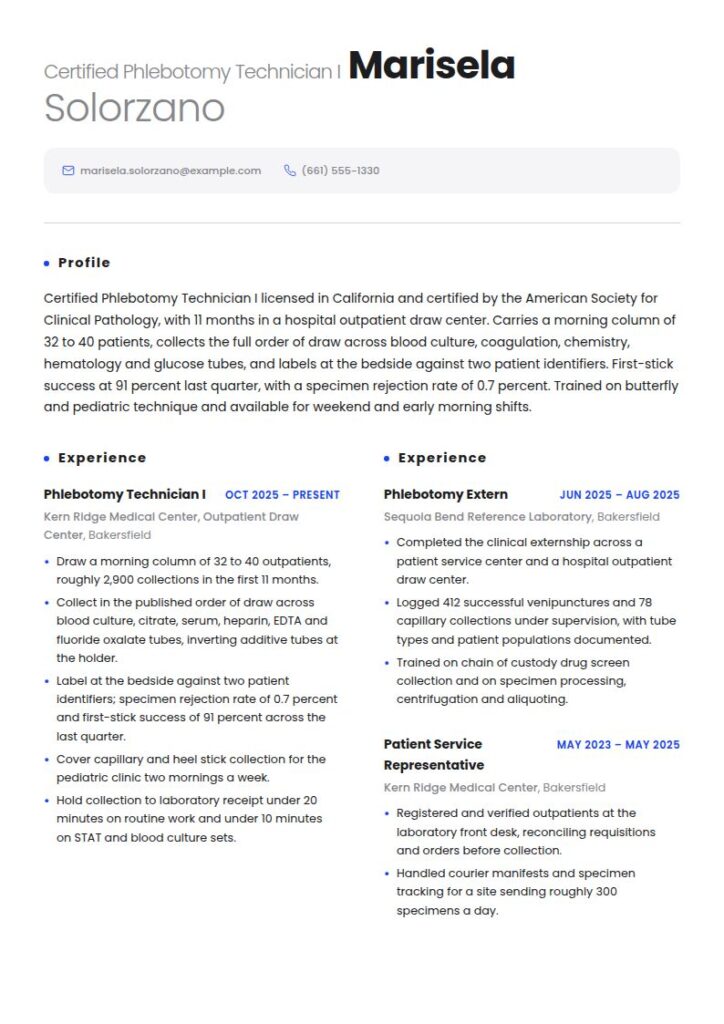
Certified Phlebotomy Technician I licensed in California and certified by the American Society for Clinical Pathology, with 11 months in a hospital outpatient draw center. Carries a morning column of 32 to 40 patients, collects the full order of draw across blood culture, coagulation, chemistry, hematology and glucose tubes, and labels at the bedside against two patient identifiers. First-stick success at 91 percent last quarter, with a specimen rejection rate of 0.7 percent. Trained on butterfly and pediatric technique and available for weekend and early morning shifts.
Work Experience
10/2025 - Present, Phlebotomy Technician I, Kern Ridge Medical Center, Outpatient Draw Center, Bakersfield, United States
- Draw a morning column of 32 to 40 outpatients, roughly 2,900 collections in the first 11 months.
- Collect in the published order of draw across blood culture, citrate, serum, heparin, EDTA and fluoride oxalate tubes, inverting additive tubes at the holder.
- Label at the bedside against two patient identifiers; specimen rejection rate of 0.7 percent and first-stick success of 91 percent across the last quarter.
- Cover capillary and heel stick collection for the pediatric clinic two mornings a week.
- Hold collection to laboratory receipt under 20 minutes on routine work and under 10 minutes on STAT and blood culture sets.
06/2025 - 08/2025, Phlebotomy Extern, Sequoia Bend Reference Laboratory, Bakersfield, United States
- Completed the clinical externship across a patient service center and a hospital outpatient draw center.
- Logged 412 successful venipunctures and 78 capillary collections under supervision, with tube types and patient populations documented.
- Trained on chain of custody drug screen collection and on specimen processing, centrifugation and aliquoting.
05/2023 - 05/2025, Patient Service Representative, Kern Ridge Medical Center, Bakersfield, United States
- Registered and verified outpatients at the laboratory front desk, reconciling requisitions and orders before collection.
- Handled courier manifests and specimen tracking for a site sending roughly 300 specimens a day.
Education
08/2024 - 08/2025, Certificate of Achievement, Phlebotomy Technician, Panorama Vista College, Bakersfield, United States
Clinical externship completed in a reference laboratory patient service center and a hospital outpatient draw center. 412 documented venipunctures and 78 capillary collections.
Skills
Venipuncture by evacuated tube, syringe and butterfly, 80
Capillary and heel stick collection, 70
Published order of draw and additive inversions, 85
Two-identifier verification and bedside labeling, 90
Specimen processing, centrifugation and aliquoting, 65
Epic Beaker laboratory information system, 70
OSHA bloodborne pathogens compliance, 80
Languages
English, native
Spanish, native
Certificates
08/2025, Certified Phlebotomy Technician I, California Department of Public Health, Laboratory Field Services, CPT1-0449182
Authorized to perform skin puncture and venipuncture.
09/2025, Phlebotomy Technician, PBT(ASCP), American Society for Clinical Pathology
06/2025, Basic Life Support for Healthcare Providers, American Heart Association
Current through 2027.
Summary
A phlebotomist resume is a one page document naming your certification, the number of draws you take in a day, how often your specimens are rejected, and the difficult sticks other people hand you. This guide gives you three adaptable versions, the credential block almost nobody writes correctly, and current Bureau of Labor Statistics pay and outlook for the occupation.
Phlebotomist resume examples by experience level
In short, a phlebotomist resume is a one page document that names your certification, the number of draws you take in a shift, how often your specimens come back rejected, and the patients other people call you for.
However, every applicant can write that they draw blood. The file that gets called names what a laboratory manager measures: first-stick success, specimen rejection, labeling errors, turnaround from collection to receipt, and whether the hard sticks on the floor can be handed to you without a second person.
Resume guide for a phlebotomist resume
In particular, this guide and the corresponding phlebotomist resume example will cover:
- First, how to write a phlebotomist resume, section by section
- How to turn the draw into a number instead of a duty
- Then three adaptable summaries: new certificate holder, working phlebotomist and lead
- Which states license phlebotomists, and which credential letters to list
- Finally, what the job market looks like and what Bureau of Labor Statistics pay data shows
How to write a phlebotomist resume
In addition, use six blocks: contact header, summary, certification and license, collection experience, skills and systems, and education. In practice, one page works for nearly everyone in this occupation, and two only once you supervise or run a site.
The order, therefore, follows how a laboratory manager reads. Certification comes first because in four states it is a legal gate and everywhere else it is the first screen. Volume and accuracy come second, because they are the only things separating two certified applicants on paper.
| Section | What it is answering | Where it goes |
|---|---|---|
| Certification and state license | May this person legally stick a patient here tomorrow? | Under the summary, with numbers and dates |
| Draw volume | Can they carry an outpatient column or a morning inpatient sweep? | In the summary and each job's scope line |
| Specimen accuracy | How often will the laboratory call for a redraw? | One number per role, with its period |
| Patient range | Pediatric, geriatric, oncology, dialysis, bariatric | A named list, not the word "all" |
| Systems | Which laboratory information system and label printing setup | Short named list |
Put your specimen rejection rate on the page
The laboratory already tracks it. Every hospital and reference laboratory keeps a rejection log broken out by reason: hemolyzed, quantity not sufficient, clotted, wrong tube, mislabeled, unlabeled. Your name is attached to those entries, so the number exists whether or not you write it, and almost no applicant writes it.
"Specimen rejection rate of 0.4 percent across roughly 8,200 draws in the last year, against a department average of 1.1 percent" is a sentence a laboratory manager can check against their own report, and it answers the question that decides the hire.
If you cannot get the figure, use what your own day gives you: draws per shift, first-stick success, hard-stick consults you were called for, or last quarter's redraw count. Ask before you leave the job, because it is easy to obtain while you are on staff and nearly impossible afterwards.
Run the finished file through the ATS resume checker before you send it. Hospital systems and national reference laboratories screen phlebotomy applications through an applicant tracking system before a laboratory manager opens one.
Choosing the best resume format for a phlebotomist resume
Reverse chronological, single column, one page. Two pages only if you lead a team, train new hires or cover several sites.
One format problem belongs to this occupation specifically. Phlebotomy careers fan out across settings rather than climb: an outpatient draw center, a hospital floor rotation, a patient service center, mobile and home draws, plasma donation, blood drives. A strict reverse chronological list of six short assignments reads as instability when it was really one job with six locations.
For example, group by employer, then list the settings under it: "Sequoia Bend Reference Laboratory, 2021 to present. Patient service center, mobile home draws and long-term care rounds." As a result, one heading covers three settings with nothing to explain.
Include your contact information
| ✅ Right | ❌ Wrong |
|---|---|
| Marisela Solorzano | Marisela Solorzano |
| Certified Phlebotomy Technician II, PBT(ASCP) | Experienced phlebotomist |
| California CPT II #CPT2-0449182, current | Certified in phlebotomy |
| (661) 555-1330, [email protected], Bakersfield, CA | (661) 555-1330, [email protected] |
Also put the certificate number on the page. In a licensing state the employer must verify it before your first shift, and the file that lets them do that in ten seconds moves first.
Make use of a summary
Keep it to four lines: certification and license, setting and daily volume, one accuracy number, and also the patient populations you are trusted with.
Certified Phlebotomy Technician I licensed in California and certified by the American Society for Clinical Pathology, with 11 months in a hospital outpatient draw center. Carries a morning column of 32 to 40 patients, collects the full order of draw across blood culture, coagulation, chemistry, hematology and glucose tubes, and labels at the bedside against two patient identifiers. First-stick success at 91 percent last quarter, with a specimen rejection rate of 0.7 percent. Trained on butterfly and pediatric technique and available for weekend and early morning shifts.
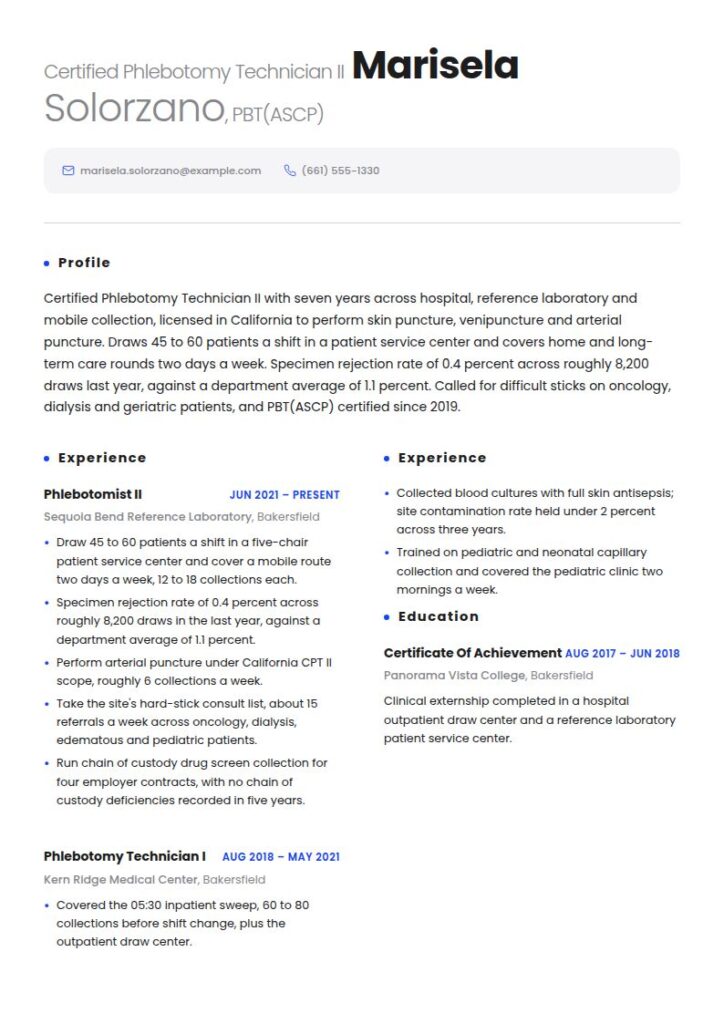
Certified Phlebotomy Technician II with seven years across hospital, reference laboratory and mobile collection, licensed in California to perform skin puncture, venipuncture and arterial puncture. Draws 45 to 60 patients a shift in a patient service center and covers home and long-term care rounds two days a week. Specimen rejection rate of 0.4 percent across roughly 8,200 draws last year, against a department average of 1.1 percent. Called for difficult sticks on oncology, dialysis and geriatric patients, and PBT(ASCP) certified since 2019.
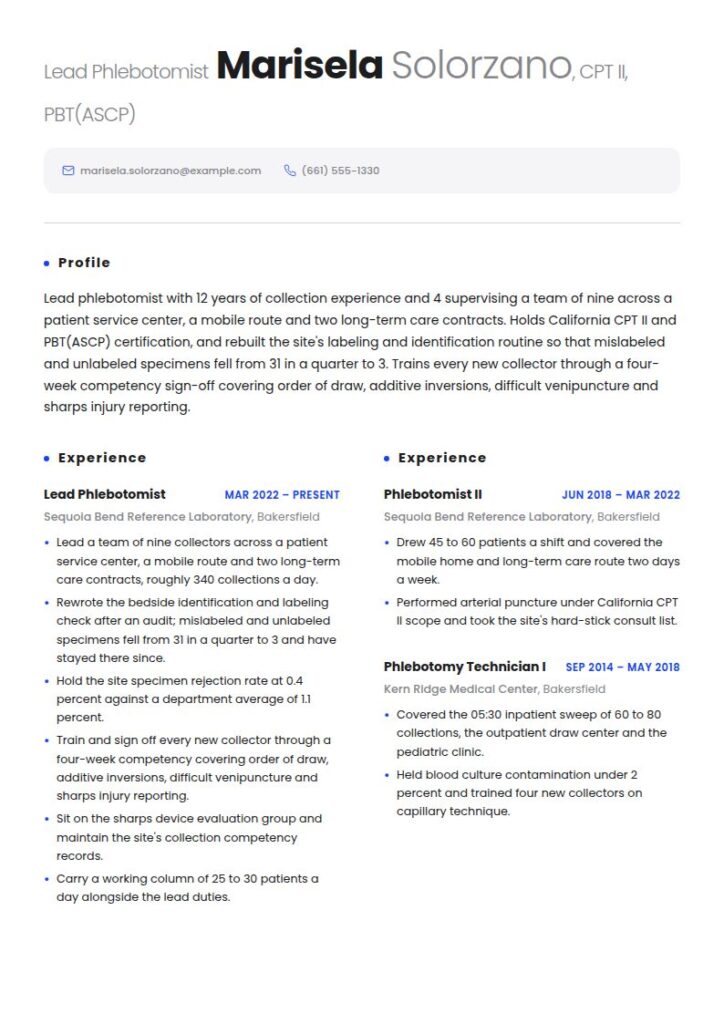
Lead phlebotomist with 12 years of collection experience and 4 supervising a team of nine across a patient service center, a mobile route and two long-term care contracts. Holds California CPT II and PBT(ASCP) certification, and rebuilt the site's labeling and identification routine so that mislabeled and unlabeled specimens fell from 31 in a quarter to 3. Trains every new collector through a four-week competency sign-off covering order of draw, additive inversions, difficult venipuncture and sharps injury reporting.
Right vs wrong: the same phlebotomist summary, twice
| ✅ Right | ❌ Wrong |
|---|---|
| Certified Phlebotomy Technician II licensed in California for skin puncture, venipuncture and arterial puncture. | Experienced phlebotomist with excellent patient care skills. |
| Draws 45 to 60 patients a shift and covers home and long-term care rounds two days a week. | Responsible for collecting blood samples from patients of all ages. |
| Specimen rejection rate of 0.4 percent across roughly 8,200 draws in the last year, against a department average of 1.1 percent. | Known for accuracy and attention to detail. |
The left column, for instance, is a shift that fills and a report a manager can pull. The right column, on the other hand, is every other file in the stack.
Outline your collection experience
Employer, setting, city, dates, then a scope line: type of site, patient population and daily volume. Then three to five bullets, each carrying a number.
| Instead of | Use |
|---|---|
| Drew blood from patients | Drew 45 to 60 outpatients a shift in a five-chair patient service center, plus a mobile route of 12 to 18 home and long-term care collections |
| Followed proper collection procedures | Collected in the published order of draw across blood culture, citrate, serum, heparin, EDTA and fluoride oxalate tubes, inverting additive tubes at the holder |
| Labeled specimens accurately | Labeled at the bedside against two patient identifiers; mislabeled and unlabeled specimens fell from 31 in a quarter to 3 after I rewrote the check |
| Worked with difficult patients | Took the site's hard-stick consult list: oncology, dialysis, edematous and pediatric patients, roughly 15 referrals a week |
Lead Phlebotomist, Sequoia Bend Reference Laboratory, Bakersfield, CA, June 2021 to Present
Five-chair patient service center plus a mobile route covering home draws and two long-term care contracts. Adult and pediatric mix roughly 85 to 15, with a standing oncology and dialysis referral list.
Draw 45 to 60 patients a shift and cover the mobile route two days a week, 12 to 18 collections each.
Hold a specimen rejection rate of 0.4 percent across roughly 8,200 draws in the last year, against a department average of 1.1 percent.
Rewrote the bedside identification and labeling check after an audit; mislabeled and unlabeled specimens fell from 31 in a quarter to 3 and have stayed there since.
Take the site's hard-stick consult list, roughly 15 referrals a week, including oncology, dialysis, edematous and pediatric patients, and train and sign off every new collector through a four-week competency.
The draw itself: order, labels, volume and the credential letters
In fact, this is the section that decides between two certified applicants, and the one most phlebotomy resumes replace with the phrase "venipuncture and capillary puncture".
The order of draw. Tube sequence is a written standard, not a preference. The Clinical and Laboratory Standards Institute publishes it in PRE02, the eighth edition of the venous blood collection standard, which replaced GP41-Ed7 from 2017 (Clinical and Laboratory Standards Institute, checked September 2026). The sequence runs blood culture tubes, sodium citrate, serum tubes, heparin, EDTA, then sodium fluoride with potassium oxalate. Name tubes by additive rather than by color alone, because color conventions vary between manufacturers and additive names do not.
Inversions. Additive tubes are inverted gently three to eight times depending on the additive and the manufacturer, as soon as the tube leaves the holder (Clinical and Laboratory Standards Institute, PRE02, checked September 2026). A line that mentions inverting at the holder tells a laboratory manager you know why clotted hematology specimens happen.
Positive patient identification and labeling. Two identifiers, confirmed with the patient wherever the patient can confirm them, and labels applied at the bedside before you leave. Mislabeling is the error category that ends employment fastest, because a mislabeled specimen is a wrong result on the wrong chart. A number here is the strongest line on your resume.
Redraw rate, difficult draws and safety
Hemolysis and the redraw rate. Hemolysis is the most common reason a specimen is rejected, and it is largely technique: needle gauge, tourniquet time, vigorous mixing, drawing through a line, forcing a syringe transfer. A phlebotomist who can say their rejection rate fell, and name what they changed, has given evidence no certificate can.
Difficult draws. Name the populations: pediatric and neonatal heel sticks, geriatric and fragile veins, oncology patients with scarred access, dialysis patients with a fistula arm that is off limits, edematous and bariatric patients, patients in isolation. "Hard-stick consult list" is a real internal phrase and it lands.
Volume and turnaround. Draws per shift, routes per week, collection to laboratory receipt in minutes, and the STAT and blood culture handling that carries its own clock. These are the numbers a laboratory schedules on, so give them.
Safety. The OSHA bloodborne pathogens standard requires employers to use needleless systems and sharps with engineered sharps injury protections, to solicit input from non-managerial employees responsible for direct patient care when selecting those devices, and to maintain a sharps injury log recording the device type and brand, the work area and an explanation of the incident (29 CFR 1910.1030, current as checked September 2026). The same standard requires hepatitis B vaccination to be made available within 10 working days of initial assignment. Saying you took part in a device evaluation, or that your vaccination and titer are documented, reads as someone who has worked in a real laboratory.
Licensure: four states, and what the letters mean
However, there is no federal phlebotomy training or certification requirement. Four states license or certify phlebotomists specifically: California, Louisiana, Nevada and Washington. Instead, everywhere else certification is an employer requirement rather than a legal one, which is why so many postings read "certification required or willing to obtain within 90 days".
California splits the credential in two. For example, a Certified Phlebotomy Technician I is authorized to perform skin puncture and venipuncture, whereas a Certified Phlebotomy Technician II is authorized to perform skin puncture, venipuncture and arterial puncture. In short, that is a genuine scope difference, so write which one you hold instead of the word "certified".
Meanwhile, national certification is separate from state licensure, and five bodies issue the credentials you will see on a posting:
| Certifying body | Credential |
|---|---|
| American Society for Clinical Pathology | PBT(ASCP) |
| National Healthcareer Association | CPT(NHA) |
| American Medical Technologists | RPT(AMT) |
| American Society of Phlebotomy Technicians | CPT(ASPT) |
| National Center for Competency Testing | NCPT(NCCT) |
Write the credential the way the body writes it, parenthetical included: that is the string a recruiter searches and a verification portal expects.
Certified Phlebotomy Technician II, California Department of Public Health, Laboratory Field Services, #CPT2-0449182, issued 2021, current
Certified Phlebotomy Technician I, California, #CPT1-0449182, issued 2018
Phlebotomy Technician, PBT(ASCP), American Society for Clinical Pathology, certified 2019
Basic Life Support for Healthcare Providers, American Heart Association, current through 2027
Hepatitis B vaccination series complete with documented titer, 2018
Build a snapshot of your key skills
Specifically, use five groups: collection technique, specimen handling, identification, patient range and systems. Above all, use named techniques and named products, never adjectives.
Collection: venipuncture by evacuated tube, syringe and butterfly, capillary and heel stick, arterial puncture under CPT II scope, blood culture collection with skin antisepsis, difficult and fragile vein technique
Specimen handling: published order of draw, additive inversions at the holder, minimum fill and quantity checks, light-protected and chilled specimens, centrifugation and aliquoting, chain of custody for drug screen collection
Identification: two-identifier verification, bedside labeling, requisition and order reconciliation, recollection and rejection logging
Patient range: pediatric and neonatal, geriatric and fragile, oncology and dialysis, bariatric, isolation precautions, needle-phobic patients
Systems and safety: Epic Beaker and Cerner laboratory information systems, bedside label printing, courier manifests, OSHA bloodborne pathogens compliance
List your education and certifications
Training program with its year, then the state certificate, then the national credential, then the safety items employers verify.
Certificate of Achievement, Phlebotomy Technician, Panorama Vista College, Bakersfield, CA, 2018. Clinical externship in a hospital outpatient draw center and a reference laboratory patient service center.
Certified Phlebotomy Technician II, California Department of Public Health, #CPT2-0449182, 2021
Phlebotomy Technician, PBT(ASCP), American Society for Clinical Pathology, 2019
Continuing education: difficult venipuncture and vein assessment, 2025; pediatric and neonatal collection, 2023; blood culture contamination reduction, 2022
Then name the training program and the externship setting. After all, a laboratory manager reading a new graduate's file wants to know where you stuck real patients and how many.
Choose the right layout and design
Similarly, use a single column, 11 or 12 point, clear headings, and no photograph. Hospital systems and national laboratories parse these into a structured record before a person reads one, and certificate strings such as CPT2-0449182 and PBT(ASCP) are what gets mangled in a two-column template.
Write the certificate number and the issuing authority in the first block. Say CPT I or CPT II if you work in California, because they are different scopes. Give draws per shift and the patient mix in every job's scope line. Put one accuracy number on the page with the period it covers. List the populations you are called for on hard sticks. Group several sites under one employer heading.
Do not write "venipuncture and capillary puncture" and stop there; that is the job description, not your record. Do not claim arterial puncture unless your credential covers it. Do not say "all ages" when the named list is what gets read. Do not describe yourself as compassionate or detail oriented. Do not name a patient or an identifiable case.
Phlebotomist job market and outlook
A small, fast-turning occupation growing faster than average, with most of the hiring split between hospitals and reference laboratories.
| Measure | Value |
|---|---|
| Phlebotomist jobs, 2025 | 143,900 |
| Projected change, 2025-35 | 7 percent, +9,800 |
| Projected annual openings | About 18,000 |
| Typical entry-level education | Postsecondary nondegree award |
| Median annual wage, May 2025 | $45,230 ($21.75 per hour) |
Source: U.S. Bureau of Labor Statistics, Occupational Outlook Handbook, Phlebotomists, 2025 to 2035 projections and May 2025 wage data.
Eighteen thousand openings a year against 143,900 jobs
BLS projects about 18,000 openings a year for phlebotomists over the 2025 to 2035 decade, against a base of 143,900 jobs in 2025 and projected growth of 7 percent, or 9,800 positions (BLS Occupational Outlook Handbook, 2025 to 2035 projections).
Openings running at roughly one in eight of the whole occupation every year are not mostly growth. They are churn: people moving between sites, moving into laboratory or nursing roles, or leaving the field.
That shapes hiring twice over. Employers screen quickly on a short list of gates: certification, availability, and whether you can carry a full column on day one. And because turnover is the pattern, a resume showing you stayed somewhere and got better there is unusual. Two years at one site with a falling rejection rate beats four sites in four years.
Where the jobs sit:
| Setting | Share of employment | Median annual wage (May 2025) |
|---|---|---|
| Hospitals; state, local, and private | 36% | $44,220 |
| Medical and diagnostic laboratories | 33% | $46,670 |
| All other ambulatory healthcare services | 16% | $39,930 |
| Offices of physicians | 9% | $44,500 |
| Outpatient care centers | 2% | $48,030 |
Source: U.S. Bureau of Labor Statistics, May 2025.
What salary you can expect as a phlebotomist
Overall, the median annual wage for phlebotomists was $45,230, or $21.75 an hour, as of May 2025. The lowest 10 percent earned less than $35,780 and the highest 10 percent more than $58,780 (BLS Occupational Outlook Handbook, May 2025).
The spread between industries is narrower here than in most occupations: $39,930 at the bottom in other ambulatory healthcare services and $48,030 at the top in outpatient care centers (BLS, May 2025). That is $8,100 across the whole published table, so choosing an industry is not where the money is.
However, what does move pay is a short list, and every item on it is something a resume can carry:
- Scope. In California, CPT II adds arterial puncture, which is a different job and often a different pay line.
- Shift and availability. Early morning hospital sweeps, nights, weekends and on-call routes carry differentials and are the hardest slots to fill.
- Mobile and specialty work. Home draws, long-term care rounds, paramedical examinations and chain of custody drug screen collection pay above the standard draw center rate, because each needs a collector who works unsupervised.
- Lead and training roles. Competency sign-off, scheduling and new-hire training move you onto a supervisory line without leaving collection.
Key takeaways for a phlebotomist resume
- First, lead with the certificate number and the issuing authority, because it is a gate, not an achievement.
- Say CPT I or CPT II if you work in California, because the scopes genuinely differ.
- Then put draws per shift and the patient mix in the scope line of every job.
- Also give one accuracy number, with the period and the comparison it sits against.
- Finally, name the populations you are called for on hard sticks.
- Group several sites under one employer heading so a fanned-out career reads as one job.
Build your phlebotomist resume in 15 minutes with our AI resume builder.
Related medical resume examples
- Lab technician resume
- Lab assistant resume
- Medical technologist resume
- Medical assistant resume
- CNA resume
- Nursing assistant resume
- Medical receptionist resume
- Medical support assistant resume
- EMT resume
- Clinical research coordinator resume
- Healthcare resume
- Medical resume
Pair it with a matching phlebotomist cover letter.
Phlebotomist resume questions, answered
How long should a phlebotomist resume be?
One page. This is a one page occupation for almost everybody in it, and a second page usually means the collection experience has been padded with duties rather than numbers. Go to two pages only once you supervise a team, run a site, or hold training and competency sign-off responsibility.
Do I need a license to work as a phlebotomist?
Not federally. Four states license or certify phlebotomists specifically: California, Louisiana, Nevada and Washington. Elsewhere certification is an employer requirement rather than a legal one, though most hospital and reference laboratory postings ask for it, or require it within a set period after hire.
Which phlebotomy certification should I list?
The one you hold, written exactly as the certifying body writes it. The five national credentials you will see on postings are PBT(ASCP), CPT(NHA), RPT(AMT), CPT(ASPT) and NCPT(NCCT), issued respectively by the American Society for Clinical Pathology, the National Healthcareer Association, American Medical Technologists, the American Society of Phlebotomy Technicians and the National Center for Competency Testing. If you are in California, list the state CPT I or CPT II separately, because the state credential and the national certification are not the same thing.
What do I put on a phlebotomist resume with no experience?
Write the externship as a job: the site, the weeks, the number of successful venipunctures and capillary sticks you logged, the tube types, and the patient populations you saw. Then the certificate with its number and date, your basic life support card, and your availability by shift. A new collector who can state a documented stick count and will take early mornings is a straightforward hire in an occupation with about 18,000 openings a year (BLS Occupational Outlook Handbook, 2025 to 2035 projections).
Is it worth putting the order of draw on a resume?
Not as a list of tube colors, which reads as a training exercise. One line saying you collect in the published sequence and invert additive tubes at the holder is enough, because it signals that you understand why specimens fail. The order is a published standard: CLSI PRE02, the eighth edition of the venous blood collection standard, replaced GP41-Ed7 from 2017 (Clinical and Laboratory Standards Institute, checked September 2026).