Marek Novotny DMD
Resident Dentist, Advanced Education in General Dentistry
[email protected] | (414) 555-0717 | Milwaukee, United States
Profile
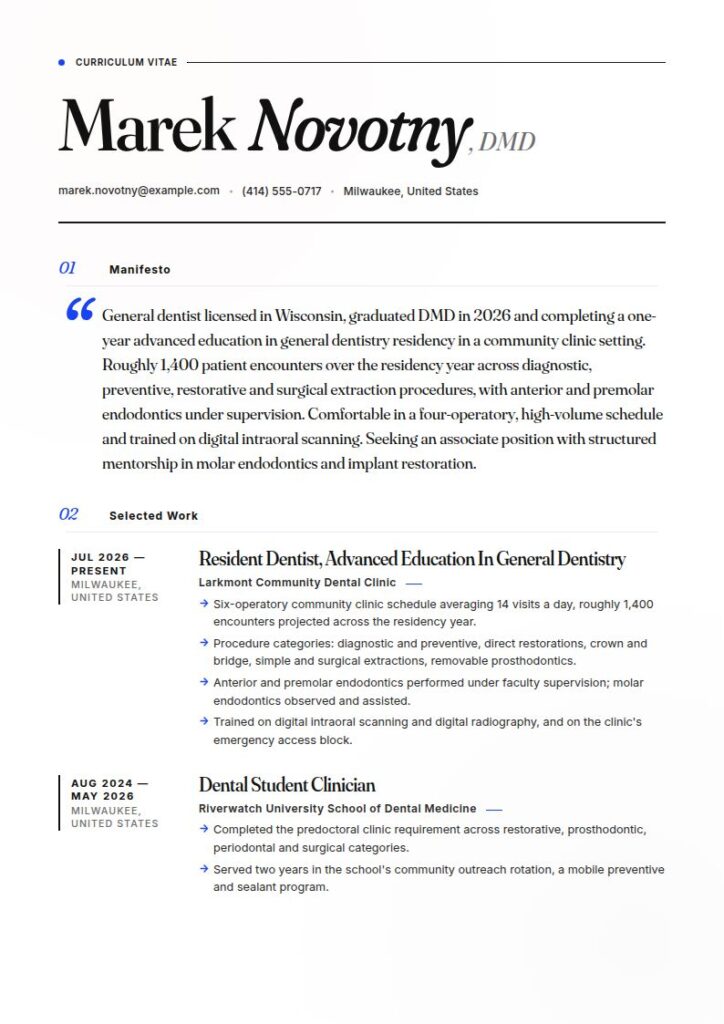
General dentist licensed in Wisconsin, graduated DMD in 2026 and completing a one-year advanced education in general dentistry residency in a community clinic setting. Roughly 1,400 patient encounters over the residency year across diagnostic, preventive, restorative and surgical extraction procedures, with anterior and premolar endodontics under supervision. Comfortable in a four-operatory, high-volume schedule and trained on digital intraoral scanning. Seeking an associate position with structured mentorship in molar endodontics and implant restoration.
Work Experience
07/2026 - Present, Resident Dentist, Advanced Education in General Dentistry, Larkmont Community Dental Clinic, Milwaukee, United States
- Six-operatory community clinic schedule averaging 14 visits a day, roughly 1,400 encounters projected across the residency year.
- Procedure categories: diagnostic and preventive, direct restorations, crown and bridge, simple and surgical extractions, removable prosthodontics.
- Anterior and premolar endodontics performed under faculty supervision; molar endodontics observed and assisted.
- Trained on digital intraoral scanning and digital radiography, and on the clinic's emergency access block.
08/2024 - 05/2026, Dental Student Clinician, Riverwatch University School of Dental Medicine, Milwaukee, United States
- Completed the predoctoral clinic requirement across restorative, prosthodontic, periodontal and surgical categories.
- Served two years in the school's community outreach rotation, a mobile preventive and sealant program.
Education
08/2022 - 05/2026, Doctor of Dental Medicine, Dentistry, Riverwatch University School of Dental Medicine, Milwaukee, United States
Predoctoral program accredited by the Commission on Dental Accreditation. Integrated National Board Dental Examination passed prior to graduation.
08/2018 - 05/2022, Bachelor of Science, Biology, Riverwatch University, Milwaukee, United States
Prerequisite coursework in biology, chemistry, physics and anatomy.
Skills
Direct and indirect restorations, 80
Crown and bridge, 70
Anterior and premolar endodontics, 70
Removable prosthodontics, 70
Simple and surgical extractions, 75
Digital intraoral scanning, 80
Digital radiography, 85
Treatment planning, 70
Infection control and OSHA compliance, 85
Practice management software, 75
Languages
English, native
Czech, native
Spanish, beginner
Certificates
06/2026, Dental License, State of Wisconsin, Wisconsin Dentistry Examining Board, WI-DEN-14032
Active. Issued on graduation.
03/2026, Integrated National Board Dental Examination, Joint Commission on National Dental Examinations
Passed. Accepted in all US states and territories toward the written examination requirement for licensure.
02/2026, Basic Life Support for Healthcare Providers, American Heart Association
Current through 2028.
Summary
A dentist resume is a one to two page document naming your state license, your DDS or DMD degree, the procedure mix you run and the production and chair time behind it. This guide gives you three adaptable versions, the business numbers an owner or a group actually reads, and current Bureau of Labor Statistics pay and outlook for dentists.
Dentist resume examples by experience level
In short, a dentist resume is a one to two page document that names your state license, your DDS or DMD degree, the procedures you perform, the chair time they take and the production they generate.
Dentistry is the corner of medicine that hires like a business, because most of it is one. For context, the Bureau of Labor Statistics puts 78 percent of dentists in offices of dentists and 12 percent self-employed (BLS Occupational Outlook Handbook, Dentists, published 27 August 2026). Often, the person reading your resume is the owner whose overhead you would increase, or a group practice manager with a production target on a spreadsheet. However, neither of them can evaluate you from a list of duties.
Above all, one rule sits above everything else on this page.
No patient goes on a dentist resume, ever
No name, no initials, no age, no case, no before-and-after photograph, no described treatment on a described person. Not a de-identified one either: a reader has no way to confirm the de-identification, and clinical photography carries its own consent trail that a resume cannot show.
Describe your clinical work by type, volume, setting and procedure instead: "roughly 1,800 patient encounters a year in a community health center, about 40 percent restorative," not a story about a person.
This is a HIPAA problem before it is a taste problem. It comes up more in dentistry than in most fields because the visual case is how dentists present work to each other, in study clubs, in continuing education and on practice sites. A portfolio and a resume are different documents with different consent requirements, and the resume is not the place.
Resume guide for a dentist resume
To help, this guide and the corresponding dentist resume example will cover:
- How to write a dentist resume, section by section
- Why chair time, procedure mix and production belong on the page
- Three adaptable summaries: new graduate, associate and practice owner
- What DDS versus DMD actually means, and how to write continuing education
- What the dentist job market looks like and what you can expect to earn
How to write a dentist resume
Six blocks: contact header, summary, licensure, clinical experience, procedure mix and production, then education and continuing education. As for length, use one page for your first three years. Then use two once you have owned or led a practice.
Licensure goes above experience because it is a gate. Dentists must be licensed in the state where they work, and requirements normally include a DDS or DMD from a program accredited by the Commission on Dental Accreditation, a written examination, and a state or regional clinical examination (BLS Occupational Outlook Handbook, Dentists, published 27 August 2026).
| Block | The question it answers | Where it goes |
|---|---|---|
| License and DEA | Can this dentist work here, starting when? | Directly under the summary |
| Procedure mix | What stays in-house instead of being referred out? | Its own block, with percentages |
| Chair time and production | What does this person cost and what do they generate? | Inside the experience bullets |
| Continuing education | What has been added since dental school? | Dated, with the hours |
Run the finished file through the ATS resume checker before you send it. Group practices and dental service organizations parse applications into a system before a human opens them.
Choosing the best resume format for a dentist resume
Reverse chronological. That is because a practice owner reads a dental resume for continuity: which practice, how long, what mix, why you left. A functional format removes exactly the detail an owner uses to work out whether you will still be there in three years, and associate turnover is the specific thing they are trying to avoid.
If you have a gap, date it and label it in one neutral line. A move between states while a license was pending is routine and reads as routine when you write it down.
Include your contact information
| ✅ Right | ❌ Wrong |
|---|---|
| Marek Novotny, DMD | Dr. Marek Novotny |
| General Dentist, Wisconsin license #WI-DEN-14032 | Licensed dentist with years of experience |
| DEA registration active; conscious sedation permit held | Skilled in all aspects of general dentistry |
| (414) 555-0717, [email protected], Milwaukee, WI | (414) 555-0717, [email protected] |
Also, put the license state and number on the page. Credentialing with insurance panels needs it anyway, and an owner who can see that you are already licensed in their state is looking at a start date rather than a wait.
Make use of a summary
Four lines: degree and license, years in practice, the procedure mix, and one number that is either production or volume.
General dentist licensed in Wisconsin, graduated DMD in 2026 and completing a one-year advanced education in general dentistry residency in a community clinic setting. Roughly 1,400 patient encounters over the residency year across diagnostic, preventive, restorative and surgical extraction procedures, with anterior and premolar endodontics under supervision. Comfortable in a four-operatory, high-volume schedule and trained on digital intraoral scanning. Seeking an associate position with structured mentorship in molar endodontics and implant restoration.
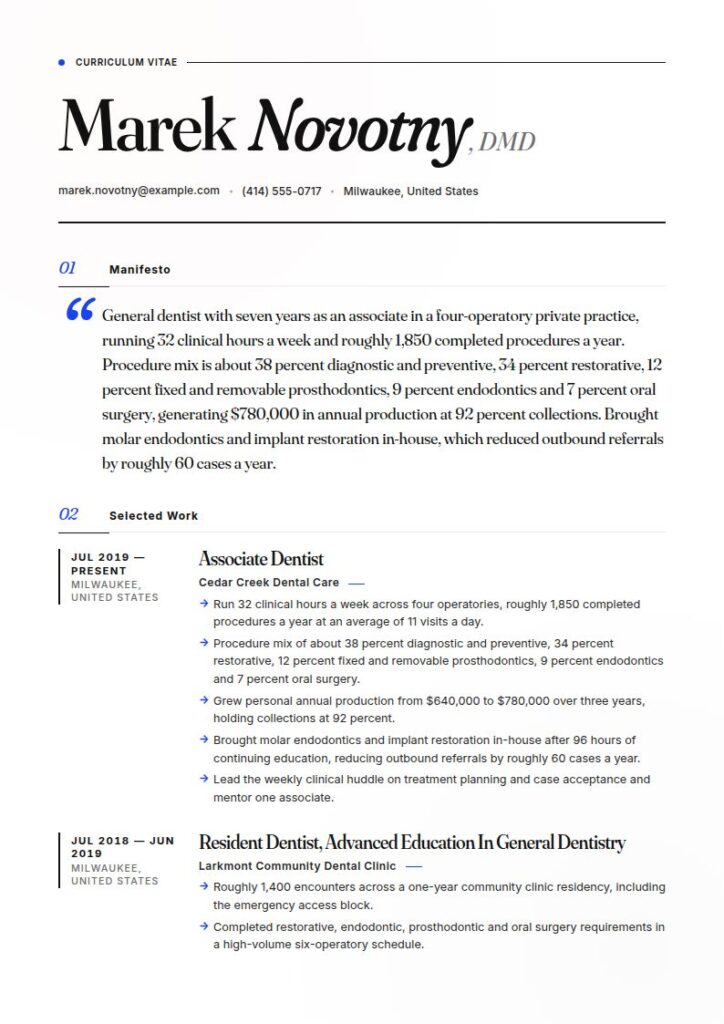
General dentist with seven years as an associate in a four-operatory private practice, running 32 clinical hours a week and roughly 1,850 completed procedures a year. Procedure mix is about 38 percent diagnostic and preventive, 34 percent restorative, 12 percent fixed and removable prosthodontics, 9 percent endodontics and 7 percent oral surgery, generating $780,000 in annual production at 92 percent collections. Brought molar endodontics and implant restoration in-house, which reduced outbound referrals by roughly 60 cases a year.
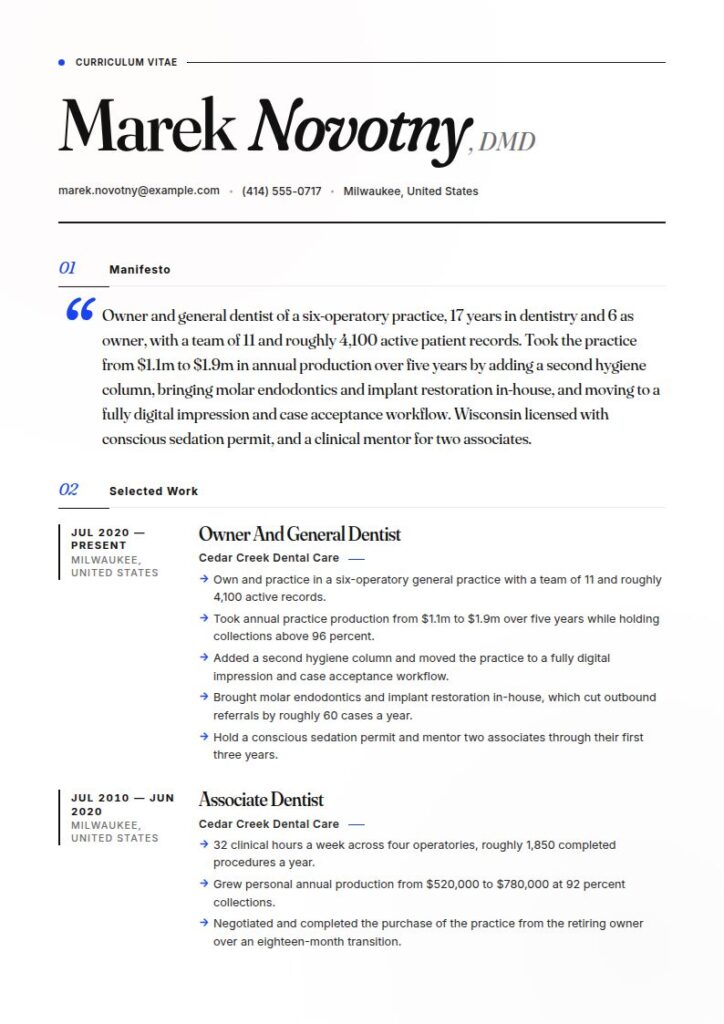
Owner and general dentist of a six-operatory practice, 17 years in dentistry and 6 as owner, with a team of 11 and roughly 4,100 active patient records. Took the practice from $1.1m to $1.9m in annual production over five years by adding a second hygiene column, bringing molar endodontics and implant restoration in-house, and moving to a fully digital impression and case acceptance workflow. Wisconsin licensed with conscious sedation permit, and a clinical mentor for two associates.
Right vs wrong: the same dentist summary, twice
| ✅ Right | ❌ Wrong |
|---|---|
| General dentist, seven years as an associate in a four-operatory private practice. | Caring dentist committed to excellent patient outcomes. |
| 32 clinical hours a week, roughly 1,850 completed procedures a year. | Experienced in a wide range of general dentistry procedures. |
| $780,000 in annual production at 92 percent collections. | Proven track record of building strong patient relationships. |
For example, an owner can model the right column against an overhead figure. By contrast, the left column is the sentence in every associate application an owner has ever opened.
Outline your clinical experience
Practice, city, operatory count, dates, then three to five bullets. In short, numbers in all of them, patients in none of them.
| Instead of | Use |
|---|---|
| Performed a full range of general dentistry procedures | Completed roughly 1,850 procedures a year across a 38/34/12/9/7 diagnostic, restorative, prosthodontic, endodontic and surgical mix |
| Provided excellent care to a diverse patient population | Roughly 2,100 patient encounters a year in a community clinic serving 14 languages through interpreter services |
| Contributed to practice growth | Took annual production from $640,000 to $780,000 over three years at 92 percent collections |
| Reduced referrals out of the practice | Brought molar endodontics and implant restoration in-house, cutting outbound referrals by roughly 60 cases a year |
| Treated a complex full-mouth rehabilitation case | Delete this line and write the volume, the mix or the production instead |
In fact, the final row is the rule in practice. A line that only works as a story about one person cannot go on a resume, however good the dentistry was.
Associate Dentist, Cedar Creek Dental Care, Milwaukee, WI, July 2019 to Present
Run 32 clinical hours a week across four operatories, roughly 1,850 completed procedures a year at an average of 11 patient visits a day.
Procedure mix of about 38 percent diagnostic and preventive, 34 percent restorative, 12 percent fixed and removable prosthodontics, 9 percent endodontics and 7 percent oral surgery.
Grew personal annual production from $640,000 to $780,000 over three years, holding collections at 92 percent.
Brought molar endodontics and implant restoration in-house after 96 hours of continuing education, reducing outbound referrals by roughly 60 cases a year.
Mentor one associate and lead the weekly clinical huddle on treatment planning and case acceptance.
Put your procedure mix, chair time and production on the page
Meanwhile, this is the block dentists leave out and owners are looking for. In other words, a dental resume that lists duties is asking the reader to judge it on adjectives. A dental resume that gives a mix, a chair-time figure and a production figure is asking to be evaluated on arithmetic, which is what the reader was going to do anyway.
Specifically, three numbers, and they answer three different questions.
Procedure mix answers what stays in-house. Give it as percentages of completed procedures across the categories your practice actually codes: diagnostic and preventive, restorative, endodontics, fixed and removable prosthodontics, oral surgery, periodontics, implant restoration, clear aligner or orthodontic cases. An owner reads that column to see which referrals stop leaving the building.
Chair time answers what you cost. Clinical hours a week, operatories, and average visits a day. An associate who runs 32 clinical hours across four operatories is a different staffing model from one who runs 24 across two.
Production and collections answer what you generate. Annual production, the collections percentage, and the period. If no one has given you your production number, ask for it before you leave a practice; it is your own figure and every interviewer afterwards will ask for it.
Write the numbers you are comfortable defending, and no others
Production is verified in the interview, sometimes in detail, and an inflated figure is the fastest way to end a process. Give a figure you can source to a report you have seen, and name the period it covers.
If you genuinely do not have production data, which is common in community health, government and hospital dentistry, use the volume figures those settings do keep: patient encounters a year, procedures completed, chair-time utilization, or the share of your schedule that was emergency access. Those are real numbers and a reader can work with them.
If you are moving out of a private practice into a public health or hospital role, the direction reverses: lead with encounters, access and the populations the program serves, and keep production as a single supporting line.
Most dentists are in private offices, but early-career affiliation has shifted
Offices of dentists account for 78 percent of dentist employment, with 12 percent self-employed, 2 percent in government, 2 percent in outpatient care centers and 2 percent in offices of physicians (BLS Occupational Outlook Handbook, Dentists, published 27 August 2026).
Inside that, where new dentists start has moved. Analyzing roughly 200,000 practicing US dentists, the ADA Health Policy Institute found that in 2024 more than one in four dentists up to ten years out of dental school were affiliated with a dental service organization, a markedly higher share than among older practitioners (ADA Health Policy Institute, reported 17 November 2025).
That changes what your resume has to carry. A DSO-affiliated group reads production, procedure mix, schedule utilization and case acceptance, because those are the fields in the system. A solo owner reads the same numbers plus the ones a spreadsheet does not hold: whether you will stay, whether the hygiene team will work with you, and whether you can eventually buy in.
Build a snapshot of your key skills
For skills, list ten to fourteen entries in three groups. Procedures first, then technology, then the practice side.
Clinical: Direct and indirect restorations, Crown and bridge, Molar and anterior endodontics, Fixed and removable prosthodontics, Simple and surgical extractions, Implant restoration, Clear aligner case management
Technology: Digital intraoral scanning, CBCT interpretation, Digital radiography, Chairside milling workflow, Practice management software
Practice: Treatment planning and case presentation, Case acceptance and financial options, Recall and hygiene scheduling, Insurance coding and claim accuracy, Infection control and OSHA compliance, Team huddles and clinical mentoring
Leave out kindness, gentleness and rapport. After all, every dental resume claims them, nobody can evidence them on paper, and they are what the working interview is for.
List your education, licensure and continuing education
License first, then the degree, then dated continuing education with hours.
Licensure: Wisconsin dental license #WI-DEN-14032, active through 2027. DEA registration active. Conscious sedation permit held. Integrated National Board Dental Examination passed 2018.
Doctor of Dental Medicine, Riverwatch University School of Dental Medicine, Milwaukee, WI, 2014 to 2018.
Advanced Education in General Dentistry residency, Larkmont Community Dental Clinic, Milwaukee, WI, 2018 to 2019.
Continuing education: Molar endodontics, 48 hours, 2021. Implant restoration and surgical placement protocols, 48 hours, 2022. Digital workflow and chairside milling, 24 hours, 2024. Infection control and Wisconsin jurisprudence, current cycle.
DDS or DMD: write the one your school awarded and move on
The American Dental Association is explicit on this. The DDS, Doctor of Dental Surgery, and the DMD, Doctor of Dental Medicine, "are the same degrees," and "both degrees use the same curriculum requirements." Which one you hold depends on the school you attended, not on what you studied or what you can do (American Dental Association, MouthHealthy, retrieved 16 September 2026).
Nobody hiring you will think otherwise, so do not explain it on the resume, do not write both, and do not add an equivalence note. Write the letters your school awarded after your name and leave the space for something a reader cannot already assume.
What is worth a line is accreditation and examination: your degree came from a program accredited by the Commission on Dental Accreditation, which has been recognized by the US Department of Education as the sole accrediting agency for dental education since 1952 and accredits more than 1,400 programs (CODA, retrieved 16 September 2026). The Integrated National Board Dental Examination, administered by the Joint Commission on National Dental Examinations, "is accepted in all U.S. states and territories as fulfilling all or part of the written examination requirements for licensure" (JCNDE, retrieved 16 September 2026). Licensure is still state by state, so list every state you hold.
Choose the right layout and design
For layout, use a single column, 11 or 12 point, clear headings, no photograph, no clinical imagery of any kind. Group practices and dental service organizations parse before a human reads, and a two-column template with a portrait is where that parsing breaks.
Lead with license state, number and status. Give procedure mix as percentages. Give chair time as clinical hours, operatories and visits a day. Give annual production with the collections rate and the period. Date every continuing education course with its hours. Say which procedures you want to add, because an owner hears that as a retention plan.
Do not put a patient, a case or a clinical photograph on the resume, de-identified or not. Do not write DDS and DMD together or explain the difference. Do not list undated continuing education. Do not claim a procedure you have performed twice. Do not inflate a production figure you cannot source to a report.
Dentist job market and outlook
Overall, it is a small, growing occupation with a narrow opening count, which makes fit and retention the whole conversation.
| Measure | Value |
|---|---|
| Dentist jobs, 2025 | 161,400 |
| Projected change, 2025-35 | 6% (faster than average), +9,000 |
| Projected annual openings | ~4,800 |
| Typical entry-level education | Doctoral or professional degree |
| Median annual wage, May 2025 | $176,110 |
Source: U.S. Bureau of Labor Statistics, Occupational Outlook Handbook, Dentists, 2025-35 projections and May 2025 wage data, published 27 August 2026.
Where the jobs sit:
| Setting | Share of employment | Median annual wage (May 2025) |
|---|---|---|
| Offices of dentists | 78% | $173,760 |
| Self-employed workers | 12% | Not published |
| Government | 2% | $219,750 |
| Outpatient care centers | 2% | $195,330 |
| Offices of physicians | 2% | $172,980 |
Source: U.S. Bureau of Labor Statistics, Occupational Outlook Handbook, Dentists, May 2025.
For example, general dentistry is the overwhelming majority of the occupation: of 161,400 dentist jobs in 2025, 141,900 were general dentists, with 7,100 orthodontists, 5,800 other specialists, 5,600 oral and maxillofacial surgeons and 1,000 prosthodontists (BLS, 2025). Similarly, the ADA Health Policy Institute counts 205,088 professionally active dentists in 2025, 60.0 per 100,000 population, 39.4 percent of them women (ADA Health Policy Institute, The U.S. Dentist Workforce, 2025 update).
What salary you can expect as a dentist
On pay, the median annual wage for dentists was $176,110 as of May 2025, or $84.67 an hour. The lowest 10 percent earned less than $89,100 and the highest 10 percent more than $337,210 (BLS Occupational Outlook Handbook, May 2025 wage data, published 27 August 2026).
In practice, specialty explains most of the top of that range. For example, oral and maxillofacial surgeons had a median of $352,220, prosthodontists $311,180 and orthodontists $289,140, against $170,950 for general dentists (BLS, May 2025). By industry, government dentistry paid a median of $219,750 and outpatient care centers $195,330, both above offices of dentists at $173,760 (BLS, May 2025), which is worth knowing if you assumed private practice always pays more.
As a result, what a resume moves is the associate offer and the buy-in conversation. Procedure mix decides how much production stays in the building, chair time decides how the schedule is built around you, and a collections figure decides whether an owner is negotiating on a percentage or on a guaranteed base. Those three numbers are the ones you either put on the page or spend the first interview reconstructing from memory.
Key takeaways for a dentist resume
- First, never put a patient, a case or a clinical photograph on the resume.
- Lead with state license number and status, then DEA and any sedation permit.
- Then give procedure mix as percentages of completed procedures.
- Give chair time as clinical hours, operatories and visits a day.
- Also, give annual production with the collections rate and the period it covers.
- In addition, write DDS or DMD, whichever your school awarded, and never explain the difference.
- Finally, date every continuing education course and give its hours.
Build your dentist resume in 15 minutes with our AI resume builder.
Related medical resume examples
- Dental hygienist resume
- Dental assistant resume
- Endodontist resume
- Dental receptionist resume
- Doctor resume
- Physician resume
- Optometrist resume
- Pharmacist resume
- Veterinarian resume
- Medical office manager resume
- Surgical tech resume
- Healthcare resume
Pair it with a matching dentist cover letter.
Dentist resume questions, answered
How long should a dentist resume be?
One page for your first three years. Two once you have owned a practice, led a team or built a procedure mix worth listing in detail. An owner reading associate applications between columns will not get to a third page.
Should I put my production numbers on a dentist resume?
Yes, if you have them and can defend them. Give annual production, the collections percentage and the period. If you have never been given your production figure, ask for it before you leave a practice, because every interview after that will ask. In community health, government or hospital dentistry, use encounters, procedures completed and access measures instead.
Is a DDS better than a DMD?
No. The ADA states that the two "are the same degrees" and that "both degrees use the same curriculum requirements"; which one you hold depends on the school (American Dental Association, MouthHealthy, retrieved 16 September 2026). Write the letters your school awarded and spend the line on something else.
Can I include before and after photographs of my work?
Not on the resume. Clinical imagery carries a consent trail that a resume cannot show, and a hiring practice has no way to verify it. If a portfolio is genuinely expected for the role, keep it as a separate document with its own documented consent, and never attach it to an application that did not ask.
What do I put on a dentist resume as a new graduate?
Your residency or final clinical year written as a job: the setting, the operatory count, encounters or procedures completed, the procedure categories you worked in, and what you did under supervision rather than independently. Then license status with its date, INBDE, DEA, and the procedures you want structured mentorship in. Owners hire new graduates on trajectory, so naming what you want to add is useful rather than a weakness.
How do I write continuing education on a dentist resume?
Dated, with hours, and grouped by what it let you do. "Molar endodontics, 48 hours, 2021" followed by a bullet showing referrals falling is a complete argument. An undated list of course titles is filler, and continuing education is a license requirement for the rest of your career, so a reader assumes you have some.