Camille Arceneaux OD
Fourth-Year Clinical Extern
[email protected] | (225) 555-0733 | Baton Rouge, United States
Profile
Doctor of Optometry licensed in Louisiana, graduated 2026, with NBEO Part I ABS, Part II PAM and Part III PEPS completed and therapeutic certification held. Fourth-year rotations covered a hospital eye clinic, a community health center and a private practice, roughly 1,900 encounters across the year with about 30 percent medical eye care. Independently operate slit lamp biomicroscopy, Goldmann applanation tonometry, binocular indirect ophthalmoscopy, optical coherence tomography and threshold visual fields. Seeking a full scope primary care optometry position with structured mentorship in specialty contact lens fitting.
Work Experience
08/2025 - 05/2026, Fourth-Year Clinical Extern, Midland Plains College of Optometry, Baton Rouge, United States
- Three rotation blocks across a hospital eye clinic, a community health center and a private practice, roughly 1,900 encounters over the year.
- About 30 percent of encounters medical rather than refractive, including glaucoma monitoring, diabetic eye examination and dry eye management.
- Operated slit lamp biomicroscopy, Goldmann applanation tonometry, binocular indirect ophthalmoscopy, optical coherence tomography and threshold visual fields independently.
- Assisted with cataract and refractive surgery co-management visits in the private practice block.
06/2021 - 07/2022, Optometric Technician, Clearspan Optical, Baton Rouge, United States
- Ran pretesting for two exam lanes in a retail optical setting: autorefraction, non-contact tonometry, fundus photography and lensometry.
- Handled optical dispensing, frame selection and insurance verification for roughly 30 patient visits a day.
Education
08/2022 - 05/2026, Doctor of Optometry, Optometry, Midland Plains College of Optometry, Baton Rouge, United States
Four-year OD program with academic coursework and supervised clinical experience. Fourth-year rotations in a hospital eye clinic, a community health center and a private practice.
08/2018 - 05/2022, Bachelor of Science, Biological Sciences, Midland Plains University, Baton Rouge, United States
Prerequisite coursework in chemistry, physics and calculus.
Skills
Comprehensive examination and refraction, 85
Dilated fundus examination, 85
Slit lamp biomicroscopy, 85
Goldmann applanation tonometry, 85
Binocular indirect ophthalmoscopy, 80
Optical coherence tomography, 80
Threshold and automated visual fields, 80
Gonioscopy, 70
Contact lens fitting, 75
Electronic health records for eye care, 80
Languages
English, native
French, intermediate
Spanish, beginner
Certificates
06/2026, Optometry License, State of Louisiana, Louisiana State Board of Optometry Examiners, LA-OD-3391
Active. Therapeutic certification held.
04/2026, NBEO Part I ABS, Part II PAM and Part III PEPS, National Board of Examiners in Optometry
Applied Basic Science, Patient Assessment and Management, and Patient Encounters and Performance Skills, all completed.
01/2026, Basic Life Support for Healthcare Providers, American Heart Association
Current through 2028.
Summary
An optometrist resume is a one to two page document naming your state license, the scope of practice you actually worked in, the setting and its volume, and the equipment you operate. This guide gives you three adaptable versions, the scope statement that most applicants leave out, and current Bureau of Labor Statistics pay and outlook for optometrists.
Optometrist resume examples by experience level
An optometrist resume is a one to two page document that names your state license, the scope of practice you actually worked in, the setting you worked in, the volume it ran at, and the equipment you operate.
Scope is the part that makes this occupation different. Two optometrists with the same OD degree, the same board examinations and the same ten years of experience can have practiced meaningfully different jobs, because what a doctor of optometry is authorized to do is set state by state. A resume that does not say which version of the job you did leaves the reader guessing, and readers who guess guess low.
One rule sits above the rest of this page.
No patient belongs on an optometrist resume
No name, no initials, no age, no diagnosis, no case, no retinal image, no anterior segment photograph, no described finding on a described person. Not a de-identified case either: the reader cannot confirm the de-identification, and ocular imaging is identifiable data.
Describe your clinical work by type, volume, setting, procedure and equipment instead: "roughly 3,600 encounters a year in a community health center, about 22 percent diabetic eye examinations," not a story about a person.
This is a HIPAA problem before it is a taste problem, and optometry attracts it because imaging is how the profession shows work to itself. A lecture deck, a case report and a resume have different consent requirements, and only two of those three can carry an image.
Resume guide for an optometrist resume
This guide and the corresponding optometrist resume example will cover:
- How to write an optometrist resume, section by section
- Why a scope of practice statement belongs on the page and where to put it
- Three adaptable summaries: new graduate, practicing OD and clinical director
- The retail, private practice and clinic split, and how each one hires
- What the optometrist job market looks like and what you can expect to earn
How to write an optometrist resume
Six blocks: contact header, summary, licensure and scope, clinical experience, equipment and procedures, then education and continuing education. One page for your first three years, two after that.
Licensure and scope sit together directly under the summary, because they are one question with two halves. All states require optometrists to be licensed, and licensure requires an OD degree from an accredited optometry school and completion of a qualifying examination sequence (BLS Occupational Outlook Handbook, Optometrists, published 27 August 2026).
| Block | The question it answers | Where it goes |
|---|---|---|
| License and scope | What is this OD authorized to do, and where? | Directly under the summary |
| Clinical experience | What setting, what volume, what share medical? | Reverse chronological, with numbers |
| Equipment and procedures | What can they walk in and run on day one? | Its own block |
| Continuing education | What has been added, and is the license current? | Dated, with hours and COPE credit |
Run the finished file through the ATS resume checker first. Retail chains, health systems and large group practices parse before a human reads.
Choosing the best resume format for an optometrist resume
Reverse chronological. The reader is reconstructing three things from the timeline: which states you were licensed in and when, which settings you worked in, and whether your medical share has grown. A functional format hides all three.
If you moved states, date the move and date each license. An OD who practiced under one scope for six years and another for four has a career worth explaining in two lines, and it explains itself badly if the dates are missing.
Include your contact information
| ✅ Right | ❌ Wrong |
|---|---|
| Camille Arceneaux, OD | Dr. Camille Arceneaux |
| Optometrist, Louisiana #LA-OD-3391 and Mississippi #MS-OD-2207 | Licensed optometrist |
| Therapeutic certification held; NBEO ISE and LSPE completed | Experienced in comprehensive eye care |
| (225) 555-0733, [email protected], Baton Rouge, LA | (225) 555-0733, [email protected] |
List every state license with its number and status. Optometry is licensed state by state, so a reader in a different state is working out both whether you can be credentialed and what you have been authorized to do, and the two answers may not be the same.
Make use of a summary
Four lines: license and scope, years in practice, the setting and its volume, and one number or one thing you built.
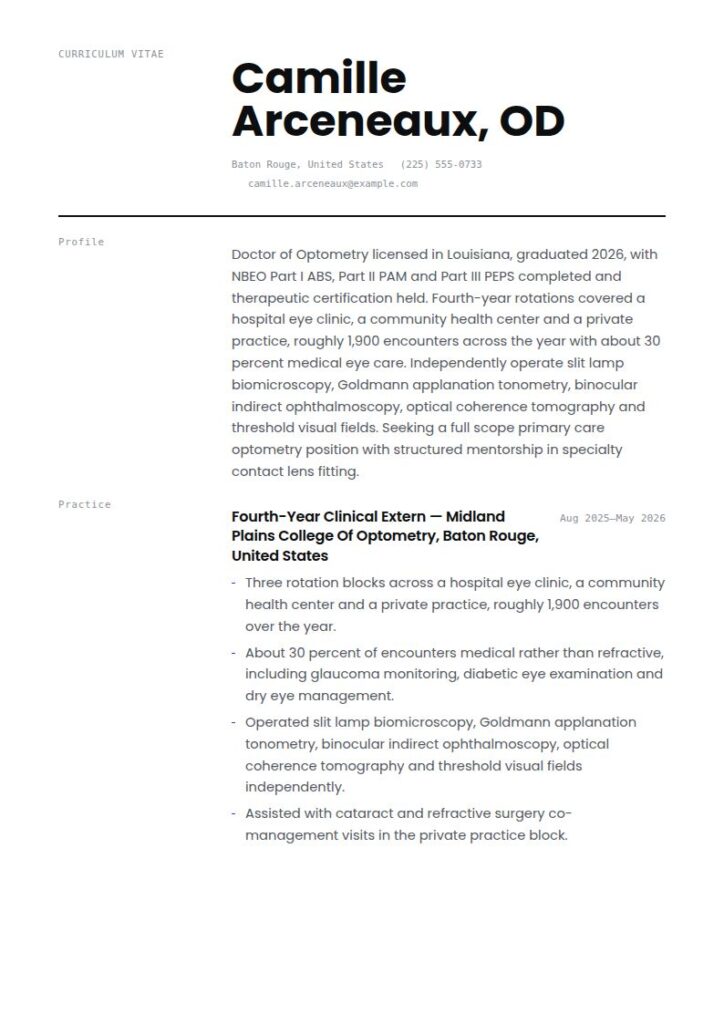
Doctor of Optometry licensed in Louisiana, graduated 2026, with NBEO Part I ABS, Part II PAM and Part III PEPS completed and therapeutic certification held. Fourth-year rotations covered a hospital eye clinic, a community health center and a private practice, roughly 1,900 encounters across the year with about 30 percent medical eye care. Independently operate slit lamp biomicroscopy, Goldmann applanation tonometry, binocular indirect ophthalmoscopy, optical coherence tomography and threshold visual fields. Seeking a full scope primary care optometry position with structured mentorship in specialty contact lens fitting.
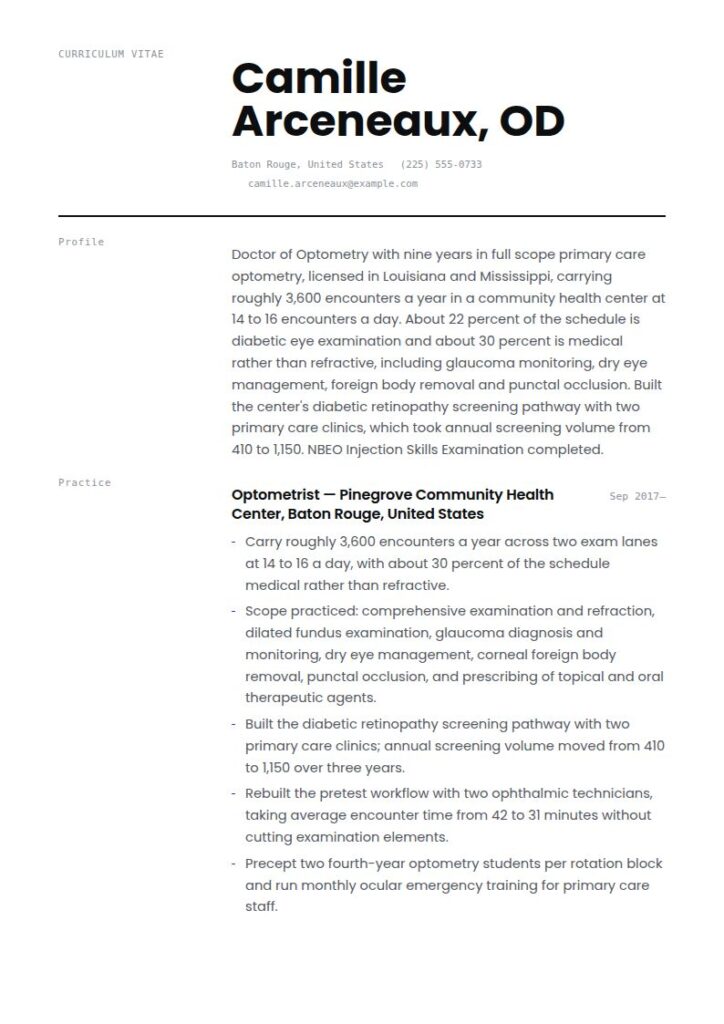
Doctor of Optometry with nine years in full scope primary care optometry, licensed in Louisiana and Mississippi, carrying roughly 3,600 encounters a year in a community health center at 14 to 16 encounters a day. About 22 percent of the schedule is diabetic eye examination and about 30 percent is medical rather than refractive, including glaucoma monitoring, dry eye management, foreign body removal and punctal occlusion. Built the center's diabetic retinopathy screening pathway with two primary care clinics, which took annual screening volume from 410 to 1,150. NBEO Injection Skills Examination completed.
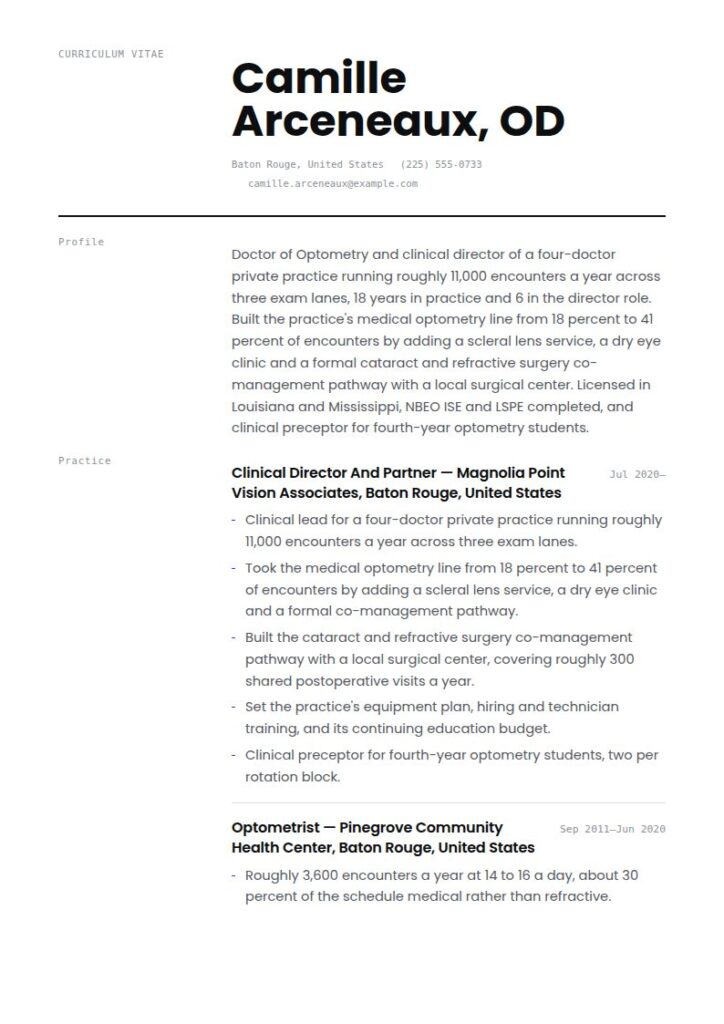
Doctor of Optometry and clinical director of a four-doctor private practice running roughly 11,000 encounters a year across three exam lanes, 18 years in practice and 6 in the director role. Built the practice's medical optometry line from 18 percent to 41 percent of encounters by adding a scleral lens service, a dry eye clinic and a formal cataract and refractive surgery co-management pathway with a local surgical center. Licensed in Louisiana and Mississippi, NBEO ISE and LSPE completed, and clinical preceptor for fourth-year optometry students.
Right vs wrong: the same optometrist summary, twice
| ✅ Right | ❌ Wrong |
|---|---|
| Nine years in full scope primary care optometry, licensed in Louisiana and Mississippi. | Dedicated optometrist passionate about preserving vision. |
| Roughly 3,600 encounters a year, 22 percent diabetic eye examination, 30 percent medical. | Experienced in comprehensive eye examinations and contact lens fitting. |
| Built a diabetic retinopathy screening pathway that took annual volume from 410 to 1,150. | Committed to delivering the highest standard of eye care. |
The right column tells a practice which lanes you can run and what share of your schedule bills as medical. The left column is the summary on almost every optometry resume ever submitted.
Outline your clinical experience
Employer, city, setting type, dates, then three to five bullets. Volume in all of them, patients in none.
| Instead of | Use |
|---|---|
| Performed comprehensive eye examinations | Roughly 3,600 encounters a year at 14 to 16 a day across two exam lanes |
| Diagnosed and managed a variety of ocular conditions | About 30 percent of the schedule medical rather than refractive: glaucoma monitoring, dry eye management, foreign body removal, punctal occlusion |
| Worked with a diverse patient population | Community health center serving 11 languages through interpreter services, 64 percent of encounters covered by public insurance |
| Improved clinic efficiency | Rebuilt the pretest workflow with two technicians, which took average encounter time from 42 to 31 minutes |
| Managed an unusual retinal case | Delete this line and write the volume, the condition category or the pathway you built |
That last row is the rule stated as a sentence. If a bullet only makes sense as a story about one person, it cannot go on a resume, however good the clinical work was.
Optometrist, Pinegrove Community Health Center, Baton Rouge, LA, September 2017 to Present
Carry roughly 3,600 encounters a year across two exam lanes at 14 to 16 a day, with about 30 percent of the schedule medical rather than refractive.
Scope practiced: comprehensive examination and refraction, dilated fundus examination, glaucoma diagnosis and monitoring, dry eye management, corneal foreign body removal, punctal occlusion, and prescribing of topical and oral therapeutic agents under Louisiana licensure.
Built the diabetic retinopathy screening pathway with two primary care clinics; annual screening volume moved from 410 to 1,150 over three years.
Rebuilt the pretest workflow with two ophthalmic technicians, taking average encounter time from 42 to 31 minutes without cutting examination elements.
Precept two fourth-year optometry students per rotation block and run the center's monthly ocular emergency training for primary care staff.
State the scope of practice you actually worked in
This is the block most optometry resumes are missing, and it is the one that stops a reader guessing.
What a doctor of optometry may do is set by each state, and the differences are not cosmetic. Dilation, therapeutic pharmaceutical agents, oral medications, injections, minor lid procedures and, in a growing number of states, ophthalmic laser procedures all sit on different sides of the line depending on where you are licensed. As of June 2026, Vermont became the seventeenth state to authorize doctors of optometry to perform ophthalmic laser procedures, the third state to expand scope that year after Kansas and Tennessee (American Optometric Association, 25 June 2026).
So a hiring practice reading "experienced optometrist" learns almost nothing. Write the scope instead, in three separate lines, because they answer three different questions.
Authorized under current licensure: comprehensive examination and refraction, dilated fundus examination, diagnostic and therapeutic pharmaceutical agents, oral therapeutic agents, glaucoma diagnosis and management, foreign body removal, punctal occlusion, minor lid procedures.
Performed routinely in practice: glaucoma monitoring and management, diabetic eye examination, dry eye management including punctal occlusion, corneal foreign body removal, scleral and specialty contact lens fitting, cataract and refractive surgery co-management.
Credentialed but not yet performed under current licensure: injections, NBEO Injection Skills Examination completed 2021. Laser and surgical procedures, NBEO Laser and Surgical Procedures Examination completed 2024.
The third line is the one that takes discipline. If you passed the examination but your state has not authorized the procedure, or your employer has not credentialed you for it, say so plainly. A practice in a broader scope state reads that line as a candidate who can be brought up quickly. A practice that discovers the gap after an offer reads it as something else.
Write the scope you practiced, not the scope your license allows
These are different claims and both belong on the page, separated. An OD licensed in a broad scope state who spent nine years in a retail setting doing mostly refraction and contact lens work should not present as a full medical practice.
Give the authorized list, then the routinely performed list, then the honest gap. A reader who has hired optometrists before is going to establish all three in the interview anyway, and the candidate who wrote them down looks like the candidate who keeps good records.
The same discipline applies when you move. If you are licensed in two states with different scope, say which scope each line was practiced under. That is one extra clause per bullet and it removes the single largest ambiguity in an optometry resume.
Build a snapshot of your key skills
Ten to fourteen entries in three groups. Equipment is the group most resumes underwrite.
Clinical: Comprehensive examination and refraction, Glaucoma diagnosis and management, Diabetic eye examination, Dry eye and ocular surface management, Cataract and refractive surgery co-management, Myopia management, Pediatric vision assessment
Equipment: Slit lamp biomicroscopy, Goldmann applanation tonometry, Binocular indirect ophthalmoscopy, Optical coherence tomography, Threshold and automated visual fields, Fundus photography, Corneal topography, Gonioscopy, Pachymetry, B-scan ultrasonography
Specialty and practice: Scleral and specialty contact lens fitting, Orthokeratology, Low vision assessment, Electronic health records and optical dispensing systems, Medical billing and coding for eye care
Leave out thoroughness, attention to detail and communication. They cannot be evidenced on paper and they appear on every competing file.
List your education, licensure and continuing education
License and scope first, then examinations, then the degree, then dated continuing education.
Licensure: Louisiana #LA-OD-3391, active through 2027, therapeutic certification held. Mississippi #MS-OD-2207, active through 2027.
Examinations: National Board of Examiners in Optometry Part I Applied Basic Science, Part II Patient Assessment and Management, Part III Patient Encounters and Performance Skills, all completed 2017. Injection Skills Examination completed 2021. Laser and Surgical Procedures Examination completed 2024.
Doctor of Optometry, Midland Plains College of Optometry, 2013 to 2017. Fourth-year rotations in a hospital eye clinic, a community health center and a private practice.
Continuing education: Glaucoma management update, 12 COPE credits, 2024. Scleral lens fitting, 16 COPE credits, 2023. Ocular disease and systemic comorbidity, 14 COPE credits, 2025. Louisiana jurisprudence, current cycle.
Write continuing education with hours, year and COPE credit. The Council on Optometric Practitioner Education, run by the Association of Regulatory Boards of Optometry, is the accreditation program member boards use for optometric continuing education, and ARBO's OE TRACKER holds the attendance record and transcript behind it (ARBO, retrieved 16 September 2026). Requirements differ by state, which is exactly why a dated, credited list is more useful than a list of course titles.
Choose the right layout and design
Single column, 11 or 12 point, clear headings, no photograph, no clinical imaging of any kind. Retail chains and health systems parse before a person reads, and a two-column template with an image is where that breaks.
List every state license with its number and status. Give the authorized scope, the routinely performed scope and the honest gap between them as three separate lines. Give encounters a year and encounters a day. Give the medical share of your schedule as a percentage. Name the equipment you operate independently. Date continuing education with hours and COPE credit.
Do not put a patient, a case or a retinal or anterior segment image on the resume. Do not write "full scope" without listing what that means in your state. Do not imply you have performed a procedure you are only credentialed for. Do not leave your license number off. Do not describe yourself as passionate about vision.
Optometrist job market and outlook
A small occupation growing much faster than average, with a small absolute opening count and demand concentrated in medical eye care.
| Measure | Value |
|---|---|
| Optometrist jobs, 2025 | 45,100 |
| Projected change, 2025-35 | 10% (much faster than average), +4,300 |
| Projected annual openings | ~2,000 |
| Typical entry-level education | Doctoral or professional degree |
| On-the-job training | None |
| Median annual wage, May 2025 | $136,570 |
Source: U.S. Bureau of Labor Statistics, Occupational Outlook Handbook, Optometrists, 2025-35 projections and May 2025 wage data, published 27 August 2026.
The Handbook attributes the growth to an aging population, higher rates of cataract and macular degeneration, rising myopia, use of electronic devices, and diabetic retinopathy from rising rates of diabetes (BLS, published 27 August 2026). Four of those five are medical eye care, which is the argument for writing your medical share on the page.
Three settings, three different jobs, three different medians
Optometrist employment splits across settings that hire on different criteria: offices of optometrists 61 percent, offices of physicians 14 percent, retail trade 13 percent, self-employed 5 percent and outpatient care centers 4 percent (BLS Occupational Outlook Handbook, Optometrists, published 27 August 2026).
The medians run in an order that surprises people. Outpatient care centers paid a median of $207,030, retail trade $159,250, offices of physicians $145,630 and offices of optometrists $129,250 (BLS, May 2025).
For your resume this matters twice. First, name the setting type for every role, because "Optometrist, 2019 to 2024" reads differently depending on whether that was a retail lane, a hospital clinic or an ophthalmology practice. Second, if you are moving between settings, write the bridge: a retail OD applying to an ophthalmology practice should lead with medical share, pathology found and referred, and equipment; a hospital OD applying to retail should lead with volume, throughput and dispensing.
What salary you can expect as an optometrist
The median annual wage for optometrists was $136,570 as of May 2025, or $65.66 an hour. The lowest 10 percent earned less than $74,870 and the highest 10 percent more than $202,180 (BLS Occupational Outlook Handbook, May 2025 wage data, published 27 August 2026).
Most of that range is setting and scope rather than seniority. Outpatient care centers had a median of $207,030 against $129,250 in offices of optometrists (BLS, May 2025), which is a gap of more than $77,000 between two settings that both employ optometrists doing recognizably the same profession.
What a resume can move is which of those doors is open to you. The scope you can evidence decides whether an ophthalmology practice or a hospital clinic will consider you. The equipment list decides whether you need a training period. The medical share of your schedule decides whether a practice sees you as a refraction lane or as a clinician who generates medical billing. Those three lines are worth more than any adjective you could put in a summary.
Key takeaways for an optometrist resume
- Never put a patient, a case or an ocular image on the resume.
- List every state license with its number and status; optometry is licensed state by state.
- Give the scope you are authorized for and the scope you actually practiced as separate lines.
- Say plainly where you are credentialed but have not yet performed.
- Name the setting type for every role: retail, private practice, ophthalmology, hospital or community clinic.
- Give encounters a year, encounters a day and the medical share as a percentage.
- List the equipment you operate independently, and date continuing education with COPE credit.
Build your optometrist resume in 15 minutes with our AI resume builder.
Related medical resume examples
- Audiologist resume
- Doctor resume
- Physician resume
- Dentist resume
- Pharmacist resume
- Physician assistant resume
- Nurse practitioner resume
- Occupational therapist resume
- Physical therapist resume
- Veterinarian resume
- Sonographer resume
- Healthcare resume
Pair it with a matching optometrist cover letter.
Optometrist resume questions, answered
How long should an optometrist resume be?
One page for your first three years, two after that. The scope block, the equipment block and multiple state licenses are what push a good optometry resume onto a second page, and all three earn the space.
What is a scope of practice statement, and do I really need one?
It is two or three lines naming what your license authorizes, what you performed routinely, and where the gap is. You need it because scope varies by state: as of June 2026, seventeen states authorize doctors of optometry to perform ophthalmic laser procedures (American Optometric Association, 25 June 2026), and comparable differences exist for injections and minor lid procedures. Without the statement, a reader in another state cannot tell what job you have been doing.
Should I list the NBEO examinations on my resume?
List Part I ABS, Part II PAM and Part III PEPS once, with the year, early in your career, and drop them to a single line later. Keep the Injection Skills Examination and the Laser and Surgical Procedures Examination on the page permanently if you have them, because those are the ones that change what a practice can credential you for.
How do I show results without describing a patient or a case?
Use what the practice counts: encounters a year, encounters a day, the medical share of the schedule, screening volume, recall rates, specialty lens fits completed, referral and co-management volume, encounter time, or a pathway you built and what it did to a number. Give the before, the after and the period.
I have only worked in a retail setting. How do I apply to a medical practice?
Write the medical work you did do, because there is almost always some: pathology detected and referred, glaucoma and diabetic monitoring, foreign body removal, urgent same-day visits, and the equipment you ran. Then give your volume, which retail settings tend to produce in quantity. Retail trade is 13 percent of optometrist employment and offices of physicians 14 percent (BLS, published 27 August 2026), so the move is common enough that a hiring practice will have seen it before.
Do I put continuing education on an optometrist resume?
Yes, dated, with hours and COPE credit, grouped by what it let you do. Continuing education is a license condition for the rest of your career and requirements differ by state, so a reader assumes you have some; what tells them something is which areas you chose and whether they line up with the work you want next.