Audiologist Gunnar Lindqvist AuD, CCC-A
Audiologist
[email protected] | (507) 555-1180 | Rochester, United States
Profile
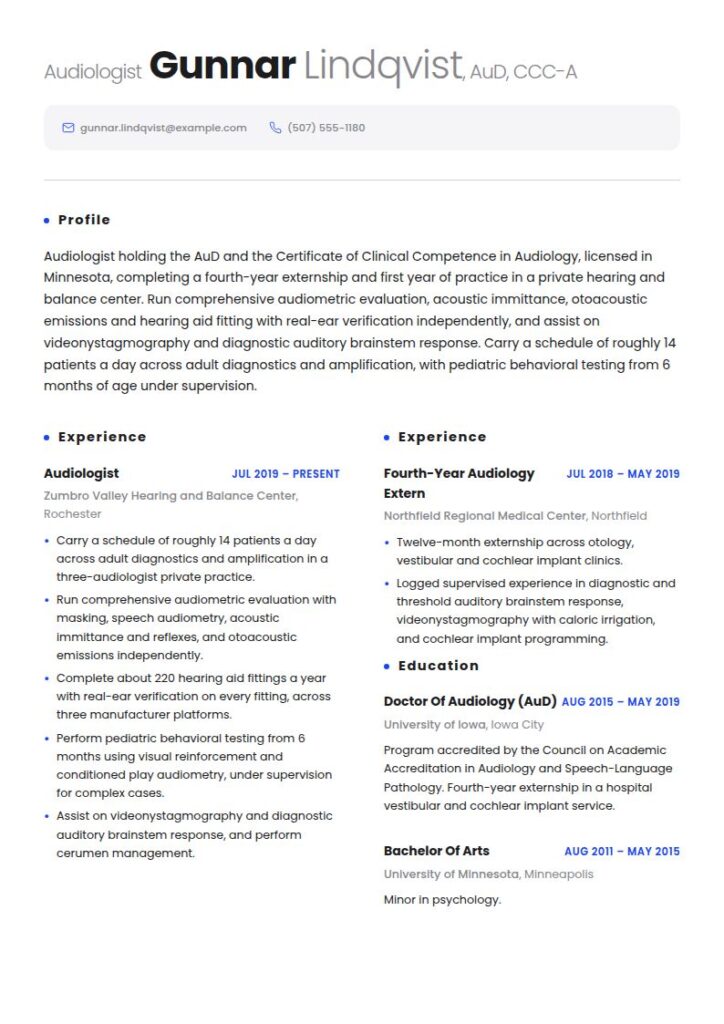
Audiologist holding the AuD and the Certificate of Clinical Competence in Audiology, licensed in Minnesota, completing a fourth-year externship and first year of practice in a private hearing and balance center. Run comprehensive audiometric evaluation, acoustic immittance, otoacoustic emissions and hearing aid fitting with real-ear verification independently, and assist on videonystagmography and diagnostic auditory brainstem response. Carry a schedule of roughly 14 patients a day across adult diagnostics and amplification, with pediatric behavioral testing from 6 months of age under supervision.
Work Experience
07/2019 - Present, Audiologist, Zumbro Valley Hearing and Balance Center, Rochester, United States
- Carry a schedule of roughly 14 patients a day across adult diagnostics and amplification in a three-audiologist private practice.
- Run comprehensive audiometric evaluation with masking, speech audiometry, acoustic immittance and reflexes, and otoacoustic emissions independently.
- Complete about 220 hearing aid fittings a year with real-ear verification on every fitting, across three manufacturer platforms.
- Perform pediatric behavioral testing from 6 months using visual reinforcement and conditioned play audiometry, under supervision for complex cases.
- Assist on videonystagmography and diagnostic auditory brainstem response, and perform cerumen management.
07/2018 - 05/2019, Fourth-Year Audiology Extern, Northfield Regional Medical Center, Northfield, United States
- Twelve-month externship across otology, vestibular and cochlear implant clinics.
- Logged supervised experience in diagnostic and threshold auditory brainstem response, videonystagmography with caloric irrigation, and cochlear implant programming.
Education
08/2015 - 05/2019, Doctor of Audiology (AuD), Audiology, University of Iowa, Iowa City, United States
Program accredited by the Council on Academic Accreditation in Audiology and Speech-Language Pathology. Fourth-year externship in a hospital vestibular and cochlear implant service.
08/2011 - 05/2015, Bachelor of Arts, Communication Sciences and Disorders, University of Minnesota, Minneapolis, United States
Minor in psychology.
Skills
Comprehensive audiometric evaluation with masking, 90
Acoustic immittance and reflexes, 90
Otoacoustic emissions, 85
Hearing aid fitting and real-ear verification, 85
Pediatric behavioral audiometry, 70
Cerumen management, 80
Counseling for new hearing loss, 80
Report writing to referring physicians, 75
Languages
English, native
Swedish, intermediate
American Sign Language, intermediate
Certificates
07/2019, Minnesota Audiology License, Minnesota Department of Health, MN-A-30417
Valid through 2028. In good standing since 2019.
08/2019, Certificate of Clinical Competence in Audiology (CCC-A), American Speech-Language-Hearing Association, ASHA-01477210
Awarded following the AuD from a CAA-accredited program, supervised clinical experience and the certification examination.
Summary
An audiologist resume is a one to two page document naming the procedures you can run independently, the populations you are cleared to run them on, and the license and certification behind both. This guide gives you three adaptable versions, the scope boundary that decides these jobs, and current Bureau of Labor Statistics pay and outlook for the occupation.
Audiologist resume examples by experience level
In summary, an audiologist resume is a one to two page document naming the procedures you can run without supervision, the patient populations your clearance covers, and the license and certification standing behind both.
In general, clinic directors hire audiologists to fill a schedule, and named procedures make up that schedule. For example, a practice that needs someone to cover VNG on Tuesdays and cochlear implant mappings on Thursdays is not reading your resume for a philosophy of patient care. Instead, it is reading it to find out whether you can cover those two columns. However, most applicants write "performed comprehensive audiological evaluations" and leave the director guessing at everything else.
Resume guide for an audiologist resume
In short, this guide and the corresponding audiologist resume example will cover:
- To begin with, how to write an audiologist resume, section by section
- Then the test battery block that most applicants leave off the page
- Also, three adaptable summaries: new graduate, practicing and clinical lead
- In addition, the scope boundary between an audiologist and a hearing aid dispenser
- Finally, what the job market looks like and what you can expect to earn
How to write an audiologist resume
Specifically, six blocks: contact header, summary, license and certification, clinical procedures and populations, clinical experience, and education. Generally, one page for your first three years, two once you have implant, vestibular or intraoperative work worth listing.
License comes before experience because it is a gate. In fact, BLS states that all states require audiologists to hold a license (BLS Occupational Outlook Handbook, 2025-35 projections), so a file that does not say which states reads as a file the credentialing office has to chase.
| Section | What it is answering | Where it goes |
|---|---|---|
| License and certification | Can this person be credentialed and billed for? | Directly under the summary |
| Procedures and populations | Which columns of my schedule does this close? | Its own block, not buried in bullets |
| Clinical experience | What did they run, how much of it, and what changed? | Reverse chronological with volumes |
| Education | AuD, and from a program accredited by whom? | Name the accreditor |
Put your state license number and your certification on the same line
Credentialing is the slowest step between an offer and a start date, and it runs on documents rather than impressions. A resume that gives the state, the license number, the expiry and the certification in one line lets a credentialing coordinator start work the day the offer goes out.
The ASHA Certificate of Clinical Competence in Audiology is the common one. Under ASHA's 2020 audiology certification standards, it requires an audiology doctoral degree from a program accredited by, or in candidacy with, the Council on Academic Accreditation, academic coursework and clinical experience meeting CAA standards, and at least 12 months of full-time supervision by a holder of the CCC-A, along with passing the certification examination (American Speech-Language-Hearing Association).
If you also hold an American Board of Audiology credential, list it separately. They are different bodies and clinic directors read them as different signals.
Run the finished file through the ATS resume checker before you submit. Hospital and health system portals parse applications into a structured record before a person opens them.
Choosing the best resume format for an audiologist resume
Above all, reverse chronological, single column, plain type, no photograph. One page until you have a second setting or a specialty caseload; two after that.
Functional formats fail here because the reader is checking continuity of clinical practice. After all, a gap in an audiology timeline is a question about currency, and a format that obscures the timeline turns a small question into a large one.
Include your contact information
| ✅ Right | ❌ Wrong |
|---|---|
| Gunnar Lindqvist, AuD, CCC-A | Gunnar Lindqvist |
| Clinical Audiologist, Vestibular and Cochlear Implant Services | Dedicated hearing care professional passionate about patient outcomes |
| Minnesota audiology license #MN-A-30417, valid through 2028 | Licensed audiologist |
| (507) 555-1180, [email protected], Rochester, MN | (507) 555-1180, [email protected] |
Four lines, four facts. Also, the license number is not vanity; it is the field a credentialing coordinator needs and cannot find anywhere else in your application.
Make use of a summary
In effect, that means four lines: your degree and certification, the setting, the procedures you run independently, and one volume or outcome with a number on it.
Audiologist holding the AuD and the Certificate of Clinical Competence in Audiology, licensed in Minnesota, completing a fourth-year externship and first year of practice in a private hearing and balance center. Run comprehensive audiometric evaluation, acoustic immittance, otoacoustic emissions and hearing aid fitting with real-ear verification independently, and assist on videonystagmography and diagnostic auditory brainstem response. Carry a schedule of roughly 14 patients a day across adult diagnostics and amplification, with pediatric behavioral testing from 6 months of age under supervision.
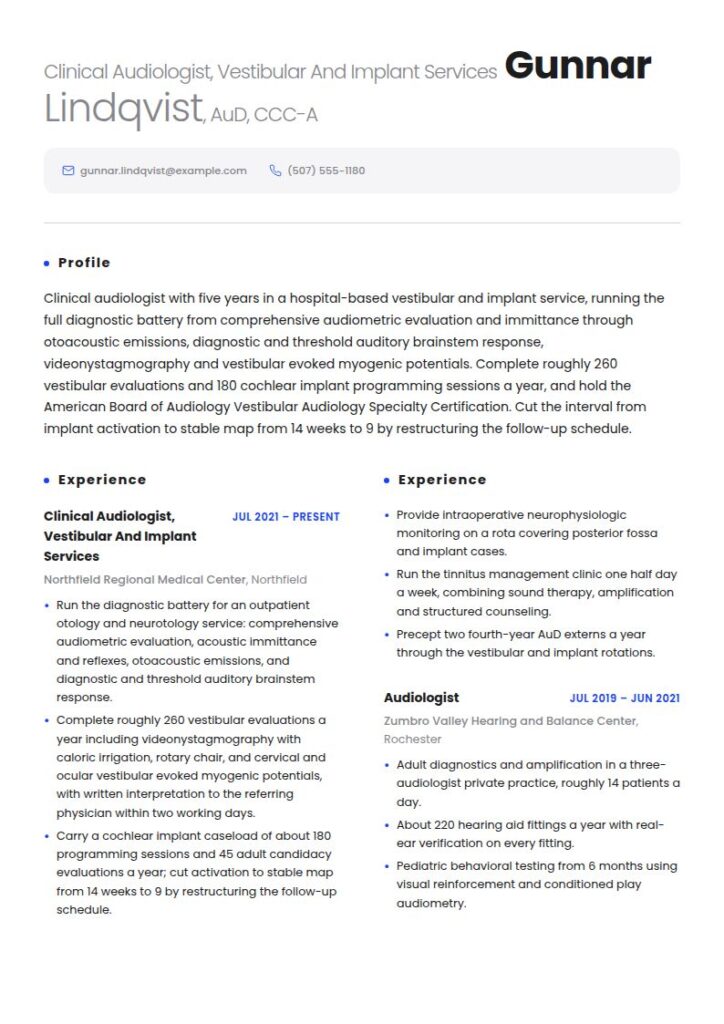
Clinical audiologist with five years in a hospital-based vestibular and implant service, running the full diagnostic battery from comprehensive audiometric evaluation and immittance through otoacoustic emissions, diagnostic and threshold auditory brainstem response, videonystagmography and vestibular evoked myogenic potentials. Complete roughly 260 vestibular evaluations and 180 cochlear implant programming sessions a year, and hold the American Board of Audiology Vestibular Audiology Specialty Certification. Cut the interval from implant activation to stable map from 14 weeks to 9 by restructuring the follow-up schedule.
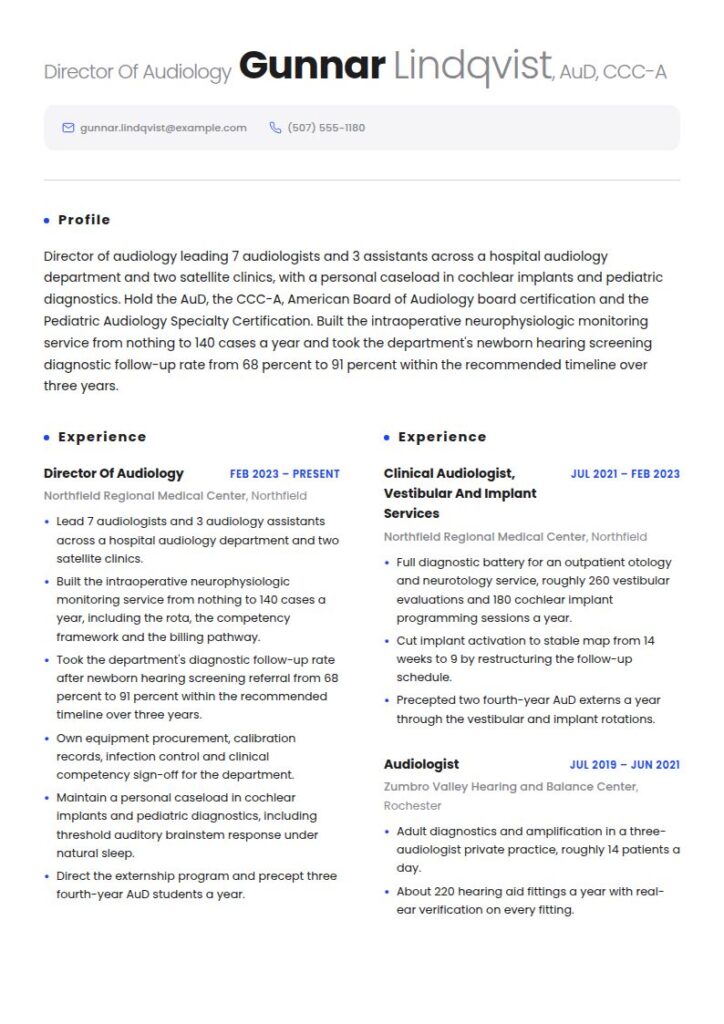
Director of audiology leading 7 audiologists and 3 assistants across a hospital audiology department and two satellite clinics, with a personal caseload in cochlear implants and pediatric diagnostics. Hold the AuD, the CCC-A, American Board of Audiology board certification and the Pediatric Audiology Specialty Certification. Built the intraoperative neurophysiologic monitoring service from nothing to 140 cases a year and took the department's newborn hearing screening diagnostic follow-up rate from 68 percent to 91 percent within the recommended timeline over three years.
Right vs wrong: the same audiologist summary, twice
| ✅ Right | ❌ Wrong |
|---|---|
| Clinical audiologist with five years in a hospital-based vestibular and implant service. | Dedicated hearing healthcare professional with a passion for improving lives. |
| Run the full battery from audiometric evaluation and immittance through ABR, VNG and VEMP. | Experienced in performing a wide range of audiological assessments. |
| Complete roughly 260 vestibular evaluations and 180 implant programming sessions a year. | Committed to providing the highest quality of patient care. |
The left column, however, is something a director can schedule. As a result, a clinic director reading it knows which rooms you can staff on Monday, and roughly how fast.
Outline your clinical experience
Employer, setting, city, dates. Then four to six bullets, each naming a procedure, a population and a number.
| Instead of | Use |
|---|---|
| Performed comprehensive audiological evaluations | Ran roughly 900 comprehensive audiometric evaluations a year across adults and children from 6 months, including masked bone conduction and speech in noise |
| Fitted hearing aids | Completed about 320 hearing aid fittings a year with real-ear verification on every fitting, across four manufacturer platforms |
| Conducted balance testing | Ran 260 vestibular evaluations a year: videonystagmography with caloric irrigation, rotary chair, cervical and ocular VEMP |
| Worked with cochlear implant patients | Completed 180 cochlear implant programming sessions a year and ran candidacy evaluations for 45 adult referrals |
| Assisted in surgery | Provided intraoperative neurophysiologic monitoring for 140 cases a year, primarily posterior fossa and cochlear implant surgery |
| Saw pediatric patients | Ran diagnostic follow-up after newborn hearing screening referral, including threshold ABR under natural sleep and visual reinforcement audiometry from 6 months |
Clinical Audiologist, Vestibular and Implant Services, Northfield Regional Medical Center, Northfield, MN, July 2021 to Present
Run the diagnostic battery for an outpatient otology and neurotology service: comprehensive audiometric evaluation, acoustic immittance and reflexes, otoacoustic emissions, diagnostic and threshold auditory brainstem response.
Complete roughly 260 vestibular evaluations a year, including videonystagmography with caloric irrigation, rotary chair, and cervical and ocular vestibular evoked myogenic potentials, with written interpretation to the referring physician within two working days.
Carry a cochlear implant caseload of about 180 programming sessions and 45 adult candidacy evaluations a year; cut activation to stable map from 14 weeks to 9 by restructuring the follow-up schedule.
Provide intraoperative neurophysiologic monitoring on a rota covering posterior fossa and implant cases.
Run the tinnitus management clinic one half day a week, combining sound therapy, hearing aid fitting and structured counseling.
Precept two fourth-year AuD externs a year through the vestibular and implant rotations.
List the test battery you can run and the populations you are cleared to run it on
Yet this is the block almost nobody includes, even though it is the block that fills a schedule.
Therefore, write it as two lists that intersect: what you can run, and who you can run it on. In fact, a clinician who can do videonystagmography on adults and a clinician who can do threshold auditory brainstem response on a sleeping six-month-old are not interchangeable, and a director staffing a pediatric diagnostic clinic needs to know which one you are.
The procedures worth naming sit inside ASHA's Scope of Practice in Audiology, which covers diagnostics, treatment, early hearing detection and intervention, educational audiology, hearing conservation and preservation, telehealth and counseling, and names comprehensive audiologic evaluation, acoustic immittance, otoacoustic emissions, auditory evoked potentials, vestibular assessment, vestibular evoked myogenic potentials, cochlear implants, intraoperative neurophysiologic monitoring, tinnitus assessment and management, hearing aid fitting and dispensing, and cerumen management (American Speech-Language-Hearing Association, Scope of Practice in Audiology, 2018).
Diagnostics: Comprehensive audiometric evaluation with masking, speech audiometry including speech in noise, acoustic immittance and acoustic reflexes, transient and distortion product otoacoustic emissions, diagnostic and threshold auditory brainstem response.
Vestibular: Videonystagmography with caloric irrigation, rotary chair, cervical and ocular vestibular evoked myogenic potentials, video head impulse testing, canalith repositioning, vestibular rehabilitation referral and follow-up.
Amplification and implants: Hearing aid selection and fitting with real-ear verification across four manufacturer platforms, bone conduction devices, cochlear implant candidacy evaluation, activation and programming, troubleshooting and outcome measurement.
Other services: Intraoperative neurophysiologic monitoring, tinnitus assessment and management, cerumen management, hearing conservation and industrial audiometry, custom earmold and hearing protection.
Populations cleared for independent practice: Adults and older adults, adolescents, children from 6 months using visual reinforcement and conditioned play audiometry, infants referred from newborn hearing screening using threshold auditory brainstem response under natural sleep, adults with developmental disability requiring modified behavioral technique.
The audiologist and dispenser scope boundary
Then the second half of this section, which is the one that separates you from the other professional who fits hearing aids.
Meanwhile, audiology and hearing instrument dispensing are two different occupations, each with its own license and entry standard, and clinic directors, physicians and patients confuse them constantly. Therefore, say which one you are, precisely, and the confusion resolves in your favor.
| Audiologist | Hearing instrument specialist | |
|---|---|---|
| Entry standard | Doctoral or professional degree; all states require licensure (BLS, 2025-35 projections) | State or jurisdictional dispensing license or certificate of registration (NBC-HIS) |
| National credential | CCC-A: AuD from a CAA-accredited program, 12 months full-time supervised experience, certification examination (ASHA 2020 standards) | BC-HIS: current dispensing license plus two years of full-time dispensing in the past five, or a diploma from an approved program, then the 100-item National Competency Exam (NBC-HIS) |
| Renewal | State license renewal plus certification maintenance | Recertification every three years with a minimum of 24 hours of education (NBC-HIS) |
| Diagnostic scope | Full battery including electrophysiology, vestibular assessment and implant programming | Patient assessment and hearing testing for the purpose of hearing instrument selection and fitting, within the five NCE domains |
What the OTC rule did, and what it did not do
FDA issued the final rule establishing a regulatory category for over-the-counter hearing aids on 17 August 2022, and the devices became available on 17 October 2022. The category is for "adults 18 years of age and older with perceived mild to moderate hearing loss" (U.S. Food and Drug Administration).
What the rule did not do is change anyone's scope of practice. FDA is explicit that people younger than 18 "need to buy your hearing aids by prescription", that OTC devices "may not provide adequate benefit for more severe hearing losses", and that "prescription hearing aids are only available through a licensed hearing health care professional who can program the device to your unique level of hearing loss" (FDA).
The market effect on a resume is straightforward. Straightforward adult amplification is now partly a retail category, which makes the parts of your battery that cannot be sold in a pharmacy more valuable, not less: pediatric diagnostics, electrophysiology, vestibular assessment, implants, intraoperative monitoring, and the counseling that follows a complicated result. Weight the page accordingly.
Build a snapshot of your key audiologist skills
Overall, ten to fourteen entries in three groups, with equipment named. Equipment matters because a clinic buys one platform and trains on it.
Clinical: Diagnostic and threshold auditory brainstem response, Videonystagmography and caloric testing, Cervical and ocular VEMP, Cochlear implant programming, Real-ear verification, Pediatric behavioral audiometry, Cerumen management
Equipment and software: Two-channel clinical audiometers and immittance bridges, Evoked potential and OAE systems, Rotary chair and video head impulse systems, Cochlear implant manufacturer fitting software, Real-ear measurement systems, Noah and clinical hearing aid fitting platforms
Professional: Report writing to referring physicians, Counseling for new and progressive hearing loss, Interdisciplinary work with otolaryngology, Externship preceptorship, Infection control and equipment calibration records
List your education, license and certifications
Above all, license first with the state, number and expiry. Then certifications. Then the degree with the accreditor named.
Minnesota audiology license #MN-A-30417, valid through 2028. Licensed and in good standing since 2022.
Certifications: Certificate of Clinical Competence in Audiology, American Speech-Language-Hearing Association, 2022. Board Certified in Audiology, American Board of Audiology, 2024. Vestibular Audiology Specialty Certification, American Board of Audiology, 2025.
Doctor of Audiology, University of Iowa, Iowa City, IA, 2022. Program accredited by the Council on Academic Accreditation in Audiology and Speech-Language Pathology.
Bachelor of Arts, Communication Sciences and Disorders, University of Minnesota, Minneapolis, MN, 2018.
Name the accreditor, because there are two and they are not interchangeable. Similarly, the Council on Academic Accreditation in Audiology and Speech-Language Pathology offers voluntary accreditation to clinical doctoral programs in audiology, and it holds recognition as an accrediting agency from the Secretary of the U.S. Department of Education (CAA). The Accreditation Commission for Audiology Education, which the American Academy of Audiology and the Academy of Doctors of Audiology founded in 2003, accredits the AuD degree and gained recognition from the Council for Higher Education Accreditation in 2012, which CHEA reaffirmed on 24 January 2022 (ACAE).
One caution on the American Board of Audiology credentials: the Cochlear Implant Specialty Certification examination was discontinued in 2018, so if you hold that credential, write the year it was awarded rather than implying it is currently obtainable. In addition, the board's active credentials are board certification in audiology, the Pediatric Audiology Specialty Certification and the Vestibular Audiology Specialty Certification, alongside certificate programs in audiology preceptorship, tinnitus management and educational audiology (American Board of Audiology).
Choose the right layout and design
In short, single column, 11 or 12 point type, clear headings, no photograph and no proficiency bars. Because hospital applicant systems parse the file into a structured record, multi-column templates are where the parser scrambles the procedures block into one run-on line.
Give the state, license number and expiry in the header. List procedures by name, including the ones you can run but have not run recently, marked as such. State the populations and age ranges you are cleared for. Put annual volumes on the procedures that carry your caseload. Name the equipment platforms and the implant manufacturers you program. Say which credential comes from ASHA and which from the American Board of Audiology.
Do not write "comprehensive audiological evaluations" and stop; it is the floor of the profession, not a differentiator. Do not describe yourself as passionate about hearing health. Do not imply a scope you do not hold, especially intraoperative monitoring or pediatric electrophysiology. Do not list a discontinued credential as if it were current. Do not leave the age range off pediatric claims, because 6 months and 6 years are different skills.
Audiologist job market and outlook
Overall, a very small occupation growing steadily, concentrated in physician offices and private practice, with a pay spread driven by setting.
| Measure | Value |
|---|---|
| Audiologist jobs, 2025 | 14,200 |
| Projected change, 2025-35 | +11%, +1,600 |
| Projected annual openings | About 600 |
| Typical entry-level education | Doctoral or professional degree |
| Median annual wage, May 2025 | $95,780 |
Source: U.S. Bureau of Labor Statistics, Occupational Outlook Handbook, May 2025 wage data and 2025-35 projections.
Where the jobs sit:
| Setting | Share of employment | Median annual wage (May 2025) |
|---|---|---|
| Offices of physicians | 26% | $92,620 |
| Offices of physical, occupational and speech therapists, and audiologists | 26% | $81,730 |
| Hospitals, state, local and private | 16% | $103,700 |
| Educational services, state, local and private | 10% | $98,110 |
Source: U.S. Bureau of Labor Statistics, Occupational Outlook Handbook, May 2025.
What salary you can expect as an audiologist
Specifically, the median annual wage for audiologists was $95,780, or $46.05 an hour, as of May 2025. The lowest 10 percent earned less than $64,610 and the highest 10 percent more than $133,120 (BLS, May 2025).
Setting explains most of that spread. However, hospitals pay a median of $103,700 and educational services $98,110, against $81,730 in offices of physical, occupational and speech therapists and audiologists (BLS, May 2025). In other words, the gap between the hospital median and the therapy-office median is roughly $22,000 a year for the same license.
What a resume can move within a setting, then, is the specialty caseload. Vestibular, implants, pediatric electrophysiology and intraoperative monitoring are the procedures that a department cannot easily cover from its existing staff, and they are the reason a director creates a post at the top of a band rather than the middle. That is why every one of them belongs on the page by name, with a volume beside it.
Key takeaways for an audiologist resume
- Firstly, lead with the state, the license number and the expiry; it is a gate, not an achievement.
- Then give a named procedure list rather than "comprehensive audiological evaluations".
- In addition, name the populations and age ranges you can test independently.
- Also put an annual volume beside the procedures that carry your caseload.
- Separate what you run now from what you are trained for but have not run recently.
- Similarly, distinguish your ASHA certification from your American Board of Audiology credentials.
- Finally, weight the page toward what patients cannot buy over the counter: electrophysiology, vestibular, pediatrics, implants.
Build your audiologist resume in 15 minutes with our AI resume builder.
Related medical resume examples
- Speech language pathologist resume
- Occupational therapist resume
- Physical therapist resume
- Physical therapist assistant resume
- Respiratory therapist resume
- Optometrist resume
- Medical social worker resume
- School nurse resume
- Health educator resume
- Behavioral therapist resume
- Doctor resume
- Dentist resume
Pair it with a matching audiologist cover letter.
Audiologist resume questions, answered
How long should an audiologist resume be?
One page for your first three years. Two once you have a second clinical setting, a specialty caseload such as vestibular or implants, preceptorship duties, or a procedures list long enough to be the point of the document.
Do I need the CCC-A to work as an audiologist?
Licensure is the legal requirement, and BLS states that all states require audiologists to be licensed. The Certificate of Clinical Competence in Audiology is a separate, voluntary credential from ASHA, requiring an audiology doctoral degree from a CAA-accredited or candidacy program, academic and clinical experience meeting CAA standards, at least 12 months of full-time supervision by a CCC-A holder, and the certification examination. Many employers and payers ask for it, so treat it as expected rather than optional.
What is the difference between an audiologist and a hearing aid specialist?
Entry standard and diagnostic scope. Audiologists hold a doctoral or professional degree and are licensed in every state (BLS). Hearing instrument specialists hold a state or jurisdictional dispensing license; the BC-HIS credential requires that license plus two years of full-time dispensing in the past five years or a diploma from an approved program, then a 100-item national competency examination covering patient assessment, hearing testing, hearing instrument prescription, fitting and servicing, and counseling (NBC-HIS).
Did over-the-counter hearing aids reduce the need for audiologists?
They created a device category, not a scope change. FDA's final rule, issued 17 August 2022 with devices available from 17 October 2022, covers adults 18 and over with perceived mild to moderate hearing loss, and FDA states that people under 18 need a prescription and that prescription hearing aids are only available through a licensed hearing health care professional. The work that has become relatively more valuable is everything a pharmacy cannot sell: pediatrics, electrophysiology, vestibular assessment and implants.
Which specialty certification is worth holding?
It depends on the schedule you want to fill. The American Board of Audiology currently offers board certification in audiology, the Pediatric Audiology Specialty Certification and the Vestibular Audiology Specialty Certification, plus certificate programs in audiology preceptorship, tinnitus management and educational audiology. The Cochlear Implant Specialty Certification examination was discontinued in 2018, so it can be listed with its year but not pursued.
How competitive is the audiologist job market?
Small and steady. There were 14,200 audiologist jobs in 2025, with 11 percent growth projected through 2035 and about 600 openings a year nationally (BLS Occupational Outlook Handbook, 2025-35 projections). In a market that size the differentiator is rarely the degree, which everyone has, and almost always the specific procedures and populations you can cover from day one.