Medical-Surgical Registered Nurse Rochelle Bankole RN, BSN
Registered Nurse, Medical-Surgical
[email protected] | (704) 555-0753 | Greensboro, United States
Profile
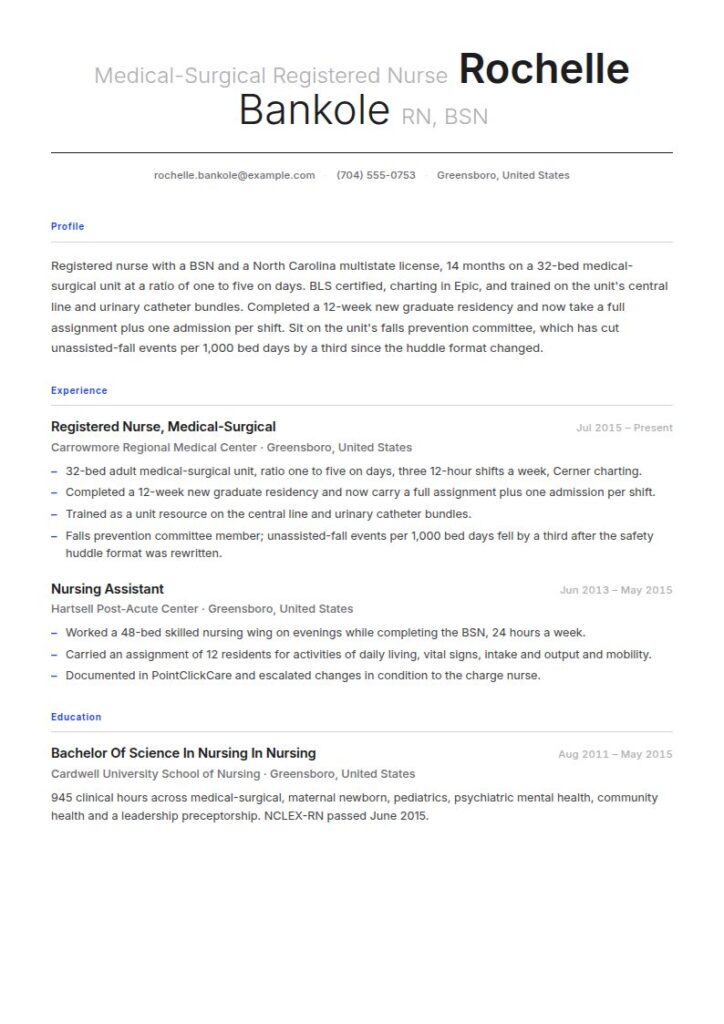
Registered nurse with a BSN and a North Carolina multistate license, 14 months on a 32-bed medical-surgical unit at a ratio of one to five on days. BLS certified, charting in Epic, and trained on the unit's central line and urinary catheter bundles. Completed a 12-week new graduate residency and now take a full assignment plus one admission per shift. Sit on the unit's falls prevention committee, which has cut unassisted-fall events per 1,000 bed days by a third since the huddle format changed.
Work Experience
07/2015 - Present, Registered Nurse, Medical-Surgical, Carrowmore Regional Medical Center, Greensboro, United States
- 32-bed adult medical-surgical unit, ratio one to five on days, three 12-hour shifts a week, Cerner charting.
- Completed a 12-week new graduate residency and now carry a full assignment plus one admission per shift.
- Trained as a unit resource on the central line and urinary catheter bundles.
- Falls prevention committee member; unassisted-fall events per 1,000 bed days fell by a third after the safety huddle format was rewritten.
06/2013 - 05/2015, Nursing Assistant, Hartsell Post-Acute Center, Greensboro, United States
- Worked a 48-bed skilled nursing wing on evenings while completing the BSN, 24 hours a week.
- Carried an assignment of 12 residents for activities of daily living, vital signs, intake and output and mobility.
- Documented in PointClickCare and escalated changes in condition to the charge nurse.
Education
08/2011 - 05/2015, Bachelor of Science in Nursing, Nursing, Cardwell University School of Nursing, Greensboro, United States
945 clinical hours across medical-surgical, maternal newborn, pediatrics, psychiatric mental health, community health and a leadership preceptorship. NCLEX-RN passed June 2015.
Skills
Medical-surgical assessment, 70
IV therapy and central line care, 65
Wound care, 60
Cerner and Epic charting, 75
Barcode medication administration, 80
Falls and pressure injury prevention, 70
Bedside SBAR handoff, 70
Discharge teaching, 60
Languages
English, native
Yoruba, conversational
Certificates
06/2015, Registered Nurse License, North Carolina #RN-2288941, North Carolina Board of Nursing, RN-2288941
Multistate license under the Nurse Licensure Compact.
06/2015, Basic Life Support (BLS) for Healthcare Providers, American Heart Association
Renewed every two years.
Summary
A nurse resume is a one to two page document naming your license and its compact status, the unit you work on with its bed count and ratio, and the certifications that gate your assignments. This guide gives you three adaptable versions, the unit profile block most applicants leave out, the rule about never writing about a patient, and current Bureau of Labor Statistics pay and outlook.
Nurse resume examples by experience level
A nurse resume is a one to two page document that names your license and whether it carries a multistate privilege, describes the unit you work on by size, ratio and acuity, lists the certifications that decide which assignments you can be given, and shows what changed on that unit while you were on it.
However, it is not a place to describe anyone you have cared for. That is the first rule of this page and it outranks every other piece of advice on it.
Resume guide for a nurse resume
To help, this guide and the corresponding nurse resume example will cover:
- How to write a nurse resume, section by section
- Why the unit profile belongs on the page and where to put it
- Three adaptable summaries: new graduate, staff nurse and clinical nurse lead
- Which certifications gate an assignment and which are decoration
- What the job market looks like and what you can expect to earn
This page is deliberately written for general registered nursing. If you work in a defined specialty, the certifications and the unit language change enough that the specialty page will serve you better: see the ICU nurse resume, the ER nurse resume or the psychiatric nurse resume.
How to write a nurse resume
Overall, it takes six sections: contact header, summary, license and certifications, unit profile, clinical experience, and education. As for length, use one page for your first five years, two once you have a clinical ladder rung, a committee and a certification with hours behind it.
License comes before experience because it is a gate rather than an achievement. That is because a nurse manager with an unfilled line on a schedule is checking legality first and quality second.
| Section | What it is answering | Where it goes |
|---|---|---|
| License and compact status | Can this person be put on my schedule, and in which states? | Directly under the summary |
| Certifications | Which assignments can I give them without a waiver? | With the license, not buried at the bottom |
| Unit profile | Have they carried a load like mine before? | Its own block above the bullets |
| Clinical experience | What changed on the unit while they were on it? | Reverse chronological, with numbers |
Describe the unit, never the person in the bed
Nurses write clinical stories onto resumes more than any other occupation, and it is the single fastest way to have a file set aside.
Anything that could identify an individual in your care is protected health information, and a resume is a document you hand to strangers, upload to vendor-hosted portals and email unencrypted. A name is obvious. So are initials, a room number, an age, a date of admission, a rare diagnosis, a photograph from the unit, and an anecdote specific enough that one person could recognize themselves in it.
There is also a plain professional reading of it. A manager who sees a case description on a resume concludes that this applicant does not have a reliable internal boundary about what leaves the building.
Write volume, type, setting, acuity and process instead. "A 32-bed medical-surgical unit at a ratio of one to five on days and one to six on nights, with a telemetry overflow of six beds" tells a manager everything a story would have, and it tells it faster.
Run the finished file through the ATS resume checker before you submit. Hospital systems parse applications into a structured record before anyone reads them.
Choosing the best resume format for a nurse resume
Reverse chronological, always. In practice, use one page through your first five years, two once you have a ladder rung, a unit committee, a certification with practice hours behind it, or a documented process you changed.
By contrast, functional and skills-based formats fail badly here. A nurse manager reads a nursing resume for continuity: which unit, which acuity, how long, and whether the moves make sense. After all, a format that hides the timeline reads as a timeline worth hiding.
Include your contact information
| ✅ Right | ❌ Wrong |
|---|---|
| Rochelle Bankole, RN, BSN, MEDSURG-BC | Rochelle Bankole |
| Medical-Surgical and Telemetry Registered Nurse | Compassionate nurse dedicated to patient care |
| NC RN License #RN-2288941, multistate | Licensed RN |
| (704) 555-0753, [email protected], Charlotte, NC | (704) 555-0753, [email protected] |
Credentials go after your name in the order the American Nurses Credentialing Center uses on its own certificates: highest degree, licensure, then national certification. Also, put the license number on the page. Nursing human resources verifies it against the state board anyway, and the file that lets them do it in ten seconds moves first.
Make use of a summary
Four lines: your license and certification, the unit type and its size, the load you carry, and one measured outcome that belongs to the unit rather than to any individual.
Registered nurse with a BSN and a North Carolina multistate license, 14 months on a 32-bed medical-surgical unit at a ratio of one to five on days. BLS certified, charting in Epic, and trained on the unit's central line and urinary catheter bundles. Completed a 12-week new graduate residency and now take a full assignment plus one admission per shift. Sit on the unit's falls prevention committee, which has cut unassisted-fall events per 1,000 bed days by a third since the huddle format changed.
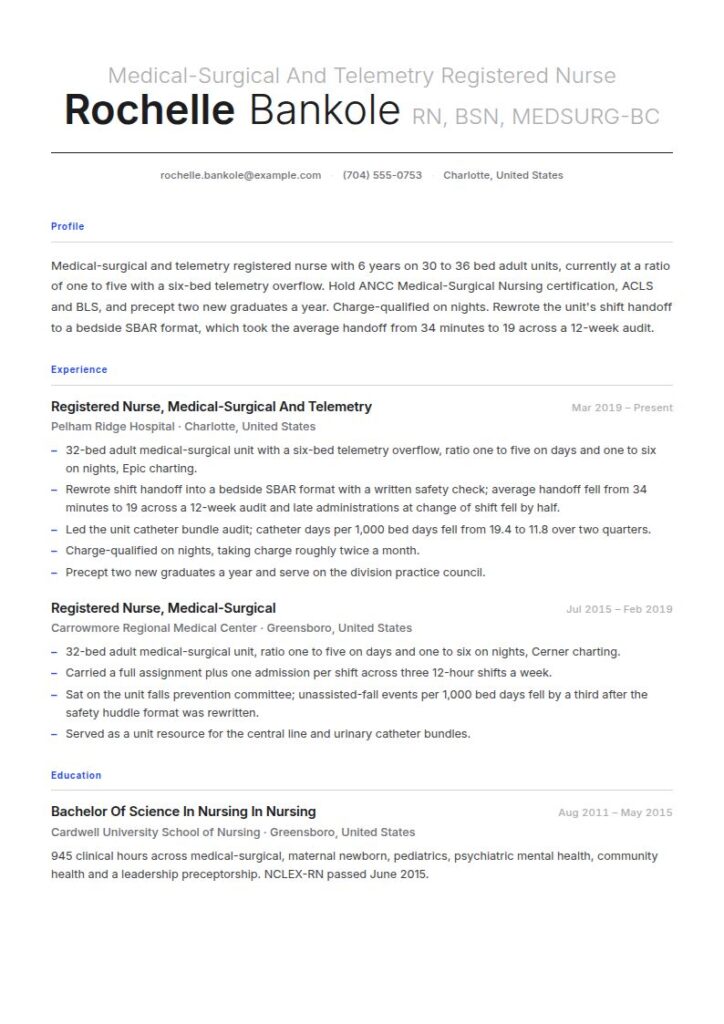
Medical-surgical and telemetry registered nurse with 6 years on 30 to 36 bed adult units, currently at a ratio of one to five with a six-bed telemetry overflow. Hold ANCC Medical-Surgical Nursing certification, ACLS and BLS, and precept two new graduates a year. Charge-qualified on nights. Rewrote the unit's shift handoff to a bedside SBAR format, which took the average handoff from 34 minutes to 19 across a 12-week audit.
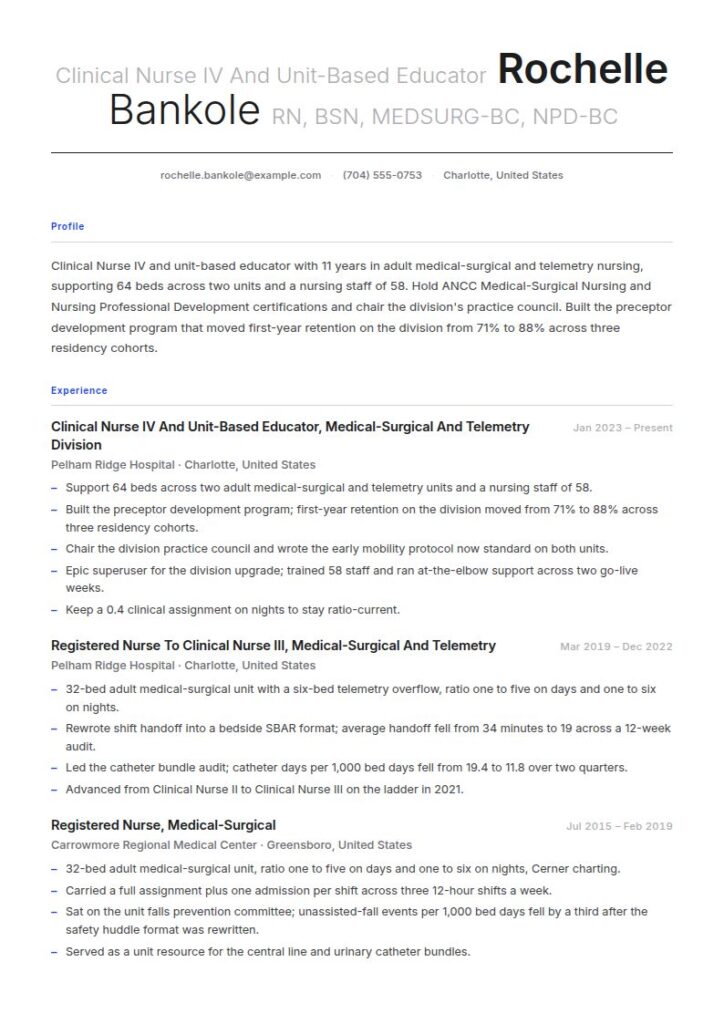
Clinical Nurse IV and unit-based educator with 11 years in adult medical-surgical and telemetry nursing, supporting 64 beds across two units and a nursing staff of 58. Hold ANCC Medical-Surgical Nursing and Nursing Professional Development certifications and chair the division's practice council. Built the preceptor development program that moved first-year retention on the division from 71% to 88% across three residency cohorts.
Right vs wrong: the same nurse summary, twice
| ✅ Right | ❌ Wrong |
|---|---|
| Medical-surgical and telemetry RN with 6 years on 30 to 36 bed adult units at a ratio of one to five. | Compassionate nurse with a passion for helping people at their most vulnerable. |
| ANCC Medical-Surgical Nursing certification, ACLS and BLS; charge-qualified on nights. | Experienced in a wide variety of nursing skills and procedures. |
| Rewrote the shift handoff to bedside SBAR; average handoff fell from 34 minutes to 19. | A story about one person I cared for, with their age, their diagnosis and how long they were with us. |
The right column can be scheduled. The left column, however, cannot, and the third wrong line is not a style problem at all. Any version of that sentence, however you disguise it, is a disclosure.
Outline your nursing experience
Facility, unit, city, dates. Then the unit profile block, then three to five bullets. In short, every bullet names a volume, a rate or a process, and none of them names a person.
| Instead of | Use |
|---|---|
| Provided compassionate care to patients | Carried a five-bed medical-surgical assignment plus one admission per shift, 36 hours a week on nights |
| Administered medications | Verified and administered a full med-surg medication load including IV push, PCA and insulin drips, under two-nurse verification |
| Worked well with the interdisciplinary team | Ran daily interdisciplinary rounds for a 32-bed unit with case management, pharmacy and therapy, seven days a week |
| Helped reduce infections | Led the CAUTI bundle audit for the unit; catheter days per 1,000 patient days fell from 19.4 to 11.8 over two quarters |
| Precepted new nurses | Precepted 7 new graduates across four cohorts, all still on the unit at 12 months |
| Charted in the electronic record | Superuser for the Epic upgrade on a 64-bed division; trained 58 staff and ran at-the-elbow support for two go-live weeks |
Registered Nurse, Medical-Surgical and Telemetry, Pelham Ridge Hospital, Charlotte, NC, March 2019 to Present
32-bed adult medical-surgical unit with a six-bed telemetry overflow, ratio one to five on days and one to six on nights, three 12-hour shifts a week, Epic.
Carry a full assignment plus one admission per shift and take charge on nights roughly twice a month.
Rewrote the shift handoff into a bedside SBAR format with a written safety check; the average handoff fell from 34 minutes to 19 across a 12-week audit and late medication administrations at shift change fell by half.
Led the unit's catheter bundle audit, taking catheter days per 1,000 bed days from 19.4 to 11.8 over two quarters.
Precept two new graduates a year and serve on the division practice council and the falls prevention committee.
Name the unit, the ratio and the acuity you actually carry
This is the block almost nobody writes, and it is the one a nurse manager is actually reading for. For example, a resume that says "provided patient care in a hospital setting" forces the manager to guess whether you can hold their assignment. By contrast, a resume that gives them the unit profile answers it in four seconds.
Six facts, in this order:
Unit: 32-bed adult medical-surgical with a 6-bed telemetry overflow
Ratio: 1:5 days, 1:6 nights, plus one admission per shift
Shift pattern: three 12-hour nights a week, self-scheduled, every third weekend
Acuity and case mix: post-surgical general and orthopedic, medical admissions from the emergency department, cardiac monitoring, tube feeds, wound vacuums, PCA and insulin drips
Charting and systems: Epic, Vocera, Pyxis, Cerner at a previous facility
Float and cross-train: floated to the progressive care unit and the observation unit; charge-qualified on nights
Six lines, all of them about the work rather than about anyone receiving it. Also note what the acuity line does: it names categories of care, which is what a manager needs, and it names no individual and no outcome belonging to one.
Nurse certifications that gate an assignment
Then the certifications, because they are what actually gates an assignment rather than what decorates a resume:
| Certification | Issuing body | What it gates |
|---|---|---|
| BLS | American Heart Association | Baseline employment on nearly every inpatient unit |
| ACLS | American Heart Association | Telemetry, step-down, procedural and rapid response assignments |
| PALS | American Heart Association | Assignments involving children in mixed or pediatric settings |
| Specialty certification, for example MEDSURG-BC | American Nurses Credentialing Center | Clinical ladder rungs, differentials and preceptor roles |
Then put the expiry date next to every one. A certification that lapses next month is a scheduling problem, and a file that is honest about the date is easier to plan around.
For example, ANCC Medical-Surgical Nursing certification is a useful example of what a real certification costs, and of why it separates files. The eligibility requirements are a current active RN license, the equivalent of two years of full-time practice as a registered nurse, a minimum of 2,000 hours of clinical practice in the specialty within the last three years, and 30 hours of continuing education in the specialty within the last three years. In addition, the credential is valid for five years (American Nurses Credentialing Center, accessed September 2026). In other words, those are hours nobody can talk their way into, which is why the four letters after your name carry weight.
Build a snapshot of your key skills
Twelve to sixteen entries in four groups: clinical, technology, regulatory, and the unit work that is not direct care.
Clinical: Medical-surgical assessment, Telemetry and rhythm interpretation, IV therapy and central line care, Wound care and negative pressure therapy, Insulin and PCA infusions, Tube feeding and enteral care, Post-operative recovery, Discharge teaching
Technology: Epic, Cerner, Pyxis automated dispensing, Vocera, Smart pump libraries, Barcode medication administration
Regulatory and safety: HIPAA, Joint Commission National Patient Safety Goals, CAUTI and CLABSI bundles, Falls and pressure injury prevention, Two-nurse verification, Incident reporting
Unit and team: Bedside SBAR handoff, Interdisciplinary rounds, Preceptorship, Charge nurse relief, Practice council, Epic superuser
Instead, skip what every licensed nurse can do. "Vital signs" takes up space a manager is using to find the rhythm interpretation line.
List your education, license and certifications
First, list the license with its number, its multistate status and its expiry. Then certifications with issuing bodies and dates. Then degrees.
North Carolina Registered Nurse License #RN-2288941, multistate under the Nurse Licensure Compact, valid through March 2027
Certifications: Medical-Surgical Nursing, ANCC (MEDSURG-BC), 2018, renewed 2023. Advanced Cardiovascular Life Support, American Heart Association, expires August 2027. Basic Life Support, American Heart Association, expires August 2027. NIH Stroke Scale, expires 2027.
Bachelor of Science in Nursing, Cardwell University School of Nursing, Greensboro, NC, 2015
Continuing education: 42 contact hours in medical-surgical nursing and dysrhythmia interpretation, 2023 to 2026
In fact, the compact line is worth a sentence of its own. The Nurse Licensure Compact lets a nurse hold one multistate license issued by their primary state of residence and practice in the other compact jurisdictions; 43 jurisdictions are currently part of the compact, applicants must meet 11 uniform licensure requirements, and a nurse who moves between compact states must apply for licensure in the new primary state of residence within 60 days (Nurse Licensure Compact, NCSBN, accessed September 2026). If your license is multistate, write the word. That is because recruiters for systems that operate across state lines filter on it.
Choose the right layout and design
For layout, use a single column, plain type at 11 or 12 point, clear headings, no photograph. Hospital applicant systems parse the file into a structured record before a human opens it, and two columns, text boxes and graphics are exactly where that parsing breaks.
Put the license number, the multistate status and the expiry in the first block. Give the unit profile: beds, ratio, shift pattern, case mix, charting system. Put an expiry date next to every certification. Use rates per 1,000 bed days, per shift or per quarter rather than raw counts. Name the committees and councils you sit on. Write the float and cross-train range, because it is worth real money on a schedule.
Do not describe anyone in your care, in any degree of disguise; no ages, initials, diagnoses, room numbers or stories. Do not name the facility's internal quality scores if your employer treats them as confidential. Do not write "provided compassionate care" where a ratio would go. Do not list an expired certification without marking it expired. Do not use a two-column template for a hospital portal. Do not pad to two pages before you have earned it.
Nurse job market and outlook
A very large occupation growing faster than average, with replacement demand that dwarfs the growth.
| Measure | Value |
|---|---|
| Registered nurse jobs, 2025 | 3,465,400 |
| Projected change, 2025-35 | 6% (faster than average), +194,700 |
| Projected annual openings | ~180,800 |
| Typical entry-level education | Bachelor's degree |
| Median annual wage, May 2025 | $97,550 |
Source: U.S. Bureau of Labor Statistics, Occupational Outlook Handbook, 2025-35 projections and May 2025 wage data, published 27 August 2026.
Most of the hiring is replacement, and most of it is in hospitals
The projected growth of 194,700 registered nurse jobs over the decade is only about 11% of the roughly 180,800 openings projected each year (BLS Occupational Outlook Handbook, 2025-35 projections). Almost nine in ten openings exist because someone left the role, not because a new line was created.
That has a direct consequence for how you write. A manager filling a vacancy is not building a team from nothing; they are replacing a specific set of hands on a specific schedule. The resume that says which shift you want, which ratio you have carried and which certifications you already hold is answering the question in front of them.
Hospitals employ 59% of registered nurses at a median of $100,220, and ambulatory healthcare services a further 19% at $91,230 (BLS, May 2025). Nurses in hospitals and nursing care facilities usually work in shifts to provide round-the-clock coverage, which is why shift availability belongs in your summary rather than in a conversation three weeks later.
Where the jobs sit:
| Setting | Share of employment | Median annual wage (May 2025) |
|---|---|---|
| Hospitals; state, local and private | 59% | $100,220 |
| Ambulatory healthcare services | 19% | $91,230 |
| Nursing and residential care facilities | 6% | $84,300 |
| Government | 5% | $110,780 |
| Educational services; state, local and private | 3% | $78,620 |
Source: U.S. Bureau of Labor Statistics, May 2025.
What salary you can expect as a nurse
Overall, the median annual wage for registered nurses was $97,550 as of May 2025. The lowest 10 percent earned less than $68,940 and the highest 10 percent more than $137,470 (BLS, May 2025). For scale, the median for all healthcare practitioner and technical occupations was $86,530 and the median for all occupations was $50,980 in the same cycle (BLS, May 2025).
Most of the spread inside a single market is setting and shift rather than negotiation. Meanwhile, government employers pay a median of $110,780 and hospitals $100,220, against $84,300 in nursing and residential care and $78,620 in educational services (BLS, May 2025). As a result, moving from a school or long-term care setting into acute care is usually the largest single pay decision of a nursing career, and the resume that gets you there is the one that translates your existing work into bed counts, ratios and acuity.
Within a setting, meanwhile, a resume can move money in the layers on top of base: shift and weekend differentials, charge differential, certification differential, preceptor pay, and clinical ladder rungs. Importantly, every one of those is awarded against documentation. Listing the certification with its issuing body and date, the charge qualification, the preceptor cohorts and the council seat is what makes you eligible at hire rather than at your first annual review.
Key takeaways for a nurse resume
- Above all, never describe anyone in your care, in any form; write the unit, not the person.
- First, lead with the license, its number, its multistate status and its expiry.
- Then give a unit profile: beds, ratio, shift pattern, case mix, charting system, float range.
- Also, put an expiry date next to every certification and name the issuing body.
- Use rates rather than raw counts, and give the period they were measured over.
- Finally, name the committees, councils and preceptor cohorts; they are what promote you.
- Say which shift you want, because most openings are replacements on a specific line.
Build your nurse resume in 15 minutes with our AI resume builder.
Related medical resume examples
- Nursing student resume
- New graduate nursing resume
- ICU nurse resume
- ER nurse resume
- NICU nurse resume
- Psychiatric nurse resume
- Charge nurse resume
- Travel nurse resume
- School nurse resume
- Nurse practitioner resume
- Licensed practical nurse resume
- CNA resume
Pair it with a matching nurse cover letter.
Nurse resume questions, answered
How long should a nurse resume be?
One page for your first five years. Two once you have a clinical ladder rung, a certification with practice hours behind it, preceptor cohorts, council seats or a documented process change. Nursing is one of the few occupations where two pages is normal at mid-career, because the license, certification and unit detail genuinely take room.
Can I describe a patient on my nursing resume?
No. Not by name, not by initials, not by age, not by diagnosis, not by room, and not as an anonymized story. Protected health information does not stop being protected because you removed the name, and a resume travels through portals, recruiters and inboxes you do not control. Describe the unit, the volume, the acuity and the process instead. Managers read that as competence; they read a case description as a warning.
What certifications should go on a nurse resume?
The ones that gate an assignment, with their issuing body and expiry: BLS and ACLS from the American Heart Association, PALS where children are in the mix, and a national specialty certification where you have the hours. ANCC Medical-Surgical Nursing, for example, requires two years of full-time equivalent RN practice, 2,000 hours in the specialty within three years and 30 hours of specialty continuing education, and is valid for five years (ANCC, accessed September 2026).
Should I put my license number on my nurse resume?
Yes, with the issuing state, the multistate status if you have it, and the expiry date. State boards publish license verification publicly, so the number is not sensitive in the way a birth date would be, and including it removes a verification step from the hiring process. Write "multistate" if your primary state of residence is one of the 43 compact jurisdictions (NCSBN, accessed September 2026).
How do I write a nurse resume when I am changing settings?
Translate. A long-term care nurse applying to acute care should write bed counts, ratios, acuity categories, charting system and the procedures they perform, because those are the terms the receiving manager thinks in. Then name the gap honestly and say what you have done about it: the ACLS course you have already booked, the telemetry class you finished, the float shifts you picked up.
What do I put on a nurse resume with no hospital experience yet?
Write your clinical rotations as a structured block with hours by specialty, then your nurse extern, tech or aide work as an ordinary job with volumes. Add the license or its pending status with a date, the certifications you hold with expiries, and the shift you are available for. The [nursing student resume guide](/resume/nursing-student/) covers that case in full.