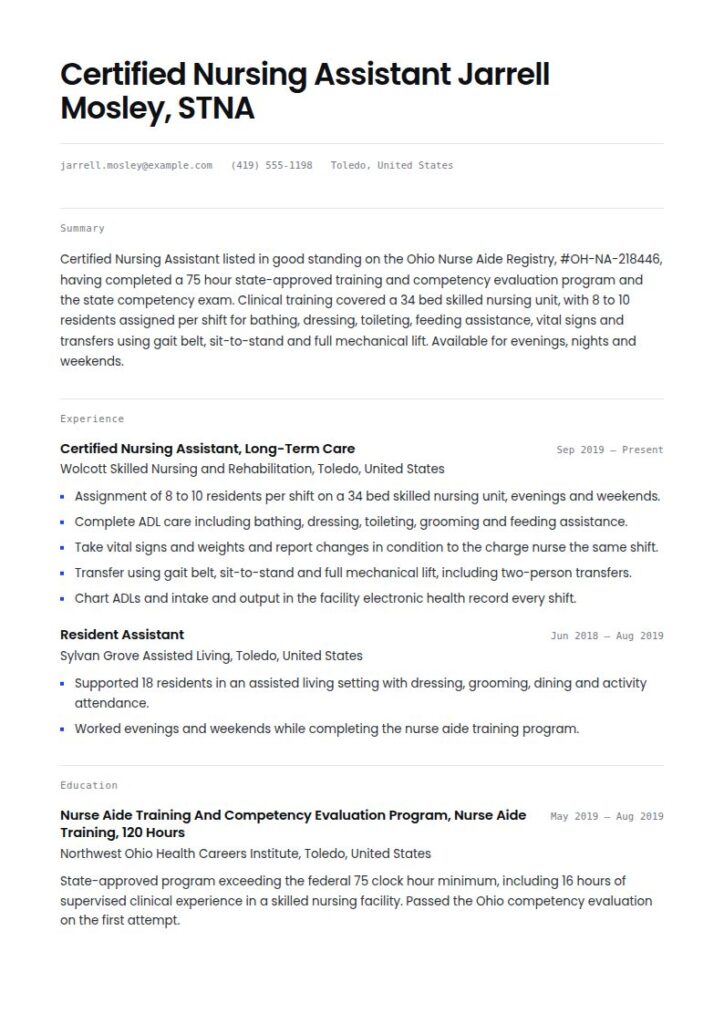
Certified Nursing Assistant Jarrell Mosley STNA
Certified Nursing Assistant, Long-Term Care
[email protected] | (419) 555-1198 | Toledo, United States
Profile
Certified Nursing Assistant listed in good standing on the Ohio Nurse Aide Registry, #OH-NA-218446, having completed a 75 hour state-approved training and competency evaluation program and the state competency exam. Clinical training covered a 34 bed skilled nursing unit, with 8 to 10 residents assigned per shift for bathing, dressing, toileting, feeding assistance, vital signs and transfers using gait belt, sit-to-stand and full mechanical lift. Available for evenings, nights and weekends.
Work Experience
09/2019 - Present, Certified Nursing Assistant, Long-Term Care, Wolcott Skilled Nursing and Rehabilitation, Toledo, United States
- Assignment of 8 to 10 residents per shift on a 34 bed skilled nursing unit, evenings and weekends.
- Complete ADL care including bathing, dressing, toileting, grooming and feeding assistance.
- Take vital signs and weights and report changes in condition to the charge nurse the same shift.
- Transfer using gait belt, sit-to-stand and full mechanical lift, including two-person transfers.
- Chart ADLs and intake and output in the facility electronic health record every shift.
06/2018 - 08/2019, Resident Assistant, Sylvan Grove Assisted Living, Toledo, United States
- Supported 18 residents in an assisted living setting with dressing, grooming, dining and activity attendance.
- Worked evenings and weekends while completing the nurse aide training program.
Education
05/2019 - 08/2019, Nurse Aide Training and Competency Evaluation Program, Nurse Aide Training, 120 hours, Northwest Ohio Health Careers Institute, Toledo, United States
State-approved program exceeding the federal 75 clock hour minimum, including 16 hours of supervised clinical experience in a skilled nursing facility. Passed the Ohio competency evaluation on the first attempt.
08/2014 - 05/2018, High School Diploma, Northwood Central High School, Toledo, United States
Skills
ADL care: bathing, dressing, toileting, grooming, 85
Feeding assistance and swallowing precautions, 80
Vital signs and weights, 85
Gait belt and sit-to-stand transfers, 85
Full mechanical lift and two-person transfers, 75
Skin care and pressure injury prevention, 75
Electronic health record charting, 70
Infection control and isolation precautions, 85
Residents' rights and abuse reporting, 90
Languages
English, native
Certificates
08/2019, Certified Nursing Assistant, Ohio Nurse Aide Registry, Ohio Department of Health, OH-NA-218446
Listed in good standing with no lapse in status.
01/2026, Basic Life Support for Healthcare Providers, American Heart Association
Renewed every two years.
Summary
A CNA resume is a one page document that names your state nurse aide registry listing and the census you carried on a normal shift. This guide gives you three adaptable versions, the federal training and registry rules behind the credential, what skilled nursing, hospital and assisted living employers each read for, and current Bureau of Labor Statistics pay and outlook for nursing assistants.
CNA resume examples by experience level
In short, a CNA resume is a one page document that names your state nurse aide registry listing and the census you carried on a normal shift.
Certified Nursing Assistant hiring is faster than almost any other clinical role, and it runs on two checks. A scheduler verifies that you are listed and in good standing on the state registry, because federal rules do not let them staff you otherwise for long. Then they work out how many residents or patients you can take, because that is how a shift is built. Everything else on the page is secondary to those two facts; however, most CNA resumes state neither.
Resume guide for a CNA resume
For this reason, this guide and the corresponding CNA resume example will cover:
- To begin with, how to write a CNA resume, section by section
- Then, why your registry listing and your census belong at the top
- Three adaptable summaries: new certificate, experienced aide and lead aide
- Also, how skilled nursing, hospital and assisted living hiring differ
- Finally, what the job market looks like and what nursing assistants earn
How to write a CNA resume
Specifically, six sections: contact header, summary, certification and registry, experience, skills, and education and training. One page. A CNA resume should almost never run to two, because the reader is a unit manager or a staffing coordinator working through a stack.
| Section | What it is answering | Where it goes |
|---|---|---|
| Registry listing | Can I verify this person and put them on the schedule? | Directly under the summary |
| Census | How many residents or patients can this person take? | In every experience entry |
| Setting and unit | Skilled nursing, hospital unit, assisted living, memory care? | In the experience header |
| Equipment | Can they transfer safely with what we have on the floor? | In skills, by name |
| Charting | Can they document without being retrained? | Name the system |
Run the finished file through the free ATS resume checker before you apply. Large health systems and nursing home groups parse applications into a system before a human opens them.
Choosing the best resume format for a CNA resume
Reverse chronological, one page, no graphics. Put certification and registry above experience, because that is the gate.
Functional and skills-only formats, on the other hand, hurt you here. That is because a staffing coordinator reads a CNA resume for continuity and attendance. Gaps are common and are not disqualifying, but a format that hides dates reads as a format hiding something, and it slows down the one thing you want to happen quickly, which is a call.
Include your contact information
| ✅ Right | ❌ Wrong |
|---|---|
| Jarrell Mosley, STNA | Jarrell Mosley |
| Certified Nursing Assistant, Ohio Nurse Aide Registry #OH-NA-218446, active | Dedicated caregiver passionate about helping people |
| Skilled nursing and medical-surgical experience, nights and weekends available | Hardworking team player |
| (419) 555-1198, [email protected], Toledo, OH | (419) 555-1198, [email protected] |
Put the registry number on the page. The employer will look you up before they call, and a resume that lets them do it in ten seconds moves ahead of one that makes them search.
Availability belongs in the header too. In addition, nights, weekends, doubles and holidays are the shifts that are hardest to fill, and saying which ones you will take often decides which resume gets the first call.
Make use of a summary
In general, four lines: your certification and registry status, your setting, your census, and your availability.
Certified Nursing Assistant listed in good standing on the Ohio Nurse Aide Registry, #OH-NA-218446, having completed a 75 hour state-approved training and competency evaluation program and the state competency exam. Clinical training covered a 34 bed skilled nursing unit, with 8 to 10 residents assigned per shift for bathing, dressing, toileting, feeding assistance, vital signs and transfers using gait belt, sit-to-stand and full mechanical lift. Available for evenings, nights and weekends.
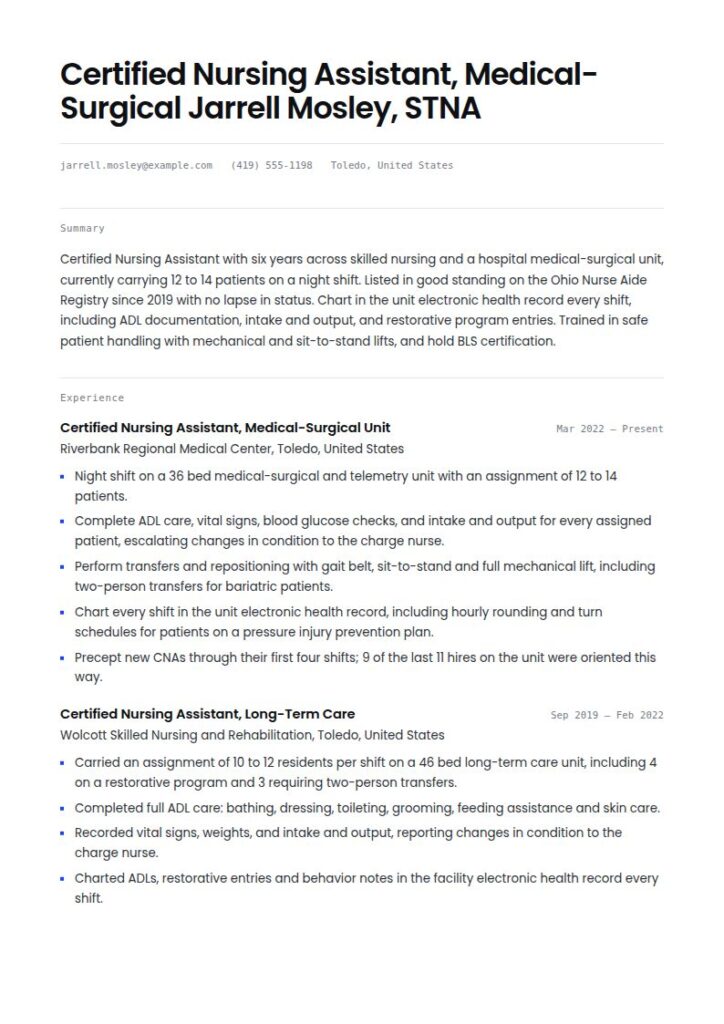
Certified Nursing Assistant with six years across skilled nursing and a hospital medical-surgical unit, currently carrying 12 to 14 patients on a night shift. Listed in good standing on the Ohio Nurse Aide Registry since 2019 with no lapse in status. Chart in the unit electronic health record every shift, including ADL documentation, intake and output, and restorative program entries. Trained in safe patient handling with mechanical and sit-to-stand lifts, and hold BLS certification.
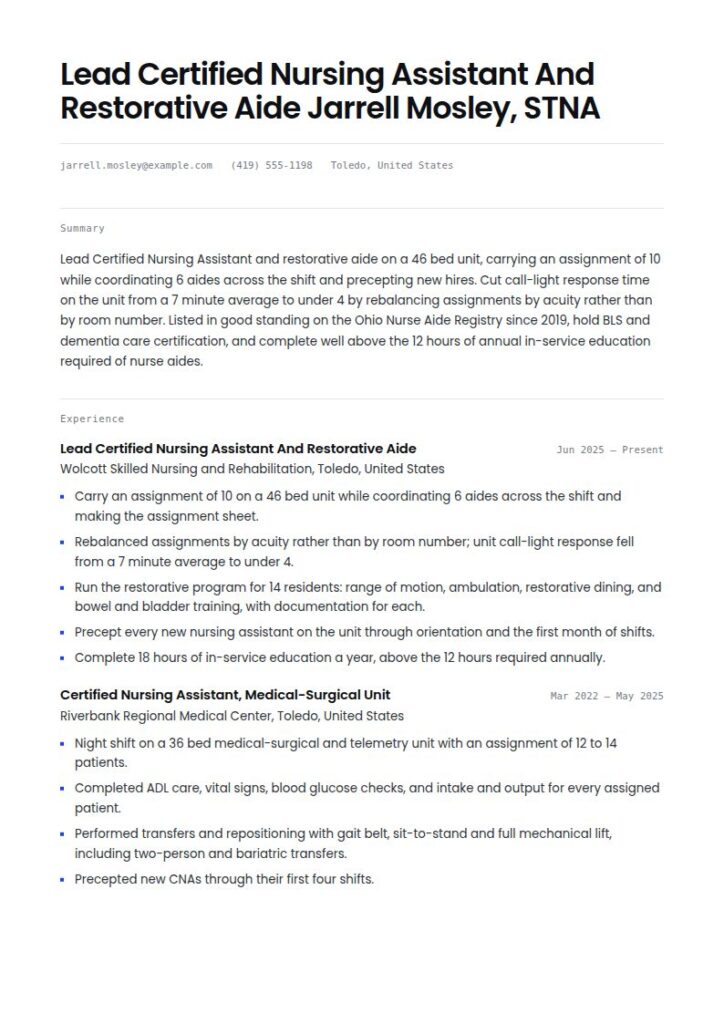
Lead Certified Nursing Assistant and restorative aide on a 46 bed unit, carrying an assignment of 10 while coordinating 6 aides across the shift and precepting new hires. Cut call-light response time on the unit from a 7 minute average to under 4 by rebalancing assignments by acuity rather than by room number. Listed in good standing on the Ohio Nurse Aide Registry since 2019, hold BLS and dementia care certification, and complete well above the 12 hours of annual in-service education required of nurse aides.
Right vs wrong: the same CNA summary, twice
| ✅ Right | ❌ Wrong |
|---|---|
| Certified Nursing Assistant with six years across skilled nursing and hospital medical-surgical. | Dedicated CNA passionate about caring for others. |
| Currently carrying 12 to 14 patients on a night shift. | Experience providing care to multiple patients. |
| Listed in good standing on the Ohio Nurse Aide Registry since 2019 with no lapse. | Certified nursing assistant in Ohio. |
| Chart ADLs, intake and output and restorative entries in the unit EHR every shift. | Good documentation skills. |
The right column can be scheduled. As a result, a staffing coordinator can read it and know which unit, which shift and how many residents. In contrast, nobody can schedule the left column at all.
Outline your experience
Facility, city, your title, dates, and the setting in one clause: skilled nursing facility, hospital unit and specialty, assisted living, memory care or home based. Then three to five bullets, each with a number.
| Instead of | Use |
|---|---|
| Provided care to residents | Carried an assignment of 10 to 12 residents per shift on a 46 bed long-term care unit |
| Assisted with activities of daily living | Completed full ADL care including bathing, dressing, toileting, grooming and feeding assistance for 10 residents |
| Took vital signs | Recorded vital signs, weights, and intake and output for 12 patients each shift and reported changes to the charge nurse |
| Used lifts safely | Performed transfers with gait belt, sit-to-stand and full mechanical lift, including two-person transfers, with no reportable incident in four years |
| Documented care | Charted ADLs, restorative entries and behavior notes in the facility EHR every shift |
Certified Nursing Assistant, Medical-Surgical Unit, Riverbank Regional Medical Center, Toledo, OH, March 2022 to Present
36 bed medical-surgical and telemetry unit. Night shift, assignment of 12 to 14 patients.
Complete ADL care, vital signs, blood glucose checks, and intake and output for every assigned patient, escalating changes in condition to the charge nurse.
Perform transfers and repositioning with gait belt, sit-to-stand and full mechanical lift, including two-person transfers for bariatric patients.
Chart every shift in the unit electronic health record, including hourly rounding and turn schedules for patients on a pressure injury prevention plan.
Precept new CNAs through their first four shifts; 9 of the last 11 hires on the unit were oriented this way.
Put your registry listing and your census on the page
These are the two facts that get you the call; however, they are the two facts most CNA resumes leave out.
Start with the registry, because it is a legal gate rather than a preference. In particular, federal regulation at 42 CFR 483.156(a) requires each state to "establish and maintain a registry of nurse aides" that is "sufficiently accessible to meet the needs of the public and health care providers promptly". Facilities check it, and 42 CFR 483.35(d) tells them why: a facility "must not use any individual working in the facility as a nurse aide for more than 4 months, on a full-time basis" unless that person is competent and has completed a state-approved training and competency evaluation program, and the facility must obtain registry verification before employing a nurse aide.
Write your CNA registry listing first
So write the state, the registry number, the status and the date first certified. Four items, one line.
One rule is worth knowing before you have to explain a gap. Moreover, under 42 CFR 483.156(c)(2), a registry "must remove entries for individuals who have performed no nursing or nursing-related services for a period of 24 consecutive months". In other words, two years away from paid nursing work and the listing comes off, which usually means retesting. If you are close to that line, say on the resume when you last worked in a nursing-related role, because it is the first thing a recruiter will want to establish.
Then the census, which is how a shift is actually built. In effect, census means the number of residents or patients you were responsible for, and it belongs in every experience entry, not in the summary alone. Give four things with it: the number assigned, the size and type of the unit, the shift, and anything about acuity that changes what that number means. For example, ten residents on a memory care unit and ten patients on a post-surgical floor are different jobs, and a coordinator knows it.
CNA skills and equipment to name
Around the census, name the four things that decide whether you can be dropped onto a floor without a week of orientation.
Also name the equipment: gait belt, sit-to-stand lift, full mechanical lift, ceiling lift, slide board, two-person transfers. Charting, by system: name the electronic health record you use, because a CNA who already charts in it is cheaper to onboard. Restorative and ADL documentation, which is its own skill: range of motion, ambulation programs, bowel and bladder training, and restorative dining are all reimbursable work in a skilled nursing facility, and an aide who documents them accurately is valuable in a way that is easy to state and rarely stated. And your response and rounding measures if your unit tracks them, such as call-light response time or hourly rounding compliance.
Certification and registry: Certified Nursing Assistant, Ohio Nurse Aide Registry #OH-NA-218446, listed in good standing since August 2019, no lapse in status. Completed a 75 hour state-approved nurse aide training and competency evaluation program and passed the state competency exam.
Census carried: 12 to 14 patients per night shift on a 36 bed medical-surgical and telemetry unit. Previously 10 to 12 residents per shift on a 46 bed long-term care unit, including 4 on a restorative program and 3 requiring two-person transfers.
Equipment: gait belt, sit-to-stand lift, full mechanical lift, slide board, two-person and bariatric transfers.
Charting: ADLs, intake and output, blood glucose, restorative entries, behavior notes and hourly rounding, in the unit electronic health record.
Know the federal floor your certificate sits on
The credential is federal at the base and state on top. Under 42 CFR 483.152(a), a nurse aide training and competency evaluation program must "consist of no less than 75 clock hours of training" and include "at least 16 hours of supervised practical training", defined as training in which "the trainee demonstrates knowledge while performing tasks on an individual under the direct supervision of a registered nurse or a licensed practical nurse". A further 16 hours must be completed before any direct contact with a resident, covering communication and interpersonal skills, infection control, safety and emergency procedures including the Heimlich maneuver, promoting residents' independence, and respecting residents' rights.
The curriculum content areas in 42 CFR 483.152(b) are basic nursing skills, personal care skills, mental health and social service needs, care of cognitively impaired residents, basic restorative services, and residents' rights. Those six headings are a ready-made outline for the skills section of your resume.
Many states require more than the federal minimum, so name your own state's program and its hours. The Ohio Department of Health, for example, states that "training programs must be no less than 75 hours" and that those hours "must include classroom instruction, skills instruction in the skills lab, and 16 hours of clinical experience in a skilled nursing facility", with the state competency evaluation delivered through a named testing vendor. Ohio also states that "an individual who is listed on the Nurse Aide Registry in good standing is referred to as a certified nurse aide (CNA) in Ohio", which is why the listing, rather than a certificate in a drawer, is the thing to put on the page.
Settings pay and staff differently, so name yours
Three settings hold most of the work, and each reads a resume for something different.
Skilled nursing facilities employ 36 percent of nursing assistants at a median annual wage of $43,000, the highest of the three, and they read for census, restorative documentation and dementia care (BLS, May 2025).
Hospitals employ 32 percent at $42,310 and read for acuity, pace, telemetry or post-surgical exposure, and whether you can chart in their system.
Continuing care retirement communities and assisted living facilities employ 11 percent at $39,490 and read for independence support, medication reminders where the state permits them, and resident relationships over a long period.
If you have worked in more than one, say so explicitly, because a candidate who can cover a hospital float pool and a long-term care unit is unusually useful and it is rarely made obvious.
Build a snapshot of your key skills
Group them under the same headings the federal curriculum uses, because a reader from any facility will recognize them.
Personal care: Bathing, dressing, grooming and oral care; Toileting and incontinence care; Feeding assistance and safe swallowing precautions; Skin care and pressure injury prevention
Basic nursing skills: Vital signs; Height, weight and intake and output; Blood glucose monitoring; Recognizing and reporting changes in condition; End of life care
Transfers and mobility: Gait belt; Sit-to-stand lift; Full mechanical lift; Slide board; Two-person and bariatric transfers; Ambulation and range of motion
Restorative and cognitive care: Restorative dining; Bowel and bladder training; Ambulation programs; Dementia and memory care communication; Behavior de-escalation
Documentation and safety: Electronic health record charting; ADL and restorative documentation; Hourly rounding; Infection control and isolation precautions; Residents' rights and abuse reporting
List your education and certifications
Registry and certification first, then the training program with its hours, then any additional certification, then high school or equivalent.
Certified Nursing Assistant, Ohio Nurse Aide Registry #OH-NA-218446, in good standing since August 2019
Nurse Aide Training and Competency Evaluation Program, 120 hours, Northwest Ohio Health Careers Institute, Toledo, OH, 2019. State-approved program exceeding the federal 75 hour minimum, including 16 hours of supervised clinical experience in a skilled nursing facility. Passed the Ohio competency evaluation on first attempt.
Basic Life Support for Healthcare Providers, American Heart Association, renewed 2026
Dementia Care Certification, 16 hours, completed 2023
In-service education: 18 hours completed in the most recent year, above the 12 hours required annually
Choose the right layout and design
Above all, one page, single column, plain type at 11 or 12 point, no photograph, no icons, no columns. Health system and nursing home group portals parse these into a structured record before anyone reads them, and a two-column template is where that breaks.
Put the state, registry number and status in the header. Give the census in every experience entry, with unit size and shift. Name the lift equipment you are trained on. Name the electronic health record you chart in. Say which shifts you will take. Say when you last worked in a nursing-related role if there is a gap. Keep it to one page.
Do not name or describe a resident, a patient or a family, even indirectly. Do not write "provided compassionate care" in place of a census. Do not list a lapsed certification without saying it is lapsed. Do not claim a skill outside a nurse aide scope of practice in your state. Do not use a two-column or graphic template for a facility portal.
CNA job market and outlook
Overall, a very large occupation with slow growth and enormous replacement demand. Those two facts together are the whole shape of this labor market, and they are worth understanding before you apply.
| Measure | Value |
|---|---|
| Nursing assistant jobs, 2025 | 1,505,900 |
| Orderly jobs, 2025 | 52,800 |
| Projected change, 2025-35 | 3% (slower than average), +41,100 combined |
| Projected annual openings | About 203,300 |
| Typical entry-level education | Postsecondary nondegree award |
| Median annual wage, nursing assistants, May 2025 | $42,260 ($20.13 per hour) |
| Median annual wage, orderlies, May 2025 | $38,290 |
Source: U.S. Bureau of Labor Statistics, Occupational Outlook Handbook, nursing assistants and orderlies, May 2025 wage data and 2025 to 2035 projections, last modified 27 August 2026. BLS publishes the two occupations on one page; the figures above are named separately because they differ.
BLS also states that "nursing assistants often need to complete a state-approved education program and pass their state's competency exam to become licensed or certified", which is the federal training floor described above.
Three percent growth and 203,300 openings a year is not a contradiction
Employment of nursing assistants and orderlies is projected to grow just 3 percent from 2025 to 2035, slower than average, adding 41,100 jobs in total. Over the same decade BLS projects about 203,300 openings a year (U.S. Bureau of Labor Statistics, Occupational Outlook Handbook, 2025 to 2035 projections).
Ten years of growth adds about 41,000 jobs. One year of openings is about 203,000. Almost every opening, therefore, is a replacement: someone leaving the occupation, moving to another facility, or moving up into nursing.
That has two consequences for you, and they pull in opposite directions. The first is that you will almost always be able to find a job, because facilities are hiring continuously rather than seasonally. The second is that employers know this, which is why pay moves slowly and why the openings that stay unfilled are nights, weekends and the hardest units.
The resume that gets paid more in this market is the one that reduces a facility's turnover risk rather than the one that simply meets the requirements. That means showing tenure in dated blocks, showing that you have precepted or oriented new hires, showing a registry listing with no lapse, and naming the shifts other people will not take. Those four things are what a staffing manager is actually buying.
What salary you can expect as a CNA
Specifically, the median annual wage for nursing assistants was $42,260, or $20.13 an hour, as of May 2025. The lowest 10 percent earned less than $33,940 and the highest 10 percent more than $51,980. Similarly, orderlies, counted on the same BLS page, had a median of $38,290, with a 10th percentile under $32,240 and a 90th percentile over $50,600 (BLS, May 2025).
Setting is the largest published lever. Meanwhile, skilled nursing facilities paid a median of $43,000 in May 2025, hospitals $42,310, and continuing care retirement communities and assisted living facilities $39,490 (BLS, May 2025).
Beyond setting, the things that move a CNA's actual pay, in fact, are shift differentials for nights and weekends, overtime, certification add-ons such as restorative or medication aide where your state allows it, lead or preceptor roles, and moving to a facility with a higher census expectation. Every one of those is something you can put on a resume, which is unusual because in many occupations the pay levers are invisible to the page.
Key takeaways for a CNA resume
- Put the state, registry number and status in the header; it is the first thing verified.
- Firstly, give the census in every experience entry, with unit size, shift and acuity.
- Then name the lift equipment and the electronic health record by name.
- Also name the setting: skilled nursing, hospital unit, assisted living or memory care.
- Say which shifts you will take, because those are the hard ones to fill.
- Show tenure and preceptor work; in a replacement-driven market that is what is valued.
- Finally, keep it to one page, single column, no graphics.
- Never name or describe a resident or patient.
Build your CNA resume in 15 minutes with our AI resume builder.
Related medical resume examples
- Nursing assistant resume
- Home health aide resume
- Licensed practical nurse (LPN) resume
- LVN resume
- Nurse resume
- Nursing home resume
- Medical assistant resume
- Phlebotomist resume
- EMT resume
- Physical therapist assistant resume
- Medical scribe resume
- New graduate nursing resume
Pair it with a matching CNA cover letter.
CNA resume questions, answered
How long should a CNA resume be?
One page. A staffing coordinator is working through a stack and needs the registry line, the census and your availability. If you have fifteen years across six facilities, summarize the older roles in one line each rather than going to a second page.
What do I put on a CNA resume with no experience?
Your clinical training, written as a job. The facility type, the unit size, how many residents you were assigned, the care you provided and the equipment you used. Then the registry line, the program name and hours, and your availability. A new certificate holder who can state a census and say they will work nights is a straightforward hire.
Does the registry number really belong on the resume?
Yes. Federal regulation requires states to maintain a nurse aide registry and requires facilities to obtain registry verification before employing a nurse aide, so the lookup happens whatever you do. Putting the number on the page moves it to the first minute rather than the third day.
What happens if my certification lapsed?
Under 42 CFR 483.156(c)(2), a registry must remove entries for individuals who have performed no nursing or nursing-related services for 24 consecutive months, which generally means retraining or retesting to be relisted. If you are inside that window, say when you last worked in a nursing-related role. If you are outside it, say where you are in the process of being relisted and give a date.
Is it worth naming the electronic health record I use?
Yes, and it is one of the cheapest wins on the page. Onboarding a CNA who already charts in the facility's system is faster and cheaper than training one who does not, and almost nobody names the system. Put it in your skills block and in at least one experience bullet.