Emergency Medical Technician Santiago Berrios NREMT
Emergency Medical Technician
[email protected] | (575) 555-1402 | Las Cruces, United States
Profile
Nationally certified EMT with a New Mexico state license, working interfacility transfers and event standby since certification eight months ago. Runs roughly 40 transports a month on a two-person basic life support unit, including cardiac monitoring handoffs, oxygen-dependent patients and bariatric transfers. Holds a Class D license with ambulance endorsement and an emergency vehicle operations course certificate, and drives on roughly half of assigned shifts. Writes every patient care report in the service's NEMSIS-format electronic system.
Work Experience
03/2019 - Present, Emergency Medical Technician, Mesilla Valley Ambulance Service, Las Cruces, United States
- Private ambulance service. Two-person basic life support unit running interfacility transfers and event medical standby.
- About 40 transports a month, including cardiac monitoring handoffs, oxygen-dependent patients, dialysis and bariatric transfers.
- Drive roughly half of assigned shifts under an emergency vehicle operations certificate, with no preventable collisions.
- Complete every patient care report in the service NEMSIS-format electronic record before end of shift.
06/2016 - 02/2019, Lifeguard and Water Safety Instructor, City of Las Cruces Parks and Recreation, Las Cruces, United States
- Worked three summer seasons plus weekends, covering a 50-meter pool and a splash park.
- Ran CPR and first aid for 11 incidents including two water rescues, and taught swim classes of up to 12 children.
Education
08/2018 - 02/2019, Certificate, Emergency Medical Technician, Sierra Vista Community College, Las Cruces, United States
Included 48 hours of clinical rotation and 10 field internship shifts, 31 patient contacts logged.
Skills
Patient assessment and vital signs, 75
Bag-valve-mask ventilation and oxygen administration, 75
Automated external defibrillation and CPR, 85
Splinting and spinal motion restriction, 70
Emergency vehicle operation, 80
NEMSIS-format patient care reporting, 80
Lifting and moving with powered cot and stair chair, 80
Languages
English, native
Spanish, native
Certificates
03/2019, Emergency Medical Technician, National Registry of Emergency Medical Technicians
New Mexico EMT license #EMS-118240, active.
03/2019, Emergency Vehicle Operations Course, Mesilla Valley Ambulance Service
Class D driver's license with ambulance endorsement.
09/2018, Basic Life Support Provider, American Heart Association
Summary
An EMT resume is a one page document naming the level you are certified at, the state license that lets you work, and the call record behind it: service model, call volume, call types and the documentation you write. This guide gives you three adaptable versions, the scope line that decides eligibility, and current Bureau of Labor Statistics pay and outlook.
EMT resume examples by experience level
An EMT resume is a one page document that names the level you are certified at, the state license that lets you work, and the calls you have actually run.
Two facts sit above everything else. The first is your certification level, because it sets your scope of practice and therefore which units a service can put you on. The second is your state license, because certification and licensure are not the same thing and only one of them lets you work. Everything after those two is the call record, which is where two equally certified applicants stop looking alike.
Resume guide for an EMT resume
Specifically, this guide and the corresponding EMT resume example will cover:
- How to write an EMT resume, block by block
- The four-level certification ladder and how to write the scope you hold
- Three adaptable summaries: new EMT, 911 EMT and advanced EMT
- How to write a call record a hiring officer can verify
- What Bureau of Labor Statistics data shows about pay and growth
How to write an EMT resume
Overall, it takes six blocks: contact header, summary, certification and licensure, field experience with a service profile line, skills, and education. One page, almost always, because EMS hiring is a volume process and your file competes against a stack.
In practice, the order follows how a hiring officer screens. Level and license are eligibility gates. However, driving credentials are a separate gate applicants forget. Everything else is comparison.
| Section | What it is answering | Where it goes |
|---|---|---|
| Certification level | What scope can this person legally work at? | Header and the first block |
| State license | Can they work in this state today, or not yet? | Same block, with the number |
| Driving credentials | Can they be put on an ambulance as a driver? | Same block, one line |
| Service profile | What kind of service, what volume, what call mix? | First line of every field job |
| Call record | What have they actually run, and how often? | Bullets, with numbers |
Write the scope you hold, not the scope you are working toward
The National Registry of Emergency Medical Technicians certifies at four levels: Emergency Medical Responder, Emergency Medical Technician, Advanced EMT and Paramedic (NREMT, nremt.org, read 16 September 2026). Each level carries a different scope of practice, and a service is hiring against one of them.
Applicants routinely blur the line. An EMT who assisted with an advanced airway on a paramedic's call has not performed an advanced airway, and an EMT halfway through a paramedic program is an EMT until the certification issues.
Write the level you hold, the certifying body and the date. Then write the program you are enrolled in as a separate education line with an expected completion date. Both facts help you. Merged into one claim they cost you the job, because a service that finds an overstated scope during field training treats it as an integrity problem rather than a resume problem.
Run the finished file through the ATS resume checker before you apply. Municipal and county services use government hiring portals that parse your file into a structured record first.
Choosing the best resume format for an EMT resume
Reverse chronological, single column, one page. Two pages only if you hold a field training officer role, a specialty team assignment or an instructor credential with a list worth reading.
Also, keep the format plain for a reason: many EMS employers are municipal, county or fire departments, and public sector hiring portals are unforgiving. Local government employs 24 percent of EMTs, second only to ambulance services at 46 percent (BLS Occupational Outlook Handbook, EMTs and paramedics, May 2025), so a file that breaks in a public portal breaks for a quarter of the market.
If you are moving from volunteer to paid, or from event standby to 911, do not hide the earlier work. Label it accurately, give the call volume, and then let the reader see the progression. Volunteer time on a busy rural service reads as real experience when it carries numbers.
Include your contact information
| ✅ Right | ❌ Wrong |
|---|---|
| Santiago Berrios | Santiago Berrios |
| EMT, NREMT certified, New Mexico EMT license #EMS-118240 | Certified EMT looking for opportunities |
| Class D license with ambulance endorsement, EVOC certified | Valid driver's license |
| (575) 555-1402, [email protected], Las Cruces, NM | (575) 555-1402, [email protected] |
First, put the license number on the page. A hiring officer verifies it against the state register anyway, and the file that lets them do it in ten seconds moves first.
Similarly, put the driving line in the header too. An ambulance crew is two people and one of them drives, so an applicant whose driving credential is unclear is one the scheduler cannot use on half the shifts.
Make use of a summary
In short, use four lines: level and years, service model and call volume, one or two call types you handle often, and your driving and certification status.
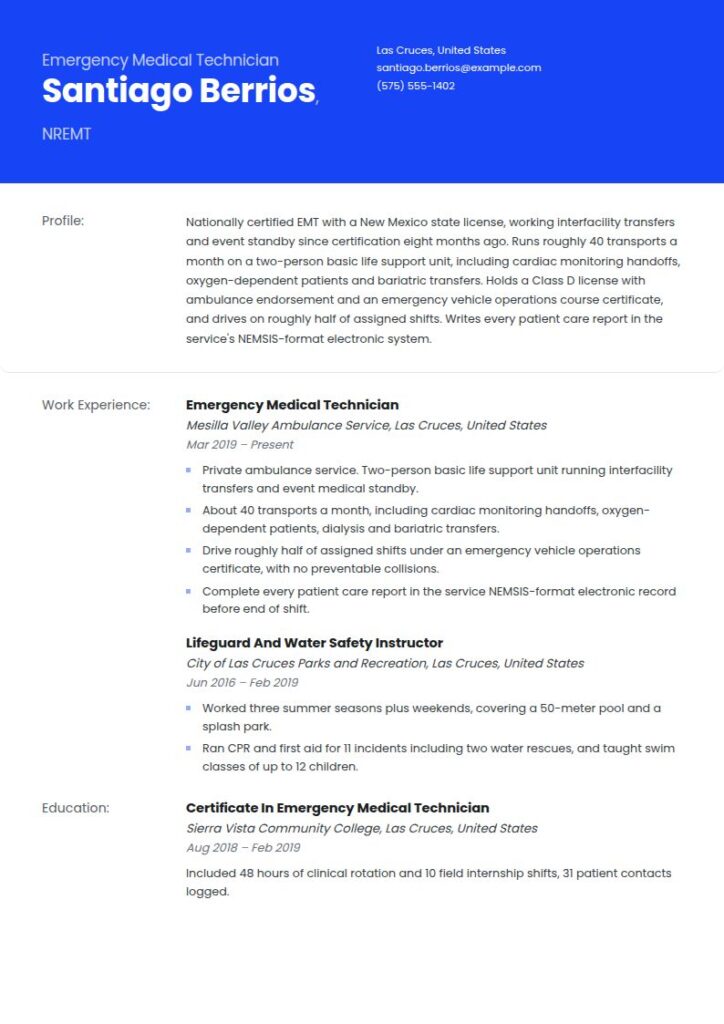
Nationally certified EMT with a New Mexico state license, working interfacility transfers and event standby since certification eight months ago. Runs roughly 40 transports a month on a two-person basic life support unit, including cardiac monitoring handoffs, oxygen-dependent patients and bariatric transfers. Holds a Class D license with ambulance endorsement and an emergency vehicle operations course certificate, and drives on roughly half of assigned shifts. Writes every patient care report in the service's NEMSIS-format electronic system.
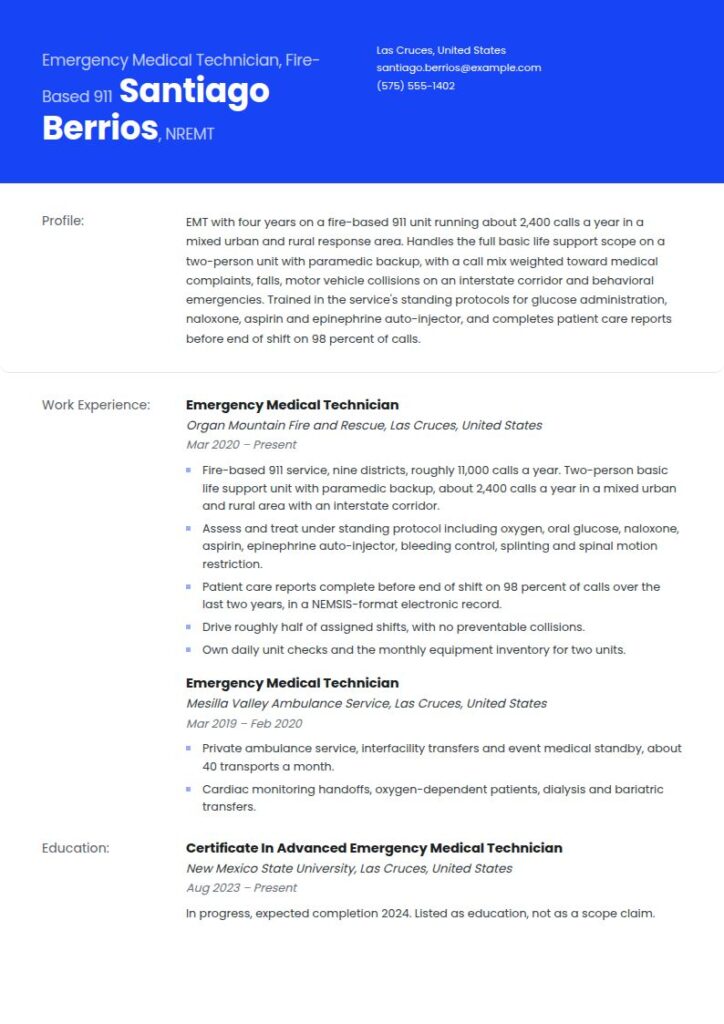
EMT with four years on a fire-based 911 unit running about 2,400 calls a year in a mixed urban and rural response area. Handles the full basic life support scope on a two-person unit with paramedic backup, with a call mix weighted toward medical complaints, falls, motor vehicle collisions on an interstate corridor and behavioral emergencies. Trained in the service's standing protocols for glucose administration, naloxone, aspirin and epinephrine auto-injector, and completes patient care reports before end of shift on 98 percent of calls.
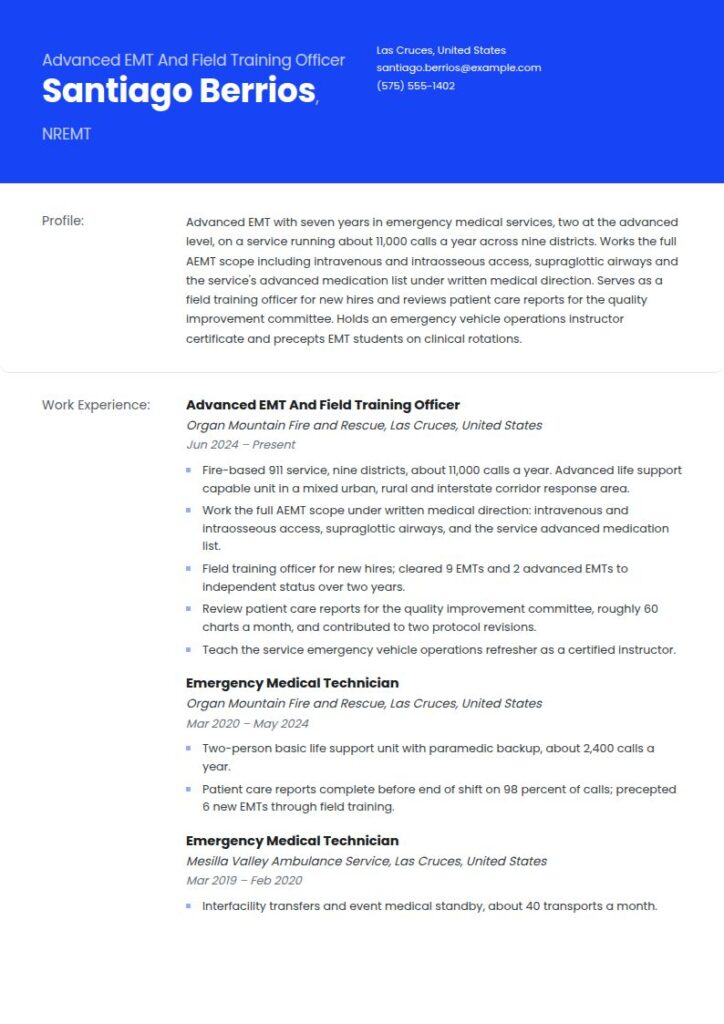
Advanced EMT with seven years in emergency medical services, two at the advanced level, on a service running about 11,000 calls a year across nine districts. Works the full AEMT scope including intravenous and intraosseous access, supraglottic airways and the service's advanced medication list under written medical direction. Serves as a field training officer for new hires and reviews patient care reports for the quality improvement committee. Holds an emergency vehicle operations instructor certificate and precepts EMT students on clinical rotations.
Right vs wrong: the same EMT summary, twice
| ✅ Right | ❌ Wrong |
|---|---|
| EMT with four years on a fire-based 911 unit running about 2,400 calls a year in a mixed urban and rural area. | Experienced EMT dedicated to providing quality patient care in emergency situations. |
| Call mix weighted toward medical complaints, falls, interstate collisions and behavioral emergencies. | Skilled in a wide range of emergency medical procedures and patient assessments. |
| Completes patient care reports before end of shift on 98 percent of calls. | Strong attention to detail and excellent documentation skills. |
For example, the left column gives a hiring officer three usable things: a service model, a volume and a documentation habit. The right column, however, gives nothing they cannot assume about any applicant in the stack.
Outline your field experience
Service, service model, city, dates, then a service profile line, then three to five bullets. In practice, the profile line carries the facts a hiring officer calibrates everything else against.
| Instead of | Use |
|---|---|
| Responded to emergency calls | Ran about 2,400 calls a year on a two-person basic life support unit with paramedic backup |
| Provided patient care in the field | Assessed and treated medical complaints, falls, collisions and behavioral emergencies under standing protocol |
| Transported patients to hospitals | Transported to three receiving facilities including a Level II trauma center and a freestanding emergency department |
| Completed documentation | Wrote every patient care report in a NEMSIS-format electronic record, complete before end of shift on 98 percent of calls |
| Worked well with other agencies | Worked scenes alongside law enforcement, fire suppression and an air medical service on interstate collisions |
| Maintained equipment | Owned daily unit checks, controlled substance seal verification and monthly equipment inventory for two units |
| Trained new staff | Precepted 6 new EMTs through field training, each cleared to independent status |
Emergency Medical Technician, Organ Mountain Fire and Rescue, Las Cruces, NM, March 2020 to Present
Fire-based 911 service, nine districts, roughly 11,000 calls a year across the service. Assigned to a two-person basic life support unit with paramedic backup, running about 2,400 calls a year in a mixed urban and rural response area with an interstate corridor.
Assess and treat under standing protocol including oxygen administration, oral glucose, naloxone, aspirin, epinephrine auto-injector, bleeding control, splinting and spinal motion restriction.
Write every patient care report in the service NEMSIS-format electronic record, complete before end of shift on 98 percent of calls over the last two years.
Drive roughly half of assigned shifts under an emergency vehicle operations certificate, with no preventable collisions.
Precepted 6 new EMTs through field training, each cleared to independent status, and run the monthly equipment inventory for two units.
The certification ladder and the call record you can document
In fact, an EMS hiring officer asks two questions in order: what level are you, and what have you run. Here, then, is how to answer both without overstating either.
Start with the ladder. NREMT certifies at four levels: Emergency Medical Responder, Emergency Medical Technician, Advanced EMT and Paramedic (NREMT, nremt.org, read 16 September 2026). Each is a distinct scope, and scope is what a service buys. Write your level in full and in the abbreviation your state uses, with the certification date.
Then the license, the fact that actually lets you work. All states require EMTs and paramedics to be licensed in the state where they work, and requirements vary by state (BLS Occupational Outlook Handbook, EMTs and paramedics, May 2025). National certification and state licensure are separate facts. Write both: the certification with its level, and the state license with its number and status. Applying across a state line, say where your reciprocity application stands, and never write a pending license as current.
Write the scope you hold, not the one you are working toward. This is the most common error on an EMT resume, and assisting on a skill is not performing it. A paramedic or AEMT program in progress belongs in education with an expected completion date, which is a genuine asset to a service planning staffing a year out.
Then the driving and vehicle side, which applicants underweight. Give your driver's license class and any ambulance endorsement your state issues. Name your emergency vehicle operations training by its actual name, whether an EVOC course, a CEVO course or a service program, with the year. Say what share of shifts you drive and whether your driving record is clean, because a service checks it before it schedules you.
Then the call record, where you separate yourself. Four facts make a call record legible:
- Service model. Fire-based, third service municipal, hospital-based, private ambulance, volunteer, or a mix. A hiring officer calibrates immediately from this word.
- Call type. 911 response, interfacility transfer, event standby, or a split with rough proportions. An applicant who has run 2,000 interfacility transfers has a real and specific skill set, and saying so beats letting a reader assume 911 volume that is not there.
- Volume. Calls a year for your unit, and the service total if you know it. Volume is the fastest signal of how much you have seen.
- Response area. Urban, suburban, rural, frontier, interstate corridor, tribal land, campus. Transport times and resource availability change how a call runs, and this word tells the reader which world you worked in.
Documentation and protocol under medical direction
Then documentation, quietly the most checked skill in the occupation. Patient care reports are a legal record, a billing document and a quality review artifact at once. Say which electronic system you use, say that your reports are NEMSIS-format if they are, and give a completion statistic if your service tracks one. "Reports complete before end of shift on 98 percent of calls" is a line a supervisor believes immediately, because they know how hard it is.
Finally, protocol and medical direction. You work under a medical director's written protocols, and a service wants to know you can operate inside that frame. Name the skills you perform under standing order, and if you have taken part in protocol review or quality improvement, say so. That is a supervisor's line and it is unusual on an EMT page.
Build a snapshot of your key skills
Ten to fourteen entries in three groups: clinical, vehicle and operations, then documentation and systems. Therefore, everything here should survive a skills check.
Clinical: patient assessment and vital signs, bag-valve-mask ventilation, oxygen administration, automated external defibrillation, cardiopulmonary resuscitation to current standards, bleeding control and tourniquet use, splinting and spinal motion restriction, oral glucose, naloxone, aspirin and epinephrine auto-injector under standing protocol, emergency childbirth, extrication assistance
Vehicle and operations: emergency vehicle operation, ambulance daily checks, radio communications and dispatch protocols, incident command system familiarity, multiple casualty incident triage, scene safety and hazard recognition, lifting and moving with powered cot and stair chair
Documentation and systems: NEMSIS-format patient care reporting, ImageTrend, controlled substance seal verification and logging, equipment inventory, HIPAA-compliant handoff and report writing
List your education, certification and licensure
Certification and license first, then driving credentials, then the program that got you there. Indeed, on an EMT resume the certificate outranks the degree, and the typical entry-level education for the occupation is a postsecondary nondegree award (BLS Occupational Outlook Handbook, May 2025).
Emergency Medical Technician, National Registry of Emergency Medical Technicians, certified 2019
Emergency Medical Technician license, New Mexico, #EMS-118240, active
Class D driver's license with ambulance endorsement. Emergency Vehicle Operations Course, completed 2019, refreshed 2023.
Basic Life Support Provider, American Heart Association, current. Prehospital Trauma Life Support, current.
Emergency Medical Technician certificate program, Sierra Vista Community College, Las Cruces, NM, 2019
Advanced EMT program, New Mexico State University, Las Cruces, NM, expected completion 2024
Choose the right layout and design
Finally, keep a single column, 11 or 12 point, plain headings, no photograph, no icons, no color bars. This matters since public sector hiring portals parse your file into a structured record, and certificate numbers and license lines are exactly what a decorative template loses.
Put your certification level, state license number and driving credentials in the header. Open every field job with a service profile line: model, volume, call type and response area. Give call volume as a number per year. Name the patient care reporting system you use. Say what share of shifts you drive. List volunteer and event standby work honestly, with its volume.
Do not write a scope you do not hold, and do not describe assisting on a skill as performing it. Do not list a license as active when the application is pending. Do not write "responded to emergency calls" where a call type and a volume belong. Do not leave your driving credential to the reader's imagination. Do not describe a memorable call in a way that could identify the patient, however long ago it was.
EMT job market and outlook
Overall, this is a large occupation with steady growth and high turnover, which together mean a service is almost always hiring and screening fast.
| Measure | Value |
|---|---|
| EMT jobs, 2025 | 181,900 |
| Paramedic jobs, 2025 | 102,200 |
| EMTs and paramedics together, 2025 | 284,100 |
| Projected change, 2025-35 | 6 percent, 16,400 more jobs |
| Projected annual openings | About 18,200 |
| Typical entry-level education | Postsecondary nondegree award |
| EMT median annual wage, May 2025 | $44,470 |
| Paramedic median annual wage, May 2025 | $60,600 |
Source: U.S. Bureau of Labor Statistics, Occupational Outlook Handbook, EMTs and paramedics, May 2025 wages with 2025 to 2035 projections.
Where EMTs work, and why it decides your resume
Ambulance services employ 46 percent of EMTs, local government 24 percent, private hospitals 16 percent, local hospitals 3 percent and outpatient care centers 2 percent (BLS Occupational Outlook Handbook, EMTs and paramedics, May 2025).
The median annual wage moves sharply with that setting. For EMTs in May 2025 it was $67,560 in outpatient care centers, $47,160 in private hospitals, $45,780 in local government, $42,260 in ambulance services and $41,650 in local hospitals (BLS Occupational Outlook Handbook, EMTs and paramedics, May 2025).
Read those lists together and the strategy becomes clear. Nearly half the jobs sit in the setting with the lowest published median, and the settings paying above it are smaller and harder to enter. That is the argument for a resume that travels: a call record credible to a fire-based service, a hospital-based service and a private operator alike, which means service model, volume, call type and response area on every entry.
What salary you can expect as an EMT
The median annual wage for EMTs was $44,470 as of May 2025, with the lowest 10 percent earning less than $34,130 and the highest 10 percent more than $62,500 (BLS Occupational Outlook Handbook, EMTs and paramedics, May 2025).
Specifically, the clearest published route upward inside the occupation is the certification ladder. Paramedics had a median annual wage of $60,600 in May 2025, with the lowest 10 percent earning less than $44,230 and the highest 10 percent more than $84,850 (BLS Occupational Outlook Handbook, EMTs and paramedics, May 2025). That gap between the EMT median and the paramedic median is the single largest lever most people in this occupation have, and that is why a paramedic program in progress belongs on your page with its expected completion date.
Setting, meanwhile, is the other lever, with published EMT medians running from $41,650 in local hospitals to $67,560 in outpatient care centers as of May 2025 (BLS, May 2025). The resume that opens doors across settings is the one with a legible call record rather than a longer list of adjectives.
Beyond those two, what a resume moves is narrower but real: a field training officer role, a specialty team assignment, an instructor credential, a driving credential that lets a scheduler use you on any shift, and documentation clean enough to survive a billing audit. In short, those are the lines that get an applicant hired ahead of someone certified at the same level in the same month.
Key takeaways for an EMT resume
- Put your certification level, state license number and driving credentials in the header.
- Write the scope you hold, and instead keep the program you are enrolled in as an education line.
- Also keep national certification and state licensure as two separate facts.
- Then open every field job with a service profile line: model, volume, call type, response area.
- In addition, give call volume as a number per year, for your unit and for the service.
- Name your patient care reporting system, and give a completion statistic if you have one.
- Finally, list volunteer and event standby work honestly, with its volume attached.
Build your EMT resume in 15 minutes with our AI resume builder.
Related medical resume examples
- Paramedic resume
- ER nurse resume
- CNA resume
- Nursing assistant resume
- Medical assistant resume
- Phlebotomist resume
- Respiratory therapist resume
- Surgical tech resume
- Medical scribe resume
- Home health aide resume
- Nursing student resume
- Healthcare resume
Pair it with a matching EMT cover letter.
EMT resume questions, answered
How long should an EMT resume be?
One page. Two only if you hold a field training officer role, a specialty team assignment or an instructor credential worth listing. Hiring officers read stacks of these against a posting with a closing date, and a second page is rarely read.
What is the difference between certification and licensure for an EMT?
Certification is issued by a certifying body, and NREMT certifies at four levels: Emergency Medical Responder, EMT, Advanced EMT and Paramedic (NREMT, read 16 September 2026). Licensure is issued by a state, and all states require EMTs and paramedics to be licensed in the state where they work, with requirements varying by state (BLS Occupational Outlook Handbook, May 2025). Put both on the page as separate lines, each with its number or level.
Does volunteer EMS experience count on a resume?
Yes, and it should be labeled as volunteer rather than disguised. What makes it count is what makes paid work count: service model, call volume, call types and response area. A volunteer on a rural service with long transport times has often seen more independent decision-making than a new hire in a dense urban system.
What do I put on an EMT resume with no field experience?
Your certification and license with their numbers, your clinical and field internship hours from the certificate program with the call count if you tracked it, your driving credentials, and any related work where you handled people under pressure. Then be specific about availability: a service scheduling twenty-four hour shifts values a clear answer more than applicants expect.
Should I put my paramedic program on my EMT resume?
Yes, as an education line with an expected completion date, never as a scope claim. A service planning staffing a year out reads an in-progress paramedic program as a reason to hire and keep you. Written as if you already held the credential, it is the fastest way to lose the offer.
How do I write the calls I have run without breaking patient privacy?
Write categories and numbers, never cases. "About 2,400 calls a year, weighted toward medical complaints, falls, interstate collisions and behavioral emergencies" tells a hiring officer everything they need. A narrative about one memorable call tells them you will discuss patients outside the record.