Paramedic, 911 Response Trevor Blanchard NRP
Paramedic, 911 Response
[email protected] | (210) 555-1114 | San Antonio, United States
Profile
Nationally Registered Paramedic and Texas-licensed EMS Paramedic, newly released to a 911 unit after 18 months as an EMT in the same system. Completed a CAAHEP-accredited paramedic program with 612 clinical and field internship hours, including 52 team lead contacts and 21 advanced airway placements. Now running roughly 9 calls a shift on an urban ambulance covering a 42-square-mile district, credentialed to the service's full advanced life support protocol set.
Work Experience
06/2019 - Present, Paramedic, 911 Response, Bexar Valley EMS, San Antonio, United States
- Run roughly 9 calls a shift on an urban advanced life support unit covering a 42-square-mile district.
- Credentialed to the service's full advanced life support protocol set by the medical director following a 12-week release process.
- Team lead on 11 cardiac arrests and 38 trauma activations in the first six months.
- Document every contact in the service's NEMSIS-compliant patient care reporting system, with all reports reviewed at monthly quality assurance.
11/2017 - 06/2019, Emergency Medical Technician, Bexar Valley EMS, San Antonio, United States
- 18 months on 911 and interfacility units in the same system, roughly 1,600 patient contacts.
- Assisted on advanced life support calls, including airway setup, 12-lead acquisition and medication draw-up under paramedic direction.
- Completed the paramedic field internship with this service while employed as an EMT.
Education
08/2017 - 05/2019, Associate of Applied Science, Emergency Medical Services Paramedicine, San Antonio College, San Antonio, United States
CAAHEP-accredited paramedic program. 612 clinical and field internship hours, 52 team lead contacts and 21 advanced airway placements.
Skills
Advanced airway management, 70
12-lead ECG acquisition and interpretation, 75
Manual defibrillation and transcutaneous pacing, 70
Intraosseous access, 75
Waveform capnography, 75
Mass casualty triage and incident command, 65
NEMSIS-compliant patient care reporting, 85
Languages
English, native
Spanish, intermediate
Certificates
05/2019, NREMT Paramedic, National Registry of Emergency Medical Technicians, P4182960
Current through March 2028. Recertified through the National Continued Competency Program, 60 credits per two-year cycle.
06/2019, Texas EMS Paramedic license, Texas Department of State Health Services, TX-EMSP-418602
Current through August 2027.
04/2019, ACLS, PALS and PHTLS provider, American Heart Association and NAEMT
All current.
Summary
A paramedic resume is a one to two page document naming your certification level, your state license, the service types you have worked and the call volume behind them. This guide gives you three adaptable versions for the new, experienced and critical care stages, the certification and call-type block most applicants leave out, and current Bureau of Labor Statistics pay for paramedics rather than for EMTs.
Paramedic resume examples by experience level
A paramedic resume is a one to two page document naming your certification level, your state license, the kinds of calls you have actually run, and the medical director whose protocols you practiced under.
In short, what separates it from an EMT resume is scope. Specifically, a paramedic holds advanced life support: drug administration, advanced airway management, cardiac monitoring and interpretation, and the judgment to choose between them under time pressure. An operations chief filling a medic seat is hiring that scope, not an ambulance shift, so the resume has to show the scope being used rather than the shift being worked.
Resume guide for a paramedic resume
To help, this guide and the corresponding paramedic resume example will cover:
- How to write a paramedic resume, section by section
- How to write certification level and state license so they are verifiable on arrival
- Three adaptable summaries: new medic, experienced field medic and critical care
- Why the service type matters more than the years
- What the job market looks like and what paramedics specifically earn
How to write a paramedic resume
Overall, it takes six sections: contact header, certification and license block, summary, field experience with call type and volume, skills and procedures, education and specialty credentials.
The certification block goes first because it is a gate. A service cannot put you on a unit until the state license is verified and the medical director has credentialed you, so the file that lets both start on day one moves fastest.
| Section | What it is answering | Where it goes |
|---|---|---|
| Certification and license | What level, in which state, and is it current? | Under the contact header |
| Service and call type | 911, interfacility, critical care, flight, tactical, event? | In each experience heading |
| Call volume | How busy was the system they came from? | First bullet of each role |
| Clinical procedures | Which advanced skills have they performed? | Its own block, with frequencies |
| Protocols and medical director | Whose scope were they practicing under? | One line per employer |
Write certification and license as two separate lines, because they are two different things
The National EMS Scope of Practice Model is explicit: "certification is an external verification of the competencies that an individual has achieved and typically involves an examination process", while "licensure represents legal authority granted to an individual by the State to perform certain restricted activities" (National Highway Traffic Safety Administration, February 2019).
So write both: "NREMT Paramedic, #P4182960, current through March 2028. Texas EMS Paramedic license #TX-EMSP-418602, current through August 2027." National Registry certification is not a license to practice in your state, and a state license is not portable, so giving only one leaves a recruiter with an unanswered question.
Add a third line if you have it: medical director credentialing. The same document notes that "EMS personnel do however, practice under the oversight of physician medical directors" and that credentialing is "a clinical determination that is the responsibility of a physician medical director". Naming the protocols you were credentialed to tells an operations chief how much onboarding you will skip.
Run the finished file through the ATS resume checker before you submit. Municipal and hospital systems parse applications into a structured record first, and certification numbers in a header graphic do not survive that.
Choosing the best resume format for a paramedic resume
For format, use reverse chronological, one page for your first five years and two once you hold a specialty credential, a field training officer role or a supervisory line.
Functional formats fail because EMS hiring is a continuity check. Services want to see where you worked, for how long, in what system, and whether the timeline has gaps. After all, a format without dates reads as a timeline someone is hiding, and background investigations in this field are thorough.
Applying to a fire-based service, keep the certification block and add fire certifications underneath rather than mixing them. Note also that a single-role medic seat and a firefighter-paramedic seat are screened for different things.
Include your contact information
| ✅ Right | ❌ Wrong |
|---|---|
| Trevor Blanchard, NRP | Trevor Blanchard |
| Paramedic, Critical Care Transport | EMS professional |
| NREMT Paramedic #P4182960; Texas EMS Paramedic license #TX-EMSP-418602 | Certified paramedic |
| (210) 555-1114, [email protected], San Antonio, TX | (210) 555-1114, [email protected] |
Put both numbers on the page. Human resources verifies them anyway, and a file that can be checked in ten seconds gets scheduled ahead of one needing an email first. Use the credential properly: NRP is the National Registry Paramedic designation, so do not write it if you hold only a state license, and do not write EMT-P as though it were the current national level.
Make use of a summary
First, write four lines: certification level and license, service type and system size, call volume, and one thing showing advanced life support judgment.
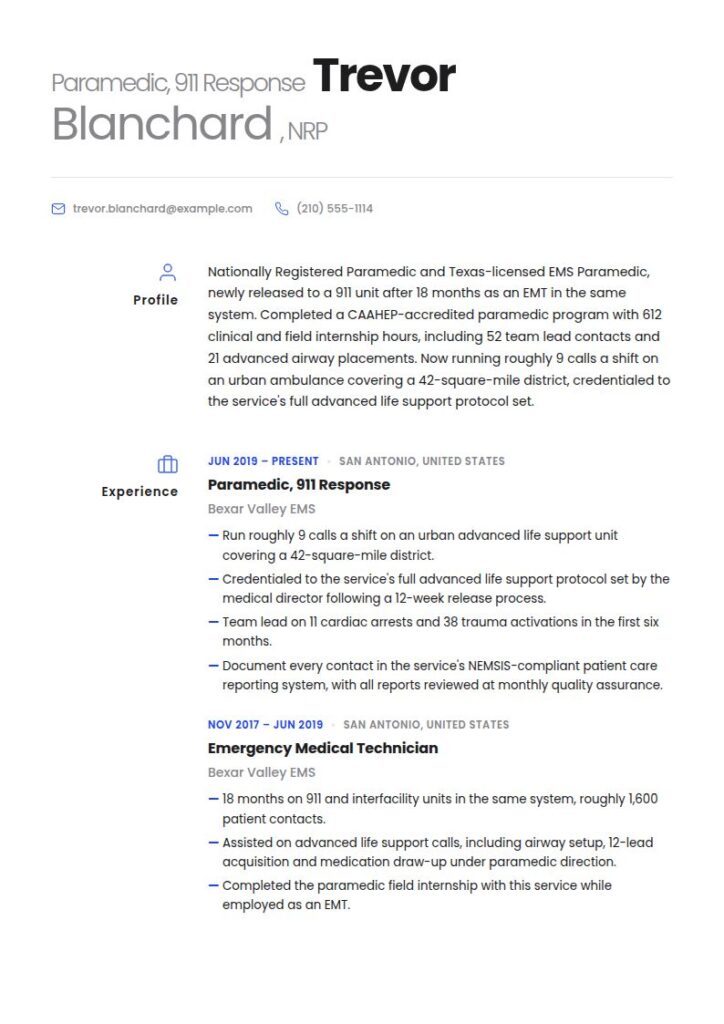
Nationally Registered Paramedic and Texas-licensed EMS Paramedic, newly released to a 911 unit after 18 months as an EMT in the same system. Completed a CAAHEP-accredited paramedic program with 612 clinical and field internship hours, including 52 team lead contacts and 21 advanced airway placements. Now running roughly 9 calls a shift on an urban ambulance covering a 42-square-mile district, credentialed to the service's full advanced life support protocol set.
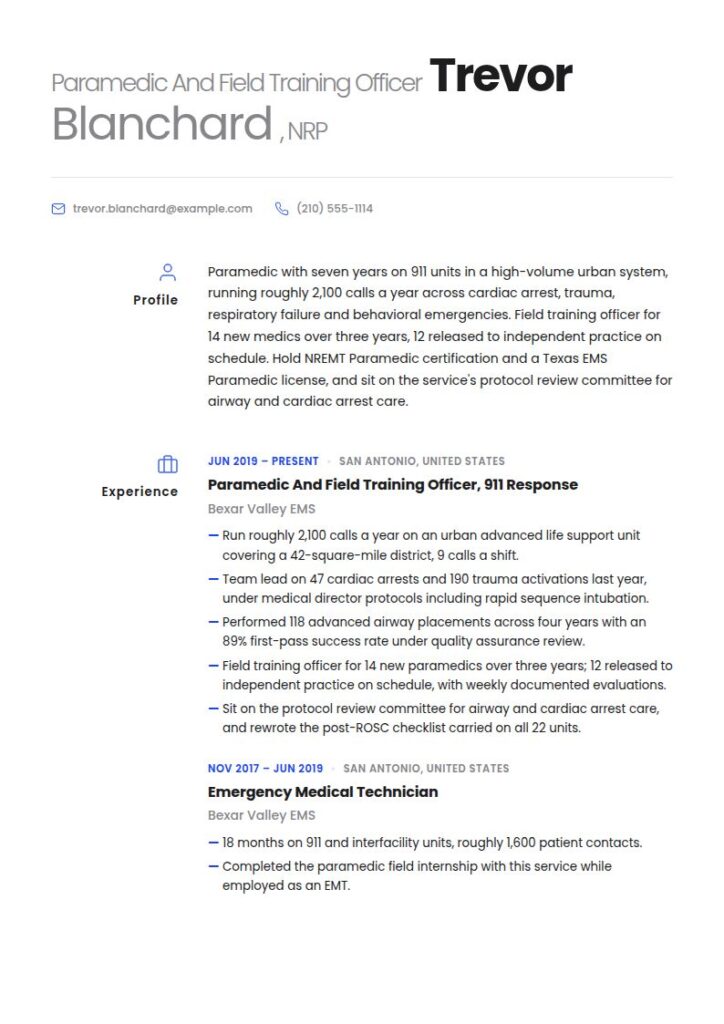
Paramedic with seven years on 911 units in a high-volume urban system, running roughly 2,100 calls a year across cardiac arrest, trauma, respiratory failure and behavioral emergencies. Field training officer for 14 new medics over three years, 12 released to independent practice on schedule. Hold NREMT Paramedic certification and a Texas EMS Paramedic license, and sit on the service's protocol review committee for airway and cardiac arrest care.
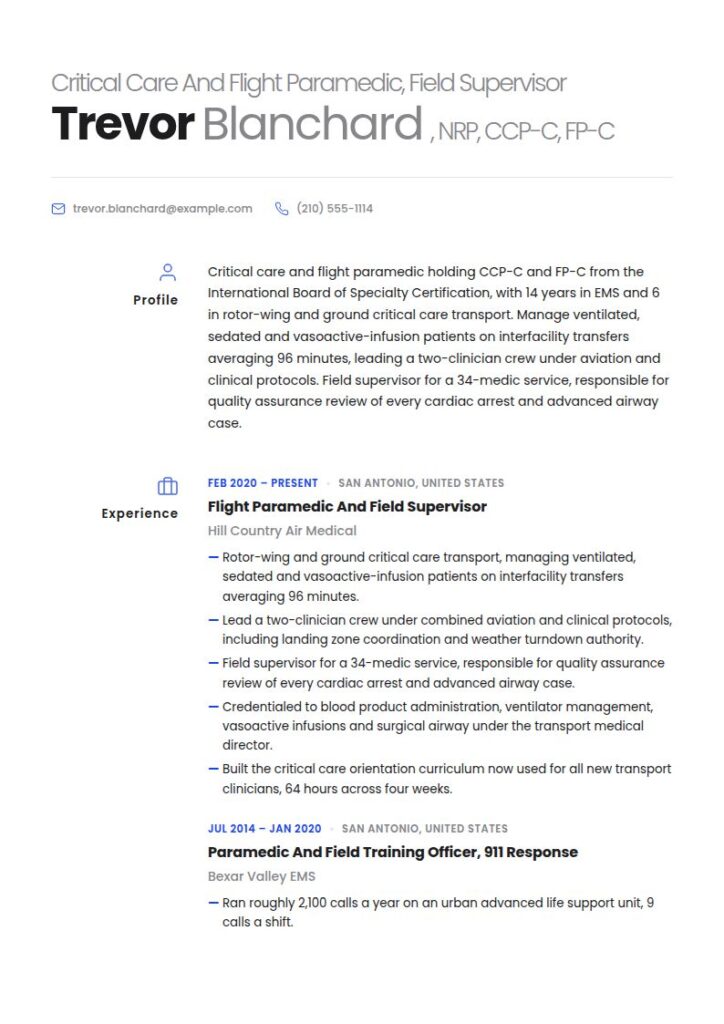
Critical care and flight paramedic holding CCP-C and FP-C from the International Board of Specialty Certification, with 14 years in EMS and 6 in rotor-wing and ground critical care transport. Manage ventilated, sedated and vasoactive-infusion patients on interfacility transfers averaging 96 minutes, leading a two-clinician crew under aviation and clinical protocols. Field supervisor for a 34-medic service, responsible for quality assurance review of every cardiac arrest and advanced airway case.
Right vs wrong: the same paramedic summary, twice
| ✅ Right | ❌ Wrong |
|---|---|
| Paramedic with seven years on 911 units in a high-volume urban system, roughly 2,100 calls a year. | Experienced paramedic with a strong work ethic and a passion for helping people. |
| Field training officer for 14 new medics; 12 released to independent practice on schedule. | Trained and mentored new staff members. |
| Sit on the protocol review committee for airway and cardiac arrest care. | Committed to providing high quality patient care. |
As a result, the right column tells an operations chief what system you came from and what you can be trusted with in theirs. By contrast, the wrong column could have been written by an EMT, a dispatcher or a student.
Outline your experience
Service, service type, city, dates, then four to six bullets. In practice, the first gives call volume and unit type; the rest give procedures, roles and outcomes, with numbers where the system tracked them.
| Instead of | Use |
|---|---|
| Responded to emergency calls and provided patient care | Ran roughly 2,100 911 calls a year on an urban ALS unit covering a 42-square-mile district |
| Administered medications as needed | Performed 118 advanced airway placements over four years, 89% first-pass success under quality review |
| Worked well under pressure | Team lead on 47 cardiac arrests in a year, each reviewed case by case at monthly quality assurance |
| Trained new employees | Field training officer for 14 new paramedics; 12 released to independent practice on schedule |
| Transported patients between facilities | Managed ventilated and vasoactive-infusion patients on transfers averaging 96 minutes, two-clinician crew |
| Followed protocols | Credentialed to the full ALS protocol set including RSI, and sat on the airway protocol review committee |
Paramedic, 911 Response, Bexar Valley EMS, San Antonio, TX, June 2019 to Present
Run roughly 2,100 calls a year on an urban advanced life support unit covering a 42-square-mile district, 9 calls a shift.
Team lead on 47 cardiac arrests and 190 trauma activations last year, under medical director protocols including rapid sequence intubation.
Performed 118 advanced airway placements across four years with an 89% first-pass success rate under quality assurance review.
Field training officer for 14 new paramedics over three years; 12 released to independent practice on schedule, with weekly documented evaluations.
Sit on the protocol review committee for airway and cardiac arrest care, and rewrote the post-ROSC checklist carried on all 22 units.
Maintain NREMT certification through the National Continued Competency Program, 60 credits a cycle.
Say your certification level, and the calls you actually ran
In practice, this block separates a paramedic resume from an EMT resume. Specifically, it makes two claims: what you are authorized to do, and what you have been doing.
The national ladder. The National EMS Scope of Practice Model published by the National Highway Traffic Safety Administration in February 2019 sets four levels: Emergency Medical Responder, Emergency Medical Technician, Advanced Emergency Medical Technician and Paramedic. The Paramedic applies "basic and advanced knowledge and skills necessary to determine patient physiologic, psychological, and psychosocial needs", administers medications, and interprets "diagnostic findings to implement treatment", with "complex judgments" and interventions using "the basic and advanced equipment typically found on an ambulance, including diagnostic equipment approved by an agency medical director". Write your level by its correct name: EMT-P and medic are informal, Paramedic is the level.
Certification against license. Both belong on the page with numbers and expiry dates. National Registry Paramedic certification runs on a two-year cycle, and the National Continued Competency Program "requires a total of sixty (60) credits of continuing education to recertify", fifteen of them a local or state component and fifteen an individual component, both of which "must be directly related to EMS patient care" (National Registry of Emergency Medical Technicians). Since 1 January 2013 the Registry has required initial paramedic applicants to have "successfully completed education from an accredited program or one that is seeking accreditation sponsored by the Commission on Accreditation of Allied Health Education Programs (CAAHEP)", so name your program's accreditation.
Name every paramedic service type you worked
The service type, the part most files leave out. Paramedic work is not one job, and the national record shows how it splits: of 54,190,579 EMS activations in the 2023 National EMS Data Report, 36,367,261 were 911 response at scene, 79.0 percent of service types, while interfacility transport accounted for 4,179,580, or 9.1 percent, across 14,369 agencies in 54 states and territories (NEMSIS, 2023 National EMS Data Report). A hiring manager for an interfacility critical care service is reading for the 9 percent, not the 79.
So name every service type you have worked as its own line: 911 response, interfacility transport, critical care transport, rotor-wing or fixed-wing flight, tactical support, event standby, industrial standby, community paramedicine. In other words, each is a different clinical rhythm, and a service hiring for one is looking for evidence of that one.
Volume, protocols and the medical director. Call volume is the cheapest way to convey what system you came from: an urban medic at 9 calls a shift and a rural medic at 3 have different skills and both know it. Give annual or per-shift numbers, unit type and district. Then name the scope you were credentialed to. Rapid sequence intubation, blood product administration, ventilator management, vasoactive infusions, surgical airway and prehospital ultrasound are not universal; a medical director credentials them service by service. Listing them, with the oversight, is the difference between a resume that reads as a scope and one that reads as a shift pattern.
Critical care and flight credentials
Above the field medic level. The critical care and flight credentials come from the International Board of Specialty Certification. The Certified Flight Paramedic examination "consists of 110 scored items and 25 unscored items" over two and a half hours, aimed at "accomplished, experienced master-level paramedics currently working with a Flight and/or Critical Care Transport Team(s)"; the Certified Critical Care Paramedic examination "consists of 135 questions (110 scored and 25 unscored pilot items)" for "master-level paramedics who have experience working as a critical care paramedic" (International Board of Specialty Certification). If you hold either, write the credential, the issuing body, the expiry and the transport modality.
Certification: NREMT Paramedic #P4182960, current through March 2028. Recertified through the National Continued Competency Program, 60 credits a cycle.
License: Texas EMS Paramedic #TX-EMSP-418602, current through August 2027.
Specialty credentials: CCP-C and FP-C, International Board of Specialty Certification. ACLS, PALS and PHTLS current.
Service types worked: 911 response (urban, 7 years). Interfacility transport (3 years). Ground critical care transport (4 years). Rotor-wing flight (2 years). Event standby.
Volume and system: 42-square-mile urban district, roughly 2,100 calls a year, 9 a shift, 22 ALS units. Critical care transfers averaging 96 minutes.
Credentialed scope: Full ALS protocol set including rapid sequence intubation, blood product administration, ventilator management and vasoactive infusions, under the medical director.
Build a snapshot of your key skills
For skills, list twelve to sixteen entries in four groups: advanced life support procedures, assessment and diagnostics, operations, and the systems you document in.
Advanced life support: Rapid sequence intubation, Supraglottic and surgical airway, Needle thoracostomy, Intraosseous access, Manual defibrillation, Transcutaneous pacing
Assessment: 12-lead ECG acquisition and interpretation, STEMI and stroke field identification, Waveform capnography, Ventilator management, Vasoactive infusion titration
Operations: Incident command system, Mass casualty triage, Extrication support, Hazardous materials awareness, Rotor-wing safety and landing zone coordination
Systems: NEMSIS-compliant patient care reporting, CAD and mobile data terminals, Controlled substance accountability, Quality assurance case review
List your education and certifications
Paramedic program first with its accreditation, then certification and license, then specialty credentials, then instructor cards. Accreditation is worth naming because it is a Registry eligibility requirement, not a nicety.
Associate of Applied Science, Emergency Medical Services Paramedicine, San Antonio College, San Antonio, TX, 2019. CAAHEP-accredited program; 612 clinical and field internship hours, 52 team lead contacts, 21 advanced airway placements.
NREMT Paramedic, National Registry of Emergency Medical Technicians, #P4182960, current through March 2028
Texas EMS Paramedic license, Texas Department of State Health Services, #TX-EMSP-418602, current through August 2027
Specialty: CCP-C (2023) and FP-C (2024), International Board of Specialty Certification
Provider and instructor cards: ACLS, PALS, PHTLS, BLS Instructor (2022)
Choose the right layout and design
For layout, use a single column, 11 or 12 point, plain headings, no photograph and no graphics. That is because municipal portals and hospital systems parse the file into a structured record, and certification numbers inside a design element are numbers nobody can verify.
Put NREMT certification and state license on separate lines with numbers and expiry dates. Name your program's accreditation. Give call volume per year or per shift, and the district. List every service type you have worked as its own line. Name the advanced procedures you were credentialed to and the medical director oversight. Write the level as Paramedic.
Do not write "EMT-P" as though it were the current national level; the four levels are EMR, EMT, AEMT and Paramedic. Do not claim NRP if you hold only a state license. Do not describe a patient or a specific call in a way that could identify anyone. Do not list an expired card without saying it is expired. Do not pad the file with every eight-hour class you have sat.
Paramedic job market and outlook
Overall, it is a growing occupation with high turnover and a wide pay gap between the two certification levels it contains.
| Measure | Value |
|---|---|
| EMT and paramedic jobs, 2025 | 284,100 |
| Projected change, 2025-35 | 6%, an increase of 16,400 |
| Projected annual openings | About 18,200 |
| Typical entry-level education | Postsecondary nondegree award |
| Median annual wage, paramedics, May 2025 | $60,600 |
| Median annual wage, EMTs, May 2025 | $44,470 |
Source: U.S. Bureau of Labor Statistics, Occupational Outlook Handbook, 2025-35 projections and May 2025 wage data.
The ladder is where the money is, and it is steep
The Bureau of Labor Statistics reports EMTs and paramedics together for employment and outlook but separately for pay, and the gap is the most important number in this occupation. The median annual wage for paramedics was $60,600 as of May 2025; for EMTs it was $44,470 (BLS, Occupational Outlook Handbook, May 2025). A difference of $16,130 a year at the median, often in the same building.
The certification population is shaped the same way. The National Registry reported passing 500,000 nationally certified EMS clinicians in March 2023, of whom more than 340,000 were EMTs and 126,500 paramedics, alongside 23,000 AEMTs and 13,000 EMRs (National Registry of Emergency Medical Technicians, March 2023).
Roughly one certified clinician in four is a paramedic. That scarcity is what your resume trades on, so the certification block should never be somewhere a reader has to hunt for.
For reference, here is where paramedics work, and what each pays:
| Setting | Median annual wage, paramedics (May 2025) |
|---|---|
| Local government | $61,980 |
| Hospitals; private | $61,370 |
| Ambulance services | $60,040 |
Source: U.S. Bureau of Labor Statistics, Occupational Outlook Handbook, May 2025 wage data.
What salary you can expect as a paramedic
The median annual wage for paramedics specifically was $60,600 as of May 2025, with the lowest 10 percent earning less than $44,230 and the highest 10 percent more than $84,850 (BLS, Occupational Outlook Handbook, May 2025). That is the paramedic figure, not the combined one: EMTs had a median of $44,470 over the same period, with a top decile above $62,500 (BLS, May 2025).
However, across settings the paramedic spread is narrow. For example, local government paid a median of $61,980, private hospitals $61,370 and ambulance services $60,040 (BLS, May 2025). Base pay is usually a published municipal or contract scale, so negotiation room is small and sits mostly in shift differentials, overtime and stipends.
That is why the resume's job is to move you up the ladder rather than along the scale. Instead, the steps that pay are the specialty ones: critical care and flight credentials, a field training officer role, a supervisory line, tactical assignment, community paramedicine, and instructor cards that let you teach. Each is awarded against documentation, so listing the credential, the service type and the volume is what makes you eligible in this round rather than the next one.
Key takeaways for a paramedic resume
- First, put NREMT certification and state license on separate lines, with numbers and expiry dates.
- Also, write the level by its correct name: Paramedic, not EMT-P.
- Then name every service type you have worked; the calls are the job, not the hours.
- In addition, give call volume per shift or per year, plus unit type and district.
- Also, name the procedures you were credentialed to and the oversight you worked under.
- Say your paramedic program was CAAHEP-accredited if it was.
- Finally, group provider cards on one line and keep the file to two pages.
Build your paramedic resume in 15 minutes with our AI resume builder.
Related medical resume examples
- EMT resume
- ER nurse resume
- ICU nurse resume
- Respiratory therapist resume
- Nurse resume
- Physician assistant resume
- Surgical tech resume
- Phlebotomist resume
- CNA resume
- Nursing assistant resume
- Home health aide resume
- Medical assistant resume
Pair it with a matching paramedic cover letter.
Paramedic resume questions, answered
How long should a paramedic resume be?
One page for your first five years, two once you hold a specialty credential, a field training officer role or a supervisory line. Group provider cards on a single line rather than listing each one; that is what pushes these files to three pages.
What is the difference between a paramedic resume and an EMT resume?
Scope, and the resume has to show it. The National EMS Scope of Practice Model places the Paramedic at the top of a four-level ladder, with authority to administer medications, interpret diagnostic findings and make complex judgments using advanced equipment approved by an agency medical director (NHTSA, February 2019). An EMT resume shows patient contacts; a paramedic resume shows advanced life support decisions, credentialed procedures and the protocols behind them.
Should I list both my NREMT certification and my state license?
Yes, as separate lines with numbers and expiry dates. They are different instruments: certification verifies competencies through an examination, licensure is legal authority granted by a state (NHTSA, National EMS Scope of Practice Model, February 2019). Registry certification does not by itself let you work in a given state, and a state license is not portable.
How do I show results when outcomes are not mine alone?
Use what your service reviews. Call volume and unit type, team lead contacts, advanced airway attempts and first-pass success rate, cardiac arrest cases run, quality assurance outcomes, protocol work, students precepted and released, and response or turnaround times where the service publishes them. Never describe an individual patient or a specific call in identifiable detail.
What do I write with no paid paramedic experience yet?
Write the internship as a job. The program and its CAAHEP accreditation, clinical and field hours, team lead contacts, advanced airway placements, the services you rode with and their call volume. Then certification and license with numbers, the service types you are ready for, and any prior EMT time in the same system, which shows you already know the geography and the radio.
Does critical care or flight certification change what I should apply for?
Yes, and it should change the top of the page. CCP-C and FP-C from the International Board of Specialty Certification are aimed at experienced paramedics already working in critical care or flight transport, and both examinations carry 110 scored items. Lead with the credential and the transport modality, because interfacility and flight services hire from a much smaller pool than 911 services.