Emergency Registered Nurse Nadira Balakrishnan BSN, RN
Emergency Registered Nurse, Fast Track and Low-Acuity Pods
[email protected] | (813) 555-1408 | Tampa, United States
Profile
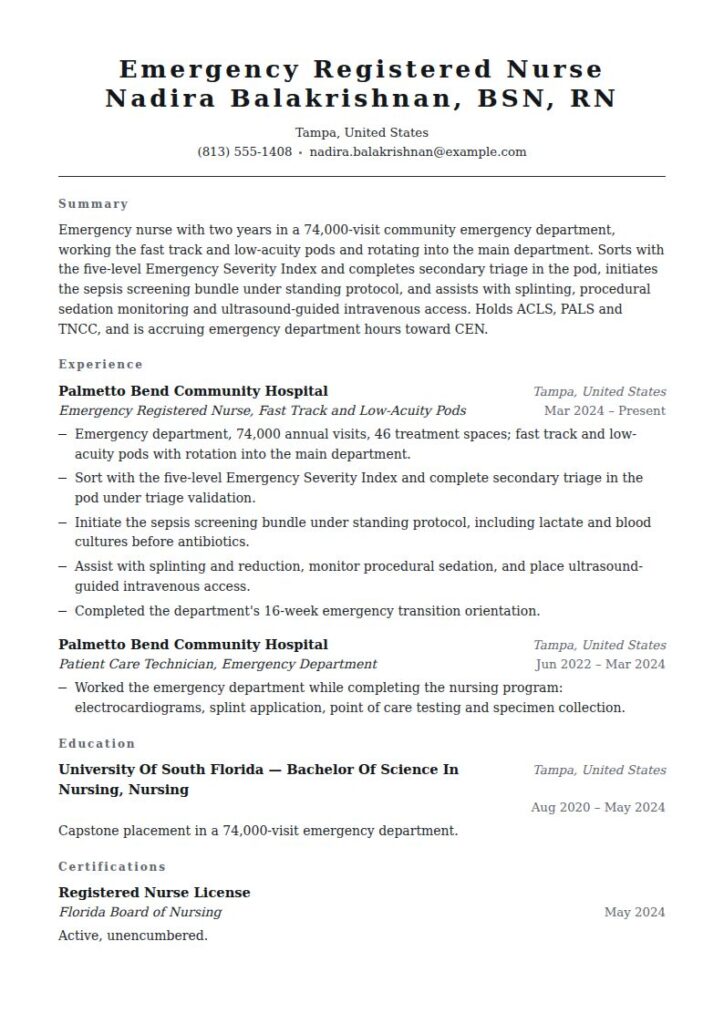
Emergency nurse with two years in a 74,000-visit community emergency department, working the fast track and low-acuity pods and rotating into the main department. Sorts with the five-level Emergency Severity Index and completes secondary triage in the pod, initiates the sepsis screening bundle under standing protocol, and assists with splinting, procedural sedation monitoring and ultrasound-guided intravenous access. Holds ACLS, PALS and TNCC, and is accruing emergency department hours toward CEN.
Work Experience
03/2024 - Present, Emergency Registered Nurse, Fast Track and Low-Acuity Pods, Palmetto Bend Community Hospital, Tampa, United States
- Emergency department, 74,000 annual visits, 46 treatment spaces; fast track and low-acuity pods with rotation into the main department.
- Sort with the five-level Emergency Severity Index and complete secondary triage in the pod under triage validation.
- Initiate the sepsis screening bundle under standing protocol, including lactate and blood cultures before antibiotics.
- Assist with splinting and reduction, monitor procedural sedation, and place ultrasound-guided intravenous access.
- Completed the department's 16-week emergency transition orientation.
06/2022 - 03/2024, Patient Care Technician, Emergency Department, Palmetto Bend Community Hospital, Tampa, United States
- Worked the emergency department while completing the nursing program: electrocardiograms, splint application, point of care testing and specimen collection.
Education
08/2020 - 05/2024, Bachelor of Science in Nursing, Nursing, University of South Florida, Tampa, United States
Capstone placement in a 74,000-visit emergency department.
Skills
Emergency Severity Index triage, 70
Sepsis screening and bundle initiation, 80
Splinting and reduction assistance, 80
Procedural sedation monitoring, 70
Ultrasound-guided intravenous access, 75
Point of care testing, 85
Epic ASAP documentation, 85
Languages
English, native
Tamil, fluent
Spanish, intermediate
Certificates
05/2024, Registered Nurse License, Florida Board of Nursing, RN-9414725
Active, unencumbered.
02/2025, Trauma Nursing Core Course (TNCC), Emergency Nurses Association
Current.
05/2025, Advanced Cardiovascular Life Support and Pediatric Advanced Life Support, American Heart Association
Both current.
Summary
An ER nurse resume is a one to two page document naming the department you worked, its volume and trauma designation, the acuity you triage at, and the time-bound bundles you start under standing protocol. This guide gives you three adaptable versions, the triage and clock block almost nobody writes, and current Bureau of Labor Statistics pay and outlook for registered nurses.
ER Nurse resume examples by experience level
An ER nurse resume is a one to two page document that names the department you worked in, how much of it came through the door, what acuity you can sort at, and what you start before anyone has written an order.
In short, an emergency department reads a resume for two abilities. The first is whether you can sort: put an accurate acuity on a patient in two minutes, with incomplete information, while three more wait behind them. The second is whether you can move: start the timed work of a sepsis, stroke, STEMI or trauma presentation on a clock that began before you met the patient. Everything else on the page, therefore, is supporting evidence.
Resume guide for an ER nurse resume
Specifically, this guide and the corresponding ER nurse resume example will cover:
- How to write an ER nurse resume, block by block
- Why department volume and acuity belong above your bullets
- Three adaptable summaries: new ER nurse, experienced, and senior
- How to write the time-bound bundles you run under standing protocol
- What Bureau of Labor Statistics data shows about pay and growth
How to write an ER nurse resume
Overall, it takes six blocks: contact header, summary, licensure and certification, emergency experience with a department line, a triage and clock block, and education. In general, use one page for your first three years, then two once you hold CEN, triage independently or precept.
In practice, the order follows how an emergency nurse manager reads. License and course cards are gates. The department line says whether your department resembles theirs. Above all, the triage and clock block separates two nurses with the same years.
| Section | What it is answering | Where it goes |
|---|---|---|
| License and course cards | Licensed, and current in ACLS, PALS, TNCC and ENPC? | Header and the first block |
| Department line | Annual volume, trauma designation, zone, beds | First line of every emergency role |
| Triage | What acuity do they sort at, and on what system? | Its own block |
| The clock | Which timed bundles do they start without an order? | Same block, by name |
| Procedures | What can they set up and assist with unprompted? | Short list |
Put the department’s annual volume in the first line of the job
Emergency departments are compared by volume, and nurses who have worked in them compare that way instinctively. A 28,000-visit community department and a 96,000-visit urban department are different jobs with different acuity mixes, boarding problems and staffing.
So write it: "Emergency department, 74,000 annual visits, 46 treatment spaces, 8-bed resuscitation and trauma area." Then your zone or pod, because a nurse who has worked resuscitation and one who has worked fast track write the same job title and do different work.
Put the trauma designation in the same line, exactly as the department states it, and say your role on an activation. Volume, designation and role together are the fastest way to tell a manager what you have seen.
Run the finished file through the ATS resume checker before you send it. Hospital applicant systems parse nursing applications into a structured record, and course card names and certification letters are exactly what a decorative template breaks.
Choosing the best resume format for an ER nurse resume
Reverse chronological, single column. Use one page for your first three years, but two once you hold CEN, triage independently, precept, or have a documented improvement in a timed metric.
In fact, emergency nursing rewards a plain format for a practical reason: managers here hire quickly and often, and they skim for volume, acuity, course cards and triage. However, all four sit badly inside a two-column design and badly inside paragraphs. Give them as lines.
Include your contact information
| ✅ Right | ❌ Wrong |
|---|---|
| Nadira Balakrishnan | Nadira Balakrishnan |
| BSN, RN, CEN | Emergency nurse who thrives under pressure |
| FL RN license #RN-9414725, active. CEN, BCEN, 2022. TNCC, ENPC, ACLS, PALS current | Registered nurse, ER experience |
| (813) 555-1408, [email protected], Tampa, FL | (813) 555-1408, [email protected] |
Therefore, course cards belong in the header, not on page two. A manager covering a short shift wants to know in four seconds whether you can be scheduled into the resuscitation rotation without waiting for a class date.
Make use of a summary
In short, use four lines: department volume and years, your triage and zone status, one timed metric with the period it moved over, and your certification and course cards.
Emergency nurse with two years in a 74,000-visit community emergency department, working the fast track and low-acuity pods and rotating into the main department. Sorts with the five-level Emergency Severity Index and completes secondary triage in the pod, initiates the sepsis screening bundle under standing protocol, and assists with splinting, procedural sedation monitoring and ultrasound-guided intravenous access. Holds ACLS, PALS and TNCC, and is accruing emergency department hours toward CEN.
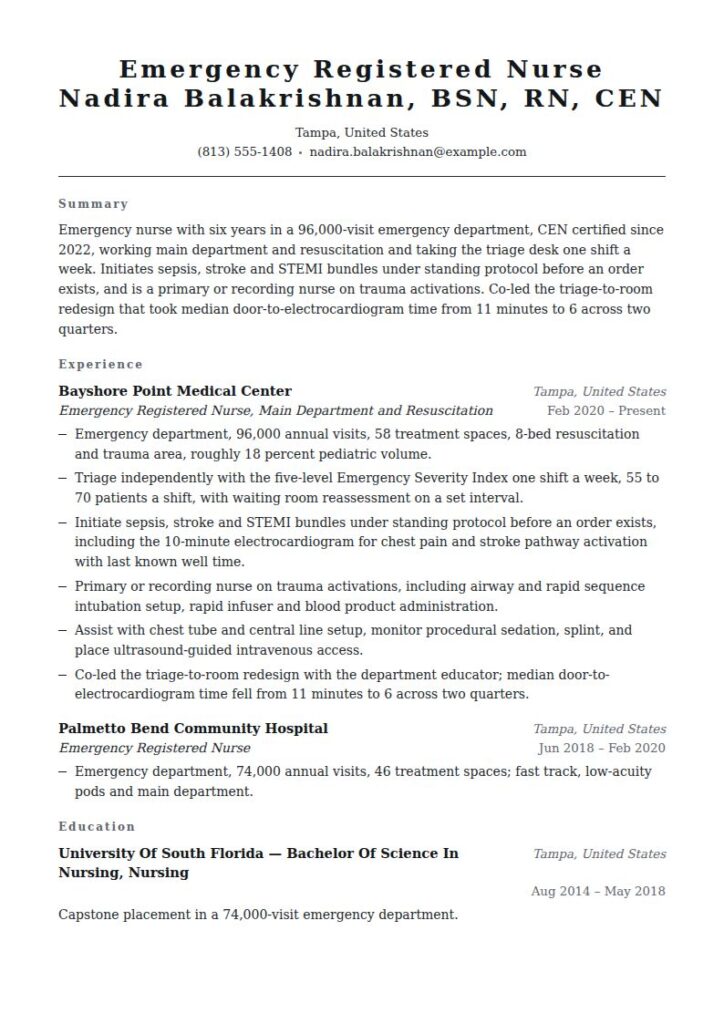
Emergency nurse with six years in a 96,000-visit emergency department, CEN certified since 2022, working main department and resuscitation and taking the triage desk one shift a week. Initiates sepsis, stroke and STEMI bundles under standing protocol before an order exists, and is a primary or recording nurse on trauma activations. Co-led the triage-to-room redesign that took median door-to-electrocardiogram time from 11 minutes to 6 across two quarters.
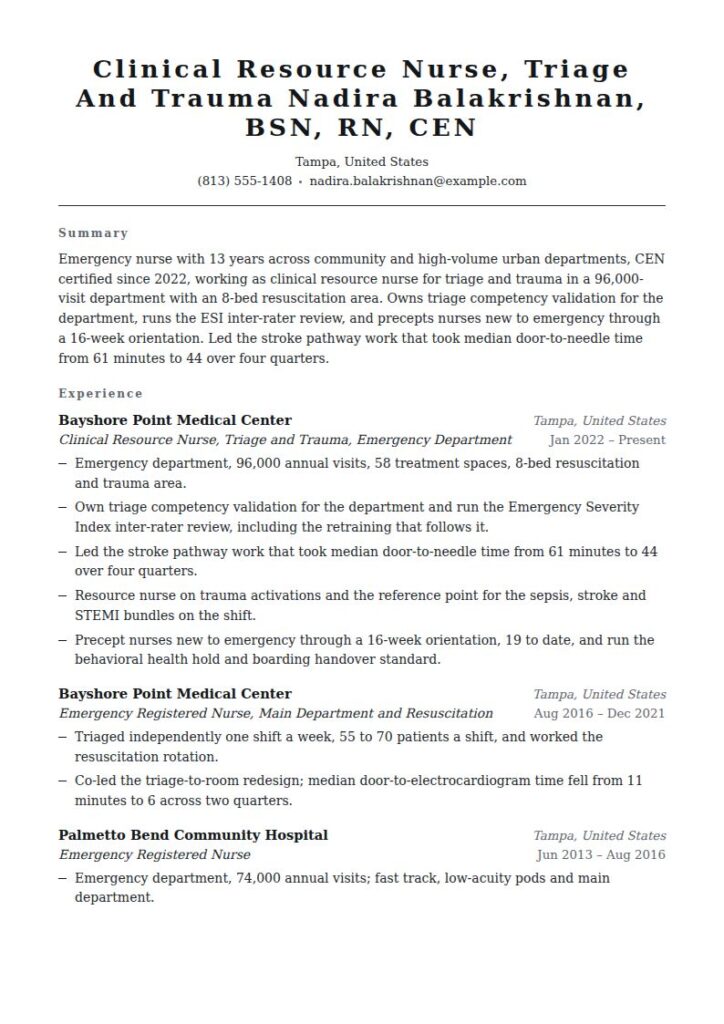
Emergency nurse with 13 years across community and high-volume urban departments, CEN certified since 2022, working as clinical resource nurse for triage and trauma in a 96,000-visit department with an 8-bed resuscitation area. Owns triage competency validation for the department, runs the ESI inter-rater review, and precepts nurses new to emergency through a 16-week orientation. Led the stroke pathway work that took median door-to-needle time from 61 minutes to 44 over four quarters.
Right vs wrong: the same ER nurse summary, twice
| ✅ Right | ❌ Wrong |
|---|---|
| Six years in a 96,000-visit emergency department, CEN since 2022, main department and resuscitation, triage desk one shift a week. | Experienced emergency nurse who works well under pressure in a fast-paced environment. |
| Initiates sepsis, stroke and STEMI bundles under standing protocol before an order exists. | Provides care to patients with a wide variety of emergent conditions. |
| Median door-to-electrocardiogram time fell from 11 minutes to 6 across two quarters. | Committed to delivering safe, high-quality emergency care. |
For example, the left column tells a manager which rotation you can be scheduled into on Monday. The right, however, describes every emergency nurse who has ever applied, which is the same as describing none.
Outline your emergency experience
Employer, department, city, dates, then a department line, then three to five bullets. The department line establishes comparability, while the bullets establish what you start without being told.
| Instead of | Use |
|---|---|
| Worked in a busy emergency department | Emergency department, 96,000 annual visits, 58 treatment spaces, 8-bed resuscitation and trauma area, main department and resuscitation rotation |
| Triaged patients | Triage nurse one shift a week using the five-level Emergency Severity Index, roughly 55 to 70 patients a shift through the triage desk |
| Cared for critically ill patients | Primary or recording nurse on trauma activations, including airway setup, rapid infuser and blood product administration |
| Followed hospital protocols | Initiate sepsis, stroke and STEMI bundles under standing protocol before an order exists, including lactate, blood cultures before antibiotics, and the stroke pathway activation |
| Performed nursing procedures | Assist with rapid sequence intubation, set up chest tube and central line trays, monitor procedural sedation, splint, and place ultrasound-guided intravenous access |
| Helped improve department metrics | Co-led the triage-to-room redesign; median door-to-electrocardiogram time fell from 11 minutes to 6 across two quarters |
Emergency Registered Nurse, Bayshore Point Medical Center, Tampa, FL, February 2020 to Present
Emergency department, 96,000 annual visits, 58 treatment spaces, 8-bed resuscitation and trauma area. Main department and resuscitation rotation, triage desk one shift a week, roughly 18 percent pediatric volume.
Triage with the five-level Emergency Severity Index, 55 to 70 patients a shift through the desk, with secondary triage and reassessment of the waiting room on a set interval.
Initiate sepsis, stroke and STEMI bundles under standing protocol before an order exists, including lactate and blood cultures before antibiotics, stroke pathway activation with last known well time, and the 10-minute electrocardiogram for chest pain.
Primary or recording nurse on trauma activations, including airway and rapid sequence intubation setup, rapid infuser, blood product administration and documentation of the timeline.
Assist with chest tube and central line setup, monitor procedural sedation, splint, and place ultrasound-guided intravenous access.
Co-led the triage-to-room redesign with the department educator; median door-to-electrocardiogram time fell from 11 minutes to 6 across two quarters.
Triage acuity and the throughput clock
Indeed, this is the block that decides an emergency hire, and it has two halves that most resumes merge into one vague claim about working under pressure. In other words, the first half is how accurately you sort. The second, then, is how fast you move once you have sorted.
Start with the triage system, by name and by level. The Emergency Severity Index is the system most United States departments sort on. It was created in 1998, it is a five-level triage system, the Emergency Nurses Association acquired it in 2019, and the Emergency Severity Index Handbook, 5th Edition was released on 28 March 2023 (Emergency Nurses Association). Write which system your department uses, say that you triage independently rather than in training, and give the volume through the desk on a shift.
Then write what triage involves in your department, because it varies: primary and secondary triage, reassessment of the waiting room on a set interval, the decision to pull a patient straight to a room, and the escalation when someone in the waiting room is deteriorating. That last one is the judgment an emergency manager is buying.
Department volume and acuity for ER nurses
Then the department itself. Annual visit volume, treatment spaces, resuscitation bay count, your zone or pod, the pediatric share of volume, and the trauma designation exactly as the department states it, with your role on an activation: primary, recording, airway, medication or circulator. A nurse who has recorded a trauma activation knows something about a timeline that cannot be picked up anywhere else.
Then the clock, which is the heart of the block. Emergency nursing is organized around time-bound bundles, and the thing that makes an emergency nurse valuable is starting them under standing protocol before an order exists. Write yours as what you initiate, not as what you assist with:
- Sepsis. Screening at triage, lactate drawn, blood cultures before antibiotics, fluids started, and the repeat lactate.
- Stroke. Pathway activation, last known well time established, imaging arranged, and what your department's door-to-needle target is against what you actually ran.
- STEMI. The 10-minute electrocardiogram for chest pain, the activation call, and door-to-balloon time as your department measures it.
- Trauma. Activation criteria, your assigned role, blood product administration and the rapid infuser, and the timeline documentation.
Give one of these a before, an after and a period. A single timed metric that moved is worth more than every adjective on the page.
Boarding, procedures and CEN certification
Then the load nobody writes down. Behavioral health presentations and holds, and boarding, where admitted patients stay in your department after the decision to admit. Both change what a shift is, and a nurse who can describe how their department handles them is describing a real department rather than a textbook one.
Then the procedures that belong to emergency. Rapid sequence intubation assist, chest tube and central line setup, procedural sedation monitoring, splinting and reduction assistance, ultrasound-guided intravenous access, pediatric weight-based dosing and length-based tape resuscitation, point of care testing, and difficult access.
Then CEN. The Board of Certification for Emergency Nursing requires, for the Certified Emergency Nurse credential, a current, unencumbered Registered Nurse license in the United States, a U.S. Territory, Canada or Australia, and recommends at least two years of experience in the specialty before scheduling the exam without requiring it (Board of Certification for Emergency Nursing, CEN eligibility, as published 16 September 2026). Write the year you certified, and list TNCC, ENPC, ACLS and PALS with their currency, because those four are what a manager checks against the schedule.
Department: emergency department, 96,000 annual visits, 58 treatment spaces, 8-bed resuscitation and trauma area, roughly 18 percent pediatric volume, trauma designation as stated by the department
Triage: five-level Emergency Severity Index, independent at the desk one shift a week, 55 to 70 patients a shift, secondary triage and waiting room reassessment on a set interval
Zone and role: main department and resuscitation rotation; primary or recording nurse on trauma activations
Clock, initiated under standing protocol: sepsis screening with lactate, blood cultures before antibiotics and fluids; stroke pathway activation with last known well time; 10-minute electrocardiogram for chest pain and STEMI activation; trauma activation criteria and timeline documentation
Timed result: median door-to-electrocardiogram time fell from 11 minutes to 6 across two quarters after the triage-to-room redesign
Load: behavioral health presentations and holds, and boarding of admitted patients in the department
Procedures: rapid sequence intubation assist, chest tube and central line setup, procedural sedation monitoring, splinting and reduction assistance, ultrasound-guided intravenous access, pediatric weight-based dosing
Certification and cards: CEN, BCEN, 2022. TNCC, ENPC, ACLS and PALS current.
Build a snapshot of your key skills
Then list twelve to sixteen entries in four groups: triage and assessment, timed pathways, procedures, and systems. Also, keep them concrete enough to be checked at interview.
Triage and assessment: five-level Emergency Severity Index triage, secondary triage and waiting room reassessment, rapid primary and secondary survey, stroke scale assessment, pediatric assessment triangle
Timed pathways: sepsis screening and bundle initiation, stroke pathway activation and last known well determination, STEMI recognition and activation, trauma activation and timeline documentation
Procedures: rapid sequence intubation assist, chest tube and central line setup, procedural sedation monitoring, splinting and reduction assistance, ultrasound-guided intravenous access, difficult access, point of care testing
Systems and safety: Epic ASAP and Cerner FirstNet, tracking board and throughput management, behavioral health hold and boarding management, mass casualty and decontamination roles, restraint documentation
List your education, license and certifications
License first with its number and status, then CEN, then the four course cards with their currency, then degrees. In emergency nursing the card list is read before the degree.
Registered Nurse, Florida, license #RN-9414725, active
Certified Emergency Nurse (CEN), Board of Certification for Emergency Nursing, certified 2022
Trauma Nursing Core Course (TNCC) and Emergency Nursing Pediatric Course (ENPC), Emergency Nurses Association, current
Advanced Cardiovascular Life Support and Pediatric Advanced Life Support, American Heart Association, current
Bachelor of Science in Nursing, University of South Florida, Tampa, FL, 2017
Additional: NIH Stroke Scale certification, current. Emergency department triage competency validation, annual.
Choose the right layout and design
Finally, keep a single column, 11 or 12 point, plain headings, no photograph. Put volume, designation, triage and course cards where a manager finds them in four seconds, because emergency hiring moves fast and a file that hides its facts loses.
Open every emergency role with annual visit volume, treatment spaces and your zone. Name the triage system and say you triage independently. Write the timed bundles as what you initiate under standing protocol. Give one timed metric a before, an after and a period. List your course cards with their currency in the header. Say your role on a trauma activation.
Do not write "fast-paced environment," which appears in nearly every emergency application and means nothing. Do not claim independent triage if you are still validated with a preceptor. Do not list an expired card without saying it is expired. Do not describe an identifiable patient or a memorable case. Do not leave the department's volume off the page, because it is the first thing another emergency nurse looks for.
ER nurse job market and outlook
Emergency nursing is hired against department volume rather than occupational growth, which is why two hospitals twenty miles apart can have very different vacancy pictures in the same year.
At the same time, the Bureau of Labor Statistics publishes no separate Occupational Outlook Handbook profile for emergency nurses. Instead, the figures below are for registered nurses, the occupation emergency nurses are counted within.
| Measure | Value |
|---|---|
| Registered nurse jobs, 2025 | About 3.5 million |
| Projected change, 2025-35 | 6 percent |
| Projected annual openings | About 180,800 |
| Share of registered nurses employed in hospitals | 59 percent |
| Median annual wage, hospitals, May 2025 | $100,220 |
| Median annual wage, all registered nurses, May 2025 | $97,550 |
Source: U.S. Bureau of Labor Statistics, Occupational Outlook Handbook, registered nurses, May 2025 wages with 2025 to 2035 projections.
Emergency nursing is a hospital occupation, so read the hospital row
Hospitals employ 59 percent of registered nurses and paid a median of $100,220 in May 2025, against $97,550 across all registered nurses and $91,230 in ambulatory healthcare services (BLS Occupational Outlook Handbook, registered nurses, May 2025).
Emergency nursing sits almost entirely inside that hospital row, which makes it the number to plan against. Free-standing emergency departments and urgent care sit in ambulatory healthcare services, and the pay difference between them is one of the practical trade-offs in an emergency nursing career.
The occupation is projected to grow 6 percent from 2025 to 2035 with about 180,800 openings a year (BLS Occupational Outlook Handbook, registered nurses, 2025 to 2035 projections), but emergency vacancies track a department's own volume, boarding pressure and turnover far more closely than that national rate. Ask for both at interview; they tell you more about the job than any projection.
What salary you can expect as an ER nurse
In other words, there is no separately published median for emergency nurses. The registered nurse median was $97,550 as of May 2025, with the lowest 10 percent earning less than $68,940 and the highest 10 percent more than $137,470, and the hospital median was $100,220 (BLS Occupational Outlook Handbook, registered nurses, May 2025).
Even so, most of the distance between the middle and the top of that range is built from things you can put on a page:
- Certification. CEN usually carries a differential, and TNCC, ENPC and NIH Stroke Scale currency decide which rotations you are eligible for.
- Shift and rotation. Nights, weekends and the resuscitation rotation carry differentials in most systems.
- Department type. A high-volume trauma-designated department and a low-volume community department price the same license differently.
- Resource and teaching roles. Triage competency validation, preceptorship and pathway work are jobs the department fills from somewhere, and they belong in a compensation conversation.
Key takeaways for an ER nurse resume
- First, open every role with annual visit volume, treatment spaces and your zone.
- Also name the triage system, say you triage independently, and give the volume through the desk.
- Similarly, put the trauma designation and your role on an activation in the same line.
- In addition, write sepsis, stroke, STEMI and trauma as what you initiate under standing protocol.
- Give one timed metric a before, an after and a period.
- Finally, list CEN with its year and the four course cards with their currency, in the header.
- Describe boarding and behavioral load, because they are what the shift is actually like.
Build your ER nurse resume in 15 minutes with our AI resume builder.
Related medical resume examples
- Nurse resume
- ICU nurse resume
- Charge nurse resume
- Travel nurse resume
- EMT resume
- Paramedic resume
- Respiratory therapist resume
- Physician assistant resume
- Surgical tech resume
- Phlebotomist resume
- Medical scribe resume
- Doctor resume
Pair it with a matching ER nurse cover letter.
ER nurse resume questions, answered
How long should an ER nurse resume be?
One page for your first three years in emergency nursing. Two once you hold CEN, triage independently, precept, or have moved a timed metric. Keep any prior medical, telemetry or critical care years, a line each, because they explain your assessment instincts.
Do I need CEN to work in an emergency department?
No, but it is the specialty's recognized credential and many departments attach a differential to it. BCEN requires a current, unencumbered Registered Nurse license in the United States, a U.S. Territory, Canada or Australia, and recommends at least two years of experience in the specialty before scheduling the exam without requiring it (Board of Certification for Emergency Nursing, CEN eligibility, as published 16 September 2026). If you are working toward it, say how many emergency department hours you have.
What should I say about triage on my resume?
Name the system, say whether you triage independently or under validation, and give the volume through the desk on a shift. Most departments sort on the Emergency Severity Index, a five-level system created in 1998 and acquired by the Emergency Nurses Association in 2019, with the Emergency Severity Index Handbook, 5th Edition released on 28 March 2023 (Emergency Nurses Association). Then describe the harder part: reassessment of the waiting room and what you do when someone in it is deteriorating.
What do I put on an ER nurse resume with no emergency experience?
Write the placement or transition program as a job: the department, its annual volume, the zones you rotated through, the triage system you were trained on and the bundles you initiated with a preceptor. Then the adjacent experience that transfers: prehospital work, critical care, telemetry, urgent care, behavioral health. Finish with your course cards and their dates, because those decide the schedule before anything else does.
How do I show results when the department's metrics are not mine alone?
Use the metric anyway and describe your part honestly. "Co-led the triage-to-room redesign with the department educator; median door-to-electrocardiogram time fell from 11 minutes to 6 across two quarters" credits the team and still says exactly what you did. Timed metrics are shared by design in emergency medicine, and no reader expects otherwise.