Internal Medicine Physician Eleni Stavrakis MD
Internal Medicine Physician
[email protected] | (414) 555-1486 | Milwaukee, United States
Profile
Internal medicine physician in the second year of practice, board certified by the American Board of Internal Medicine and licensed in Wisconsin. Carry a primary care panel of 1,140 patients across 4 clinic sessions a week at a federally qualified health center, at 14 to 18 visits a session. Moved the panel's diabetes control measure from 58 percent to 71 percent at hemoglobin A1c below 8 over 18 months. DEA registration active, no malpractice claims and no licensure actions.
Work Experience
08/2024 - Present, Internal Medicine Physician, Oak Leaf Community Health Center, Milwaukee, United States
- Carry a primary care panel of 1,140 patients across 4 clinic sessions a week at a federally qualified health center, at 14 to 18 visits a session.
- Panel diabetes control at hemoglobin A1c below 8 moved from 58 percent to 71 percent over 18 months after rebuilding the recall list.
- Perform roughly 60 office procedures a year within granted privileges: skin biopsy, joint injection, incision and drainage and nail avulsion.
- Sit on the clinic's pharmacy and therapeutics committee and co-wrote the hypertension standing order set.
07/2021 - 06/2024, Resident Physician, Internal Medicine, Kinnickinnic Regional Medical Center, Milwaukee, United States
- Completed three years of categorical internal medicine training: roughly 14 admissions a block on inpatient service, plus a continuity clinic panel of 180 patients.
- Chief resident, 2023 to 2024, writing the call schedule for 33 residents and running weekly morning report.
Education
08/2017 - 05/2021, Doctor of Medicine, Medicine, Medical College of Wisconsin, Milwaukee, United States
United States Medical Licensing Examination Steps 1, 2 and 3 passed on first attempt.
08/2013 - 05/2017, Bachelor of Science, Biochemistry, Marquette University, Milwaukee, United States
Skills
Adult primary care, 80
Chronic disease management, 80
Inpatient adult medicine, 75
Office procedures within privileges, 70
Panel management and recall design, 70
Epic, 85
Languages
English, native
Greek, native
Spanish, intermediate
Certificates
11/2024, Board certification, Internal Medicine, American Board of Internal Medicine
Continuing certification current through 2034.
06/2024, Wisconsin physician and surgeon license, Wisconsin Medical Examining Board, WI-MD-58412
Active. DEA registration active, Wisconsin.
02/2025, Advanced Cardiovascular Life Support, American Heart Association
Summary
A physician resume is a one to two page document naming your board certification status, your active state licenses, your DEA registration and the clinical volume you carry. This guide gives you three adaptable versions, the credentialing block most physicians leave off, the CV versus resume decision and who wants which, and current Bureau of Labor Statistics pay and outlook for the occupation.
Physician resume examples by experience level
In short, a physician resume is a one to two page document that names your board certification status, your active state licenses, your DEA registration and the clinical volume you carry, in roughly the order a credentialing office will check them.
It is not your curriculum vitae. Most physicians keep one document, grown by accretion since medical school, and send it to everything. That works for academic appointments and fails almost everywhere else, because a health system recruiter is looking for four facts and a three page publication list sits in front of all of them.
Resume guide for a physician resume
Specifically, this guide and the corresponding physician resume example will cover:
- How to write a physician resume, section by section
- When to send a CV instead, and what each document carries
- Three adaptable summaries: first post, practicing physician and medical director
- The credentialing block that answers a recruiter's real questions
- What the job market looks like and what you can expect to earn
How to write a physician resume
Overall, it takes six blocks: contact header with credentials, summary, credentialing and licensure, clinical experience with volume, training, skills. In general, use one page for your first post, then two once you have privileges, quality results and a leadership line.
Licensure and certification come before experience because they are gates. After all, a recruiter who cannot establish that you are certified and licensed in their state will not read the rest.
| Section | What it is answering | Where it goes |
|---|---|---|
| Board certification | Can I list this physician in our directory and bill as a specialist? | Header, with the board named |
| State licenses | Can this person see patients in my state, and when? | Directly under the summary |
| Clinical volume | Have they worked at my pace, with my case mix? | Employer line, with panel, RVUs or cases |
| Privileges | Which procedures can I schedule without a proctoring plan? | With the hospital, by procedure |
Write the four facts a recruiter screens on into the top third
Physician recruiting is a verification business before it is a persuasion business. Four facts decide whether you get a call: specialty and board status, the states you are licensed in, work authorization status if it applies, and availability date.
Put them where they cannot be missed: specialty and board in the header, licenses by state under the summary, availability in the summary's last line. A physician who writes "Wisconsin license active, Illinois in process, available 1 March" has answered in eleven words what usually takes two emails and a week.
Then attach volume: panel size, work RVUs, case counts, and a quality measure with a before and an after. Volume is how a group works out whether you can carry their schedule.
Run the finished file through the ATS resume checker before you send it. Health systems parse applications into a structured record, and a two column CV template is where that parsing breaks.
Choosing the best resume format for a physician resume, and whether it should be a CV
First, a reverse chronological resume, one to two pages, for anything clinical and employed. Then a CV, with no page limit, for academic appointments, fellowships and research posts, where a search committee reads publications.
However, the two documents are not the same file at different lengths, because they carry different things.
| Carried by both | CV only | Resume only |
|---|---|---|
| Medical education, residency, fellowship | Peer reviewed publications and abstracts | A summary written for one post |
| Board certification and licenses | Grants, funding and study roles | Volume framed for the employer's model |
| Teaching roles | Committee service in full | Availability, volume and measures |
Send the CV when the posting asks for one or the post is academic. Send the resume to health systems, private groups, urgent care, telehealth, occupational medicine and locum agencies, where the reader is a recruiter rather than a faculty committee. If you are unsure, send the resume and attach the CV.
Include your contact information
| ✅ Right | ❌ Wrong |
|---|---|
| Eleni Stavrakis, MD | Eleni Stavrakis |
| Internal Medicine, ABIM board certified | Physician passionate about patient-centered care |
| Licensed in WI and IL, DEA active, available 1 March | Board certified physician seeking new opportunity |
| (414) 555-1486, [email protected], Milwaukee, WI | (414) 555-1486, [email protected] |
Also, put the degree and the board in the header. "MD, Internal Medicine, ABIM board certified" is the string a recruiter searches, and what routes your file to the right requisition.
Make use of a summary
In short, use four lines: specialty and board status, years and setting, the volume you carry, one measured result. Finally, close with license states and an availability date.
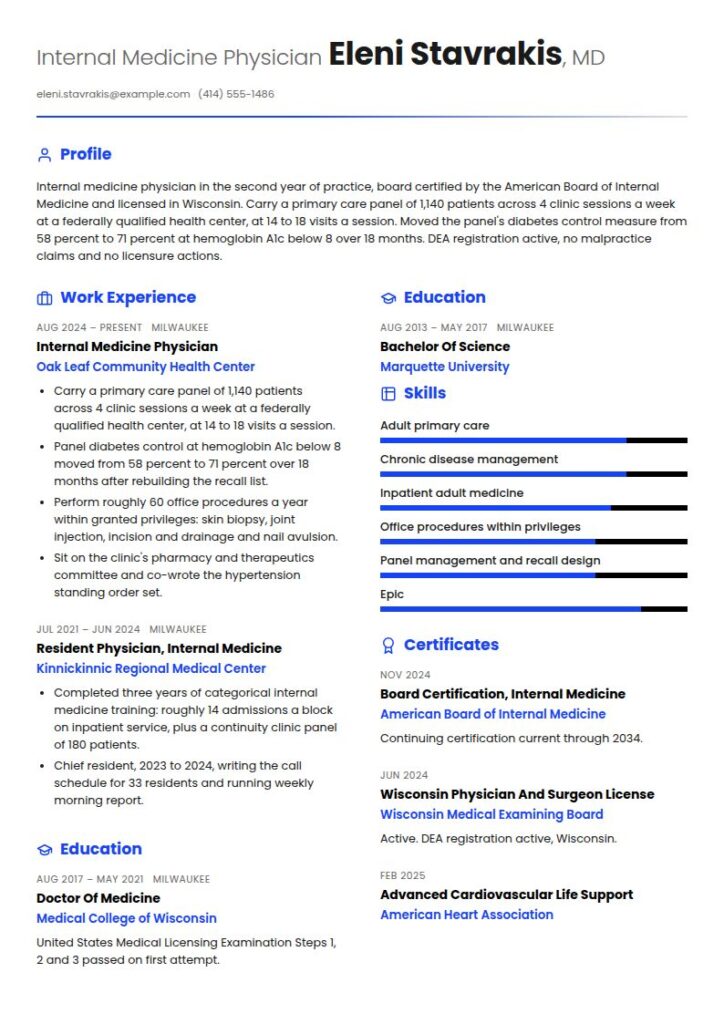
Internal medicine physician in the second year of practice, board certified by the American Board of Internal Medicine and licensed in Wisconsin. Carry a primary care panel of 1,140 patients across 4 clinic sessions a week at a federally qualified health center, at 14 to 18 visits a session. Moved the panel's diabetes control measure from 58 percent to 71 percent at hemoglobin A1c below 8 over 18 months. DEA registration active, no malpractice claims and no licensure actions.
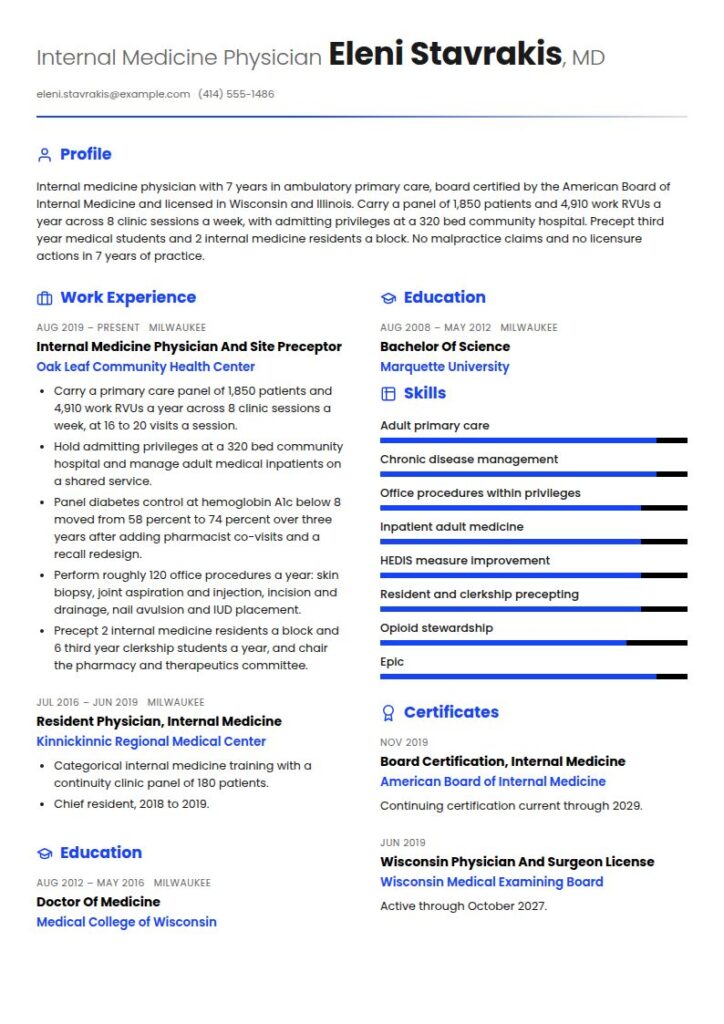
Internal medicine physician with 7 years in ambulatory primary care, board certified by the American Board of Internal Medicine and licensed in Wisconsin and Illinois. Carry a panel of 1,850 patients and 4,910 work RVUs a year across 8 clinic sessions a week, with admitting privileges at a 320 bed community hospital. Precept third year medical students and 2 internal medicine residents a block. No malpractice claims and no licensure actions in 7 years of practice.
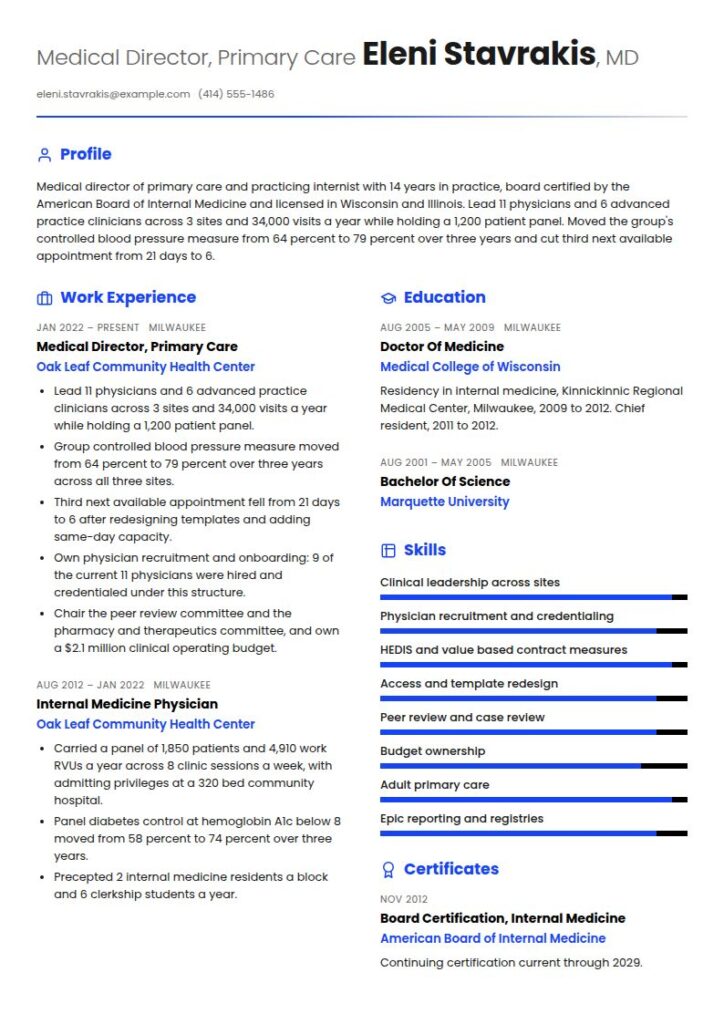
Medical director of primary care and practicing internist with 14 years in practice, board certified by the American Board of Internal Medicine and licensed in Wisconsin and Illinois. Lead 11 physicians and 6 advanced practice clinicians across 3 sites and 34,000 visits a year while holding a 1,200 patient panel. Moved the group's controlled blood pressure measure from 64 percent to 79 percent over three years and cut third next available appointment from 21 days to 6.
Right vs wrong: the same physician summary, twice
| ✅ Right | ❌ Wrong |
|---|---|
| Internal medicine physician with 7 years in ambulatory primary care, ABIM board certified. | Compassionate physician with a passion for whole-person care. |
| Panel of 1,850 patients and 4,910 work RVUs a year across 8 clinic sessions a week. | Extensive experience managing a busy outpatient practice. |
| Controlled blood pressure measure moved from 64 percent to 79 percent over three years. | Committed to delivering the highest quality of care to every patient. |
For example, the right column can be credentialed, scheduled and budgeted. The left column, however, cannot, and the person reading is doing all three.
Outline your clinical experience
Employer, city, setting, specialty, volume, then dates. Then three to five bullets, each carrying a number and a period of time.
| Instead of | Use |
|---|---|
| Provided primary care to a diverse patient population | Carry a panel of 1,850 patients across 8 clinic sessions a week, 4,910 work RVUs a year |
| Managed chronic conditions | Diabetes control at hemoglobin A1c below 8 moved from 58 percent to 74 percent across the panel over three years |
| Performed office procedures | Perform roughly 120 procedures a year: skin biopsy, joint injection, incision and drainage, nail avulsion, IUD placement |
| Participated in quality improvement | Led the hypertension recall redesign; controlled blood pressure moved from 64 percent to 79 percent across 34,000 annual visits |
Internal Medicine Physician, Oak Leaf Community Health Center, Milwaukee, WI, federally qualified health center, 8 clinic sessions a week, August 2019 to Present
Carry a primary care panel of 1,850 patients and 4,910 work RVUs a year, at 16 to 20 visits a session, with admitting privileges at a 320 bed community hospital.
Diabetes control at hemoglobin A1c below 8 moved from 58 percent to 74 percent across the panel over three years after rebuilding the recall list and adding pharmacist co-visits.
Perform roughly 120 office procedures a year, including skin biopsy, joint injection, incision and drainage and nail avulsion, all within granted privileges.
Precept 2 internal medicine residents a block and 6 third year clerkship students a year as a site preceptor for the affiliated medical school.
Chair the clinic's pharmacy and therapeutics committee and wrote the standing order set for the hypertension recall.
The credentialing file behind your physician resume, and the gaps you will be asked to explain
In fact, every physician hire runs through credentialing, and credentialing is a documents process. Write the resume so it hands over the documents rather than hinting at them.
Board certification is the first line, and its status matters as much as its existence. The American Board of Medical Specialties reports that 1,025,104 physicians were actively certified by an ABMS Member Board as of 30 June 2025, across 24 member boards covering 38 specialties and 89 subspecialties, with 34,619 new specialty certificates and 17,528 new subspecialty certificates awarded during the reporting year (ABMS Board Certification Report 2024 to 2025, published 5 November 2025). Write the board by name, the certificate area, the year first certified, and the continuing certification status. "Board eligible" is a real category: say it plainly, with the date your eligibility window closes, because a reader who discovers it later treats it as concealment. An osteopathic physician certified through the American Osteopathic Association's Bureau of Osteopathic Specialists should name that board rather than writing "board certified" unqualified.
State licenses and DEA registration
State licenses are per state, and the count is not small. The Federation of State Medical Boards counted 1,082,187 licensed physicians in the United States in its 2024 census (FSMB, published 15 August 2025). List each license by state with its number and expiry, and mark anything in process with the date you applied, because a recruiter's next question is always when you can start seeing patients.
DEA registration is location bound, which surprises people. Federal regulation states that "Every person who manufactures, distributes, dispenses, imports, or exports any controlled substance … shall obtain a registration unless exempted by law" (21 CFR 1301.11), and that "A separate registration is required for each principal place of business or professional practice at one general physical location where controlled substances are manufactured, distributed, imported, exported, or dispensed by a person" (21 CFR 1301.12, eCFR current as of 14 September 2026). Write the status, the state and the expiry, but not the number itself on a publicly posted resume; supply that in the application portal.
Primary source verification and malpractice checks
Primary source verification means nothing you write is taken on trust. Accreditation standards for credentialing require "verification of practitioner credentials through a primary source, through a recognized source or through a contracted agent of the primary source" (National Committee for Quality Assurance, credentialing standards, checked September 2026). Your medical school, your residency program, each state board and each specialty board will be contacted directly. Write names and dates you can stand behind exactly, because a residency end date that is a month out becomes a query that stalls a start date. Give your NPI in full too: it is already public in the CMS National Plan and Provider Enumeration System, so writing it costs you nothing and saves a verifier a search.
The malpractice and disciplinary check is federal and repeats. Hospitals must query the National Practitioner Data Bank when physicians, dentists and other practitioners "apply for medical staff appointment (courtesy or otherwise) or for clinical privileges" and "every two years thereafter" for everyone holding privileges, under Title IV of Public Law 99-660, and hospitals are "the only health care entities mandated by federal law to query the NPDB" (National Practitioner Data Bank, HRSA, checked September 2026). Do not narrate claims history on a resume. Do have the dates, the disposition and a factual two sentence account ready for the application and the interview.
International medical graduates carry one extra document. ECFMG states that "The Accreditation Council for Graduate Medical Education (ACGME) requires IMGs who enter ACGME-accredited residency or fellowship programs to be certified by ECFMG", and that ECFMG certification is an eligibility requirement for Step 3 of the United States Medical Licensing Examination (ECFMG, checked September 2026). If that applies to you, put the certification and its year on the page with your work authorization status, because both are screening questions.
Gaps get asked about, so answer them first. Credentialing applications ask for continuous work history by month and year, and any break will be queried. A line reading "March 2023 to January 2024: parental leave, licenses maintained" closes the question. An unexplained fourteen month space invites a slower, more suspicious version of the same conversation.
Board certification: American Board of Internal Medicine, Internal Medicine, certified 2019, continuing certification current through 2029.
Licenses: Wisconsin, #WI-MD-58412, active through October 2027. Illinois, #IL-036-129884, active through July 2027.
DEA registration: active, Wisconsin, expires April 2028. Registration number supplied in the application portal.
NPI: listed in full, verifiable in CMS NPPES.
Hospital privileges: Kinnickinnic Regional Medical Center, Milwaukee, WI. Active courtesy staff, internal medicine. Privileged for admission and management of adult medical inpatients, skin biopsy, joint aspiration and injection, and incision and drainage.
Continuous practice history: no breaks since residency completion, June 2019. Licenses maintained continuously.
Build a snapshot of your key skills
Twelve to sixteen entries in four groups, naming procedures, populations and systems rather than qualities.
Clinical: Adult primary care, Chronic disease management in diabetes, hypertension and heart failure, Inpatient adult medicine, Cancer screening, Behavioral health integration, Opioid stewardship
Procedures: Skin biopsy, Joint aspiration and injection, Incision and drainage, Nail avulsion, IUD placement, Point of care ultrasound
Quality and operations: HEDIS measure improvement, Panel management and recall design, Standing order sets, Third next available appointment, Peer review
Systems and teaching: Epic, Controlled substance prescription monitoring, Resident and clerkship precepting, Interpreter-supported visits
List your education, training and board certification
Similarly, list training in reverse chronological order, with the exact program names and months a verifier will match against the primary source.
Residency, Internal Medicine, Kinnickinnic Regional Medical Center, Milwaukee, WI, July 2016 to June 2019. Chief resident, 2018 to 2019.
Doctor of Medicine, Medical College of Wisconsin, Milwaukee, WI, 2016.
Bachelor of Science, Biochemistry, Marquette University, Milwaukee, WI, 2012.
Certification: American Board of Internal Medicine, certified 2019, continuing certification current through 2029. Advanced Cardiovascular Life Support, American Heart Association, current through 2027. Controlled substance prescribing education requirement completed 2023.
Choose the right layout and design
Finally, keep a single column, plain type at 11 or 12 point, clear headings, no photograph, no rating bars. After all, health system portals parse the file before a human opens it, and a five star graphic next to "internal medicine" reads badly to a physician reviewer.
Put the degree, specialty and board in the header line. List every license by state, with number and expiry. State board certification status precisely, including board eligible with its window. Give volume: panel, work RVUs, cases, sessions a week. Attach one quality measure with a before, an after and a period. Explain every gap over a month in four words. Name privileges by procedure.
Do not send a nine page CV to a group practice recruiter. Do not print your DEA number on a publicly posted resume. Do not write "board certified" without the board. Do not describe malpractice history on the resume. Do not round a work RVU figure you have not looked up. Do not put a patient detail, initial or date of service on the page.
Physician job market and outlook
A high paying occupation with steady growth, where almost all of the hiring pressure sits inside specialty and geography rather than in the headline number.
| Measure | Value |
|---|---|
| Physician and surgeon jobs, 2025 | 862,800 |
| Projected change, 2025-35 | 4 percent, about as fast as average, +31,300 |
| Projected annual openings | About 22,100 |
| Typical entry-level education | Doctoral or professional degree, plus 3 to 9 years of residency |
| Median annual wage, May 2025 | $275,930 |
Source: U.S. Bureau of Labor Statistics, Occupational Outlook Handbook, physicians and surgeons, May 2025 wages and 2025-35 projections, published 27 August 2026.
A million certified physicians, and the file is what separates them
The American Board of Medical Specialties reports 1,025,104 physicians actively certified by an ABMS Member Board as of 30 June 2025, across 24 boards, 38 specialties and 89 subspecialties (ABMS Board Certification Report 2024 to 2025, published 5 November 2025). Separately, the Federation of State Medical Boards counted 1,082,187 licensed physicians in its 2024 census (FSMB, published 15 August 2025).
Read those two counts together and the recruiting problem is obvious: board certification is normal rather than distinguishing, a threshold you must clear and cannot win on.
What separates two certified, licensed internists is what the credentialing file cannot infer: the panel you carried, the RVUs you generated, the procedures you are privileged for, the measure you moved, the states you can already practice in, and the date you are free. A CV buries all six behind a publication list.
What salary you can expect as a physician
Specifically, the median annual wage for physicians and surgeons was $275,930 as of May 2025, with the lowest 10 percent below $76,560 and the highest 10 percent above $488,320 (BLS Occupational Outlook Handbook, May 2025).
That spread is specialty, not seniority. Meanwhile, on the same BLS page for May 2025, pediatric surgeons had a median of $559,030, cardiologists $496,010, radiologists $420,860, anesthesiologists $391,490 and orthopedic surgeons $358,550, against $244,180 for family medicine physicians and $210,040 for pediatricians. As a result, two board certified physicians with identical years in practice can sit $300,000 apart on the board they hold.
Even so, within a specialty, three things on a resume move an offer. Volume, because most employed contracts pay a base against a work RVU target and a recruiter is modeling whether you will clear it. Licensure and start date, because an unfilled clinic session costs money every week. And quality measures, because value based contracts attach revenue to them.
Also, the step up is rarely a bigger version of the same job. Instead, it is a medical directorship, a service line role or a subspecialty fellowship, and all three are awarded against documentation. Therefore, a resume already carrying committee work, precepting and a measure you moved shortens every one of those paths.
Key takeaways for a physician resume
- Above all, send a resume to recruiters and a CV to search committees, because they are different documents.
- Put degree, specialty and board in the header, because that is the searched string.
- Then list every license by state with its number, expiry and application status.
- State board certification precisely, including board eligible and its closing date.
- In addition, attach volume to every clinical role: panel, work RVUs, cases or sessions a week.
- Give one quality measure with a before, an after and a period of time.
- Explain every gap over a month on the page, before credentialing asks.
Build your physician resume in 15 minutes with our AI resume builder.
Related medical resume examples
- Doctor resume
- Physician assistant resume
- Nurse practitioner resume
- Medical student resume
- Medical science liaison resume
- Epidemiologist resume
- Clinical research coordinator resume
- Healthcare project manager resume
- Health care administration resume
- Psychologist resume
- Medical scribe resume
- Medical coder resume
Pair it with a matching physician cover letter.
Physician resume questions, answered
Should a physician send a resume or a CV?
The posting usually tells you. Send the resume to health systems, group practices, urgent care, telehealth and locum agencies, where a recruiter reads for board status, licensure, volume and availability. Send the CV to academic appointments, fellowships and research posts, where a committee reads publications, grants and teaching. If the posting is ambiguous, send the resume and attach the CV.
How long should a physician resume be?
One page for your first attending post, two once you have privileges, quality results and a leadership line. A CV has no limit, which is exactly why it is the wrong document for a recruiter screening forty files.
What do I put on a physician resume during residency?
Write residency as the job it is: the program, the specialty, the years, and the volume, meaning admissions a block, continuity panel size, procedures logged and any chief or teaching role. Then your board eligibility date, license status and availability. A line reading "board eligible through 2028, Wisconsin license application submitted August, available 1 July" does the recruiter's work for them.
Do I have to disclose a malpractice claim on my resume?
No, and do not narrate it there. Disclose it on the credentialing application, accurately and completely, because hospitals must query the National Practitioner Data Bank at appointment and every two years thereafter under Title IV of Public Law 99-660 (National Practitioner Data Bank, HRSA, checked September 2026). The resume's job is to avoid any appearance of concealment: exact dates, explained gaps.
How do I show volume if my group does not give me RVU reports?
Use what you can count and say where it comes from: sessions a week and visits a session, panel size from the attribution list, procedure counts from your own log, admissions or consults a month. Then one quality measure your group reports, with a before, an after and a period. A counted number with a stated source reads as evidence; an adjective reads as filler.