Medical Coder Lorraine Wickersham CPC
Coding Specialist I, Outpatient
[email protected] | (316) 555-1294 | Wichita, United States
Profile
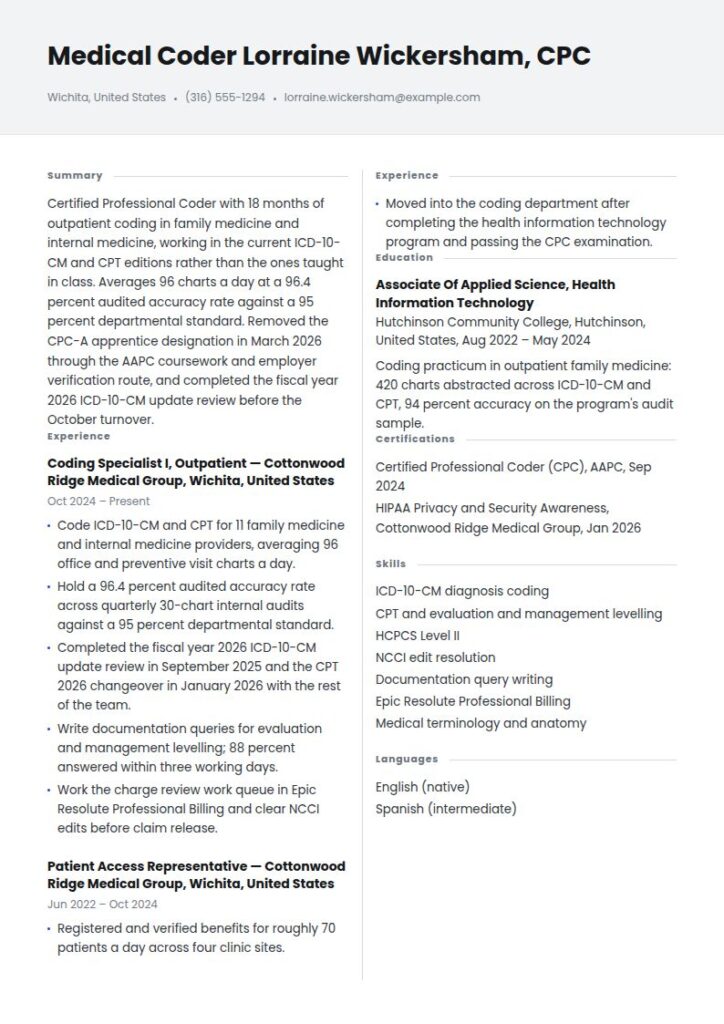
Certified Professional Coder with 18 months of outpatient coding in family medicine and internal medicine, working in the current ICD-10-CM and CPT editions rather than the ones taught in class. Averages 96 charts a day at a 96.4 percent audited accuracy rate against a 95 percent departmental standard. Removed the CPC-A apprentice designation in March 2026 through the AAPC coursework and employer verification route, and completed the fiscal year 2026 ICD-10-CM update review before the October turnover.
Work Experience
10/2024 - Present, Coding Specialist I, Outpatient, Cottonwood Ridge Medical Group, Wichita, United States
- Code ICD-10-CM and CPT for 11 family medicine and internal medicine providers, averaging 96 office and preventive visit charts a day.
- Hold a 96.4 percent audited accuracy rate across quarterly 30-chart internal audits against a 95 percent departmental standard.
- Completed the fiscal year 2026 ICD-10-CM update review in September 2025 and the CPT 2026 changeover in January 2026 with the rest of the team.
- Write documentation queries for evaluation and management levelling; 88 percent answered within three working days.
- Work the charge review work queue in Epic Resolute Professional Billing and clear NCCI edits before claim release.
06/2022 - 10/2024, Patient Access Representative, Cottonwood Ridge Medical Group, Wichita, United States
- Registered and verified benefits for roughly 70 patients a day across four clinic sites.
- Moved into the coding department after completing the health information technology program and passing the CPC examination.
Education
08/2022 - 05/2024, Associate of Applied Science, Health Information Technology, Hutchinson Community College, Hutchinson, United States
Coding practicum in outpatient family medicine: 420 charts abstracted across ICD-10-CM and CPT, 94 percent accuracy on the program's audit sample.
Skills
ICD-10-CM diagnosis coding, 80
CPT and evaluation and management levelling, 75
HCPCS Level II, 70
NCCI edit resolution, 65
Documentation query writing, 70
Epic Resolute Professional Billing, 75
Medical terminology and anatomy, 85
Languages
English, native
Spanish, intermediate
Certificates
09/2024, Certified Professional Coder (CPC), AAPC, 01894427
Apprentice designation removed March 2026 through the coursework and employer verification route. Current through 2028.
01/2026, HIPAA Privacy and Security Awareness, Cottonwood Ridge Medical Group
Summary
A medical coder resume is a one to two page document naming the code sets you work in, the specialties you code, your credential, and the audited accuracy rate and chart volume you hold. This guide gives you three adaptable versions, the currency test that separates a working coder from a recent graduate, and current Bureau of Labor Statistics pay for medical records specialists.
Medical Coder resume examples by experience level
A medical coder resume is a one to two page document that names the code sets you work in, the specialties you code, the credential you hold, and the accuracy rate an auditor has actually measured on your work.
The thing that decides this hiring is narrower than most applicants expect. A coding manager is asking whether you are working in this year's editions, whether someone has audited you recently, and what happened when they did. Everything else is context for those three answers.
Resume guide for a medical coder resume
This guide and the corresponding medical coder resume example will cover:
- How to write a medical coder resume, section by section
- Why the code set edition you are working in belongs on the page
- Three adaptable summaries: new coder, multispecialty coder and coding quality lead
- What an audited accuracy rate is, and how to state one honestly
- What the job market looks like and what Bureau of Labor Statistics pay data shows
How to write a medical coder resume
Six sections: contact header, summary, credentials, coding experience, code sets and systems, and education. One page for your first five years, two once you audit, train or lead a changeover.
The order matters because a coding manager reads for gates first. The credential is a gate, current-edition work is a gate, and a measured accuracy rate is the tiebreaker between two files that clear both.
| Section | What it is answering | Where it goes |
|---|---|---|
| Credential | Do they hold a CPC, CCS or equivalent, and is it current? | Directly under the summary, with the member or certificate number |
| Code sets and depth | Which sets, at what level, and in which edition? | Its own block, split by set, not buried in bullets |
| Coding experience | What volume, what specialties, what audited accuracy? | Reverse chronological, with numbers on every line |
| Systems | Which encoder, which electronic health record, which clearinghouse? | Short list, named products |
Say which edition you are working in, not just which code set
Code sets do not sit still, and this is the fastest way a coding manager sorts a stack of applications.
The ICD-10-CM diagnosis code set turns over on a fixed federal cycle: the Centers for Medicare and Medicaid Services publishes the annual revision for discharges and encounters occurring from 1 October through 30 September of the following year (CMS, ICD-10 code resources, checked September 2026).
The CPT procedure code set turns over on a different date. The American Medical Association released the CPT 2026 code set with 418 total changes, made up of 288 new codes, 84 deletions and 46 revisions, effective for services on and after 1 January 2026 (American Medical Association press release, 11 September 2025).
So a coder's year has two changeovers in it, three months apart. A resume that says "completed the ICD-10-CM fiscal year 2026 update review in September 2025 and the CPT 2026 changeover in December 2025" says you were current on time. "ICD-10-CM and CPT" says nothing at all.
Run the finished file through the ATS resume checker before you send it. Health systems and coding vendors both screen through an applicant tracking system, and credential strings are exactly the text a two-column layout scrambles.
Choosing the best resume format for a medical coder resume
Reverse chronological. One page for your first five years, two once you have led a changeover, run audits, or carried a specialty book with numbers worth citing.
Functional formats fail badly here. Coding is a production job measured continuously, and a manager reads the timeline to see whether your volume and accuracy rose or fell between employers. A format that hides which employer produced which number reads as a number worth hiding.
Include your contact information
| ✅ Right | ❌ Wrong |
|---|---|
| Lorraine Wickersham | Lorraine Wickersham |
| Certified Professional Coder, CPC, CPMA, CCS | Detail-oriented medical coding professional |
| AAPC member #01894427, CPC current through 2027 | Certified coder |
| (316) 555-1294, [email protected], Wichita, KS | (316) 555-1294, [email protected] |
Put the credential number on the page. AAPC and AHIMA both publish credential verification lookups and human resources will use one. A file that lets them confirm you in ten seconds moves ahead of the file that makes them email you for a number.
Make use of a summary
Four lines: credential and code sets, specialties and setting, audited accuracy rate with the standard it was measured against, and daily volume.
Certified Professional Coder with 18 months of outpatient coding in family medicine and internal medicine, working in the current ICD-10-CM and CPT editions rather than the ones taught in class. Averages 96 charts a day at a 96.4 percent audited accuracy rate against a 95 percent departmental standard. Removed the CPC-A apprentice designation in March 2026 through the AAPC coursework and employer verification route, and completed the fiscal year 2026 ICD-10-CM update review before the October turnover.
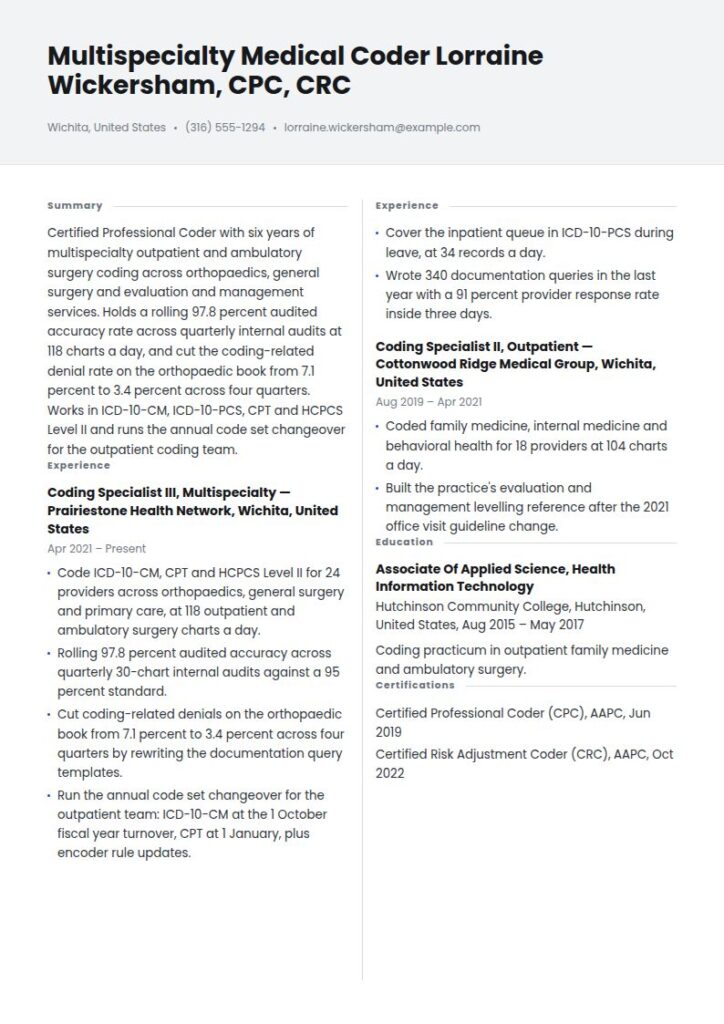
Certified Professional Coder with six years of multispecialty outpatient and ambulatory surgery coding across orthopaedics, general surgery and evaluation and management services. Holds a rolling 97.8 percent audited accuracy rate across quarterly internal audits at 118 charts a day, and cut the coding-related denial rate on the orthopaedic book from 7.1 percent to 3.4 percent across four quarters. Works in ICD-10-CM, ICD-10-PCS, CPT and HCPCS Level II and runs the annual code set changeover for the outpatient coding team.
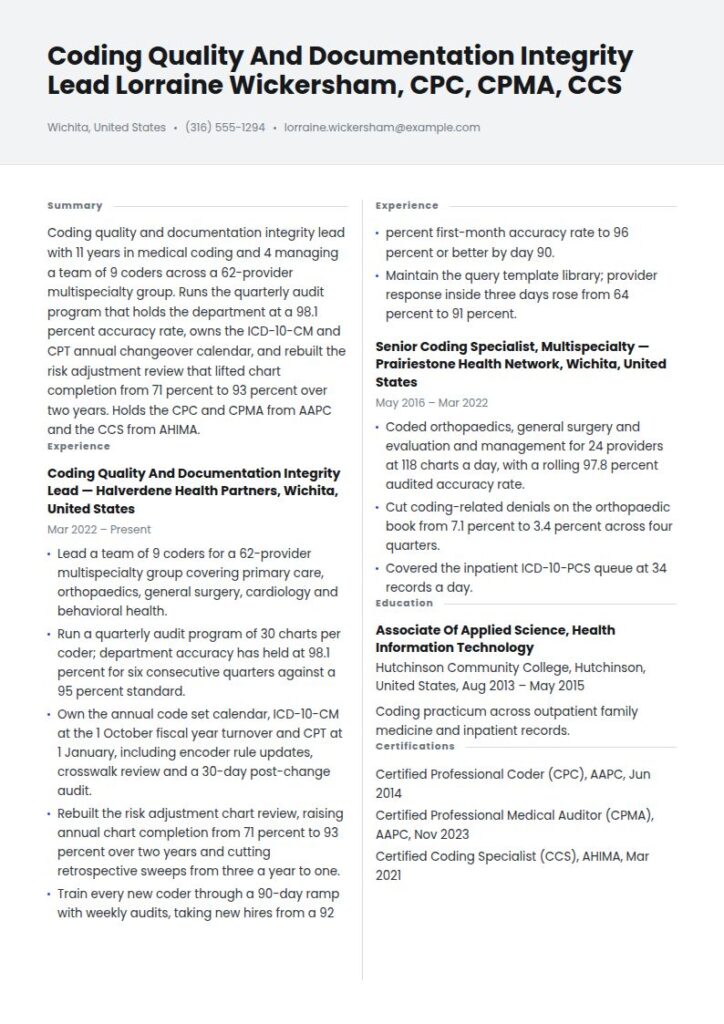
Coding quality and documentation integrity lead with 11 years in medical coding and 4 managing a team of 9 coders across a 62-provider multispecialty group. Runs the quarterly audit program that holds the department at a 98.1 percent accuracy rate, owns the ICD-10-CM and CPT annual changeover calendar, and rebuilt the risk adjustment review that lifted chart completion from 71 percent to 93 percent over two years. Holds the CPC and CPMA from AAPC and the CCS from AHIMA.
Right vs wrong: the same medical coder summary, twice
| ✅ Right | ❌ Wrong |
|---|---|
| Certified Professional Coder with six years of multispecialty outpatient and ambulatory surgery coding. | Detail-oriented coding professional with a strong work ethic and excellent attention to detail. |
| Rolling 97.8 percent audited accuracy rate across quarterly internal audits at 118 charts a day. | Consistently maintains high accuracy and productivity standards. |
| Cut the coding-related denial rate on the orthopaedic book from 7.1 percent to 3.4 percent across four quarters. | Experienced in reducing claim denials and improving revenue cycle performance. |
The left column can be audited. The right column is what every other file in the folder says, and a coding manager who has read forty of them stops reading at "detail-oriented".
Outline your coding experience
Employer, setting, dates, then the scope line: how many providers, which specialties, which encounter types, what daily target. Then three to five bullets, each with a number.
| Instead of | Use |
|---|---|
| Responsible for coding medical records accurately | Coded 118 outpatient and ambulatory surgery charts a day at a 97.8 percent audited accuracy rate |
| Assigned ICD-10 and CPT codes | Coded ICD-10-CM and CPT for orthopaedics, general surgery and E/M across 24 providers |
| Reduced claim denials | Cut coding-related denials on the orthopaedic book from 7.1 percent to 3.4 percent across four quarters |
| Worked with providers on documentation | Wrote 340 documentation queries in a year with a 91 percent provider response rate inside 3 days |
Coding Quality and Documentation Integrity Lead, Halverdene Health Partners, Wichita, KS, March 2022 to Present
Lead a team of 9 coders for a 62-provider multispecialty group covering primary care, orthopaedics, general surgery, cardiology and behavioral health.
Run a quarterly audit program of 30 charts per coder; department accuracy has held at 98.1 percent for six consecutive quarters against a 95 percent standard.
Own the annual code set calendar, ICD-10-CM at the 1 October fiscal year turnover and CPT at 1 January, including encoder rule updates, crosswalk review and a 30-day post-change audit.
Rebuilt the risk adjustment chart review, raising annual chart completion from 71 percent to 93 percent over two years and cutting retrospective sweeps from three a year to one.
Train every new coder through a 90-day ramp with weekly audits, taking new hires from a 92 percent first-month accuracy rate to 96 percent or better by day 90.
Write the scope line even if you think it is obvious. "Coded for a 62-provider multispecialty group" and "coded for a three-provider family practice" are different jobs with the same title.
Code set currency and the accuracy number
This section separates a working coder from a credentialed one, and almost nobody writes it deliberately.
Two facts do the work. The code sets change on a fixed annual cycle, so the edition you last worked in states when you last worked. And coding is one of the few clinical-adjacent jobs where a number measuring your personal output already exists, because your employer audits you.
Name the code sets, and name the depth. ICD-10-CM, ICD-10-PCS, CPT and HCPCS Level II are different skills and different jobs. ICD-10-PCS is inpatient procedure coding and it is what a hospital post screens for. CMS adopts ICD-10, HCPCS, CPT, CDT and the National Drug Codes as the standard code sets under HIPAA administrative simplification (CMS, Administrative Simplification code sets, checked September 2026), so naming which of them you work in is a precise claim.
Name the specialties. Coding orthopaedics is not coding behavioral health, and evaluation and management levelling is its own discipline again. List the specialties you have coded in production, separately from the ones you have trained in but not run.
Give the accuracy rate with three things attached: the number, the standard it was measured against, and who measured it. "96 percent accuracy" is unverifiable. "96.4 percent audited accuracy across quarterly 30-chart internal audits against a 95 percent departmental standard" names the sampling method and the bar.
Give the volume with the encounter type. Ninety-six office visits a day and ninety-six inpatient surgical records a day are separated by a factor of ten in effort.
Code sets in production: ICD-10-CM (FY2026 edition), CPT 2026, HCPCS Level II 2026, ICD-10-PCS (FY2026, inpatient surgical and obstetric)
Specialties coded: orthopaedics, general surgery, cardiology, primary care and evaluation and management levelling, behavioral health
Trained, not yet in production: interventional radiology, emergency department facility coding
Audited accuracy: 98.1 percent rolling across four quarters, 30-chart quarterly internal audit, 95 percent departmental standard
Volume: 118 outpatient and ambulatory surgery charts a day; 34 inpatient records a day on the inpatient queue
Annual changeover: led the FY2026 ICD-10-CM update review in September 2025 and the CPT 2026 changeover in December 2025, including encoder rule configuration and a 30-day post-change audit
The last line gets read twice. A manager who runs two changeovers a year wants somebody who has led one, not somebody who has survived one.
Build a snapshot of your key skills
Ten to fourteen entries in four groups: code sets, clinical knowledge, revenue cycle, and the systems you operate. Named products, not categories.
Code sets: ICD-10-CM, ICD-10-PCS, CPT, HCPCS Level II, modifier application, NCCI edit resolution
Clinical: medical terminology, anatomy and physiology, operative report abstraction, pathology report abstraction, pharmacology for coding
Revenue cycle: charge capture review, denial analysis and appeal narrative, documentation query writing, risk adjustment and HCC capture, local and national coverage determination research
Compliance and audit: audit sampling design, error-type analysis, coder retraining plans, HIPAA minimum necessary standard, payer-specific coding policy
Systems: 3M encoder, Epic Resolute Professional Billing, Cerner, TruCode, Availity, Microsoft Excel for audit tracking
Name the encoder. It takes weeks to learn, and it is one of the few things on a coding resume a manager reads as a training cost saved.
List your education and certifications
Credentials first with their numbers and current-through dates, then the continuing education position, then the degree or certificate.
Certified Professional Coder (CPC), AAPC, member #01894427, awarded June 2019, current through 2027
Certified Professional Medical Auditor (CPMA), AAPC, awarded November 2023
Certified Coding Specialist (CCS), AHIMA, awarded March 2021
Continuing education: 36 AAPC continuing education units submitted for the 2025 to 2026 cycle, including the ICD-10-CM fiscal year 2026 update and the CPT 2026 changes
Associate of Applied Science, Health Information Technology, Hutchinson Community College, Hutchinson, KS, 2015
Two details about the credentials, taken from the issuing bodies rather than assumed. The AAPC Certified Professional Coder examination is 150 multiple-choice questions over 5 hours and 40 minutes, passing at 70 percent, a coder who passes without two years of documented on-the-job coding carries the CPC-A apprentice designation, and the credential is maintained with 36 continuing education units every two years (AAPC, checked September 2026). AHIMA runs a separate ladder: the Certified Coding Associate as the entry credential, the Certified Coding Specialist for hospital and facility coding, the Certified Coding Specialist, Physician-based on the ambulatory side, and the RHIT and RHIA academic credentials (AHIMA, checked September 2026).
If you are still an apprentice, write it. "CPC-A, apprentice designation removal in progress" is what the credential lookup shows anyway, and coding managers hire apprentices routinely.
Choose the right layout and design
Single column, plain type at 11 or 12 point, clear headings, no photograph, no skills bar graphics. Health systems parse applications into a structured record before a human opens them, and credential strings with commas and hyphens are what break in a two-column template.
Put the credential and its number in the header. Name the code set editions you are working in now, with the changeover dates. Give the audited accuracy rate with its sampling method and the standard it was measured against. State the volume with the encounter type attached. Name the encoder and the electronic health record by product. Separate specialties you code in production from ones you have only trained in.
Do not write "100 percent accuracy"; no audit program produces that and it reads as someone who has never been audited. Do not list ICD-10-PCS unless you have coded inpatient procedures, because the coding test will find it. Do not claim a credential that is lapsed without saying so, since both AAPC and AHIMA publish verification lookups. Do not describe yourself as detail-oriented. Do not put patient identifiers, chart numbers or screenshots of real records anywhere near the file.
Medical coder job market and outlook
Coding sits inside a healthcare labor market that is expanding quickly, though the current-cycle detail for the specific occupation is thinner than usual this year.
The Bureau of Labor Statistics classifies most medical coders as medical records specialists, and its Occupational Outlook Handbook reports a 2025 median pay of $51,140 for that occupation with a typical entry-level education of a postsecondary nondegree award (BLS Occupational Outlook Handbook, Healthcare Occupations, last modified 27 August 2026). The rest of the current-cycle detail, including the employment count, the projected growth rate and the annual openings figure, was not available at the time of writing, so it is left out here rather than estimated.
What current figures do show is the shape of the market around the job.
| Measure | Value | Occupation |
|---|---|---|
| Median annual wage, May 2025 | $51,140 | Medical records specialists |
| Typical entry-level education | Postsecondary nondegree award | Medical records specialists |
| Median annual wage, May 2025 | $86,530 | Healthcare practitioners and technical occupations |
| Median annual wage, May 2025 | $38,340 | Healthcare support occupations |
| Projected annual openings, 2025-35 | About 1.9 million a year | All healthcare occupations |
| Median annual wage, May 2025 | $123,860 | Medical and health services managers |
| Projected change, 2025-35 | 24 percent, much faster than average | Medical and health services managers |
Source: U.S. Bureau of Labor Statistics, Occupational Outlook Handbook, May 2025 wage data and 2025-35 projections, pages last modified 27 August 2026.
The management ladder above coding is the fastest-growing part of the market
BLS projects overall employment in healthcare occupations to grow much faster than the average for all occupations from 2025 to 2035, with about 1.9 million openings a year on average across the group (BLS Occupational Outlook Handbook, Healthcare Occupations, last modified 27 August 2026).
The steepest published growth near coding is in the layer directly above it. Medical and health services managers, the group that includes coding managers, health information managers and revenue cycle directors, held 640,400 jobs in 2025 and is projected to grow 24 percent from 2025 to 2035, much faster than average, with about 62,300 openings a year (BLS Occupational Outlook Handbook, 2025-35 projections). In offices of physicians, which employ 13 percent of that group, the May 2025 median was $105,770.
The lines that show you audit, retrain and run a changeover read as management-track, and they are also the lines coding managers use to sort senior applicants.
What salary you can expect as a medical coder
The median annual wage for medical records specialists was $51,140 as of May 2025 (BLS Occupational Outlook Handbook, Healthcare Occupations, last modified 27 August 2026). For comparison, the median annual wage for all occupations was $50,980 in May 2025.
No percentile range for the occupation was retrievable at the time of writing, so the spread is not quoted here. The surrounding data does place the job between the two large healthcare wage bands: healthcare support occupations had a May 2025 median of $38,340 and healthcare practitioners and technical occupations $86,530 (BLS, May 2025).
Where a resume genuinely moves money in this occupation is narrower than in most:
- Credential stacking. The CPMA moves you towards audit work, the CCS towards hospital inpatient coding, a risk adjustment credential towards payer work. Each is a separate pay band in most employers' structures.
- Inpatient and ICD-10-PCS. Inpatient surgical coding pays above outpatient office coding almost everywhere, because the record is longer and the error cost is higher.
- Audit and education. The coder who audits others and runs retraining is on the medical and health services manager ladder, where the May 2025 median was $123,860.
- Denial and appeal work. Appeal narratives that overturn denials produce a number the finance side can see.
None of these is a negotiation tactic. They are documentation: the credential number, the specialty list and the audit results either are on the page or they are not.
Key takeaways for a medical coder resume
- Lead with the credential and its number; it is a gate, not an achievement.
- Name the code set editions you are working in now, with the two changeover dates.
- Give an audited accuracy rate with its sampling method and the standard it was measured against.
- State daily volume with the encounter type attached, because charts a day means nothing alone.
- List specialties coded in production separately from specialties trained in.
- Name the encoder and the electronic health record by product.
- Keep it single column and parseable; portals read credential strings before a person does.
Build your medical coder resume in 15 minutes with our AI resume builder.
Related medical resume examples
- Medical biller resume
- Medical office manager resume
- Medical administrative assistant resume
- Medical receptionist resume
- Medical support assistant resume
- Health care administration resume
- Clinic coordinator resume
- Medical scribe resume
- Healthcare project manager resume
- Medical assistant resume
- Healthcare resume
- Medical resume
Pair it with a matching medical coder cover letter.
Medical coder resume questions, answered
How long should a medical coder resume be?
One page for your first five years. Two once you have run audits, led an annual changeover, trained coders, or carried more than one specialty book with numbers worth citing. Never three, and never a page of code set names with no volume or accuracy attached.
Do I need the CPC or the CCS?
It depends on the setting, not on which is harder. AAPC's Certified Professional Coder is what physician groups and outpatient employers screen for; AHIMA's Certified Coding Specialist is the hospital and facility credential (AAPC and AHIMA, checked September 2026). If you hold both, put the one the posting names first.
What do I put on a medical coder resume with no experience?
Write the practicum as a job: the setting, the specialties, the chart types, the volume and any accuracy figure your program recorded. Then the credential with its number, with the apprentice designation stated plainly if you hold it. Then the code set editions you trained in. An apprentice who trained on the fiscal year 2026 ICD-10-CM edition and CPT 2026 is applying with current tools, which is more than many experienced applicants demonstrate.
How do I state an accuracy rate I cannot prove?
State the method instead of inflating the number. If your employer audits a 30-chart quarterly sample against a 95 percent standard, say so and give the figure from the last audit you saw. If you have never been audited, write the quality control you do run: self-review percentage, query rate, or the denial rate on your book. A modest number with a method reads better than a large number without one.
Does the annual code update really belong on a resume?
Yes, and it is the most underused line in the occupation. ICD-10-CM turns over on 1 October each federal fiscal year (CMS, checked September 2026) and CPT turned over on 1 January 2026 with 418 changes across 288 additions, 84 deletions and 46 revisions (American Medical Association, 11 September 2025). A coding manager runs both changeovers with whoever is on the team, and showing you have done it shows you will not be a cost in October.