Practice Coordinator Octavio Ferrantino
Practice Coordinator
[email protected] | (210) 555-1288 | San Antonio, United States
Profile
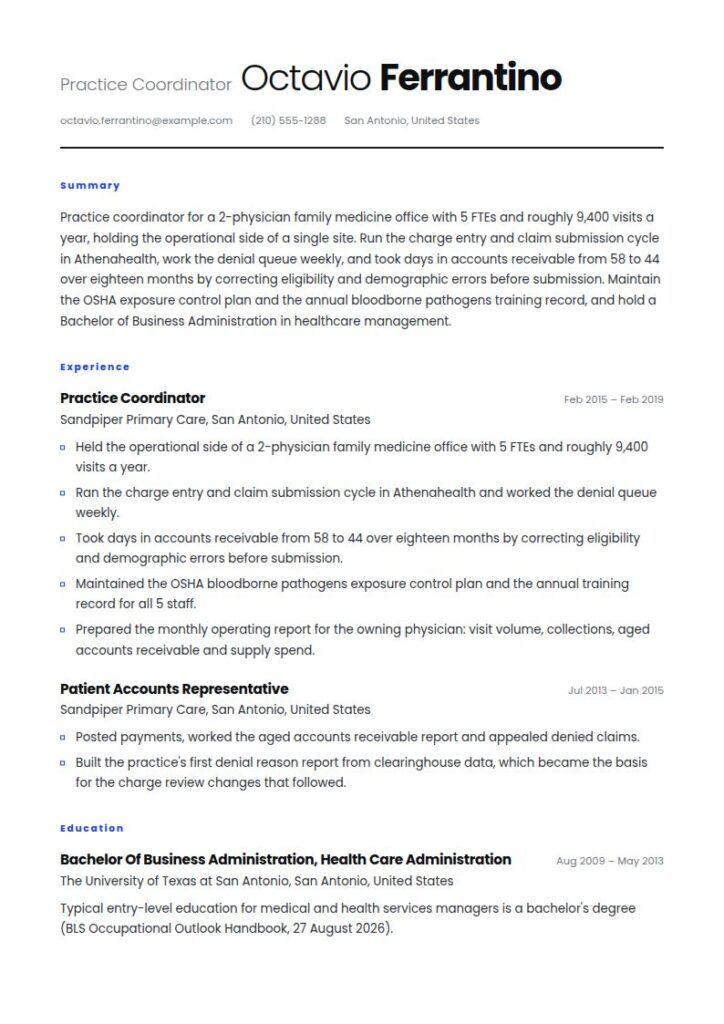
Practice coordinator for a 2-physician family medicine office with 5 FTEs and roughly 9,400 visits a year, holding the operational side of a single site. Run the charge entry and claim submission cycle in Athenahealth, work the denial queue weekly, and took days in accounts receivable from 58 to 44 over eighteen months by correcting eligibility and demographic errors before submission. Maintain the OSHA exposure control plan and the annual bloodborne pathogens training record, and hold a Bachelor of Business Administration in healthcare management.
Work Experience
02/2015 - 02/2019, Practice Coordinator, Sandpiper Primary Care, San Antonio, United States
- Held the operational side of a 2-physician family medicine office with 5 FTEs and roughly 9,400 visits a year.
- Ran the charge entry and claim submission cycle in Athenahealth and worked the denial queue weekly.
- Took days in accounts receivable from 58 to 44 over eighteen months by correcting eligibility and demographic errors before submission.
- Maintained the OSHA bloodborne pathogens exposure control plan and the annual training record for all 5 staff.
- Prepared the monthly operating report for the owning physician: visit volume, collections, aged accounts receivable and supply spend.
07/2013 - 01/2015, Patient Accounts Representative, Sandpiper Primary Care, San Antonio, United States
- Posted payments, worked the aged accounts receivable report and appealed denied claims.
- Built the practice's first denial reason report from clearinghouse data, which became the basis for the charge review changes that followed.
Education
08/2009 - 05/2013, Bachelor of Business Administration, Health Care Administration, The University of Texas at San Antonio, San Antonio, United States
Typical entry-level education for medical and health services managers is a bachelor's degree (BLS Occupational Outlook Handbook, 27 August 2026).
Skills
Revenue cycle operations, 80
Denial management and appeals, 80
Days in accounts receivable, 75
Eligibility and benefit verification workflow, 80
OSHA bloodborne pathogens program, 75
Athenahealth, 85
Operating reporting in Excel, 80
Vendor and supply ordering, 70
Languages
English, native
Spanish, native
Certificates
03/2016, OSHA bloodborne pathogens program administration, Occupational Safety and Health Administration standard 29 CFR 1910.1030
Written exposure control plan reviewed and updated at least annually, with training at initial assignment and annually thereafter.
01/2018, HIPAA privacy and security workforce training, Sandpiper Primary Care
Completed annually as a condition of access to protected health information.
Summary
A medical office manager resume is a one to two page document that states operational scope in numbers a group practice recognizes, providers, sites, FTEs, visit volume, payer mix, days in accounts receivable and clean claim rate, and then names the compliance you personally owned. This guide gives you three adaptable versions and current Bureau of Labor Statistics pay data.
Medical Office Manager resume examples by experience level
A medical office manager resume is a one to two page document answering a question that has a numeric answer: how much practice were you running, and what were you accountable for when it went wrong.
However, almost every resume for this job describes duties. Very few state scope. A physician owner or a regional director is comparing candidates against a practice of a known size, and without providers, sites, staff and visit volume there is nothing to compare. "Managed daily operations of a busy medical office" tells the reader nothing; "6 providers, 2 sites, 19 FTEs, roughly 31,000 visits a year" tells them enough to shortlist.
Resume guide for a medical office manager resume
In particular, this guide and the corresponding medical office manager resume example will cover:
- First, how to write a medical office manager resume, section by section
- Then the scope statement that belongs in your first two lines
- Also, three adaptable summaries: coordinator, office manager and practice administrator
- In addition, the compliance stack a group practice expects you to have personally owned
- Finally, what the job market looks like and what you can expect to earn
How to write a medical office manager resume
Use six sections: contact header, scope summary, operational experience, the revenue cycle and compliance block, education and certification, and finally systems. Use one page for a single-site manager, then two once you carry multiple sites, a compliance program and credentialing.
Scope goes first because it makes everything under it legible. A gain in days in accounts receivable means something different at two providers than at fourteen, and the reader cannot calibrate your numbers until they know the denominator.
| Section | What it is answering | Where it goes |
|---|---|---|
| Operational scope | How much practice was this person actually running? | First line of the summary and every company line |
| Revenue cycle results | Days in A/R, clean claim rate, denial rate, collections | Its own block, with before and after |
| Compliance owned | Who signs the risk analysis and the exposure control plan here? | Named explicitly, with the regulation |
| Credentialing and enrollment | Can they get a new provider billing without a three-month gap? | One bullet with a turnaround figure |
Open with a scope statement, not a job description
Write the practice as a set of figures before you write anything you did to it: providers, sites, full-time equivalents reporting to you, annual visit or encounter volume, payer mix, and the specialties.
"Practice administrator for a 14-provider multi-specialty group across 4 sites, 61 FTEs, roughly 104,000 visits a year, with a payer mix of 44% commercial, 29% Medicare, 21% Medicaid and 6% self-pay" is a scope statement. It takes one line and it makes every number under it readable.
Payer mix in particular is worth the space. A heavily Medicaid practice and a heavily commercial one are different jobs, with different denial patterns and different margins, and a reader hiring for one will not assume you have done the other.
Run the finished file through the ATS resume checker before you send it. Health systems and management services organizations parse applications into a structured record before a human opens them.
Choosing the best resume format for a medical office manager resume
Reverse chronological, with the scope figures inside each company line rather than buried in bullets. One page while you run a single site; two once you carry sites, a compliance program and a credentialing function.
A functional format fails here because progression is the argument. For example, coordinator to office manager to administrator, with the provider count rising at each step, is a story a reader can check in four seconds. As a result, any layout that hides the sequence removes the strongest thing you have.
Include your contact information
| ✅ Right | ❌ Wrong |
|---|---|
| Octavio Ferrantino | Octavio Ferrantino |
| Practice Administrator, 14 providers across 4 sites | Experienced healthcare management professional |
| CMPE, American College of Medical Practice Executives | Certified in medical management |
| (210) 555-1288, [email protected], San Antonio, TX | (210) 555-1288, [email protected] |
In fact, the scope line under your name does the work of an entire paragraph. It lets a reader place you against their own practice before they read a bullet.
Make use of a summary
Four lines: scope in figures, the revenue cycle numbers you hold, the compliance you personally own, and one result with a before, an after and a period.
Practice coordinator for a 2-physician family medicine office with 5 FTEs and roughly 9,400 visits a year, holding the operational side of a single site. Run the charge entry and claim submission cycle in Athenahealth, work the denial queue weekly, and took days in accounts receivable from 58 to 44 over eighteen months by correcting eligibility and demographic errors before submission. Maintain the OSHA exposure control plan and the annual bloodborne pathogens training record, and hold a Bachelor of Business Administration in healthcare management.
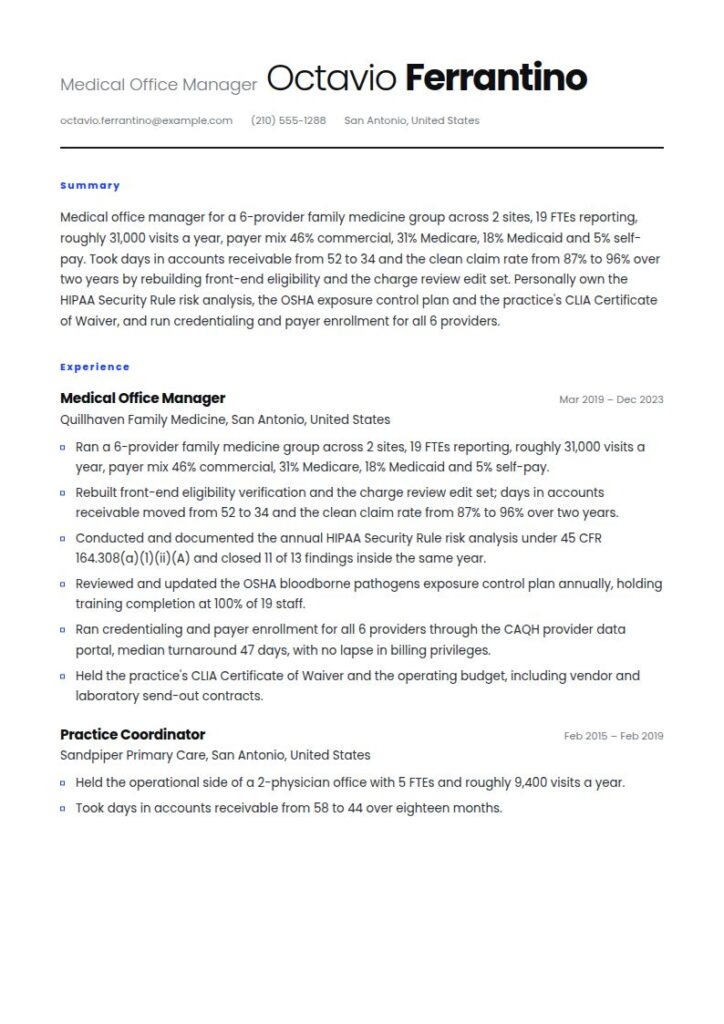
Medical office manager for a 6-provider family medicine group across 2 sites, 19 FTEs reporting, roughly 31,000 visits a year, payer mix 46% commercial, 31% Medicare, 18% Medicaid and 5% self-pay. Took days in accounts receivable from 52 to 34 and the clean claim rate from 87% to 96% over two years by rebuilding front-end eligibility and the charge review edit set. Personally own the HIPAA Security Rule risk analysis, the OSHA exposure control plan and the practice's CLIA Certificate of Waiver, and run credentialing and payer enrollment for all 6 providers.
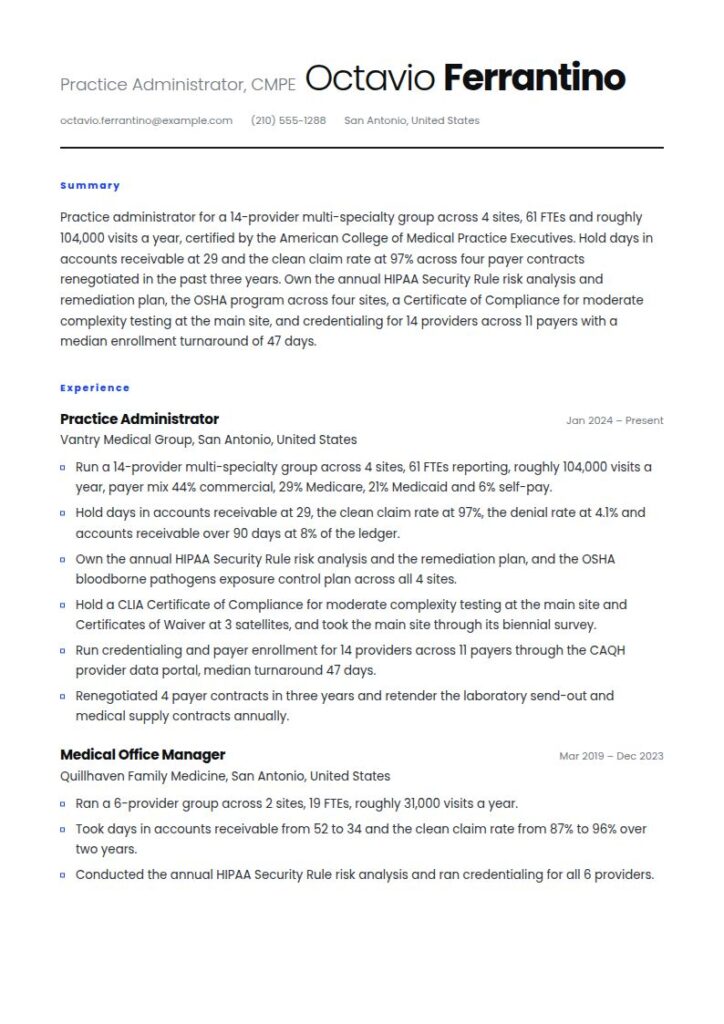
Practice administrator for a 14-provider multi-specialty group across 4 sites, 61 FTEs and roughly 104,000 visits a year, certified by the American College of Medical Practice Executives. Hold days in accounts receivable at 29 and the clean claim rate at 97% across four payer contracts renegotiated in the past three years. Own the annual HIPAA Security Rule risk analysis and remediation plan, the OSHA program across four sites, a Certificate of Compliance for moderate complexity testing at the main site, and credentialing for 14 providers across 11 payers with a median enrollment turnaround of 47 days.
Right vs wrong: the same medical office manager summary, twice
| ✅ Right | ❌ Wrong |
|---|---|
| Medical office manager for a 6-provider group across 2 sites, 19 FTEs, roughly 31,000 visits a year. | Experienced office manager overseeing daily operations of a busy medical practice. |
| Took days in accounts receivable from 52 to 34 and the clean claim rate from 87% to 96% over two years. | Improved billing efficiency and reduced outstanding claims. |
| Personally own the HIPAA Security Rule risk analysis and the OSHA exposure control plan. | Ensured compliance with all applicable healthcare regulations. |
| Run credentialing and payer enrollment for all 6 providers. | Assisted with provider onboarding and paperwork. |
The right column, for instance, is a practice a reader can picture. The left column could be any office in any industry, and that is exactly how it will be scored.
Outline your experience
Then give the practice, city, specialty, providers, sites, FTEs, visit volume, dates. Then three to five bullets, each carrying a number and a period.
| Instead of | Use |
|---|---|
| Managed daily operations of a medical office | Ran a 6-provider, 2-site family medicine group with 19 FTEs and roughly 31,000 visits a year |
| Improved billing processes | Took days in accounts receivable from 52 to 34 and the clean claim rate from 87% to 96% over two years |
| Ensured HIPAA compliance | Conducted the annual HIPAA Security Rule risk analysis under 45 CFR 164.308(a)(1)(ii)(A) and closed 11 of 13 findings within the year |
| Handled OSHA requirements | Reviewed and updated the bloodborne pathogens exposure control plan annually and held training completion at 100% of 19 staff |
| Credentialed providers | Enrolled 6 providers across 9 payers through the CAQH provider data portal, median turnaround 47 days |
Medical Office Manager, Quillhaven Family Medicine, San Antonio, TX, 6 providers across 2 sites, 19 FTEs, roughly 31,000 visits a year, March 2019 to December 2023
Held operational accountability for both sites: staffing model and rota, budget, vendor contracts, revenue cycle and compliance.
Rebuilt front-end eligibility verification and the charge review edit set; days in accounts receivable moved from 52 to 34 and the clean claim rate from 87% to 96% over two years.
Conducted and documented the annual HIPAA Security Rule risk analysis, tracked the remediation plan, and closed 11 of 13 findings inside the same year.
Reviewed and updated the OSHA bloodborne pathogens exposure control plan annually and held training completion at 100% of 19 staff, with hepatitis B vaccination offered inside the required window.
Ran credentialing and payer enrollment for all 6 providers through the CAQH provider data portal, with a median enrollment turnaround of 47 days and no lapse in billing privileges across five years.
State your operational scope, then the compliance you personally owned
In short, this is the section that separates a practice manager's resume from every other administrative one, and it has two halves.
The scope statement. Seven figures make a practice legible to anyone who runs one: providers, sites, full-time equivalents reporting to you, annual visit volume, payer mix, days in accounts receivable, and clean claim rate. The first five describe the practice; the last two describe how well it is run, and a regional director looks for those first. The Medical Group Management Association's financial and operational benchmarking uses measures of this kind, including days of adjusted fee-for-service charges in accounts receivable and the adjusted collection percentage (MGMA, revenue cycle benchmarking guidance, checked September 2026), so a manager who reports in that vocabulary reads as someone who has been benchmarked before.
Also write the movement, not the level alone. "Days in A/R 34" is a fact. "Days in A/R from 52 to 34 over two years, by rebuilding front-end eligibility and the charge review edit set" is a claim about you.
The compliance stack a practice manager owns
The compliance stack. Group practices are hiring someone who will personally hold four things, and naming them with their regulation is what proves you have actually done it rather than watched someone else do it.
The HIPAA Security Rule risk analysis. Under 45 CFR 164.308(a)(1)(ii)(A) a covered entity must "conduct an accurate and thorough assessment of the potential risks and vulnerabilities to the confidentiality, integrity, and availability of electronic protected health information" it holds (U.S. Department of Health and Human Services, guidance on risk analysis, content last reviewed 12 August 2026). Say that you conducted it, when, how many findings came out and how many you closed. That bullet does more than "ensured HIPAA compliance" ever will.
OSHA. The bloodborne pathogens standard at 29 CFR 1910.1030 requires a written exposure control plan "reviewed and updated at least annually," training at initial assignment and at least annually thereafter, and hepatitis B vaccination made available within 10 working days of initial assignment for employees with occupational exposure (Code of Federal Regulations, current as of 14 September 2026). Give the training completion rate and the staff count.
CLIA certificates and payer credentialing
CLIA. If the practice tests specimens, it holds a certificate, and which one changes the survey burden completely. The Centers for Medicare and Medicaid Services issue a Certificate of Waiver, a Certificate for Provider-Performed Microscopy Procedures, a Certificate of Registration, a Certificate of Compliance and a Certificate of Accreditation, with nonwaived moderate and high complexity testing surveyed every two years (CMS, CLIA Program and Medicare Laboratory Services, MLN006270, March 2026). Name which certificate your practice holds and whether you have taken a site through a survey.
Credentialing and payer enrollment. A provider who cannot bill is the most expensive problem a practice has. Health plans collect and verify provider data through the CAQH provider data portal, which supports collecting professional information, primary source verification and sanctions monitoring (CAQH, provider data management, checked September 2026). Give the provider count, the payer count and the median turnaround in days.
Scope: 14 providers across 4 sites, 61 FTEs reporting, roughly 104,000 visits a year, multi-specialty. Payer mix 44% commercial, 29% Medicare, 21% Medicaid, 6% self-pay.
Revenue cycle: days in accounts receivable 29, clean claim rate 97%, denial rate 4.1%, accounts receivable over 90 days at 8% of the ledger.
Compliance owned: annual HIPAA Security Rule risk analysis and remediation plan, HIPAA privacy policies and workforce training, OSHA bloodborne pathogens exposure control plan across 4 sites, CLIA Certificate of Compliance for moderate complexity testing at the main site and Certificates of Waiver at 3 satellites.
Credentialing: 14 providers across 11 payers through the CAQH provider data portal, median enrollment turnaround 47 days, no lapse in billing privileges in five years.
Contracts: 4 payer contracts renegotiated in three years, laboratory send-out and supply contracts retendered annually.
Build a snapshot of your key skills
In practice, list twelve to sixteen entries in four groups: operations, revenue cycle, compliance, and the systems you run.
Operations: Multi-site practice management, Staffing model and rota design, Operating budget ownership, Vendor contracting, Provider schedule and template design, Capacity and access planning
Revenue cycle: Days in accounts receivable, Clean claim rate, Denial management and appeals, Charge review edit sets, Eligibility and benefit verification workflow, Payer contract negotiation, Fee schedule analysis
Compliance: HIPAA Security Rule risk analysis, HIPAA privacy policies and workforce training, OSHA bloodborne pathogens program, CLIA certificate maintenance, Incident reporting and breach assessment, Credentialing and payer enrollment
Systems: Athenahealth, Epic, Microsoft 365, Excel modeling, CAQH provider data portal, clearinghouse denial reporting
List your education and certifications
After all, typical entry-level education for medical and health services managers is a bachelor's degree (BLS Occupational Outlook Handbook, 27 August 2026), so the differentiator is the certification and what you have taken through a survey or an audit.
CMPE, Certified Medical Practice Executive, American College of Medical Practice Executives, 2022. Board certification requires a qualifying combination of healthcare management experience and education, a multiple-choice examination and a scenario-based examination (MGMA, checked September 2026).
Master of Business Administration, Healthcare Management concentration, The University of Texas at San Antonio, San Antonio, TX, 2020
Bachelor of Business Administration, Health Care Administration, The University of Texas at San Antonio, San Antonio, TX, 2013
Training: HIPAA Security Rule risk analysis workshop, 2023. OSHA bloodborne pathogens program administration, renewed 2025.
Choose the right layout and design
Above all, use a single column, plain type at 11 or 12 point, clear headings, and no photograph. Health system and management services organization portals parse the file into a structured record before anyone reads it, and two columns, text boxes and graphics are where that parsing breaks.
Keep the scope figures inside the company line of each role, so a reader skimming only the employer lines still sees your trajectory.
Open with a scope statement in figures. Put providers, sites, FTEs and visit volume in every company line. Give payer mix, because it changes the job. Report revenue cycle results as a movement over a period. Name the regulation behind each compliance claim. Give credentialing a provider count, a payer count and a turnaround in days.
Do not write "oversaw daily operations" without the numbers that make it mean something. Do not claim compliance you supported rather than owned; interviewers ask who signed it. Do not include any patient identifier, and do not name a payer contract rate, which is usually confidential. Do not present a hospital department role as a group practice role; they are different labor markets. Do not go past two pages.
Medical office manager job market and outlook
Overall, it is one of the fastest-growing management occupations in the federal projections.
| Measure, medical and health services managers | Value |
|---|---|
| Jobs, 2025 | 640,400 |
| Projected change, 2025-35 | 24% growth, much faster than average |
| Projected annual openings | About 62,300 |
| Typical entry-level education | Bachelor's degree |
| Median annual wage, May 2025 | $123,860, or $59.55 per hour |
Source: U.S. Bureau of Labor Statistics, Occupational Outlook Handbook, 2025-35 projections and May 2025 wage data.
Read the industry row, not the headline median
The occupation median of $123,860 as of May 2025 is dominated by hospitals, which employ 28 percent of medical and health services managers at a median of $133,580 (BLS Occupational Outlook Handbook, May 2025).
A medical office manager works in offices of physicians, which is a different row: 13 percent of the occupation at a median of $105,770 as of May 2025 (BLS, May 2025). That is the number to carry into a negotiation for a group practice role, and quoting the headline figure instead is the fastest way to look unfamiliar with your own sector.
The growth, though, is real across all of it. BLS projects employment of medical and health services managers to grow 24 percent from 2025 to 2035, much faster than the average for all occupations, with about 62,300 openings a year on average (BLS, 2025-35 projections). Very little of that demand is for someone who cannot state their scope in numbers.
Where the jobs sit:
| Industry | Share of employment | Median annual wage (May 2025) |
|---|---|---|
| Hospitals, state, local and private | 28% | $133,580 |
| Offices of physicians | 13% | $105,770 |
| Nursing and residential care facilities | 9% | $100,520 |
| Outpatient care centers | 7% | $116,060 |
| Government, excluding education and hospitals | 7% | $136,130 |
Source: U.S. Bureau of Labor Statistics, Occupational Outlook Handbook, May 2025.
What salary you can expect as a medical office manager
The median annual wage for medical and health services managers was $123,860 as of May 2025, or $59.55 an hour, with the lowest 10 percent earning less than $73,390 and the highest 10 percent more than $224,340 (BLS, May 2025). Indeed, all of those figures sit well above the median for all occupations of $50,980 as of May 2025 (BLS, May 2025).
For a group practice role the relevant figure is offices of physicians at $105,770 (BLS, May 2025), and the spread inside that row is mostly scope. In practice, a single-site manager with three providers sits nearer the bottom of the range, whereas a multi-site administrator with fourteen providers, sixty staff and payer contract responsibility sits near the top of it.
Specifically, three things move you between those points, and all three are resume lines. First, scope, stated in providers, sites, FTEs and visit volume. Next, revenue cycle accountability, evidenced by days in accounts receivable and clean claim rate with a movement attached. Finally, board certification: ACMPE certification requires a qualifying combination of healthcare management experience and education plus two examinations (MGMA, checked September 2026), and it is what moves a candidate from the office manager pile into the practice administrator one.
Key takeaways for a medical office manager resume
- Above all, open with a scope statement: providers, sites, FTEs, visit volume, payer mix.
- Repeat the scope figures inside every company line, not only the summary.
- In addition, report days in accounts receivable and clean claim rate as movements over a period.
- Also name the regulation behind each compliance claim instead of just the acronym.
- Say which CLIA certificate the practice holds and whether you survived a survey.
- Give credentialing a provider count, a payer count and a turnaround in days.
- Similarly, quote offices of physicians pay instead of the hospital-weighted median.
Build your medical office manager resume in 15 minutes with our AI resume builder.
Related medical resume examples
- Health care administration resume
- Healthcare project manager resume
- Clinic coordinator resume
- Medical biller resume
- Medical coder resume
- Medical receptionist resume
- Medical administrative assistant resume
- Dental receptionist resume
- Nursing home resume
- Healthcare resume
- Physician resume
- Medical support assistant resume
Pair it with a matching medical office manager cover letter.
Medical office manager resume questions, answered
How long should a medical office manager resume be?
One page while you run a single site. Two once you carry multiple sites, a compliance program and credentialing, because those three need room to be evidenced rather than asserted. Two pages of scope figures is fine; two pages of duty statements is not.
What numbers matter most on a medical office manager resume?
Seven: providers, sites, full-time equivalents reporting to you, annual visit volume, payer mix, days in accounts receivable and clean claim rate. The first five let a reader size the practice. The last two tell them how well it was run. If you can only fit two, use days in accounts receivable and the clean claim rate, each with a before, an after and a period.
Should I list HIPAA and OSHA if every job requires them?
List them only where you personally owned the program, and then name the regulation. "Conducted and documented the annual HIPAA Security Rule risk analysis under 45 CFR 164.308(a)(1)(ii)(A), closing 11 of 13 findings in the year" is evidence. "HIPAA compliant" is filler, and an interviewer who asks who signed the risk analysis will find out which one you are in about eight seconds.
Is ACMPE board certification worth it?
It is widely recognized in group practice management and frequently listed as preferred on practice administrator postings. Board certification through the American College of Medical Practice Executives requires a qualifying combination of healthcare management experience and education, a multiple-choice examination and a scenario-based examination, along with continuing education (MGMA, checked September 2026). Moving from single-site management into a multi-site or administrator role, it is usually the cheapest lever available.
How do I write this resume if my practice never reported revenue cycle metrics?
Build them from what the systems do produce. Your clearinghouse reports rejections and denials, your practice management system reports aged accounts receivable, and visit counts come out of the schedule. Calculate days in accounts receivable and the clean claim rate for two comparable periods and use them. A manager who built the measurement because nobody else had is describing exactly the work the job is.