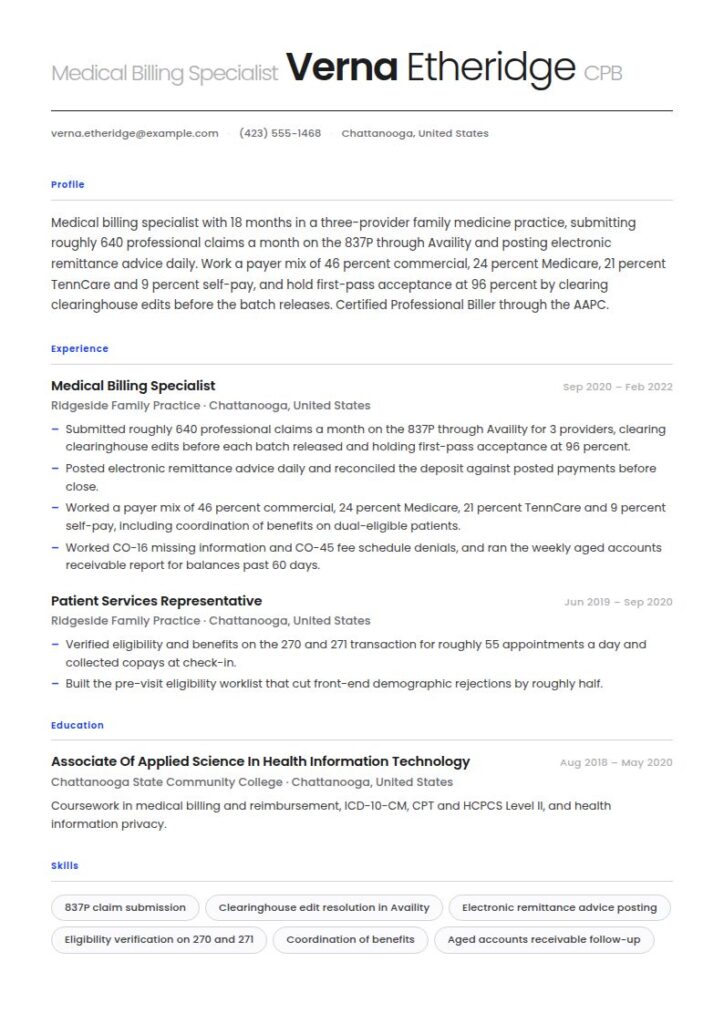
Medical Billing Specialist Verna Etheridge CPB
Medical Billing Specialist
[email protected] | (423) 555-1468 | Chattanooga, United States
Profile
Medical billing specialist with 18 months in a three-provider family medicine practice, submitting roughly 640 professional claims a month on the 837P through Availity and posting electronic remittance advice daily. Work a payer mix of 46 percent commercial, 24 percent Medicare, 21 percent TennCare and 9 percent self-pay, and hold first-pass acceptance at 96 percent by clearing clearinghouse edits before the batch releases. Certified Professional Biller through the AAPC.
Work Experience
09/2020 - 02/2022, Medical Billing Specialist, Ridgeside Family Practice, Chattanooga, United States
- Submitted roughly 640 professional claims a month on the 837P through Availity for 3 providers, clearing clearinghouse edits before each batch released and holding first-pass acceptance at 96 percent.
- Posted electronic remittance advice daily and reconciled the deposit against posted payments before close.
- Worked a payer mix of 46 percent commercial, 24 percent Medicare, 21 percent TennCare and 9 percent self-pay, including coordination of benefits on dual-eligible patients.
- Worked CO-16 missing information and CO-45 fee schedule denials, and ran the weekly aged accounts receivable report for balances past 60 days.
06/2019 - 09/2020, Patient Services Representative, Ridgeside Family Practice, Chattanooga, United States
- Verified eligibility and benefits on the 270 and 271 transaction for roughly 55 appointments a day and collected copays at check-in.
- Built the pre-visit eligibility worklist that cut front-end demographic rejections by roughly half.
Education
08/2018 - 05/2020, Associate of Applied Science, Health Information Technology, Chattanooga State Community College, Chattanooga, United States
Coursework in medical billing and reimbursement, ICD-10-CM, CPT and HCPCS Level II, and health information privacy.
Skills
837P claim submission, 80
Clearinghouse edit resolution in Availity, 80
Electronic remittance advice posting, 85
Eligibility verification on 270 and 271, 85
Coordination of benefits, 70
Aged accounts receivable follow-up, 70
Languages
English, native
Certificates
03/2021, Certified Professional Biller (CPB), AAPC, CPB-2286431
AAPC examinations in this family run four hours.
Summary
A medical biller resume is a one page document reporting your payer mix, the systems you bill in, and four numbers: clean claim rate, denial rate, days in accounts receivable and aged AR over 90 days. This guide gives you three adaptable versions, the denial-code detail most applicants leave out, the credentials the AAPC, AHIMA and HFMA issue, and what federal wage data does and does not publish for this job.
Medical Biller resume examples by experience level
In short, a medical biller resume is a one page document reporting your payer mix, the systems you bill in, and four numbers a revenue cycle manager can act on.
Billing is one of the few clinical-adjacent jobs where the work produces a ledger, but almost nobody uses that advantage. For example, the typical medical biller resume says "submitted claims to insurance companies and followed up on outstanding balances," which describes the posting rather than the person. The manager wants to know whether your claims go out clean, how often they come back, how long the money takes, and how much of the ledger has gone stale.
Resume guide for a medical biller resume
Specifically, this guide and the corresponding medical biller resume example will cover:
- First, how to write a medical biller resume, section by section
- Secondly, payer mix and the four numbers that decide this hire
- Thirdly, three adaptable summaries: new, experienced and lead
- Fourthly, which denial codes to name, and which credential to hold
- Lastly, what the job market looks like and what you can expect to earn
How to write a medical biller resume
Overall, it takes five blocks: contact header, summary, revenue cycle results, experience with payer mix, and education with credentials. One page. The results block sits above experience, because it is what a manager reads twice.
| Section | What it is answering | Where it goes |
|---|---|---|
| Credential | Is this verifiable, and which body issued it? | Header line, with the initials |
| Revenue cycle results | Do claims go out clean and does money arrive? | Its own block, four numbers |
| Payer mix | Have they billed my payers, in my specialty? | Employer line, as percentages |
| Systems | Which practice management system and clearinghouse? | Named, never "various EMRs" |
Write the ledger, not the task list
Every billing job involves claim submission, payment posting, denial work and patient balances. Naming those tells a reader nothing; the next twelve resumes do too.
What separates a file is pairing a number with a cause. Not "reduced denials," but: the denial rate was 9.8 percent, two thirds of it CO-197 for absent authorization on advanced imaging, I moved the authorization check to scheduling, and it came down to 4.1 percent over three quarters.
That sentence proves three things at once: you can read a remittance, you found a root cause upstream of yourself, and you can report it in the vocabulary a finance meeting uses.
Run the file through the ATS resume checker first. Health systems and billing companies parse applications into a structured record before a person opens one.
Choosing the best resume format for a medical biller resume
Reverse chronological, one page. Employer, city, specialty, provider count, monthly claim volume, dates, then three to five bullets that each carry a number.
First, put the specialty in the employer line. After all, orthopedic billing is modifier and global-period work, behavioral health is authorization and unit limits, a surgical center is implants and multiple-procedure reductions. Therefore, a manager scanning for their specialty needs it in the first line of each entry.
Include your contact information
| ✅ Right | ❌ Wrong |
|---|---|
| Verna Etheridge, CPB, CRCR | Verna Etheridge |
| Revenue Cycle Lead, Orthopedics and Ambulatory Surgery | Detail-oriented billing professional |
| athenaOne and Epic Resolute, Availity and Waystar | Experienced with billing software |
| (423) 555-1468, [email protected], Chattanooga, TN | (423) 555-1468, [email protected] |
Put the credential initials next to your name. Similarly, CPB, CCA and CRCR are searchable strings, whereas "certified biller" is not. Name your practice management system and clearinghouse in the header too, because a practice running Waystar edits is filtering for those words.
Make use of a summary
Four lines: the credential, the scale and specialty, the payer mix, and one of the four numbers with a before and an after.
Medical billing specialist with 18 months in a three-provider family medicine practice, submitting roughly 640 professional claims a month on the 837P through Availity and posting electronic remittance advice daily. Work a payer mix of 46 percent commercial, 24 percent Medicare, 21 percent TennCare and 9 percent self-pay, and hold first-pass acceptance at 96 percent by clearing clearinghouse edits before the batch releases. Certified Professional Biller through the AAPC.
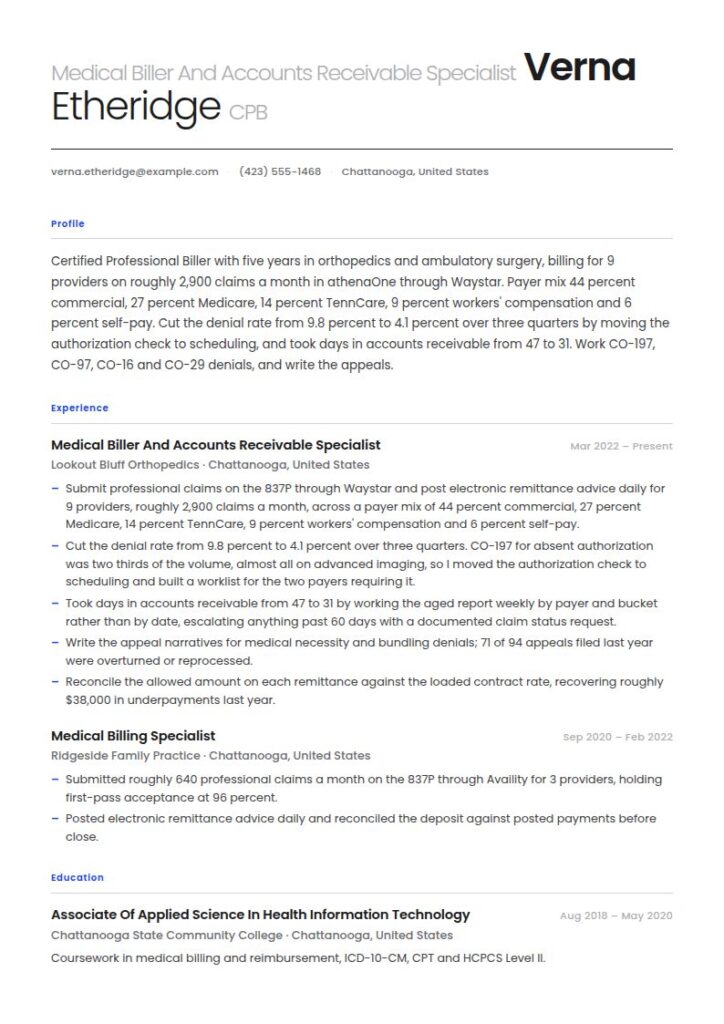
Certified Professional Biller with five years in orthopedics and ambulatory surgery, billing for 9 providers on roughly 2,900 claims a month in athenaOne through Waystar. Payer mix 44 percent commercial, 27 percent Medicare, 14 percent TennCare, 9 percent workers' compensation and 6 percent self-pay. Cut the denial rate from 9.8 percent to 4.1 percent over three quarters by moving the authorization check to scheduling, and took days in accounts receivable from 47 to 31. Work CO-197, CO-97, CO-16 and CO-29 denials, and write the appeals.
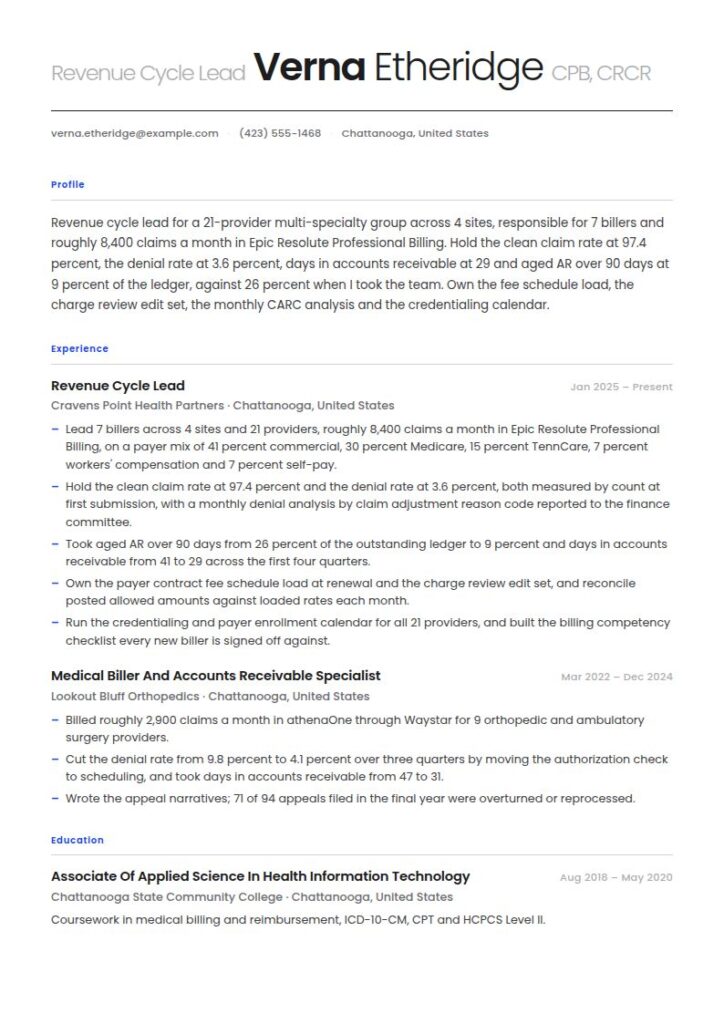
Revenue cycle lead for a 21-provider multi-specialty group across 4 sites, responsible for 7 billers and roughly 8,400 claims a month in Epic Resolute Professional Billing. Hold the clean claim rate at 97.4 percent, the denial rate at 3.6 percent, days in accounts receivable at 29 and aged AR over 90 days at 9 percent of the ledger, against 26 percent when I took the team. Own the fee schedule load, the charge review edit set, the monthly CARC analysis and the credentialing calendar.
Right vs wrong: the same medical biller summary, twice
| ✅ Right | ❌ Wrong |
|---|---|
| Billing for 9 providers on roughly 2,900 claims a month in athenaOne through Waystar. | Experienced in medical billing for a busy practice. |
| Payer mix 44 percent commercial, 27 percent Medicare, 14 percent TennCare, 9 percent workers' compensation. | Familiar with a wide range of insurance carriers. |
| Aged AR over 90 days went from 26 percent of the ledger to 9 percent, and the denial rate from 9.8 percent to 4.1 percent. | Proven success in reducing denials and improving accounts receivable. |
For instance, the right column can be checked at interview, which is why it reads as credible. The wrong column, however, is what every other applicant sent.
Outline your experience
Then list employer, city, specialty, provider count, monthly claim volume, dates. Then three to five bullets, each naming a payer, a code or a process, and carrying a number.
| Instead of | Use |
|---|---|
| Submitted claims to insurance companies | Submit roughly 2,900 professional claims a month on the 837P through Waystar, clearing front-end edits before the batch releases |
| Followed up on unpaid claims | Work the aged AR report weekly by payer and bucket; aged AR over 90 days fell from 26 percent to 9 percent |
| Handled claim denials | Analyze denials monthly by claim adjustment reason code; CO-197 was two thirds of the volume, and moving authorization to scheduling cut the denial rate from 9.8 percent to 4.1 percent |
Medical Biller and Accounts Receivable Specialist, Lookout Bluff Orthopedics, Chattanooga, TN, orthopedics and ambulatory surgery, 9 providers, roughly 2,900 claims a month, March 2022 to Present
Submit professional claims on the 837P through Waystar and post electronic remittance advice daily across a payer mix of 44 percent commercial, 27 percent Medicare, 14 percent TennCare, 9 percent workers' compensation and 6 percent self-pay.
Cut the denial rate from 9.8 percent to 4.1 percent over three quarters. CO-197 for absent authorization was two thirds of the volume, almost all on advanced imaging, so I moved the authorization check to scheduling and built a worklist for the two payers requiring it.
Took days in accounts receivable from 47 to 31 by working the aged report weekly by payer and bucket rather than by date, escalating anything past 60 days with a documented claim status request.
Write the appeal narratives for medical necessity and bundling denials; 71 of 94 appeals filed last year were overturned or reprocessed, and reconciling each remittance against the loaded contract rate recovered roughly $38,000 in underpayments.
Your payer mix and the four numbers a revenue cycle manager hires on
In fact, this is what separates a medical biller resume from every neighboring administrative role. A receptionist, a coder and a practice manager, for example, all touch a claim. You are the one whose work is measured in a ledger, so put the ledger on the page.
Start with the payer mix, as percentages. Commercial, Medicare, Medicaid or its state plan name, workers' compensation, and self-pay. The mix determines almost everything else: authorization burden, timely filing windows, appeal procedure, fee schedule complexity and patient balance work. A biller from a 70 percent Medicare practice and one from a 70 percent workers' compensation practice have almost nothing in common, and the mix is the cheapest way to say which you are.
| Measure | What it means | What to write |
|---|---|---|
| Clean claim or first-pass rate | Claims accepted on first submission without rework | 89 percent to 97.4 percent over four quarters |
| Denial rate | Submitted claims denied, by dollars or by count | 9.8 percent to 4.1 percent over three quarters |
| Days in accounts receivable | Average days from date of service to payment | 47 days to 31 days |
| Aged AR over 90 days | Share of the ledger older than 90 days | 26 percent to 9 percent |
Give each a before, an after and a period, and say whether it is by count or by dollars. A manager who has run these reports knows the two give different answers, so saying which you used signals you are not repeating a number someone handed you.
Denial codes a medical biller should name
Then name the codes you personally worked. Claim adjustment reason codes are the shared language: X12 describes them as codes that "describe why a claim or service line was paid differently than it was billed" (X12, Claim Adjustment Reason Codes, status last reviewed 1 August 2026). Writing CO-197 for absent authorization, CO-97 for bundling, CO-16 for missing information, CO-29 for timely filing and CO-11 for a diagnosis inconsistent with the procedure says exactly which problems you have solved, and cannot be faked in an interview.
Name the transactions and forms, not "billing software." The professional claim is the 837P, which CMS calls "the standard format used by health care professionals and suppliers to transmit health care claims electronically," with initial Medicare claims required to be electronic unless the provider qualifies for an exception under the Administrative Simplification Compliance Act (CMS, Medicare Billing: 837P and Form CMS-1500). The paper counterpart is Form CMS-1500, maintained by the National Uniform Claim Committee (CMS, Professional Paper Claim Form, last modified 10 September 2024). Add the 835 remittance advice and the 270, 271, 276 and 277 transactions.
Know your filing windows. Medicare fee-for-service claims "must be filed within one calendar year after the date of service" under 42 CFR 424.44 (CMS, Timely Filing Requirements), and commercial windows are shorter.
Payer mix: Commercial 44 percent, Medicare 27 percent, TennCare 14 percent, workers' compensation 9 percent, self-pay 6 percent
Clean claim rate: 89 percent to 97.4 percent over four quarters, by count at first submission. Denial rate: 9.8 percent to 4.1 percent over three quarters, by count
Days in accounts receivable: 47 to 31. Aged AR over 90 days: 26 percent of the ledger to 9 percent. Appeals: 94 filed, 71 overturned or reprocessed
Denial codes worked: CO-197 authorization, CO-97 bundling, CO-16 missing information, CO-29 timely filing, CO-11 diagnosis inconsistency, PR-204 non-covered
Transactions: 837P, CMS-1500, 835 remittance advice, 270 and 271 eligibility, 276 and 277 status
Build a snapshot of your key skills
Then list twelve to sixteen entries in four groups: named systems, transactions and processes.
Claims: 837P submission, Clearinghouse edit resolution, Charge review and scrubber rules, Modifier review, Coordination of benefits
Denials and appeals: CARC and RARC analysis, Appeal narrative writing, Authorization and precertification, Medical necessity documentation requests, Payer policy research
Accounts receivable: Aged AR by payer and bucket, Claim status requests, Underpayment recovery, Patient statement cycle, Good faith estimates
Systems: athenaOne, Epic Resolute Professional Billing, eClinicalWorks, Availity, Waystar, Payer portals, Excel pivot reporting
List your education and certifications
Above all, the credential is the largest single lever on this page, and three bodies matter.
The AAPC issues the Certified Professional Biller, the credential most often named on physician-practice postings; its examinations in this family, including the CPB, run four hours (AAPC, certification exam information, checked September 2026). Meanwhile, AHIMA sits on the record and coding side: its Certified Coding Associate requires a high school diploma, recommends six months of direct coding experience or an approved program, and runs 105 questions in two hours, renewing every two years (AHIMA, checked September 2026). In addition, HFMA's Certified Revenue Cycle Representative is the finance-side option, recommending one or more years of revenue cycle experience and assessed in 75 questions in 90 minutes at a 70 percent pass mark (HFMA, checked September 2026).
Also, write each credential with its issuing body, number and expiry, and the systems you are trained on beside them.
Certified Professional Biller (CPB), AAPC, #CPB-2286431, current through 2027
Certified Revenue Cycle Representative (CRCR), Healthcare Financial Management Association, 2025
Associate of Applied Science, Health Information Technology, Chattanooga State Community College, Chattanooga, TN, 2020
Systems: Epic Resolute Professional Billing certified, 2024. athenaOne and eClinicalWorks administration. Waystar and Availity edit configuration.
Additional: HIPAA privacy and security training, current. No Surprises Act and good faith estimate training, 2024.
Choose the right layout and design
Finally, keep a single column, plain type at 11 or 12 point, clear headings, no photograph, no rating bars. The four numbers should be visible without scrolling on a phone, because the first read is a screening read.
Put the credential initials next to your name. Give the payer mix as percentages in every employer line. Report the four numbers with a before, an after and a period, and say whether they are by count or by dollars. Name the denial codes you worked, the practice management system and the clearinghouse. Say what you changed upstream to move a number.
Do not write "submitted claims and followed up on balances" and stop. Do not claim a number you cannot reproduce from a report at interview. Do not describe coding decisions as yours if a coder made them. Do not write "various EMRs"; it reads as none. Do not put a patient name, account number or claim number on a resume.
Medical biller job market and outlook
Overall, billing is a large, stable occupation whose federal statistics are split across two published jobs, one only partly retrievable this year.
The Bureau of Labor Statistics publishes no Handbook profile titled medical biller. Most of the work is counted under billing and posting clerks, inside the Handbook's financial clerks profile, and the record and coding side under medical records specialists. Billing and posting clerks is published in full this cycle. For medical records specialists, the current-cycle median pay appears in the Handbook's healthcare occupations summary, but the detailed profile was not retrievable at the time of writing, so its employment count, growth rate, annual openings and industry table are left out rather than estimated.
| Measure | Value | Occupation |
|---|---|---|
| Employment, 2025 | 418,000 | Billing and posting clerks |
| Projected change, 2025-35 | 0 percent, minus 200 | Billing and posting clerks |
| Median annual wage, May 2025 | $48,500 | Billing and posting clerks |
| Typical entry-level education | High school diploma or equivalent | Billing and posting clerks |
| Median annual wage, May 2025 | $49,990 | All financial clerks |
| Lowest and highest 10 percent | Less than $37,440, more than $73,760 | All financial clerks |
| Projected annual openings, 2025-35 | About 88,000 | All financial clerks |
| Median annual wage, May 2025 | $51,140 | Medical records specialists |
Source: U.S. Bureau of Labor Statistics, Occupational Outlook Handbook, Financial Clerks and Healthcare Occupations, May 2025 wage data and 2025-35 projections, pages last modified 27 August 2026.
Nearly one in five in-network claims was denied, and almost nobody appeals
Analyzing federal transparency data on HealthCare.gov issuers, KFF found insurers denied 19 percent of in-network claims in 2024, with rates ranging from 3 percent to 36 percent across the 157 reporting issuers, and out-of-network claims denied at 37 percent. Fewer than 1 percent of denied claims were appealed by consumers, and 66 percent of appeals filed were upheld by the insurer (KFF, Claims Denials and Appeals in ACA Marketplace Plans in 2024, published 24 March 2026).
The reason categories belong on your resume. In the same analysis, 25 percent of denials were recorded as administrative, 13 percent an excluded service, 9 percent a missing prior authorization or referral and 5 percent medical necessity, with 36 percent classified as other.
Administrative denials are the largest named category, and the ones a biller prevents rather than appeals: eligibility not verified, demographics wrong, coordination of benefits stale, authorization missing, filed past the window. If you moved a clean claim rate by fixing something upstream at registration or scheduling, write that.
What salary you can expect as a medical biller
Specifically, billing and posting clerks had a median annual wage of $48,500 as of May 2025, inside a financial clerks group with a median of $49,990, a bottom decile under $37,440 and a top decile over $73,760 (BLS Occupational Outlook Handbook, May 2025). Medical records specialists, covering the coding and record side, had a 2025 median of $51,140 (BLS Occupational Outlook Handbook, Healthcare Occupations, last modified 27 August 2026). No percentile range for that occupation was retrievable at the time of writing, so none is quoted.
In practice, what moves an offer here is narrow and entirely documentary:
- Credential stacking. The CPB is the practice-side baseline, the CRCR signals the finance side, and a coding credential moves you towards audit work. Each sits in a different pay band.
- Specialty. Orthopedics, ambulatory surgery, behavioral health and anesthesia billing pay above primary care billing nearly everywhere, because the rules are denser and the error cost higher.
- Appeal and underpayment recovery. An overturn count and a recovered dollar figure are the two lines a finance director converts into a salary.
- The supervisory step. Revenue cycle lead and practice administrator sit on a different ladder, reached by reporting the four numbers as a team result. Flat employment with roughly 88,000 openings a year across financial clerks means replacement hiring, which rewards the candidate who arrives able to work a denial.
Key takeaways for a medical biller resume
- First, put the credential initials next to your name, because CPB and CRCR are the searched strings.
- Give the payer mix as percentages in every employer line.
- Then report four numbers: clean claim rate, denial rate, days in A/R, aged AR over 90 days.
- Give each a before, an after and a period, and say count or dollars.
- Also name the denial codes you worked, and the system and clearinghouse by name.
- Finally, say what you changed upstream, because administrative denials are prevented, not appealed.
Build your medical biller resume in 15 minutes with our AI resume builder.
Related medical resume examples
- Medical coder resume
- Medical office manager resume
- Medical receptionist resume
- Medical administrative assistant resume
- Medical support assistant resume
- Health care administration resume
- Clinic coordinator resume
- Medical assistant resume
- Dental receptionist resume
- Healthcare project manager resume
- Medical social worker resume
- Healthcare resume
Pair it with a matching medical biller cover letter.
Medical biller resume questions, answered
How long should a medical biller resume be?
One page. A revenue cycle lead across four sites still fits, because the four numbers and the payer mix are lines, not paragraphs. A second page usually means the results block was replaced by duties.
What if my practice does not report a clean claim rate or days in A/R?
Build them. The clearinghouse reports rejections and acceptances, the practice management system reports aged accounts receivable by bucket, and charge counts come out of the ledger. Calculate each for two comparable periods and say how. A biller who built the measurement because nobody else had is describing the job itself.
Which medical biller certification should I get?
If you bill for a physician practice, the AAPC Certified Professional Biller is the credential most often named on postings, and its examination runs four hours (AAPC, checked September 2026). Moving towards hospital revenue cycle, the HFMA Certified Revenue Cycle Representative recommends one or more years of revenue cycle experience and is assessed in 75 questions in 90 minutes at a 70 percent pass mark (HFMA, checked September 2026). For coding, auditing and appeals, an AHIMA credential such as the Certified Coding Associate is the better step (AHIMA, checked September 2026).
Is a medical biller the same as a medical coder?
No, though small practices combine them. A coder reads the record and assigns ICD-10-CM, CPT and HCPCS codes. A biller takes the coded encounter, builds and submits the claim, posts the remittance, works denials and appeals, and pursues the balance. Federal statistics reflect the split: coding sits largely under medical records specialists, billing under billing and posting clerks (BLS Occupational Outlook Handbook, last modified 27 August 2026). If you do both, say so with a number for each.
What do I put on a medical biller resume with no experience?
Whatever produced a claim. An externship in a billing office, front desk work where you verified eligibility and collected copays, accounts receivable work in another industry, or a completed billing program with the modules named. Then the credential or examination date, the systems you have logged into, and one number: claims entered a day, eligibility checks completed, or the acceptance rate on the batches you released.