Verna Etheridge Certified Professional Biller, CPB, CRCR Chattanooga, 37405, United States [email protected] · (423) 555-1468
16 September 2026
Ms. Lorna Broadhurst Revenue Cycle Tiftonia Surgical Partners Chattanooga, United States
Application for Revenue Cycle Specialist, Tiftonia Surgical Partners
Dear Ms. Broadhurst,
I am applying for the Revenue Cycle Specialist post at Tiftonia Surgical Partners. I am a Certified Professional Biller with five years in orthopedics and ambulatory surgery, billing roughly 2,900 claims a month in athenaOne through Waystar on a mix of 44 percent commercial, 27 percent Medicare, 14 percent TennCare, 9 percent workers' compensation and 6 percent self-pay.
The result I would most want to bring is on denials. When I took the book, the denial rate was 9.8 percent, and the first month of CARC analysis showed that CO-197, absent authorization, was roughly two thirds of it, almost all on advanced imaging ordered the same week it was performed. The fix was not in billing at all. I moved the authorization check to the point of scheduling, built a worklist for the two payers that required it, and wrote a one-page reference for the front desk on which imaging needed what. Over three quarters the denial rate came down to 4.1 percent, and days in accounts receivable fell from 47 to 31.
I noticed your posting mentions implant billing and a move to Epic Resolute. I am Resolute Professional Billing certified, and I have worked the multiple-procedure and implant side of an ambulatory surgery book, including reconciling each remittance against the loaded contract rate, which recovered roughly $38,000 in underpayments last year. I would want to own the denial analysis and the appeal narratives, since that is where I have been most useful.
My CPB number is CPB-2286431, current through 2027, and I also hold the HFMA Certified Revenue Cycle Representative. I can start on two weeks' notice. Thank you for your time.
Sincerely, Verna Etheridge, CPB, CRCR
Summary
A medical biller cover letter tells a revenue cycle manager which payers you have billed, which systems you bill in, and one number you moved with the cause attached. This guide gives you a full adaptable letter, how the letter changes between a small practice and a hospital revenue cycle team, and the openings that get a file read to the end.
Medical Biller cover letter examples by experience level
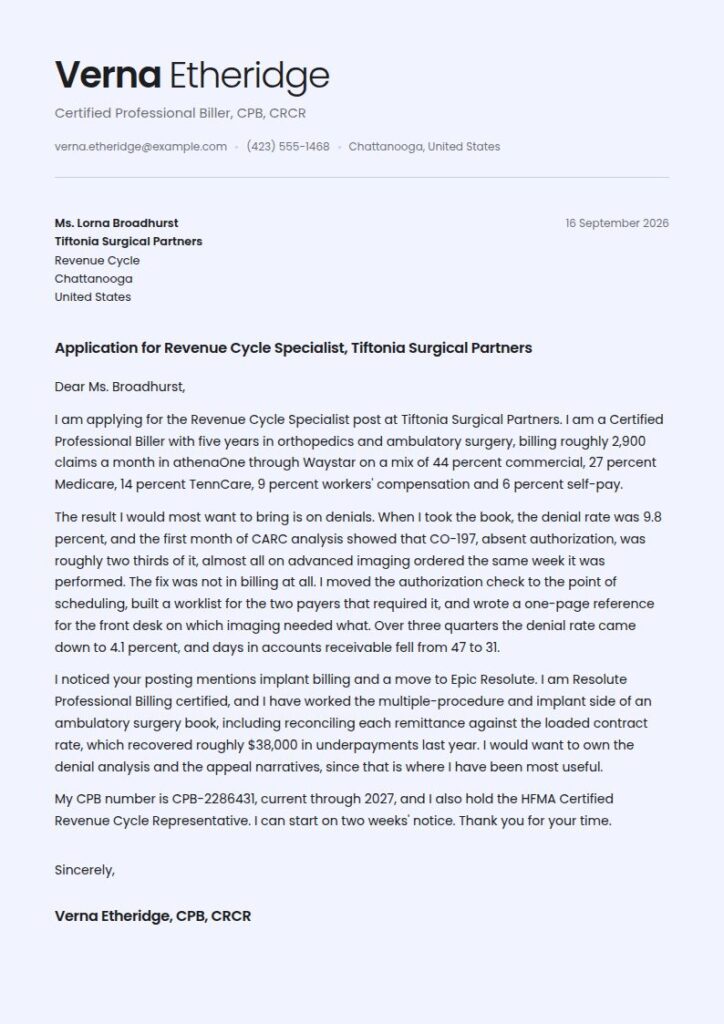
A medical biller cover letter is a one-page letter that tells a revenue cycle manager which payers you have billed, which systems you bill in, and one number you moved with the cause attached.
That last part is the whole letter. Every applicant can say they worked denials. Very few can say which code dominated their book, what they changed upstream, and what the rate did afterwards.
Guide to a medical biller cover letter
This guide and the corresponding medical biller cover letter example will cover:
- How to structure the letter, paragraph by paragraph
- Why the payer mix and the system belong in the first paragraph
- How to build a number when nobody has ever handed you one
- How the letter changes between a small practice and a hospital revenue cycle team
How to write a medical biller cover letter
| Paragraph | Its job | Length |
|---|---|---|
| Opening | The post, your credential, your payer mix, your system | 2 to 3 sentences |
| Evidence | One denial code, one cause, one number, a before and an after | 4 to 5 sentences |
| Fit | Something specific about their organization, and what you would take on | 3 to 4 sentences |
| Close | Credential numbers, availability, thank you | 2 sentences |
Lead with the payer mix and the system, not the duties
A revenue cycle manager reading applications has a specific gap: a TennCare-heavy book nobody is working, an athenaOne migration, an orthopedic denial backlog. They are not weighing your commitment to accuracy against the next candidate's.
So open with what they are matching on: "I am a Certified Professional Biller with five years in orthopedics and ambulatory surgery, billing roughly 2,900 claims a month in athenaOne through Waystar, on a mix of 44 percent commercial, 27 percent Medicare and 14 percent TennCare."
Two sentences, and the reader knows whether to keep going. Then spend the rest of the letter on one number.
A medical biller cover letter example you can adapt
Dear Ms. Broadhurst,
I am applying for the Revenue Cycle Specialist post at Tiftonia Surgical Partners. I am a Certified Professional Biller with five years in orthopedics and ambulatory surgery, billing roughly 2,900 claims a month in athenaOne through Waystar on a mix of 44 percent commercial, 27 percent Medicare, 14 percent TennCare, 9 percent workers' compensation and 6 percent self-pay.
The result I would most want to bring is on denials. When I took the book, the denial rate was 9.8 percent, and the first month of CARC analysis showed that CO-197, absent authorization, was roughly two thirds of it, almost all on advanced imaging ordered the same week it was performed. The fix was not in billing at all. I moved the authorization check to the point of scheduling, built a worklist for the two payers that required it, and wrote a one-page reference for the front desk on which imaging needed what. Over three quarters the denial rate came down to 4.1 percent, and days in accounts receivable fell from 47 to 31.
I noticed your posting mentions implant billing and a move to Epic Resolute. I am Resolute Professional Billing certified, and I have worked the multiple-procedure and implant side of an ambulatory surgery book, including reconciling each remittance against the loaded contract rate, which recovered roughly $38,000 in underpayments last year. I would want to own the denial analysis and the appeal narratives, since that is where I have been most useful.
My CPB number is CPB-2286431, current through 2027, and I also hold the HFMA Certified Revenue Cycle Representative. I can start on two weeks' notice. Thank you for your time.
Sincerely, Verna Etheridge, CPB, CRCR
Openings that work
| Instead of | Use |
|---|---|
| I am writing to express my interest in your medical billing position | I am applying for the Revenue Cycle Specialist post, and I bill roughly 2,900 claims a month in athenaOne through Waystar |
| I have strong attention to detail and excellent organizational skills | My book is 44 percent commercial, 27 percent Medicare, 14 percent TennCare and 9 percent workers' compensation |
| I have a proven track record of reducing denials | CO-197 was two thirds of my denial volume; moving authorization to scheduling took the rate from 9.8 percent to 4.1 percent |
| I would be an asset to your revenue cycle team | I noticed your posting mentions implant billing and a move to Epic Resolute; I am Resolute Professional Billing certified |
Building a number when nobody has handed you one
Plenty of billers work in practices that never report a clean claim rate. The data still exists, and calculating it yourself is the most persuasive thing in the letter.
| Where to look | The number it gives you |
|---|---|
| Clearinghouse acceptance report | First-pass acceptance rate, by batch and by payer |
| Remittance advice, grouped by CARC | Denial rate and the code that dominates it |
| Aged AR report by payer and bucket | Days in accounts receivable, and aged AR over 90 days |
| Appeal log | Appeals filed and the share overturned or reprocessed |
| Contract fee schedule against posted allowed amounts | Underpayment dollars recovered |
Take two comparable periods, say which you used, and whether you counted claims or dollars. A manager can tell within one sentence whether you have run the report.
Small practice or hospital revenue cycle team
For a small practice, show breadth: charge entry, submission, posting, denials, appeals, patient statements and the deposit reconciliation, because one person will do all of it. For a hospital or large group, show depth in one lane and name the system, because the work is split by function and the reader is filling a specific seat. Use the state plan's own name rather than "Medicaid" when you know it.
Do not open with attention to detail; every letter in the folder does. Do not quote a number you cannot reproduce from a report at interview. Do not describe coding decisions as yours if a coder made them. Do not write "various billing systems", or put a patient name, account number or claim number in a letter.
Nearly one in five in-network claims was denied, and hardly any were appealed
Analyzing federal transparency data on HealthCare.gov issuers, KFF found insurers denied 19 percent of in-network claims in 2024, with rates ranging from 3 percent to 36 percent across the 157 reporting issuers. Fewer than 1 percent of denied claims were appealed by consumers, and 66 percent of the appeals filed were upheld by the insurer. Of the denials, 25 percent were recorded as administrative, 13 percent as an excluded service, 9 percent for a missing prior authorization or referral and 5 percent for medical necessity (KFF, Claims Denials and Appeals in ACA Marketplace Plans in 2024, published 24 March 2026).
Write your letter against that. Administrative reasons are the largest named category, and the ones a biller prevents rather than appeals. A paragraph showing that you traced a denial category to its cause upstream at registration or scheduling, then moved the rate, is aimed at the biggest single share of the problem.
Length, format and sending it
One page, four paragraphs, 250 to 400 words. PDF unless the portal says otherwise, named for yourself and the post: verna-etheridge-medical-biller-cover-letter.pdf
Address a person. Revenue cycle directors and practice administrators are usually named on an organization's site or on LinkedIn, and "Dear Hiring Manager" on a letter that is otherwise this specific looks like one sent to twelve employers.
Keep every figure identical to your resume, because the interview will compare them. Our medical biller resume example uses the numbers written here, and the free ATS checker will tell you whether the credential strings survive the parser.
Key takeaways
- Open with the credential, the payer mix and the system you bill in.
- Spend the middle of the letter on one number with the cause attached.
- Name the denial code, not "claim issues".
- Say what you changed upstream, because administrative denials are prevented.
- Calculate the number yourself if nobody reports it, and say how.
- Name one real thing about their organization, from their own pages.
- Address a named person and keep it to one page.
Build your medical biller resume in 15 minutes with our AI resume builder.
Medical biller cover letter questions, answered
How long should a medical biller cover letter be?
One page, four paragraphs, 250 to 400 words. Managers read these in batches, and the letter is competing on whether it contains a checkable number, not on length.
Do I need a cover letter if the application is a portal?
Attach one wherever there is a field for it. The portal collects the same structured record from everyone. The letter is the only place you can name your payer mix, your system and the one number you moved.
What do I write with no billing experience yet?
Write whatever produced a claim or a payment. An externship in a billing office, front desk work verifying eligibility and collecting copays, accounts receivable work in another industry, or a completed billing program with the modules named. Then your credential or examination date, the systems you have logged into, and one small number: claims entered a day, or the acceptance rate on the batches you released.
Should I mention specific payers by name?
Yes, and use the state plan's own name where you know it, because a Tennessee practice hiring for a TennCare-heavy book is looking for that word. Give the mix as percentages, since a 70 percent Medicare book and a 70 percent workers' compensation book are different jobs with the same title.
How do I write to an organization I know nothing about?
Spend ten minutes on their site first: the services they bill for, whether they run an ambulatory surgery center, the patient billing pages, and the system named in the posting. One accurate sentence about their actual revenue cycle, such as a migration or a specialty line, is worth more than a paragraph of admiration.