Vasily Sokolov Certified Surgical Technologist, CST Spokane, 99202, United States [email protected] · (509) 555-1426
11 September 2026
Ms. Danielle Bergeron Surgical Services Kootenai Ridge Regional Hospital Coeur d'Alene, United States
Application for Certified Surgical Technologist, Orthopedics, Kootenai Ridge Regional Hospital
Dear Ms. Bergeron,
I am applying for the Certified Surgical Technologist post in orthopedics at Kootenai Ridge Regional Hospital. I hold an active CST credential through the NBSTSA and current basic life support certification, I am primary scrub in orthopedics and general surgery including total joint and spine sets for two vendor systems, and I take call one week in four including trauma activations.
At Cascade Summit Medical Center I scrub about 620 cases a year across four surgeons in a 14-room Level II trauma department that runs roughly 11,000 cases annually. The number I would point to is preference card accuracy: I rebuilt 74 cards across 9 surgeons over 18 months, and average intraoperative instrument pulls fell from 3.1 to 0.7 per case. First-case on-time starts in my assigned rooms have stayed above the department target for eight consecutive quarters, and I have had no unresolved count discrepancy in six years.
I noticed that Kootenai Ridge is adding a second robotic system and expanding the spine service. I scrub robotic general surgery and urology, including docking and instrument exchange, and I have precepted 11 new techs and students through their first 20 cases. I would want to help build the day-before pull standard for the new service, which is the piece that decides whether a room starts on time.
My CST credential is active and my basic life support card is current. I can start on three weeks' notice and I am available for call from my first week. Thank you for your time.
Sincerely, Vasily Sokolov, CST
Summary
A surgical tech cover letter names the service lines you can scrub without a preceptor, the case volume behind that claim, and whether you take call. This guide gives you a full adaptable letter, the openings that work, what to write as a new graduate or a traveler, and the operational numbers a manager is measured on.
Surgical Tech cover letter examples by experience level
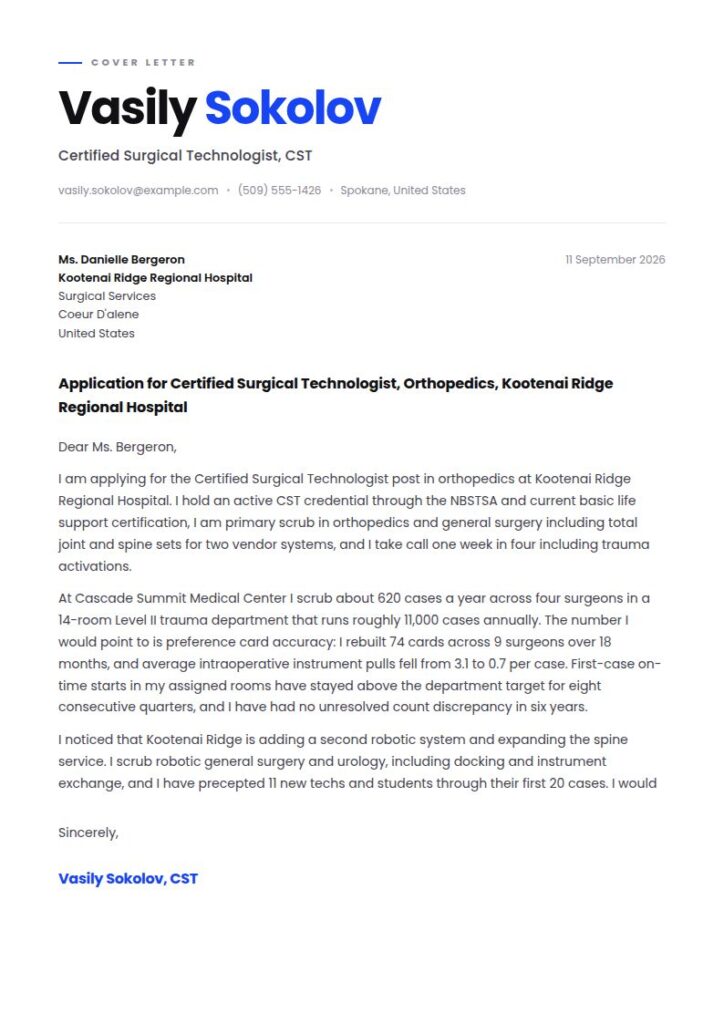
A surgical tech cover letter is a one-page letter telling a surgical services manager which service lines you scrub without a preceptor, how many cases a year sit behind that, and whether you take call.
Managers here hire against a room assignment board and a call rotation with holes in it. A letter naming the services you cover and the call you take answers the question they woke up with, which most letters do not.
Guide to a surgical tech cover letter
This guide and the corresponding surgical tech cover letter example will cover:
- How to structure the letter, paragraph by paragraph
- Why service lines and call belong in the first paragraph
- The operational numbers that count as evidence in an operating room
- What to write as a new graduate, and as a traveler
- The published market data behind the post
How to write a surgical tech cover letter
| Paragraph | Its job | Length |
|---|---|---|
| Opening | The post, your certification, service lines, call availability | 2 to 3 sentences |
| Evidence | One facility profile, one volume, one operational number | 4 to 5 sentences |
| Fit | Something real about their department, and what you would take on | 3 to 4 sentences |
| Close | Credential status, start date, thank you | 2 sentences |
Name the services and the call in your first paragraph
A surgical services manager reading applications has a board in front of them: orthopedics short on Thursdays, no consistent scrub on the robot, a call rotation covered by two people who are tired. Write the answer: "I am a Certified Surgical Technologist and primary scrub in orthopedics and general surgery, including total joint and spine sets for two vendor systems, and I take call one week in four."
That is a hire-or-not sentence, and the manager reading it is already picturing where you go on the board.
A surgical tech cover letter example you can adapt
Dear Ms. Bergeron,
I am applying for the Certified Surgical Technologist post in orthopedics at Kootenai Ridge Regional Hospital. I hold an active CST credential through the NBSTSA and current basic life support certification, I am primary scrub in orthopedics and general surgery including total joint and spine sets for two vendor systems, and I take call one week in four including trauma activations.
At Cascade Summit Medical Center I scrub about 620 cases a year across four surgeons in a 14-room Level II trauma department that runs roughly 11,000 cases annually. The number I would point to is preference card accuracy: I rebuilt 74 cards across 9 surgeons over 18 months, and average intraoperative instrument pulls fell from 3.1 to 0.7 per case. First-case on-time starts in my assigned rooms have stayed above the department target for eight consecutive quarters, and I have had no unresolved count discrepancy in six years.
I noticed that Kootenai Ridge is adding a second robotic system and expanding the spine service. I scrub robotic general surgery and urology, including docking and instrument exchange, and I have precepted 11 new techs and students through their first 20 cases. I would want to help build the day-before pull standard for the new service, which is the piece that decides whether a room starts on time.
My CST credential is active and my basic life support card is current. I can start on three weeks' notice and I am available for call from my first week. Thank you for your time.
Sincerely, Vasily Sokolov, CST
Openings that work
| Instead of | Use |
|---|---|
| I am passionate about working in the operating room | I am a CST and primary scrub in orthopedics and general surgery, and I take call one week in four |
| I am writing to express my interest in your surgical tech opening | I am applying for the orthopedics post and run total joint and spine sets for two vendor systems |
| I am a hard worker with great attention to detail | No unresolved count discrepancy in six years, first-case starts above target for eight quarters |
Every row turns a personal quality into a room assignment.
The numbers that count as evidence in an operating room
The hardest part of this letter is that the outcome of the case belongs to the surgeon. That stops being a problem once you know which numbers are yours.
| Number | Why a manager cares |
|---|---|
| Cases a year, and surgeon count | Volume says what you have seen; surgeon count, how adaptable you are |
| First-case on-time starts | The metric the department is measured on, and nobody puts it on a page |
| Count record | Counts to policy, discrepancies resolved, no retained item |
| Preference card work | Cards you rebuilt or own, and the effect on pulls |
| Call taken | Weeks in the rotation, trauma activations, weekend and holiday cover |
Pick two, not five. One volume figure and one operational number reads as confident; all six reads as a resume that escaped into prose.
Name your certification, its board and its status in the first line. List the service lines you scrub without a preceptor, separately from those you could cover. Say whether you take call and how often. Give one facility profile: rooms, type, annual volume. Name the vendor instrumentation and robotic systems you run. Name one real thing the department is doing.
Do not open with a sentence about your passion for the operating room. Do not claim a service line you scrubbed twice. Do not describe a case, a patient or an adverse event. Do not hide travel contracts. Do not leave certification status or call availability unstated.
New graduates and travelers, two letters that work differently
As a new graduate, your case log is the letter. Programs track cases precisely, so use the real numbers: total documented cases, the first scrub and second scrub split, the services you rotated through, the procedures by name. Then your certification status, your basic life support card, and the two things nobody else in the stack offers: shift flexibility and willingness to take call once cleared.
As a traveler, your letter is about the first week. The value of a contract tech is being useful fast, so say it that way: how many facilities, what room counts, what services, how quickly you took independent assignments. Then name the systems you know; a tech who has run the same vendor trays and perioperative record needs no orientation week.
What the market looks like before you write
Surgical technologists held 118,400 jobs in 2025, and surgical assistants and technologists together 142,800, projected to reach 150,200 by 2035, a 5 percent increase with about 8,600 openings a year. The median annual wage was $64,650 for surgical technologists and $66,800 for surgical assistants in May 2025 (BLS Occupational Outlook Handbook, May 2025 with 2025 to 2035 projections).
Hospitals employ 71 percent of surgical technologists at a median of $65,020, offices of physicians 11 percent at $64,590, outpatient care centers 10 percent at $64,670, and administrative and support services 4 percent at $62,400 (BLS, May 2025).
Two things follow. Steady rather than urgent growth means you compete with people who look like you on paper, so operational numbers matter more than in a shortage occupation. And with published medians nearly flat across the three largest settings, what separates offers is shift, call and specialty, all of which your first paragraph can claim.
Length, format and sending it
One page, four paragraphs, 250 to 400 words. PDF unless the portal says otherwise, named for yourself and the post: vasily-sokolov-surgical-tech-cover-letter.pdf.
Address a person. Surgical services managers are usually named on a hospital's own site, and a generic salutation reads as a file sent to eight facilities. Keep every figure identical to your resume: our surgical tech resume example uses the same numbers.
Key takeaways
- Name your certification, its board and status in the first line.
- List the service lines you scrub without a preceptor, in those words.
- State your call availability; it is the hardest schedule gap.
- Give one facility profile: rooms, facility type, annual case volume.
- Pick two operational numbers, not five.
- As a new graduate write the case log; as a traveler write the first week.
- Name one real thing their department is doing.
Write your surgical tech cover letter in 10 minutes with our AI cover letter builder.
Surgical tech cover letter questions, answered
How long should a surgical tech cover letter be?
One page, four paragraphs, 250 to 400 words. Managers read these against a start date they need covered, and length delays the only sentences they want.
Do I need a cover letter if the hospital uses an application portal?
Attach one wherever there is a field for it. The portal collects credentials and dates from everyone; only the letter says which services you scrub without a preceptor and how much call you take.
What do I write as a new graduate with no paid experience?
Your case log, in numbers. Total documented cases, the first scrub and second scrub split, the services you rotated through, the procedures by name. Then your certification status, your basic life support card, and your shift and call availability once cleared. Programs record these precisely, so there is more material there than you think.
Should I mention travel contracts in the letter?
Yes, framed as adaptability rather than explained away. Say how many facilities, what room counts, what services, and how fast you took independent assignments. A manager sees someone useful in the first week, not someone who moves around.
How do I write about results when the outcome belongs to the surgeon?
Use the numbers that are yours: case volume and surgeon count, first-case on-time starts, your count record as a process, preference card work and its effect on intraoperative pulls, call taken, and staff precepted to independent assignment. None claim the surgeon's outcome; each describes the part of the case you own.