Certified Surgical Technologist Vasily Sokolov CST
Surgical Technology Clinical Rotations
[email protected] | (509) 555-1426 | Spokane, United States
Profile
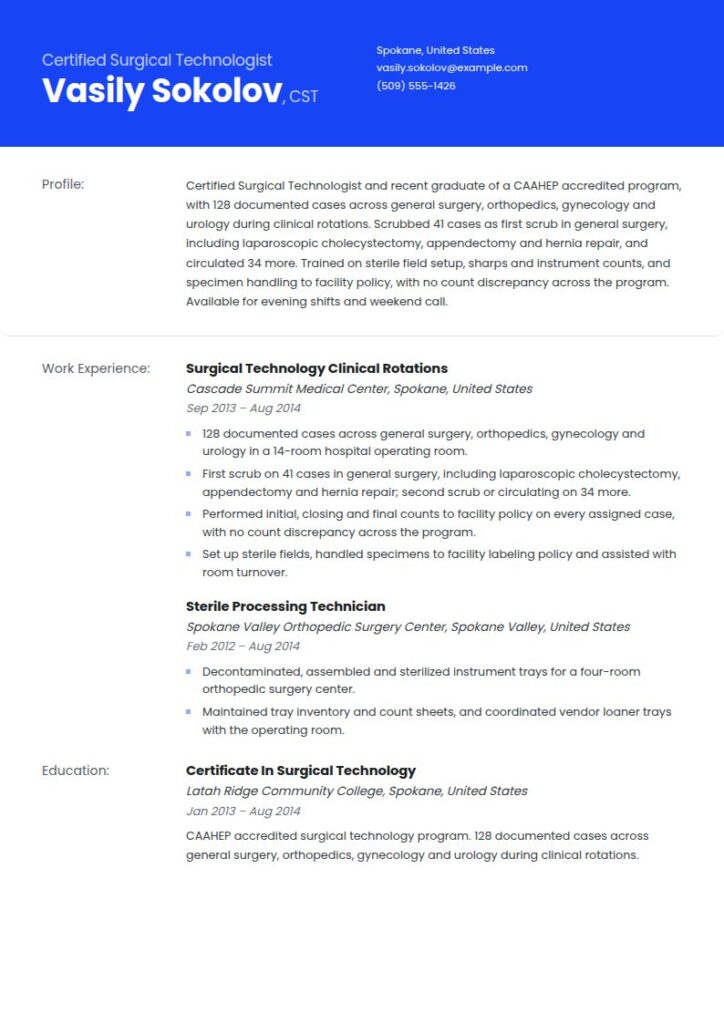
Certified Surgical Technologist and recent graduate of a CAAHEP accredited program, with 128 documented cases across general surgery, orthopedics, gynecology and urology during clinical rotations. Scrubbed 41 cases as first scrub in general surgery, including laparoscopic cholecystectomy, appendectomy and hernia repair, and circulated 34 more. Trained on sterile field setup, sharps and instrument counts, and specimen handling to facility policy, with no count discrepancy across the program. Available for evening shifts and weekend call.
Work Experience
09/2013 - 08/2014, Surgical Technology Clinical Rotations, Cascade Summit Medical Center, Spokane, United States
- 128 documented cases across general surgery, orthopedics, gynecology and urology in a 14-room hospital operating room.
- First scrub on 41 cases in general surgery, including laparoscopic cholecystectomy, appendectomy and hernia repair; second scrub or circulating on 34 more.
- Performed initial, closing and final counts to facility policy on every assigned case, with no count discrepancy across the program.
- Set up sterile fields, handled specimens to facility labeling policy and assisted with room turnover.
02/2012 - 08/2014, Sterile Processing Technician, Spokane Valley Orthopedic Surgery Center, Spokane Valley, United States
- Decontaminated, assembled and sterilized instrument trays for a four-room orthopedic surgery center.
- Maintained tray inventory and count sheets, and coordinated vendor loaner trays with the operating room.
Education
01/2013 - 08/2014, Certificate, Surgical Technology, Latah Ridge Community College, Spokane, United States
CAAHEP accredited surgical technology program. 128 documented cases across general surgery, orthopedics, gynecology and urology during clinical rotations.
Skills
Sterile field setup and maintenance, 80
Surgical counts to facility policy, 85
Instrument tray assembly and sterilization, 90
Laparoscopic setup, 70
Patient positioning and prepping, 70
Specimen labeling and handoff, 75
Room turnover and case cart accuracy, 80
Languages
English, native
Russian, native
Certificates
09/2014, Certified Surgical Technologist, National Board of Surgical Technology and Surgical Assisting, CST-208844
Active.
06/2014, Basic Life Support Provider, American Heart Association
Current.
Summary
A surgical tech resume is a one page document naming the service lines you scrub, your case volume, and the specialty instrument and robot sets you can run. This guide gives you three adaptable versions, the case mix block that decides which rooms you can be assigned to, and current Bureau of Labor Statistics pay and outlook for the occupation.
Surgical Tech resume examples by experience level
In short, a surgical tech resume is a one page document that names the service lines you scrub, the volume you have run, and the specialty sets you can pull and set up without help.
In fact, a surgical services manager is not hiring a generic pair of hands. They are filling a call rotation and a room assignment board, and they need to know which services you can be put in on Monday, whether you can take the first case of the day, and whether the charge nurse will have to send a preceptor in with you. Therefore, everything useful on this page answers one of those three questions.
Resume guide for a surgical tech resume
Specifically, this guide and the corresponding surgical tech resume example will cover:
- How to write a surgical tech resume, block by block
- Certification and program accreditation, and how to write both correctly
- Three adaptable summaries: new graduate, specialty scrub and lead tech
- The case mix block that decides which rooms you can be assigned to
- What Bureau of Labor Statistics data shows about pay, setting and growth
How to write a surgical tech resume
Six blocks: contact header, summary, certification and program, operating room experience with a facility profile line, the case mix block, then skills and education. One page for nearly everyone, two only if you run a service line or coordinate a team.
In practice, the order follows how a surgical services manager screens. First, certification is a preference or requirement depending on the employer. Then the facility profile tells them what kind of room you came from. The case mix, meanwhile, decides the assignment board.
| Section | What it is answering | Where it goes |
|---|---|---|
| Certification | Certified, eligible, or neither? | Header and first block |
| Facility profile | How many rooms, what services, what acuity? | First line of every job |
| Case mix | Which services can I assign without a preceptor? | Its own block |
| Call and shift | Can this person take call, nights, weekends? | One line, near the top |
Write the certification and the program accreditation as separate facts
Certification for surgical technologists is not universally mandated, but it "may be beneficial for finding a job, and some employers may require it," while cardiopulmonary resuscitation or basic life support is often required and some states regulate the work (BLS Occupational Outlook Handbook, surgical assistants and technologists, May 2025).
The certification most employers mean is the Certified Surgical Technologist, issued by the National Board of Surgical Technology and Surgical Assisting. Eligibility runs through program accreditation: to sit the CST exam you must graduate from a CAAHEP or ABHES accredited surgical technology program, and the exam is four hours and 175 multiple-choice questions, 150 of them scored (NBSTSA, nbstsa.org, read 16 September 2026).
So write two lines, not one: your credential with its status, and your program with its accrediting body. A manager in a state that regulates the role, or a facility whose policy requires certification, is checking both.
Run the finished file through the ATS resume checker before you apply. Hospital systems parse applications into a structured record before a surgical services manager ever opens one.
Choosing the best resume format for a surgical tech resume
Reverse chronological, single column, one page. Two pages only if you lead a service line, coordinate a team, or carry a long specialty list that genuinely changes what you can be assigned to.
Keep facilities visible and in order. After all, a manager reads an operating room resume for room count, acuity and case mix, so a skills-based format that hides where you worked hides all three. Travel and per diem assignments are an asset rather than something to disguise: list the agency, the facility type and the contract length, because a tech who has walked into six unfamiliar rooms and functioned by day two is describing the adaptability the job needs.
Include your contact information
| ✅ Right | ❌ Wrong |
|---|---|
| Vasily Sokolov, CST | Vasily Sokolov |
| Certified Surgical Technologist, orthopedics and robotics | Hardworking surgical tech seeking new opportunity |
| CST #CST-208844, NBSTSA. BLS current. Available for call. | Certified, CPR trained |
| (509) 555-1426, [email protected], Spokane, WA | (509) 555-1426, [email protected] |
Also, put the credential number and the basic life support status in the header. Both are verified before an offer, and the file that lets credentialing do it in ten seconds moves ahead of the one that does not.
Put your call availability there too. Call coverage, for example, is often the hardest part of a manager's schedule to fill, and a tech who takes call is solving a problem nobody else in the stack has offered to solve.
Make use of a summary
Four lines: certification and years, facility profile, the service lines you scrub, and one operational number such as first-case starts or call coverage.
Certified Surgical Technologist and recent graduate of a CAAHEP accredited program, with 128 documented cases across general surgery, orthopedics, gynecology and urology during clinical rotations. Scrubbed 41 cases as first scrub in general surgery, including laparoscopic cholecystectomy, appendectomy and hernia repair, and circulated 34 more. Trained on sterile field setup, sharps and instrument counts, and specimen handling to facility policy, with no count discrepancy across the program. Available for evening shifts and weekend call.
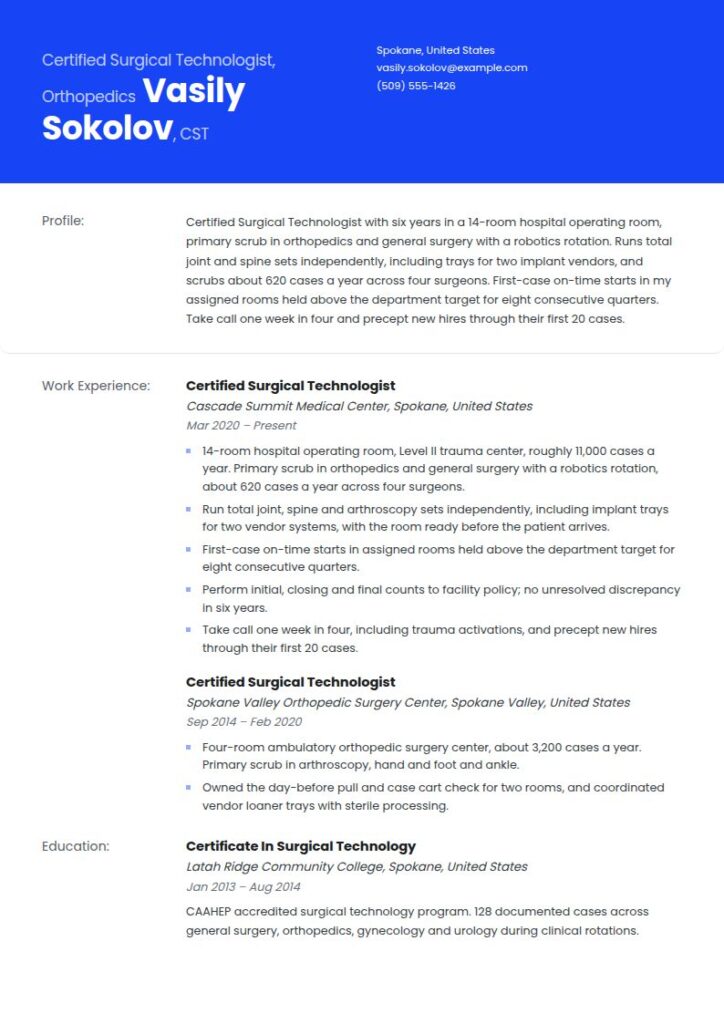
Certified Surgical Technologist with six years in a 14-room hospital operating room, primary scrub in orthopedics and general surgery with a robotics rotation. Runs total joint and spine sets independently, including trays for two implant vendors, and scrubs about 620 cases a year across four surgeons. First-case on-time starts in my assigned rooms held above the department target for eight consecutive quarters. Take call one week in four and precept new hires through their first 20 cases.
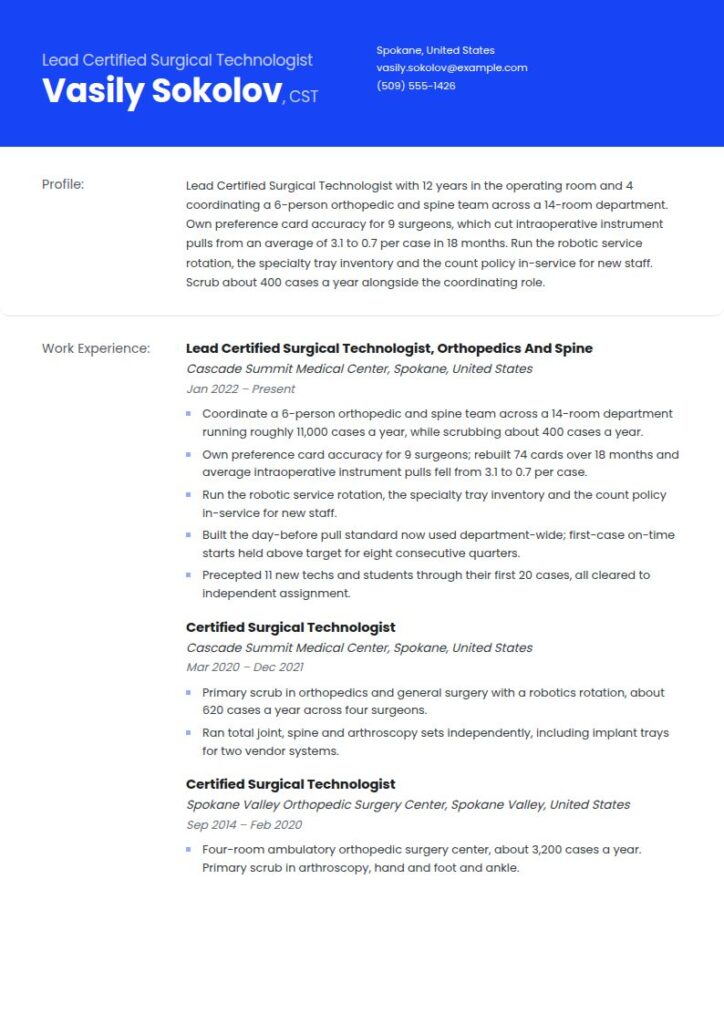
Lead Certified Surgical Technologist with 12 years in the operating room and 4 coordinating a 6-person orthopedic and spine team across a 14-room department. Own preference card accuracy for 9 surgeons, which cut intraoperative instrument pulls from an average of 3.1 to 0.7 per case in 18 months. Run the robotic service rotation, the specialty tray inventory and the count policy in-service for new staff. Scrub about 400 cases a year alongside the coordinating role.
Right vs wrong: the same surgical tech summary, twice
| ✅ Right | ❌ Wrong |
|---|---|
| Certified Surgical Technologist with six years in a 14-room hospital operating room, primary scrub in orthopedics and general surgery. | Experienced surgical technologist dedicated to providing excellent patient care in the operating room. |
| Runs total joint and spine sets independently, including trays for two implant vendors, about 620 cases a year across four surgeons. | Skilled in a wide variety of surgical procedures and instrumentation. |
| First-case on-time starts in my assigned rooms above department target for eight consecutive quarters. | Strong attention to detail and excellent teamwork skills. |
For instance, the left column can be put on the assignment board tomorrow. The right column, however, could describe anyone who has ever been in an operating room, and a manager reading thirty files is looking for the difference.
Outline your operating room experience
Facility, room count, city, dates, then a facility profile line, then three to five bullets. In practice, the profile line is what a manager calibrates the rest against.
| Instead of | Use |
|---|---|
| Assisted surgeons during procedures | Primary scrub in orthopedics and general surgery, about 620 cases a year across four surgeons |
| Prepared the operating room | Pulled, set up and verified instrument and implant trays for total joint and spine cases, including two vendor systems |
| Maintained sterile technique | Held the sterile field through 620 cases a year with no documented break attributed to my setup |
| Counted instruments and sponges | Performed initial, closing and final counts to facility policy with no unresolved discrepancy in six years |
| Worked with the robotic system | Scrubbed robotic general surgery and urology cases, including docking, instrument exchange and troubleshooting |
| Helped train new staff | Precepted 11 new techs and students through their first 20 cases, all cleared to independent assignment |
Certified Surgical Technologist, Cascade Summit Medical Center, Spokane, WA, March 2020 to Present
14-room hospital operating room, Level II trauma center, roughly 11,000 cases a year. Primary scrub in orthopedics and general surgery with a robotics rotation, about 620 cases a year across four surgeons.
Run total joint, spine and arthroscopy sets independently, including implant trays for two vendor systems, with the room ready before the patient arrives.
First-case on-time starts in assigned rooms held above the department target for eight consecutive quarters; own the day-before pull and the morning room check that made that possible.
Perform initial, closing and final counts to facility policy; no unresolved discrepancy in six years.
Take call one week in four, including trauma activations, and precept new hires through their first 20 cases.
The service lines you scrub and the preference cards you can run
This is the block that separates two otherwise identical surgical tech files, and it is the one a surgical services manager actually reads before deciding whether to call you.
Start with the service lines, listed by depth rather than as a pile. Split them three ways: services where you are primary scrub and need no preceptor, services you have scrubbed enough to cover competently, and services you have seen but would want orientation for. That honesty is not a weakness. A manager who knows exactly where to put you is a manager who can make you an offer this week.
Case volume and specialty sets for surgical techs
Then the case volume and the surgeon count. Cases a year is the fastest signal of how much you have seen. Surgeon count matters separately, because scrubbing 600 cases for one surgeon and 600 across six are different skills: the second means you have adapted to six sets of habits, six card layouts and six ways of asking for the same instrument.
Then the specialty sets and the vendor systems, where hiring is decided. Name the trays you can pull and set up unsupervised: total joint by vendor system, spine instrumentation, arthroscopy towers, laparoscopic and endoscopic setups, C-arm positioning, robotic docking and instrument exchange. Vendor familiarity is worth stating plainly, because it is the difference between a rep-dependent room and one that runs on time.
Preference cards, counts and first-case starts
Then the preference cards, the quietest and most valuable line on the page. A preference card is the record of what a surgeon wants in the room, and an inaccurate one costs the department money and minutes on every case. If you have corrected, rebuilt or owned cards, say so with a number: how many surgeons, how many cards, and what happened to intraoperative pulls or to setup time afterwards. Very few candidates mention preference cards at all, which is exactly why the line lands.
Then counts, the sterile field and first-case starts, the trust block. Counts are a patient safety process governed by facility policy, so write your record in process terms: initial, closing and final counts performed to policy, discrepancies resolved, no retained item event. Then the sterile field: your practice on setup, breaks and correction. Then first-case on-time starts, the number surgical services managers are measured on and almost never see on a resume.
Primary scrub, no preceptor needed: Orthopedics including total hip, total knee, arthroscopy and trauma fixation; general surgery including open and laparoscopic; spine including posterior fusion.
Competent to cover: Urology, gynecology, robotic general surgery and urology, plastics.
Would want orientation: Cardiovascular, neurosurgery cranial, pediatric.
Volume: About 620 cases a year across four primary surgeons and a rotating trauma call panel.
Specialty sets: Total joint instrumentation for two vendor systems; spine instrumentation; arthroscopy towers; laparoscopic and endoscopic setups; C-arm positioning; robotic docking and instrument exchange.
Preference cards: Own card accuracy for 9 surgeons across orthopedics and general surgery. Rebuilt 74 cards over 18 months; average intraoperative instrument pulls fell from 3.1 to 0.7 per case.
Counts and field: Initial, closing and final counts to facility policy. No unresolved count discrepancy and no retained item event in six years. First-case on-time starts in assigned rooms above department target for eight consecutive quarters.
In short, with five blocks a surgical services manager can put you on the assignment board, the call rotation and the robotics rotation without a single phone call.
Build a snapshot of your key skills
Twelve to sixteen entries in four groups: sterile technique and safety, instrumentation, service lines, then systems. Also, only list a set you could pull and check tomorrow.
Sterile technique and safety: Sterile field setup and maintenance, gowning and gloving, surgical counts to facility policy, sharps safety and neutral zone, specimen labeling and handoff, fire and laser safety, patient positioning and prepping
Instrumentation: Total joint instrumentation, spine instrumentation, arthroscopy towers, laparoscopic and endoscopic setups, powered instruments, C-arm and imaging positioning, robotic docking and instrument exchange
Service lines: Orthopedics, general surgery, spine, trauma, urology, gynecology, robotic surgery
Systems and process: Preference card building and auditing, instrument tray assembly and sterile processing coordination, case cart and pick list accuracy, Epic OpTime or comparable perioperative record, implant log and vendor tray coordination
List your education and certifications
Certification first with its number and status, then the accredited program, then basic life support and any specialty credential. Indeed, on this page the certificate outranks any degree, and the typical entry-level education for the occupation is a postsecondary nondegree award (BLS Occupational Outlook Handbook, May 2025).
Certified Surgical Technologist, National Board of Surgical Technology and Surgical Assisting, #CST-208844, active
Surgical Technology certificate program, Latah Ridge Community College, Spokane, WA, 2014. CAAHEP accredited.
Basic Life Support Provider, American Heart Association, current
Additional training: Robotic surgery in-service, two vendor total joint instrumentation systems, laser safety, malignant hyperthermia response drill participation
Two rules here. Write your certification status plainly as active, lapsed or exam-eligible, because a facility whose policy requires it will check before interviewing. In addition, name your program's accrediting body, since CAAHEP or ABHES accreditation is what makes a graduate eligible for the CST exam (NBSTSA, read 16 September 2026).
Choose the right layout and design
Finally, keep a single column, 11 or 12 point, plain headings, no photograph, no icons, no color bars. Hospital systems run applications through parsing software before a surgical services manager opens them, and credential numbers, case volumes and service line lists are exactly what a decorative template loses.
Put your credential number, basic life support status and call availability in the header. Open every job with a facility profile line: room count, facility type, annual case volume. Split service lines into primary scrub, competent to cover, and would want orientation. Name the vendor instrumentation systems you can set up. Say whether you have owned or rebuilt preference cards, with a number. Give your count record in process terms.
Do not list a service line you scrubbed twice as one you can be assigned to. Do not write "assisted the surgeon" where a service line and a volume belong. Do not describe a patient, a case or an adverse event in a way that could identify anyone. Do not hide travel or per diem contracts; list them with the facility type and length. Do not leave your certification status ambiguous.
Surgical tech job market and outlook
Overall, this is a stable occupation with steady replacement demand, concentrated almost entirely in hospitals and moving slowly toward outpatient surgery.
| Measure | Value |
|---|---|
| Surgical technologist jobs, 2025 | 118,400 |
| Surgical assistants and technologists together, 2025 | 142,800 |
| Projected total, 2035 | 150,200 |
| Projected change, 2025-35 | 5 percent |
| Projected annual openings | About 8,600 |
| Typical entry-level education | Postsecondary nondegree award |
| Surgical technologist median annual wage, May 2025 | $64,650 |
| Surgical assistant median annual wage, May 2025 | $66,800 |
Source: U.S. Bureau of Labor Statistics, Occupational Outlook Handbook, surgical assistants and technologists, May 2025 wages with 2025 to 2035 projections.
Seven in ten of these jobs are in one setting
Hospitals employ 71 percent of surgical technologists at a median annual wage of $65,020 in May 2025. Offices of physicians employ 11 percent at $64,590, outpatient care centers 10 percent at $64,670, administrative and support services 4 percent at $62,400 and offices of dentists 2 percent at $48,190 (BLS Occupational Outlook Handbook, May 2025).
Two things follow. First, the published wage barely moves across the three largest settings, a spread of under $500 between hospitals, physician offices and outpatient centers. Pay in this occupation is driven by shift, call and specialty rather than by which door you walk through.
Second, because the hospital operating room is where seven of ten jobs sit, the resume has to be legible to a hospital surgical services manager even when you are applying to a surgery center. That means room count, case volume, service lines, call and counts, in that order.
What salary you can expect as a surgical tech
Specifically, the median annual wage for surgical technologists was $64,650 as of May 2025, with surgical assistants at $66,800 and the two occupations together at $64,700, or $31.10 an hour (BLS Occupational Outlook Handbook, surgical assistants and technologists, May 2025).
Setting is a weak lever here. Meanwhile, published medians run from $65,020 in hospitals to $64,670 in outpatient care centers, $64,590 in offices of physicians and $62,400 in administrative and support services (BLS, May 2025). However, the gap between the largest three settings is small enough that choosing between them on published pay alone is not a strategy.
Instead, what does move pay is what the resume can show: call and standby coverage, night and weekend differentials, specialty service lines a department struggles to staff, robotics, travel and contract assignments, and a lead or coordinator role. The occupation is projected to grow 5 percent from 2025 to 2035 with about 8,600 openings a year (BLS Occupational Outlook Handbook, 2025 to 2035 projections), a steady rather than urgent market. In one like that, differentials and specialty assignments are where the money is, since each is awarded against documented capability.
Key takeaways for a surgical tech resume
- Put your credential number, basic life support status and call availability in the header.
- Above all, write certification and program accreditation as two separate facts.
- Then open every job with a facility profile line: rooms, facility type, annual case volume.
- Similarly, split service lines into primary scrub, competent to cover, and needs orientation.
- Likewise, name the vendor instrumentation systems and robotic sets you can run.
- Say whether you have owned or rebuilt preference cards, with a number attached.
- Finally, give counts and first-case starts, the two numbers managers are measured on.
Build your surgical tech resume in 15 minutes with our AI resume builder.
Related medical resume examples
- EMT resume
- CNA resume
- Sonographer resume
- Respiratory therapist resume
- Medical assistant resume
- Phlebotomist resume
- Lab technician resume
- ICU nurse resume
- ER nurse resume
- Nurse resume
- Physician assistant resume
- Medical technologist resume
Pair it with a matching surgical tech cover letter.
Surgical tech resume questions, answered
How long should a surgical tech resume be?
One page. Two only if you lead a service line, coordinate a team, or carry a specialty and vendor list long enough to change what you can be assigned to. Surgical services managers read these against a posting with a start date, and a second page of adjectives is not read.
Do I need to be certified to work as a surgical tech?
Not everywhere. BLS states that certification is not universally mandated but may be beneficial, that some employers require it, and that some states regulate the work (BLS Occupational Outlook Handbook, May 2025). The common credential is the Certified Surgical Technologist through NBSTSA, and eligibility requires graduating from a CAAHEP or ABHES accredited program (NBSTSA, read 16 September 2026). Write your status plainly, including exam-eligible if that is where you are.
What do I put on a surgical tech resume with no work experience?
Your clinical rotations, written as a job. Facility type, room count, the services you rotated through, your documented case count split into first scrub and second scrub, and the procedures you scrubbed by name. Programs track case logs precisely, so use those numbers. Then your credential status, your basic life support card, and your shift and call availability.
Should I list travel and per diem contracts?
Yes, all of them, with the agency, the facility type, the room count and the contract length. Walking into an unfamiliar room and being useful by the second day is a genuine skill, and a manager reading five short contracts with facility profiles attached sees adaptability rather than instability.
How do I show results in a job where the outcome is the surgeon's?
Use the operational numbers the department is measured on: first-case on-time starts, turnover time in your rooms, count discrepancies, preference card accuracy and intraoperative pulls, case volume, and the number of staff you have precepted to independent assignment. None of those claim the surgeon's outcome and all of them describe the part of the case you own.