Associate Medical Science Liaison, Oncology Anand Sivaraman PharmD
Medical Affairs Fellow, Oncology
[email protected] | (617) 555-1108 | Cambridge, United States
Profile
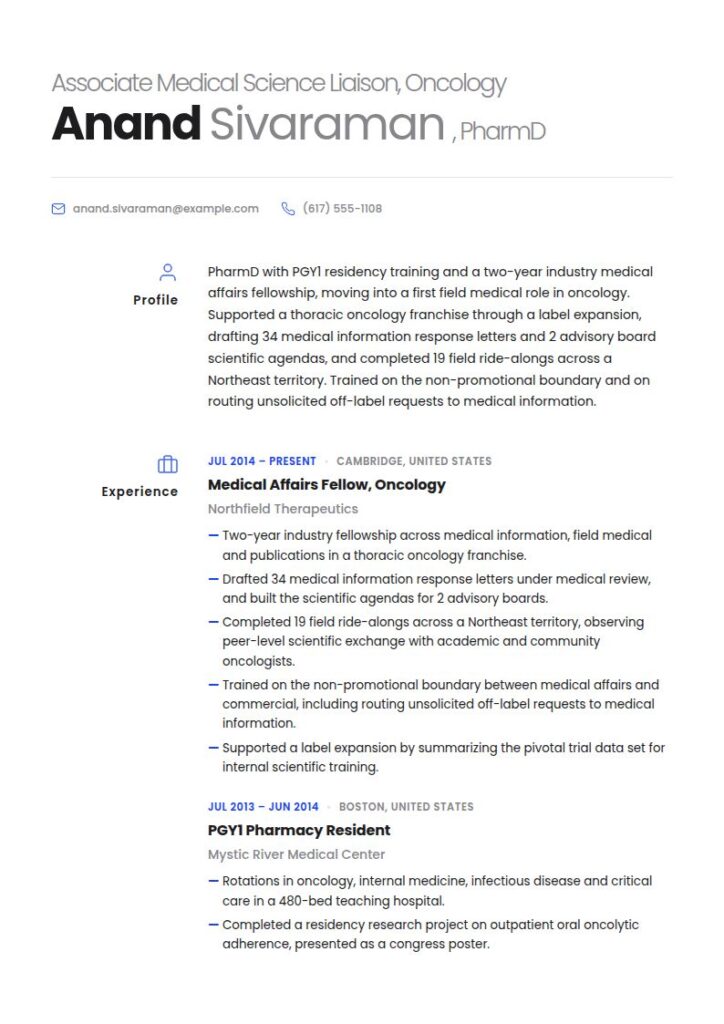
PharmD with PGY1 residency training and a two-year industry medical affairs fellowship, moving into a first field medical role in oncology. Supported a thoracic oncology franchise through a label expansion, drafting 34 medical information response letters and 2 advisory board scientific agendas, and completed 19 field ride-alongs across a Northeast territory. Trained on the non-promotional boundary and on routing unsolicited off-label requests to medical information.
Work Experience
07/2014 - Present, Medical Affairs Fellow, Oncology, Northfield Therapeutics, Cambridge, United States
- Two-year industry fellowship across medical information, field medical and publications in a thoracic oncology franchise.
- Drafted 34 medical information response letters under medical review, and built the scientific agendas for 2 advisory boards.
- Completed 19 field ride-alongs across a Northeast territory, observing peer-level scientific exchange with academic and community oncologists.
- Trained on the non-promotional boundary between medical affairs and commercial, including routing unsolicited off-label requests to medical information.
- Supported a label expansion by summarizing the pivotal trial data set for internal scientific training.
07/2013 - 06/2014, PGY1 Pharmacy Resident, Mystic River Medical Center, Boston, United States
- Rotations in oncology, internal medicine, infectious disease and critical care in a 480-bed teaching hospital.
- Completed a residency research project on outpatient oral oncolytic adherence, presented as a congress poster.
- Led 14 journal clubs and delivered 6 formal case presentations to the pharmacy and medical staff.
Education
09/2009 - 05/2013, Doctor of Pharmacy, Pharmacy, Northeastern University, Boston, United States
PGY1 pharmacy residency completed 2013 to 2014 at Mystic River Medical Center, Boston.
09/2005 - 05/2009, Bachelor of Science, Biochemistry, University of Massachusetts Amherst, Amherst, United States
Skills
Thoracic oncology disease-area knowledge, 70
Clinical trial design and endpoint interpretation, 75
Medical information response writing, 80
Non-promotional communication standards, 80
Literature searching in PubMed and Embase, 85
Advisory board scientific content, 65
Veeva Vault MedComms, 70
Languages
English, native
Tamil, native
French, intermediate
Certificates
08/2014, Good Clinical Practice, CITI Program
06/2013, Registered Pharmacist, Massachusetts, Massachusetts Board of Registration in Pharmacy, MA-PH-20713
Active. Held from clinical practice; medical science liaison is a non-licensed role.
Summary
A medical science liaison resume is a two page document naming your terminal degree, the therapeutic area you can hold a scientific conversation in, and the territory you can cover. This guide gives you three adaptable versions, the non-promotional boundary that every MSL resume has to get right, and published federal wage data for the adjacent occupations, since the Bureau of Labor Statistics publishes no Handbook profile for this job.
Medical Science Liaison resume examples by experience level
In short, a medical science liaison resume is a two page document naming your terminal degree, the therapeutic area you can hold a peer-level conversation in, and the geography you can cover in a week.
Those three decide almost every MSL hire, before anyone reads your bullets. In practice, a field medical director with an open territory is matching a doctorate that lets a physician treat you as a peer, command of one disease area deep enough to be useful in a specialist's office, and a home base that makes the territory economically sensible. However, a recruiter with sixty applications infers none of them.
The Medical Science Liaison Society says MSLs "concentrate on specific therapeutic areas (e.g. Oncology, Cardiology, CNS, Hematology, Women's Health Care) and disease states", and that their "primary purpose" is "to establish and maintain peer to peer relationships with leading physicians, referred to as Key Opinion Leaders (KOLs)". For this reason, show that in the first eight lines.
Resume guide for a medical science liaison resume
To help, this guide and the corresponding medical science liaison resume example will cover:
- How to write a medical science liaison resume, section by section
- Why therapeutic area, degree and territory belong above everything else
- Three adaptable summaries: first field role, practicing MSL and field medical lead
- How to write the non-promotional boundary so a compliance-aware reader trusts you
- What pay looks like when no federal profile exists for the role
How to write a medical science liaison resume
Overall, it takes six sections: contact header with degree and territory, summary, field medical experience, scientific background, competency snapshot, and education with credentials. Two pages is normal here, unlike most of healthcare, because the science has to be shown.
In fact, the order is deliberate: territory sits in the header rather than an experience line because it is a screening filter, and therapeutic area sits in the summary's first clause for the same reason.
| Section | What it is answering | Where it goes |
|---|---|---|
| Degree and territory | Peer credibility, and can they cover this geography? | Contact header |
| Therapeutic area | Can they hold a conversation in this disease area? | First clause of the summary |
| Field medical experience | Engagement volume, KOL depth, insight quality | Reverse chronological, with numbers |
| Scientific background | Where the depth came from: bench, clinic or trial | Its own block |
| Non-promotional framing | Do they understand what medical affairs is? | In the verbs, not claimed as a skill |
Write engagement numbers, not relationship adjectives
Every MSL resume says it built strong KOL relationships. None of those claims is falsifiable, so none is read.
Field medical teams measure a small number of things: KOLs mapped and engaged in a quarter, scientific exchange meetings run, advisory boards supported, study concepts routed and progressed, congresses covered, and field insights that reached a medical strategy document.
"Covered a 9-state Northeast territory with 74 mapped KOLs, engaging 51 a quarter, and submitted 38 field insights in the year, 6 of which changed the phase 4 evidence plan." That tells a field medical director what a paragraph of relationship language does not.
Run the finished file through the ATS resume checker before you submit. Large pharmaceutical employers parse applications into a structured record first, and a degree written only inside a graphic header is one the system never sees.
Choosing the best resume format for a medical science liaison resume
Reverse chronological, two pages. The second page earns itself here, because hiring managers want to see where the science came from: the doctorate, the residency, the trials, the publications. Also, keep the publication list to a count and up to three entries; a fifteen-page CV sent to a field medical opening reads as a candidate who has not made the transition to industry.
Functional formats fail worse here than elsewhere. After all, territory coverage is a timeline question: which years, which geography, which product stage. As a result, remove the dates and there is no way to check the claim.
Include your contact information
| ✅ Right | ❌ Wrong |
|---|---|
| Anand Sivaraman, PharmD | Anand Sivaraman |
| Medical Science Liaison, Thoracic Oncology | Pharmaceutical professional |
| Northeast territory, based Cambridge, MA, 60% travel | Willing to relocate |
| (617) 555-1108, [email protected] | (617) 555-1108, [email protected] |
First, put the base city and territory in the header. That is because MSL postings are written against a named geography, and the first filter is whether you live inside it; "willing to relocate" is weaker than an address. Put the degree next to your name every time, because it is the peer-credibility claim the role rests on.
Make use of a summary
Then write four lines: degree and therapeutic area, territory, engagement numbers that show scale, and one insight or launch outcome.
PharmD with PGY1 residency training and a two-year industry medical affairs fellowship, moving into a first field medical role in oncology. Supported a thoracic oncology franchise through a label expansion, drafting 34 medical information response letters and 2 advisory board scientific agendas, and completed 19 field ride-alongs across a Northeast territory. Trained on the non-promotional boundary and on routing unsolicited off-label requests to medical information.
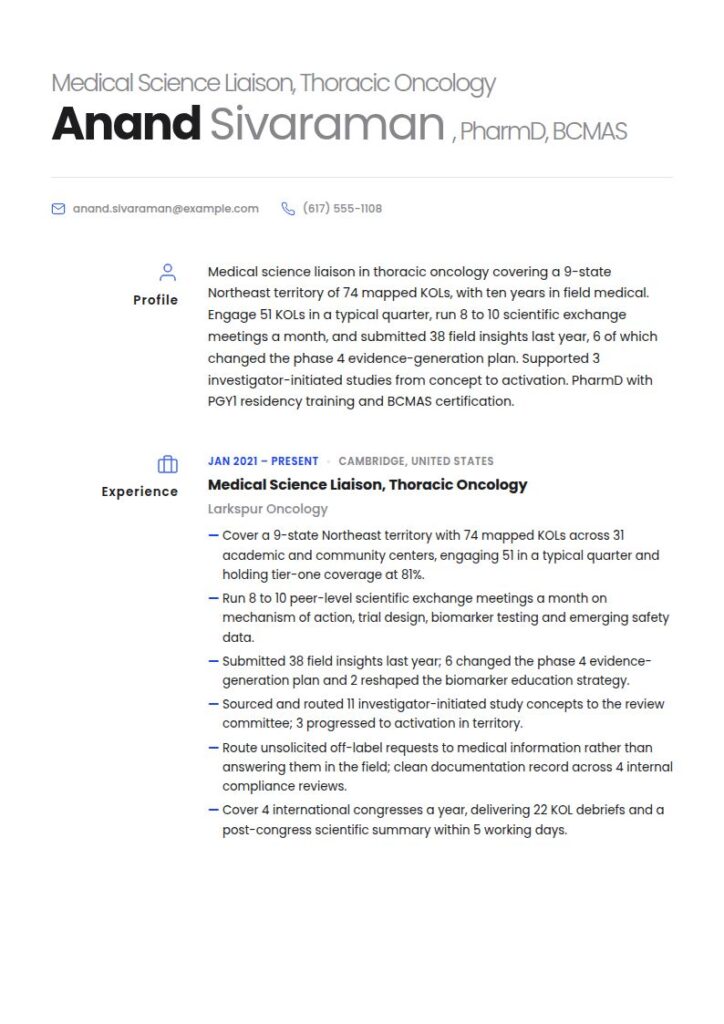
Medical science liaison in thoracic oncology covering a 9-state Northeast territory of 74 mapped KOLs, with ten years in field medical. Engage 51 KOLs in a typical quarter, run 8 to 10 scientific exchange meetings a month, and submitted 38 field insights last year, 6 of which changed the phase 4 evidence-generation plan. Supported 3 investigator-initiated studies from concept to activation. PharmD with PGY1 residency training and BCMAS certification.
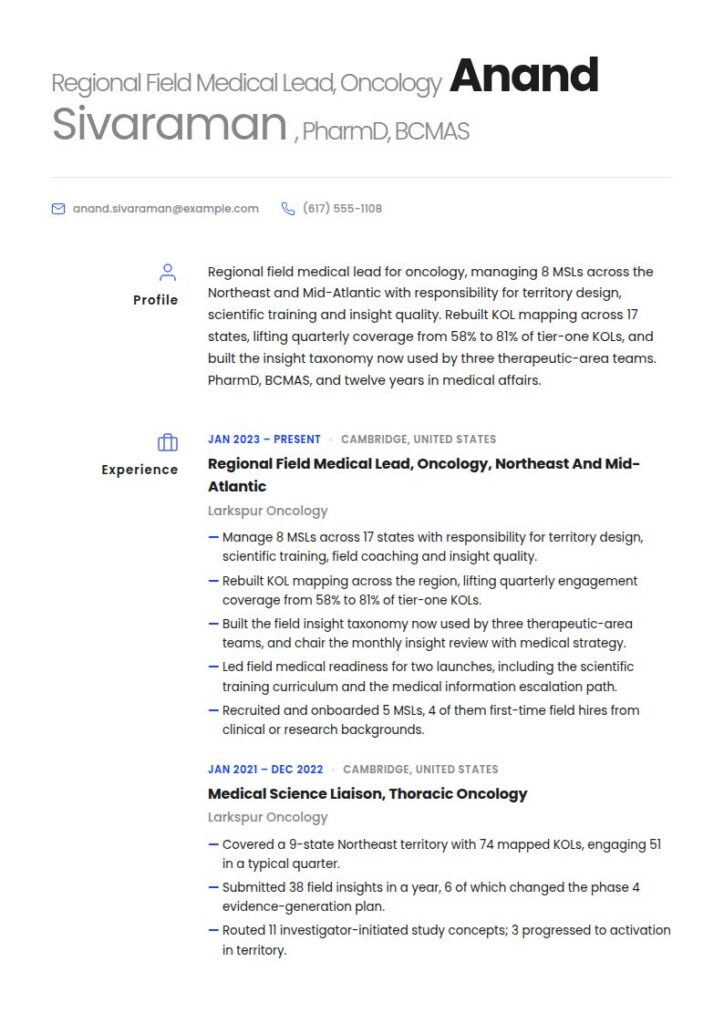
Regional field medical lead for oncology, managing 8 MSLs across the Northeast and Mid-Atlantic with responsibility for territory design, scientific training and insight quality. Rebuilt KOL mapping across 17 states, lifting quarterly coverage from 58% to 81% of tier-one KOLs, and built the insight taxonomy now used by three therapeutic-area teams. PharmD, BCMAS, and twelve years in medical affairs.
Right vs wrong: the same medical science liaison summary, twice
| ✅ Right | ❌ Wrong |
|---|---|
| Medical science liaison in thoracic oncology covering a 9-state Northeast territory of 74 mapped KOLs. | Experienced MSL with a strong scientific background and excellent communication skills. |
| Engage 51 KOLs in a typical quarter and run 8 to 10 scientific exchange meetings a month. | Builds and maintains strong relationships with key opinion leaders. |
| Submitted 38 field insights last year, 6 of which changed the phase 4 evidence-generation plan. | Provides valuable scientific insights to internal stakeholders. |
For example, the right column is a territory a director can staff and a record they can compare. By contrast, the wrong column appears in every other file in the folder.
Outline your experience
Company, therapeutic area, territory and dates, then four to six bullets. Specifically, each names a countable field medical activity. Also, avoid any verb that would sit on a sales resume.
| Instead of | Use |
|---|---|
| Built strong relationships with key opinion leaders | Mapped 74 KOLs across 9 states and engaged 51 a quarter, tier-one coverage at 81% |
| Provided scientific support to healthcare professionals | Ran 8 to 10 peer-level scientific exchange meetings a month on mechanism, trial design and safety |
| Gathered insights from the field | Submitted 38 field insights in the year, 6 of which changed the phase 4 evidence plan |
| Supported clinical trials | Routed 11 investigator-initiated study concepts; 3 progressed to activation in territory |
| Attended medical conferences | Covered 4 congresses, delivering 22 KOL debriefs and a scientific summary within 5 days |
| Worked with internal teams | Trained 14 field colleagues on approved disease-state background under medical review |
Medical Science Liaison, Thoracic Oncology, Larkspur Oncology, Cambridge, MA, March 2021 to Present
Cover a 9-state Northeast territory with 74 mapped KOLs across 31 academic and community centers, engaging 51 in a typical quarter and holding tier-one coverage at 81%.
Run 8 to 10 peer-level scientific exchange meetings a month on mechanism of action, trial design, biomarker testing and emerging safety data.
Submitted 38 field insights last year; 6 changed the phase 4 evidence-generation plan and 2 reshaped the biomarker education strategy.
Sourced and routed 11 investigator-initiated study concepts to the review committee, of which 3 progressed to activation in territory.
Route unsolicited off-label requests to medical information rather than answering them in the field, with a clean documentation record across 4 internal compliance reviews.
Cover 4 international congresses a year, delivering 22 KOL debriefs and a post-congress scientific summary within 5 working days.
Name the therapeutic area, the degree and the territory
In other words, this is the section that decides the interview, and it is three claims, not one. Put simply, an MSL vacancy is an intersection: a disease area, a credential bar, and a map. Miss one and the file goes no further, however strong the other two are.
The therapeutic area. Write yours at the level of the disease, not the division. "Oncology" is too broad to be evidence; "thoracic oncology, with working command of EGFR, ALK and PD-L1 biomarker testing pathways" tells a hiring manager you can walk into a lung cancer clinic. If you are moving between areas, name the transferable scientific spine: immunology to oncology through checkpoint biology, cardiology to nephrology through cardiorenal outcomes. State the bridge, because nobody else will build it for you.
The terminal degree. The MSL Society states that "MSLs have advanced scientific training and academic credentials generally consisting of a doctorate degree (PhD, PharmD or MD) in the life sciences". That describes the market, not a statute. If you hold one, put it beside your name with the research or clinical work behind it. If you do not, lead with clinical depth, trial experience, publications and disease area, and state the degree plainly, because it surfaces in screening anyway.
The territory. Field medical is a geography job. Write the base city, the states covered, the number of accounts or mapped KOLs, and a realistic travel percentage. "Northeast territory, based Cambridge, MA, 9 states, 74 mapped KOLs, 60% travel" is a line a recruiter can act on in four seconds.
The medical affairs and sales boundary
Then the boundary, which most applicants get wrong and a compliance-aware reader checks for.
Above all, an MSL sits in medical affairs, not sales. That is not a cultural preference; it is how regulators expect the function to be structured. FDA's draft guidance "Responding to Unsolicited Requests for Off-Label Information About Prescription Drugs and Medical Devices" (FDA, December 2011) recommends "that questions or requests about off-label uses be referred to the firm's medical or scientific representative or department", and states plainly that "sales and marketing personnel … should have no input on the content of responses to unsolicited questions or requests for off-label information". Similarly, the OIG's Compliance Program Guidance for Pharmaceutical Manufacturers (Office of Inspector General, Federal Register, 5 May 2003) applies the same logic to money: "manufacturers should separate their grant making functions from their sales and marketing functions".
As a result, the consequence for your resume is a vocabulary rule. For example, never write that you drove adoption, grew market share, influenced prescribing, hit a target or owned a book of business. After all, those verbs describe commercial work, and here they read as a misunderstanding of the role. Instead, write scientific exchange, medical education, insight generation, evidence-generation support, investigator-initiated study facilitation, congress coverage and medical information routing.
Say it once explicitly, in an experience bullet rather than a skill line. "Routed unsolicited off-label requests to medical information rather than answering them in the field" shows a reader you know where the boundary runs.
Therapeutic area: Thoracic oncology. Working command of EGFR, ALK, ROS1 and PD-L1 biomarker testing pathways, treatment sequencing, and immune-related adverse event management. Prior depth in genitourinary oncology.
Degree and scientific background: PharmD, PGY1 pharmacy residency, two-year industry medical affairs fellowship. Co-author on 4 peer-reviewed papers and 9 congress abstracts in thoracic oncology.
Territory: Northeast, based Cambridge, MA. Nine states, 31 academic and community centers, 74 mapped KOLs, 60% travel.
Scope: Non-promotional medical affairs. Scientific exchange, advisory board scientific content, investigator-initiated study facilitation, congress coverage, field insight generation. Unsolicited off-label requests routed to medical information.
Build a snapshot of your key skills
For skills, list twelve to sixteen entries in four groups: therapeutic and scientific, field medical, compliance and process, and systems. Name disease-area specifics rather than the category.
Therapeutic and scientific: Thoracic oncology, Biomarker testing pathways, Immuno-oncology mechanism, Clinical trial design and endpoint interpretation, Real-world evidence appraisal
Field medical: Peer-level scientific exchange, KOL mapping and tiering, Advisory board scientific content, Investigator-initiated study facilitation, Congress coverage and debrief, Field insight generation and synthesis
Compliance and process: Non-promotional communication standards, Medical information request routing, Medical, legal and regulatory review, Adverse event and product complaint reporting
Systems: Veeva CRM and Vault MedComms, Medical affairs insight platforms, PubMed and Embase searching, ClinicalTrials.gov monitoring, Power BI territory dashboards
List your education and certifications
Doctorate first with institution and year, then residency or fellowship, then any medical affairs credential, then publications as a count plus up to three entries.
Be careful with wording. Note that there is no license for medical science liaisons, and implying one is a real error. The Board Certified Medical Affairs Specialist credential from the Accreditation Council for Medical Affairs is a voluntary certification, not licensure: ACMA describes the program as covering "13 core competencies", with six months of access and most candidates finishing in two to three months across roughly 30 hours of study. Instead, write it as a certification, with the issuing body and the year.
Doctor of Pharmacy, Northeastern University, Boston, MA, 2013
PGY1 Pharmacy Residency, Mystic River Medical Center, Boston, MA, 2013 to 2014
Industry Medical Affairs Fellowship, Oncology, Northfield Therapeutics, Cambridge, MA, 2014 to 2016
Bachelor of Science, Biochemistry, University of Massachusetts Amherst, Amherst, MA, 2009
Certifications: Board Certified Medical Affairs Specialist (BCMAS), Accreditation Council for Medical Affairs, 2019. Good Clinical Practice, 2025 refresher.
Publications: 4 peer-reviewed papers and 9 congress abstracts in thoracic oncology, with three representative entries listed.
Choose the right layout and design
For layout, use a single column, 11 point, two pages, headings a parser can find, no photograph. In addition, put the degree, the therapeutic area and the territory in plain text near the top; those are the three fields a recruiter searches on, and a graphic header hides all three.
Put your degree beside your name, and your base city and territory in the header. Name the disease area, not the division. Give KOL, engagement and insight counts with the period they cover. State the non-promotional boundary once, in a verb rather than a claim. Name the bridge to any new therapeutic area. Keep publications to a count plus three entries.
Do not use commercial verbs: adoption, market share, prescribing influence, quota, book of business. Do not imply a license is required to be an MSL, because none exists. Do not send a full academic CV to a field medical opening. Do not claim a therapeutic area you have only read about. Do not describe an identifiable physician, investigator or patient.
Medical science liaison job market and outlook
The U.S. On pay, the Bureau of Labor Statistics publishes no Occupational Outlook Handbook profile for medical science liaisons: no federal employment count, no projection and no median wage for the job title. Meanwhile, the retired static wage pages that once carried adjacent titles belong to an older cycle, too stale to quote. So this page gives no MSL wage, and names the published occupations the work sits between instead.
| Bracketing occupation, BLS published | Median annual wage, May 2025 | Why it brackets field medical work |
|---|---|---|
| Medical scientists | $103,410 | The scientific half: doctoral entry, translational research, evidence interpretation |
| Wholesale and manufacturing sales representatives, technical and scientific products | $104,920 | The field half: territory-based, travel-heavy, peer-level technical conversation |
| Wholesale and manufacturing sales representatives, all | $76,460 | The floor for territory work with no scientific requirement |
Source: U.S. Bureau of Labor Statistics, Occupational Outlook Handbook, May 2025 wage data.
Of the two, medical scientists is the closer in substance, and its published detail is the most useful reference available:
| Measure, medical scientists | Value |
|---|---|
| Jobs, 2025 | About 181,000 |
| Projected change, 2025-35 | 13% (much faster than average) |
| Projected annual openings | About 10,500 |
| Median annual wage, May 2025 | $103,410 |
| Entry-level education | Doctoral or professional degree |
Source: U.S. Bureau of Labor Statistics, Occupational Outlook Handbook, 2025-35 projections and May 2025 wage data.
Two occupations, two very different growth rates
The gap between the two bracketing occupations is the most useful thing on this page. Medical scientists are projected to grow 13 percent between 2025 and 2035, much faster than average, with about 10,500 openings a year. Wholesale and manufacturing sales representatives are projected to change 0 percent over the same decade, on employment of 1,571,400 in 2025 (BLS, Occupational Outlook Handbook, 2025-35 projections). Within that sales occupation, the technical and scientific half had a median of $104,920 as of May 2025 against $72,080 for the rest, with the top 10 percent above $200,440 (BLS, May 2025).
The scientific requirement is where the growth and the money both are. That is the argument your resume should make: not that you can cover a territory, but that you can cover it at the depth the top of that distribution is paid for.
What salary you can expect as a medical science liaison
Therefore, with no federal wage figure for the job title, treat the bracketing occupations as the band your offer sits inside, and treat any figure quoted online without a source and date as unusable.
First, the scientific anchor is medical scientists, median $103,410 as of May 2025, lowest 10 percent under $64,800 and highest 10 percent above $177,780 (BLS, May 2025). Inside that occupation, meanwhile, research and development in the physical, engineering and life sciences paid a median of $125,700 and pharmaceutical and medicine manufacturing $106,800, against $98,620 in hospitals and $74,970 in state colleges and universities (BLS, May 2025). In short, the move from an academic laboratory into industry is visible in those four numbers.
Second, the field anchor is the technical and scientific half of wholesale and manufacturing sales representatives, median $104,920 as of May 2025, lowest 10 percent under $52,600 and highest 10 percent above $200,440 (BLS, May 2025). In fact, that long upper tail is what territory work with a scientific requirement looks like at the top.
What moves an offer inside the band is documentable: the therapeutic area and how scarce it is, whether you have taken a product through a launch or label expansion, territory size and tier-one coverage, whether you have trained MSLs, and your publication record. All countable, which is why they belong in your bullets rather than the interview.
Key takeaways for a medical science liaison resume
- Then put the degree beside your name; peer credibility is the premise of the role.
- Name the disease area, not the division, and the bridge if you are switching.
- Finally, put base city, states covered and travel percentage in the header.
- Give KOL, engagement and insight counts with the period they cover.
- Use medical affairs verbs; commercial verbs read as a misunderstanding of the job.
- Say once how you route unsolicited off-label requests.
- Write BCMAS as a voluntary certification; no license exists for this role.
Build your medical science liaison resume in 15 minutes with our AI resume builder.
Related medical resume examples
- Pharmaceutical sales representative resume
- Clinical research coordinator resume
- Epidemiologist resume
- Chemist resume
- Pharmacist resume
- Physician resume
- Medical technologist resume
- Healthcare project manager resume
- Health care administration resume
- Medical student resume
- Lab technician resume
- Doctor resume
Pair it with a matching medical science liaison cover letter.
Medical science liaison resume questions, answered
How long should a medical science liaison resume be?
Two pages. The second page earns itself here because the scientific background has to be visible. Keep publications to a count and three entries; a full bibliography reads as an incomplete transition to industry.
Do I need a PhD, PharmD or MD to be a medical science liaison?
It is the market norm, not a legal requirement. The Medical Science Liaison Society states that MSLs "have advanced scientific training and academic credentials generally consisting of a doctorate degree (PhD, PharmD or MD) in the life sciences". Others do get hired, usually on disease-area depth, trial experience or publication record, so lead with those and state the degree plainly.
Is there a license or certification for MSLs?
There is no license. Medical science liaison is a non-licensed role, and any resume implying otherwise is wrong. Voluntary certifications exist: the Board Certified Medical Affairs Specialist credential from the Accreditation Council for Medical Affairs covers "13 core competencies", with six months of access and most candidates finishing in two to three months.
How do I show the difference between medical affairs and sales on a resume?
Through verbs and one explicit line. Use scientific exchange, insight generation, evidence-generation support and medical information routing, never adoption, market share or quota. Then state once how you handled unsolicited off-label requests. FDA's December 2011 draft guidance recommends they be referred to "the firm's medical or scientific representative or department" and that sales and marketing personnel "should have no input on the content of responses".
What if I am coming from the clinic or the bench with no field experience?
Write the scientific depth as the asset and the field mechanics as trainable. Name the disease area and what you did in it: trials run or enrolled, patients managed at the protocol level, assays developed, papers and posters. Then the field-facing skills you have: teaching, presenting to clinicians, journal club leadership, tumor board participation. Finally, the territory you would cover and your travel availability.