Anand Sivaraman Medical Science Liaison, Thoracic Oncology Cambridge, 02139, United States [email protected] · (617) 555-1108
11 September 2026
Dr. Marit Lindqvist Field Medical, Thoracic Oncology Halcyon Bioscience Boston, United States
Application for Medical Science Liaison, Northeast, Halcyon Bioscience
Dear Dr. Lindqvist,
I am applying for the Medical Science Liaison post covering the Northeast for your thoracic oncology portfolio. I am a PharmD with PGY1 residency training and a two-year industry medical affairs fellowship, and I have spent ten years in field medical in thoracic oncology, covering nine states from Cambridge with roughly 60 percent travel.
My territory holds 74 mapped KOLs across 31 academic and community centers, and I engage about 51 of them in a typical quarter, running 8 to 10 peer-level scientific exchange meetings a month on mechanism, trial design and biomarker testing. Last year I submitted 38 field insights; six changed the phase 4 evidence-generation plan, and two reshaped how we approached biomarker testing education in community practice. I also routed 11 investigator-initiated study concepts to the review committee, three of which reached activation in my territory.
Your posting says biomarker testing rates in community centers are the portfolio's current evidence gap. That is the work I have been closest to: in my territory the constraint turned out to be testing turnaround rather than testing intent, and the insight from that reached medical strategy. I would build the same picture across your footprint before proposing anything.
I am non-promotional by training and habit: unsolicited off-label requests go to medical information rather than being answered in the field. I can travel at the level the territory needs and start within six weeks. Thank you for your time.
Sincerely, Anand Sivaraman, PharmD
Summary
A medical science liaison cover letter names your terminal degree, the therapeutic area you can hold a peer-level conversation in, and the territory you can cover, then gives one field insight that changed something. This guide gives you a full adaptable letter, the openings that work, the verbs that keep you inside medical affairs, and how to write a move between therapeutic areas.
Medical Science Liaison cover letter examples by experience level
A medical science liaison cover letter tells a field medical director which doctorate you hold, which disease area you can hold a peer-level conversation in, and which territory you can cover from home.
It has a second job most healthcare cover letters do not: it has to show, in its verbs, that you understand medical affairs is not sales. A field medical director reads for that in the first paragraph, because a candidate who writes like a sales representative is a compliance problem first.
Guide to a medical science liaison cover letter
This guide and the corresponding medical science liaison cover letter example will cover:
- How to structure the letter, paragraph by paragraph
- Why degree, therapeutic area and territory belong in the opening sentence
- What a field insight looks like written as evidence
- The verbs that keep the letter inside medical affairs
- How to write a move between disease areas
How to write a medical science liaison cover letter
| Paragraph | Its job | Length |
|---|---|---|
| Opening | The post, your degree, your therapeutic area, your territory | 2 to 3 sentences |
| Evidence | One insight or engagement record, with numbers and a period | 4 to 5 sentences |
| Fit | Something specific about their pipeline, and what you would do | 3 to 4 sentences |
| Close | Availability, travel, thank you | 2 sentences |
Open with the intersection, because that is what the vacancy is
An MSL posting is three constraints at once: a disease area, a credential bar and a map. The Medical Science Liaison Society describes MSLs as concentrating "on specific therapeutic areas … and disease states", with credentials "generally consisting of a doctorate degree (PhD, PharmD or MD) in the life sciences".
So the first sentence should carry all three: "I am a PharmD with ten years in field medical in thoracic oncology, covering a nine-state Northeast territory from Cambridge, and I am applying for your lung cancer MSL post in the same footprint." That answers every screening question a recruiter has, leaving three paragraphs for evidence rather than qualification.
A medical science liaison cover letter example you can adapt
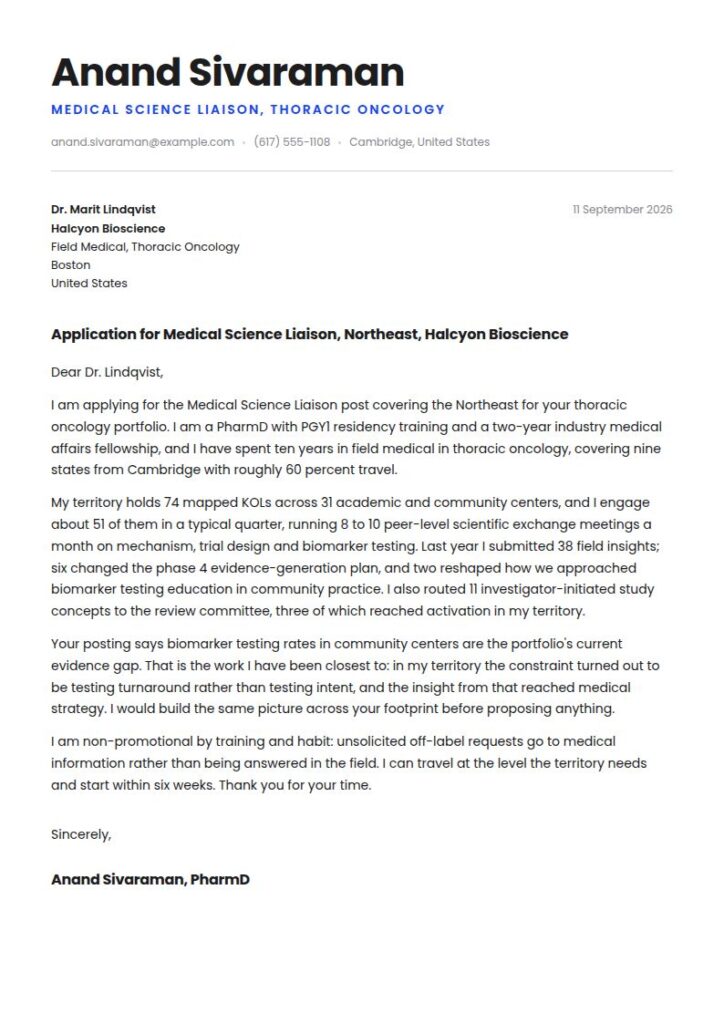
Dear Dr. Lindqvist,
I am applying for the Medical Science Liaison post covering the Northeast for your thoracic oncology portfolio. I am a PharmD with PGY1 residency training and a two-year industry medical affairs fellowship, and I have spent ten years in field medical in thoracic oncology, covering nine states from Cambridge with roughly 60 percent travel.
My territory holds 74 mapped KOLs across 31 academic and community centers, and I engage about 51 of them in a typical quarter, running 8 to 10 peer-level scientific exchange meetings a month on mechanism, trial design and biomarker testing. Last year I submitted 38 field insights; six changed the phase 4 evidence-generation plan, and two reshaped how we approached biomarker testing education in community practice. I also routed 11 investigator-initiated study concepts to the review committee, three of which reached activation in my territory.
Your posting says biomarker testing rates in community centers are the portfolio's current evidence gap. That is the work I have been closest to: in my territory the constraint turned out to be testing turnaround rather than testing intent, and the insight from that reached medical strategy. I would build the same picture across your footprint before proposing anything.
I am non-promotional by training and habit: unsolicited off-label requests go to medical information rather than being answered in the field. I can travel at the level the territory needs and start within six weeks. Thank you for your time.
Sincerely, Anand Sivaraman, PharmD
Openings that work
| Instead of | Use |
|---|---|
| I am writing to express my interest in your MSL opening | I am a PharmD with ten years in field medical in thoracic oncology, covering nine states from Cambridge |
| I have a strong scientific background and excellent communication skills | My territory holds 74 mapped KOLs and I engage about 51 a quarter |
| I have built excellent relationships with key opinion leaders | Six of the 38 insights I submitted last year changed the phase 4 evidence plan |
| I helped drive adoption of our product in my region | I routed 11 study concepts; three reached activation in territory |
| I am excited about your innovative pipeline | Your posting names community biomarker testing as the evidence gap; that is my closest work |
What counts as evidence in a field medical letter
Field medical is measured, and those measures are what a director wants in paragraph two.
| Kind of evidence | What it looks like in a sentence |
|---|---|
| Territory scale | Nine states, 31 centers, 74 mapped KOLs, roughly 60 percent travel |
| Engagement | About 51 KOLs engaged a quarter, tier-one coverage at 81 percent |
| Scientific exchange | 8 to 10 peer-level meetings a month on mechanism and trial design |
| Insight quality | 38 insights submitted last year, 6 changing the phase 4 evidence plan |
| Evidence generation | 11 study concepts routed, 3 activated in territory |
| Congress | 4 congresses covered, 22 KOL debriefs, a summary within 5 days |
| Internal contribution | Built the insight taxonomy used by three therapeutic-area teams |
The insight line separates letters. Anyone can report meetings; reporting what an insight changed shows you understand why field medical exists.
The verbs that keep you inside medical affairs
Write scientific exchange, medical education, insight generation, evidence-generation support, study facilitation, congress coverage and medical information routing. Name the disease area, not the division. Put your base city and travel percentage in the letter. Say once how you handle unsolicited off-label requests. If you are switching areas, name the scientific bridge.
Do not write adoption, market share, prescribing influence, quota or book of business; those verbs belong to a different function and a compliance-aware reader sees them. Do not imply a license is required, because none exists. Do not name an identifiable physician, investigator or patient. Do not send a fifteen-page CV with the letter. Do not claim a therapeutic area you have only read about; the interview is scientific.
Where the money and the growth actually sit
There is no Occupational Outlook Handbook profile for medical science liaisons, so the honest comparison is the two published occupations the role sits between. Medical scientists had a median wage of $103,410 as of May 2025, on employment of about 181,000 projected to grow 13 percent through 2035 with about 10,500 openings a year (BLS, Occupational Outlook Handbook, 2025-35 projections and May 2025 wage data).
The technical and scientific half of wholesale and manufacturing sales representatives had a median of $104,920 as of May 2025, against $72,080 for the non-technical half, with the top 10 percent above $200,440 (BLS, May 2025), on an occupation projected to change 0 percent through 2035.
The scientific requirement is the whole difference, and it is where the growth and the upper tail live.
Switching therapeutic areas, or moving into the field
A letter that changes disease area has one extra sentence, and it has to be specific. Name the scientific bridge: immunology to oncology through checkpoint biology, cardiology to nephrology through cardiorenal outcomes. Then show you have crossed it once, in a journal club, a tumor board or a protocol. Moving in from the clinic or the bench works the same way, in that order: disease-area depth, then teaching and presenting to clinicians, then the territory and your travel availability.
Length, format and sending it
One page, four paragraphs, 250 to 400 words. PDF unless the portal says otherwise, named for yourself and the post: anand-sivaraman-msl-oncology-cover-letter.pdf.
Address a person. "Dear Hiring Manager" on an otherwise precise letter reads like a file sent to twelve companies. Keep every number identical to your resume; our medical science liaison resume example uses these figures.
Key takeaways
- Put degree, therapeutic area and territory in the first sentence.
- Give one insight and say what it changed, not how many meetings you ran.
- Use medical affairs verbs; commercial verbs read as misunderstanding the role.
- State once how you route unsolicited off-label requests.
- Name the scientific bridge if you are switching disease areas.
- Give base city and travel percentage; the territory is the vacancy.
- Address a named person and keep it to one page.
Write your medical science liaison cover letter in 10 minutes with our AI cover letter builder.
Medical science liaison cover letter questions, answered
How long should a medical science liaison cover letter be?
One page, four paragraphs, 250 to 400 words. Field medical directors read between territory calls, and scientific depth is tested at interview rather than in the letter.
Should I mention that I understand the non-promotional boundary?
Yes, once, as a fact about how you work rather than a claim about your values. FDA's December 2011 draft guidance on unsolicited off-label requests recommends such questions be referred to "the firm's medical or scientific representative or department", and says sales and marketing personnel "should have no input on the content of responses". One sentence is enough.
What if I do not hold a PhD, PharmD or MD?
State your degree plainly and lead with depth. The Medical Science Liaison Society describes the doctorate as the market norm rather than a requirement, so the letter's job is the scientific case: disease area, trials, publications, protocol work. Obscuring the degree fails, because screening finds it.
How do I write a territory I do not live in yet?
Say where you live, what you would cover, and be concrete about the move. Field vacancies exist because a geography is uncovered, so a candidate inside the footprint is cheaper and faster. If you are outside it, say when you can be inside it.
Can I name the product or the trial in the letter?
Public information only: published trial names, published data, approved indications. Never unpublished data, internal strategy or anything your employment agreement covers. A field medical director reads carelessness about confidentiality as carelessness about compliance.