Desmond Ifeanyi Registered Respiratory Therapist, RRT-ACCS Detroit, 48207, United States [email protected] · (313) 555-1132
16 September 2026
Ms. Lourdes Vasquez Director of Respiratory Care Belle Isle Regional Medical Center Detroit, United States
Application for Registered Respiratory Therapist, Adult Critical Care Nights
Dear Ms. Vasquez,
I am applying for the Registered Respiratory Therapist post on your adult critical care nights rota. I am an RRT-ACCS licensed in Michigan, and I currently cover a mixed medical and surgical intensive care and emergency assignment of 8 to 11 ventilated patients a shift in a 540-bed teaching hospital. I am comfortable across volume control, pressure control, pressure regulated volume control, airway pressure release ventilation and high-flow nasal cannula, and I have been a standing member of the adult rapid response and code team for five years.
The work I would most want to bring is the ventilator liberation protocol. I rebuilt it with our intensivist group two years ago, we retrained the department around it, and mean ventilator days on the medical intensive care unit fell from 6.1 to 4.8 across the following year. I also precept, eleven therapists so far through our unit competency matrix, which took the time to independent intensive care assignment from twelve weeks to eight.
Your posting mentions that the department is moving to a unit-based competency model and that nights carry the rapid response pager. Both are familiar: I helped write the matrix we use, and I have carried the pager at roughly nine activations a month. I would take the nights rota rather than ask to be moved to days later.
My Michigan license is active, and my ACLS, PALS and BLS cards are current. I can start with four weeks of notice. Thank you for your time.
Sincerely, Desmond Ifeanyi, RRT-ACCS
Summary
A respiratory therapist cover letter names your NBRC credential level, the units you are cleared to cover and the ventilator modes and teams you carry. This guide gives you a full adaptable letter, the openings that reach a shift manager, what changes between a general floor post and an intensive care, neonatal or transport one, and how to show a result without describing an identifiable patient.
Respiratory Therapist cover letter examples by experience level
A respiratory therapist cover letter is a one-page letter that tells a manager which units they can put you on, at what credential level, running which ventilator modes.
Respiratory departments are staffed by unit and by shift, and the person reading your letter usually builds the assignment sheet. They have a hole: nights on the medical intensive care unit, a neonatal rota short one therapist, a transport call covered by overtime since the spring. The letter that names the hole gets a call.
Guide to a respiratory therapist cover letter
This guide and the corresponding respiratory therapist cover letter example will cover:
- How to structure the letter, paragraph by paragraph
- Why the credential string and the unit list belong in the opening
- What counts as evidence when you cannot discuss a patient
- How the letter changes between general floor, intensive care, neonatal and transport posts
- The openings that get a file to the shift manager
How to write a respiratory therapist cover letter
| Paragraph | Its job | Length |
|---|---|---|
| Opening | The post, your credential string, and the units you cover | 2 to 3 sentences |
| Evidence | One unit, one assignment size, one number with a period | 4 to 5 sentences |
| Fit | Something specific about their department, and the shift you would take | 3 to 4 sentences |
| Close | License status, life support cards, availability, thank you | 2 sentences |
Lead with the credential string and the units, in that order
The NBRC writes its specialty credentials as compounds, RRT-ACCS for the Adult Critical Care Specialist and RRT-NPS for the Neonatal/Pediatric Specialist, and the eligibility rules behind them are strict: the ACCS examination requires you to have held the RRT for at least a year before applying, and the NPS examination requires the RRT (NBRC, accessed September 2026).
That means the letters carry time as well as knowledge, and a manager reads them that way.
Write the first sentence as a scheduling fact: "I am an RRT-ACCS licensed in Michigan, currently covering a mixed adult intensive care and emergency assignment of 8 to 11 ventilated patients a shift." Then say what shift you want, because that is the second question and it is rarely asked directly.
A respiratory therapist cover letter example you can adapt
Dear Ms. Vasquez,
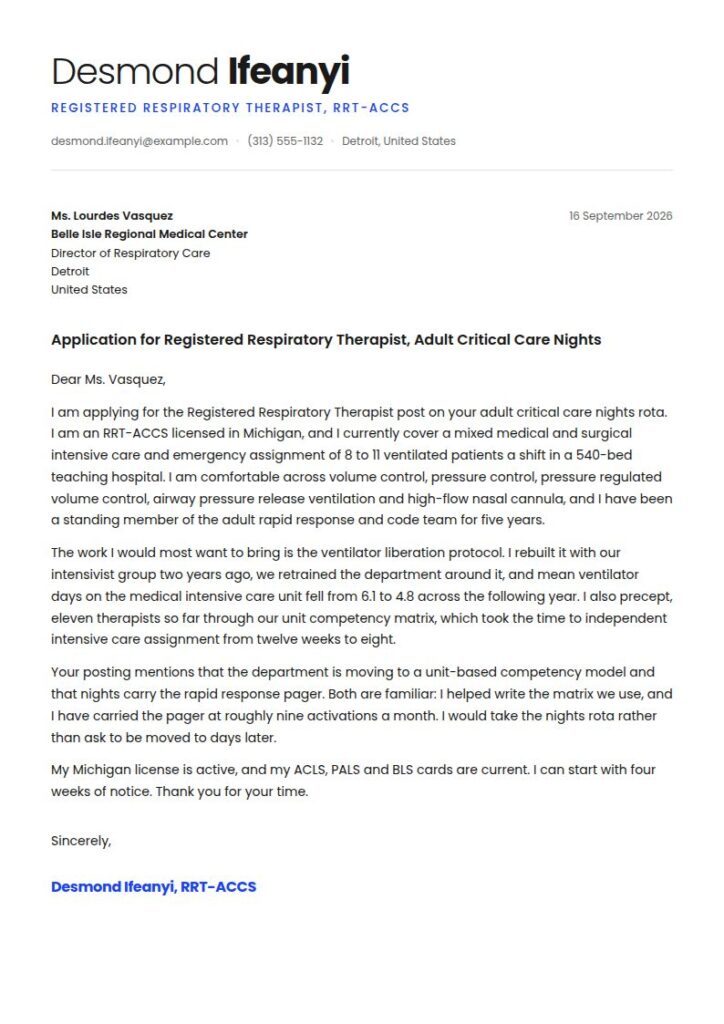
I am applying for the Registered Respiratory Therapist post on your adult critical care nights rota. I am an RRT-ACCS licensed in Michigan, and I currently cover a mixed medical and surgical intensive care and emergency assignment of 8 to 11 ventilated patients a shift in a 540-bed teaching hospital. I am comfortable across volume control, pressure control, pressure regulated volume control, airway pressure release ventilation and high-flow nasal cannula, and I have been a standing member of the adult rapid response and code team for five years.
The work I would most want to bring is the ventilator liberation protocol. I rebuilt it with our intensivist group two years ago, we retrained the department around it, and mean ventilator days on the medical intensive care unit fell from 6.1 to 4.8 across the following year. I also precept, eleven therapists so far through our unit competency matrix, which took the time to independent intensive care assignment from twelve weeks to eight.
Your posting mentions that the department is moving to a unit-based competency model and that nights carry the rapid response pager. Both are familiar: I helped write the matrix we use, and I have carried the pager at roughly nine activations a month. I would take the nights rota rather than ask to be moved to days later.
My Michigan license is active, and my ACLS, PALS and BLS cards are current. I can start with four weeks of notice. Thank you for your time.
Sincerely, Desmond Ifeanyi, RRT-ACCS
Openings that work
| Instead of | Use |
|---|---|
| I am a compassionate respiratory care professional | I am an RRT-ACCS licensed in Michigan, covering adult intensive care and emergency |
| I am writing to express my interest in your respiratory therapist position | I am applying for the Registered Respiratory Therapist post on your adult critical care nights rota |
| I have extensive experience with ventilators | Volume control, pressure control, pressure regulated volume control, airway pressure release and high-flow nasal cannula |
| I would love to be part of your wonderful team | I would take the nights rota rather than ask to be moved to days later |
What counts as evidence in a respiratory department
You cannot write about an individual patient. Everything below describes the work instead.
| Kind of evidence | What it looks like in a sentence |
|---|---|
| Assignment size | 8 to 11 ventilated patients a shift across a 26-bed medical intensive care unit and a 42-bay emergency department |
| Modes | Volume control, pressure control, pressure regulated volume control, airway pressure release, high-flow nasal cannula |
| Team membership | Standing member of the adult rapid response and code team, roughly 9 activations a month |
| Protocol result | Mean ventilator days on the medical intensive care unit fell from 6.1 to 4.8 across a year |
How the letter changes by unit
For a general floor or step-down post, lead with assignment size, aerosol and airway clearance volume, and non-invasive set-up. For adult intensive care, lead with the credential, the ventilated assignment size and the modes by name. For neonatal or paediatric, lead with the RRT-NPS if you hold it, the cot or bed count, and high-frequency and nitric oxide experience. For transport, say ground, rotor or fixed wing, the call rota shape and the transport ventilator you have used. For sleep or pulmonary function, name the credential, CRT-SDS, RRT-SDS, CPFT or RPFT, and the study or test volume.
Do not write "all units and all ages"; a scheduler reads that as none. Do not describe an identifiable patient or a memorable case. Do not leave the shift question unanswered, because nights is usually what is open. Do not claim a mode you have seen but never run. Do not imply the CRT and the RRT are interchangeable; they are different NBRC examinations, and in ten states they are a different license.
The RRT is becoming the floor, not the differentiator
The American Association for Respiratory Care reports that state licensure is mandatory for respiratory therapists everywhere in the United States except Alaska, and lists ten states requiring the RRT for entry to licensure: Ohio and California from 2015, Arizona from 2017, Oregon and New Mexico from 2018, Georgia from 2020, Washington and West Virginia from 2022, Missouri from 1 January 2027 and Indiana from 1 January 2028 (AARC, accessed September 2026).
The occupation itself is growing: 142,000 jobs in 2025, 9 percent projected growth through 2035 and about 8,600 openings a year, against a median wage of $82,280 in May 2025 (BLS Occupational Outlook Handbook, 2025 to 2035 projections and May 2025 wage data).
Together those say the letter should not spend its space on the RRT. It should spend it on the layer above: the specialty credential, the units you cover and the teams you sit on.
Length, format and sending it
One page, four paragraphs, 250 to 400 words. PDF unless the hospital portal says otherwise, named for yourself and the post.
Use the same figures as your resume so the two agree. Our respiratory therapist resume example is written with the numbers used here, and you can check the finished file with the free ATS checker.
Key takeaways
- Put the NBRC credential string in the first sentence, written as the board writes it.
- Name the units you cover and the assignment size on them.
- List ventilator modes by name rather than saying "ventilator management".
- Say which shift and rota you are asking for.
- Give one protocol or teaching result with a before, an after and a period.
- Name one real thing from their posting or their department pages.
- Close with license status and current ACLS, PALS and NRP cards.
Write your respiratory therapist cover letter in 10 minutes with our AI cover letter builder.
Respiratory therapist cover letter questions, answered
How long should a respiratory therapist cover letter be?
One page, four paragraphs, 250 to 400 words. Directors read these between shifts, so the credential and the units belong in the first three sentences.
Should I mention CRT versus RRT in the letter?
Yes, plainly, because it is a licensing fact in ten states rather than a preference. The CRT comes from the low cut score on the Therapist Multiple-Choice examination and the RRT requires the high cut score plus the Clinical Simulation Examination (NBRC, accessed September 2026). If you hold the CRT and are working towards the RRT, say so and give your examination date; that is a stronger line than silence.
What do I write as a new graduate with no hospital post yet?
Write your clinical rotations as the job: the site, the units, the hours, and the size of the assignment you carried. Add your procedure counts, intubation assists, bronchoscopy assists and blood gas draws, and say the program was CoARC accredited, since that is what your NBRC eligibility rests on. Then name the shift you will take. A new graduate who asks for nights is an easy first call.
How do I show a result without discussing a patient?
Use department-level numbers. Mean ventilator days before and after a protocol change, spontaneous breathing trials a shift, rapid response activations a month, or time to independent unit assignment for therapists you precepted. All of these describe the work and identify nobody.
Does the cover letter matter if the hospital uses an online portal?
Attach one wherever there is a field. The portal collects the same structured record from every applicant and cannot tell the manager which units you are ready for tonight or which shift you want. Against roughly 8,600 openings a year nationally (BLS Occupational Outlook Handbook, 2025 to 2035 projections), that paragraph of scheduling detail is what separates two otherwise identical files.