Desmond Ifeanyi RRT
Respiratory Therapy Student, Clinical Rotations
[email protected] | (313) 555-1132 | Detroit, United States
Profile
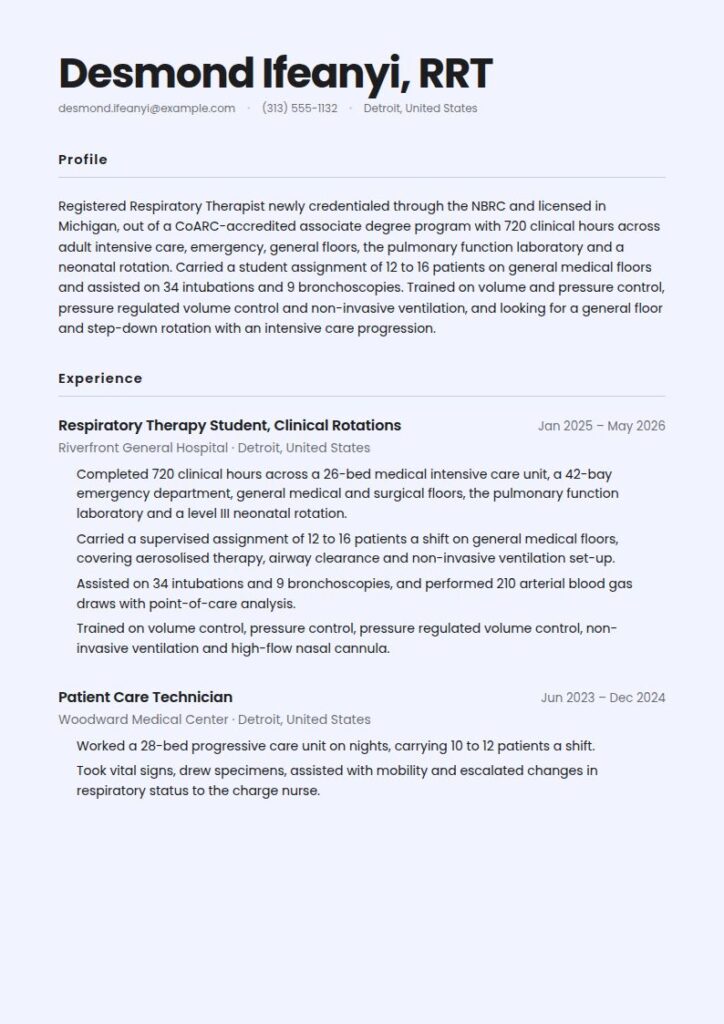
Registered Respiratory Therapist newly credentialed through the NBRC and licensed in Michigan, out of a CoARC-accredited associate degree program with 720 clinical hours across adult intensive care, emergency, general floors, the pulmonary function laboratory and a neonatal rotation. Carried a student assignment of 12 to 16 patients on general medical floors and assisted on 34 intubations and 9 bronchoscopies. Trained on volume and pressure control, pressure regulated volume control and non-invasive ventilation, and looking for a general floor and step-down rotation with an intensive care progression.
Work Experience
01/2025 - 05/2026, Respiratory Therapy Student, Clinical Rotations, Riverfront General Hospital, Detroit, United States
- Completed 720 clinical hours across a 26-bed medical intensive care unit, a 42-bay emergency department, general medical and surgical floors, the pulmonary function laboratory and a level III neonatal rotation.
- Carried a supervised assignment of 12 to 16 patients a shift on general medical floors, covering aerosolised therapy, airway clearance and non-invasive ventilation set-up.
- Assisted on 34 intubations and 9 bronchoscopies, and performed 210 arterial blood gas draws with point-of-care analysis.
- Trained on volume control, pressure control, pressure regulated volume control, non-invasive ventilation and high-flow nasal cannula.
06/2023 - 12/2024, Patient Care Technician, Woodward Medical Center, Detroit, United States
- Worked a 28-bed progressive care unit on nights, carrying 10 to 12 patients a shift.
- Took vital signs, drew specimens, assisted with mobility and escalated changes in respiratory status to the charge nurse.
Education
08/2024 - 05/2026, Associate of Applied Science, Respiratory Therapy, Henry Ford College, Dearborn, United States
CoARC-accredited entry into professional practice program. 720 clinical hours. Program accreditation by CoARC is the eligibility route to the NBRC credentialing examinations.
Skills
Invasive ventilator management, 65
Non-invasive ventilation and high-flow nasal cannula, 75
Arterial blood gas sampling and analysis, 85
Intubation assist, 70
Aerosolised medication delivery, 85
Chest physiotherapy and airway clearance, 80
Pulmonary function testing, 60
Epic clinical documentation, 75
Languages
English, native
Igbo, native
Certificates
06/2026, Registered Respiratory Therapist (RRT), National Board for Respiratory Care
Therapist Multiple-Choice examination at the high cut score plus the Clinical Simulation Examination.
07/2026, Michigan Respiratory Care License, Michigan Department of Licensing and Regulatory Affairs, MI-RC-40921
Active.
03/2026, Basic Life Support and Advanced Cardiovascular Life Support, American Heart Association
Both current.
Summary
A respiratory therapist resume is a one to two page document naming your state license, your NBRC credential level and the units you are cleared to cover. This guide gives you three adaptable versions, the unit and ventilator scope block most applicants leave out, the ten states where the RRT is now the entry credential, and current Bureau of Labor Statistics pay and outlook for the occupation.
Respiratory Therapist resume examples by experience level
In short, a respiratory therapist resume is a one to two page document that names your state license, your credential level, and the units a shift manager could put you on without a second thought.
As a result, recruiters read those three things in that order, and they read them fast. That is because respiratory therapy is staffed by unit, shift by shift, and the person building tomorrow's assignment sheet is not asking whether you are a good clinician in the abstract. They are asking whether they can put you in the neonatal intensive care unit at 7pm, whether you can take the emergency department when a code goes out, and whether you can run the ventilator modes that particular floor uses.
Resume guide for a respiratory therapist resume
To help, this guide and the corresponding respiratory therapist resume example will cover:
- How to write a respiratory therapist resume, section by section
- Why credential level and unit scope belong above your experience
- Three adaptable summaries: new credential holder, intensive care RRT and specialty lead
- What the NBRC credentials, CoARC accreditation and state licensure are worth on the page
- What the job market looks like and what you can expect to earn
How to write a respiratory therapist resume
Overall, it takes six blocks: contact header, summary, credentials and licensure, unit and equipment scope, clinical experience, and education. As for length, use one page as a new credential holder, two once you carry specialty credentials and a supervisory line.
Credentials come first because they are a gate rather than an achievement, and unit scope comes second because it tells the reader how to interpret every bullet underneath it.
| Section | What it is answering | Where it goes |
|---|---|---|
| Credentials and licensure | CRT or RRT, which specialties, licensed in which state? | Header line and the block below the summary |
| Unit and equipment scope | Which floors can I assign this person to tonight? | Its own block, above experience |
| Clinical experience | What volumes and acuity have they actually carried? | Reverse chronological, with numbers |
| Education | Was the program CoARC accredited? | With the institution and the year |
Put the credential string in your header, exactly as the NBRC writes it
The National Board for Respiratory Care writes its specialty credentials as compounds: RRT-ACCS for the Adult Critical Care Specialist, RRT-NPS for the Neonatal/Pediatric Specialist, and CRT-SDS or RRT-SDS for the Sleep Disorders Specialty, alongside CPFT and RPFT in pulmonary function and the AE-C asthma educator credential (NBRC, accessed September 2026).
Write the string the way the board writes it: "Desmond Ifeanyi, RRT-ACCS, RRT-NPS". A manager scanning a stack sees the specialty in the first line rather than on page two.
The eligibility rules are worth knowing because they tell the reader what the letters cost. The ACCS examination requires you to have held the RRT for at least one year before applying, the NPS examination requires the RRT, and the SDS examination opens at six months as a CRT or three months as an RRT (NBRC, accessed September 2026).
Run the finished file through the ATS resume checker before you apply. Hospital systems parse applications into a structured record before a human sees one.
Choosing the best resume format for a respiratory therapist resume
Reverse chronological. In practice, use one page for your first two or three years, two once you carry specialty credentials, transport or a supervisory line.
The reason is scheduling. A manager reads for continuity of acuity: which hospital, which units, how many beds, how many years, and whether the acuity went up or stayed flat. A functional format hides the sequence, and in an occupation where managers assume competence accumulates by unit, hiding the sequence reads badly.
Include your contact information
| ✅ Right | ❌ Wrong |
|---|---|
| Desmond Ifeanyi, RRT-ACCS | Desmond Ifeanyi |
| Registered Respiratory Therapist, Adult Critical Care Specialist | Caring respiratory care professional |
| Michigan Respiratory Care License #MI-RC-40921, NBRC RRT | Licensed and certified therapist |
| (313) 555-1132, [email protected], Detroit, MI | (313) 555-1132, [email protected] |
Also, put the credential letters after your name and the license number in the header block. Credentialing offices verify both, and the file that lets them do it quickly moves through faster.
Make use of a summary
First, write four lines: credential level and license state, the units you cover, an acuity or volume number, and one thing you own beyond the assignment sheet.
Registered Respiratory Therapist newly credentialed through the NBRC and licensed in Michigan, out of a CoARC-accredited associate degree program with 720 clinical hours across adult intensive care, emergency, general floors, the pulmonary function laboratory and a neonatal rotation. Carried a student assignment of 12 to 16 patients on general medical floors and assisted on 34 intubations and 9 bronchoscopies. Trained on volume and pressure control, pressure regulated volume control and non-invasive ventilation, and looking for a general floor and step-down rotation with an intensive care progression.
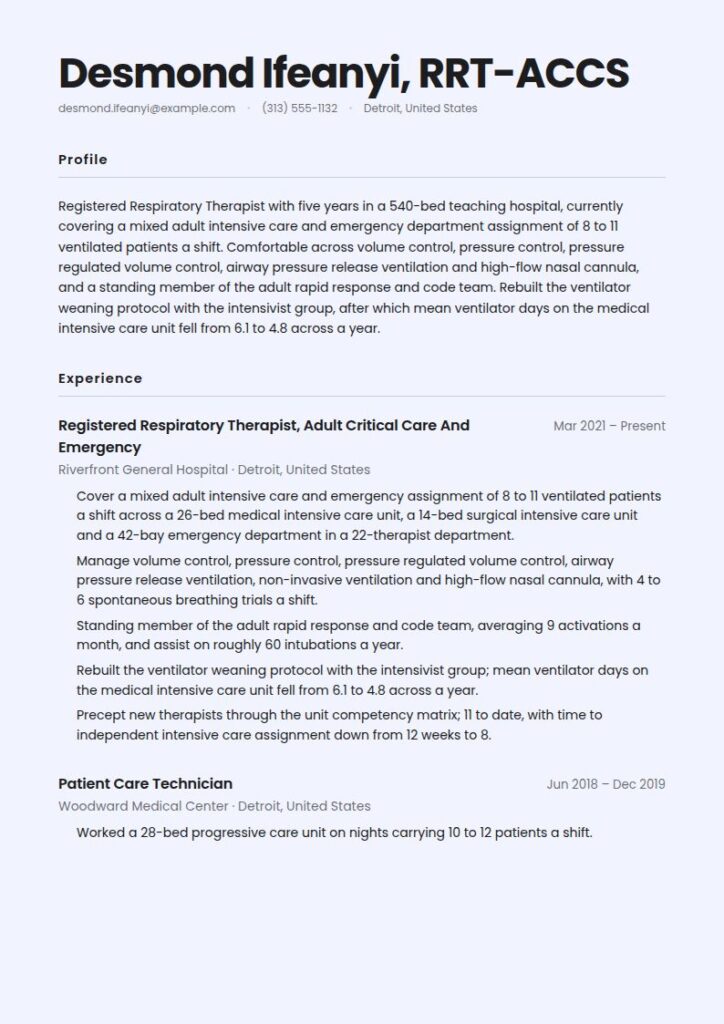
Registered Respiratory Therapist with five years in a 540-bed teaching hospital, currently covering a mixed adult intensive care and emergency department assignment of 8 to 11 ventilated patients a shift. Comfortable across volume control, pressure control, pressure regulated volume control, airway pressure release ventilation and high-flow nasal cannula, and a standing member of the adult rapid response and code team. Rebuilt the ventilator weaning protocol with the intensivist group, after which mean ventilator days on the medical intensive care unit fell from 6.1 to 4.8 across a year.
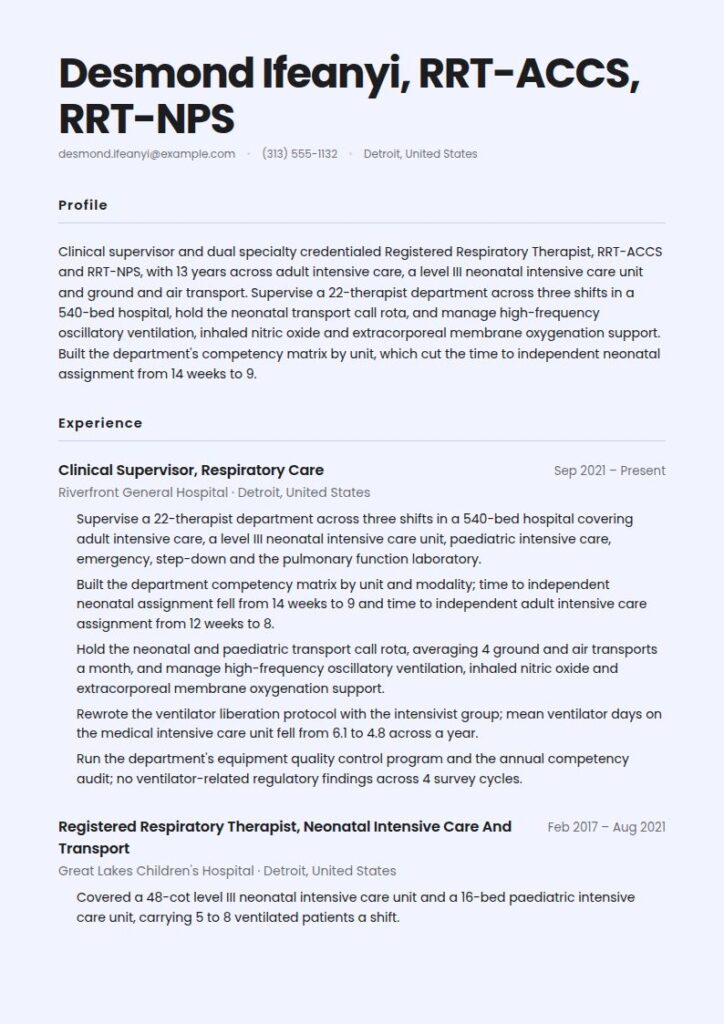
Clinical supervisor and dual specialty credentialed Registered Respiratory Therapist, RRT-ACCS and RRT-NPS, with 13 years across adult intensive care, a level III neonatal intensive care unit and ground and air transport. Supervise a 22-therapist department across three shifts in a 540-bed hospital, hold the neonatal transport call rota, and manage high-frequency oscillatory ventilation, inhaled nitric oxide and extracorporeal membrane oxygenation support. Built the department's competency matrix by unit, which cut the time to independent neonatal assignment from 14 weeks to 9.
Right vs wrong: the same respiratory therapist summary, twice
| ✅ Right | ❌ Wrong |
|---|---|
| Registered Respiratory Therapist with five years in a 540-bed teaching hospital. | Compassionate respiratory care professional with a heart for patients. |
| Covers a mixed adult intensive care and emergency assignment of 8 to 11 ventilated patients a shift. | Experienced in a wide variety of respiratory care settings. |
| Ventilator weaning protocol rebuild; mean ventilator days on the medical intensive care unit fell from 6.1 to 4.8 across a year. | Committed to providing the highest quality of patient care. |
For example, the right column can be put on tomorrow's assignment sheet. By contrast, the left column cannot, and a manager covering three shifts is building an assignment sheet.
Outline your clinical experience
Then list hospital, bed count, department size, units covered and dates. Then three to five bullets, each naming a unit or a modality and carrying a number.
| Instead of | Use |
|---|---|
| Provided respiratory care to patients | Covered a mixed adult intensive care and emergency assignment of 8 to 11 ventilated patients a shift across a 26-bed medical intensive care unit |
| Managed ventilators | Ran volume control, pressure control, pressure regulated volume control, airway pressure release ventilation and non-invasive ventilation; managed 4 to 6 weaning trials a shift |
| Responded to emergencies | Standing member of the adult rapid response and code team, averaging 9 activations a month over 5 years |
| Performed airway management | Assisted on roughly 60 intubations a year, managed difficult airway cart readiness and performed tracheostomy changes on the step-down unit |
| Improved patient outcomes | Rebuilt the ventilator weaning protocol with the intensivist group; mean ventilator days on the medical intensive care unit fell from 6.1 to 4.8 across a year |
| Trained staff | Precepted 11 new therapists through the unit competency matrix, cutting time to independent intensive care assignment from 12 weeks to 8 |
Registered Respiratory Therapist, Adult Critical Care and Emergency, Riverfront General Hospital, Detroit, MI, 540 beds, 22-therapist department, March 2021 to Present
Cover a mixed adult intensive care and emergency department assignment of 8 to 11 ventilated patients a shift, across a 26-bed medical intensive care unit, a 14-bed surgical intensive care unit and a 42-bay emergency department.
Manage volume control, pressure control, pressure regulated volume control, airway pressure release ventilation, non-invasive ventilation and high-flow nasal cannula, with 4 to 6 spontaneous breathing trials a shift.
Standing member of the adult rapid response and code team, averaging 9 activations a month, and assist on roughly 60 intubations a year.
Rebuilt the ventilator weaning protocol with the intensivist group; mean ventilator days on the medical intensive care unit fell from 6.1 to 4.8 across a year.
Precept new therapists through the unit competency matrix; 11 to date, with time to independent intensive care assignment down from 12 weeks to 8.
Credential level and the units you can cover
In fact, this is the block that decides your shortlist, and almost nobody writes it as a block. It has two halves, and both are specific to this occupation.
The credential half. The NBRC awards two therapist credentials, and they are not seniority labels; they are different examination outcomes. You earn the Certified Respiratory Therapist by reaching the low cut score on the Therapist Multiple-Choice examination. The Registered Respiratory Therapist requires the high cut score on the same examination plus the separate Clinical Simulation Examination (NBRC, accessed September 2026). On top of those sit the specialty credentials: RRT-ACCS, RRT-NPS, CRT-SDS and RRT-SDS, plus CPFT and RPFT in pulmonary function and the AE-C asthma educator credential.
Two structural facts about that ladder belong on your page rather than in your head. First, eligibility for any of it runs through program accreditation: CoARC states plainly that "program accreditation by CoARC is necessary in order to be eligible for the National Board for Respiratory Care (NBRC) professional credentialing examinations" (CoARC, accessed September 2026). For this reason, name your program and say it was CoARC accredited.
When the respiratory credential is the license
Second, the credential level increasingly is the license. The American Association for Respiratory Care reports that "state licensure is mandatory for respiratory therapists practicing in the U.S., except for Alaska," and lists ten states that require the RRT for entry to licensure: Ohio and California from 2015, Arizona from 2017, Oregon and New Mexico from 2018, Georgia from 2020, Washington and West Virginia from 2022, Missouri from 1 January 2027 and Indiana from 1 January 2028 (AARC, accessed September 2026). If you hold only the CRT and you are applying across state lines, that list is the first thing to check, and saying on your resume that you are RRT-eligible with a Clinical Simulation Examination date booked is a meaningful line.
The unit half. Write the units you have actually covered, the equipment you have run on them, and the teams you sit on. These are different jobs, not different shades of one job.
Units covered independently: adult medical and surgical intensive care, emergency department, progressive care and step-down, general medical and surgical floors
Units covered with a preceptor: level III neonatal intensive care, paediatric intensive care
Ventilation: volume control, pressure control, pressure regulated volume control, airway pressure release ventilation, non-invasive ventilation, high-flow nasal cannula, transport ventilators
Airway and procedures: intubation assist, difficult airway cart, tracheostomy change on step-down, bronchoscopy assist, arterial line sampling, arterial blood gas analysis and point-of-care testing
Teams: adult rapid response, adult code team, ventilator liberation rounds
Diagnostics and outpatient: pulmonary function laboratory, six-minute walk testing, overnight sleep study set-up
Not yet covered: extracorporeal membrane oxygenation, high-frequency oscillatory ventilation, air and ground transport
The last line matters as much as the first. In practice, a manager who knows exactly which units you cannot yet take can build an orientation plan, and a candidate who volunteers the gap reads as someone who has been on a real assignment sheet. By contrast, a candidate who writes "all units, all ages" reads as someone who has not.
Build a snapshot of your key skills
For skills, list twelve to sixteen entries in four groups: ventilation, airway and procedures, diagnostics, and the systems the hospital runs.
Ventilation: Invasive ventilator management, Non-invasive ventilation and high-flow nasal cannula, Ventilator liberation and spontaneous breathing trials, Airway pressure release ventilation, Transport ventilation
Airway and procedures: Intubation assist and difficult airway cart, Tracheostomy management, Bronchoscopy assist, Arterial blood gas sampling and analysis, Chest physiotherapy and airway clearance
Diagnostics and outpatient: Pulmonary function testing, Six-minute walk testing, Overnight sleep study set-up, Aerosolised medication delivery, Asthma and chronic obstructive pulmonary disease education
Systems and teams: Epic clinical documentation, Rapid response and code team, Ventilator liberation rounds, Unit competency matrix and precepting, Equipment quality control and infection prevention
Name the electronic record. After all, Epic, Cerner and Meditech charting speed is a real screening consideration for float and travel roles.
List your education, license and certifications
Credentials first with their NBRC status, then the state license with its number, then the degree with its institution and accreditation, then the rest.
NBRC Registered Respiratory Therapist (RRT), 2021. NBRC Adult Critical Care Specialist (RRT-ACCS), 2023. NBRC Neonatal/Pediatric Specialist (RRT-NPS), 2025.
Michigan Respiratory Care License #MI-RC-40921, active.
Bachelor of Science, Respiratory Therapy, University of Michigan-Flint, Flint, MI, 2024. Degree advancement program for credentialed therapists.
Associate of Applied Science, Respiratory Therapy, Henry Ford College, Dearborn, MI, 2021. CoARC-accredited program, 720 clinical hours.
Certifications: Advanced Cardiovascular Life Support and Basic Life Support, American Heart Association, current. Neonatal Resuscitation Program, current. Pediatric Advanced Life Support, current.
Similarly, life support cards are not decoration in this occupation. ACLS, PALS and NRP currency determines which teams a manager can place you on, so give the issuing body and say current rather than listing a year that may have lapsed.
Choose the right layout and design
For layout, use a single column, 11 or 12 point, no photograph, no skill bars. Credential letters in the header. Two pages maximum.
Write the credential string exactly as the NBRC writes it, in the header. Give the license number and the state. Name every unit you cover, and say which you cover independently and which with a preceptor. List ventilator modes by name. State your rapid response and code team membership. Say your program was CoARC accredited. Give bed counts and department size for every hospital.
Do not write "all units" or "all patient populations"; a manager reads that as no units. Do not describe an identifiable patient, however instructive the case. Do not list a lapsed ACLS, PALS or NRP card without saying it is lapsed. Do not put CRT and RRT in the same breath as though they are interchangeable; they are different examinations and in ten states a different license. Do not use a two-column template for a hospital applicant system.
Respiratory therapist job market and outlook
A mid-sized occupation growing much faster than average, concentrated overwhelmingly in hospitals, with a steady replacement flow.
| Measure | Value |
|---|---|
| Respiratory therapist jobs, 2025 | 142,000 |
| Projected change, 2025-35 | 9% (much faster than average) |
| Projected annual openings | About 8,600 |
| Typical entry-level education | Associate's degree |
| Median annual wage, May 2025 | $82,280 |
Source: U.S. Bureau of Labor Statistics, Occupational Outlook Handbook, 2025 to 2035 projections and May 2025 wage data.
The credential bar is rising state by state
Ten states now require the Registered Respiratory Therapist credential for entry to licensure, phased in over more than a decade: Ohio and California from 2015, Arizona from 2017, Oregon and New Mexico from 2018, Georgia from 2020, Washington and West Virginia from 2022, with Missouri following on 1 January 2027 and Indiana on 1 January 2028 (AARC, accessed September 2026).
At the same time the NBRC's CRT-to-Registry admission policy, the alternative route into the Registered examinations for experienced Certified Respiratory Therapists, expires at the end of December 2026 (NBRC, accessed September 2026).
Read together, those two facts describe a profession that is closing the gap between its entry credential and its practice credential. For a resume that means the RRT is no longer a differentiator in most markets; it is becoming the floor. What differentiates now is the specialty layer above it, RRT-ACCS and RRT-NPS in particular, and the unit scope those credentials unlock.
For reference, here is where the jobs sit, and what each setting pays:
| Setting | Median annual wage (May 2025) |
|---|---|
| Hospitals; state, local, and private | $82,730 |
| Nursing care facilities (skilled nursing facilities) | $79,270 |
| Offices of physicians | $77,890 |
Source: U.S. Bureau of Labor Statistics, Occupational Outlook Handbook, May 2025 wage data.
What salary you can expect as a respiratory therapist
On pay, the median annual wage for respiratory therapists was $82,280 as of May 2025, or $39.56 an hour. The lowest 10 percent earned less than $63,660 and the highest 10 percent more than $118,050 (BLS Occupational Outlook Handbook, May 2025 wage data).
That is a comparatively narrow band for a healthcare occupation, and the three published industry medians sit within about $4,800 of each other. However, which kind of employer you pick decides very little of your pay.
Instead, what does move it is shift, credential and scope. Nights, weekends and on-call carry differentials that a contract sets rather than a negotiation. In addition, specialty credentials and charge or supervisory responsibility carry their own. Transport, extracorporeal membrane oxygenation support and neonatal assignment sit at the top of most differential schedules because the pool of therapists cleared for them is small. Meanwhile, travel and per diem contracts pay above the band and buy none of the progression.
The practical consequence for the resume is that the unit scope block is a pay document as much as a competence document. A therapist who can cover the neonatal intensive care unit, the transport rota and the adult code team is eligible for three differentials rather than none, and employers assess eligibility from what you can show on paper on your first day.
Key takeaways for a respiratory therapist resume
- First, put the NBRC credential string in the header exactly as the board writes it.
- Then give the license number and state; in ten states the RRT is now the entry credential.
- Also, name every unit you cover, split into independent and with a preceptor.
- Then list ventilator modes by name rather than writing "ventilator management".
- Finally, state rapid response and code team membership; it is a scheduling fact.
- Say your program was CoARC accredited, since that is what NBRC eligibility runs through.
- Keep ACLS, PALS and NRP currency visible, because it decides team placement.
Build your respiratory therapist resume in 15 minutes with our AI resume builder.
Related medical resume examples
- ICU nurse resume
- NICU nurse resume
- ER nurse resume
- Nurse resume
- Paramedic resume
- EMT resume
- Physical therapist resume
- Occupational therapist resume
- Surgical tech resume
- Charge nurse resume
- Physician assistant resume
- Medical assistant resume
Pair it with a matching respiratory therapist cover letter.
Respiratory therapist resume questions, answered
How long should a respiratory therapist resume be?
One page for your first two or three years, two once you hold specialty credentials, cover transport or neonatal assignment, or carry a supervisory line. Two pages is normal mid-career because the unit scope block and the credential block both take real space, and compressing them removes the evidence a scheduler is reading for.
Is the CRT or the RRT the one employers want?
Both are real NBRC credentials, but they are different examination outcomes and the market has moved. The CRT comes from the low cut score on the Therapist Multiple-Choice examination; the RRT requires the high cut score plus the Clinical Simulation Examination (NBRC, accessed September 2026). Ten states now require the RRT for entry to licensure. If you hold the CRT, write that you are RRT-eligible and give your examination date.
How do I write unit scope without overclaiming?
Split it in two. List the units you cover independently, then the units you cover with a preceptor, then a short line naming what you have not covered. That structure is honest, it is what a scheduler needs, and it protects you: a therapist placed unsupervised on a level III neonatal unit on the strength of a vague resume is in a bad position on the first shift.
What do I put on a respiratory therapist resume with no experience?
Your clinical rotations, written as jobs: the site, the units, the hours and the assignment size. Then your procedure counts, intubation assists, bronchoscopy assists and blood gas draws. Then your credential status with its date, your license, and your ACLS, PALS and NRP cards. Say that the program was CoARC accredited, since that is what your NBRC eligibility rests on.
Do specialty credentials actually change what I earn?
They change what you can be assigned to, and assignment is what carries differentials. The ACCS requires holding the RRT for at least a year before applying and the NPS requires the RRT (NBRC, accessed September 2026), so both signal real time in the units. Against a national median of $82,280 in May 2025 with a top decile above $118,050 (BLS, May 2025), most of the distance between those two figures is shift, specialty assignment and supervisory responsibility.