Registered Nurse, Medical Intensive Care Callista Brubaker RN, BSN
Staff Nurse, Medical Intensive Care Unit
[email protected] | (937) 555-1318 | Dayton, United States
Profile
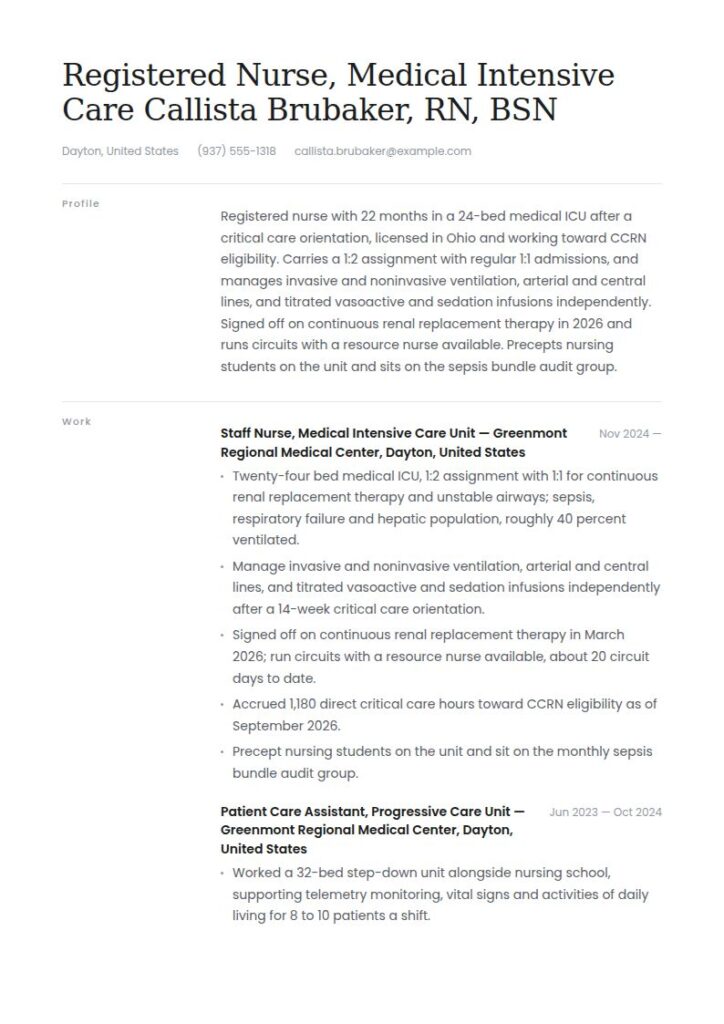
Registered nurse with 22 months in a 24-bed medical ICU after a critical care orientation, licensed in Ohio and working toward CCRN eligibility. Carries a 1:2 assignment with regular 1:1 admissions, and manages invasive and noninvasive ventilation, arterial and central lines, and titrated vasoactive and sedation infusions independently. Signed off on continuous renal replacement therapy in 2026 and runs circuits with a resource nurse available. Precepts nursing students on the unit and sits on the sepsis bundle audit group.
Work Experience
11/2024 - Present, Staff Nurse, Medical Intensive Care Unit, Greenmont Regional Medical Center, Dayton, United States
- Twenty-four bed medical ICU, 1:2 assignment with 1:1 for continuous renal replacement therapy and unstable airways; sepsis, respiratory failure and hepatic population, roughly 40 percent ventilated.
- Manage invasive and noninvasive ventilation, arterial and central lines, and titrated vasoactive and sedation infusions independently after a 14-week critical care orientation.
- Signed off on continuous renal replacement therapy in March 2026; run circuits with a resource nurse available, about 20 circuit days to date.
- Accrued 1,180 direct critical care hours toward CCRN eligibility as of September 2026.
- Precept nursing students on the unit and sit on the monthly sepsis bundle audit group.
06/2023 - 10/2024, Patient Care Assistant, Progressive Care Unit, Greenmont Regional Medical Center, Dayton, United States
- Worked a 32-bed step-down unit alongside nursing school, supporting telemetry monitoring, vital signs and activities of daily living for 8 to 10 patients a shift.
- Trained in safe transfer and lift technique and in point of care glucose testing.
Education
08/2020 - 05/2024, Bachelor of Science in Nursing, Nursing, Wright State University, Dayton, United States
Senior capstone preceptorship completed in a 24-bed medical ICU, 180 hours.
Skills
Invasive and noninvasive ventilation, 75
Vasoactive and sedation infusion titration, 70
Arterial and central line management, 75
Continuous renal replacement therapy, 55
Sepsis bundle execution, 80
RASS and CAM-ICU assessment, 80
Epic critical care flowsheets, 85
Languages
English, native
Certificates
07/2024, Registered Nurse License, Ohio Board of Nursing, RN-4482619
Active, compact multistate privilege.
08/2024, Advanced Cardiovascular Life Support, American Heart Association
Basic Life Support held concurrently.
03/2026, Continuous Renal Replacement Therapy Unit Competence, Greenmont Regional Medical Center Department of Nursing Education
Summary
An ICU nurse resume is a one to two page document naming the unit type and bed count you work, the acuity and assignment ratio you carry, the devices and drips you manage independently, and the critical care hours behind your certification. This guide gives you three adaptable versions, the competence block almost nobody writes, and current Bureau of Labor Statistics pay data.
ICU Nurse resume examples by experience level
In short, an ICU nurse resume is a one to two page document that names the unit you work, the acuity you carry, the devices and drips you run without help, and the critical care hours sitting behind your certification.
Every applicant for an intensive care post holds a registered nurse license, so the license is not the question. The question a critical care manager is actually asking is narrower and harder: can this nurse take a fresh post-operative admission on four vasoactive infusions at seven in the morning, or does somebody have to stand behind them for the first hour. Therefore, the resume that answers that in its first two blocks gets the call.
Resume guide for an ICU nurse resume
In particular, this guide and the corresponding ICU nurse resume example will cover:
- How to write an ICU nurse resume, block by block
- The unit profile line that belongs at the top of every job, and what goes in it
- Three adaptable summaries: new to critical care, experienced ICU nurse, and senior specialist
- How to write a device and drip competence list a charge nurse would recognize
- What the job market looks like and what Bureau of Labor Statistics pay data shows
How to write an ICU nurse resume
Use seven blocks: contact header, summary, license and certifications, critical care experience with a unit profile line on each job, a device and drip competence block, skills and systems, and finally education. One page for your first five years in critical care, two once you carry a device specialty, precept, or have worked more than one unit type.
In practice, the way an intensive care manager reads sets the order. Certifications come before experience because they are checkable. The unit profile line comes before the bullets because it tells the reader what your bullets are worth.
| Section | What it is answering | Where it goes |
|---|---|---|
| License and certifications | Is this nurse current, and are they CCRN? | Header and a block under the summary |
| Unit profile line | What kind of ICU, how many beds, what ratio, what population? | First line of every critical care job |
| Device and drip competence | What can this nurse run at three in the morning without calling anyone? | Its own block, split by level of independence |
| Critical care experience | What did they change on the unit, with a number? | Reverse chronological, under each profile line |
| Systems | Which record, which monitors, which pumps and libraries? | Short named list |
Open every job with a unit profile line
An intensive care unit is not a generic setting, and two nurses with the same job title can have had completely different years.
Write one line under each job heading before any bullets: unit type, bed count, typical assignment ratio, patient population and the proportion of your assignment that is one to one. "Twenty-four bed medical ICU, 1:2 with 1:1 for continuous renal replacement therapy and unstable airways, mixed sepsis, respiratory failure and hepatic population, roughly 40 percent ventilated" tells a reader more about what you can do than four bullets of verbs.
Run the finished file through the ATS resume checker before you send it. Large hospital systems screen nursing applications through an applicant tracking system before a nurse manager opens one, and certification strings are exactly what a badly formatted file loses.
Choosing the best resume format for an ICU nurse resume
Reverse chronological, single column. One page while your whole history is one or two units, two pages once you have worked more than one unit type, hold a subspecialty certification, or carry a device role such as continuous renal replacement therapy or extracorporeal membrane oxygenation resource.
Functional formats fail badly here. Critical care competence is cumulative and time-stamped: how long in this unit type, how long since orientation ended, how many hours of direct critical care care in the last two years. After all, a format that hides the timeline hides the only variable the reader needs.
Include your contact information
| ✅ Right | ❌ Wrong |
|---|---|
| Callista Brubaker | Callista Brubaker |
| RN, BSN, CCRN | Experienced critical care professional |
| Ohio RN license #RN-4482619, CCRN (Adult) since 2019 | Licensed nurse, certified |
| (937) 555-1318, [email protected], Dayton, OH | (937) 555-1318, [email protected] |
Also put the license number and the credential letters in the header. In fact, the American Association of Critical-Care Nurses requires "a current, unencumbered U.S. RN or APRN license" before a CCRN application is considered (AACN, CCRN Adult eligibility, checked September 2026), so license and certification belong on the page together.
Make use of a summary
Keep it to four lines: unit type and years in critical care, acuity and ratio, your device range, and also one number that moved.
Registered nurse with 22 months in a 24-bed medical ICU after a critical care orientation, licensed in Ohio and working toward CCRN eligibility. Carries a 1:2 assignment with regular 1:1 admissions, and manages invasive and noninvasive ventilation, arterial and central lines, and titrated vasoactive and sedation infusions independently. Signed off on continuous renal replacement therapy in 2026 and runs circuits with a resource nurse available. Precepts nursing students on the unit and sits on the sepsis bundle audit group.
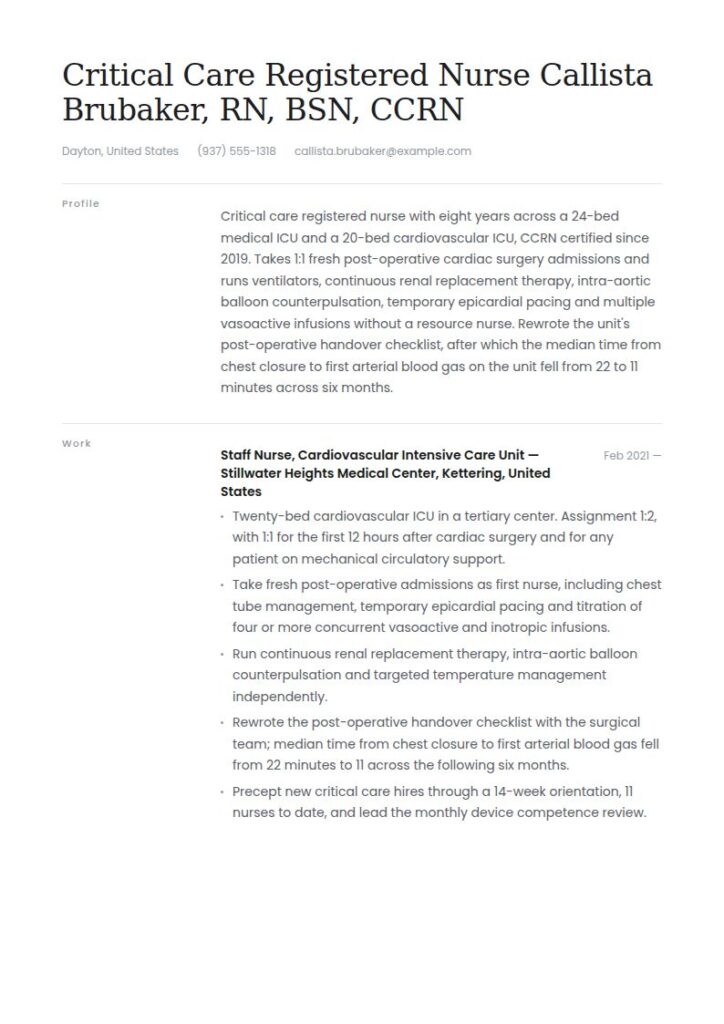
Critical care registered nurse with eight years across a 24-bed medical ICU and a 20-bed cardiovascular ICU, CCRN certified since 2019. Takes 1:1 fresh post-operative cardiac surgery admissions and runs ventilators, continuous renal replacement therapy, intra-aortic balloon counterpulsation, temporary epicardial pacing and multiple vasoactive infusions without a resource nurse. Rewrote the unit's post-operative handover checklist, after which the median time from chest closure to first arterial blood gas on the unit fell from 22 to 11 minutes across six months.
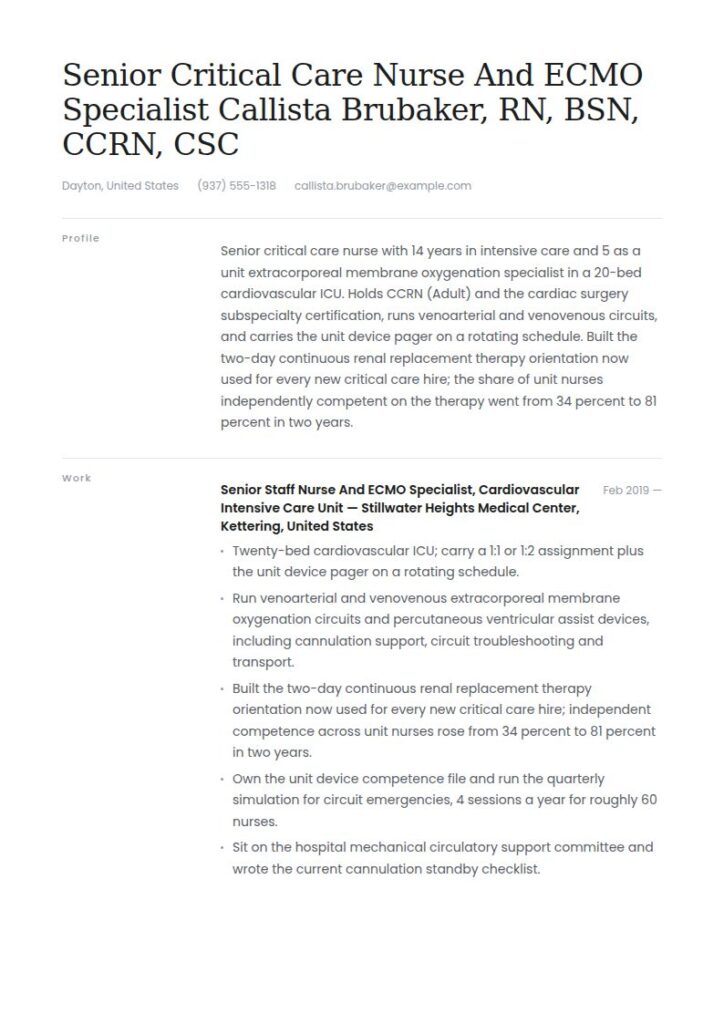
Senior critical care nurse with 14 years in intensive care and 5 as a unit extracorporeal membrane oxygenation specialist in a 20-bed cardiovascular ICU. Holds CCRN (Adult) and the cardiac surgery subspecialty certification, runs venoarterial and venovenous circuits, and carries the unit device pager on a rotating schedule. Built the two-day continuous renal replacement therapy orientation now used for every new critical care hire; the share of unit nurses independently competent on the therapy went from 34 percent to 81 percent in two years.
Right vs wrong: the same ICU nurse summary, twice
| ✅ Right | ❌ Wrong |
|---|---|
| Critical care nurse with eight years across a 24-bed medical ICU and a 20-bed cardiovascular ICU, CCRN since 2019. | Compassionate ICU nurse with a strong work ethic and excellent clinical skills. |
| Takes 1:1 fresh post-operative cardiac admissions; runs ventilators, CRRT, intra-aortic balloon pump and multiple vasoactive infusions without a resource nurse. | Experienced with critical care equipment and high acuity patients. |
| Median time from chest closure to first arterial blood gas fell from 22 to 11 minutes across six months. | Committed to providing the highest quality patient care. |
For example, a manager can put the left column on a schedule. The right column, on the other hand, needs an interview before anyone knows what it means.
Outline your critical care experience
Hospital, unit, city, dates, then the unit profile line, then three to five bullets. In practice, each bullet names a device, a population or a protocol, and carries a number.
| Instead of | Use |
|---|---|
| Provided care for critically ill patients | Carried a 1:2 assignment in a 24-bed medical ICU with roughly 40 percent of patients ventilated |
| Managed ventilated patients | Managed invasive and noninvasive ventilation and performed daily spontaneous awakening and breathing trials on protocol |
| Administered medications | Titrated norepinephrine, vasopressin, epinephrine, nicardipine, insulin, propofol and dexmedetomidine to ordered end points |
| Experienced with dialysis | Ran continuous renal replacement therapy circuits independently, roughly 60 circuit days a year, including filter changes and citrate anticoagulation monitoring |
| Helped train new staff | Precepted 11 nurses through critical care orientation, 9 of whom are still on the unit |
| Participated in quality improvement | Rewrote the post-operative handover checklist; median chest closure to first arterial blood gas fell from 22 to 11 minutes over six months |
Staff Nurse, Cardiovascular Intensive Care Unit, Stillwater Heights Medical Center, Kettering, OH, February 2021 to Present
Twenty-bed cardiovascular ICU in a tertiary center. Assignment 1:2, with 1:1 for the first 12 hours after cardiac surgery and for any patient on mechanical circulatory support. Population is post-operative coronary artery bypass and valve surgery, cardiogenic shock, and post-arrest targeted temperature management.
Take fresh post-operative admissions as first nurse, including chest tube management, temporary epicardial pacing, and titration of four or more concurrent vasoactive and inotropic infusions.
Rewrote the post-operative handover checklist with the surgical team; median time from chest closure to first arterial blood gas on the unit fell from 22 minutes to 11 across the following six months.
Precept new critical care hires through a 14-week orientation, 11 nurses to date, and lead the monthly device competence review for the unit.
Unit acuity, device competence and the CCRN hour bar on an ICU nurse resume
However, this is the block that separates two critical care resumes, and most applicants replace it with the word "high acuity" and move on.
Specifically, three things belong here, in this order.
Unit type and bed count. Say which ICU. Medical, surgical, cardiovascular or cardiothoracic, neurological, trauma, burn, or the mixed unit that a community hospital runs where one nurse covers all of it. A nurse from a mixed 10-bed community ICU and a nurse from a 24-bed academic medical ICU have both worked intensive care, and they have not had the same year. Give the bed count, because it stands in for volume, staffing model and how often the worst thing happens.
Acuity and assignment ratio. Write the ratio you carry and what pushes it to one to one on your unit. Continuous renal replacement therapy, mechanical circulatory support, an unstable airway, targeted temperature management, active massive transfusion, a fresh post-operative hour. The list itself tells a reader what your unit treats. Add the proportion of your patients who are ventilated, because it is the single cleanest proxy for acuity and almost nobody writes it.
ICU device and drip competence
Device and drip competence, split three ways. This is the part to be honest about, and honesty is what makes it credible.
Independent: invasive and noninvasive mechanical ventilation, arterial and central venous lines, continuous renal replacement therapy including citrate anticoagulation, intra-aortic balloon counterpulsation, temporary epicardial pacing, targeted temperature management, massive transfusion protocol, bedside ultrasound-assisted line setup
Independent with resource available: venoarterial and venovenous extracorporeal membrane oxygenation circuits, percutaneous ventricular assist device, continuous electroencephalography monitoring
Trained, not yet signed off: intracranial pressure and external ventricular drain management
Vasoactive and continuous infusions titrated to ordered end points: norepinephrine, vasopressin, epinephrine, phenylephrine, dobutamine, milrinone, nicardipine, nitroglycerin, amiodarone, insulin, propofol, dexmedetomidine, ketamine, fentanyl, cisatracurium
Three headings, because they answer three different questions: what you can be left alone with, what you can do with a phone call available, and what you have trained on but would not yet claim. As a result, a manager who reads that block knows exactly where you fit in a staffing grid, and the third line makes them believe the first.
The CCRN certification and its hour bar
Then the certification, with its hour bar. The CCRN is the credential critical care managers look for, and its eligibility rules are themselves a statement about how much time you have spent at the bedside. The American Association of Critical-Care Nurses sets two routes for CCRN (Adult): practice as an RN or APRN for 1,750 hours in direct care of acutely or critically ill adult patients during the previous two years, with 875 of those hours in the most recent year before applying; or practice during the previous five years with a minimum of 2,000 hours in direct care of acutely or critically ill adult patients, with 144 of those hours in the most recent year before applying (American Association of Critical-Care Nurses, CCRN Adult eligibility, checked September 2026). Either way, AACN requires a current, unencumbered United States RN or APRN license.
Those numbers are useful on a resume even before you sit the exam. However, if you are not certified yet, write the hours: "1,180 direct critical care hours accrued toward CCRN eligibility as of September 2026, on track to apply in early 2027" is a precise, checkable claim about your experience, and it reads far better than silence. If you are certified, put the year you first certified, because the length of time you have held it is a proxy for years at the bedside that nothing else on the page carries.
Build a snapshot of your key skills
In practice, list twelve to sixteen entries in four groups: clinical management, devices, procedures and protocols, and systems. Named modalities, not adjectives.
Clinical management: hemodynamic monitoring and interpretation, vasoactive and inotropic titration, ventilator management and weaning, sedation and delirium assessment with RASS and CAM-ICU, sepsis bundle execution, end of life and family meeting support
Devices: continuous renal replacement therapy, intra-aortic balloon counterpulsation, extracorporeal membrane oxygenation circuits, percutaneous ventricular assist device, temporary epicardial pacing, targeted temperature management, continuous electroencephalography
Procedures and protocols: central and arterial line insertion assistance, bronchoscopy and chest tube assistance, bedside tracheostomy, massive transfusion protocol, rapid response and code team response, prone positioning, early mobility protocol
Systems: Epic, Cerner, Philips and GE bedside monitoring, smart pump drug libraries, point of care blood gas analyzers
List your education, license and certifications
License first with its number and its state, then certifications with the issuing body and the year, then degrees.
Registered Nurse, Ohio Board of Nursing, license #RN-4482619, active, compact multistate privilege
CCRN (Adult), American Association of Critical-Care Nurses, first certified 2019
Cardiac Surgery Subspecialty Certification, American Association of Critical-Care Nurses, 2023
Advanced Cardiovascular Life Support and Basic Life Support, American Heart Association, current
Bachelor of Science in Nursing, Wright State University, Dayton, OH, 2017
Unit extracorporeal membrane oxygenation specialist course, completed 2022, 80 hours of didactic and simulation training plus supervised circuit hours
Also give the state and the number, because every board publishes a verification lookup and a recruiter will run it. If you hold a compact multistate privilege, say so on the same line, because it decides whether you can start next month or in three.
Choose the right layout and design
Above all, use a single column, 11 or 12 point, plain headings, and no photograph. Hospital systems parse nursing applications into a structured record before a human opens them, and credential strings and device names are what a graphic template loses.
Put the unit type, bed count and assignment ratio on the first line of each critical care job. Split your device list into independent, independent with a resource, and trained but not signed off. Say what proportion of your patients are ventilated. Name the vasoactive infusions you titrate. Give your accrued critical care hours if you are not yet certified. State whether your license carries a compact multistate privilege. Name the electronic record and the monitoring platform by product.
Do not write "high acuity" without the ratio and the population that make it true. Do not claim a device you have only watched; a competence file exists on every unit and it is checked. Do not describe yourself as compassionate or hardworking, because every file in the pile does. Do not name or describe an identifiable patient or a specific case. Do not let a certification lapse quietly on the page without the year and the current status.
ICU nurse job market and outlook
Overall, critical care sits inside a very large, growing occupation, and hospitals carry most of the hiring pressure.
However, the Bureau of Labor Statistics does not publish a separate occupation for intensive care nurses. BLS counts ICU nurses inside registered nurses, so the figures below describe the occupation your post sits within, not critical care alone.
| Measure | Value |
|---|---|
| Registered nurse jobs, 2025 | 3,465,400 |
| Projected employment, 2035 | 3,660,100 |
| Projected change, 2025-35 | 6 percent, faster than average, +194,700 |
| Projected annual openings | About 180,800 |
| Typical entry-level education | Bachelor's degree |
| Median annual wage, May 2025 | $97,550 ($46.90 per hour) |
Source: U.S. Bureau of Labor Statistics, Occupational Outlook Handbook, Registered Nurses, May 2025 wages with 2025 to 2035 projections.
Fifty-nine percent of registered nurses work in hospitals, and that is where critical care is
Hospitals, state, local and private, employ 59 percent of registered nurses at a median annual wage of $100,220. Ambulatory healthcare services employ 19 percent at $91,230, nursing and residential care facilities 6 percent at $84,300, government excluding education and hospitals 5 percent at $110,780, and educational services 3 percent at $78,620 (BLS Occupational Outlook Handbook, May 2025).
For a critical care nurse that concentration matters more than it does for the occupation as a whole, because the intensive care unit exists almost exclusively inside the 59 percent. Your employer pool is hospitals, and inside hospitals it is a small number of units, which is why the specificity on your page has to be unit level rather than hospital level.
What salary you can expect as an ICU nurse
Specifically, the median annual wage for registered nurses was $97,550, or $46.90 an hour, as of May 2025. The lowest 10 percent earned less than $68,940 and the highest 10 percent more than $137,470 (BLS Occupational Outlook Handbook, May 2025). Critical care nursing sits in the upper half of that distribution in most markets, but BLS does not publish a critical care wage, so treat any single national ICU figure you see quoted with suspicion.
What actually moves an individual offer sits on top of a base scale, and most of it is documentation:
- Certification differential. Many hospitals pay a flat hourly or annual differential for CCRN. Employers award it against the certificate, which is why the year you first certified belongs on the page.
- Shift and weekend differentials. Nights, weekends and holiday rotations carry premiums that can be a substantial share of critical care pay, and stating the rotation you are willing to work is a negotiating position.
- Device and resource roles. An extracorporeal membrane oxygenation specialist role, a continuous renal replacement therapy resource role or a rapid response rotation usually carries either a differential or a step on the clinical ladder.
Key takeaways for an ICU nurse resume
- First, open every critical care job with a unit profile line: type, bed count, ratio, population.
- Then give the proportion of your patients who are ventilated, because it is the cleanest acuity proxy on the page.
- Split the device list into independent, independent with a resource, and trained but not signed off.
- Finally, name the vasoactive infusions you titrate instead of "drips".
- Put CCRN with the year you first certified, or your accrued critical care hours if you are not yet eligible.
- Give the license number, the state and whether it carries a compact multistate privilege.
- Keep it single column and parseable, because a hospital system reads it before a nurse manager does.
Build your ICU nurse resume in 15 minutes with our AI resume builder.
Related medical resume examples
- Nurse resume
- ER nurse resume
- NICU nurse resume
- Charge nurse resume
- Travel nurse resume
- Psychiatric nurse resume
- Respiratory therapist resume
- Paramedic resume
- Physician assistant resume
- Nurse practitioner resume
- Licensed practical nurse resume
- Surgical tech resume
Pair it with a matching ICU nurse cover letter.
ICU nurse resume questions, answered
How long should an ICU nurse resume be?
One page while your history is a single unit and a single orientation. Two pages once you have worked more than one unit type, hold a subspecialty certification, carry a device role, or precept. Do not pad: a manager reading for device competence would rather have one dense page than two thin ones.
Do I need CCRN to get an ICU job?
No, and many units hire without it, but it is the credential the posting will name as preferred. The American Association of Critical-Care Nurses requires either 1,750 direct care hours with acutely or critically ill adult patients in the previous two years, with 875 in the most recent year, or 2,000 such hours in the previous five years with 144 in the most recent year, plus a current unencumbered United States RN or APRN license (AACN, checked September 2026). If you are still accruing, write the hours you have and the date you expect to apply.
How do I move from medical-surgical or step-down into the ICU?
Write the critical care content you already have rather than the job title. Ventilated or tracheostomy patients on your unit, titrated infusions your state and hospital let you run, rapid response activations you attended, telemetry and arterial line experience, code team participation, and any critical care course you have completed. Then say plainly that you are applying for a critical care orientation, because that is what you are asking the manager to budget.
What numbers can I use if my unit does not track anything I own?
Use the shape of your own assignment: bed count, ratio, percentage ventilated, admissions taken as first nurse in a typical month, circuit days, codes attended, nurses precepted. Those come from your own schedule and competence file rather than a dashboard, and a reader can sanity check them against the unit you name.
Should I list every drip and device I have ever seen?
No. The three-way split is the point. A list that claims everything reads as a list that was not checked, and every unit keeps a competence file that a new employer's education department will ask about. The nurse who writes "trained, not yet signed off" on one line is the nurse whose other two lines get believed.