Psychiatric Registered Nurse Theodora Vasilenko BSN, RN
Registered Nurse, Adult Inpatient Psychiatric Unit
[email protected] | (612) 555-1366 | Minneapolis, United States
Profile
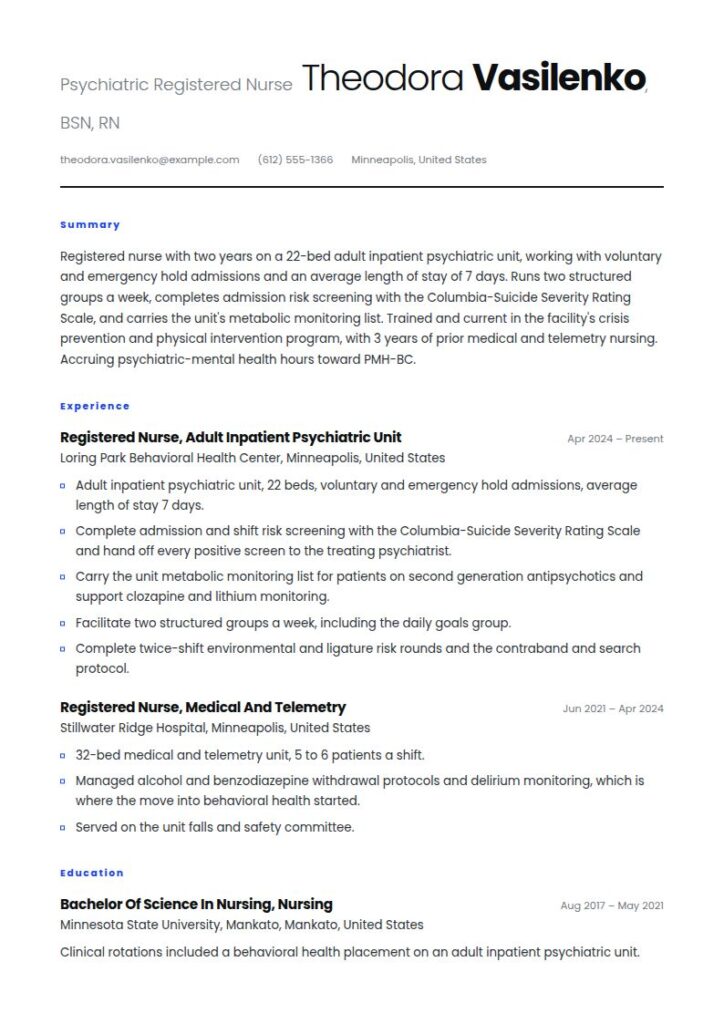
Registered nurse with two years on a 22-bed adult inpatient psychiatric unit, working with voluntary and emergency hold admissions and an average length of stay of 7 days. Runs two structured groups a week, completes admission risk screening with the Columbia-Suicide Severity Rating Scale, and carries the unit's metabolic monitoring list. Trained and current in the facility's crisis prevention and physical intervention program, with 3 years of prior medical and telemetry nursing. Accruing psychiatric-mental health hours toward PMH-BC.
Work Experience
04/2024 - Present, Registered Nurse, Adult Inpatient Psychiatric Unit, Loring Park Behavioral Health Center, Minneapolis, United States
- Adult inpatient psychiatric unit, 22 beds, voluntary and emergency hold admissions, average length of stay 7 days.
- Complete admission and shift risk screening with the Columbia-Suicide Severity Rating Scale and hand off every positive screen to the treating psychiatrist.
- Carry the unit metabolic monitoring list for patients on second generation antipsychotics and support clozapine and lithium monitoring.
- Facilitate two structured groups a week, including the daily goals group.
- Complete twice-shift environmental and ligature risk rounds and the contraband and search protocol.
06/2021 - 04/2024, Registered Nurse, Medical and Telemetry, Stillwater Ridge Hospital, Minneapolis, United States
- 32-bed medical and telemetry unit, 5 to 6 patients a shift.
- Managed alcohol and benzodiazepine withdrawal protocols and delirium monitoring, which is where the move into behavioral health started.
- Served on the unit falls and safety committee.
Education
08/2017 - 05/2021, Bachelor of Science in Nursing, Nursing, Minnesota State University, Mankato, Mankato, United States
Clinical rotations included a behavioral health placement on an adult inpatient psychiatric unit.
Skills
Suicide and violence risk screening, 70
De-escalation and verbal intervention, 75
Milieu management, 65
Metabolic and medication monitoring, 70
Group facilitation, 60
Withdrawal assessment and monitoring, 80
Epic behavioral health documentation, 80
Languages
English, native
Ukrainian, fluent
Certificates
06/2021, Registered Nurse License, Minnesota Board of Nursing, RN-2246108
Active, no restrictions.
09/2025, Crisis Prevention and Physical Intervention Program, Loring Park Behavioral Health Center
Facility de-escalation and physical intervention training, current.
04/2025, Basic Life Support, American Heart Association
Current.
Summary
A psychiatric nurse resume is a one to two page document naming the behavioral health settings and populations you have worked with, the therapeutic and safety practice behind that, and your route to PMH-BC certification. This guide gives you three adaptable versions, the safety record block almost nobody writes, and current Bureau of Labor Statistics pay and outlook for registered nurses.
Psychiatric Nurse resume examples by experience level
In short, a psychiatric nurse resume is a one to two page document that names the behavioral health settings you have worked in, the populations you can hold, the therapeutic work you do inside a shift, and the safety practice that surrounds it.
In fact, a behavioral health unit hires against one question, and it is not the one most nursing resumes answer. It is whether you can hold a therapeutic relationship and a safe environment at the same time, on the same shift, with the same patient. Those two pull against each other constantly, and a nurse manager is reading your file for evidence that you have held both.
Resume guide for a psychiatric nurse resume
Specifically, this guide and the corresponding psychiatric nurse resume example will cover:
- How to write a psychiatric nurse resume, block by block
- Why setting and population sit above everything else on the page
- Three adaptable summaries: new to behavioral health, experienced, and senior
- How to write a de-escalation and safety record without naming anyone
- What Bureau of Labor Statistics data shows about pay and growth
How to write a psychiatric nurse resume
Overall, it takes six blocks: contact header, summary, licensure and certification, clinical experience with a setting line, a therapeutic and safety block, and education. In general, use one page for your first three years, then two once you hold a certification or a quality result worth citing.
In practice, the order follows how a behavioral health nurse manager reads. License and certification are gates. Setting and population decide whether your experience transfers. Then the safety record separates two applicants who clear both.
| Section | What it is answering | Where it goes |
|---|---|---|
| License and certification | Is this nurse licensed, and are they PMH-BC or eligible? | Header and the first block under the summary |
| Setting and population | Have they held the kind of unit I am staffing? | First line of every clinical job |
| Therapeutic practice | What do they actually do in a group, a one to one, an intake? | Bullets under each role |
| Safety record | How do they prevent an event, and what did they change? | Its own block |
| Medication monitoring | Can they run clozapine, lithium and metabolic monitoring? | Skills block, by name |
Write the setting and the population before you write anything else
Behavioral health is not one job. An adult inpatient unit, an adolescent unit, a geriatric psychiatry unit, a consultation liaison service, a crisis stabilization unit, a partial hospitalization program and a community mental health clinic are seven different working days with seven different risk profiles.
So open every role with a setting line: unit type, bed count, population, and the general mix of legal statuses you have worked with, described in general terms only. "Adult inpatient psychiatric unit, 22 beds, voluntary and emergency hold admissions, average length of stay 7 days" tells a reader more than four bullets of adjectives.
Run the finished file through the ATS resume checker before you send it. Health systems screen nursing applications through an applicant tracking system, and credential strings are what a decorative template breaks.
Choosing the best resume format for a psychiatric nurse resume
Reverse chronological, single column. Use one page for your first three years in behavioral health, but two once you hold PMH-BC, have built or changed a program, or have precepted.
If you came to behavioral health from another kind of nursing, keep those years and compress them to a line each. After all, a manager wants to know you can recognize a medical problem in a psychiatric setting, and those years are the evidence. For this reason, do not hide them, and do not let them take a third of the page.
Include your contact information
| ✅ Right | ❌ Wrong |
|---|---|
| Theodora Vasilenko | Theodora Vasilenko |
| BSN, RN, PMH-BC | Compassionate mental health professional |
| MN RN license #RN-2246108, active. PMH-BC, ANCC, certified 2021 | Registered nurse, psych experience |
| (612) 555-1366, [email protected], Minneapolis, MN | (612) 555-1366, [email protected] |
Also, put the license number and the certification year in the header. That matters because a recruiter who can verify you against a state board register in ten seconds moves your file first, and PMH-BC is a term some systems search on directly.
Make use of a summary
In short, use four lines: setting and years, the population you hold, one safety or quality number with the period it moved over, and your certification status.
Registered nurse with two years on a 22-bed adult inpatient psychiatric unit, working with voluntary and emergency hold admissions and an average length of stay of 7 days. Runs two structured groups a week, completes admission risk screening with the Columbia-Suicide Severity Rating Scale, and carries the unit's metabolic monitoring list. Trained and current in the facility's crisis prevention and physical intervention program, with 3 years of prior medical and telemetry nursing. Accruing psychiatric-mental health hours toward PMH-BC.
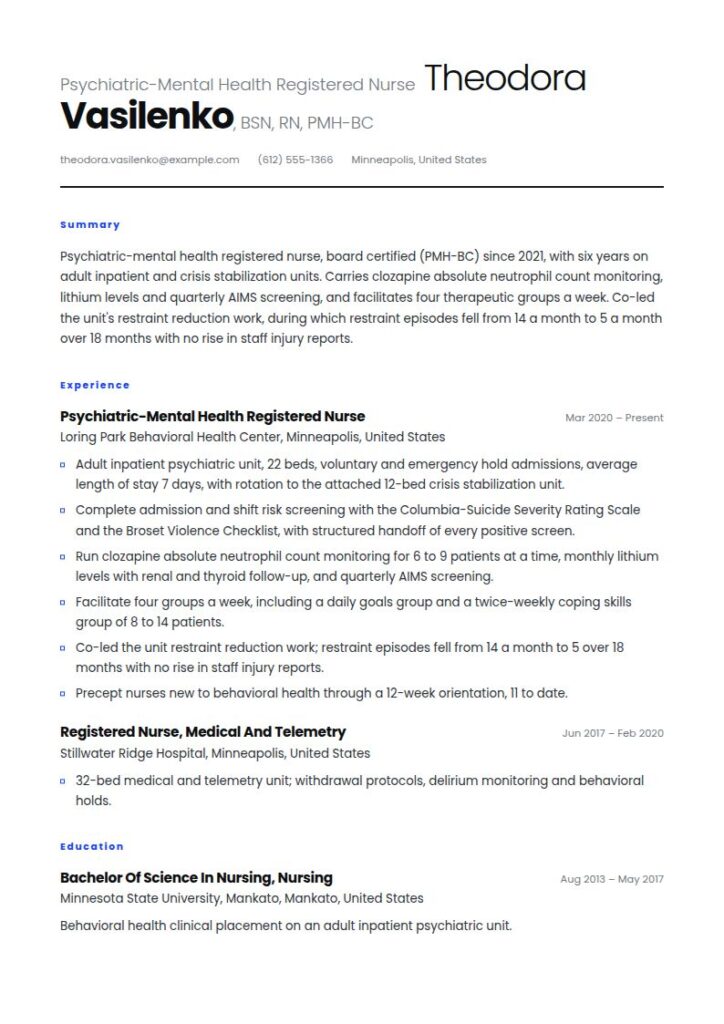
Psychiatric-mental health registered nurse, board certified (PMH-BC) since 2021, with six years on adult inpatient and crisis stabilization units. Carries clozapine absolute neutrophil count monitoring, lithium levels and quarterly AIMS screening, and facilitates four therapeutic groups a week. Co-led the unit's restraint reduction work, during which restraint episodes fell from 14 a month to 5 a month over 18 months with no rise in staff injury reports.
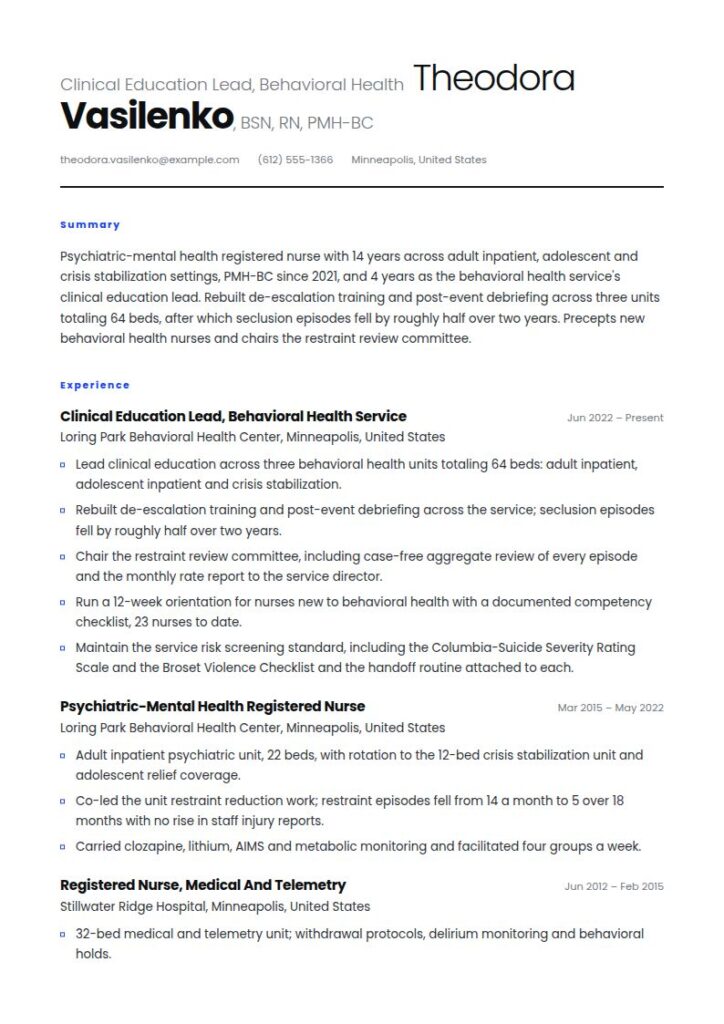
Psychiatric-mental health registered nurse with 14 years across adult inpatient, adolescent and crisis stabilization settings, PMH-BC since 2021, and 4 years as the behavioral health service's clinical education lead. Rebuilt de-escalation training and post-event debriefing across three units totaling 64 beds, after which seclusion episodes fell by roughly half over two years. Precepts new behavioral health nurses and chairs the restraint review committee.
Right vs wrong: the same psychiatric nurse summary, twice
| ✅ Right | ❌ Wrong |
|---|---|
| PMH-BC since 2021, six years across adult inpatient and crisis stabilization, 22-bed unit. | Experienced psychiatric nurse providing compassionate care to patients in need. |
| Runs clozapine, lithium and quarterly AIMS monitoring; facilitates four groups a week. | Skilled in medication administration and therapeutic communication. |
| Restraint episodes fell from 14 a month to 5 a month over 18 months with no rise in staff injury reports. | Committed to creating a safe and supportive environment for all. |
For example, the left column can be scheduled onto a unit tomorrow. The right column could have been written by any of the applicants in the folder, and a nurse manager reading it learns nothing about what happens when a shift goes wrong.
Outline your psychiatric nursing experience
Employer, setting, city, dates, then a setting line, then three to five bullets. The setting line carries the facts a manager is screening on, while the bullets carry what you did with them.
| Instead of | Use |
|---|---|
| Provided nursing care to psychiatric patients | Adult inpatient psychiatric unit, 22 beds, voluntary and emergency hold admissions, average length of stay 7 days |
| Administered medications | Ran clozapine absolute neutrophil count monitoring for 6 to 9 patients at a time and monthly lithium levels with renal and thyroid follow-up |
| Used therapeutic communication | Facilitated four groups a week, including a daily goals group and a twice-weekly coping skills group of 8 to 14 patients |
| Assessed patients for risk | Completed admission and shift risk screening using the Columbia-Suicide Severity Rating Scale and the Broset Violence Checklist, with handoff of every positive screen to the treating psychiatrist |
| Helped de-escalate situations | Co-led restraint reduction work; restraint episodes fell from 14 a month to 5 a month over 18 months with no rise in staff injury reports |
| Participated in treatment planning | Presented 18 to 22 patients a week in interdisciplinary treatment team, including discharge risk formulation |
Psychiatric-Mental Health Registered Nurse, Loring Park Behavioral Health Center, Minneapolis, MN, March 2020 to Present
Adult inpatient psychiatric unit, 22 beds, voluntary and emergency hold admissions, average length of stay 7 days, with rotation to the attached 12-bed crisis stabilization unit.
Complete admission and shift risk screening with the Columbia-Suicide Severity Rating Scale and the Broset Violence Checklist, and carry the unit's environmental safety round twice a shift.
Run clozapine absolute neutrophil count monitoring for 6 to 9 patients at a time, monthly lithium levels with renal and thyroid follow-up, quarterly AIMS screening, and the metabolic monitoring list for second generation antipsychotics.
Facilitate four groups a week, including a daily goals group and a twice-weekly coping skills group of 8 to 14 patients.
Co-led the unit's restraint reduction work with the nurse manager and the unit psychologist; restraint episodes fell from 14 a month to 5 over 18 months with no rise in staff injury reports.
Therapeutic scope and the safety record you can put in writing
In fact, this is the block that decides a behavioral health hire, and almost nobody writes it. It has three parts: the scope you can hold, the safety practice you run, and the certification that formalizes both.
Scope first, and scope here means setting plus population plus legal status. Write the settings by name: inpatient adult, adolescent, geriatric psychiatry, consultation liaison psychiatry in a general hospital, crisis stabilization, partial hospitalization, or community mental health. Then the populations. Then, in general terms only, the legal status mix you are used to: voluntary admissions, emergency holds, court-ordered treatment. A nurse whose work has been entirely voluntary in a partial hospitalization program is a different hire from one who has held involuntary admissions overnight, and both are legitimate. Say which you are.
Never describe a patient. Instead, describe the unit, the population and the work. In other words, a resume that reaches for a memorable individual story has misunderstood the standard it is being read against.
Safety practice on a psychiatric nurse resume
Then the safety practice. Behavioral health safety is a set of named, teachable practices. List yours as such:
- The risk screening tools you complete and hand off, by name. The Columbia-Suicide Severity Rating Scale and the Broset Violence Checklist are the two most commonly named, and the point is less which tool than what you do with a positive screen.
- Environmental safety rounds, ligature risk checks, and contraband and search practice.
- Your de-escalation training program by name, and what you do in the first two minutes of an escalation.
- Restraint and seclusion practice: the monitoring, the documentation, the physician notification, and the debrief with both the patient and the staff afterward.
- The reduction work you contributed to, with a number and a period. Indeed, this is the strongest single line a behavioral health nurse can write.
Then medication monitoring, which is the part of psychiatric nursing that reads as technical: clozapine absolute neutrophil count monitoring, lithium levels with renal and thyroid follow-up, quarterly AIMS screening for tardive dyskinesia, metabolic monitoring for second generation antipsychotics, long-acting injectable scheduling, and recovery care after electroconvulsive therapy if you have it. Then group facilitation, which is clinical work and is routinely written as if it were an activity. Name the groups, their frequency and their size.
Where you stand on PMH-BC certification
Then PMH-BC. The American Nurses Credentialing Center requires, for its Psychiatric-Mental Health Nursing Certification, a current active registered nurse license, the equivalent of 2 years of full-time practice as a registered nurse, a minimum of 2,000 hours of clinical practice in psychiatric-mental health nursing within the last 3 years, and 30 hours of continuing education in psychiatric-mental health nursing within the last 3 years; the credential is valid for 5 years (American Nurses Credentialing Center, PMH-BC eligibility, as published 16 September 2026).
Therefore, read those thresholds as a resume instruction. If you hold the credential, write the year you certified and the year it runs through. If you do not, however, write where you are against the hours and the continuing education: "1,400 psychiatric-mental health hours accrued toward PMH-BC, sitting the exam in 2027" tells a manager exactly what they are getting and when.
Settings: adult inpatient psychiatric (22 beds), crisis stabilization (12 beds), adolescent inpatient relief coverage
Legal status experience: voluntary admissions, emergency holds and court-ordered treatment, in general practice across all three
Risk screening: Columbia-Suicide Severity Rating Scale on admission and per shift, Broset Violence Checklist, structured handoff of every positive screen to the treating psychiatrist
Safety practice: twice-shift environmental and ligature risk rounds, contraband and search protocol, facility crisis prevention and physical intervention training, current
Restraint and seclusion: monitoring, documentation and physician notification per policy; patient and staff debrief after every episode; co-led the unit reduction work described in the experience section
Medication monitoring: clozapine absolute neutrophil count, lithium levels with renal and thyroid follow-up, quarterly AIMS screening, metabolic monitoring for second generation antipsychotics, long-acting injectable scheduling
Groups: daily goals group, twice-weekly coping skills group of 8 to 14 patients, weekly medication education group
Build a snapshot of your key skills
Then list twelve to sixteen entries in four groups: assessment and risk, therapeutic practice, medication and monitoring, and systems. Similarly, use the names a behavioral health manager already knows.
Assessment and risk: admission and shift suicide risk screening, violence risk screening, mental status examination, withdrawal assessment and monitoring, discharge risk formulation and safety planning
Therapeutic practice: therapeutic relationship and boundary maintenance, group facilitation, motivational interviewing, de-escalation and verbal intervention, trauma-informed care
Medication and monitoring: clozapine absolute neutrophil count monitoring, lithium level monitoring with renal and thyroid follow-up, AIMS screening for tardive dyskinesia, metabolic monitoring, long-acting injectable administration and scheduling, electroconvulsive therapy recovery care
Systems and documentation: Epic and Cerner behavioral health modules, restraint and seclusion documentation, event reporting and debrief, care coordination with county and community providers
List your education, license and certifications
License first with its number and status, then certification with its body and year, then degrees, then the training that belongs to this specialty.
Registered Nurse, Minnesota, license #RN-2246108, active
Psychiatric-Mental Health Nursing Certification (PMH-BC), American Nurses Credentialing Center, certified 2021, valid through 2026
Bachelor of Science in Nursing, Minnesota State University, Mankato, MN, 2017
Training: facility crisis prevention and physical intervention program, current. Basic Life Support, American Heart Association, current. Mental health first aid instructor, 2023. Trauma-informed care, 16 hours, 2024.
Continuing education: 42 hours in psychiatric-mental health nursing in the last 3 years, exceeding the 30-hour ANCC renewal threshold
Choose the right layout and design
Finally, keep a single column, 11 or 12 point, plain headings, no photograph. This matters since hospital applicant systems parse these into a structured record, and license numbers, certification letters and the safety block are what a two-column template breaks.
Open every role with a setting line: unit type, bed count, population and length of stay. Name your risk screening tools and say what you do with a positive screen. Write restraint and seclusion practice as monitoring, documentation and debrief. Give your reduction work a number and a period. List medication monitoring by drug class and by test. Write your PMH-BC hours and continuing education even if you have not yet sat the exam.
Do not describe an identifiable patient, an admission or a story that could identify anyone. Do not write "therapeutic communication" as a skill with nothing under it. Do not claim a de-escalation program you are no longer current in. Do not hide the medical or emergency nursing years you had before behavioral health, because they are the evidence that you can spot a medical problem on a psychiatric unit. Do not use a two-column template for a hospital portal.
Psychiatric nurse job market and outlook
However, the Bureau of Labor Statistics publishes no separate Occupational Outlook Handbook profile for psychiatric nurses. Instead, the figures below are for registered nurses, the occupation psychiatric nurses are counted within, and they are the correct numbers to plan against.
| Measure | Value |
|---|---|
| Registered nurse jobs, 2025 | About 3.5 million |
| Projected change, 2025-35 | 6 percent |
| Projected annual openings | About 180,800 |
| Typical entry-level education | Bachelor's degree |
| Median annual wage, May 2025 | $97,550 |
Source: U.S. Bureau of Labor Statistics, Occupational Outlook Handbook, registered nurses, May 2025 wages with 2025 to 2035 projections.
For a psychiatric nurse, the setting moves pay more than the specialty does
Registered nurse median pay splits sharply by industry. In May 2025 the median was $110,780 in government excluding state, local and private education and hospitals; $100,220 in state, local and private hospitals; $91,230 in ambulatory healthcare services; and $84,300 in nursing and residential care facilities (BLS Occupational Outlook Handbook, registered nurses, May 2025).
Read that against where behavioral health nursing is delivered. State psychiatric hospitals and county crisis services sit in the government row. Community mental health clinics and partial hospitalization programs sit in ambulatory healthcare services. Residential behavioral health and psychiatric long-term care sit in nursing and residential care facilities. General hospital psychiatric units sit in the hospital row, which employs 59 percent of all registered nurses (BLS Occupational Outlook Handbook, registered nurses, May 2025).
The gap between the top and the bottom of that list is more than $26,000 a year, and none of it is about how good a psychiatric nurse you are. It is a decision about setting, worth making deliberately.
What salary you can expect as a psychiatric nurse
The median annual wage for registered nurses was $97,550 as of May 2025, with the lowest 10 percent earning less than $68,940 and the highest 10 percent more than $137,470 (BLS Occupational Outlook Handbook, registered nurses, May 2025). There is no separate published median for psychiatric nurses, so that range is the one to negotiate inside.
What moves an individual offer in behavioral health is mostly documentation:
- Certification. PMH-BC is the credential the specialty recognizes and many employers attach a differential to it. Write the year and the expiry, not the letters alone.
- Setting. The industry medians above are the largest single lever available to you, and state and county employers sit at the top of them.
- Teaching and program work. Running orientation, teaching de-escalation or sitting on a restraint review committee is work the service has to buy from somewhere, and it is fair to raise in a compensation conversation.
Key takeaways for a psychiatric nurse resume
- Open every role with a setting line: unit type, bed count, population and length of stay.
- Say which legal statuses you have worked with, in general terms, and never with a patient story.
- First, name your risk screening tools and what you do with a positive screen.
- Write restraint and seclusion practice as monitoring, documentation and debrief, then give your reduction work a number.
- List medication monitoring by drug class and by test, including clozapine, lithium and AIMS.
- Write your PMH-BC hours and continuing education even before you sit the exam.
- Keep the medical nursing years you had before behavioral health, compressed to a line each.
Build your psychiatric nurse resume in 15 minutes with our AI resume builder.
Related medical resume examples
- Nurse resume
- Nurse practitioner resume
- Licensed practical nurse resume
- CNA resume
- Psychologist resume
- Psychotherapist resume
- Behavioral therapist resume
- Marriage and family therapist resume
- Art therapist resume
- Medical social worker resume
- Nursing home resume
- Healthcare resume
Pair it with a matching psychiatric nurse cover letter.
Psychiatric nurse resume questions, answered
How long should a psychiatric nurse resume be?
One page for your first three years in behavioral health. Two once you hold PMH-BC, have led a program change, or have precepted new staff. Keep any earlier medical or emergency nursing on the page, a line each, because it shows you can recognize a medical problem on a psychiatric unit.
Do I need PMH-BC to get a psychiatric nursing job?
Not usually to be hired, but it is the credential the specialty recognizes and many employers pay a differential for it. ANCC requires a current active registered nurse license, the equivalent of 2 years of full-time registered nurse practice, at least 2,000 hours of psychiatric-mental health clinical practice within the last 3 years and 30 hours of psychiatric-mental health continuing education within the last 3 years, and the credential is valid for 5 years (American Nurses Credentialing Center, PMH-BC eligibility, as published 16 September 2026). Write your progress against those thresholds while you accrue them.
How do I write about restraint and seclusion without it reading badly?
Write it as practice, not as incident. Name the monitoring you perform, the documentation and physician notification you complete, and the debrief you hold with the patient and the staff afterward. Then, if you contributed to reduction work, give the before, the after and the period. A nurse who treats restraint as something to be measured and reduced is the strongest signal a unit can read.
What do I put on a psychiatric nurse resume with no psychiatric experience?
Write the clinical placement as a job: unit type, bed count, population, the groups you co-facilitated, and the screening tools you were trained on. Then the adjacent experience that transfers: emergency department behavioral holds, medical units with delirium and withdrawal management, substance use treatment, crisis line work, residential support work. Name the de-escalation program you were trained in and say whether you are current in it.
Should I list the medications I monitor?
Yes, by class and by test. It is one of the few genuinely technical lines on a psychiatric nursing resume, and every item is verifiable at interview: clozapine absolute neutrophil count monitoring, lithium levels with renal and thyroid follow-up, quarterly AIMS screening, metabolic monitoring, long-acting injectable scheduling.
Is psychiatric nursing a growing field to move into?
Registered nursing overall is projected to grow 6 percent from 2025 to 2035, with about 180,800 openings a year on average over the decade (BLS Occupational Outlook Handbook, registered nurses, 2025 to 2035 projections). BLS does not break psychiatric nursing out separately, so judge the local market by which behavioral health settings are hiring near you.