Art Therapist, ATR-Provisional Yuki Haraguchi
Art Therapist, ATR-Provisional
[email protected] | (253) 555-1276 | Tacoma, United States
Profile
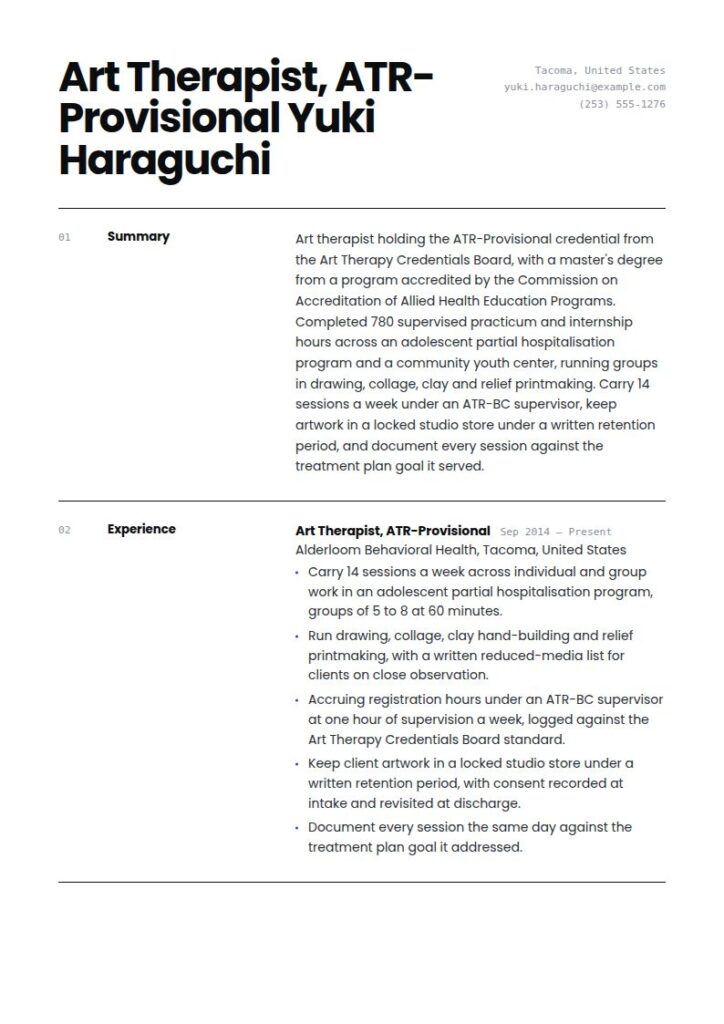
Art therapist holding the ATR-Provisional credential from the Art Therapy Credentials Board, with a master's degree from a program accredited by the Commission on Accreditation of Allied Health Education Programs. Completed 780 supervised practicum and internship hours across an adolescent partial hospitalisation program and a community youth center, running groups in drawing, collage, clay and relief printmaking. Carry 14 sessions a week under an ATR-BC supervisor, keep artwork in a locked studio store under a written retention period, and document every session against the treatment plan goal it served.
Work Experience
09/2014 - Present, Art Therapist, ATR-Provisional, Alderloom Behavioral Health, Tacoma, United States
- Carry 14 sessions a week across individual and group work in an adolescent partial hospitalisation program, groups of 5 to 8 at 60 minutes.
- Run drawing, collage, clay hand-building and relief printmaking, with a written reduced-media list for clients on close observation.
- Accruing registration hours under an ATR-BC supervisor at one hour of supervision a week, logged against the Art Therapy Credentials Board standard.
- Keep client artwork in a locked studio store under a written retention period, with consent recorded at intake and revisited at discharge.
- Document every session the same day against the treatment plan goal it addressed.
09/2013 - 05/2014, Art Therapy Intern, Perrindale Youth Services, Tacoma, United States
- Completed 480 of 780 supervised practicum and internship hours across after-school group programming for young people aged 11 to 17.
- Co-facilitated 3 open studio groups a week and built the materials inventory and safety data sheet file for a shared community room.
Education
08/2012 - 05/2014, Master of Arts, Art Therapy and Counseling, School of the Art Institute of Chicago, Chicago, United States
Program accredited by the Commission on Accreditation of Allied Health Education Programs on the recommendation of the Accreditation Council for Art Therapy Education. 780 supervised practicum and internship hours.
09/2007 - 06/2011, Bachelor of Fine Arts, Painting and Printmaking, Western Washington University, Bellingham, United States
Studio concentration in painting and relief printmaking, with a minor in psychology.
Skills
Individual and group art therapy, 80
Drawing, painting and collage, 90
Clay hand-building, 85
Relief printmaking, 90
Treatment plan goal writing, 75
Artwork storage, consent and retention, 80
Studio safety and safety data sheets, 85
Same-day clinical documentation, 80
Languages
English, native
Japanese, native
Certificates
08/2014, ATR-Provisional, Provisional Registered Art Therapist, Art Therapy Credentials Board, P-14-02277
Required step before applying for registration as a Registered Art Therapist.
07/2014, Basic Life Support Provider, American Heart Association
Renewed every two years.
Summary
An art therapist resume is a one to two page document that evidences clinical training and studio practice at the same time: your place on the Art Therapy Credentials Board ladder, the media you can run safely in session, and how you store, retain and consent client artwork. This guide gives you three adaptable versions and the published pay data for the occupations that bracket the work.
Art Therapist resume examples by experience level
In short, an art therapist resume is a one to two page document that has to prove two things at once: that you are a clinician, and that you can run a studio.
Most applicants prove one of them. A clinical director is looking for the overlap, and the overlap is specific: which credential you hold, which materials you can safely put in front of which population, and what you do with the artwork afterwards.
That last one is the line no neighboring profession has to answer, and it is the fastest way to tell an experienced art therapist from a new one on paper.
Resume guide for an art therapist resume
In particular, this guide and the corresponding art therapist resume example will cover:
- First, how to write an art therapist resume, section by section
- Then the ATCB credential ladder and where it goes on the page
- Three adaptable summaries: provisional, board certified and supervisor
- Media competence, studio safety and the client artwork boundary
- What the market looks like when the federal Handbook has no profile for you
How to write an art therapist resume
Use seven sections: contact header, summary, credentials and licensure, clinical experience, media and modalities, education, and finally skills. One page while you are provisional, two once you hold board certification and a supervision load.
Credentials go above experience. A director cannot bill, supervise or roster you past what your credential allows, so it is a gate rather than an achievement.
| Section | What it is answering | Where it goes |
|---|---|---|
| ATCB credential and state license | Can this person practice here, and at what level of independence? | Directly under the summary |
| Media and modalities | Which materials can I schedule them to run, with which population? | Its own block, not scattered through bullets |
| Clinical experience | Populations, settings, caseload, and what changed | Reverse chronological, with numbers |
| Artwork handling | Do they understand the ethical line unique to this job? | One line in experience, one in skills |
Write the caseload the way a clinical director counts it
Nobody hiring an art therapist knows what "provided art therapy services" means in hours. They are staffing a schedule.
Give them the unit they already use: individual sessions a week, groups a week, group size, session length, and the setting. "Carry 9 individual sessions and 6 groups a week, groups of 4 to 8, 60 minutes, on a 20-bed inpatient child and adolescent unit" is a roster line. "Provided individual and group art therapy" is not. Then add who supervises you, or whom you supervise.
Run the finished file through the ATS resume checker before you send it. Hospital and health system portals parse your resume into a structured record before a human opens it.
Choosing the best resume format for an art therapist resume
Reverse chronological. Practicum, internship and provisional years included as dated roles, because supervised hours are the currency of this profession and a gap in the timeline reads as a gap in hours.
However, a functional or portfolio-led format fails here for a reason specific to art therapy: the reader is checking a sequence of supervised hours against a credential standard. As a result, a layout that hides dates makes that check impossible, and an impossible check is a no.
Include your contact information
| ✅ Right | ❌ Wrong |
|---|---|
| Yuki Haraguchi | Yuki Haraguchi |
| Art Therapist, ATR-BC | Creative healing practitioner |
| ATR-BC #24-06188, Art Therapy Credentials Board | Board certified |
| (253) 555-1276, [email protected], Tacoma, WA | (253) 555-1276, [email protected] |
Also put the credential number on the page. After all, human resources verifies it against the board's register anyway, and the file that lets them do that in ten seconds moves first.
Make use of a summary
Keep it to four lines: credential and years, setting and population, the media you run, and also one outcome with a number and a period attached.
Art therapist holding the ATR-Provisional credential from the Art Therapy Credentials Board, with a master's degree from a program accredited by the Commission on Accreditation of Allied Health Education Programs. Completed 780 supervised practicum and internship hours across an adolescent partial hospitalisation program and a community youth center, running groups in drawing, collage, clay and relief printmaking. Carry 14 sessions a week under an ATR-BC supervisor, keep artwork in a locked studio store under a written retention period, and document every session against the treatment plan goal it served.
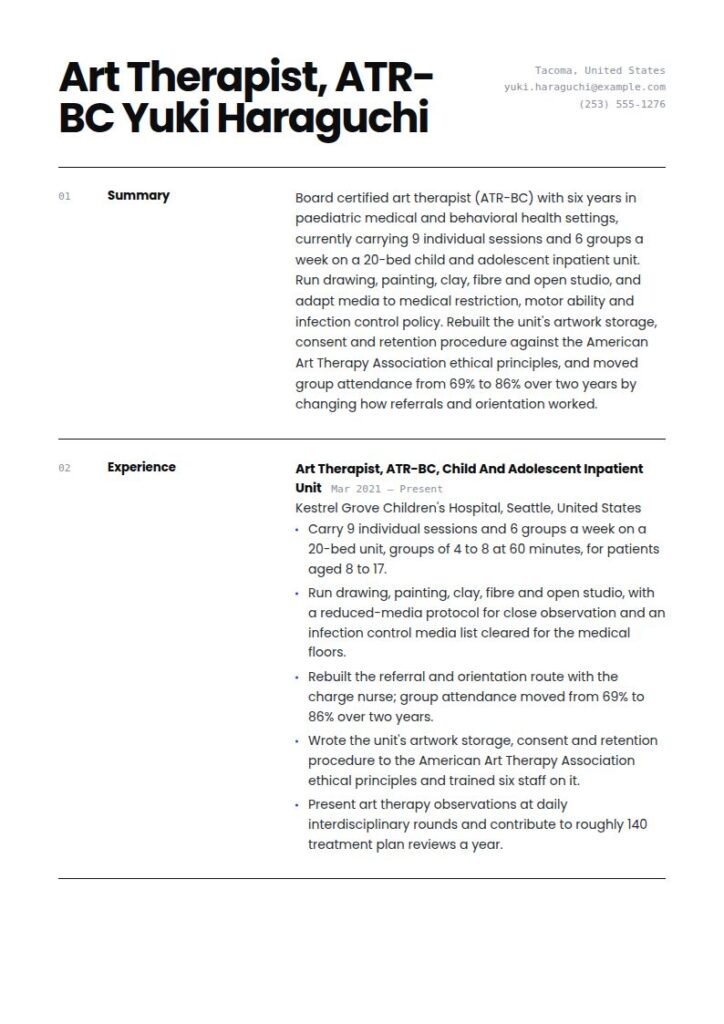
Board certified art therapist (ATR-BC) with six years in paediatric medical and behavioral health settings, currently carrying 9 individual sessions and 6 groups a week on a 20-bed child and adolescent inpatient unit. Run drawing, painting, clay, fibre and open studio, and adapt media to medical restriction, motor ability and infection control policy. Rebuilt the unit's artwork storage, consent and retention procedure against the American Art Therapy Association ethical principles, and moved group attendance from 69% to 86% over two years by changing how referrals and orientation worked.
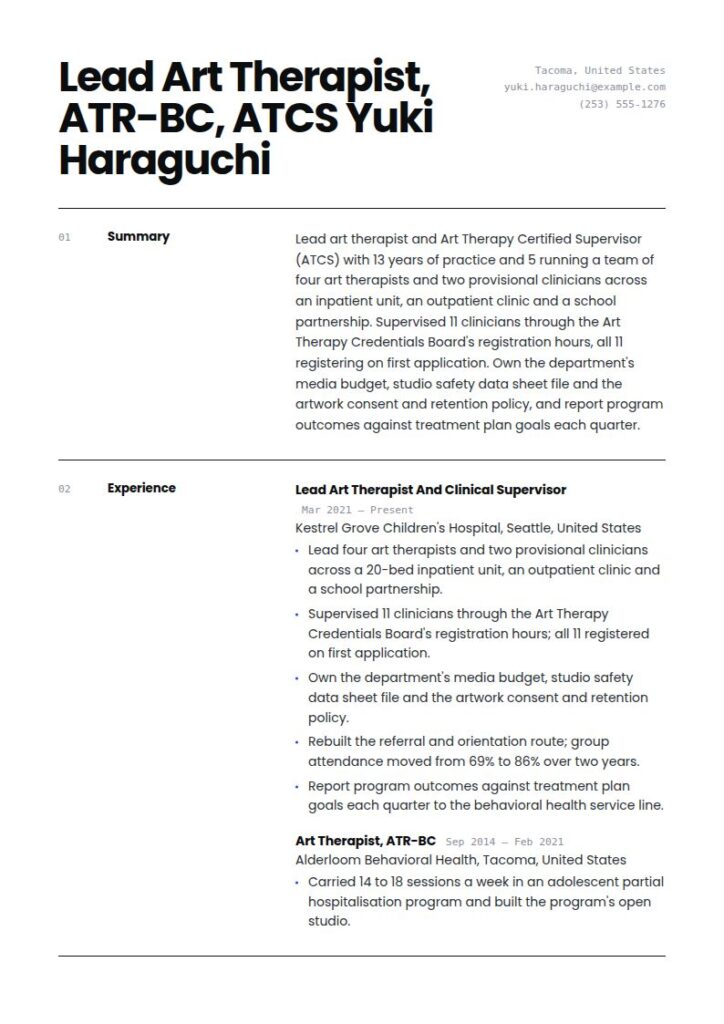
Lead art therapist and Art Therapy Certified Supervisor (ATCS) with 13 years of practice and 5 running a team of four art therapists and two provisional clinicians across an inpatient unit, an outpatient clinic and a school partnership. Supervised 11 clinicians through the Art Therapy Credentials Board's registration hours, all 11 registering on first application. Own the department's media budget, studio safety data sheet file and the artwork consent and retention policy, and report program outcomes against treatment plan goals each quarter.
Right vs wrong: the same art therapist summary, twice
| ✅ Right | ❌ Wrong |
|---|---|
| Board certified art therapist (ATR-BC) with six years in paediatric medical and behavioral health settings. | Creative and intuitive art therapist with a love of the healing power of art. |
| Carry 9 individual sessions and 6 groups a week on a 20-bed child and adolescent inpatient unit. | Provide individual and group art therapy to a variety of populations. |
| Moved group attendance from 69% to 86% over two years. | Committed to helping clients express themselves. |
For example, a manager can put the right column on a rota tomorrow. The left column, on the other hand, cannot, and a clinical director reading thirty files is building a rota.
Outline your experience
Setting, unit, city, population, dates. Then three to five bullets, each carrying a number. If someone supervised the role, say who, because that is what makes the hours count.
| Instead of | Use |
|---|---|
| Provided art therapy to clients | Carried 9 individual sessions and 6 groups a week on a 20-bed child and adolescent inpatient unit |
| Used a variety of art materials | Ran drawing, painting, clay, fibre and relief printmaking, with a reduced-media protocol for clients on 1:1 observation |
| Documented sessions | Wrote same-day notes in Epic against the treatment plan goal each session addressed, at 100% within 24 hours across two audits |
| Supervised students | Supervised 11 clinicians through the ATCB registration hours; all 11 registered on first application |
Art Therapist, ATR-BC, Child and Adolescent Inpatient Unit, Kestrel Grove Children's Hospital, Seattle, WA, March 2021 to Present
Carry 9 individual sessions and 6 groups a week on a 20-bed unit, groups of 4 to 8 at 60 minutes, for patients aged 8 to 17 admitted for mood, trauma and eating disorder presentations.
Run drawing, painting, clay, fibre and open studio, with a written reduced-media protocol for clients on close observation and a separate media list cleared by infection prevention for the medical floors.
Rebuilt the referral and orientation route with the charge nurse; group attendance moved from 69% to 86% over two years and no-show slots were redirected to individual sessions rather than lost.
Wrote and implemented the unit's artwork storage, consent and retention procedure to the American Art Therapy Association ethical principles: a locked store, a written retention period and a documented discharge conversation about the work.
The ATCB ladder, the media you can run, and what happens to the artwork
In fact, this is the section that separates an art therapist's resume from every neighboring one, and almost nobody writes it deliberately.
The credential ladder. The Art Therapy Credentials Board issues a sequence, and where you sit on it decides how independently you can be rostered. The ATR-Provisional comes first, and since June 2024 it is the required step before applying for registration (American Art Therapy Association, credentials and licensure page, checked September 2026). The Registered Art Therapist (ATR) comes next: under the board's 2026 registration standards, a graduate of a CAAHEP-accredited program needs 1,000 hours of direct client contact and 100 hours of supervision, of which 50 must be supervised by a board certified art therapist (Art Therapy Credentials Board, 2026 registration standards, checked September 2026). Board certification (ATR-BC) sits on top of an active ATR, requiring the board's examination and then recertification every five years with 100 continuing education credits (ATCB, checked September 2026). The Art Therapy Certified Supervisor (ATCS) sits above that.
Write your exact position on that ladder, with the number, plus your hour count if you are still accruing. "ATR-Provisional, 640 of 1,000 direct client contact hours accrued, 74 supervision hours including 38 with an ATR-BC" tells a hiring director precisely when you become independently rosterable. Indeed, nothing else on your resume does that.
The accreditation line. The hour requirement is written against your program's accreditation. Art therapy master's programs are accredited by the Commission on Accreditation of Allied Health Education Programs on the recommendation of the Accreditation Council for Art Therapy Education, whose current standards were approved in November 2024 (CAAHEP, checked September 2026). Name that accreditation next to the degree.
The state license, which is a separate question. A minority of states issue a dedicated art therapy license. The American Art Therapy Association names Connecticut, Delaware, Kentucky, Maryland, Mississippi, New Jersey, New Mexico, Ohio, Oregon, Tennessee and Virginia along with the District of Columbia, with a further group regulating art therapy under a related counseling license (AATA, credentials and licensure page, checked September 2026). If your state has no dedicated license, let the ATCB credential carry the weight; if you also hold a counseling license, list it, because in many states it is what makes your sessions billable.
Media competence, written as a list you can be held to. A director is deciding what to buy and what to permit on a unit. Split the list.
Run independently: graphite and charcoal drawing, acrylic and watercolour painting, collage, hand-building in clay, relief printmaking, fibre and textile, altered book, mask making
Run with studio controls: wheel-thrown ceramics with kiln access, encaustic, solvent-based media, plaster casting
Adapted protocols held: reduced-media protocol for close observation, infection control media list for medical inpatient floors, low-motor adaptations for post-surgical patients
Studio safety: safety data sheet file, ventilation and dust control, sharps and tool count, non-toxic substitutions
The client artwork boundary in art therapy
The artwork boundary. This is the ethical line that belongs to art therapy and no other job on the unit. The American Art Therapy Association's Ethical Principles for Art Therapists, revised December 2013, states at section 4.0 that "art therapists regard client artwork as a form of protected information and the property of the client," requires that clients be told when copies or digital images are retained in the file, and requires written informed consent before artwork is photographed, taught from or exhibited (AATA, Ethical Principles for Art Therapists, revised December 2013).
As a result, there are two consequences for the document you are writing. Never put an image of client artwork on a resume, in a portfolio sent with it, or on a personal website, however anonymised you believe it to be; a panel of art therapists reads that as a disqualifying error, not a work sample. Instead, do write about the systems you built around the artwork: where you store it, how long you keep it, who sees it, what you tell the client at intake, and what happens to it at discharge.
Build a snapshot of your key skills
In practice, list twelve to sixteen entries in four groups: clinical, media and studio, ethics and documentation, and systems.
Clinical: Individual and group art therapy, Trauma-informed practice, Treatment planning and goal writing, Psychosocial assessment, Interdisciplinary rounds
Media and studio: Drawing and painting, Clay hand-building and wheel, Printmaking, Fibre and textile, Open studio facilitation, Studio safety and safety data sheets, Media adaptation for medical restriction
Ethics and documentation: AATA ethical principles, Artwork storage, consent and retention, Informed consent at intake, HIPAA, Same-day clinical documentation, Outcome reporting against treatment goals
Systems: Epic, Microsoft 365, Qualtrics for outcome surveys, Inventory and media budget tracking
List your education and certifications
Credential first with its number and cycle, then the state license if your state issues one, then degrees with the accreditation named, then the rest.
ATR-BC, Board Certified Art Therapist, Art Therapy Credentials Board, #24-06188, certified 2021, recertification due 2026
ATCS, Art Therapy Certified Supervisor, Art Therapy Credentials Board, 2024
Master of Arts, Art Therapy and Counseling, School of the Art Institute of Chicago, Chicago, IL, 2014. Program accredited by the Commission on Accreditation of Allied Health Education Programs on the recommendation of the Accreditation Council for Art Therapy Education.
Bachelor of Fine Arts, Painting and Printmaking, Western Washington University, Bellingham, WA, 2011
Certifications: Basic Life Support Provider, American Heart Association (2026). Nonviolent crisis intervention, renewed 2025.
Choose the right layout and design
Above all, use a single column, plain type at 11 or 12 point, clear headings, and no photograph, artwork or color blocks. Health system portals parse the file into a structured record before anyone reads it, and two columns, text boxes and graphics are where that parsing breaks.
In fact, the temptation here is to design the resume as a sample of your visual thinking. Resist it. In contrast, the portfolio, where a posting asks for one, is a separate file of your own studio work, and it is the only place to argue your visual practice.
Put the ATCB credential and its number in the header. State your accrued client contact and supervision hours if you are still working towards registration. Split media into what you run independently and what needs studio controls. Name the populations and the settings, not just the modality. Describe the artwork storage, consent and retention procedure you work to. Give one number per experience bullet.
Do not include images of client artwork anywhere, in any form, at any level of anonymisation. Do not write "various art media" when the named list is what gets you scheduled. Do not describe yourself as intuitive or creative; every file in the folder does. Do not present your own studio practice as clinical experience.
Art therapist job market and outlook
The U.S. Bureau of Labor Statistics publishes no Occupational Outlook Handbook profile for art therapists, so there is no federal employment count, growth rate or wage for the occupation, and this page does not invent one. Instead, BLS publishes the set of occupations that bracket the work, and those are where employers budget art therapy posts.
| Bracketing occupation, BLS published | Median annual wage, May 2025 | Why it brackets art therapy |
|---|---|---|
| Recreational therapists | $61,960 | The closest published occupation in daily shape: a creative arts and activity clinician inside a treatment team, in hospitals and residential care |
| Marriage and family therapists | $66,940 | Where a master's-level art therapist who also holds a counseling or therapy license is usually banded |
| Healthcare practitioners and technical occupations, group | $86,530 | The wider group median, which shows how far the licensed and hospital-based end of the band reaches |
Source: U.S. Bureau of Labor Statistics, Occupational Outlook Handbook, May 2025 wage data.
Recreational therapists is the occupation to read in detail, because the settings match almost exactly:
| Measure, recreational therapists | Value |
|---|---|
| Jobs, 2025 | 15,600 |
| Projected change, 2025-35 | 5% growth, faster than average |
| Projected annual openings | About 1,400 |
| Median annual wage, May 2025 | $61,960, or $29.79 per hour |
| Typical entry-level education | Bachelor's degree |
Source: U.S. Bureau of Labor Statistics, Occupational Outlook Handbook, 2025-35 projections and May 2025 wage data.
The profession has no federal count, but its employers are hiring hard
There is no BLS Handbook profile for art therapists, which means no published employment total, no growth rate and no wage. Anyone quoting you a national art therapist salary is quoting a survey or a job board, not federal wage data.
Meanwhile the settings that employ art therapists are growing fast. BLS projects employment in healthcare occupations to grow much faster than the average for all occupations from 2025 to 2035, with about 1.9 million openings a year on average (BLS Occupational Outlook Handbook, Healthcare Occupations, 27 August 2026). Marriage and family therapists, the licensed master's-level comparator, is projected to grow 14 percent from 2025 to 2035, much faster than average (BLS, 2025-35 projections).
For example, within that occupation, hospitals employ 42 percent at a median of $63,780, government excluding education and hospitals 21 percent at $79,910, and nursing and residential care facilities 20 percent at $51,690 (BLS, May 2025). The spread between those three settings is wider than anything a single negotiation will move.
What salary you can expect as an art therapist
Therefore, with no federal wage figure for art therapists, treat the bracketing occupations above as the band your offer sits inside, and be explicit in negotiation about which one your post resembles.
For instance, at the community and residential end, the work prices near recreational therapists: a median of $61,960 a year, or $29.79 an hour, with the lowest 10 percent under $40,990 and the highest 10 percent over $100,420 (BLS, May 2025).
At the licensed clinical end, however, the band moves. Specifically, marriage and family therapists had a median of $66,940 a year, or $32.18 an hour, with the lowest 10 percent under $44,650 and the highest 10 percent over $123,730 (BLS, May 2025). Overall, both of those sit above the median for all occupations of $50,980 as of May 2025 (BLS, May 2025).
Three things move you up the band, and all three are resume lines rather than interview answers. Board certification, because ATR-BC is what a hospital credentialing file wants. Also, a state license that makes your sessions billable. Finally, supervision, because ATCS holders carry students and the department's training load, and get paid for it.
Key takeaways for an art therapist resume
- First, put the ATCB credential and its number in the header, because it is a gate, not an achievement.
- If you are still accruing, state your client contact and supervision hours as numbers.
- Similarly, name the accreditation of your master's program next to the degree.
- Say whether your state issues an art therapy license, and list any counseling license you hold.
- Split media into what you run independently and what needs studio controls.
- Then write the caseload the way you would build a rota: sessions a week, group size, session length, setting.
- Finally, describe your artwork storage, consent and retention procedure, and never show client artwork.
Build your art therapist resume in 15 minutes with our AI resume builder.
Related medical resume examples
- Psychotherapist resume
- Marriage and family therapist resume
- Behavioral therapist resume
- Child psychologist resume
- Psychologist resume
- Occupational therapist resume
- Medical social worker resume
- ABA therapist resume
- BCBA resume
- Health educator resume
- Psychiatric nurse resume
- Speech language pathologist resume
Pair it with a matching art therapist cover letter.
Art therapist resume questions, answered
How long should an art therapist resume be?
One page while you hold the ATR-Provisional and are accruing hours. Two once you are board certified and carrying supervision, a media budget or a program. The second page is earned through supervision and program building, not through a longer list of materials.
Should I include my portfolio or images of my artwork?
Your own studio work, yes, as a separate file or a plain URL in the header, and only where the posting asks for one. Client artwork, never, in any form and at any level of anonymisation. The American Art Therapy Association's Ethical Principles for Art Therapists, revised December 2013, treats client artwork as protected information and the property of the client, and requires written informed consent before it is reproduced or exhibited. A panel of art therapists will read an anonymised client image as a failure of judgement, not as a work sample.
What do I put on an art therapist resume with no paid experience yet?
Practicum and internship, written as dated roles with the setting, the population, the caseload and the supervision. Then your accrued hours as numbers, split into direct client contact and supervision, with how many supervision hours were with an ATR-BC. Then the media list. A director can work out from that when you become independently rosterable, which is the question a first post turns on.
Does the ATR-BC credential actually change what I am paid?
It changes what you can be hired into, which is usually the same thing. Board certification requires an active ATR, passing the board's examination, and recertification every five years with 100 continuing education credits (Art Therapy Credentials Board, checked September 2026). Hospital and health system posts, which sit in the highest-paying settings in the comparator data above, frequently require it outright, and supervision work is generally closed to you without it.
How do I show outcomes when art therapy is hard to measure?
Use what your service already counts. Group attendance and engagement, referral to first session time, completion of the treatment plan goal the session addressed, restraint or seclusion rates on a unit where art therapy was added, documentation timeliness, or the growth of a program you built. Give the before, the after and the period.