Postdoctoral Fellow, Clinical Child Psychology Marcela Ocampo PhD
Postdoctoral Fellow in Clinical Child Psychology
[email protected] | (505) 555-1192 | Albuquerque, United States
Profile
Postdoctoral fellow in clinical child psychology completing supervised hours toward New Mexico licensure, out of an APA-accredited doctoral program and an APA-accredited internship with a child and adolescent track. Carry 14 therapy clients aged 4 to 17 and complete 4 to 6 psychological evaluations a month across cognitive, achievement, autism-specific and behavior rating measures. Administer the WPPSI-IV, WISC-V, WIAT-4, ADOS-2 Modules 1 through 3, Vineland-3 and BASC-3.
Work Experience
08/2020 - Present, Postdoctoral Fellow in Clinical Child Psychology, Alameda Vista Children's Behavioral Health Center, Albuquerque, United States
- Completed 4 to 6 psychological evaluations a month, ages 2 to 17, across cognitive, achievement, autism-specific and behavior rating measures.
- Carried a weekly therapy caseload of 14, mainly anxiety, trauma and disruptive behavior presentations.
- Accrued supervised hours toward the 3,000 required for New Mexico licensure under 16.22.6 NMAC.
- Trained to independent administration on the ADOS-2 Toddler Module through Module 3.
07/2019 - 06/2020, Doctoral Intern, Child and Adolescent Track, High Desert Children's Hospital, Albuquerque, United States
- APA-accredited doctoral internship matched through the APPIC Match, with rotations in outpatient assessment, inpatient consultation and pediatric primary care.
- Completed 38 psychological evaluations across ages 2 to 17, including 11 autism diagnostic evaluations using the ADOS-2.
- Carried a weekly therapy caseload of 9 in cognitive behavioral and trauma-focused work.
- Delivered caregiver feedback sessions in English and Spanish.
08/2018 - 05/2019, Psychology Extern, Vista Larga Public Schools, Albuquerque, United States
- Completed 22 psychoeducational evaluations for special education eligibility across three elementary campuses.
- Attended eligibility meetings and wrote recommendations in language the team could act on.
Education
08/2014 - 08/2020, Doctor of Philosophy, Clinical Psychology, Child and Adolescent Specialization, Bosque Peak University, Albuquerque, United States
APA-accredited doctoral program in clinical psychology. Dissertation on caregiver-report and clinician-observation agreement in preschool autism referrals.
08/2010 - 05/2014, Bachelor of Arts, Psychology, Bosque Peak University, Albuquerque, United States
Skills
WISC-V and WPPSI-IV administration and scoring, 80
WIAT-4 achievement testing, 75
ADOS-2 Modules 1 to 3, 70
Vineland-3 adaptive behavior interviewing, 75
BASC-3 and Conners 4 multi-rater administration, 80
Cognitive behavioral therapy with children and adolescents, 75
Integrated report writing, 70
Consent and assent procedures with minors, 85
Bilingual assessment and caregiver feedback in Spanish, 90
Languages
English, native
Spanish, native
Certificates
11/2020, Examination for Professional Practice in Psychology, Part 1 (Knowledge), Association of State and Provincial Psychology Boards
Passing score recorded with the New Mexico board.
06/2019, ADOS-2 Clinical Training, Western Psychological Services
Toddler Module and Modules 1 to 3.
Summary
A child psychologist resume is a two page document that names your license, the assessment instruments you can administer, and the age bands you have used them with. This guide gives you three adaptable versions, the battery vocabulary that separates two otherwise identical candidates, how the school, clinic, hospital and forensic settings each hire, and current Bureau of Labor Statistics pay and outlook for psychologists.
Child Psychologist resume examples by experience level
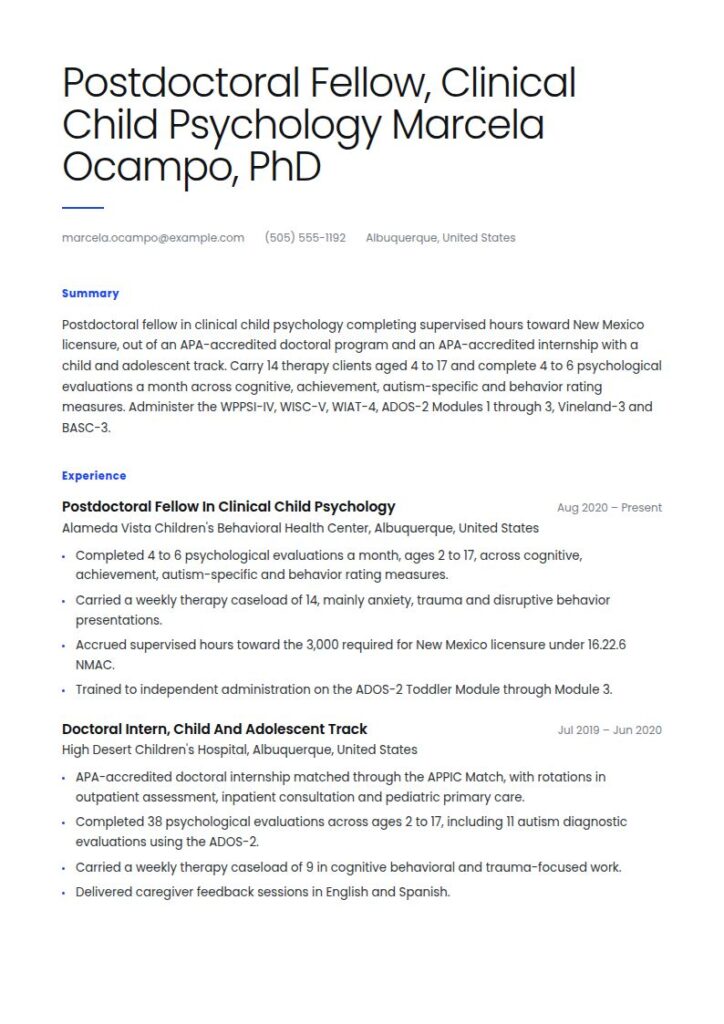
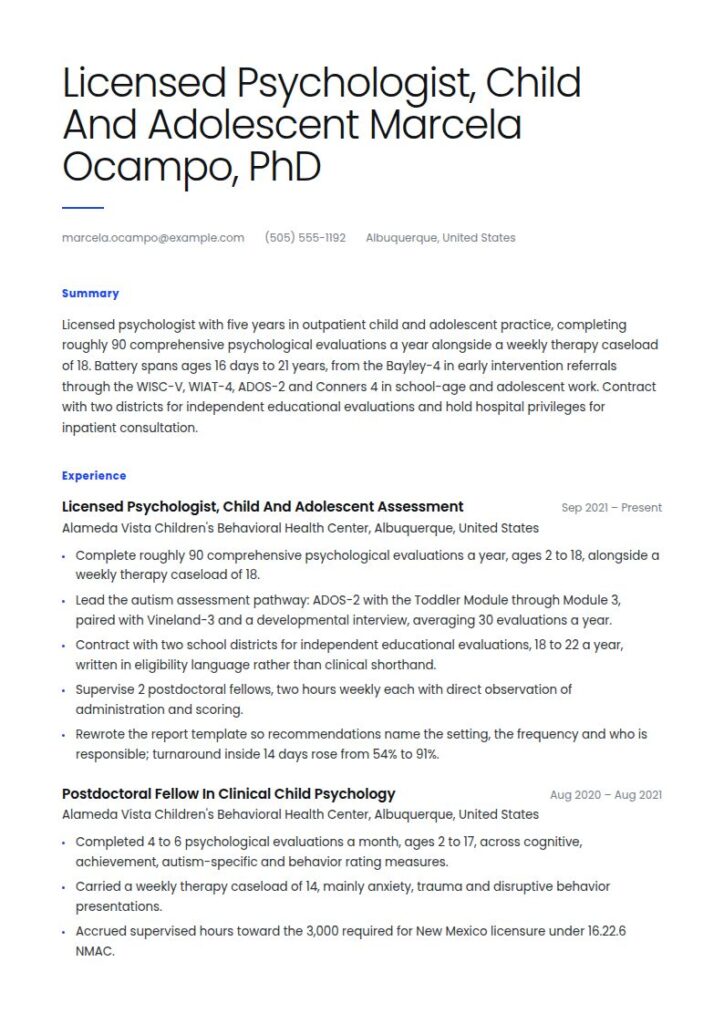
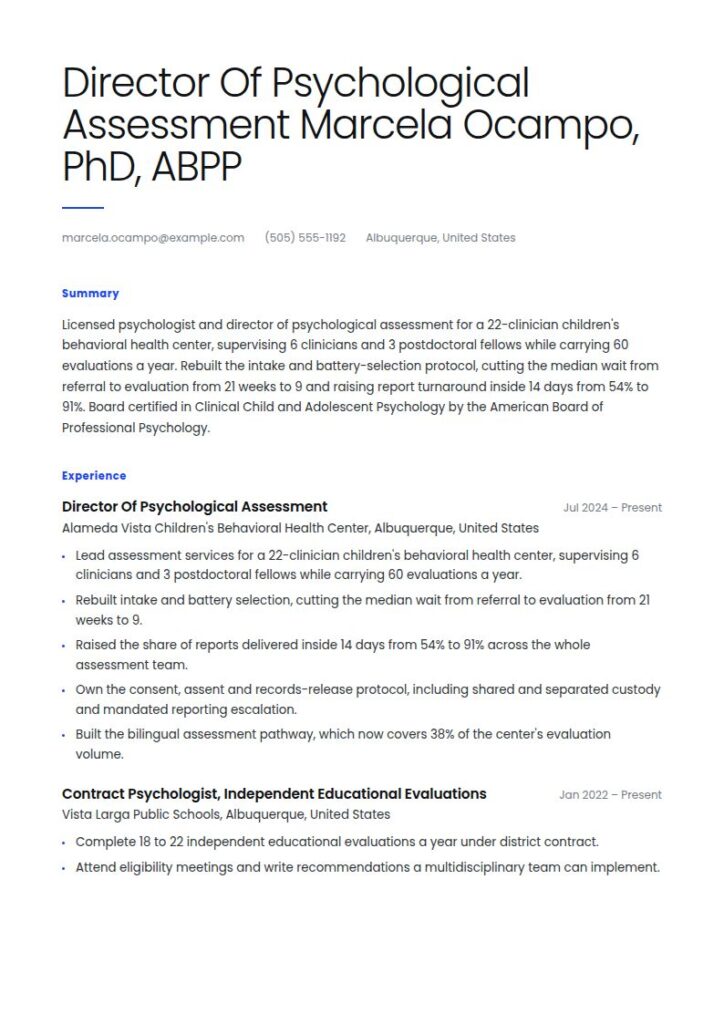
In short, a child psychologist resume is a two page document that names your license, the assessment instruments you can administer, and the age bands you have used them with.
That last part is the whole argument. Two applicants can hold the same doctorate, the same license and the same years, and still be worth very different amounts to a clinic, because one of them can pick up a 30-month-old referred for a developmental concern and the other cannot. Age band is not a detail. In effect, it decides which referrals a director can assign to you on Monday.
Resume guide for a child psychologist resume
For this reason, this guide and the corresponding child psychologist resume example will cover:
- To begin with, how to write a child psychologist resume, section by section
- Then, why your test battery belongs on the page as a named list with age ranges
- Also, three adaptable summaries: postdoctoral fellow, licensed clinician and assessment lead
- How the four settings hire differently
- Finally, what the job market looks like and what psychologists earn
How to write a child psychologist resume
Specifically, seven sections: contact header, summary, licensure, assessment battery, clinical experience, education and training, and skills. Two pages is normal here; one page is right only while you are a trainee.
License status is a gate, so it sits directly under the summary. The battery sits above the job history because a clinical director reads for what you can administer before reading for where you did it.
| Section | What it is answering | Where it goes |
|---|---|---|
| License and mobility | Can this person bill and sign a report here, and from when? | Directly under the summary |
| Assessment battery | Which referrals on my waitlist can I assign to this person? | Its own block, with age ranges |
| Clinical experience | Caseload, presenting concerns, and what changed | Reverse chronological, with numbers |
| Education and training | Was the program and the internship accredited? | Include accreditation status by name |
Run the finished file through the ATS resume checker before you submit. Hospital systems and large group practices parse applications into a structured record before a human opens them.
Choosing the best resume format for a child psychologist resume
Generally, reverse chronological, with an assessment battery block near the top. Two pages, occasionally three if a hospital or academic post asks for a publication record.
Functional formats fail here because supervised hours are counted by period. A licensing board, a credentialing office and a clinical director all need continuous dated blocks: practicum, internship, postdoctoral fellowship, then licensed practice. After all, a format that removes the dates removes the evidence.
Include your contact information
| ✅ Right | ❌ Wrong |
|---|---|
| Marcela Ocampo, PhD | Marcela Ocampo |
| Licensed Psychologist, Clinical Child and Adolescent | Dedicated child psychologist passionate about helping kids |
| New Mexico license #NM-PSY-4472, active through 2028 | Licensed in New Mexico |
| (505) 555-1192, [email protected], Albuquerque, NM | (505) 555-1192, [email protected] |
Also put the license number and its expiry on the page. Credentialing verifies it anyway, and a file that lets a hospital start that process the same day moves ahead of one that does not.
Make use of a summary
In general, four lines: license status, the population and age range you work with, your battery in one clause, and one number for caseload, volume or wait time.
Postdoctoral fellow in clinical child psychology completing supervised hours toward New Mexico licensure, out of an APA-accredited doctoral program and an APA-accredited internship with a child and adolescent track. Carry 14 therapy clients aged 4 to 17 and complete 4 to 6 psychological evaluations a month across cognitive, achievement, autism-specific and behavior rating measures. Administer the WPPSI-IV, WISC-V, WIAT-4, ADOS-2 Modules 1 through 3, Vineland-3 and BASC-3.
Licensed psychologist with five years in outpatient child and adolescent practice, completing roughly 90 comprehensive psychological evaluations a year alongside a weekly therapy caseload of 18. Battery spans ages 16 days to 21 years, from the Bayley-4 in early intervention referrals through the WISC-V, WIAT-4, ADOS-2 and Conners 4 in school-age and adolescent work. Contract with two districts for independent educational evaluations and hold hospital privileges for inpatient consultation.
Licensed psychologist and director of psychological assessment for a 22-clinician children's behavioral health center, supervising 6 clinicians and 3 postdoctoral fellows while carrying 60 evaluations a year. Rebuilt the intake and battery-selection protocol, cutting the median wait from referral to evaluation from 21 weeks to 9 and raising report turnaround inside 14 days from 54% to 91%. Board certified in Clinical Child and Adolescent Psychology by the American Board of Professional Psychology.
Right vs wrong: the same child psychologist summary, twice
| ✅ Right | ❌ Wrong |
|---|---|
| Licensed psychologist with five years in outpatient child and adolescent practice. | Passionate child psychologist dedicated to the wellbeing of children. |
| Roughly 90 comprehensive evaluations a year alongside a therapy caseload of 18. | Extensive experience conducting psychological assessments. |
| Battery spans ages 16 days to 21 years, from the Bayley-4 through the WISC-V and ADOS-2. | Skilled in a wide range of psychological testing instruments. |
| Contract with two districts for independent educational evaluations. | Excellent collaboration with schools and families. |
The right column, however, can be scheduled against a waitlist. A clinical director with 40 children waiting for an autism evaluation can read it and know whether three of them move this month.
Outline your clinical experience
Then list employer, city, title, dates, and the setting in one clause: outpatient clinic, school district, hospital, community mental health, private practice or forensic. Then three to five bullets with numbers.
| Instead of | Use |
|---|---|
| Conducted psychological assessments with children | Completed roughly 90 comprehensive evaluations a year, ages 2 to 18, across cognitive, achievement, autism-specific and behavioral measures |
| Provided therapy to children and adolescents | Carried a weekly caseload of 18, ages 6 to 17, mostly anxiety, trauma and disruptive behavior presentations |
Licensed Psychologist, Child and Adolescent Assessment, Alameda Vista Children's Behavioral Health Center, Albuquerque, NM, September 2021 to Present
Outpatient children's behavioral health center. Complete roughly 90 comprehensive psychological evaluations a year, ages 2 to 18, alongside a weekly therapy caseload of 18.
Lead the autism assessment pathway: ADOS-2 with the Toddler Module through Module 3, paired with Vineland-3 and a developmental interview, averaging 30 evaluations a year.
Contract with two school districts for independent educational evaluations, 18 to 22 a year, written in eligibility language rather than clinical shorthand.
Supervise 2 postdoctoral fellows, two hours weekly each with direct observation of administration and scoring.
Rewrote the report template so recommendations name the setting, the frequency and who is responsible; turnaround inside 14 days rose from 54% to 91%.
Name the instruments you can administer and the ages you have used them with
This is the block most child psychologist resumes leave out, even though it is the one a clinical director reads first. Therefore, write it as a table, grouped by what the instrument does, with the publisher's age range beside each one.
To begin with, group into five families: cognitive, academic achievement, autism-specific, developmental and adaptive, and behavior rating scales. Because those are the five things a children's referral asks for, a battery covering all five can take an unscreened waitlist. Also, use the publisher's own age boundaries rather than approximations.
| Instrument | Publisher's age range | Family |
|---|---|---|
| Bayley-4 (Pearson, 2019) | 16 days to 42 months | Developmental |
| WPPSI-IV (Pearson, 2012) | 2:6 to 7:7 | Cognitive |
| WISC-V (Pearson, 2014) | 6:0 to 16:11 | Cognitive |
| WIAT-4 (Pearson, 2020) | 4:0 to 50:11, prekindergarten to Grade 12 | Achievement |
| ADOS-2 (WPS, 2012) | 12 months to adulthood, across five modules | Autism-specific |
| Vineland-3 (Pearson, 2016) | Birth to 90; Teacher Form 3 to 21 | Adaptive |
| BASC-3 (Pearson, 2015) | 2:0 to 21:11 rating scales; self-report 6:0 to college age | Behavior rating |
| Conners 4 (MHS) | 6 to 18; self-report 8 to 18 | Behavior rating |
Sources: publisher product pages for each instrument, retrieved 16 September 2026.
ADOS-2 modules and multi-rater scales
Two of those rows deserve a sentence of their own, because they are where candidates differ most.
The ADOS-2 is not one test. WPS describes five modules: a Toddler Module "for children between 12 and 30 months of age who do not consistently use phrase speech", Module 1 "for children 31 months and older who do not consistently use phrase speech", Module 2 "for children of any age who use phrase speech but are not verbally fluent", Module 3 "for verbally fluent children and young adolescents" and Module 4 "for verbally fluent older adolescents and adults". A clinician trained on Modules 1 to 3 cannot take the 26-month-old referral, so say which modules you administer and roughly how many of each.
Similarly, the BASC-3 and the Conners 4 are multi-rater systems, and the rater matters. For example, Pearson publishes BASC-3 Teacher and Parent Rating Scales for ages 2:0 to 21:11, with preschool, child and adolescent levels, and a Self-Report of Personality from 6:0 through college age. Likewise, MHS publishes the Conners 4 for youth aged 6 to 18, with parent and teacher forms from 6 and self-report from 8. As a result, writing "multi-rater administration, parent, teacher and self-report" says you can run a full battery rather than a single form.
Say which settings you have actually worked in, because they hire differently
Child psychology is one credential covering four hiring markets, and each reads the resume for something different.
A school district or district contract reads for eligibility language: can you write a report a multidisciplinary team can act on, and do you know what an independent educational evaluation is for.
An outpatient clinic reads for throughput and battery breadth: evaluations a year, report turnaround, and whether your battery covers the waitlist without triage.
A hospital reads for consultation and pace: brief assessment at the bedside, work alongside medical teams, sometimes inpatient behavioral crisis support.
A forensic or court-involved role reads for report defensibility and for the boundaries of your role, including who your client is and who is entitled to the findings.
Name the settings in your experience header rather than leaving them to be inferred. A candidate who has done three of the four is unusually flexible.
Write the consent and reporting boundary into your skills, because it is specific to minors
Working with children changes two things an adult clinician's resume never has to address.
The first is consent. The APA Ethical Principles of Psychologists and Code of Conduct, effective 1 June 2003 with amendments in 2010 and 2016 and in its current form from 1 January 2017, sets Standard 9.03 Informed Consent in Assessments, alongside Standard 9.01, which requires that psychologists "base the opinions contained in their recommendations, reports, and diagnostic or evaluative statements, including forensic testimony, on information and techniques sufficient to substantiate their findings", and Standard 9.02(b), which requires that psychologists "use assessment instruments whose validity and reliability have been established for use with members of the population tested". With a minor, that last clause is why the age band on your battery table matters.
The second is mandated reporting. The Child Welfare Information Gateway's State Statutes review of mandatory reporting of child abuse and neglect, current through May 2023, records that approximately 46 states designate particular professions as mandated reporters, that "counselors, therapists, and other mental health professionals" are named in 38 states and school personnel in 44, and that in approximately 17 states and Puerto Rico any person who suspects abuse or neglect must report.
A line reading "mandated reporting, consent and assent procedures, and release of records with separated or shared custody" tells a hiring manager you were trained in the part of the work that gets clinics into trouble.
Build a snapshot of your key skills
For skills, similarly, group them in four blocks: assessment, intervention, systems and consultation, and ethics and documentation.
Assessment: Cognitive assessment, ages 2:6 to 16:11; Academic achievement testing; Autism diagnostic assessment, ADOS-2 Toddler Module through Module 3; Developmental assessment with the Bayley-4; Adaptive behavior interviewing; Multi-rater behavior rating scales; Integrated report writing
Intervention: Cognitive behavioral therapy with children and adolescents; Trauma-focused CBT; Parent management training; Exposure-based anxiety treatment; School-based behavior support planning
Systems and consultation: Independent educational evaluation; Eligibility team consultation; Pediatric primary care consultation; Interpreter-supported assessment; Caregiver feedback sessions
Ethics and documentation: Consent and assent with minors; Mandated reporting; Records release with shared or separated custody; Supervision of postdoctoral fellows; Electronic health record documentation
List your education, training and certifications
License first, then board certification, then the doctorate with accreditation status, then internship and postdoctoral fellowship with their accreditation.
Licensed Psychologist, New Mexico #NM-PSY-4472, New Mexico State Board of Psychologist Examiners, active through 2028
Board Certified in Clinical Child and Adolescent Psychology, American Board of Professional Psychology, 2025
Postdoctoral Fellowship in Clinical Child Psychology, Alameda Vista Children's Behavioral Health Center, Albuquerque, NM, 2020 to 2021. Supervised assessment and therapy, ages 2 to 18.
APA-accredited Doctoral Internship, Child and Adolescent Track, High Desert Children's Hospital, Albuquerque, NM, 2019 to 2020
Doctor of Philosophy, Clinical Psychology, Bosque Peak University, Albuquerque, NM, 2020. APA-accredited program, child and adolescent specialization.
Four things about the training route are worth stating explicitly, because hiring managers check all four.
Accreditation, internship and supervised hours
Accreditation of both the program and the internship. The APA Standards of Accreditation for Health Service Psychology, approved February 2015 with revisions approved February 2026, require doctoral programs to develop nine profession-wide competencies, assessment and intervention among them, and define the internship as "1 year of full-time training to be completed in no fewer than 12 months (or 10 months for school psychology internships), or the equivalent of half-time training to be completed within 24 months". In addition, write "APA-accredited" against both entries, or say plainly that one was not accredited.
The internship match. Moreover, the APPIC Match allocates internship places, and it is competitive: in the combined 2026 Match results published on 25 March 2026, 4,662 applicants registered and 3,919 matched, a match rate of 87 percent, filling 3,919 of 3,996 positions. If your internship was in the Match and had a child or adolescent focus, say so.
Then supervised hours, which are set jurisdiction by jurisdiction. For example, New Mexico, under 16.22.6 NMAC, requires two years, or 3,000 hours, of supervised experience for licensure, counted across practicum, doctoral internship and postdoctoral work. Therefore, state your own jurisdiction's requirement and that you have met it, with dates.
EPPP and child psychology board certification
The examination and board certification. The Association of State and Provincial Psychology Boards administers the two-part EPPP "on behalf of our 66 jurisdictional boards in the U.S. and Canada"; all 66 require a passing score on Part 1, Knowledge, before licensure, Part 2, Skills, is required by some, and ASPPB has said an integrated EPPP will launch in the fourth quarter of 2027 and replace the two-part structure by 1 April 2028. Beyond licensure, the American Board of Professional Psychology certifies in Clinical Child and Adolescent Psychology, requiring a doctorate from an APA- or CPA-accredited program, "a one-year full-time or two-year half-time internship program" of which "at least fifty percent of this training should focus on child/adolescent populations", licensure "as a psychologist for independent practice at the doctoral level", and "a minimum of THREE years of post-degree experience", assessed through a credentials review, a practice sample review and an oral examination.
Choose the right layout and design
Overall, single column, plain type at 11 or 12 point, clear headings, no photograph. In general, the battery block can be a simple two or three column table, whereas anything more decorative breaks parsing in health system portals.
Put the license number and expiry in the header. Give the battery as a named list with age ranges. Say which ADOS-2 modules you have administered. Name the settings you have worked in. State accreditation for the doctoral program and the internship separately. Give evaluations per year and report turnaround. Say where you are in the licensure sequence if you are not yet licensed.
Do not describe a child, a family or a case in any way that could identify them, including an unusual presentation. Do not list an instrument you administered twice under supervision as part of your battery. Do not write "psychological testing" as a single skill; the point is which tests, for which ages. Do not omit the age ranges. Do not call yourself a psychologist in a jurisdiction where you are not licensed to use the title.
Child psychologist job market and outlook
However, the Bureau of Labor Statistics publishes no separate line for child psychologists. Instead, its Occupational Outlook Handbook covers psychologists as one occupation with four subtypes, and child work sits inside two: clinical and counseling psychologists, and school psychologists.
| Measure | Value |
|---|---|
| Psychologist jobs, all types, 2025 | 209,400 |
| Of which clinical and counseling psychologists | 81,300 |
| Of which school psychologists | 64,000 |
| Projected change, 2025-35 | 6% (faster than average) |
| Projected annual openings | About 11,300 |
| Median annual wage, clinical and counseling, May 2025 | $100,580 |
| Median annual wage, school psychologists, May 2025 | $95,990 |
Source: U.S. Bureau of Labor Statistics, Occupational Outlook Handbook, psychologists, May 2025 wage data and 2025 to 2035 projections, last modified 27 August 2026.
Furthermore, BLS states on the same page that most states require licensure to provide psychology services or use the title "psychologist", which is why the license line sits so high.
Two published lines, and your work probably straddles both
In May 2025 the median annual wage for clinical and counseling psychologists was $100,580 and for school psychologists $95,990, against $99,110 for psychologists overall, or $47.65 an hour, with the lowest 10 percent under $59,080 and the highest 10 percent over $163,380 (U.S. Bureau of Labor Statistics, Occupational Outlook Handbook, May 2025).
Employment splits in a way that matters for a job search: 25 percent of psychologists work in ambulatory healthcare services at a median of $98,590, 24 percent in elementary and secondary schools at $95,230, 23 percent are self-employed, and 8 percent in government excluding education at $130,960 (BLS, May 2025).
A child psychologist's career usually crosses those lines, and a resume written for only one of them is invisible to the other. If you have done district contract work, name it in the language a school would use. If you have done clinic work, name evaluations per year and turnaround. The battery block is what lets one document serve both readers.
What salary you can expect as a child psychologist
As a result, there is no published child psychologist wage. The two nearest figures are $100,580 for clinical and counseling psychologists and $95,990 for school psychologists, both May 2025 medians, against $99,110 for psychologists as a whole, in a band running from under $59,080 at the 10th percentile to over $163,380 at the 90th (BLS, May 2025).
Even so, three things move a number inside that band, and all three belong on a resume. Setting is the largest; in particular, government work outside education had a median of $130,960 in May 2025 against $95,230 in elementary and secondary schools. Board certification is second. The third is assessment volume, because an evaluation is a billable, schedulable unit of work, and a clinician completing 90 a year with a 14-day turnaround is making a different economic argument than one who does not say.
Key takeaways for a child psychologist resume
- Firstly, lead with the license, its number and its expiry; it is a gate.
- In addition, put the battery on the page as a named list with the publisher's age ranges.
- Moreover, say which ADOS-2 modules you have administered, not just that you use the ADOS-2.
- Similarly, name the settings you have worked in: school, clinic, hospital, forensic.
- Likewise, give evaluations per year, therapy caseload and report turnaround.
- State accreditation for the doctoral program and the internship separately.
- Finally, name the consent, assent and mandated reporting work, because it is specific to minors.
Build your child psychologist resume in 15 minutes with our AI resume builder.
Related medical resume examples
- Psychologist resume
- Psychotherapist resume
- Behavioral therapist resume
- ABA therapist resume
- BCBA resume
- Marriage and family therapist resume
- Art therapist resume
- Medical social worker resume
- SLP resume
- Health educator resume
- School nurse resume
- Clinical research coordinator resume
Pair it with a matching child psychologist cover letter.
Child psychologist resume questions, answered
How long should a child psychologist resume be?
Two pages, because the license, the battery, the training sequence and the experience all have to fit. One page is right only while you are a practicum student. Three pages belongs to academic or research posts where a publication list is expected, and then it is a curriculum vitae.
Should I list every instrument I have ever administered?
No. List the instruments you can currently administer, score and interpret without supervision, with their age ranges. An instrument you used twice under supervision four years ago belongs in a training description, not your battery. A clinical director assigns referrals from that list, so it has to be accurate.
What do I write if I am not licensed yet?
Write exactly where you are: the jurisdiction, hours completed against the requirement, your EPPP status, and the date you expect licensure. New Mexico requires two years or 3,000 hours of supervised experience under 16.22.6 NMAC, so "2,400 of 3,000 supervised hours completed, EPPP Part 1 passed, licensure expected March 2027" is a sentence a hiring manager can plan around.
Is board certification worth it for a child psychologist?
It is the clearest specialty signal available. The American Board of Professional Psychology certifies in Clinical Child and Adolescent Psychology, requiring an APA- or CPA-accredited doctorate, an internship with at least fifty percent child and adolescent focus, doctoral-level licensure and a minimum of three years of post-degree experience, assessed through credentials review, practice samples and an oral examination. Put it on the resume if you hold it, and say so if you are in process.
How do I show outcomes without describing a child?
Use aggregate measures: evaluations per year, median wait from referral to evaluation, report turnaround, share of reports delivered within a target, therapy caseload size, attendance or dropout rates, standardized outcome measure change at the group level, and trainees supervised. All of those describe your practice rather than any individual.