Clinical Research Coordinator I Torbjorn Aune
Clinical Research Coordinator I
[email protected] | (919) 555-1444 | Durham, United States
Profile
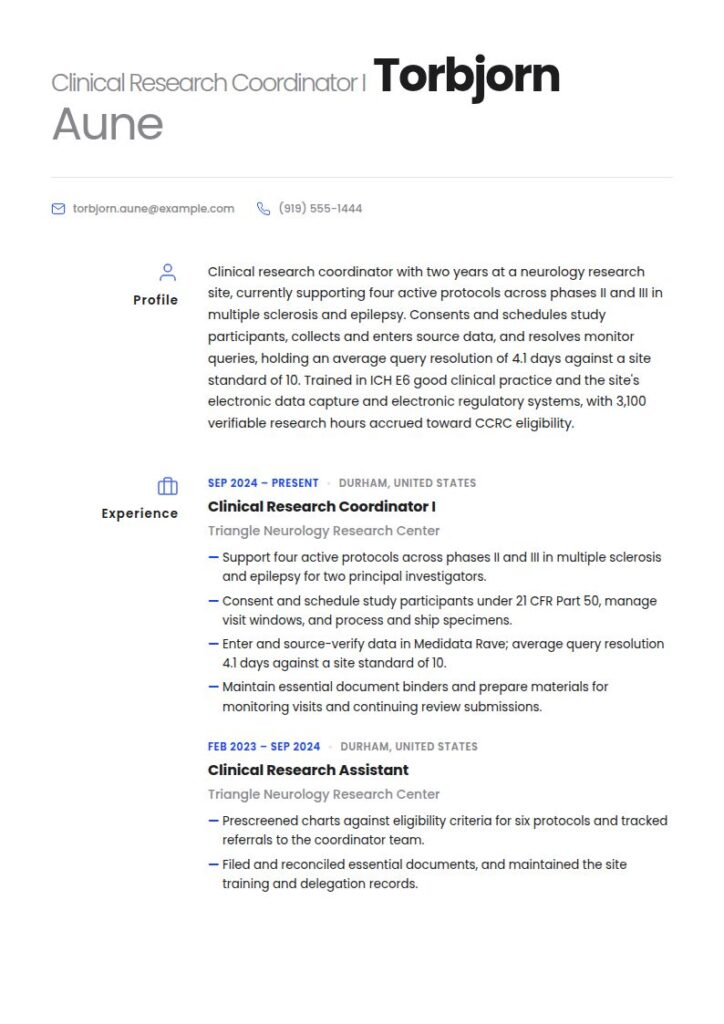
Clinical research coordinator with two years at a neurology research site, currently supporting four active protocols across phases II and III in multiple sclerosis and epilepsy. Consents and schedules study participants, collects and enters source data, and resolves monitor queries, holding an average query resolution of 4.1 days against a site standard of 10. Trained in ICH E6 good clinical practice and the site's electronic data capture and electronic regulatory systems, with 3,100 verifiable research hours accrued toward CCRC eligibility.
Work Experience
09/2024 - Present, Clinical Research Coordinator I, Triangle Neurology Research Center, Durham, United States
- Support four active protocols across phases II and III in multiple sclerosis and epilepsy for two principal investigators.
- Consent and schedule study participants under 21 CFR Part 50, manage visit windows, and process and ship specimens.
- Enter and source-verify data in Medidata Rave; average query resolution 4.1 days against a site standard of 10.
- Maintain essential document binders and prepare materials for monitoring visits and continuing review submissions.
02/2023 - 09/2024, Clinical Research Assistant, Triangle Neurology Research Center, Durham, United States
- Prescreened charts against eligibility criteria for six protocols and tracked referrals to the coordinator team.
- Filed and reconciled essential documents, and maintained the site training and delegation records.
Education
08/2018 - 05/2022, Bachelor of Science, Biology, North Carolina State University, Raleigh, United States
Undergraduate research assistant in a neuroimmunology laboratory for three semesters.
Skills
Informed consent process, 75
Source documentation and data entry, 80
Query resolution, 80
Specimen processing and shipping, 75
Medidata Rave and REDCap, 75
ICH E6 good clinical practice, 70
Languages
English, native
Norwegian, native
Certificates
02/2026, ICH E6(R3) Good Clinical Practice Training, Site training program
Previously trained on E6(R2).
01/2026, Human Subjects Protections Training, CITI Program
10/2025, IATA Dangerous Goods, Biological Substances Category B, International Air Transport Association
Summary
A clinical research coordinator resume is a one to two page document built around a portfolio of trials: phase, therapeutic area, sponsor, enrollment against target, monitoring and query record, and the regulatory binder you kept inspection-ready. This guide gives you three adaptable versions, the portfolio table that replaces vague bullets, and what the role pays.
Clinical Research Coordinator resume examples by experience level
A clinical research coordinator resume is a one to two page document built around the trials you have run: their phase, their therapeutic area, who sponsored them, how close enrollment came to target, and what your data and regulatory record looked like when a monitor sat down with it.
Most coordinator resumes are written as duties: "obtained informed consent, scheduled study visits, maintained regulatory documents". Every coordinator in the stack wrote that, because it is the job description. What a research manager reads for is a portfolio: what you have run, at what phase, at what scale, and whether the site was clean when somebody came to check.
Resume guide for a clinical research coordinator resume
This guide and the corresponding clinical research coordinator resume example will cover:
- How to write a CRC resume, block by block
- The trial portfolio table that replaces a page of duty bullets
- Which numbers a research manager reads: enrollment, queries, deviations
- Three adaptable summaries: coordinator I, coordinator II and lead
- What certification requires, and what the role pays
How to write a clinical research coordinator resume
Five blocks: contact header, summary, trial portfolio, experience, and skills, with education and certification at the end. One page early on, two once the portfolio is genuinely long.
The portfolio block is the structural difference between this resume and every other clinical resume. Put it high; it is what gets read, and nobody else includes it.
| Block | What it answers | Where it goes |
|---|---|---|
| Certification | CCRC, CCRP, or working toward one | Contact header and its own line |
| Trial portfolio | What have you actually run, and at what scale? | Directly under the summary, as a table |
| Experience | What did you own at each site, and for how many studies? | Reverse chronological with numbers |
| Regulatory | Was the site inspection-ready when you left? | One line per role |
Certification is measured in hours, so put the hours on the page
The Certified Clinical Research Coordinator credential is awarded by the Association of Clinical Research Professionals, which describes it as formally recognizing clinical research professionals with experience coordinating and facilitating clinical trial activities in adherence to good clinical practice under the direction of a principal investigator. Eligibility requires 3,000 hours of verifiable work experience in human subject research that represents a paid contractual employment agreement and can be verified through an employer, and ACRP may grant one experience waiver of 1,500 hours to applicants holding an active ACRP certification or who have completed an approved clinical research education program (ACRP, CCRC certification, checked September 2026).
The Society of Clinical Research Associates issues the Certified Clinical Research Professional credential, which requires a successful written application and a passing examination score (SOCRA, CCRP certification program, checked September 2026).
If you are not yet certified, say where you are: "3,100 verifiable hours accrued, CCRC examination scheduled for March 2027" is a real statement about a career.
Run the finished file through the ATS resume checker before you submit. Academic centers, health systems and contract research organizations all screen applications through a tracking system first.
Choosing the best resume format for a CRC resume
Reverse chronological with a portfolio block, single column. Two pages is normal here sooner than in most roles, because the portfolio is content rather than padding.
The format trap specific to this occupation is the hybrid resume that leads with a long skills grid. Coordinators are often told to do this because the title varies so much between sites. It backfires: a research manager reads a skills grid as a list of things you have heard of. The portfolio table proves the same skills with studies attached, in less space.
Include your contact information
| ✅ Right | ❌ Wrong |
|---|---|
| Torbjorn Aune | Torbjorn Aune |
| Clinical Research Coordinator II, CCRC | Research professional |
| Oncology and neurology, phases I to III | Experienced in clinical trials |
| (919) 555-1444, [email protected], Durham, NC | (919) 555-1444, [email protected] |
Three lines under your name, not one: the title with its level, the certification, and the therapeutic areas with the phase range. A sponsor hiring for a phase I unit and a health system hiring for an investigator-initiated oncology portfolio want different people, and those lines sort you immediately.
Make use of a summary
Four lines: title and certification, therapeutic areas and phases, portfolio size, and one number about enrollment, queries or an inspection.
Clinical research coordinator with two years at a neurology research site, currently supporting four active protocols across phases II and III in multiple sclerosis and epilepsy. Consents and schedules study participants, collects and enters source data, and resolves monitor queries, holding an average query resolution of 4.1 days against a site standard of 10. Trained in ICH E6 good clinical practice and the site's electronic data capture and electronic regulatory systems, with 3,100 verifiable research hours accrued toward CCRC eligibility.
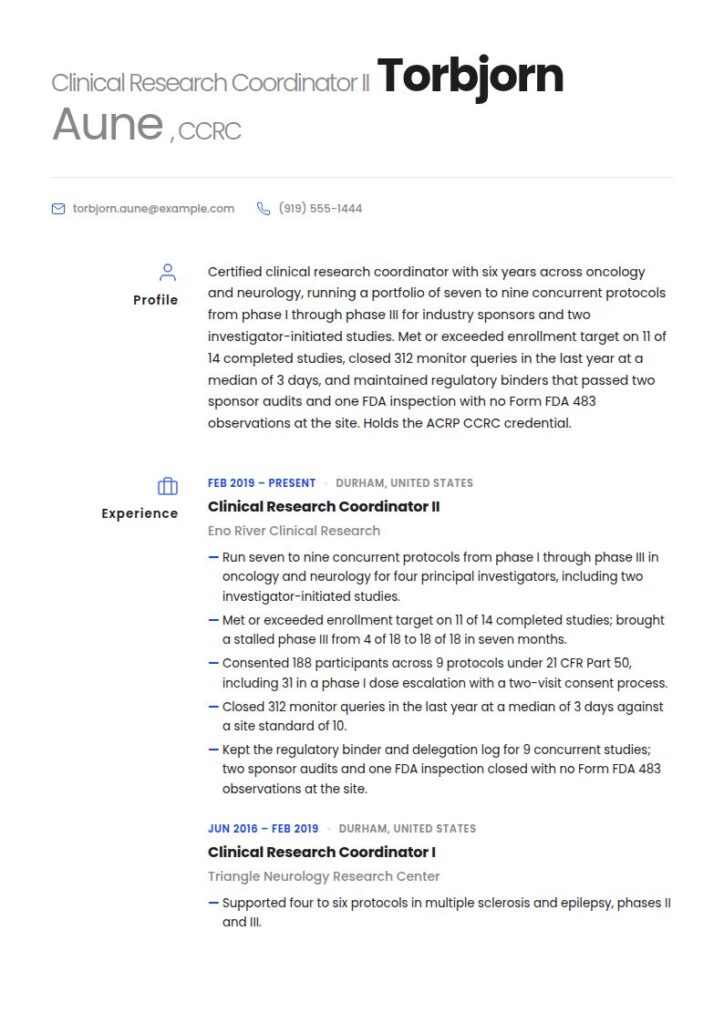
Certified clinical research coordinator with six years across oncology and neurology, running a portfolio of seven to nine concurrent protocols from phase I through phase III for industry sponsors and two investigator-initiated studies. Met or exceeded enrollment target on 11 of 14 completed studies, closed 312 monitor queries in the last year at a median of 3 days, and maintained regulatory binders that passed two sponsor audits and one FDA inspection with no Form FDA 483 observations at the site. Holds the ACRP CCRC credential.
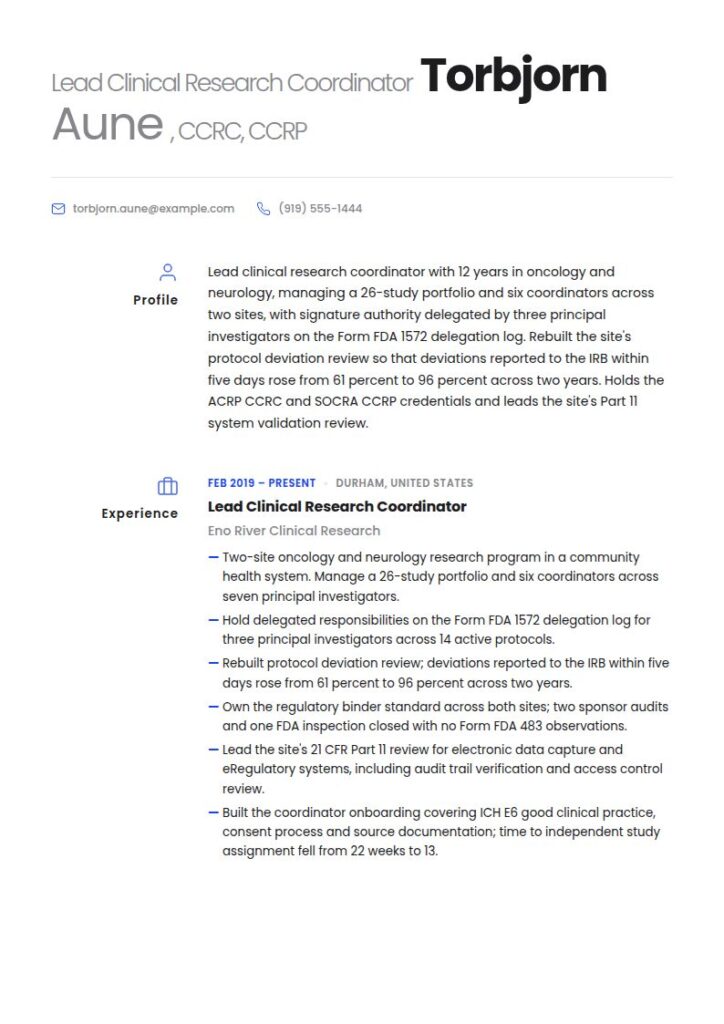
Lead clinical research coordinator with 12 years in oncology and neurology, managing a 26-study portfolio and six coordinators across two sites, with signature authority delegated by three principal investigators on the Form FDA 1572 delegation log. Rebuilt the site's protocol deviation review so that deviations reported to the IRB within five days rose from 61 percent to 96 percent across two years. Holds the ACRP CCRC and SOCRA CCRP credentials and leads the site's Part 11 system validation review.
Right vs wrong: the same clinical research coordinator summary, twice
| ✅ Right | ❌ Wrong |
|---|---|
| Certified clinical research coordinator running seven to nine concurrent protocols, phases I to III, in oncology and neurology. | Detail-oriented research professional with experience in clinical trials. |
| Met or exceeded enrollment target on 11 of 14 completed studies. | Successfully recruited patients for multiple studies. |
| Regulatory binders passed two sponsor audits and one FDA inspection with no Form FDA 483 observations at the site. | Maintained regulatory documents in compliance with all applicable regulations. |
The right column is a portfolio. The left column is a job description with an adjective bolted on, and it is what every other file in the stack already says.
Outline your experience as a clinical research coordinator
Site, setting and dates on the heading line. Then a scope line: concurrent studies, phases, therapeutic areas, how many principal investigators, and what you were delegated. Then bullets with numbers.
| Instead of | Use |
|---|---|
| Obtained informed consent from study participants | Consented 188 participants across 9 protocols under 21 CFR Part 50, including 31 in a phase I dose escalation with a two-visit consent process |
| Maintained regulatory binders | Kept the regulatory binder and the delegation log for 9 concurrent studies; two sponsor audits and one FDA inspection closed with no site observations |
| Entered data into study databases | Entered and source-verified data for 9 protocols in Medidata Rave; closed 312 monitor queries in a year at a median of 3 days |
| Assisted with patient recruitment | Met or exceeded enrollment target on 11 of 14 completed studies; brought a stalled phase III from 4 of 18 to 18 of 18 in seven months |
Lead Clinical Research Coordinator, Eno River Clinical Research, Durham, NC, February 2019 to Present
Two-site oncology and neurology research program in a community health system. Manage a 26-study portfolio and six coordinators across seven principal investigators.
Hold delegated responsibilities on the Form FDA 1572 delegation log for three principal investigators across 14 active protocols.
Rebuilt protocol deviation review; deviations reported to the IRB within five days rose from 61 percent to 96 percent across two years.
Own the regulatory binder standard across both sites; two sponsor audits and one FDA inspection closed with no Form FDA 483 observations.
Lead the site's 21 CFR Part 11 review for electronic data capture and eRegulatory systems, including audit trail verification and access control review.
Put your trial portfolio on the page as a table
This is the block that changes a coordinator resume from a job description into evidence, and almost nobody includes it.
A research manager has one question duty bullets never answer: what has this person actually run? Phase I is not phase III. A 12-participant device study is not a 400-participant registration trial. An investigator-initiated protocol is a different job from an industry protocol with a dedicated monitor. Put it in a table and the question is answered in eight seconds.
| Study | Phase | Area | Sponsor type | Enrollment | Status |
|---|---|---|---|---|---|
| Randomized, double-blind, placebo-controlled | III | Oncology, breast | Industry | 22 of 20 target | Closed to enrollment |
| Open-label dose escalation | I | Oncology, solid tumor | Industry | 9 of 12 target | Active |
| Randomized, open-label | III | Neurology, multiple sclerosis | Industry | 18 of 18 target | Follow-up |
| Investigator-initiated, single arm | II | Neurology, epilepsy | Investigator-initiated | 14 of 15 target | Active |
Six columns is the maximum a page can carry. If you have run thirty studies, summarize instead: "26 protocols since 2019: 4 phase I, 11 phase II, 9 phase III, 2 registries; 19 industry, 5 investigator-initiated, 2 cooperative group."
The four numbers a research manager reads
Enrollment against target. Not "recruited patients", the fraction. "Met or exceeded target on 11 of 14 completed studies" is the most portable number in this occupation, because enrollment failure is the most expensive thing that happens to a site. If you rescued a stalled study, write the recovery: from what, to what, over how long.
Queries and data timeliness. Monitor queries measure your source documentation directly. Give volume and speed: "312 queries closed in the last year at a median of 3 days against a site standard of 10". Entry lag from visit to database is the other half of that story.
Protocol deviations, reported honestly. Nobody believes a site with no deviations, and a candidate claiming none reads as one who does not recognize them. What impresses is reporting discipline: how many, how they were categorized, how fast they reached the IRB, and what changed afterwards.
Audit and inspection history. Sponsor audits, monitoring findings and regulatory inspections. State the outcome plainly, and attribute it to your site rather than to an organization.
The regulatory record behind those numbers
Name the framework you work in, rather than "maintained compliance with all applicable regulations", which tells a reader nothing:
- The investigator statement. Before an investigator takes part, the sponsor obtains a signed investigator statement, Form FDA-1572, in which the investigator commits to conduct the study in accordance with the relevant current protocol, to personally conduct or supervise it, to report adverse experiences, and to ensure staff are informed about their obligations; it also requires a curriculum vitae or other statement of qualifications, a list of subinvestigators, and affirmation that an IRB will be responsible for initial and continuing review (21 CFR 312.53). If you are named on a delegation log, say for how many investigators and protocols.
- Electronic records. Closed systems must use secure, computer-generated, time-stamped audit trails to independently record the date and time of operator entries and actions that create, modify or delete electronic records (21 CFR 11.10(e)). A coordinator who can speak about audit trails, access control and validation is describing an uncommon skill.
- Good clinical practice. ICH E6 is the harmonized good clinical practice guideline; its current revision, E6(R3), was finalized in September 2025 and takes a risk-based approach to trial quality (US Food and Drug Administration, E6(R3) guidance). Write which revision you were trained on, and when.
Build a snapshot of your key skills
Four groups. Every entry is a system you have worked in, a regulation you can discuss, or a task you have done at volume.
Study conduct: informed consent process, eligibility screening, visit scheduling and window management, investigational product accountability, specimen processing and shipping, adverse event and serious adverse event reporting
Regulatory: Form FDA 1572 and delegation logs, IRB submissions, amendments and continuing review, protocol deviation reporting, essential document binders, sponsor audit and inspection preparation, ICH E6 good clinical practice, 21 CFR Parts 11, 50 and 56
Data: source documentation design, electronic data capture entry and source verification, query resolution, Medidata Rave, OnCore CTMS, Florence eBinders, REDCap
Program: budget and coverage analysis support, feasibility questionnaires, site initiation and close-out visits, recruitment planning, coordinator onboarding
List your education and certifications
Degree first, then certification with the issuing body and date, then the good clinical practice training with its revision and year, then human subjects protections training.
Bachelor of Science, Biology, North Carolina State University, Raleigh, NC, 2014
Certified Clinical Research Coordinator (CCRC), Association of Clinical Research Professionals, 2018, current
Certified Clinical Research Professional (CCRP), Society of Clinical Research Associates, 2022, current
ICH E6(R3) good clinical practice training, 2026; previously trained on E6(R2)
Human subjects protections and conflict of interest training, current
IATA dangerous goods shipping, biological substances Category B, current
Choose the right layout and design
Single column, 11 or 12 point, plain headings, no photograph. The portfolio table should be the only table on the page, a simple grid with plain borders, because heavily styled tables are where applicant tracking systems lose the content.
Put a trial portfolio table directly under the summary. Give enrollment as a fraction of target. State query volume with a median resolution time. Report deviations and how fast they reached the IRB. Name your EDC, CTMS and eRegulatory systems. Say which good clinical practice revision you were trained on and when. Give your accrued hours if you are not yet certified.
Do not write "maintained regulatory compliance" without a regulation behind it. Do not claim zero protocol deviations. Do not name a participant, a diagnosis or anything that could identify someone on a study. Do not claim an inspection outcome for an organization when you mean your site. Do not list a sponsor's proprietary compound name if your site agreement does not allow it; write the phase and the indication instead.
Clinical research coordinator job market and outlook
The Bureau of Labor Statistics publishes no Occupational Outlook Handbook profile for clinical research coordinators, so there is no official wage, employment or projection figure for the title. The honest way to read the market is through the published occupations coordinators sit between.
| Occupation | Jobs, 2025 | Growth, 2025 to 2035 | Annual openings | Median wage, May 2025 |
|---|---|---|---|---|
| Medical scientists | 181,000 | 13 percent | About 10,500 | $103,410 |
| Medical and health services managers | 640,400 | 24 percent | About 62,300 | $123,860 |
Source: U.S. Bureau of Labor Statistics, Occupational Outlook Handbook, 2025 to 2035 projections and May 2025 wage data. BLS publishes no Handbook profile for clinical research coordinators.
The two occupations a coordinator career runs between
Medical scientists, the occupation covering much of the investigator-side research workforce, had 181,000 jobs in 2025 with 13 percent projected growth through 2035 and a May 2025 median of $103,410, though typical entry-level education is a doctoral or professional degree (BLS Occupational Outlook Handbook).
Medical and health services managers, where site managers and research operations leaders sit, had 640,400 jobs in 2025, 24 percent projected growth, about 62,300 openings a year, and a May 2025 median of $123,860 on a bachelor's degree entry requirement (BLS Occupational Outlook Handbook).
That contrast is the practical career map. The scientist track is gated by a doctorate; the management track is not, it grows faster, and it pays more at the median. A coordinator resume showing portfolio size, staff supervised, budget or feasibility work and inspection readiness is already written for the second track.
Where research employment sits, by industry, for medical scientists:
| Setting | Share of employment | Median annual wage, May 2025 |
|---|---|---|
| Research and development in the physical, engineering and life sciences | 32% | $125,700 |
| Hospitals; state, local and private | 22% | $98,620 |
| Colleges, universities and professional schools | 12% | $74,970 |
| Medical and diagnostic laboratories | 6% | $81,910 |
| Pharmaceutical and medicine manufacturing | 4% | $106,800 |
Source: U.S. Bureau of Labor Statistics, Occupational Outlook Handbook, May 2025.
What salary you can expect as a clinical research coordinator
There is no Bureau of Labor Statistics median for this job title, because BLS publishes no Handbook profile for it. Treat any single number quoted for the role with suspicion and read the published occupations around it instead.
Two things there are worth planning against. First, the setting spread is large in research generally: for medical scientists, published industry medians run from $74,970 in colleges and universities to $125,700 in research and development services, a gap of $50,730 (BLS, May 2025). Academic sites pay less than industry across the research workforce, and coordinator roles follow that pattern.
Second, the management route is the one that is open without a doctorate. Medical and health services managers enter at bachelor's level, are projected to grow 24 percent through 2035, and carry a May 2025 median of $123,860 (BLS Occupational Outlook Handbook). What moves a coordinator along it:
- Certification. CCRC or CCRP is the standard filter for coordinator II and lead roles, and both are verifiable through the issuing body.
- Phase and complexity. Phase I, first-in-human, device and gene therapy work is scarcer and priced accordingly.
- Portfolio and supervision. Concurrent study count and coordinators supervised move a coordinator into a management band.
- Regulatory depth. Inspection preparation, Part 11 validation and delegation log management are specialist work sites cannot hire easily.
- Setting. Contract research organizations, sponsors, academic centers and community health systems pay differently for the same title, which means different things in each.
Key takeaways for a clinical research coordinator resume
- Put a trial portfolio table directly under the summary; it is the differentiator.
- Give enrollment as a fraction of target, study by study or in aggregate.
- State query volume and median resolution time, not "maintained data quality".
- Report deviations and how quickly they reached the IRB; zero is not believable.
- Name the regulations you work under, with their citations.
- Name your EDC, CTMS and eRegulatory systems, because sites hire on those.
- Give certification, or your accrued hours and examination date.
Build your clinical research coordinator resume in 15 minutes with our AI resume builder.
Related medical resume examples
- Medical science liaison resume
- Epidemiologist resume
- Chemist resume
- Healthcare project manager resume
- Health care administration resume
- Medical technologist resume
- Lab technician resume
- Medical coder resume
- Pharmaceutical sales representative resume
- Pharmacist resume
- Medical student resume
- Nurse resume
Pair it with a matching clinical research coordinator cover letter.
Clinical research coordinator resume questions, answered
How long should a clinical research coordinator resume be?
Two pages is normal after about five years, earlier than in most clinical roles, because the portfolio is evidence rather than padding. Keep the portfolio table on page one with the summary. One page is right while you support fewer than five protocols.
Do I need CCRC or CCRP certification to get a coordinator job?
Not for an entry-level post, but it is the usual filter above it. The ACRP CCRC requires 3,000 hours of verifiable paid work experience in human subject research, with one possible waiver of 1,500 hours for holders of an active ACRP certification or graduates of an approved clinical research education program (ACRP, checked September 2026). The SOCRA CCRP requires a successful written application and a passing examination (SOCRA, checked September 2026). Until you qualify, put your accrued hours and examination date on the page.
What is the single most useful number on a CRC resume?
Enrollment against target, as a fraction. Enrollment failure is the most expensive thing that happens to a site, so "met or exceeded target on 11 of 14 completed studies" answers the reader's largest question. A rescued study is next best: where it started, where it finished, over what period.
Should I list protocol deviations on my resume?
Yes, and claiming none is a mistake. Deviations happen at every site, and a candidate reporting zero reads as someone who does not identify them. Show the discipline: the count, how they were categorized, how fast they reached the IRB, and what you changed as a result.
Can I name the studies I have worked on?
Name the design, phase, therapeutic area and sponsor type rather than proprietary compound names or protocol numbers, unless your site agreement clearly permits more. Never name or describe a participant. "Randomized, double-blind, placebo-controlled, phase III, oncology, industry sponsored, 22 of 20 target" is more informative than a protocol number and carries no confidentiality risk.